
Bee pollen is a natural bee product commonly sold as granules, powder, capsules, and tablets. People use it as a dietary supplement because it contains protein, carbohydrates, amino acids, vitamins, minerals, and plant compounds. However, one important question remains: How much bee pollen should you take daily?
There is no scientifically established daily dose of bee pollen proven to be both safe and effective for everyone. Some manufacturers recommend servings such as half a teaspoon or one teaspoon, while others provide different instructions. These amounts are product-specific serving recommendations, not medically established daily requirements.
The amount listed on a supplement label should not be confused with a clinically proven dose. Bee pollen also varies in composition depending on the flowers visited by honey bees, geographical conditions, harvesting methods, and processing.
Safety is especially important. People with pollen allergies can experience serious allergic reactions after consuming bee pollen. Its safety during pregnancy and breastfeeding has also not been established.
In this guide, you will learn how much bee pollen different products contain, how to interpret serving sizes, what scientific research says about its potential benefits, how to measure it, and who should avoid taking it.
How Much Bee Pollen Should You Take Daily?
There is no universally recommended daily amount of bee pollen because scientific research has not established a standard dose that is effective and safe for everyone.
Commercial products may recommend different serving sizes. For example, one product listed in the US National Institutes of Health Dietary Supplement Label Database specifies half a teaspoon, approximately 1,175 milligrams, per serving. Other products may recommend one teaspoon or provide instructions based on capsule weight.
These differences demonstrate why there is no single teaspoon measurement that applies to every bee pollen supplement.
Consider the following examples:
| Measurement | Equivalent weight or meaning |
|---|---|
| 500 mg | 0.5 grams |
| 1,000 mg | 1 gram |
| 1,175 mg | 1.175 grams |
| 2,000 mg | 2 grams |
| ½ teaspoon | Depends on the product’s density and granule size |
| 1 teaspoon | Depends on the product’s density and granule size |
Important: These are measurement comparisons, not recommended daily doses.
A product containing 1,175 mg per half-teaspoon does not establish that every half-teaspoon of bee pollen weighs the same. Always check the manufacturer’s serving information.
Before considering bee pollen supplementation:
- Read the full ingredient list and serving instructions.
- Check whether the product contains pure bee pollen or a mixture of other ingredients.
- Do not increase the amount to obtain faster or greater health benefits.
- Discuss possible interactions with a healthcare professional if you take medication.
- Avoid bee pollen if you have a known pollen allergy.
According to MedlinePlus, there is insufficient scientific information to determine an appropriate general dosage of bee pollen.
Why Does Bee Pollen Dosage Vary Between Products?
One reason bee pollen products have different serving sizes is that bee pollen is not a completely uniform substance.
Honey bees collect pollen from flowering plants and transport it to their colonies in small pellets attached to their hind legs. During collection, the pollen becomes mixed with small quantities of nectar and bee secretions that help hold the pellets together.
The resulting product can differ considerably depending on its botanical origin and production conditions.
1. Different flowering plants produce different pollen
A honey bee collecting pollen from sunflower flowers does not necessarily collect pollen with the same nutritional composition as a bee visiting clover, eucalyptus, or other flowering plants.
Each plant species produces pollen with its own characteristics.
Consequently, the protein, carbohydrate, lipid, mineral, and plant-compound content can vary between bee pollen samples.
2. Geographical conditions influence composition
Soil conditions, climate, rainfall, flowering seasons, and the surrounding vegetation can influence the characteristics of the pollen collected by honey bees.
Bee pollen harvested from one region may therefore have a different nutritional profile from pollen collected elsewhere.
3. Processing and storage make a difference
Freshly collected bee pollen contains moisture. Drying, freezing, storage conditions, and other processing methods can affect its moisture content, stability, and nutritional characteristics.
For example, fresh pollen and dried pollen should not automatically be considered equivalent when comparing their weight.
These differences help explain why two supplements with similar serving weights may not have identical nutritional compositions.
Research reviews published in scientific journals, including Bee Pollen as Functional Food: Insights into Its Composition and Therapeutic Properties, discuss these variations.
Is One Teaspoon of Bee Pollen a Day Enough?
One teaspoon may be the serving size recommended by a particular manufacturer, but it is not an established daily dose for everyone.
The main problem is that teaspoons measure volume rather than weight.
A teaspoon of large, loosely packed bee pollen granules may weigh differently from a teaspoon of finely ground pollen powder.
For example, imagine two supplements:
- Product A lists half a teaspoon as approximately 1,175 mg.
- Product B lists one teaspoon as its suggested serving.
You cannot conclude that Product B provides twice as much bee pollen without checking its actual weight.
You also cannot conclude that either serving produces a particular health benefit.
The most reliable way to compare supplements is to examine the amount of bee pollen listed in milligrams or grams per serving.
People with pollen allergies should not experiment with one teaspoon or a smaller amount to test their tolerance. Even small exposures can trigger serious allergic reactions.
How Much Bee Pollen Should Beginners Take?
If you are considering bee pollen for the first time, determining whether it is appropriate for your health is more important than choosing a starting quantity.
Some manufacturers recommend gradually increasing the serving size. However, this does not establish that bee pollen is safe for everyone or prevent allergic reactions.
A person with a pollen allergy can experience a severe reaction even after a small exposure.
Before considering a bee pollen supplement:
- Read the product label and identify all its ingredients.
- Check the allergy warnings.
- Consider whether you have a history of pollen-related allergic reactions.
- Speak with a healthcare professional if you have asthma, take medication, or have an existing medical condition.
- Follow the manufacturer’s instructions only if a healthcare professional determines that the product is suitable for you.
There is no medical requirement to begin taking bee pollen simply because it is marketed as a superfood.
A balanced diet can provide essential nutrients without requiring bee pollen supplementation.
How Much Bee Pollen Should You Take for Different Purposes?
People consume bee pollen for different reasons, including general nutrition, energy, exercise performance, and seasonal allergies.
However, scientific research has not established a reliable daily dosage for these purposes.
1. Bee Pollen for General Nutrition
Bee pollen contains several nutritional components, including:
- Protein and amino acids.
- Carbohydrates.
- Small amounts of fats and fatty acids.
- Vitamins and minerals.
- Polyphenols and flavonoids.
- Other naturally occurring plant compounds.
Its nutritional composition varies according to botanical origin and processing.
For example, pollen collected from different flowering plants can contain different proportions of protein and carbohydrates. Therefore, a nutritional analysis of one sample should not be treated as the exact nutritional profile of every bee pollen supplement.
Bee pollen can be consumed as a food ingredient, but there is no established daily amount proven to improve nutritional health in the general population.
If you suspect a nutritional deficiency, consult a healthcare professional rather than relying on bee pollen as a treatment.
2. Bee Pollen for Energy
Bee pollen is sometimes marketed as a natural energy booster because it contains carbohydrates and other nutrients.
Carbohydrates provide energy to the body, while protein supplies amino acids used in tissue maintenance and other biological processes.
However, the presence of these nutrients does not prove that taking bee pollen improves energy levels.
There is insufficient reliable human evidence to establish that bee pollen treats persistent fatigue or provides a dependable energy boost.
There is also no scientifically established daily amount for increasing energy.
If you regularly experience fatigue, consider sleep, diet, hydration, stress, and possible underlying medical conditions. Persistent or unexplained tiredness may require medical evaluation.
3. Bee Pollen for Exercise and Athletic Performance
Some athletes use bee pollen because of its nutritional composition and its marketing as a natural stamina supplement.
However, available evidence does not establish that oral bee pollen reliably improves athletic performance.
It should not replace a balanced diet, appropriate hydration, sufficient recovery, or a properly designed training programme.
There is no scientifically established bee pollen dosage for increasing muscle strength, endurance, or exercise capacity.
4. Bee Pollen for Seasonal Allergies
Bee pollen is sometimes promoted as a natural treatment for hay fever and seasonal allergies.
The proposed idea is that consuming pollen might help the body become less sensitive to environmental allergens.
However, reliable clinical evidence has not established that eating bee pollen treats seasonal allergic rhinitis.
There is also an important safety concern: bee pollen contains plant pollen that may trigger allergic reactions in susceptible individuals.
People with pollen allergies should not attempt to treat their symptoms by consuming bee pollen.
Established allergy treatments and advice from a qualified healthcare professional are safer approaches.
Bee Pollen Granules vs Powder vs Capsules: Does Dosage Differ?
Bee pollen supplements are available in several forms. Although these products may contain bee pollen, their serving measurements are not necessarily interchangeable.
| Product type | Description | What to check |
|---|---|---|
| Granules | Small pellets of bee-collected pollen | Serving weight and storage instructions |
| Powder | Ground bee pollen | Weight per serving and processing information |
| Capsules | Bee pollen enclosed in capsules | Milligrams per capsule |
| Tablets | Compressed supplement ingredients | Actual bee pollen content |
| Extracts | Concentrated or processed preparations | Extract concentration and standardized serving information |
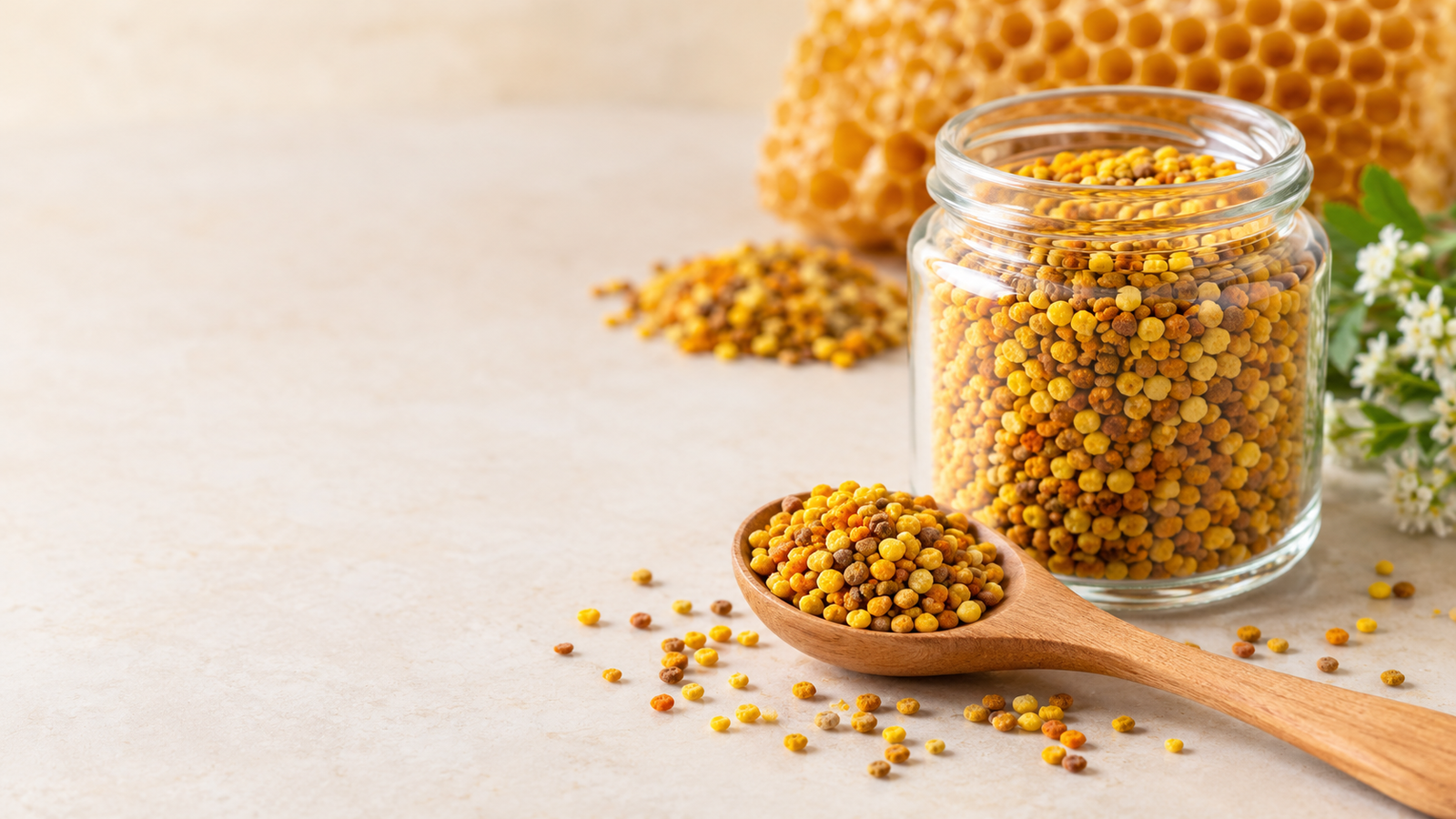
Bee pollen granules
Granules are among the most recognizable forms of bee pollen.
They are small pellets that may contain different colours depending on the plants from which the bees collected the pollen.
People sometimes add them to yoghurt, porridge, or smoothies.
Bee pollen powder
Powdered bee pollen has been ground into smaller particles.
Because it has a different physical form from whole granules, its weight per teaspoon may differ.
Use the weight specified on the product label rather than assuming that powder and granules have identical measurements.
Bee pollen capsules
Capsules provide a measured quantity of the ingredients inside each capsule.
For example, if a capsule contains 500 mg of bee pollen, two capsules provide 1,000 mg of the stated ingredient.
This is a mathematical comparison, not a recommendation to take two capsules.
Bee pollen tablets
Tablets may contain bee pollen alongside other ingredients.
Check the supplement facts panel to determine how much actual bee pollen is present rather than relying only on the total tablet weight.
Bee pollen extracts
Extracts may have different concentrations and compositions from ordinary bee pollen granules.
A serving of an extract should not be treated as equivalent to the same weight of whole pollen unless the manufacturer provides appropriate information.
The important difference: A product’s physical form affects how its serving is measured, but none of these forms has a universally established effective daily dosage.
What Is the Best Time to Take Bee Pollen?
There is no scientifically established best time of day to consume bee pollen.
Research has not demonstrated that taking it in the morning, afternoon, before meals, or after meals produces superior health benefits.
Some manufacturers provide specific instructions for their products. If a healthcare professional has approved your use, follow the instructions for that particular supplement.
Consider these common situations:
| Timing | What the evidence says |
|---|---|
| Morning | No established additional benefit |
| Before breakfast | No proven advantage |
| With food | Some products can be added to food |
| Before exercise | No established performance advantage |
| Before bedtime | No reliable evidence of greater effectiveness |
Do not assume that consuming bee pollen on an empty stomach improves absorption or makes it more effective.
Should You Take Bee Pollen Every Day?
Daily bee pollen supplementation is not necessary for everyone.
There is insufficient evidence to establish an ideal daily supplementation schedule or a universally appropriate duration of use.
MedlinePlus describes bee pollen as possibly safe for most people when taken by mouth for up to 30 days. This limited assessment should not be interpreted as proof that long-term daily use is safe.
Before considering regular use, think about:
Your reason for taking it: Many advertised benefits, including improved immunity, increased energy, and allergy relief, have not been established through strong human clinical evidence.
The product’s quality: Look for a reputable manufacturer with clear ingredient information, serving measurements, storage instructions, and appropriate quality controls.
Your medical history: Pollen allergies, asthma, pregnancy, breastfeeding, and medication use may affect whether bee pollen is suitable.
The duration: Evidence about long-term safety remains limited.
Taking bee pollen every day does not automatically provide additional health benefits.
What Happens If You Take Too Much Bee Pollen?
The effects of excessive bee pollen consumption have not been adequately studied. Researchers have not established a universally safe maximum daily amount.
One of the most important concerns is allergic reactions.
People who are sensitive to particular pollens may experience symptoms after consuming bee pollen, including:
- Itching.
- Skin rashes.
- Hives.
- Swelling of the lips or face.
- Swelling of the tongue or throat.
- Wheezing.
- Difficulty breathing.
- Dizziness or faintness.
In severe cases, an allergic reaction can develop into anaphylaxis, a potentially life-threatening emergency.
When to seek emergency help: If someone develops difficulty breathing, throat or tongue swelling, or faintness after consuming bee pollen, seek emergency medical attention immediately. If they have prescribed epinephrine, use it according to their emergency action plan.
Taking a larger amount does not guarantee greater nutritional or health benefits.
Increasing your intake may instead increase exposure to allergens without providing a proven additional benefit.
Who Should Avoid Bee Pollen?
Bee pollen is not suitable for everyone. Certain individuals should avoid it, while others should seek professional advice before considering supplementation.
1. People With Pollen Allergies
Bee pollen contains plant pollen collected by foraging bees.
People who are allergic to particular airborne or plant pollens may experience allergic reactions after consuming it.
Symptoms can include itching, hives, swelling, breathing difficulties, and potentially anaphylaxis.
If you have a known pollen allergy, do not attempt to test your tolerance by consuming a small quantity.
2. People With Allergies to Bee Products
A history of allergic reactions to bee pollen is a direct reason to avoid further exposure unless an allergy specialist provides specific advice.
It is also important to distinguish between different types of allergies.
A bee-sting allergy involves a reaction to substances in bee venom. A pollen allergy involves sensitivity to particular pollen proteins.
These are not automatically the same allergy. Having a bee-sting allergy does not, by itself, establish that someone is allergic to ingested bee pollen.
Nevertheless, anyone with a history of serious allergic reactions should obtain specialist advice before considering bee-derived supplements.
3. People With Asthma
People with asthma should be particularly cautious because a severe allergic reaction can involve wheezing and breathing difficulties.
Consult an allergy specialist or qualified healthcare professional before considering bee pollen.
4. Pregnant Women
Bee pollen should be avoided during pregnancy because its safety has not been adequately established.
MedlinePlus also identifies a concern that bee pollen might stimulate the uterus and potentially threaten pregnancy.
There is no established pregnancy-safe daily dosage.
5. Breastfeeding Women
There is insufficient reliable information about the effects of bee pollen during breastfeeding.
Avoid supplementation unless your healthcare professional specifically advises otherwise after considering the available safety information.
6. Children
There is no established safe and effective daily dose of bee pollen for children.
Children can also experience serious allergic reactions to pollen-containing products.
Do not give a child bee pollen supplements without guidance from a qualified healthcare professional.
7. People Taking Warfarin or Other Medication
Bee pollen may interact with warfarin, an anticoagulant medication used to prevent blood clots.
MedlinePlus identifies a potential interaction that could increase warfarin’s effects and the risk of bruising or bleeding.
People taking warfarin should avoid combining it with bee pollen unless their prescribing healthcare professional specifically approves and supervises its use.
If you take other regular medication, ask your doctor or pharmacist before using bee pollen.
Do not stop or change prescribed medication to accommodate a supplement.
How Do You Measure Bee Pollen Correctly?
If a healthcare professional has approved your use of bee pollen, understanding the product’s serving measurements can help prevent confusion.
Measuring bee pollen granules
Granules can vary in size and density.
A household teaspoon is a volume measurement, not a precise weight measurement.
For more accurate comparisons:
- Check the manufacturer’s stated serving size.
- Identify whether the label uses teaspoons, grams, or milligrams.
- If the label specifies weight, use a suitable digital kitchen scale.
- Do not assume that different brands have identical teaspoon-to-gram conversions.
- Follow the storage instructions to maintain product quality.
Measuring bee pollen powder
Powdered bee pollen may settle differently from granules.
Avoid transferring a teaspoon measurement from one product to another without checking its serving information.
Understanding supplement labels
Consider this example of a product label:
| Label information | Example |
|---|---|
| Serving size | ½ teaspoon |
| Bee pollen per serving | 1,175 mg |
| Weight in grams | 1.175 g |
| Daily value | Not established |
The conversion is straightforward:
1,175 milligrams ÷ 1,000 = 1.175 grams.
However, the listed serving size is specific to that product. It is not a universal daily dosage.
Understanding this distinction helps consumers compare products without assuming that a manufacturer’s recommendation is a clinically proven amount.
How Does Bee Pollen Quality Affect Safety?
Dosage is not the only consideration when choosing bee pollen.
The quality and handling of the product also matter.
Bee pollen is collected from plants growing in particular environments. As a result, its composition may reflect local environmental conditions.
Scientific reviews have identified potential concerns involving:
- Heavy metals.
- Pesticide residues.
- Environmental pollutants.
- Pyrrolizidine alkaloids from certain plants.
- Microbial contamination.
- Mould and mycotoxins under unsuitable storage conditions.
The presence and concentration of these substances vary. They should not be assumed to occur in every bee pollen product.
However, they explain why proper harvesting, drying, storage, and quality testing are important.
When choosing a product:
- Purchase from an identifiable and reputable manufacturer.
- Check the ingredient list and country of origin where available.
- Look for transparent quality-control information.
- Prefer products with appropriate contaminant and microbiological testing.
- Check the expiry date and storage instructions.
- Avoid products with damaged packaging, unusual odours, or visible signs of spoilage.
A product being labelled natural or organic does not automatically establish that it is free from contaminants or allergens.
Does Taking More Bee Pollen Provide More Benefits?
There is no reliable evidence that consuming larger amounts of bee pollen produces greater health benefits.
Although bee pollen contains nutrients and biologically active plant compounds, many claims about immunity, energy, inflammation, and disease prevention remain insufficiently supported by high-quality human research.
It is important to distinguish between laboratory findings and demonstrated human health benefits.
For example, researchers may observe antioxidant activity when testing bee pollen extracts in laboratory experiments. That does not prove that eating a particular quantity of bee pollen prevents disease or produces the same effect in the human body.
The amount of an active compound, its absorption, metabolism, and the quantity actually consumed all influence whether laboratory findings can translate into meaningful human benefits.
Therefore, do not increase your intake because a retailer, influencer, or another consumer claims that a larger amount works better.
More is not necessarily better when it comes to dietary supplements.
How Can You Add Bee Pollen to Your Diet?
Bee pollen granules are sometimes incorporated into ordinary foods and drinks.
If a healthcare professional has approved its use and the product is intended for consumption in this way, common serving suggestions include:
- Sprinkling granules over plain yoghurt.
- Mixing them into a smoothie.
- Adding them to porridge.
- Sprinkling them over a fruit bowl.
- Incorporating them into suitable recipes.
Photo placement: Bee pollen granules sprinkled over yoghurt, berries, and oatmeal.
Suggested image alt text: Bee pollen granules sprinkled over yoghurt and fresh berries.
These are food-use examples, not medically recommended dosage instructions.
Adding bee pollen to honey, tea, or a smoothie does not eliminate its allergy risks.
People with known pollen allergies should not use food preparation methods to test whether they can tolerate bee pollen.
Frequently Asked Questions About How Much Bee Pollen to Take Daily
1. How much bee pollen should I take daily?
There is no scientifically established universal daily dose of bee pollen. Some manufacturers recommend half a teaspoon or one teaspoon per serving, but these are product-specific instructions rather than proven medical dosages. Consult a healthcare professional before using bee pollen supplements.
2. Is one teaspoon of bee pollen a day too much?
One teaspoon may match the serving size of some products, but it is not an established safe or effective amount for everyone. The actual weight depends on the product’s density and granule size.
3. Is 500 mg of bee pollen a day enough?
There is no established effective daily dose, so it is not possible to say whether 500 mg is enough to produce a particular health benefit. Check the product’s serving information and consider your individual health circumstances.
4. Can you take two tablespoons of bee pollen a day?
Two tablespoons should not be treated as an established safe or effective daily amount. Research has not determined a universal maximum daily dose. Taking a larger quantity does not guarantee additional benefits.
5. Can you take three tablespoons of bee pollen daily?
Three tablespoons is not a scientifically established safe daily maximum. Do not use retailer recommendations or another person’s supplement routine as evidence that this quantity is suitable for you.
6. Should beginners start with a small amount of bee pollen?
A small quantity does not guarantee safety. People with pollen allergies or a history of serious allergic reactions should avoid experimenting with bee pollen. If you are unsure whether it is suitable, seek advice from a qualified healthcare professional.
7. Can I take bee pollen every morning?
There is no reliable evidence that taking bee pollen every morning provides greater health benefits than consuming it at another time. If its use has been approved for you, follow the instructions for your particular product.
8. Can I take bee pollen on an empty stomach?
There is insufficient evidence that taking bee pollen on an empty stomach improves its effectiveness or absorption. Follow the manufacturer’s instructions if a healthcare professional has approved its use.
9. Is bee pollen safe to take every day?
Its safety depends on the individual, product, and duration of use. Evidence about long-term daily supplementation is limited. People with pollen allergies may experience serious reactions, even after relatively small exposures.
10. Can I take bee pollen with honey?
Bee pollen and honey are different bee products. Combining them does not establish a safe bee pollen dosage or remove the risk of an allergic reaction.
11. Is bee pollen safe for children?
A safe and effective daily dose has not been established for children. Consult a qualified healthcare professional before giving a child any bee pollen supplement.
12. How many grams of bee pollen are in one teaspoon?
There is no universal gram measurement for one teaspoon of bee pollen. The weight depends on the product’s granule size, density, and how tightly it is packed. Check the manufacturer’s label or weigh the product using a suitable scale.
13. How long can you take bee pollen?
There is insufficient evidence to establish an ideal supplementation duration or long-term safety for everyone. MedlinePlus describes limited safety information for use of up to 30 days, but this should not be interpreted as proof that longer-term use is safe.
14. Does bee pollen have side effects?
Yes. Possible adverse effects include itching, rashes, hives, swelling, and serious allergic reactions. Rare reports of liver and kidney problems have also been described, although a direct cause has not been established.
Final Thoughts: How Much Bee Pollen to Take Daily?
So, how much bee pollen should you take daily?
The most scientifically responsible answer is that there is no established daily amount proven to be both safe and effective for everyone.
Some manufacturers recommend servings such as half a teaspoon or one teaspoon, but these measurements represent product-specific instructions rather than universal medical guidelines.
The actual amount of bee pollen in a serving can differ depending on the product’s weight, composition, and formulation.
Before considering supplementation, examine the product label, understand its ingredients, and consider your health history. People with pollen allergies should avoid bee pollen because it can trigger serious allergic reactions. Pregnant and breastfeeding women should also avoid supplementation unless appropriately advised by a healthcare professional.
Most importantly, do not assume that taking more bee pollen will provide greater health benefits. Its nutritional composition is interesting, but many advertised health claims still require stronger human clinical evidence.
A balanced diet and evidence-based healthcare remain more dependable ways to support your health.
Medical disclaimer: This article is for educational purposes only and is not a substitute for professional medical advice, diagnosis, or treatment.
Scientific References
- MedlinePlus – Bee Pollen: Uses, Safety, Effectiveness and Dosage. National Library of Medicine.
- Bee Pollen as Functional Food: Insights into Its Composition and Therapeutic Properties. Scientific review of nutritional composition and biological properties.
- Bee Pollen as a Food and Feed Supplement and a Therapeutic Remedy: Recent Trends in Nanotechnology. Frontiers in Nutrition, 2024.
- Chemical Properties and Biological Activity of Bee Pollen. Scientific review of chemical composition and biological activity.
- Bee Pollen as Functional Food and Environmental Bioindicator: Current Evidence and Future Challenges. Journal of the Science of Food and Agriculture, 2026.
- NIH Dietary Supplement Label Database – Bee Pollen Nutrition. Example of a manufacturer-specific supplement serving label.
