
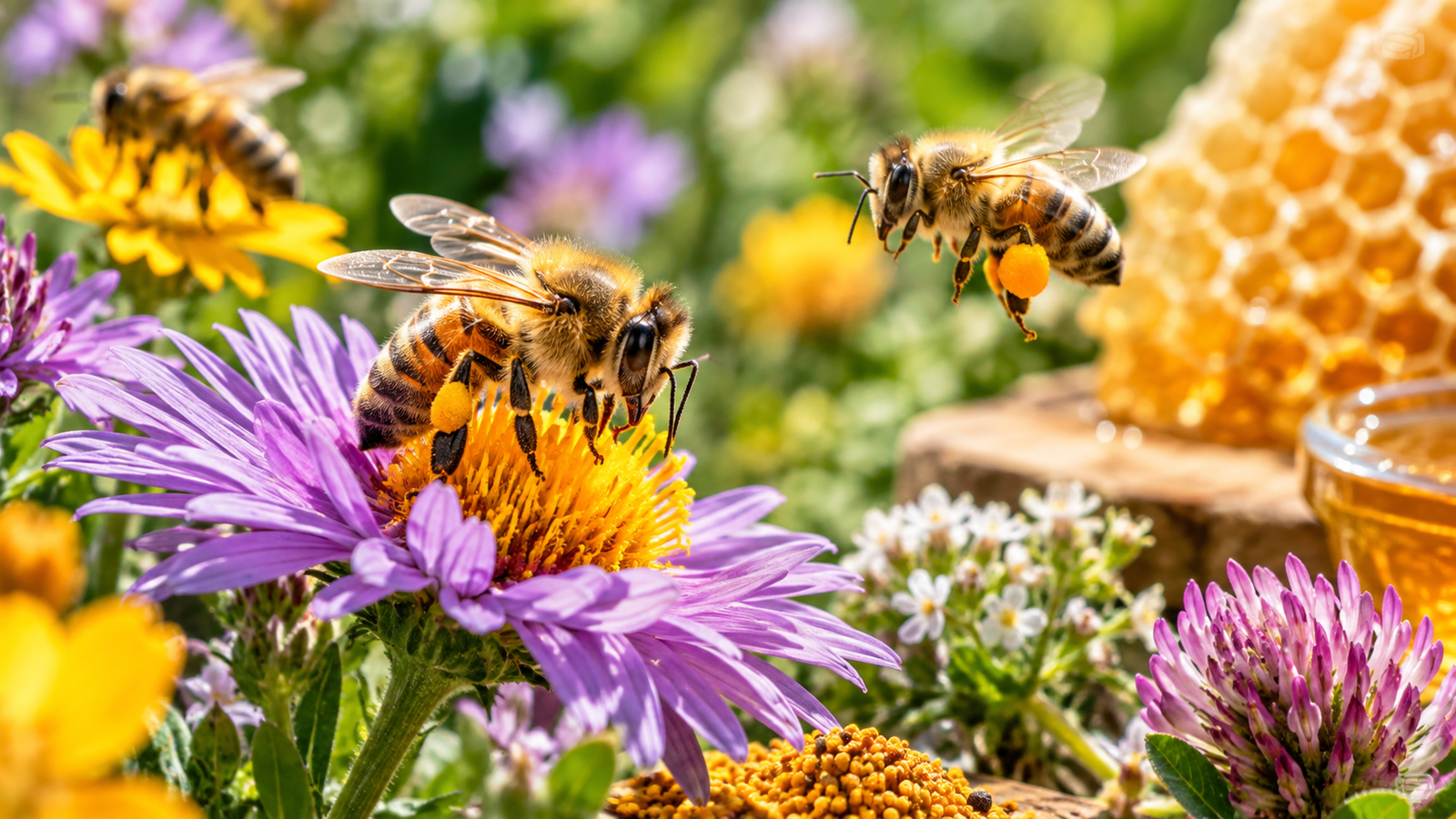
Bees mainly eat nectar and pollen from flowers. Nectar provides bees with carbohydrates that give them energy, while pollen provides protein, fats, vitamins, minerals, and other nutrients. Honey bees also eat honey, which is made from nectar and stored in the hive as a food reserve.
However, what bees eat can vary depending on the type of bee, its age, its role in the colony, and the availability of food. Baby honey bees, for example, receive specialized food from worker bees, while adult bees rely heavily on nectar, honey, and pollen.
What Do Bees Eat?
The main foods bees consume or use for nutrition are:
- Nectar – a sugary liquid from flowers that provides carbohydrates and energy.
- Pollen – a major source of protein, fats, vitamins, minerals, and other nutrients.
- Honey – processed and stored nectar that provides concentrated energy for honey bee colonies.
- Bee bread – fermented pollen mixed with nectar and other substances and stored in the hive.
- Royal jelly – a specialized food produced by worker bees and given to developing honey bee larvae, especially queen larvae.
The exact diet differs between bee species and between different stages of a bee’s life.
What Is the Main Food of Bees?
For most bees, nectar and pollen are the two most important natural food resources.
Nectar is rich in sugars and provides the energy bees need for activities such as flying, foraging, maintaining the colony, and feeding young.
Pollen is nutritionally different from nectar. It supplies protein and other nutrients that are particularly important for growth and development.
For honey bees, nectar is also the raw material from which they produce honey. The colony stores this honey so it has an energy supply when fresh nectar is unavailable.
1. Nectar
Nectar is one of the most important foods for adult bees.
Flowers produce nectar in structures called nectaries. The sugary liquid attracts bees and other pollinators to the flowers.
When a honey bee visits a flower, it uses its long tongue-like proboscis to collect nectar. The nectar is temporarily stored in a specialized part of its digestive system commonly called the honey stomach or crop.
The bee then returns to the colony, where the nectar is transferred and processed.
Nectar provides mainly carbohydrates, which give bees the energy needed for:
- Flying
- Foraging
- Maintaining body temperature
- Working inside the hive
- Feeding the colony
- Performing other daily activities
What happens to nectar after bees collect it?
Honey bees transform nectar into honey.
The bees place the nectar into honeycomb cells and reduce its water content. Enzymes and other processes also change the nectar. Once the honey has reached a suitable consistency, the bees store it in the comb.
The resulting honey becomes an important food reserve for the colony.
2. Pollen
Pollen is an important source of protein and other nutrients for bees.
As bees visit flowers, pollen grains stick to hairs covering their bodies. Honey bees groom themselves and pack the collected pollen into structures on their hind legs called pollen baskets, or corbiculae.
They then carry the pollen back to the hive.
Pollen supplies nutrients that nectar and honey do not provide in sufficient amounts, making it particularly important for the growth and development of young bees.
A variety of pollen sources can provide bees with a broader range of nutrients.
What Is Bee Bread?
Honey bees can turn collected pollen into a stored food called bee bread.
Workers pack pollen into honeycomb cells and mix it with nectar and other substances. The stored mixture undergoes fermentation, making the nutrients in pollen more accessible.
Bee bread becomes an important food source within the colony, particularly for developing larvae.
This is one reason pollen is so important even though adult bees also depend heavily on sugary nectar and honey for energy.
3. Honey
Honey bees eat honey.
Honey is essentially a concentrated, stored food made from nectar.
When flowers are abundant, worker bees collect nectar and the colony converts much of it into honey. The honey is stored inside honeycomb cells and can later be consumed when fresh nectar is difficult to find.
Honey is especially important during:
- Winter
- Drought
- Cold weather
- Periods of poor flowering
- Other times when nectar is scarce
Therefore, honey is not simply a product that humans harvest. For a honey bee colony, it is also an important stored food supply.
What Do Baby Bees Eat?
Baby bees are called larvae during their early developmental stage, and they do not simply eat the same foods as adult bees.
Honey bee larvae are fed by worker bees. Their food includes specialized secretions produced by nurse bees.
One of these foods is royal jelly.
Young larvae receive royal jelly during their early development. After the first few days, the diet of most developing worker and drone larvae changes and includes foods such as bee bread and honey.
Queen larvae receive a much more specialized diet and are fed royal jelly throughout their larval development.
What Is Royal Jelly?
Royal jelly is a nutrient-rich secretion produced by young worker bees.
Nurse bees produce it from glands and use it to feed developing larvae.
Royal jelly is especially important in queen development. A female larva that develops into a queen receives royal jelly throughout its larval development.
This specialized feeding pattern is one of the major differences between the development of queen bees and worker bees.
What Do Worker Bees Eat?
Adult worker honey bees primarily consume nectar, honey, and pollen, depending on their nutritional needs.
Nectar and honey provide carbohydrates and energy for activities such as flying and working inside the colony.
Pollen provides protein and other nutrients that are particularly important when workers are producing food for developing larvae.
Worker bees have different responsibilities during their lives, including:
- Cleaning the hive
- Feeding larvae
- Producing food for the colony
- Building comb
- Guarding the hive
- Collecting nectar
- Collecting pollen
- Collecting water
Because their activities require energy, carbohydrates from nectar and honey are an essential part of their diet.
What Does the Queen Bee Eat?
The queen honey bee has a specialized feeding relationship with the colony.
She does not normally forage for nectar and pollen herself. Instead, worker bees feed her.
During her development as a larva, she receives royal jelly throughout the larval stage. As an adult, she continues to receive food from worker bees.
The queen’s primary biological role is reproduction, particularly laying eggs, so the colony provides her with the food she needs.
What Do Male Bees Eat?
Male honey bees are called drones.
Drones do not perform the same foraging and colony-maintenance jobs as worker bees. They depend on worker bees for food.
Adult drones consume food supplied by the colony, including stored honey and other food resources.
Their main biological role is to mate with queens.
Do Bees Eat Honey?
Yes, honey bees eat honey.
Honey is one of the colony’s most important stored energy sources.
The process is essentially:
Flower nectar → collected by bees → processed → honey → stored in honeycomb → eaten by bees when needed
Honey allows a honey bee colony to maintain an energy supply even when flowers are not producing enough nectar.
Do Bees Eat Sugar Water?
Honey bees can consume sugar water, but sugar water is not the same as their natural diet.
Beekeepers sometimes provide sugar syrup to managed honey bee colonies when natural nectar sources are temporarily inadequate.
Sugar water mainly provides carbohydrates. It does not replace the complete nutritional value of natural pollen and a diverse range of floral resources.
For this reason, supplemental sugar feeding should not be confused with the natural diet of bees.
Do Bees Eat Fruit?
Bees are not primarily fruit-eating insects.
Their normal food comes mainly from flowers, especially nectar and pollen.
However, bees can sometimes be attracted to damaged or overripe fruit because it may contain exposed sugary juices or fermented liquids.
This does not make fruit a normal staple of the honey bee diet.
Do Bees Eat Other Insects?
Most bees do not normally eat other insects.
Bees are primarily associated with nectar and pollen. However, the bee family contains thousands of species with different feeding behaviors, and some unusual bee species have specialized diets.
Therefore, while nectar and pollen are the typical food resources associated with bees, it is not accurate to assume that every bee species has exactly the same diet.
Do Bees Drink Water?
Yes. Bees collect and use water, although water is not a food source.
Honey bees may use water for purposes such as:
- Regulating the temperature of the hive
- Maintaining humidity
- Preparing food
- Supporting colony activities
Worker bees can collect water from puddles, soil, streams, and other available sources.
What Do Bees Eat in Winter?
Honey bees can have very different feeding conditions during winter because many plants stop producing nectar.
A honey bee colony therefore depends heavily on stored honey and other food reserves.
When temperatures are low, honey bees cluster together inside the hive and consume stored food to obtain energy.
In warmer climates, bees may continue finding flowers during parts of the year, so winter feeding varies according to local conditions.
Do All Bees Eat the Same Food?
No.
There are thousands of bee species, and not all bees live in large colonies or produce honey.
Many bees feed on nectar and pollen, but some species have specialized feeding behaviors.
Different bee species may collect food from different plants, and some have unusual nutritional sources.
This means that when someone asks “What do bees eat?”, the most accurate general answer is nectar and pollen, while recognizing that individual species can have different diets.
What Do Bumble Bees Eat?
Bumble bees primarily feed on nectar and pollen.
Nectar provides the carbohydrates they need for energy, while pollen provides protein and other nutrients.
Bumble bees regularly visit flowers to collect both resources and use them to support themselves and their developing young.
Unlike honey bees, bumble bee colonies generally do not maintain the same large, long-term stores of honey. Their colonies typically have a different annual life cycle.
What Do Carpenter Bees Eat?
Carpenter bees primarily feed on nectar and pollen.
Despite their name, carpenter bees do not eat wood.
They excavate tunnels in wood to create nesting areas, which can cause damage to wooden structures, but the wood is used for nesting rather than as their food.
What Do Bees Eat Besides Nectar and Pollen?
For most bees, nectar and pollen are the central food resources.
However, honey bees also consume:
- Honey
- Bee bread
- Royal jelly, depending on their developmental stage
Some bee species have more specialized diets and may obtain nutrients from unusual sources.
The important distinction is that nectar generally provides energy, while pollen supplies many of the nutrients required for growth and development.
How Do Bees Find Their Food?
Bees use their senses to locate flowers containing nectar and pollen.
They can respond to:
- Flower color
- Flower shape
- Floral scents
- Patterns on flowers
- The availability of food
Honey bees can also communicate information about productive food sources to other members of their colony.
One of their most famous communication behaviors is the waggle dance, which provides other worker bees with information about the direction and approximate distance of a food source.
How Do Bees Collect Nectar?
A bee uses its proboscis to reach nectar inside flowers.
After collecting the nectar, a honey bee stores it temporarily in its crop and carries it back to the colony.
Other worker bees receive and process the nectar. The water content is reduced, and the resulting honey is stored in honeycomb.
How Do Bees Collect Pollen?
Pollen sticks to the hairs on a bee’s body as it visits flowers.
Honey bees groom the pollen from their bodies and pack it into pollen baskets on their hind legs.
The bee then carries the pollen back to the colony.
Inside the hive, the pollen can be stored and processed into bee bread.
Why Do Bees Need Both Nectar and Pollen?
Nectar and pollen serve different nutritional purposes.
| Bee food | Main nutritional role |
|---|---|
| Nectar | Provides carbohydrates and energy |
| Honey | Provides concentrated, stored energy |
| Pollen | Provides protein, fats, vitamins, minerals, and other nutrients |
| Bee bread | Provides stored, processed pollen-based nutrition |
| Royal jelly | Specialized food for developing honey bee larvae and queens |
This is why bees benefit from access to diverse flowering plants rather than relying on only one type of food.
What Plants Provide Food for Bees?
Many flowering plants provide nectar, pollen, or both.
Examples include:
- Sunflowers
- Clover
- Lavender
- Fruit trees
- Wildflowers
- Rosemary
- Thyme
- Many native flowering plants
Planting different species that flower at different times can help provide bees with food over a longer period.
For people who want to support bees, a diverse selection of bee-friendly flowering plants can be more useful than providing artificial food alone.
Frequently Asked Questions About What Bees Eat
What do bees eat most?
Bees primarily obtain food from nectar and pollen. Nectar provides energy through carbohydrates, while pollen supplies protein and other nutrients.
Do bees eat honey?
Yes. Honey bees eat honey, especially when fresh nectar is unavailable.
Do bees eat pollen?
Yes. Pollen is an important source of protein and other nutrients and is particularly important for developing bees.
Do bees eat nectar?
Yes. Nectar is a major source of carbohydrates and energy for adult bees.
What do baby bees eat?
Honey bee larvae are fed specialized food by worker bees. Their diet includes royal jelly during early development, while most worker and drone larvae later receive food containing bee bread and honey.
What does the queen bee eat?
The queen is fed by worker bees. During her larval development, she receives royal jelly throughout the larval stage.
Do bees eat sugar?
Bees naturally obtain sugars from nectar and honey. Managed honey bee colonies may also be given sugar syrup as supplemental food when natural food sources are inadequate.
Do bees eat fruit?
Bees do not normally rely on fruit as food. They may occasionally be attracted to damaged or overripe fruit because of its sugary juices.
Do bees eat insects?
Most bees do not eat insects. Their typical food sources are nectar and pollen, although some bee species have specialized diets.
Do bees eat wood?
No. Carpenter bees excavate wood for nesting, but they do not eat the wood.
What do bees eat when flowers are not available?
Honey bee colonies rely heavily on stored honey and other food reserves when fresh nectar and pollen are scarce.
Do bees drink water?
Yes. Bees collect water for several colony functions, including cooling and regulating the hive environment.
Final Answer: What Do Bees Eat?
Bees mainly eat nectar and pollen. Nectar supplies carbohydrates that give bees energy, while pollen provides protein, fats, vitamins, minerals, and other nutrients.
Honey bees also eat stored honey, which is made from nectar and provides an important energy reserve when flowers are scarce. Within a honey bee colony, developing larvae receive specialized foods such as royal jelly and bee bread.
The exact diet depends on the bee species and its stage of development. Worker bees, queens, drones, and larvae have different nutritional requirements, while different bee species can have specialized feeding habits.
So, if you need the simplest answer to “What do bees eat?”:
Bees primarily eat nectar and pollen, while honey bees also consume stored honey and provide specialized foods to developing bees.
