

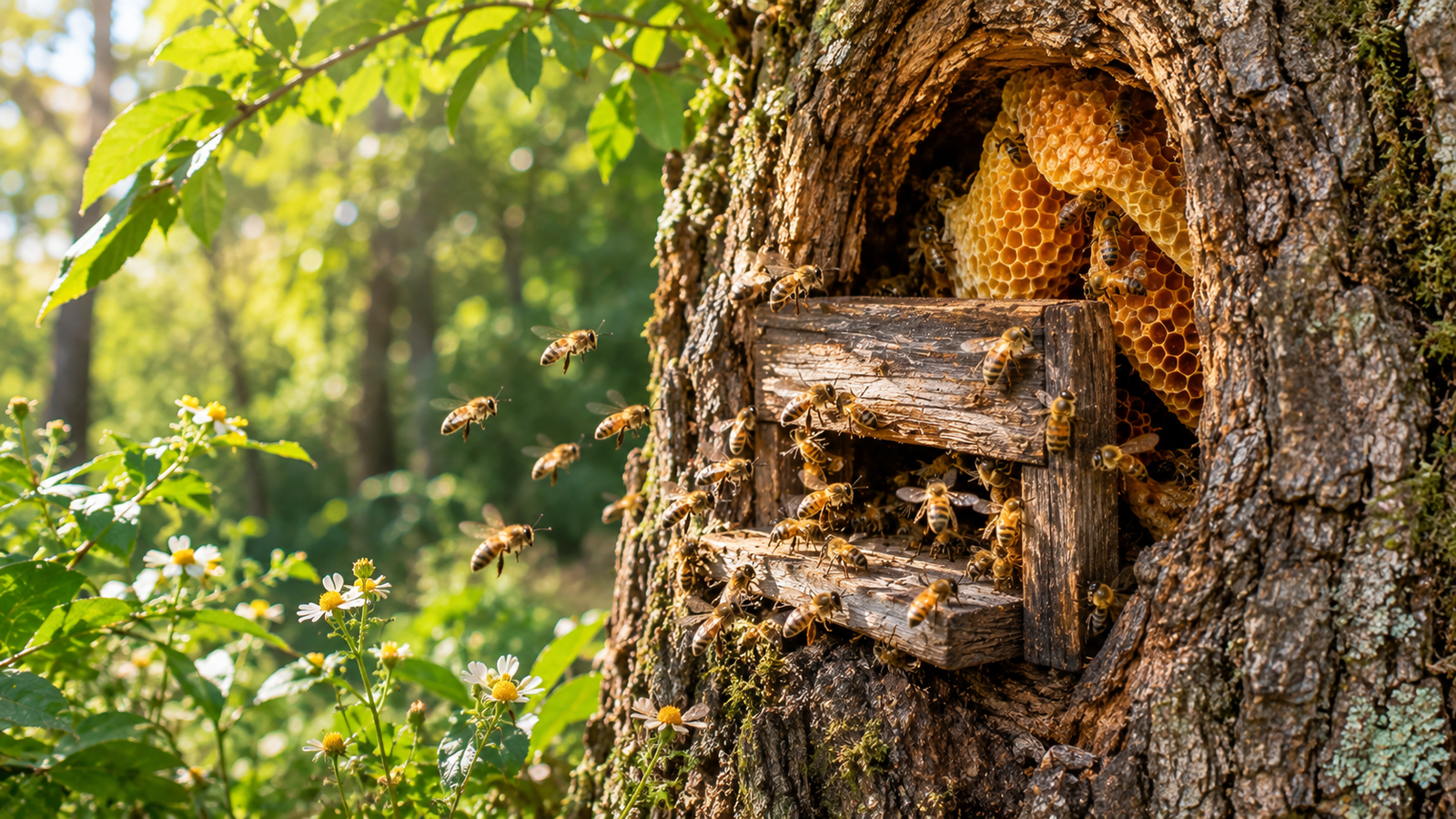
The place where a bee lives is generally called a bee nest or beehive. A beehive usually refers to the home of a honey bee colony, while a bee nest is a broader term that describes the nesting place of different bee species. Some bees live inside hollow trees, while others build underground tunnels, excavate holes in wood, or occupy hollow plant stems.
A place where beekeepers keep several beehives is called an apiary or bee yard. Although honey bees are well known for living together in large colonies, most bee species are solitary and build individual nests rather than living in traditional beehives.
The type of home a bee uses depends on its species, nesting behaviour, available materials, and surrounding environment. Some bees construct their own nesting structures, while others modify existing holes or occupy protected natural cavities.
In this guide, you will learn where bee lives is called what, where different bee species make their homes, how their nests are constructed, what happens inside them, and how to recognise different types of bee nests.
Where Bee Lives Is Called What?
The answer to the question “Where bee lives is called what?” is generally a bee nest or beehive.
However, these terms do not mean exactly the same thing. A honey bee colony may occupy a managed beehive or a natural cavity, whereas a solitary bee may live inside a small underground tunnel or an existing hole in a plant stem.
Here are the important terms:
| Term | Meaning | Example |
|---|---|---|
| Bee nest | The place where a bee lays eggs and raises its young | An underground mining bee nest |
| Beehive | A structure housing a honey bee colony, often a managed wooden box | A Langstroth beehive |
| Honeycomb | A structure of connected beeswax cells used for brood rearing and food storage | Wax comb inside a honey bee nest |
| Apiary | A place where beekeepers keep one or more beehives | A managed beekeeping yard |
| Burrow | A tunnel or underground cavity used as a nesting site | A mining bee’s soil tunnel |
| Habitat | The broader environment providing food, shelter, and suitable nesting conditions | A flowering meadow with bare soil and nesting sites |
For example, a western honey bee (Apis mellifera) may establish a colony inside a hollow tree, while a mining bee may excavate a small tunnel in the soil. Both locations are bee nests, but only the honey bee’s managed housing structure would ordinarily be called a beehive.
It is also important to understand that honeycomb is not the entire bee home. It is the wax structure inside certain bee nests, particularly those constructed by honey bees.
Where Do Bees Live in the Wild?
Wild bees occupy different nesting environments depending on their species and biological requirements.
Some live in organised colonies, while others raise their offspring independently. Their homes can be found underground, inside trees, in dead wood, within hollow stems, and in other sheltered cavities.
The following are some of the most common places where bees establish their nests.
1. Hollow Trees
Hollow trees are important natural nesting locations for honey bees.
A suitable cavity inside a tree provides protection from rain, strong winds, excessive sunlight, and some predators. Its enclosed structure also helps honey bee colonies maintain relatively stable internal conditions.
When a honey bee swarm selects a suitable hollow tree, worker bees begin constructing beeswax combs inside the cavity.
These combs contain hexagonal cells used for:
- Raising eggs, larvae, and pupae.
- Storing honey for food.
- Storing pollen for brood development.
- Supporting the organisation of the colony.
The western honey bee (Apis mellifera) commonly uses enclosed cavities, including hollow trees, although it can also occupy cavities inside buildings and other structures.
Not every tree cavity is suitable. Bees need enough internal space, an accessible entrance, and protection from excessive moisture and disturbance.
Practical example: If you observe honey bees repeatedly entering a small opening in an old tree trunk, there may be an established colony inside. The bees may be using the cavity as a permanent nesting location rather than simply resting there.
2. Underground Burrows
Many bee species nest underground rather than inside trees or traditional beehives.
Ground-nesting bees excavate tunnels in suitable soil and create chambers where their eggs and developing offspring remain.
Mining bees, particularly species belonging to the genus Andrena, are common examples.
A female mining bee typically:
- Selects a suitable area of soil.
- Excavates an entrance tunnel.
- Creates one or more underground nesting chambers.
- Collects pollen and nectar to provide food for her offspring.
- Deposits an egg in a provisioned chamber.
- Seals the chamber before the developing bee completes its life cycle.
The nest structure varies by species. Some have relatively simple tunnels, while others contain branching passages and several brood chambers.
Soil conditions matter. Different species may prefer sandy, loose, compact, or well-drained soil.
An interesting fact: Oregon State University Extension reports that approximately 70% of bee species nest underground. This helps explain why traditional beehives represent only a small part of the nesting diversity found among bees.
3. Dead Wood and Wooden Cavities
Some bees use dead wood, tree branches, and other wooden structures as nesting locations.
Carpenter bees are particularly well known for excavating their own tunnels in wood.
Female carpenter bees use their strong mandibles to remove wood fibres and create elongated nesting galleries. These tunnels provide spaces for laying eggs and raising young.
Depending on the species and available wood, a nesting tunnel may contain several chambers arranged along its length.
Other solitary bees do not excavate their own tunnels. Instead, they use existing holes created by wood-boring insects or other natural openings.
Example:
A large carpenter bee may excavate a tunnel in a dry wooden branch, while a smaller cavity-nesting bee may occupy an existing hole in a piece of dead wood.
These are two different nesting strategies, even though both bees use wood.
4. Hollow Plant Stems and Reeds
Hollow stems and reeds provide suitable nesting spaces for several solitary bee species.
These cavities are especially useful to bees that prefer narrow, enclosed spaces for raising their offspring.
Mason bees and leafcutter bees are examples of species that may use hollow stems or similar cavities, depending on their individual nesting requirements.
A female bee may prepare the available space by constructing individual brood chambers.
Each chamber generally contains:
- An egg.
- A supply of pollen and nectar.
- A protective partition or cell lining.
The materials used to construct these partitions differ between species.
For example, some mason bees use mud, while leafcutter bees use pieces of leaves to line their brood cells.
Leaving suitable hollow stems in a garden can provide natural nesting opportunities for some cavity-nesting bees.
5. Rock Crevices and Wall Cavities
Some bees use small spaces in rocks, masonry, and building structures as nesting locations.
These cavities can provide protection from direct rainfall, strong winds, and other environmental disturbances.
Depending on the species, bees may use:
- Cracks in rocks.
- Small holes in walls.
- Gaps between building materials.
- Existing cavities in masonry.
- Sheltered spaces beneath outdoor structures.
Some solitary bees are particularly adaptable and can use artificial cavities when natural nesting locations are limited.
However, the suitability of a cavity depends on its dimensions, moisture conditions, location, and accessibility.
A hole that is suitable for one bee species may be unsuitable for another.
6. Abandoned Animal Burrows
Some bumblebees use abandoned rodent burrows and other protected underground cavities.
Unlike mining bees, which generally excavate their own soil tunnels, many bumblebee queens take advantage of existing sheltered spaces when establishing their seasonal colonies.
A queen emerging from winter dormancy searches for a suitable nesting location.
Once she finds one, she begins preparing the nest, collecting pollen and nectar, and producing the first generation of workers.
As the colony develops, the workers help maintain the nest, collect food, and care for developing offspring.
The abandoned burrow provides a useful starting structure, reducing the need for the queen to excavate an entirely new underground space.
Do All Bees Live in Beehives?
No. Not all bees live in beehives.
Although honey bees are famous for their large colonies and organised hive structures, most bee species are solitary.
Solitary bees generally have individual nesting spaces, and females take responsibility for constructing or selecting their nests and provisioning their offspring.
The difference becomes clearer when comparing several common bee groups.
Honey Bees
Honey bees are highly social insects that live together in organised colonies.
A typical honey bee colony contains:
- One reproductive queen under normal colony conditions.
- Numerous female worker bees.
- Male drones during the appropriate reproductive period.
The workers cooperate in collecting food, producing wax, building comb, maintaining the nest, caring for brood, and defending the colony.
The western honey bee (Apis mellifera) commonly nests inside enclosed natural cavities or managed beehives.
However, not every honey bee species uses an enclosed hive.
For example, the giant honey bee (Apis dorsata) builds a large, exposed comb beneath tree branches or cliff overhangs rather than inside a hollow tree.
This is an important exception to the idea that every honey bee lives inside a conventional beehive.
Bumblebees
Bumblebees belong to the genus Bombus.
They are social bees, but their colonies generally have a seasonal life cycle rather than the long-lasting colony structure associated with many honey bee colonies.
A fertilised queen typically emerges from winter dormancy and searches for a protected nesting location.
Depending on the species, she may use:
- An abandoned rodent burrow.
- A cavity beneath grass or vegetation.
- An old nesting space.
- A protected space in a compost heap.
- Another suitable enclosed location.
The queen initially raises the first generation of workers herself.
Once these workers emerge, they help collect food and care for the growing colony.
Later in the season, the colony produces new queens and males. In many species, the old colony eventually dies, while newly mated queens overwinter and establish colonies in the following season.
Carpenter Bees
Carpenter bees are known for excavating tunnels in wood.
They are generally solitary or have limited social interactions, depending on the species.
A female carpenter bee selects suitable wood and excavates a tunnel in which she creates brood chambers.
She provisions these chambers with pollen and nectar before laying eggs.
Although several carpenter bees may use the same wooden structure or nest close together, this does not automatically mean they form a single cooperative colony.
Each female may maintain her own nesting chambers and care for her own offspring.
Mason Bees
Mason bees are solitary bees belonging to the genus Osmia.
Many species use existing cavities in wood, hollow stems, and other narrow spaces.
They are particularly known for using mud to separate the individual brood chambers inside their nests.
A female mason bee collects pollen and nectar, places the food inside a chamber, lays an egg, and constructs a mud partition.
She repeats this process until the available nesting space is filled.
Different species use different cavity dimensions and nesting materials.
For example:
- Red mason bees (Osmia bicornis) commonly use cavities and mud partitions.
- Orchard mason bees (Osmia lignaria) use suitable holes in wood and artificial nesting materials.
Mason bees are important pollinators and can be particularly useful in gardens and orchards.
Leafcutter Bees
Leafcutter bees belong to the genus Megachile.
They are solitary bees known for cutting pieces of leaves or flower petals to construct protective linings for their brood cells.
Depending on the species, their nests may be located in:
- Hollow plant stems.
- Existing holes in wood.
- Underground spaces.
- Other suitable cavities.
A female gathers leaf pieces and arranges them inside her chosen nesting space.
She then provisions the chambers with pollen and nectar before laying eggs.
The leaf material protects the developing offspring.
Small, rounded sections removed from leaves may therefore indicate the activity of leafcutter bees rather than serious damage to the plant.
Comparison: Where Do Different Bee Species Live?
The following table summarises the nesting habits of several important bee groups.
| Bee species or group | Common nesting location | Nesting behaviour |
|---|---|---|
| Western honey bee (Apis mellifera) | Hollow trees and managed hives | Builds wax combs in colonies |
| Giant honey bee (Apis dorsata) | Tree branches and cliff overhangs | Builds large exposed combs |
| Bumblebees (Bombus) | Underground burrows and sheltered cavities | Establishes seasonal colonies |
| Mining bees (Andrena) | Underground soil tunnels | Females excavate individual nests |
| Carpenter bees (Xylocopa) | Dead wood and wooden structures | Excavates nesting tunnels |
| Mason bees (Osmia) | Hollow stems and existing cavities | Uses mud partitions in many species |
| Leafcutter bees (Megachile) | Soil and existing cavities | Uses leaf pieces to line brood cells |
The main distinction is that honey bees and bumblebees are social, while most other bee species are solitary.
However, nesting behaviour is diverse, and there are exceptions within individual bee groups.
What Is the Difference Between a Bee Nest and a Beehive?
A bee nest and a beehive are closely related terms, but they are not interchangeable in every situation.
A bee nest is the broader biological term for the place where a bee or group of bees establishes a nesting site.
A beehive commonly refers to the structure housing a honey bee colony, particularly one provided and managed by a beekeeper.
Consider these examples:
Example 1: A honey bee colony in a hollow tree
The bees have a natural nest inside the tree cavity. They construct wax combs inside the available space.
Example 2: A honey bee colony in a wooden box
The wooden structure is a managed beehive. The colony occupies the hive and builds or uses combs inside it.
Example 3: A mining bee in the soil
The underground tunnel is a bee nest, but it is not a traditional beehive.
Example 4: A mason bee inside a hollow reed
The reed contains the bee’s nesting chambers. It is a solitary bee nest, not a honey bee hive.
Therefore, when someone asks what a bee’s home is called, bee nest is the broader answer, while beehive is the familiar term most commonly associated with honey bees.
What Is Inside a Honey Bee Hive?
A honey bee hive contains more than just bees and honey.
It is an organised living environment containing wax combs, developing offspring, food stores, and adult bees performing different tasks.
Here are the main components.
1. Honeycomb
Honeycomb is a network of beeswax cells constructed by worker bees.
The cells are generally hexagonal and serve several purposes.
They provide space for:
- Storing honey.
- Storing pollen.
- Raising worker bees.
- Raising drones.
- Developing new queens in specially constructed queen cells.
The comb is one of the most important structures inside a honey bee nest.
2. Queen Bee
The queen is normally the primary reproductive female in a healthy honey bee colony.
Her main responsibility is laying eggs that develop into new colony members.
She also produces chemical signals that influence the behaviour and organisation of the colony.
A healthy colony generally has one functional queen, although queen replacement and other unusual situations can occur.
3. Worker Bees
Worker bees are female honey bees that perform most of the colony’s daily activities.
Their responsibilities include:
- Cleaning brood cells.
- Feeding developing larvae.
- Producing beeswax.
- Building and repairing comb.
- Guarding the hive entrance.
- Collecting nectar and pollen.
- Regulating the nest environment.
The tasks performed by workers change as the colony ages and its needs develop.
4. Drones
Drones are male honey bees.
Their primary biological role is to mate with queens.
Unlike worker bees, drones do not normally collect nectar, construct comb, or perform the majority of hive maintenance activities.
Their numbers vary according to the colony’s reproductive cycle and environmental conditions.
5. Brood Cells
Brood cells are the honeycomb cells containing developing honey bees.
The brood passes through three main developmental stages:
- Egg.
- Larva.
- Pupa.
After completing development, the adult bee emerges from its cell.
Worker bees care for the developing brood and maintain the conditions required for its survival.
6. Food Stores
Honey bees store honey and pollen inside their combs.
Honey provides carbohydrates and energy, while pollen supplies protein, fats, vitamins, and minerals needed for brood development and colony maintenance.
These stored resources are especially important when weather conditions prevent the bees from collecting food outside.
How Do Bees Build Their Homes?
Bees use different construction methods depending on their species.
Some produce their own building materials, while others collect mud, leaves, soil, or other materials from their surroundings.
Understanding these differences helps explain why bee nests can look completely different.
How Honey Bees Build Their Nests
Honey bees produce beeswax using specialised wax glands located on the underside of their abdomens.
Worker bees secrete small wax scales and manipulate them with their legs and mouthparts.
They gradually shape the wax into connected cells that form honeycomb.
The comb serves as the colony’s main internal structure.
Its cells are used for raising young bees and storing food.
In natural environments, the colony attaches its combs to the interior surfaces of a suitable cavity.
How Mining Bees Build Underground Nests
Mining bees excavate tunnels in suitable soil using their mandibles and legs.
A female creates an entrance tunnel and prepares individual brood chambers.
She collects pollen and nectar and places food provisions inside each chamber before laying an egg.
Some species also smooth or line the walls of their underground chambers with materials that help protect the brood.
The nest architecture varies considerably between species.
How Carpenter Bees Build Wooden Nests
Carpenter bees excavate tunnels by chewing into suitable wood.
Their nesting galleries can extend along the grain of the wood and may contain several brood chambers.
The female prepares provisions for each developing offspring and lays eggs in the chambers.
Some carpenter bee species reuse older nesting galleries and may expand them over time.
How Mason Bees Build Their Nests
Mason bees generally use existing cavities.
After selecting a suitable hole, a female gathers pollen and nectar and prepares a brood chamber.
She places an egg inside and uses mud to create a partition separating it from the next chamber.
This process continues until the available nesting space is filled.
How Leafcutter Bees Build Their Nests
Leafcutter bees collect small pieces of leaves or petals using their specialised jaws.
They carry these pieces to a suitable nesting cavity and arrange them to form protective brood cells.
After preparing each cell, the female adds pollen and nectar and lays an egg.
The completed cells provide food and protection for the developing offspring.
Why Do Some Bees Live Together While Others Live Alone?
Not all bees have the same social organisation.
Some species have evolved complex colonies, while others reproduce independently.
The distinction is important because a group of bees living close together does not necessarily represent a colony.
Social bees, such as honey bees, generally demonstrate:
- Cooperation in caring for offspring.
- Division of reproductive and worker responsibilities.
- Overlapping generations.
- Shared nest maintenance and defence.
Solitary bees generally have a different arrangement.
Each female typically establishes and provisions her own nest without depending on a large cooperative colony.
What Is a Bee Nest Aggregation?
A bee nest aggregation occurs when many individual bees establish their nests close to one another.
For example, a suitable sandy patch of soil may contain dozens or even hundreds of mining bee nest entrances.
At first glance, the area may look like one large bee colony.
However, the individual females generally maintain separate nests and provide food for their own offspring.
This is different from a honey bee colony, where many workers cooperate within a shared nest.
A nest aggregation is therefore a concentration of individual nests, not necessarily a social colony.
This distinction is particularly important when identifying ground-nesting bees.
How Can You Identify Different Types of Bee Nests?
The location and appearance of a nest can provide useful clues about which bee may be living there.
However, these clues are not always enough to identify a species with certainty.
| What you observe | Possible bee | What to look for |
|---|---|---|
| Small holes in bare soil | Mining bees | Individual entrances in suitable soil |
| A large wooden tunnel | Carpenter bees | Circular entrance holes in wood |
| Mud partitions inside a hollow tube | Mason bees | Individual brood chambers |
| Leaf pieces inside a cavity | Leafcutter bees | Leaf-lined brood cells |
| A wax comb inside a tree cavity | Honey bees | Multiple workers entering and leaving |
| A seasonal colony in an old burrow | Bumblebees | Bumblebee activity around a protected entrance |
| A large exposed comb hanging from a branch | Giant honey bees | A single large open comb covered by bees |
Important: Do not open, touch, or disturb an unidentified nest to confirm its identity. Some bee colonies can defend their homes, and other insects, including wasps, may occupy similar-looking locations.
Where Do Bees Live During Winter?
Bee survival during winter depends on the species and the climate in which it lives.
Different bees use different strategies to survive cold temperatures and periods when flowers are unavailable.
Honey Bees During Winter
Honey bee colonies can remain active inside their hives throughout cold periods.
Workers cluster together around the queen and generate heat by contracting their flight muscles.
The colony consumes stored honey to obtain the energy required to maintain warmth.
The cluster changes its arrangement as temperatures rise and fall.
This cooperative behaviour allows honey bee colonies to survive conditions that individual bees would struggle to tolerate.
Bumblebees During Winter
In many temperate bumblebee species, most of the colony dies towards the end of the season.
Newly mated queens find protected places where they can overwinter.
Depending on the species and environment, these locations may include sheltered soil or other protected spaces.
When favourable conditions return, the queens emerge and search for suitable places to establish new colonies.
Solitary Bees During Winter
Many solitary bees spend winter inside their nests.
Depending on the species, they may remain as larvae, prepupae, or adults until conditions become suitable for further development or emergence.
Some cavity-nesting species remain protected inside their brood chambers, while many ground-nesting species remain underground.
This is why disturbing old nesting materials or excavating occupied soil can interfere with the life cycles of solitary bees.
How Can You Help Bees Find Suitable Homes?
You do not need to keep honey bee hives to support wild bees.
Many species need relatively simple nesting environments and access to suitable flowering plants.
Here are practical ways to help.
1. Leave Some Bare Soil
Ground-nesting bees need suitable soil for digging their tunnels.
Consider leaving small, undisturbed patches of bare, well-drained soil in your garden.
Avoid covering every available area with thick mulch or artificial materials.
2. Preserve Suitable Dead Wood
Some solitary bees use dead branches, logs, and existing cavities in wood.
Where safe, leaving suitable dead wood in an appropriate outdoor location can provide additional nesting opportunities.
3. Maintain Flowering Plants
Bees need nectar and pollen for food.
Grow a variety of flowering plants that provide resources across different parts of the year.
Native flowering plants can be particularly valuable because they support local pollinator communities.
4. Provide Suitable Nesting Cavities
Some solitary bees can use properly designed bee hotels.
However, a bee hotel is not suitable for every bee species.
Ground-nesting bees, for example, need appropriate soil rather than artificial tubes.
If you install a bee hotel, use appropriate materials, suitable cavity dimensions, and proper maintenance to reduce the risk of parasites and disease.
5. Avoid Unnecessary Pesticides
Pesticides can harm bees directly or indirectly.
Avoid unnecessary pesticide applications, especially when flowering plants are attracting pollinators.
Always follow applicable product instructions and local environmental guidance.
6. Avoid Disturbing Active Nests
Observe bee nesting locations from a safe distance.
Do not block entrances, dig into active nests, or destroy nesting structures unnecessarily.
If a honey bee colony has established itself inside a building, contact a qualified local beekeeper or appropriate professional for advice.
Supporting bees means protecting both their food sources and their nesting environments.
Frequently Asked Questions
1. Where bee lives is called what?
The place where a bee lives is generally called a bee nest or beehive. A beehive usually refers to a honey bee colony’s home, while a bee nest is a broader term that includes underground tunnels, hollow stems, wooden cavities, and other nesting locations.
2. What is a bee’s house called?
A bee’s house is commonly called a nest or beehive. Honey bees usually live in colonies inside natural cavities or managed beehives, while solitary bees use individual nesting spaces.
3. What is the place where many beehives are kept called?
A place where beekeepers keep multiple beehives is called an apiary or bee yard. It may be located in a garden, field, orchard, or another suitable outdoor area.
4. Is an apiary the same as a beehive?
No. A beehive is a structure that houses a honey bee colony, while an apiary is the location where beekeepers keep their hives. An apiary may contain one or several beehives.
5. Do all bees live in hives?
No. Most bee species are solitary and establish individual nests. Some live underground, while others use dead wood, hollow plant stems, and existing cavities. Honey bees and bumblebees are examples of social bees that live in colonies.
6. Where do honey bees live naturally?
Western honey bees commonly establish colonies inside hollow trees and other enclosed cavities. They construct wax combs inside these spaces for raising young and storing food. However, some honey bee species, such as the giant honey bee, build exposed combs beneath branches and cliffs.
7. Do bees live underground?
Yes. Many bee species nest underground. Mining bees excavate their own tunnels, while some bumblebee species use abandoned rodent burrows and other protected underground cavities.
8. What is the inside of a beehive called?
The inside of a beehive contains honeycomb, brood areas, food stores, and adult bees. The wax structure made of connected cells is called honeycomb.
9. Can bees live without a man-made beehive?
Yes. Wild honey bees can establish colonies inside natural cavities, such as hollow trees. Many solitary bees never use traditional beehives and instead build nests in soil, dead wood, hollow stems, and other suitable spaces.
10. Why do bees need a nest?
Bees use their nests to lay eggs and provide suitable conditions for their offspring to develop. Depending on the species, nests also provide protection, shelter, and space for storing food.
11. What is the difference between a bee nest and a bee colony?
A bee nest is the physical location where bees establish their home. A bee colony is a group of bees living and working together in a social organisation. Solitary bees can have nests without forming large social colonies.
12. Do bees return to the same nest every year?
This depends on the species. Some solitary bees reuse suitable nesting areas, while others establish new nests. Many honey bee colonies can occupy the same established nest for extended periods, whereas many bumblebee species establish new seasonal colonies each year.
13. Can bees build nests inside houses?
Yes. Honey bees may establish colonies inside wall cavities, roof spaces, chimneys, and other enclosed parts of buildings. Some solitary bees may also use small openings in walls or wooden structures. If you discover an active colony, avoid disturbing it and seek qualified assistance.
Conclusion
The answer to the question “Where bee lives is called what?” is generally a bee nest or beehive. However, the correct term depends on the type of bee and the structure it occupies.
Honey bees commonly live in colonies inside natural cavities or managed beehives, while bumblebees establish seasonal colonies in protected spaces. Many solitary bees build individual nests underground, inside dead wood, or within hollow plant stems.
An apiary is different because it refers to the place where beekeepers keep their beehives, while honeycomb is the wax structure found inside certain bee nests.
Understanding these differences helps explain why bees do not all live in the same type of home. Their nesting environments reflect their species, reproductive behaviour, and adaptations to the natural world.
References and scientific sources to include
Use these sources in the article as contextual citations, particularly in the sections indicated.
1. Oregon State University Extension – Seventy Percent of Bees Live in Nests Underground, Not in Hives. Supports the discussion of ground-nesting bees and underground nest construction.
2. University of Florida IFAS Extension – Giant Honey Bee (Apis dorsata). Supports the explanation of exposed honey bee combs.
3. University of Florida IFAS Extension – The Social Organization of Honey Bees. Supports the distinction between social colonies and solitary bee nest aggregations.
4. University of Nebraska–Lincoln Extension – Creating a Solitary Bee Hotel. Supports cavity-nesting behaviour and brood chamber construction.
5. Penn State Extension – Nesting Behavior of Stinging Insects. Supports comparisons of honey bee, bumblebee, carpenter bee, mason bee, and leafcutter bee nesting behaviour.
6. University of California Statewide Integrated Pest Management Program – Removing Honey Bee Swarms and Established Hives. Supports honey bee cavity selection and natural nesting locations.
