

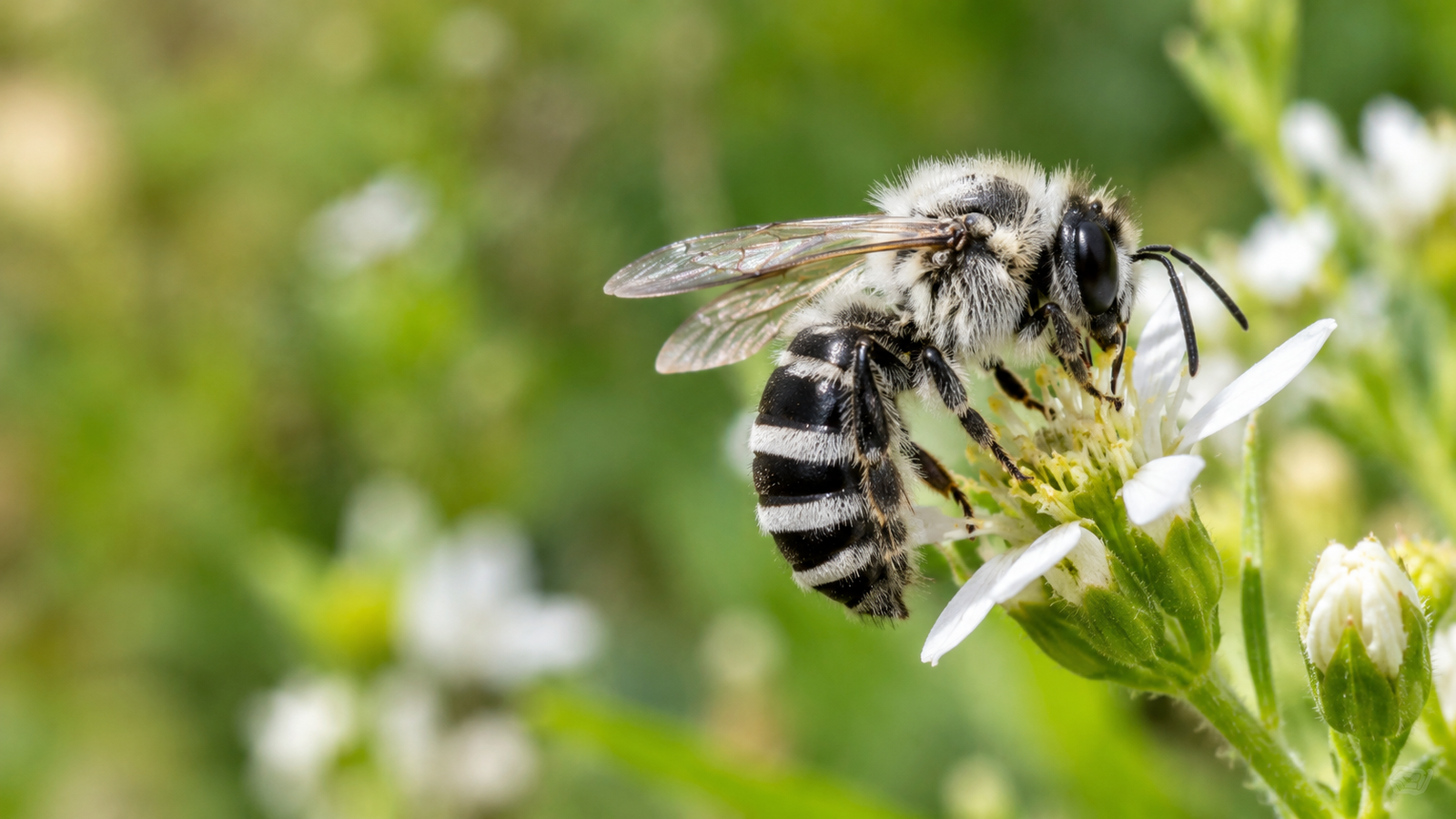
When you see a bee with a black body and white stripes, gray hair, or pale markings, you might wonder what kind of bee it is. Several bee species have black-and-white coloration, but there is no single species known simply as the black-and-white bee.
Some of the most recognizable examples include the ashy mining bee (Andrena cineraria), white-banded digger bee (Amegilla quadrifasciata), broad-footed cellophane bee (Colletes latitarsis), and small resin bees in the genus Heriades. Other bees, including cuckoo bees, leafcutter bees, and carder bees, can also have dark bodies with contrasting pale markings.
The appearance of these bees varies considerably. Some have white bands across their abdomens, others have gray hairs covering their thoraxes, and a few have small pale patches on their faces or legs.
The quickest way to identify a black-and-white bee is to examine its body shape, hair patterns, abdominal markings, size, and behavior rather than relying on color alone.
This guide covers 10 types of black-and-white or dark-and-pale bees, their identifying characteristics, habitats, nesting habits, and ability to sting.
Quick Identification: What Bee Is Black and White?
| Bee | What it looks like | Distinguishing feature |
|---|---|---|
| Ashy mining bee | Black body with gray-white thoracic hairs | Two contrasting gray hair bands across the thorax |
| White-banded digger bee | Dark abdomen with pale transverse bands | Long mouthparts and hairy thorax |
| Broad-footed cellophane bee | Dark body with grayish hairs | Broad hind-leg segment |
| Small resin bee | Black body with narrow white abdominal bands | Small cylindrical body |
| Bellflower resin bee | Mostly black with sparse pale hairs | Small, compact body and association with bellflowers |
| Triepeolus cuckoo bee | Black with striking white hair patterns | Short, flattened hair arranged in patches |
| Epeolus cuckoo bee | Black body with pale hair bands or patches | Often parasitizes cellophane bees |
| Stelis cuckoo bee | Black or metallic dark body with pale markings in some species | Does not collect pollen |
| Carder bee | Dark body with white or yellowish markings in some species | Female gathers plant hairs for nest building |
| Coelioxys cuckoo bee | Dark gray or black body, sometimes with pale hair | Female has a narrow, pointed abdomen |
Important: These are identification groups and examples, not ten species that all have identical coloration. Some entries describe a genus because several species within that group share similar markings. Exact species identification may require a specialist.
1. Ashy Mining Bee (Andrena cineraria)
The ashy mining bee is one of the clearest examples of a naturally black-and-white bee. It has a dark, almost black body contrasted by distinctive ash-gray hairs covering parts of its thorax.
Unlike bees with alternating black and yellow stripes, the ashy mining bee has a more monochromatic appearance.
How to identify an ashy mining bee
Look for these characteristics:
- A dark blue-black or black body.
- Broad gray hairs on the thorax.
- A contrasting dark band across the upper thorax.
- A dark abdomen.
- A moderately hairy appearance.
Female ashy mining bees are particularly recognizable because of the contrasting gray and black hairs on their thorax. Males are generally slimmer and have different facial and body-hair characteristics.
Where does it live?
The ashy mining bee occurs across parts of Europe and extends eastward into Asia. It is commonly associated with gardens, parks, woodland edges, and other habitats where suitable nesting soil and flowering plants are available.
Females excavate individual nests in the ground. Several females may nest close together, creating an aggregation that looks like a colony.
However, these aggregations are not equivalent to honeybee colonies. Each female provisions and manages her own nest.
Does it sting?
Female ashy mining bees possess a sting, but they are generally not aggressive. Males do not have stings.
Identification tip: If you see a dark bee with two conspicuous gray hair areas across its thorax, an ashy mining bee is worth considering, particularly in regions where the species occurs.
2. White-Banded Digger Bee (Amegilla quadrifasciata)
The white-banded digger bee is another recognizable example of a bee with a black-and-white appearance.
Its abdomen has alternating dark and pale transverse bands, creating a striped appearance. However, its thorax is generally brownish or orange-brown rather than completely black and white.
This distinction is important because the bee is not uniformly monochromatic.
How to identify it
Look for:
- A dark abdomen with distinct pale bands.
- A densely hairy thorax.
- A relatively robust body.
- A conspicuous, elongated mouthpart used to reach nectar.
- Fast, active flight around flowering plants.
The pale abdominal bands are among its most noticeable characteristics.
Where does it live?
Amegilla quadrifasciata is recorded in parts of Europe and the Mediterranean region. Its preferred habitats include warm, relatively open areas with flowering plants and suitable soil for nesting.
It belongs to a group of solitary digger bees. Females construct individual underground nests rather than living in large colonies like honeybees.
Does it sting?
Females can sting when threatened, but these bees generally concentrate on feeding and nesting rather than attacking people.
Males cannot sting.
Identification tip: A bee with a dark abdomen crossed by several clearly defined white bands and a brownish hairy thorax may be a white-banded digger bee. Confirm the location before assigning the species.
3. Broad-Footed Cellophane Bee (Colletes latitarsis)
The broad-footed cellophane bee is a member of the family Colletidae.
It may appear dark gray, black, and white depending on the species’ hair coloration, lighting, and viewing angle.
Its appearance is less dramatically striped than that of the white-banded digger bee.
How to identify it
Useful characteristics include:
- A dark body.
- Grayish or pale hairs.
- Subtle pale abdominal bands.
- A moderately hairy thorax.
- Distinctive hind-leg structures.
The broad hind-leg segment is particularly useful when examining the species closely.
It is also important not to confuse this bee with every other gray or black cellophane bee. Several species in the genus Colletes look similar.
Where does it live?
Colletes latitarsis is a North American bee recorded in parts of the United States.
It is associated with flowering plants and suitable nesting environments. Like other cellophane bees, females excavate underground nesting tunnels.
They produce a waterproof secretion that they use to line their brood cells. This material helps protect the developing offspring and their stored food.
Does it sting?
Female cellophane bees possess a sting, but they are generally not aggressive. Males cannot sting.
Identification tip: Look beyond the gray coloration. The bee’s body proportions and hind-leg characteristics are more useful for distinguishing it from other similar-looking bees.
4. Small Resin Bees (Heriades Species)
Small resin bees are among the best examples of dark bees with pale abdominal bands.
Members of the genus Heriades are generally small, dark, and relatively compact. Their abdomens may have narrow white or pale hair bands along the edges of the segments.
One documented example is the large-headed armoured-resin bee, Heriades truncorum.
How to identify them
Look for:
- A small, dark, cylindrical body.
- A relatively smooth-looking but heavily pitted body surface.
- Narrow white hair bands along the abdomen.
- A compact appearance.
- Less body hair than many larger bees.
The female carries pollen using specialized hairs underneath her abdomen.
This is an important difference between many resin bees and honeybees, which carry pollen on their hind legs.
Where do they live?
Resin bees occur in different parts of the world.
They commonly use existing cavities in dead wood, hollow stems, and other suitable nesting spaces.
Females collect plant resin to construct partitions and close their nesting chambers.
Does it sting?
Females have a sting, but these small bees are not generally aggressive toward people.
Identification tip: A small black bee with narrow white lines along its abdominal segments may belong to the genus Heriades.
5. Bellflower Resin Bee (Megachile campanulae)
The bellflower resin bee is an interesting example because it is predominantly black rather than strongly black and white.
Its body has relatively sparse pale hairs, making it appear darker and less furry than many other leafcutter bees.
Despite belonging to the genus Megachile, it is unusual because it uses resin in nest construction.
How to identify it
Look for:
- A small, compact body.
- A predominantly black appearance.
- Sparse pale hairs on the thorax.
- A relatively narrow, parallel-sided abdomen.
- A female with pollen-carrying hairs underneath her abdomen.
Females are generally around 10–12 mm long, while males are approximately 8–9 mm in the Minnesota DNR account.
Where does it live?
The species occurs in eastern North America and has been recorded across parts of the United States.
It is particularly associated with bellflowers (Campanula), which provide an important source of pollen.
Females use cavities for nesting and construct brood cells using resin.
Does it sting?
Females possess a sting but are not generally aggressive. Males cannot sting.
Identification tip: Do not expect this bee to have bold white stripes. Its mostly black body and relatively subtle pale hairs are more characteristic.
6. Variegated Cuckoo Bees (Triepeolus Species)
Variegated cuckoo bees are among the most striking dark-and-white bees.
Many species have black bodies decorated with short, flattened white or pale hairs. These hairs form distinctive patterns across the abdomen and thorax.
Unlike bees with long, fluffy body hair, the markings of Triepeolus often look like carefully arranged white patches.
How to identify them
Look for:
- A dark or black body.
- Short, flattened white or pale hairs.
- Distinctive pale abdominal bands or patches.
- Relatively little long, fluffy body hair.
- A body shape that can appear wasp-like.
Their markings can be bold enough to make them look like miniature black-and-white wasps.
Where do they live?
Different Triepeolus species occur in different regions, including North America.
They are generally associated with habitats where their host bees are present.
Why are they called cuckoo bees?
These bees are cleptoparasites.
Instead of building and provisioning their own nests, females enter the nests of other bee species and lay their eggs there.
The developing cuckoo bee offspring use the food provisions collected by the host bee.
They do not collect pollen for their own brood in the usual way.
Does it sting?
Females possess a sting, but their behavior is not generally directed toward people. Males cannot sting.
Identification tip: Short, flattened white hair patterns against a black body are particularly useful clues when considering a Triepeolus cuckoo bee.
7. Epeolus Cuckoo Bees (Epeolus Species)
Epeolus bees are another group of cuckoo bees that can have noticeable black-and-white markings.
Their bodies are generally dark, with pale hairs arranged in bands or patches.
They may look similar to Triepeolus, which is why identifying them from color alone can be difficult.
How to identify them
Look for:
- A black or very dark body.
- Short pale hair markings.
- Contrasting patterns on the abdomen.
- A relatively compact body.
- A lack of specialized pollen-carrying structures.
Their markings are made by body hairs rather than simply painted-looking color bands.
Where do they live?
The genus occurs in several parts of the world, with different species occupying different geographical ranges.
Many species are associated with cellophane bees in the genus Colletes.
What do they eat?
Adult Epeolus bees visit flowers for nectar.
However, females do not collect pollen to provision their own offspring because they use the nests of host bees.
Does it sting?
Female cuckoo bees have a sting, although they are not generally aggressive toward people. Males cannot sting.
Identification tip: A dark bee with short, pale abdominal patches that appears to be searching around the nesting areas of other bees may be a cuckoo bee. A photograph alone may not be enough to separate Epeolus from similar genera.
8. Dark Cuckoo Bees (Stelis Species)
Some Stelis cuckoo bees have black bodies with pale markings, while others are almost entirely dark or metallic.
This makes the genus useful to include in a black-and-white bee identification guide, but not every Stelis species is black and white.
How to identify them
Depending on the species, look for:
- A black or dark metallic body.
- Small white or pale hair patches.
- Occasionally yellow or pale markings.
- A relatively compact appearance.
- The absence of specialized pollen-collecting hairs in females.
Some species can resemble leafcutter bees.
Where do they live?
Different Stelis species occur across multiple regions.
They commonly use the nests of other bees, particularly members of the family Megachilidae.
Females enter suitable host nests and lay eggs. Their offspring develop using the provisions intended for the host bee’s young.
Does it sting?
Females possess a sting, but these bees are not normally aggressive toward humans.
Identification tip: Do not identify a Stelis bee by its color alone. Its nesting behavior and lack of pollen-collecting structures provide more useful clues.
9. Carder Bees (Anthidium Species)
Carder bees are recognizable because of their distinctive nesting behavior and body markings.
Some species have dark bodies with white or pale markings, while others have yellow markings.
Therefore, not every carder bee is strictly black and white.
How to identify them
Look for:
- A robust body.
- Noticeable hair on the thorax.
- Dark abdominal segments.
- Pale or yellowish markings in some species.
- Strong mandibles.
Female carder bees collect soft plant hairs from leaves and stems.
They use these materials to construct and line their nests.
Where do they live?
Carder bees occur in several parts of the world.
Depending on the species, they may nest in cavities, hollow stems, or other suitable spaces.
Some species are associated with gardens and areas containing flowering plants and suitable nesting materials.
Do they sting?
Females can sting if handled or threatened, but they are generally focused on collecting nesting materials and visiting flowers.
Males cannot sting.
Identification tip: If you see a dark bee with contrasting pale or yellow patches collecting plant hairs from leaves, a carder bee may be worth considering.
10. Sharp-Tailed Cuckoo Bees (Coelioxys Species)
Sharp-tailed cuckoo bees are dark-bodied bees that can have a gray, black, or pale-haired appearance.
The most useful identification feature is the shape of the female’s abdomen.
Rather than having the broad, rounded appearance of many other bees, the female’s abdomen narrows toward a pointed tip.
How to identify them
Look for:
- A dark gray or black body.
- A relatively narrow abdomen.
- A pointed abdominal tip in females.
- Short body hairs.
- A wasp-like appearance in some species.
The male’s abdominal shape differs from the female’s, so both sexes should not be identified using exactly the same characteristics.
Where do they live?
Coelioxys species occur in several parts of the world.
They are commonly associated with leafcutter bees.
Females enter the nests of host bees and lay eggs without constructing their own fully provisioned brood cells.
Do they sting?
Females possess a sting, but they are not generally aggressive toward people.
Identification tip: The pointed abdomen of a female Coelioxys is more informative than its dark coloration.
Why Are Some Bees Black and White?
Bee coloration is influenced by several factors, including body pigmentation, body hairs, species characteristics, and differences between males and females.
The black-and-white appearance of a bee does not necessarily mean its body is naturally divided into black and white colored sections.
In many cases, the white or gray appearance comes from tiny hairs covering the body.
1. Pigmentation
The outer body surface, called the exoskeleton, may have dark pigmentation.
This can give a bee a black or dark brown appearance.
2. Pale body hairs
Some bees have gray, white, or cream-colored hairs covering parts of their bodies.
These hairs can create the appearance of white stripes even when the underlying exoskeleton is black.
3. Differences between males and females
Male and female bees of the same species may have different hair patterns, body sizes, facial markings, and antenna lengths.
The ashy mining bee is a useful example because its males and females have different identification characteristics.
4. Lighting and photography
A bee photographed in bright sunlight may look lighter than the same bee photographed in shade.
Dust, pollen, reflections, and camera exposure can also affect its apparent color.
This is why identification should involve several physical characteristics rather than one photograph’s color balance.
How to Identify a Black-and-White Bee in Your Garden
If you encounter a black-and-white bee, use the following process to narrow down its identity.
Step 1: Examine the abdomen
Look for:
- Continuous white bands.
- Broken white patches.
- Gray hair along the abdominal segments.
- A completely black abdomen.
A bee with clear transverse white bands may belong to a different group from one with scattered pale patches.
Step 2: Examine the thorax
The thorax is the middle section of the bee’s body where the legs and wings attach.
Check whether it is:
- Completely black.
- Covered with gray hairs.
- Brownish with pale hairs.
- Marked with white patches.
For example, the gray thoracic hairs of Andrena cineraria are especially distinctive.
Step 3: Check the body size and shape
Small resin bees are generally more compact and cylindrical than large, hairy bees.
Cuckoo bees can have a relatively smooth or sparsely hairy appearance.
Larger digger bees are often more robust and noticeably hairy.
Size is helpful, but it should not be used as the only identification feature.
Step 4: Observe its behavior
Behavior can help narrow down the possibilities.
| What you observe | Possible bee group |
|---|---|
| Digging in exposed soil | Mining or digger bees |
| Entering small holes in dead wood | Resin or leafcutter bees |
| Searching around other bee nests | Cuckoo bees |
| Collecting plant hairs | Carder bees |
| Visiting bellflowers | Bellflower resin bee |
These are clues rather than definitive identification rules.
Step 5: Photograph the bee
Take clear photographs showing:
- The top of the bee.
- Its side profile.
- Its face.
- Its abdomen.
- Its hind legs, if visible.
Avoid touching or catching the bee simply to obtain a photograph.
If identification remains difficult, submit the photographs to a specialist identification community or a regional bee-recording organization.
Black-and-White Bees vs. Black-and-Yellow Bees
Not every bee with contrasting stripes is black and white.
Many familiar bees have black-and-yellow markings.
| Feature | Black-and-white bees | Black-and-yellow bees |
|---|---|---|
| Common markings | Gray, white, or pale hair bands | Yellow or golden bands |
| Examples | Ashy mining bees, some cuckoo bees | Many bumblebees and carder bees |
| Appearance | Often gray, black, or monochromatic | Often brighter and more contrasting |
| Identification | Hair patterns and body markings | Yellow bands, body shape, and hair patterns |
Coloration alone does not determine whether a bee is dangerous or whether it can sting.
Black-and-White Bees vs. Wasps and Hoverflies
Some insects have black-and-white markings but are not bees.
This is particularly important because certain wasps and flies imitate the appearance of bees.
| Feature | Bee | Wasp | Hoverfly |
|---|---|---|---|
| Wings | Two pairs | Two pairs | One pair |
| Body hair | Often noticeably hairy | Usually less hairy | Varies, sometimes very hairy |
| Antennae | Usually visible and relatively long | Usually visible and relatively long | Usually short |
| Pollen collection | Many female bees collect pollen | Does not collect pollen to provision bee-like brood cells | Does not collect pollen for offspring |
| Sting | Female bees of most non-parasitic groups have a sting | Many females have a sting or ovipositor | No sting |
A hoverfly may have convincing bee-like markings, but it is a fly and has only one pair of functional wings.
Wasps may also resemble bees, but their bodies are often less hairy and more visibly narrow-waisted.
A photograph showing the wings, antennae, and body shape is much more useful than color alone.
Do Black-and-White Bees Sting?
Some black-and-white bees can sting, but their coloration does not tell you whether they are dangerous.
The ability to sting depends mainly on the bee’s sex and reproductive anatomy.
Female bees
Female bees in most non-parasitic bee groups possess a modified egg-laying structure called an ovipositor that functions as a sting.
They may use it to defend themselves or their nests.
Male bees
Male bees do not have a functional sting.
They may fly close to people, investigate movement, or appear defensive, but they cannot deliver a sting.
Are black-and-white bees aggressive?
Most solitary bees are not interested in attacking humans.
They generally concentrate on:
- Finding nectar.
- Collecting pollen.
- Building nests.
- Reproducing.
- Protecting their offspring.
Avoid handling bees or blocking the entrances to their nests.
If a bee is disturbed, giving it space is usually the safest response.
Anyone experiencing difficulty breathing, swelling of the tongue or throat, faintness, or other signs of a severe allergic reaction after a sting should seek emergency medical care.
Where Do Black-and-White Bees Live?
Black-and-white bees are found in different geographical regions depending on the species.
Some are common in Europe and North America, while other dark-and-pale bee species occur in Africa, Asia, and other parts of the world.
Their habitats include:
- Gardens.
- Grasslands.
- Woodland edges.
- Agricultural landscapes.
- Open sandy areas.
- Flower-rich meadows.
- Deadwood and hollow plant stems.
Are black-and-white bees found in Africa?
Yes. Africa has a diverse native bee fauna, including many solitary bee groups.
However, the ten examples in this guide should not be treated as a list of species all found in Ghana or elsewhere in Africa.
For instance, Andrena cineraria and Colletes latitarsis have documented distributions outside tropical West Africa.
West African bee research has documented several species in the genus Colletes, including a species described in a 2025 taxonomic study.
In Ghana, honeybees include Apis mellifera adansonii and Apis mellifera scutellata, according to the Ghana Bee Health Manual. These honeybees are generally brownish or dark-banded rather than true black-and-white bees.
When identifying a bee in Ghana, its geographical location is therefore an important part of the identification process.
What Do Black-and-White Bees Eat?
Like other bees, black-and-white bees commonly obtain food from flowering plants.
Their diets depend on their species and life cycle.
Nectar
Adult bees use nectar as an important energy source.
They visit flowers to obtain the sugars needed for flight and other activities.
Pollen
Many female solitary bees collect pollen and store it in their nests.
Pollen provides protein and other nutrients for developing larvae.
Important exception: Cuckoo bees
Cuckoo bees such as Triepeolus, Epeolus, and Stelis do not collect pollen to provision their own offspring in the normal way.
Instead, their larvae use food stored by their host bees.
Adult cuckoo bees may still visit flowers for nectar.
Are Black-and-White Bees Beneficial?
Yes. Many black-and-white bees are important pollinators.
They transfer pollen between flowers while feeding on nectar and collecting pollen.
Their contribution can support:
- Wildflower reproduction.
- Native plant diversity.
- Garden productivity.
- Agricultural pollination.
- Healthy ecosystems.
Different bee species visit different plants, so maintaining a variety of flowering plants helps support a wider range of pollinators.
You can encourage native bees by:
- Growing flowering plants that provide nectar and pollen.
- Maintaining some areas of undisturbed soil for ground-nesting species.
- Leaving suitable deadwood and hollow stems where appropriate.
- Avoiding unnecessary pesticide applications.
- Providing a continuous supply of flowers throughout the growing season.
Not every bee needs a managed hive. Many solitary bees are valuable pollinators even though they never produce harvestable honey.
Frequently Asked Questions
1. What is the name of a black-and-white bee?
There is no single species called the black-and-white bee. Several species have dark bodies with white or gray hairs and markings. Examples include the ashy mining bee (Andrena cineraria), white-banded digger bee (Amegilla quadrifasciata), and small resin bees in the genus Heriades.
2. Are black-and-white bees rare?
Not necessarily. Some black-and-white bee species are locally common, while others have restricted geographical distributions. Their abundance depends on the species, habitat, climate, and availability of suitable nesting sites.
3. Can a black-and-white bee sting you?
Yes. Female bees in most non-parasitic bee groups possess a sting. Male bees cannot sting. Most bees are not aggressive toward people unless they are handled, trapped, or threatened.
4. Are black-and-white bees honeybees?
Usually not. Honeybees, including Apis mellifera, generally have brown, amber, and dark abdominal bands. Many noticeably black-and-white bees belong to solitary bee groups such as mining bees, digger bees, resin bees, and cuckoo bees.
5. Do black-and-white bees make honey?
Most do not produce honey in quantities that people can harvest. Solitary bees generally collect nectar and pollen to provision individual nests. Honeybees are different because they store substantial quantities of honey in their colonies.
6. What is the difference between a black-and-white bee and a black-and-yellow bee?
The main visible difference is the color of their markings. Black-and-white bees usually have gray, white, or pale hairs, while black-and-yellow bees have yellow or golden markings. However, color alone is not enough to identify a species.
7. How can I identify a black-and-white bee from a photograph?
Look at its abdominal bands, thoracic hairs, facial markings, body shape, and approximate size. Also consider where the photograph was taken. A clear photograph from several angles can help an expert narrow down the identification.
8. Are black-and-white bees found in Ghana?
Ghana has a diverse bee fauna, including honeybees and native solitary bees. However, not every black-and-white bee species found in Europe or North America occurs in Ghana. A reliable identification should consider local species records and geographical distribution.
9. Are black-and-white bees dangerous?
Most are not dangerous when left undisturbed. Female bees can sting if threatened, but many solitary species are less defensive of people than social honeybee colonies. Avoid handling unfamiliar bees.
10. Why does a black-and-white bee have white stripes?
The white stripes may be created by pale hairs covering the bee’s dark exoskeleton. These hairs form bands or patches across the abdomen or thorax. In some species, differences in body pigmentation also contribute to their appearance.
Conclusion: What Bee Is Black and White?
Several bee species can appear black and white, and identifying the correct one requires more than looking at its overall color.
The ashy mining bee is one of the clearest examples because of its contrasting black body and gray thoracic hairs. The white-banded digger bee has a distinctive dark abdomen crossed by pale bands, while small resin bees have narrow white hair bands along their abdominal segments.
Cuckoo bees, carder bees, and certain leafcutter bees can also have dark bodies with contrasting pale markings.
If you encounter a black-and-white bee, examine its abdomen, thorax, body shape, and behavior before deciding what species it is. Also consider your geographical location because not all bee species occur in every country.
The most reliable identification combines physical characteristics, behavior, habitat, and geographical distribution rather than relying on color alone.
Scientific References and Further Reading
The following educational and scientific resources provide additional information about bee identification, taxonomy, and behavior.
- BWARS – Ashy Mining Bee (Andrena cineraria).
- BWARS – Heriades truncorum.
- Minnesota Native Bees – Bee Identification Guide.
- Minnesota Department of Natural Resources – Bellflower Resin Bee (Megachile campanulae).
- University of Minnesota – Identifying Bees and Wasps.
- Xerces Society – Cuckoo Bees.
- Kuhlmann, M. and Goergen, G. (2025) – The bee genus Colletes in West Africa.
- Ghana Bee Health Manual – Ghana’s Honeybee Species and Biology.
- Pollinator Partnership – Beginner Bee Field Guide.
- Vermont Atlas of Life – Leafcutter Bees (Megachile).
