

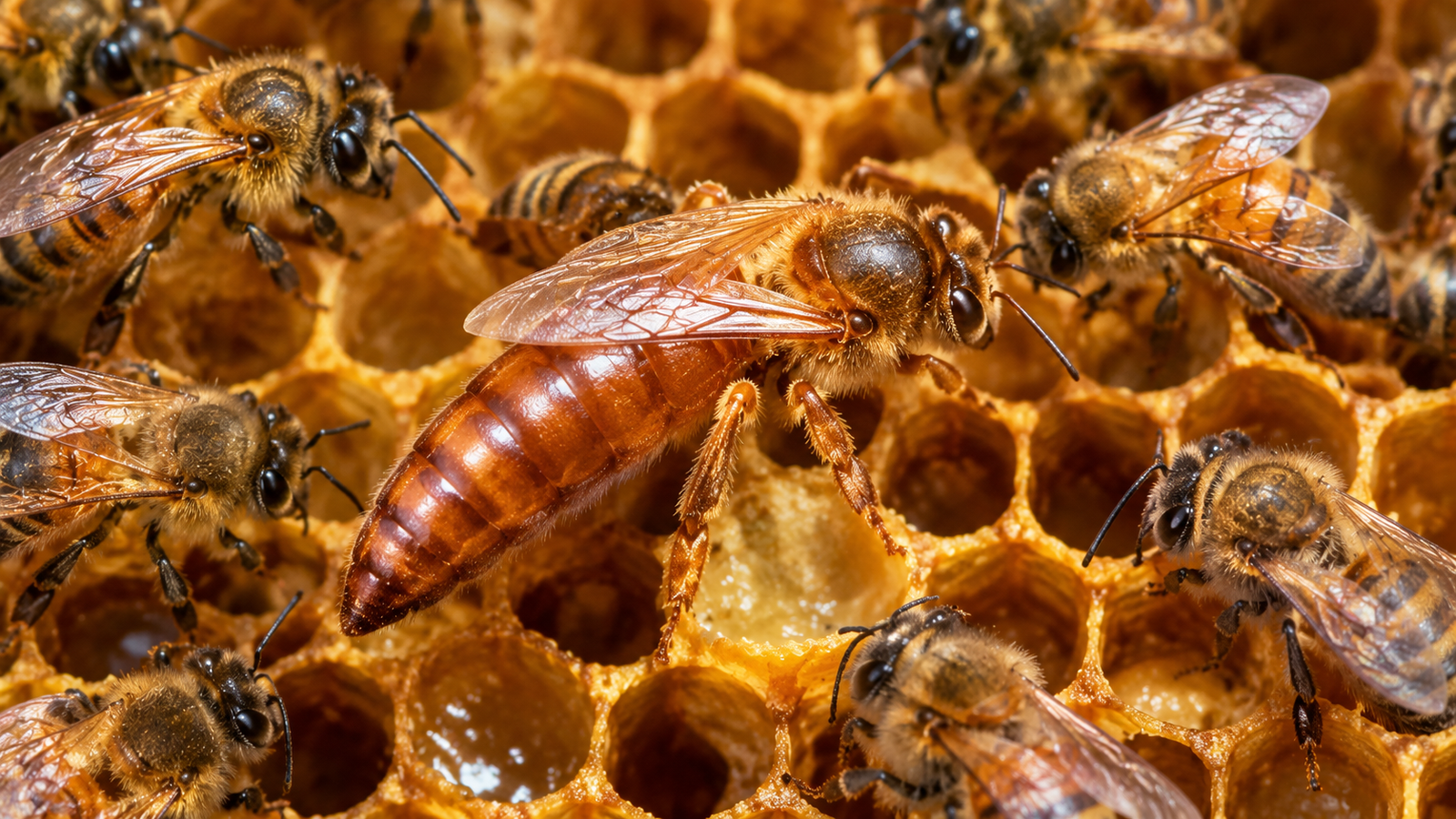
A queen bee looks different from the other bees in her colony because she has a longer, more elongated body, a noticeably extended abdomen, and a slightly larger thorax. In a honey bee colony, she is usually the longest bee, and her abdomen often extends well beyond the tips of her folded wings. Unlike worker bees, she does not have pollen baskets on her hind legs.
However, identifying a queen is not always as simple as looking for the biggest bee. A drone can appear broad and bulky, while a newly emerged or unmated queen may have a slimmer abdomen than a mature queen that is laying eggs.
The most reliable way to recognize a queen honey bee is to examine her overall body shape, especially the length of her abdomen, the appearance of her thorax, and how her body compares with nearby workers and drones.
This guide explains seven physical features of a queen bee, how to distinguish her from other bees, what she looks like at different stages of development, and how to find her inside a beehive.
What Does a Queen Bee Look Like?
A queen honey bee (Apis mellifera) is a relatively long, slender-looking female bee with an elongated abdomen, a broad thorax, and wings that appear short in relation to her body.
Her abdomen is usually the most noticeable identifying feature. When her wings are folded, they cover only part of her abdomen, leaving the rear portion exposed. Workers generally have shorter abdomens that are more completely covered by their wings.
A queen may be golden, brown, reddish, or almost black, depending partly on her genetic background and the honey bee strain. Her color alone cannot reliably establish whether she is a queen.
Here are the main features to look for:
- A long, tapered abdomen extending beyond the folded wings.
- A relatively large thorax with less conspicuous hair on its upper surface.
- A longer overall body than a typical worker.
- No specialized pollen baskets on the hind legs.
- A modified stinger with fewer or reduced barbs compared with a worker’s stinger.
- A body shape adapted for reproduction rather than collecting pollen.
- A distinctive appearance that becomes more pronounced in a mature, laying queen.
7 Physical Features That Help You Identify a Queen Bee
1. A Long, Elongated Abdomen
The abdomen is the most useful external feature for identifying a queen honey bee.
A mature laying queen has a long, extended abdomen that usually reaches well beyond the tips of her folded wings. This gives her a noticeably elongated appearance compared with the shorter, more compact body of a worker bee.
The queen’s abdomen contains her reproductive organs, including her ovaries and spermatheca. The spermatheca is a specialized organ that stores sperm collected during mating flights. She uses stored sperm to fertilize eggs when producing female offspring.
As a queen matures and begins laying eggs, her abdomen can become fuller and more distended.
How to recognize it: When examining a honey bee on a comb, compare the abdomen with the folded wings. If the abdomen extends noticeably beyond the wings and the bee has a long overall body, it may be the queen.
However, do not rely on this feature alone. A virgin queen may have a less developed, slimmer abdomen than a mature laying queen.
2. A Relatively Large Thorax
The thorax is the middle section of a bee’s body. It connects the head to the abdomen and carries the legs and wings.
A queen’s thorax is relatively large compared with that of a worker. It provides attachment points for the flight muscles and supports her movement during mating flights and other activities.
The upper surface of a queen’s thorax can also appear smoother and less hairy than that of a worker. This is a useful supporting feature, although it is not always obvious in photographs or under different lighting conditions.
How to recognize it: Look at the section immediately behind the head. A queen often has a substantial thorax followed by a long abdomen. Do not confuse a broad thorax with the drone’s generally bulky body and large head.
3. Wings That Appear Short Compared With Her Abdomen
Queen honey bees have two pairs of wings, just like worker bees and drones.
However, their elongated abdomens make the wings appear relatively short. In a mature queen, the folded wings generally cover only part of the abdomen rather than reaching its rear end.
This is one of the easiest features to understand when comparing a queen with workers.
A worker’s folded wings usually cover most of her abdomen, while the queen’s exposed abdominal tip is much more noticeable.
Queens can fly. They use their wings during mating flights, swarming, and other movements. Their wings are not simply decorative or nonfunctional.
How to recognize it: Look at where the folded wings end. If a substantial section of the abdomen continues beyond them, examine the bee more closely for other queen characteristics.
4. No Specialized Pollen Baskets on Her Hind Legs
Worker honey bees collect pollen from flowers and carry it back to their colony using specialized structures called corbiculae, commonly known as pollen baskets.
These structures are located on the outer surfaces of their hind legs.
Queens do not have functional pollen baskets like worker bees. Their bodies are specialized for reproduction rather than pollen collection.
This is a useful biological difference because a queen does not perform the same foraging duties as a worker.
How to recognize it: If you can see the hind legs clearly, look for the flattened, slightly concave pollen-carrying area that workers use to transport pollen. A queen lacks these specialized pollen baskets.
Be careful when using this feature in photographs. The absence of visible pollen does not mean a bee is a queen. A worker may simply have returned without a pollen load.
5. A Color That Can Differ From the Workers
Queen honey bees can have different shades of color.
Depending on the colony’s genetics and honey bee strain, a queen may appear:
- Golden or yellowish.
- Reddish-brown.
- Dark brown.
- Almost black.
Some queens have more noticeable abdominal bands than others. Others appear darker or more uniformly colored.
For example, Italian honey bees often have lighter golden coloration, while Carniolan honey bees are generally darker. However, individual variation occurs, and color should never be treated as a definitive caste-identification feature.
A queen can also look different from her workers because of her body proportions and the way light reflects from her thorax and abdomen.
How to recognize it: Use color only as a supporting clue. Focus on the abdomen, wings, thorax, and overall body shape before deciding whether a bee is the queen.
6. A Modified Stinger
A queen honey bee has a stinger, but it is structurally different from the worker’s defensive stinger.
The queen’s stinger is a modified ovipositor, an egg-laying structure that evolved into a weapon used primarily against rival queens.
Compared with the worker’s stinger, the queen’s stinger has fewer and much less prominent barbs. This means she can generally use it without suffering the same consequences that a worker experiences after stinging a mammal.
Worker honey bees have a more strongly barbed stinger. When a worker stings human skin, the stinger may become embedded and tear away from her body, usually causing her death.
How to recognize it: The stinger is not a practical feature for identifying a living queen because it is hidden inside the abdomen. Its importance is mainly anatomical: it helps explain how the queen differs from workers.
Never try to handle or provoke a bee to examine its stinger.
7. A Distinctive Overall Body Shape
The queen’s overall body proportions bring together the characteristics that make her recognizable.
Rather than simply looking like a larger worker, she has a different body shape:
- A relatively substantial thorax.
- A long, tapered abdomen.
- Wings that cover only part of the abdomen.
- No specialized pollen baskets.
- A reproductive body structure adapted for producing eggs.
The difference becomes particularly noticeable when a mature laying queen is standing among workers on a honeycomb frame.
A useful way to identify her is to compare several bees in the same area instead of examining one bee in isolation.
Practical example: Imagine inspecting a brood frame with hundreds of workers. Most have compact bodies with folded wings covering much of their abdomens. One bee has a noticeably longer body, with the rear of her abdomen extending beyond her wings. That bee deserves closer examination.
The comparison is more reliable than assuming the largest bee must be the queen.
What Color Is a Queen Bee?
A queen bee does not have one universal color. Her appearance depends on the genetic characteristics of her honey bee population.
Some queens have golden or yellowish bodies, while others are reddish-brown or very dark.
For example:
- Italian honey bee queens often have golden or yellowish coloration.
- Carniolan honey bee queens commonly have darker brown or black coloration.
- Other honey bee populations may show intermediate or mixed color patterns.
These are general tendencies rather than guaranteed identification rules.
Why Do Some Queen Bees Have Colored Dots?
Beekeepers sometimes place a small spot of specialized paint on a queen’s thorax to make her easier to locate during hive inspections.
The mark is not a natural body feature. It is an identification aid.
International queen-marking conventions use different colors for different calendar years:
| Year ending | Queen marking color |
|---|---|
| 0 or 5 | Blue |
| 1 or 6 | White |
| 2 or 7 | Yellow |
| 3 or 8 | Red |
| 4 or 9 | Green |
For example, queens marked in 2026 are assigned white.
Not all queens are marked. A marking can also wear off, so beekeepers should learn to recognize a queen by her natural body characteristics.
Queen Bee vs Worker Bee vs Drone: What Are the Differences?
A honey bee colony contains three main adult castes or types: the queen, workers, and drones.
Although all three belong to the same species, their bodies have developed differently to support their roles.
| Feature | Queen bee | Worker bee | Drone bee |
|---|---|---|---|
| Sex | Female | Female | Male |
| Main function | Reproduction | Colony maintenance | Mating |
| Overall body | Long and elongated | Smaller and compact | Broad and bulky |
| Abdomen | Long and tapered | Shorter and more compact | Broad and rounded |
| Eyes | Relatively small | Relatively small | Very large |
| Pollen baskets | Absent | Present | Absent |
| Stinger | Modified stinger | Barbed stinger | No stinger |
| Reproductive role | Main egg-layer | Usually non-reproductive | Produces sperm |
How to Tell a Queen From a Worker
The queen is generally longer than a worker, particularly during her egg-laying period.
Her abdomen extends beyond her folded wings, while a worker’s wings usually cover most of her abdomen.
Workers also have specialized pollen baskets and perform activities such as feeding larvae, cleaning the hive, collecting nectar, and defending the colony.
How to Tell a Queen From a Drone
This comparison is important because drones can look large and bulky.
A drone usually has a broader, more rounded body and exceptionally large compound eyes that meet at the top of its head.
A queen has a longer, more tapered abdomen and much smaller eyes relative to the drone.
The easiest distinction is therefore:
- Queen: Long, elongated body and abdomen.
- Drone: Broad body, rounded abdomen, and very large eyes.
Do not assume that a large bee is automatically a queen.
What Does a Queen Bee Look Like at Different Stages?
A queen does not always have the same appearance throughout her development.
Her body changes as she matures, mates, and begins laying eggs.
1. What Does a Virgin Queen Bee Look Like?
A virgin queen is an adult queen that has not yet completed mating.
She generally has a slimmer abdomen than a mature laying queen because her reproductive system has not reached its fully developed, egg-laying condition.
She may also move more quickly and appear more restless during this stage.
After emerging from her queen cell, she undergoes further maturation before taking mating flights.
A virgin queen can be mistaken for a large worker if the observer is unfamiliar with queen identification.
2. What Does a Mated Queen Bee Look Like?
A mated queen has completed her mating flights and has stored sperm in her spermatheca.
When she begins laying eggs, her abdomen often becomes longer, fuller, and more distended.
This is the appearance many people associate with a traditional queen bee.
Her abdomen is particularly noticeable when she is moving over brood comb and inspecting cells before laying eggs.
3. What Does an Old Queen Bee Look Like?
An older queen may still have the elongated body characteristic of a queen, but her physical condition and egg-laying performance may change.
Her wings may become worn, and her body may show signs of age or physical damage.
However, appearance alone cannot reliably establish a queen’s age or reproductive quality.
Beekeepers should assess her performance by considering brood patterns, egg-laying activity, colony development, and other indicators.
How to Identify a Queen Bee Inside a Beehive
Finding a queen among thousands of workers can be difficult, especially for someone who has little beekeeping experience.
The best approach is to search methodically instead of moving frames randomly.
Step 1: Start With the Brood Nest
The queen is often found in the brood area because this is where she lays eggs.
Look for frames containing eggs, young larvae, and developing brood.
However, she can be on other frames or in another brood box, so do not assume that she must be on the first brood frame you inspect.
Step 2: Examine Both Sides of Each Frame
Lift a frame carefully and inspect its entire surface.
Look at the edges of clusters of workers, around brood cells, and in areas where bees are moving between cells.
Turn the frame carefully and inspect the other side.
The queen may be partially hidden beneath workers.
Step 3: Compare the Bees’ Body Shapes
Rather than searching for the biggest bee, look for one with:
- An unusually long abdomen.
- Wings that cover only part of the abdomen.
- A relatively substantial thorax.
- An elongated overall appearance.
Compare the suspected queen with nearby workers.
Step 4: Look for Attending Workers
A queen is often surrounded by a small group of worker bees known as her retinue.
These workers may face toward her, touch her with their antennae, groom her, and feed her.
This behavior can help draw your attention to the queen.
However, not every group of clustered workers contains a queen. Use the physical characteristics to confirm your identification.
Step 5: Look for a Marking Dot
If the beekeeper has marked the queen, look for a small spot of colored paint on her thorax.
A marking makes identification easier, particularly when inspecting a busy colony.
However, a missing marking does not mean that the colony has lost its queen.
Step 6: Handle the Frame Carefully
Keep the frame above the open hive while inspecting it.
Avoid sudden movements, shaking, squeezing, or dropping the frame.
If you locate the queen, return her frame carefully to the hive before continuing your inspection.
This reduces the risk of accidentally injuring or losing her.
What If You Cannot Find the Queen?
Failing to see a queen during a hive inspection does not automatically mean the colony is queenless.
Queens can be difficult to locate because they may move behind workers, hide on the opposite side of a frame, or occupy another part of the hive.
Instead of immediately assuming the queen is missing, look for evidence of recent egg-laying.
Look for Fresh Eggs
Fresh honey bee eggs appear as tiny white structures standing upright or leaning inside individual brood cells.
As they develop, they change position before hatching into larvae.
The presence of very young eggs is evidence that a queen was laying recently.
However, eggs do not prove that the queen is physically present at the moment of inspection. A colony can retain eggs for a period after losing its queen.
Also examine the brood pattern, larvae, and other signs of colony development.
If you suspect the colony is queenless, consider its full condition before taking action such as introducing another queen.
What Does a Queen Bee Look Like Compared With Other Bee Species?
Not every bee that looks like a queen is a honey bee queen.
Bumblebees and stingless bees have different body structures, and their queens should not be identified using exactly the same characteristics as Apis mellifera.
Honey Bee Queen
The honey bee queen usually has an elongated abdomen, a relatively large thorax, and a body that looks longer than those of the workers.
Her body is adapted for egg production and colony reproduction.
Bumblebee Queen
A bumblebee queen generally has a robust, hairy body and is often considerably larger than the workers of her colony.
Her body is usually covered in dense hair, and her coloration depends on the bumblebee species.
Unlike a honey bee queen, a bumblebee queen typically starts a new colony herself after emerging from hibernation and mating.
She initially builds the nest and raises the first generation of workers.
Stingless Bee Queen
Stingless bee queens vary considerably in appearance across species.
In some species, the queen has a greatly enlarged abdomen compared with workers. This can make her body look unusually swollen.
Stingless bees also differ in their nesting behavior, colony structure, and reproductive biology.
A large abdomen may be a useful clue, but identifying a stingless bee queen requires knowledge of the particular species.
What Does a Dead Queen Bee Look Like?
A dead queen bee may still have the elongated abdomen and body proportions that distinguish her from workers.
However, after death, her body can become distorted, damaged, or dried out.
Some identifying features include:
- A relatively long abdomen.
- A larger body than typical workers.
- Wings that appear short compared with the abdomen.
- A thorax that may be relatively substantial.
- A modified stinger, although this is not usually visible.
A dead queen may also have missing legs, damaged wings, or other injuries.
It is important not to identify a dead bee as a queen based on size alone. A large worker, drone, or another bee species could be mistaken for one.
Frequently Asked Questions About What a Queen Bee Looks Like
1. Is a queen bee bigger than a regular bee?
Yes. A queen honey bee is generally longer than a worker bee, particularly when she is a mature laying queen. Her elongated abdomen makes her stand out in a colony. However, drones can appear broader and bulkier, so overall length and body shape are more useful than size alone.
2. What color is a queen bee?
A queen bee can be golden, yellowish, reddish-brown, dark brown, or nearly black. Her coloration depends on her genetic background and honey bee strain. Color is not a reliable way to identify a queen without examining her body shape.
3. Does every beehive have only one queen?
A healthy, established honey bee colony generally has one reproductive queen. However, temporary situations involving queen replacement, supersedure, or swarming can result in more than one queen being present for a period.
4. Can a queen bee fly?
Yes. Queen honey bees have functional wings and can fly. Young virgin queens take mating flights, while established queens may also fly during swarming.
5. Does a queen bee have a stinger?
Yes. A queen has a modified stinger that is primarily used against rival queens. It has fewer and reduced barbs compared with a worker’s defensive stinger.
6. Can a queen bee look like a worker?
Yes. A newly emerged or virgin queen may have a slimmer abdomen and may be harder to distinguish from a large worker. Looking at her overall proportions and comparing her with nearby bees makes identification easier.
7. How can I tell if a queen bee is laying eggs?
A queen that is actively laying eggs may have a fuller abdomen. You can also examine the brood comb for fresh eggs and young larvae. However, the presence of eggs indicates recent laying, not necessarily that the queen is still present.
8. Why do worker bees surround the queen?
Workers form a retinue around the queen. They groom, feed, and touch her with their antennae, helping distribute her chemical signals throughout the colony. This behavior is part of the colony’s social organization.
9. Can a queen bee be black?
Yes. Some queen honey bees are very dark brown or almost black. This is particularly common in some darker honey bee populations. A black bee is not necessarily a queen.
10. How long does a queen bee live?
A honey bee queen can live for several years, although her productive lifespan in managed colonies is often shorter. Her longevity depends on genetics, mating quality, colony conditions, and other factors.
Conclusion: How to Recognize a Queen Bee
A queen honey bee is recognized mainly by her long, elongated abdomen, relatively substantial thorax, and wings that cover only part of her abdomen. She is generally longer than the workers in her colony, although her appearance changes as she matures and begins laying eggs.
Her color can vary, so it should not be the main identification clue. The best way to distinguish her is to examine several characteristics together, particularly her abdomen, wings, and overall body proportions.
When inspecting a beehive, compare suspected queens with nearby workers and drones, look for attending workers, and search carefully around the brood nest.
Once you understand these physical differences, identifying a queen becomes much easier, even in a busy colony.
Scientific References and Further Reading
The following educational and scientific resources support the anatomical and biological information in this article.
- Utah State University Extension – How Can I Identify a Queen Bee?
- Mid-Atlantic Apiculture Research and Extension Consortium – The Colony and Its Organization
- University of Florida IFAS Extension – Welcome to the Hive! Honey Bee 4-H Project Book
- University of Arizona Cooperative Extension – Honey Bee Basic Biology
- PLOS ONE – Morphometric Identification of Queens, Workers and Intermediates in In Vitro Reared Honey Bees (Apis mellifera)
- Pennsylvania State University, Frost Entomological Museum – Honey Bees
