

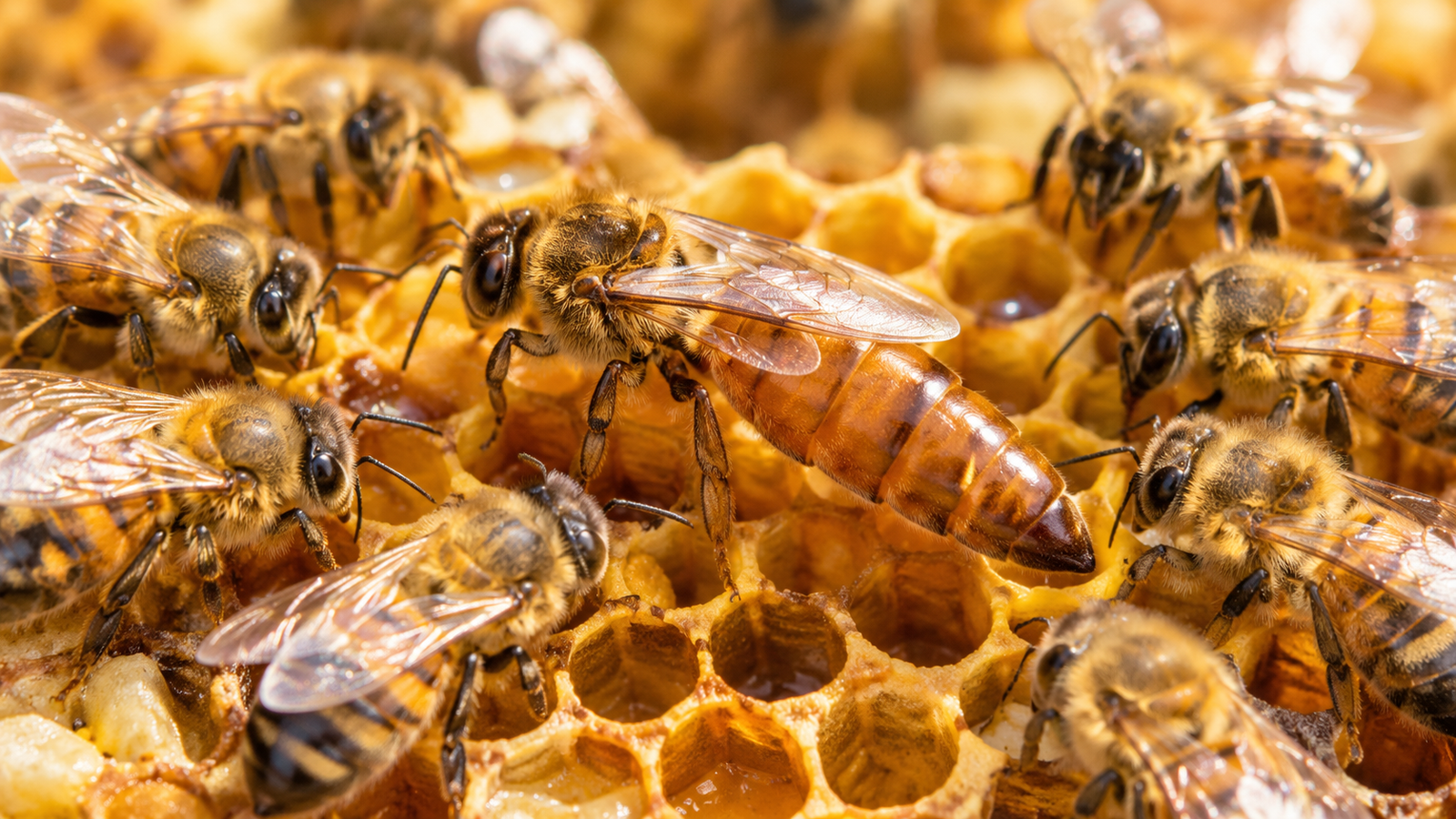
The phrase queen bee has two main meanings. In biology, a queen bee is a reproductive female in a social bee colony, such as a honey bee or bumble bee colony. She plays an important role in producing offspring and maintaining the colony’s reproductive system. In everyday language, a queen bee is a woman or girl who is especially popular, influential, dominant, or socially powerful within a group.
For example, a honey bee queen lays eggs that develop into new colony members, while calling someone the queen bee of a school usually means she is one of the most influential or popular students. Depending on the context, the expression can describe respected leadership or controlling behavior.
Understanding what queen bee means requires looking at both its biological definition and its figurative use in everyday conversations.
What Does Queen Bee Mean?
The expression “queen bee” has two primary definitions:
- Biological meaning: A queen bee is a reproductive female in a social bee colony who produces eggs and contributes to the colony’s reproductive continuity.
- Figurative meaning: A queen bee is a woman or girl who holds a prominent, influential, or dominant position within a social group.
In a honey bee colony, the queen is the primary reproductive female. Worker bees perform most of the activities needed to maintain the hive, including collecting food, caring for young bees, building comb, and defending the nest.
In everyday conversation, the phrase describes someone who occupies an important social position. She might be admired for her confidence and leadership or criticized for using her popularity to control others.
Although the two meanings are connected by the idea of an influential central figure, a biological queen bee does not rule her colony like a human leader.
What Does Queen Bee Mean in Biology?
In biology, a queen bee is a reproductive female belonging to a social bee colony. The term is especially familiar in honey bee colonies, where one established queen normally performs most of the colony’s egg-laying.
Honey bees are social insects that live in organized colonies. Their adult members have different reproductive roles, commonly described as three castes:
- Queen: A reproductive female responsible for producing eggs.
- Workers: Female bees that perform most colony-maintenance activities.
- Drones: Male bees whose primary reproductive role is to mate with queens.
These three types of honey bees are physically and biologically different.
A queen generally has a longer abdomen than worker bees, while drones have broader bodies and noticeably larger eyes. Workers are smaller and have specialized structures, such as pollen baskets on their hind legs, that help them collect and transport pollen.
A queen develops from a fertilized egg, just like a worker. However, differences in larval nutrition and development cause her to develop reproductive organs and other characteristics associated with the queen caste.
What Does a Queen Bee Do?
The queen’s main responsibility is reproduction, but her presence also influences the social organization of the colony.
1. Laying eggs
A healthy, productive honey bee queen can lay more than 2,000 eggs per day under favorable conditions, although egg production varies with season, food availability, colony strength, and the queen’s age.
She lays eggs in hexagonal wax cells constructed by worker bees.
In honey bees:
- Fertilized eggs generally develop into females (workers or queens).
- Unfertilized eggs develop into males called drones.
The queen can control whether an egg is fertilized using sperm stored in a specialized organ called the spermatheca.
2. Producing pheromones
A queen produces chemical substances called pheromones. These signals influence worker behavior and help maintain social organization.
For example, queen pheromones help communicate her presence and reproductive condition. They also influence worker reproduction and the colony’s response to the need for a replacement queen.
Workers do not simply follow spoken commands. Instead, they respond to chemical signals, physical interactions, food availability, brood conditions, and environmental changes.
3. Mating and storing sperm
A young virgin honey bee queen usually leaves the hive on mating flights, during which she mates with several drones.
She stores the sperm in her spermatheca and uses it to fertilize eggs over an extended period.
This stored sperm allows her to produce female offspring throughout much of her reproductive life without mating every time she lays an egg.
4. Maintaining colony reproduction
A queen’s reproductive performance affects the colony’s ability to replace aging workers and produce new generations.
If she becomes unhealthy, stops laying sufficient eggs, or dies, the colony may need to raise or accept a replacement queen.
However, the queen does not perform every activity in the hive. Workers collect food, feed larvae, regulate nest conditions, construct comb, and defend the colony.
How Does a Queen Bee Develop?
A honey bee queen develops through four life stages:
- Egg
- Larva
- Pupa
- Adult queen
The process begins when the queen bee lays a fertilized egg in a suitable queen cell.
After approximately three days, the egg hatches into a larva. Nurse bees feed the developing larva a rich diet of royal jelly throughout its queen development.
Royal jelly is a nutritious secretion produced by young worker bees. Its composition and the amount and pattern of feeding help direct queen development.
An important fact is that a queen and a worker can develop from fertilized eggs. They are not born as two completely different types of eggs. Their developmental environment, particularly larval nutrition, plays a major role in determining their caste.
A honey bee queen generally emerges as an adult about 16 days after the egg was laid.
What Does Queen Bee Mean When Describing a Person?
When someone calls a woman or girl a queen bee, they usually mean she is one of the most influential, popular, or socially prominent members of a group.
The expression is commonly used when discussing friendships, schools, workplaces, social circles, and popular culture.
For example:
“Sarah is the queen bee of her school.”
This suggests that Sarah has considerable social influence. Other students may admire her, follow her lead, seek her approval, or want to belong to her friendship group.
However, the expression does not necessarily mean that Sarah holds an official leadership position.
A queen bee in a social setting might be:
- A popular student who influences school trends.
- A woman who organizes and leads a friendship group.
- A manager who has considerable informal influence in the workplace.
- Someone whose opinions affect decisions within a social circle.
- A person who uses popularity to control or exclude others.
The meaning depends on the person’s behavior and the speaker’s intention.
Is Queen Bee a Compliment or an Insult?
The expression queen bee can be either a compliment or an insult. Its meaning depends on the behavior being described and the context in which it is used.
When Queen Bee Is a Compliment
The phrase can describe a woman who is confident, respected, influential, or naturally good at bringing people together.
For example:
- A student who welcomes new classmates and helps them feel included.
- A woman who organizes community activities and encourages others.
- A manager who motivates her team and earns their respect.
- A popular person who uses her influence to support friends.
In these situations, queen bee suggests positive influence, confidence, and social leadership.
When Queen Bee Is an Insult
The expression can also criticize someone who uses popularity or social influence to control other people.
For example:
- A student who excludes classmates from a friendship group.
- A coworker who tries to control workplace relationships.
- Someone who expects everyone to follow her preferences.
- A person who uses social status to intimidate or embarrass others.
Here, queen bee suggests arrogance, manipulation, or excessive concern with social status.
Important distinction: Being popular, confident, or assertive does not automatically make someone controlling. The negative meaning applies when the expression is used to criticize specific behavior rather than simply describe social influence.
What Does Queen Bee Mean in Slang?
In slang, a queen bee is the person considered the most important, popular, or influential member of a particular social group.
The phrase is informal and is often used when talking about school friendships, social circles, workplace relationships, and group dynamics.
Consider these examples:
Example 1: “She thinks she is the queen bee.”
Meaning: She behaves as though she is more important than everyone else and expects others to follow her wishes.
Example 2: “Everyone looks up to her as the queen bee.”
Meaning: She is admired and recognized as an influential member of the group.
Example 3: “The new manager became the queen bee of the office.”
Meaning: The manager became a central figure in the workplace’s social environment.
Example 4: “She is the queen bee because she brings everyone together.”
Meaning: She is respected and influential because she helps unite the group.
The phrase does not always describe someone who is unkind. It can communicate admiration, popularity, dominance, or criticism depending on how it is used.
What Does Queen Bee Mean in School?
In a school setting, queen bee usually refers to a popular or socially influential girl who occupies a central position within a friendship group or school social hierarchy.
She may influence:
- Which students are included in particular friendship groups.
- Fashion choices and popular trends.
- Social activities and gatherings.
- Conversations and opinions among classmates.
- The way other students interact with one another.
For example, imagine a student named Emily who is widely recognized throughout her school. Other students frequently ask her opinion, invite her to social events, and follow the trends she introduces.
Someone might describe Emily as the queen bee of her school because of her popularity and influence.
However, another student with similar popularity might use her position to exclude others, spread rumors, or pressure classmates.
Both situations may be described using the expression, but the first suggests positive social influence while the second suggests unhealthy social dominance.
The term describes an informal social position, not an official school title.
What Does Queen Bee Mean in a Relationship?
In relationships and social circles, queen bee can describe a woman who expects attention, dominates conversations, or tries to influence the decisions of others.
For example, someone might use the phrase to describe a person who:
- Expects friends to prioritize her preferences.
- Wants to make every decision in a friendship group.
- Becomes upset when others disagree with her.
- Uses popularity to influence who is accepted into a social circle.
- Expects constant attention or admiration.
However, being confident, independent, or assertive does not automatically make someone a queen bee in the negative sense.
A person can be socially influential without manipulating others.
The expression is informal and is not a psychological diagnosis. It should not be used as proof that someone has a particular personality disorder.
What Is the Difference Between a Queen Bee, Worker Bee, and Drone?
In a honey bee colony, the queen, workers, and drones have different biological roles.
Although they belong to the same species, their physical characteristics and reproductive functions are not identical.
| Feature | Queen Bee | Worker Bee | Drone Bee |
|---|---|---|---|
| Sex | Female | Female | Male |
| Main role | Reproduction | Colony maintenance | Mating |
| Reproductive ability | Fully reproductive | Usually reproductively inactive | Produces sperm |
| Body shape | Long abdomen | Smaller body | Broad, heavy body |
| Pollen collection | Not a normal task | Yes | No |
| Larval care | No routine nursing | Yes | No |
| Main contribution | Produces offspring | Maintains the colony | Fertilizes queens |
How to Identify Each Type
Queen bee: Look for a relatively long, tapered abdomen extending beyond the wings. She is often surrounded by worker bees that feed and groom her.
Worker bee: Workers are smaller than queens and have specialized structures for collecting pollen. They perform most of the visible activities around a hive.
Drone bee: Drones have thicker bodies, large compound eyes, and no pollen baskets. They are generally easier to distinguish from workers when examined closely.
Practical example: If you open a healthy honey bee hive and see a long-abdomen bee surrounded by several workers, you may have found the queen. If you see a broad-bodied bee with unusually large eyes, it may be a drone.
Physical identification is easier when comparing several adult bees from the same colony.
Do All Bee Species Have a Queen?
No. Not all bee species have queens.
This is one of the most important distinctions when understanding what queen bee means in biology.
Most bee species are solitary rather than highly social. In solitary species, a female builds and provisions her own nest without relying on a colony of specialized worker bees.
Many solitary females perform the reproductive and nest-maintenance responsibilities that are divided between queens and workers in social colonies.
There are several important examples.
1. Honey Bees
Honey bees are highly social insects.
A typical established honey bee colony has one functioning reproductive queen, thousands of workers, and seasonal populations of drones.
The queen lays eggs, while workers handle most of the colony’s daily activities.
2. Bumble Bees
Bumble bees are also social insects, but their colonies usually have an annual life cycle.
In many bumble bee species, a fertilized queen emerges from winter dormancy in spring and establishes a new nest.
Initially, she collects food, lays eggs, and cares for her developing offspring.
Once her first workers emerge, they take over much of the foraging and nest-maintenance work.
Later in the season, the colony produces new queens and males. The newly produced queens mate and prepare for the next reproductive cycle, while the original colony eventually declines.
3. Solitary Bees
Solitary bees do not have the same queen-and-worker organization found in honey bees.
For example, a female leafcutter bee constructs her own nest, gathers pieces of leaves, creates individual brood cells, supplies them with pollen and nectar, and lays eggs.
She does not depend on a separate group of worker bees to complete these activities.
Other examples include mason bees and many mining bees.
Although several solitary females may nest close together, that does not automatically make them a colony with a queen.
| Bee type | Social organization | Queen present? |
|---|---|---|
| Honey bee | Highly social | Yes |
| Bumble bee | Social | Yes |
| Leafcutter bee | Solitary | No |
| Mason bee | Solitary | No |
| Mining bee | Mostly solitary | No |
This distinction matters because the biological meaning of queen bee applies to social reproductive systems, not every female bee.
Can a Bee Colony Have More Than One Queen Bee?
A typical established honey bee colony generally has one functioning queen. However, two or more queens can sometimes coexist temporarily during certain colony transitions.
Two important situations help explain this.
Queen Supersedure
Supersedure occurs when a colony replaces an existing queen because workers respond to signs that she is failing or no longer performing adequately.
For example, an aging queen may produce fewer eggs or provide a weaker reproductive signal.
Workers can raise a replacement queen from suitable young female larvae. The old queen and the new queen may temporarily coexist before the old queen disappears or is removed.
Swarming
Swarming is a natural method of honey bee colony reproduction.
When a colony becomes ready to swarm, the old queen typically leaves with a large group of workers to establish a new colony elsewhere.
The original colony remains behind with workers and developing queen cells. A new queen eventually emerges and takes over reproduction after successful mating.
During some colony transitions, more than one queen may briefly be present.
However, this does not mean that established honey bee colonies normally operate with several queens sharing equal reproductive responsibilities.
Does the Queen Bee Control All the Other Bees?
No. A queen bee does not control the colony in the same way a human manager controls employees.
Although the queen has an important reproductive role, the colony functions through coordinated behavior among thousands of individual bees.
Queen pheromones influence worker behavior and help maintain the colony’s reproductive organization. However, workers also respond to environmental conditions, food availability, brood requirements, temperature, and signals from other colony members.
For example, when a honey bee colony loses its queen, workers can detect the change in the colony’s chemical environment.
If suitable young larvae are available, they may begin raising replacement queens.
Workers also make collective decisions about important activities, including food collection, nest maintenance, and swarming.
This means the queen is essential to colony reproduction, but she is not a ruler giving instructions to every bee.
What Is Another Word for Queen Bee?
When describing a person, several expressions can have meanings similar to queen bee, although they are not perfect substitutes.
| Alternative expression | Meaning |
|---|---|
| Leader | Someone who guides or directs a group |
| Dominant figure | Someone with considerable influence over others |
| Popular girl | A girl recognized for her social popularity |
| Influential woman | A woman whose opinions or actions affect others |
| Social powerhouse | Someone with considerable social influence |
| Head of the group | A person regarded as being in charge |
The most appropriate alternative depends on the situation.
For example, leader usually emphasizes guidance and responsibility, while queen bee often emphasizes popularity, social status, or dominance.
In biology, however, queen bee is the specific term for the reproductive female in a social bee colony, especially a honey bee colony.
Frequently Asked Questions About What Queen Bee Means
1. What does queen bee mean in simple words?
Queen bee means the main reproductive female in a social bee colony or, when describing a person, a woman who is popular, influential, or dominant within a group.
2. What does it mean when someone calls you a queen bee?
It generally means that someone sees you as a popular, influential, or socially prominent person. It can be a compliment about your confidence and leadership or a criticism of controlling behavior.
3. Does queen bee mean a beautiful woman?
No. Queen bee does not specifically refer to physical beauty. It usually describes social influence, popularity, leadership, or dominance.
4. Does queen bee mean the boss?
Sometimes, but not necessarily. A queen bee may be a formal leader, such as a manager, but the expression can also describe someone who has informal social influence without holding an official position.
5. Is a queen bee always female?
In the biological sense, yes. A queen bee is a female bee. In everyday language, the expression most commonly describes a woman or girl, although it can occasionally be applied metaphorically to someone of another gender.
6. Why is a dominant woman called a queen bee?
The expression draws on the reproductive importance of a queen bee in a social honey bee colony. It became a metaphor for a woman who holds a prominent or influential position within a social group.
7. Do all female bees become queen bees?
No. In honey bees, female larvae can develop into queens or workers depending largely on their developmental nutrition and other biological factors. In solitary bee species, females do not develop into queen and worker castes.
8. Can worker bees lay eggs?
Yes. Worker honey bees can sometimes lay eggs, especially when a colony has been queenless for an extended period.
However, worker bees generally cannot mate. Their eggs are usually unfertilized and develop into drones rather than female workers or queens.
9. Can a honey bee colony survive without a queen?
A colony can continue functioning temporarily after losing its queen because existing workers and developing brood remain alive.
If suitable young female larvae are available, workers may raise a replacement queen. Without a replacement, the colony eventually loses its ability to produce new workers and is unlikely to survive long-term.
10. Is a queen bee bigger than a worker bee?
Generally, yes. A queen honey bee usually has a longer abdomen and a larger overall body than a worker. Her abdomen is elongated to accommodate her reproductive organs and sperm-storage organ.
11. How long does a queen bee live?
A honey bee queen can live for several years, sometimes more than five years under favorable conditions. However, her egg-laying performance may decline earlier, which is why beekeepers sometimes replace queens before the end of their natural lifespan.
12. Is a queen bee the same as a queen ant?
No. Both are reproductive females in social insect colonies, but bees and ants belong to different insect groups and have different biological characteristics, colony structures, and life cycles.
13. Does the queen bee control the entire hive?
No. The queen produces eggs and chemical signals that influence colony organization, but worker bees carry out most daily activities. Colony behavior results from communication and coordinated responses among its members.
Scientific References and Further Reading
The following educational and scientific resources provide additional information about queen bee biology, colony organization, reproduction, and bee diversity.
- University of Georgia Bee Program – Honey Bee Biology. An introduction to honey bee castes, queen reproduction, worker activities, and drones.
https://bees.caes.uga.edu/beekeeping-resources/getting-started-topics/getting-started-honey-bee-biology.html - Penn State Extension – An Introduction to Queen Honey Bee Development. Explains how queens develop, the importance of larval nutrition, and the role of royal jelly.
https://extension.psu.edu/an-introduction-to-queen-honey-bee-development - Oregon State University Extension – Shrubs and Trees for Bees. Discusses social and solitary bee species and explains the differences between their nesting and reproductive systems.
https://extension.oregonstate.edu/catalog/em-9391-shrubs-trees-bees - University of Florida IFAS Extension – The Basics of Queen Management in Beekeeping Operations. Covers queen health, reproduction, pheromones, and queen management.
https://ask.ifas.ufl.edu/publication/IN1457 - National Center for Biotechnology Information – Chemical Communication in the Honey Bee Society. Provides scientific background on queen pheromones and chemical communication within honey bee colonies.
https://www.ncbi.nlm.nih.gov/books/NBK200983/
These resources help explain why the queen is important to social bee colonies and why her biological role should not be confused with the behavior of every female bee species.
Conclusion: What Does Queen Bee Mean?
The meaning of queen bee depends on whether the expression is used in biology or everyday conversation.
In biology, a queen bee is a reproductive female in a social bee colony. In honey bees, she lays eggs, stores sperm after mating, and produces pheromones that influence colony organization. Worker bees perform most of the daily activities required to maintain the hive.
Not all bees have queens, however. Honey bees and bumble bees have queen-based social structures, while most bee species are solitary and do not have separate queen and worker castes.
In everyday language, queen bee describes a woman or girl who is popular, influential, or dominant within a social group. The expression can be positive when it describes respected leadership or negative when it suggests controlling behavior.
Understanding these two meanings makes it easier to recognize what someone means when they use the phrase queen bee in conversation, school, relationships, or discussions about bee biology.
