

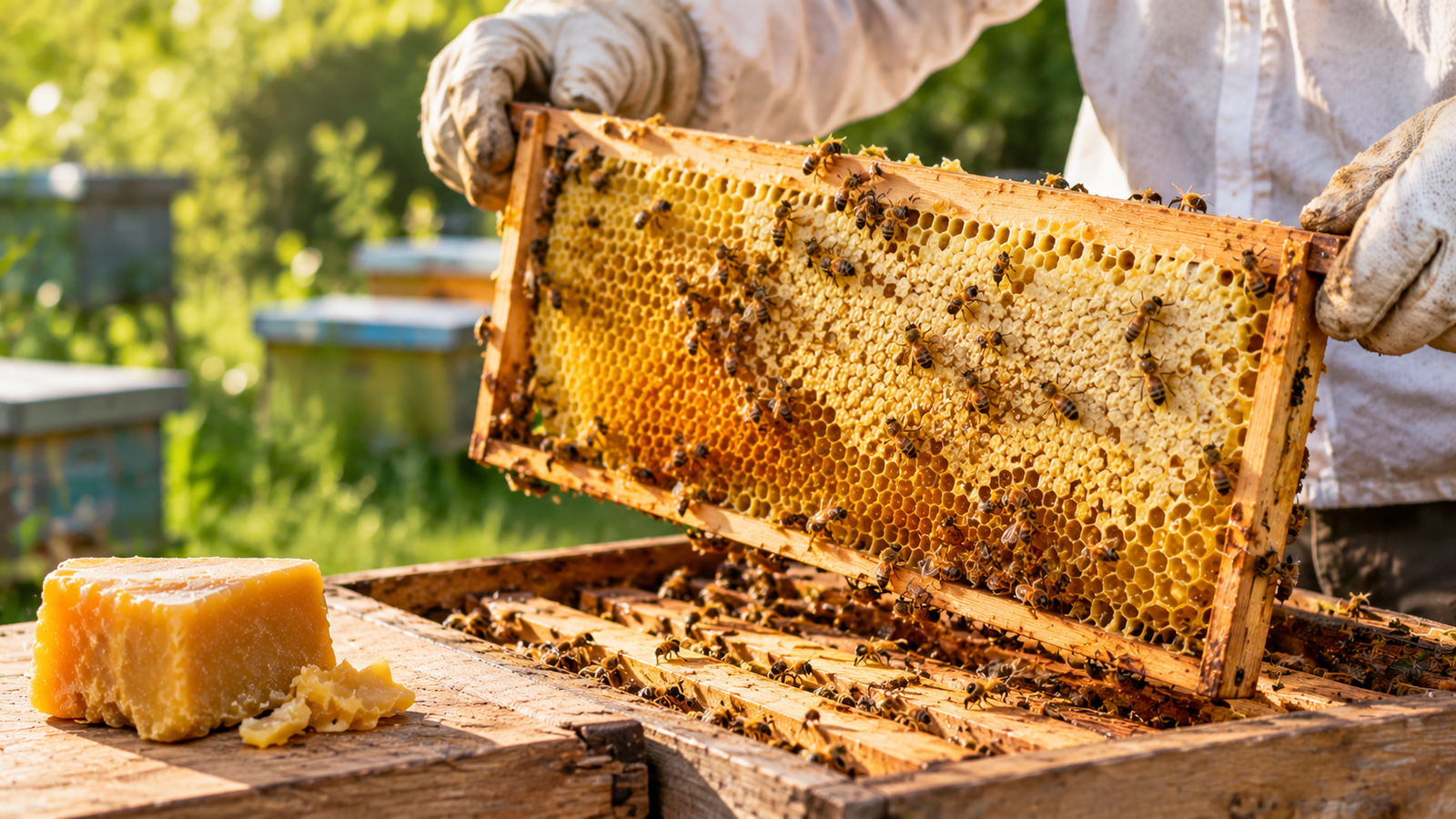
A honey bee hive can provide a useful amount of beeswax, but the quantity depends on colony strength, food availability, comb-building activity, season and beekeeping practices. A practical harvesting guideline from Utah State University Extension is approximately 1–2 pounds (0.45–0.9 kg) of beeswax for every 100 pounds (45 kg) of honey harvested.
This is a useful estimate for understanding recoverable wax, not a guarantee that every hive produces the same amount each year. A colony may manufacture wax to build brood comb, expand honey-storage space and seal honey cells without producing an equivalent quantity that a beekeeper can collect.
Understanding the difference between wax production and wax harvesting helps beekeepers estimate their potential yield, manage their colonies responsibly and avoid removing more comb than the bees need.
How Much Beeswax Does a Hive Produce Per Year?
There is no fixed annual beeswax production figure for every honey bee hive. Some colonies build substantial amounts of new comb, while others spend much of the season maintaining existing comb and raising brood.
For practical planning, Utah State University Extension reports that beekeepers can usually harvest approximately 1–2 pounds of beeswax for every 100 pounds of honey harvested.
The following table applies that guideline to different honey harvests.
| Honey harvested | Estimated recoverable beeswax |
|---|---|
| 25 lb (11.3 kg) | 0.25–0.5 lb (0.11–0.23 kg) |
| 50 lb (22.7 kg) | 0.5–1 lb (0.23–0.45 kg) |
| 75 lb (34 kg) | 0.75–1.5 lb (0.34–0.68 kg) |
| 100 lb (45.4 kg) | 1–2 lb (0.45–0.91 kg) |
| 150 lb (68 kg) | 1.5–3 lb (0.68–1.36 kg) |
| 200 lb (90.7 kg) | 2–4 lb (0.91–1.81 kg) |
These are illustrative estimates, not guaranteed harvests. Actual wax recovery depends on the amount and type of comb removed, the proportion of honey extracted from capped comb, and how carefully the beekeeper separates wax from honey and other hive materials.
Example: A hive producing 50 pounds of honey
Suppose a beekeeper harvests 50 pounds of honey from a productive colony.
Using the 1–2% harvesting guideline, the beekeeper might recover approximately 0.5–1 pound of beeswax.
However, this does not mean the colony produced only 0.5–1 pound of wax. Some wax remains in the frames as brood comb, honey-storage comb and other hive structures.
The estimate is useful for planning a small beeswax harvest, but it should not be treated as a measurement of the colony’s total biological wax production.
Important: The honey-to-wax harvesting guideline and the amount of honey metabolized by bees to manufacture wax are two different measurements. They should not be confused.
How Do Honey Bees Produce Beeswax?
Honey bees manufacture beeswax inside their bodies using specialized glands located on the underside of the abdomen.
In western honey bees (Apis mellifera), four pairs of wax-producing glands are associated with abdominal segments four through seven. These eight glands secrete tiny wax scales that workers use to construct and repair honeycomb.
Wax production is particularly active in young adult worker bees.
How the wax-making process works
The process involves several stages:
- Worker bee development: As young worker bees mature, their wax glands become functionally active.
- Wax secretion: The glands produce small quantities of wax that appear as thin scales on the underside of the abdomen.
- Wax removal: Worker bees use their legs to remove the scales.
- Wax manipulation: They transfer the scales to their mouthparts and soften them through chewing and manipulation.
- Comb construction: Workers shape the wax into the hexagonal cells that form the honeycomb.
The resulting comb provides space for raising young bees, storing pollen and keeping honey.
Wax production is not restricted to the bees visibly building comb. Different workers contribute to wax secretion, wax manipulation and comb construction.
At what age do worker bees produce the most wax?
Wax production is strongly associated with worker age.
Research indicates that wax secretion can occur in adult workers from approximately three to 21 days after emergence, with substantial activity commonly occurring between nine and 21 days. Some research identifies a peak around 12 days, although the exact pattern varies with colony conditions and study methods.
This explains why young adult workers are particularly important during periods of active comb construction.
However, age alone does not determine whether a bee produces wax. Food availability, colony needs and environmental conditions also influence wax secretion.
How Much Honey Does It Take to Produce Beeswax?
Beeswax production requires considerable energy. Honey bees obtain much of the energy needed for this process from carbohydrates in honey or nectar.
Scientific sources report different honey-to-wax conversion estimates. For example, research has reported figures around 20 grams of honey per gram of beeswax, while other beekeeping and nutritional estimates are lower.
These figures should be treated as approximate rather than as a universal biological conversion rate.
The difference between estimates can reflect experimental conditions, the definition of production efficiency and the way energy consumption is measured.
Why do bees need so much energy to make wax?
Honey bees must obtain energy from their food and use their wax-producing glands to synthesize the materials that form beeswax.
The energy needed for wax production is part of the colony’s wider resource budget.
A colony also needs food for:
- Feeding developing larvae.
- Maintaining adult worker activity.
- Keeping the brood nest at a suitable temperature.
- Supporting flight and nectar collection.
- Surviving periods when flowers provide little food.
This is why abundant nectar availability can support comb construction, while a shortage of food may limit the colony’s ability to expand.
Beekeepers should not encourage unnecessary comb building at the expense of the colony’s food reserves.
What Factors Affect How Much Beeswax a Hive Produces?
Two colonies with similar populations can produce different amounts of new comb. Their wax production depends on biological needs, food supplies and the amount of space available.
1. Colony strength
A strong colony generally has more worker bees available for different tasks, including comb construction.
However, a large colony does not automatically produce more beeswax.
If it already has enough suitable comb for brood rearing and honey storage, workers may have little reason to construct additional comb.
2. Worker bee age
Young adult workers have particularly active wax glands.
A colony with an appropriate population of developing and young adult workers may have greater capacity for comb construction than a colony with fewer workers in these age groups.
This is one reason colony demographics matter in addition to total population.
3. Nectar availability
Nectar provides carbohydrates that bees use for energy.
When flowering plants provide abundant nectar, colonies may have more resources available for comb construction, especially when they also need additional storage space.
A nectar shortage can reduce comb-building activity because the colony must prioritize essential survival and brood-rearing requirements.
4. Pollen availability
Pollen provides proteins, fats, vitamins and minerals that support worker development and colony nutrition.
Although pollen is not the direct raw material from which beeswax is manufactured, adequate pollen availability helps support a healthy workforce capable of performing different colony tasks.
5. Available comb and hive space
A colony with sufficient existing comb may need to produce relatively little additional wax.
By contrast, a growing colony that needs more brood cells or honey-storage space may construct new comb when conditions are suitable.
Providing appropriate space can encourage construction, but excessive empty space does not guarantee increased wax production.
6. Seasonal conditions
Wax production is influenced by the timing and availability of flowering plants, nectar flows, temperature and colony development.
In many temperate regions, comb construction increases during periods of active spring and summer growth.
In tropical areas, including Ghana, flowering and nectar availability can follow local rainfall patterns and vegetation cycles rather than the same seasonal calendar used in colder countries.
Therefore, beekeepers should observe local forage conditions instead of relying on a single universal wax-production season.
7. Beekeeping management
Management decisions influence how much new comb bees need to construct.
Examples include:
- Providing suitable frames and foundation where appropriate.
- Allowing enough room for colony growth.
- Replacing damaged or unsuitable comb when necessary.
- Avoiding unnecessary removal of healthy brood comb.
- Maintaining sufficient food reserves.
- Monitoring colony health and strength.
Good management supports natural comb-building activity without forcing bees to spend resources on unnecessary construction.
How Much Beeswax Can a Beekeeper Actually Harvest?
The amount of beeswax a colony manufactures and the amount a beekeeper recovers are not necessarily equal.
Bees use wax throughout the hive, and much of it remains in place as comb.
Beekeepers commonly recover wax from three main sources.
1. Honey cappings
Honey bees seal mature honey cells with thin layers of wax.
During honey extraction, beekeepers remove these cappings to access the honey.
Cappings are generally one of the cleanest and most desirable sources of recoverable beeswax because they have not been used repeatedly for raising brood.
2. Broken or damaged honeycomb
Broken honey-storage comb can also provide recoverable beeswax.
This material may contain honey, pollen and other debris, so it generally requires cleaning and filtering.
3. Old brood comb
Brood comb is repeatedly used by the colony to raise developing bees.
Over time, it becomes darker as cocoons, larval residues, propolis and other materials accumulate.
Old brood comb can contain recoverable wax, but it usually produces less clean wax than honey cappings or fresh honey-storage comb.
It should be replaced when appropriate for colony hygiene and management, rather than removed simply to increase the beekeeper’s wax harvest.
Comparison of beeswax sources
| Wax source | Appearance | Relative cleanliness |
|---|---|---|
| Honey cappings | Usually light yellow or pale | Generally very clean |
| Fresh broken comb | White to yellow | Relatively clean |
| Used honey comb | Yellow to darker yellow | Variable |
| Old brood comb | Dark brown to nearly black | Contains more debris |
The Food and Agriculture Organization explains that honey cappings generally produce high-quality, light-coloured wax, while old black brood comb produces lower-quality wax.
This is an important consideration when estimating the commercial value of a harvest.
What Is the Difference Between Fresh, Yellow and Dark Beeswax?
Beeswax can vary considerably in appearance.
Fresh wax is often white or nearly colourless. As comb is used, it can become yellow, brown or dark because of materials that accumulate within the comb.
Fresh white beeswax
Newly produced beeswax is naturally very light in colour.
It may become yellowish after contact with pollen oils, propolis and other substances in the hive.
Yellow beeswax
Yellow beeswax is common in harvested honey comb and cappings.
Its colour is influenced by natural pigments and materials from the hive and surrounding environment.
It is widely used in candles, cosmetics and other products.
Dark beeswax
Dark beeswax often comes from older brood comb.
Its colour develops through repeated use and the accumulation of larval cocoons, residues and other materials.
Dark wax is not necessarily useless, but it generally requires more processing and may have a lower commercial value than clean cappings wax.
Remember: Colour alone does not establish beeswax purity. Wax can contain chemical residues or contaminants that cannot be identified reliably by appearance.
Do All Bee Species Produce Beeswax?
Not all bees build their nests using beeswax in the same way as honey bees.
The western honey bee (Apis mellifera) is especially important commercially because it constructs extensive wax combs that can be harvested and processed.
Other bee groups have different nesting behaviours.
| Bee group | Nest-building material | Commercial wax importance |
|---|---|---|
| Honey bees (Apis mellifera) | Extensive wax comb | Major source of commercial beeswax |
| Bumble bees (Bombus) | Wax secretions used in nest structures and food pots | Not a major commercial wax source |
| Mason bees (Osmia) | Mud and other materials | No comparable commercial comb production |
| Leafcutter bees (Megachile) | Cut leaf pieces used to line brood cells | No comparable commercial comb production |
Bumble bees also produce wax-like secretions, so it would be inaccurate to say that honey bees are the only bees capable of producing wax.
The important difference is that honey bees construct large, reusable comb structures that make commercial beeswax recovery practical.
Solitary bees such as mason and leafcutter bees use different nesting materials and do not produce comparable quantities of harvestable honeycomb wax.
How Can Beekeepers Encourage Beeswax Production?
Beekeepers can support healthy comb construction by ensuring that colonies have the resources and conditions they need.
The goal should be to support natural colony growth rather than force bees to manufacture unnecessary wax.
Maintain a healthy colony
A healthy colony with a functioning queen, sufficient workers and manageable disease and pest pressure is better positioned to construct comb when needed.
Provide appropriate space
Growing colonies need enough space for brood development and food storage.
Providing suitable frames and foundation can give workers a surface on which to construct comb.
Ensure adequate food availability
Bees require carbohydrate sources for energy and pollen to support worker development.
During periods of food scarcity, beekeepers should prioritize colony nutrition and survival rather than unnecessary comb expansion.
Monitor comb condition
Inspect comb regularly and identify damaged, unsuitable or excessively old brood comb.
Replace comb when colony management and hygiene requirements justify it.
Avoid excessive harvesting
Removing too much useful comb can force bees to rebuild structures they already had.
This uses colony resources and may interfere with brood rearing and honey storage.
A good beekeeper balances beeswax recovery with the colony’s long-term needs.
When Should You Harvest Beeswax?
The best time to collect beeswax depends on the source.
During honey extraction
Honey cappings are commonly collected during honey harvesting.
This is a convenient opportunity to recover relatively clean wax without removing entire frames of healthy brood comb.
When replacing old comb
Old, damaged or unsuitable comb can be removed as part of routine hive management.
It can then be processed separately from cleaner cappings wax.
After repairing damaged comb
Broken or damaged honey-storage comb may provide another source of recoverable wax.
However, beekeepers should avoid disturbing healthy brood areas unnecessarily.
How Do You Extract and Clean Beeswax?
Raw beeswax usually contains honey, pollen, propolis, cocoons and other debris.
Processing separates the wax from these materials.
A simple method involves the following steps:
- Separate the wax sources: Keep clean honey cappings separate from old brood comb.
- Remove excess honey: Allow honey to drain from cappings and suitable comb pieces.
- Break up the material: Smaller pieces are easier to process.
- Melt gently: Use a suitable dedicated wax-processing container or a double boiler. Avoid direct high heat.
- Filter the melted wax: Pass it through a suitable filter to remove solid debris.
- Allow it to cool: As the wax cools, it solidifies and separates from the water.
- Remove remaining debris: Scrape unwanted material from the underside of the solidified wax if necessary.
- Store properly: Keep clean, dry beeswax in a cool place away from excessive heat and contamination.
Never use an open flame to melt beeswax. It is combustible, and excessive heating can damage its quality.
For additional processing instructions, consult the Ghana Bee Health Manual and Utah State University Extension’s guide to processing beeswax.
What Is Beeswax Used For?
Beeswax is a valuable hive product with applications in several industries.
Candles
Beeswax is used to manufacture candles because it melts and burns in a way that makes it suitable for candle production.
Cosmetics and skincare products
Processed beeswax is used in lip balms, creams, lotions and other formulations.
It can help provide structure and consistency to products.
Polishes and protective coatings
Beeswax is used in some wood polishes, furniture treatments and protective coatings.
Beekeeping equipment
Beeswax can be used to manufacture foundation sheets that guide honey bees when constructing comb in managed hives.
Other products
Additional applications include wax wraps, leather treatments, modelling materials and certain industrial products.
The value of beeswax depends on its cleanliness, quality, processing method and local market demand.
Is Beeswax Production Profitable?
Beeswax can provide an additional source of income for beekeepers, particularly when it is recovered during normal honey extraction and comb replacement.
However, profitability depends on more than the quantity collected.
Important considerations include:
- The amount of wax recovered.
- The quality and cleanliness of the wax.
- Processing and storage costs.
- Local buyer demand.
- Packaging and transportation.
- The cost of equipment and labour.
In Ghana and other African beekeeping markets, wax cappings and suitable comb material can represent an additional product that might otherwise be discarded.
The Food and Agriculture Organization has highlighted the economic importance of beeswax and its uses in cosmetics, pharmaceuticals and candle production.
Beekeepers should investigate local demand and actual buying prices before investing in additional processing equipment.
Frequently Asked Questions
1. How much beeswax does one hive produce annually?
There is no fixed annual amount. A useful harvesting guideline is approximately 1–2 pounds of beeswax per 100 pounds of honey harvested. Actual recovery depends on the amount of comb removed, the colony’s comb-building activity and the beekeeper’s management practices.
2. How much beeswax can I get from 50 pounds of honey?
Using the Utah State University Extension harvesting guideline, 50 pounds of harvested honey corresponds to approximately 0.5–1 pound of recoverable beeswax. This is an estimate, not a guaranteed yield.
3. How many bees are needed to produce one pound of beeswax?
There is no universal number of bees required to produce one pound of wax. Production depends on the number of active wax-producing workers, their age, food availability, colony needs and the time available for comb construction.
4. Do honey bees produce beeswax every day?
Honey bees can secrete wax when their glands are active and colony conditions support production. However, individual bees do not necessarily produce wax continuously. Wax secretion is influenced by age, nutrition and the need for additional comb.
5. Why do bees produce white beeswax?
Newly secreted beeswax is naturally very light in colour. It can become yellow, brown or darker as pollen oils, propolis, brood residues and other substances accumulate in the comb.
6. Does a stronger hive produce more beeswax?
A stronger hive may have more workers available for wax production, but colony size alone does not determine yield. A strong colony with sufficient existing comb may construct less new wax than a smaller colony that needs to expand.
7. Can bees produce beeswax without making honey?
Yes. Honey production and wax production are related but different activities. Bees can construct comb using energy obtained from available carbohydrates, including stored honey or incoming nectar. They do not have to produce a harvestable honey crop before constructing wax.
8. Is old brood comb suitable for making beeswax products?
Old brood comb can be processed to recover beeswax, but it usually contains more debris and accumulated material than honey cappings. It should be separated and processed appropriately. The recovered wax must be assessed for its intended use and possible contamination.
9. Which bees produce the most commercial beeswax?
Honey bees, particularly Apis mellifera, are the principal source of commercial beeswax because they construct extensive combs that can be harvested and processed. Other bees may produce wax-like secretions, but they do not generally provide comparable commercial quantities.
10. Can beekeepers increase beeswax production?
Beekeepers can encourage suitable comb construction by maintaining healthy colonies, providing appropriate space and ensuring adequate nutrition. However, unnecessary comb building should not be encouraged at the expense of honey reserves, brood development or colony health.
Conclusion
How much beeswax does a hive produce? The answer depends on whether you are measuring the wax manufactured by the bees or the amount a beekeeper can recover.
A practical harvesting benchmark is approximately 1–2 pounds of beeswax for every 100 pounds of honey harvested. However, actual yields vary with colony strength, nectar availability, comb requirements, season and hive management.
Honey bees manufacture wax to construct brood comb, store honey and maintain their nest. Beekeepers recover it mainly from honey cappings, broken comb and old comb removed during appropriate hive maintenance.
Understanding these differences helps beekeepers estimate potential wax yields, protect healthy colonies and make better use of an additional valuable hive product.
Below is the complete rewritten article for BeekeeperBase. It maintains your exact primary search query, “How Much Beeswax Does a Hive Produce”, while improving scientific accuracy, practical value, comparisons, examples, references and readability.
The article also makes an important distinction between the wax honey bees manufacture and the wax beekeepers can actually recover.
SEO settings
- SEO title: How Much Beeswax Does a Hive Produce? Annual Yield Explained
- H1: How Much Beeswax Does a Hive Produce? Complete Guide
- Primary keyword: How Much Beeswax Does a Hive Produce
- URL: Keep your existing URL.
- Search intent: Informational / beekeeping / beeswax production.
- Suggested meta description: How much beeswax does a hive produce? Learn typical wax yields, how honey bees make wax, what affects production, and how much beekeepers can harvest.
How Much Beeswax Does a Hive Produce? Complete Guide
A honey bee hive can provide a useful amount of beeswax, but the quantity depends on colony strength, food availability, comb-building activity, season and beekeeping practices. A practical harvesting guideline from Utah State University Extension is approximately 1–2 pounds (0.45–0.9 kg) of beeswax for every 100 pounds (45 kg) of honey harvested.
This is a useful estimate for understanding recoverable wax, not a guarantee that every hive produces the same amount each year. A colony may manufacture wax to build brood comb, expand honey-storage space and seal honey cells without producing an equivalent quantity that a beekeeper can collect.
Understanding the difference between wax production and wax harvesting helps beekeepers estimate their potential yield, manage their colonies responsibly and avoid removing more comb than the bees need.
How Much Beeswax Does a Hive Produce Per Year?
There is no fixed annual beeswax production figure for every honey bee hive. Some colonies build substantial amounts of new comb, while others spend much of the season maintaining existing comb and raising brood.
For practical planning, Utah State University Extension reports that beekeepers can usually harvest approximately 1–2 pounds of beeswax for every 100 pounds of honey harvested.
The following table applies that guideline to different honey harvests.
| Honey harvested | Estimated recoverable beeswax |
|---|---|
| 25 lb (11.3 kg) | 0.25–0.5 lb (0.11–0.23 kg) |
| 50 lb (22.7 kg) | 0.5–1 lb (0.23–0.45 kg) |
| 75 lb (34 kg) | 0.75–1.5 lb (0.34–0.68 kg) |
| 100 lb (45.4 kg) | 1–2 lb (0.45–0.91 kg) |
| 150 lb (68 kg) | 1.5–3 lb (0.68–1.36 kg) |
| 200 lb (90.7 kg) | 2–4 lb (0.91–1.81 kg) |
These are illustrative estimates, not guaranteed harvests. Actual wax recovery depends on the amount and type of comb removed, the proportion of honey extracted from capped comb, and how carefully the beekeeper separates wax from honey and other hive materials.
Example: A hive producing 50 pounds of honey
Suppose a beekeeper harvests 50 pounds of honey from a productive colony.
Using the 1–2% harvesting guideline, the beekeeper might recover approximately 0.5–1 pound of beeswax.
However, this does not mean the colony produced only 0.5–1 pound of wax. Some wax remains in the frames as brood comb, honey-storage comb and other hive structures.
The estimate is useful for planning a small beeswax harvest, but it should not be treated as a measurement of the colony’s total biological wax production.
Important: The honey-to-wax harvesting guideline and the amount of honey metabolized by bees to manufacture wax are two different measurements. They should not be confused.
How Do Honey Bees Produce Beeswax?
Honey bees manufacture beeswax inside their bodies using specialized glands located on the underside of the abdomen.
In western honey bees (Apis mellifera), four pairs of wax-producing glands are associated with abdominal segments four through seven. These eight glands secrete tiny wax scales that workers use to construct and repair honeycomb.
Wax production is particularly active in young adult worker bees.
How the wax-making process works
The process involves several stages:
- Worker bee development: As young worker bees mature, their wax glands become functionally active.
- Wax secretion: The glands produce small quantities of wax that appear as thin scales on the underside of the abdomen.
- Wax removal: Worker bees use their legs to remove the scales.
- Wax manipulation: They transfer the scales to their mouthparts and soften them through chewing and manipulation.
- Comb construction: Workers shape the wax into the hexagonal cells that form the honeycomb.
The resulting comb provides space for raising young bees, storing pollen and keeping honey.
Wax production is not restricted to the bees visibly building comb. Different workers contribute to wax secretion, wax manipulation and comb construction.
At what age do worker bees produce the most wax?
Wax production is strongly associated with worker age.
Research indicates that wax secretion can occur in adult workers from approximately three to 21 days after emergence, with substantial activity commonly occurring between nine and 21 days. Some research identifies a peak around 12 days, although the exact pattern varies with colony conditions and study methods.
This explains why young adult workers are particularly important during periods of active comb construction.
However, age alone does not determine whether a bee produces wax. Food availability, colony needs and environmental conditions also influence wax secretion.
How Much Honey Does It Take to Produce Beeswax?
Beeswax production requires considerable energy. Honey bees obtain much of the energy needed for this process from carbohydrates in honey or nectar.
Scientific sources report different honey-to-wax conversion estimates. For example, research has reported figures around 20 grams of honey per gram of beeswax, while other beekeeping and nutritional estimates are lower.
These figures should be treated as approximate rather than as a universal biological conversion rate.
The difference between estimates can reflect experimental conditions, the definition of production efficiency and the way energy consumption is measured.
Why do bees need so much energy to make wax?
Honey bees must obtain energy from their food and use their wax-producing glands to synthesize the materials that form beeswax.
The energy needed for wax production is part of the colony’s wider resource budget.
A colony also needs food for:
- Feeding developing larvae.
- Maintaining adult worker activity.
- Keeping the brood nest at a suitable temperature.
- Supporting flight and nectar collection.
- Surviving periods when flowers provide little food.
This is why abundant nectar availability can support comb construction, while a shortage of food may limit the colony’s ability to expand.
Beekeepers should not encourage unnecessary comb building at the expense of the colony’s food reserves.
What Factors Affect How Much Beeswax a Hive Produces?
Two colonies with similar populations can produce different amounts of new comb. Their wax production depends on biological needs, food supplies and the amount of space available.
1. Colony strength
A strong colony generally has more worker bees available for different tasks, including comb construction.
However, a large colony does not automatically produce more beeswax.
If it already has enough suitable comb for brood rearing and honey storage, workers may have little reason to construct additional comb.
2. Worker bee age
Young adult workers have particularly active wax glands.
A colony with an appropriate population of developing and young adult workers may have greater capacity for comb construction than a colony with fewer workers in these age groups.
This is one reason colony demographics matter in addition to total population.
3. Nectar availability
Nectar provides carbohydrates that bees use for energy.
When flowering plants provide abundant nectar, colonies may have more resources available for comb construction, especially when they also need additional storage space.
A nectar shortage can reduce comb-building activity because the colony must prioritize essential survival and brood-rearing requirements.
4. Pollen availability
Pollen provides proteins, fats, vitamins and minerals that support worker development and colony nutrition.
Although pollen is not the direct raw material from which beeswax is manufactured, adequate pollen availability helps support a healthy workforce capable of performing different colony tasks.
5. Available comb and hive space
A colony with sufficient existing comb may need to produce relatively little additional wax.
By contrast, a growing colony that needs more brood cells or honey-storage space may construct new comb when conditions are suitable.
Providing appropriate space can encourage construction, but excessive empty space does not guarantee increased wax production.
6. Seasonal conditions
Wax production is influenced by the timing and availability of flowering plants, nectar flows, temperature and colony development.
In many temperate regions, comb construction increases during periods of active spring and summer growth.
In tropical areas, including Ghana, flowering and nectar availability can follow local rainfall patterns and vegetation cycles rather than the same seasonal calendar used in colder countries.
Therefore, beekeepers should observe local forage conditions instead of relying on a single universal wax-production season.
7. Beekeeping management
Management decisions influence how much new comb bees need to construct.
Examples include:
- Providing suitable frames and foundation where appropriate.
- Allowing enough room for colony growth.
- Replacing damaged or unsuitable comb when necessary.
- Avoiding unnecessary removal of healthy brood comb.
- Maintaining sufficient food reserves.
- Monitoring colony health and strength.
Good management supports natural comb-building activity without forcing bees to spend resources on unnecessary construction.
How Much Beeswax Can a Beekeeper Actually Harvest?
The amount of beeswax a colony manufactures and the amount a beekeeper recovers are not necessarily equal.
Bees use wax throughout the hive, and much of it remains in place as comb.
Beekeepers commonly recover wax from three main sources.
1. Honey cappings
Honey bees seal mature honey cells with thin layers of wax.
During honey extraction, beekeepers remove these cappings to access the honey.
Cappings are generally one of the cleanest and most desirable sources of recoverable beeswax because they have not been used repeatedly for raising brood.
2. Broken or damaged honeycomb
Broken honey-storage comb can also provide recoverable beeswax.
This material may contain honey, pollen and other debris, so it generally requires cleaning and filtering.
3. Old brood comb
Brood comb is repeatedly used by the colony to raise developing bees.
Over time, it becomes darker as cocoons, larval residues, propolis and other materials accumulate.
Old brood comb can contain recoverable wax, but it usually produces less clean wax than honey cappings or fresh honey-storage comb.
It should be replaced when appropriate for colony hygiene and management, rather than removed simply to increase the beekeeper’s wax harvest.
Comparison of beeswax sources
| Wax source | Appearance | Relative cleanliness |
|---|---|---|
| Honey cappings | Usually light yellow or pale | Generally very clean |
| Fresh broken comb | White to yellow | Relatively clean |
| Used honey comb | Yellow to darker yellow | Variable |
| Old brood comb | Dark brown to nearly black | Contains more debris |
The Food and Agriculture Organization explains that honey cappings generally produce high-quality, light-coloured wax, while old black brood comb produces lower-quality wax.
This is an important consideration when estimating the commercial value of a harvest.
What Is the Difference Between Fresh, Yellow and Dark Beeswax?
Beeswax can vary considerably in appearance.
Fresh wax is often white or nearly colourless. As comb is used, it can become yellow, brown or dark because of materials that accumulate within the comb.
Fresh white beeswax
Newly produced beeswax is naturally very light in colour.
It may become yellowish after contact with pollen oils, propolis and other substances in the hive.
Yellow beeswax
Yellow beeswax is common in harvested honey comb and cappings.
Its colour is influenced by natural pigments and materials from the hive and surrounding environment.
It is widely used in candles, cosmetics and other products.
Dark beeswax
Dark beeswax often comes from older brood comb.
Its colour develops through repeated use and the accumulation of larval cocoons, residues and other materials.
Dark wax is not necessarily useless, but it generally requires more processing and may have a lower commercial value than clean cappings wax.
Remember: Colour alone does not establish beeswax purity. Wax can contain chemical residues or contaminants that cannot be identified reliably by appearance.
Do All Bee Species Produce Beeswax?
Not all bees build their nests using beeswax in the same way as honey bees.
The western honey bee (Apis mellifera) is especially important commercially because it constructs extensive wax combs that can be harvested and processed.
Other bee groups have different nesting behaviours.
| Bee group | Nest-building material | Commercial wax importance |
|---|---|---|
| Honey bees (Apis mellifera) | Extensive wax comb | Major source of commercial beeswax |
| Bumble bees (Bombus) | Wax secretions used in nest structures and food pots | Not a major commercial wax source |
| Mason bees (Osmia) | Mud and other materials | No comparable commercial comb production |
| Leafcutter bees (Megachile) | Cut leaf pieces used to line brood cells | No comparable commercial comb production |
Bumble bees also produce wax-like secretions, so it would be inaccurate to say that honey bees are the only bees capable of producing wax.
The important difference is that honey bees construct large, reusable comb structures that make commercial beeswax recovery practical.
Solitary bees such as mason and leafcutter bees use different nesting materials and do not produce comparable quantities of harvestable honeycomb wax.
How Can Beekeepers Encourage Beeswax Production?
Beekeepers can support healthy comb construction by ensuring that colonies have the resources and conditions they need.
The goal should be to support natural colony growth rather than force bees to manufacture unnecessary wax.
Maintain a healthy colony
A healthy colony with a functioning queen, sufficient workers and manageable disease and pest pressure is better positioned to construct comb when needed.
Provide appropriate space
Growing colonies need enough space for brood development and food storage.
Providing suitable frames and foundation can give workers a surface on which to construct comb.
Ensure adequate food availability
Bees require carbohydrate sources for energy and pollen to support worker development.
During periods of food scarcity, beekeepers should prioritize colony nutrition and survival rather than unnecessary comb expansion.
Monitor comb condition
Inspect comb regularly and identify damaged, unsuitable or excessively old brood comb.
Replace comb when colony management and hygiene requirements justify it.
Avoid excessive harvesting
Removing too much useful comb can force bees to rebuild structures they already had.
This uses colony resources and may interfere with brood rearing and honey storage.
A good beekeeper balances beeswax recovery with the colony’s long-term needs.
When Should You Harvest Beeswax?
The best time to collect beeswax depends on the source.
During honey extraction
Honey cappings are commonly collected during honey harvesting.
This is a convenient opportunity to recover relatively clean wax without removing entire frames of healthy brood comb.
When replacing old comb
Old, damaged or unsuitable comb can be removed as part of routine hive management.
It can then be processed separately from cleaner cappings wax.
After repairing damaged comb
Broken or damaged honey-storage comb may provide another source of recoverable wax.
However, beekeepers should avoid disturbing healthy brood areas unnecessarily.
How Do You Extract and Clean Beeswax?
Raw beeswax usually contains honey, pollen, propolis, cocoons and other debris.
Processing separates the wax from these materials.
A simple method involves the following steps:
- Separate the wax sources: Keep clean honey cappings separate from old brood comb.
- Remove excess honey: Allow honey to drain from cappings and suitable comb pieces.
- Break up the material: Smaller pieces are easier to process.
- Melt gently: Use a suitable dedicated wax-processing container or a double boiler. Avoid direct high heat.
- Filter the melted wax: Pass it through a suitable filter to remove solid debris.
- Allow it to cool: As the wax cools, it solidifies and separates from the water.
- Remove remaining debris: Scrape unwanted material from the underside of the solidified wax if necessary.
- Store properly: Keep clean, dry beeswax in a cool place away from excessive heat and contamination.
Never use an open flame to melt beeswax. It is combustible, and excessive heating can damage its quality.
For additional processing instructions, consult the Ghana Bee Health Manual and Utah State University Extension’s guide to processing beeswax.
What Is Beeswax Used For?
Beeswax is a valuable hive product with applications in several industries.
Candles
Beeswax is used to manufacture candles because it melts and burns in a way that makes it suitable for candle production.
Cosmetics and skincare products
Processed beeswax is used in lip balms, creams, lotions and other formulations.
It can help provide structure and consistency to products.
Polishes and protective coatings
Beeswax is used in some wood polishes, furniture treatments and protective coatings.
Beekeeping equipment
Beeswax can be used to manufacture foundation sheets that guide honey bees when constructing comb in managed hives.
Other products
Additional applications include wax wraps, leather treatments, modelling materials and certain industrial products.
The value of beeswax depends on its cleanliness, quality, processing method and local market demand.
Is Beeswax Production Profitable?
Beeswax can provide an additional source of income for beekeepers, particularly when it is recovered during normal honey extraction and comb replacement.
However, profitability depends on more than the quantity collected.
Important considerations include:
- The amount of wax recovered.
- The quality and cleanliness of the wax.
- Processing and storage costs.
- Local buyer demand.
- Packaging and transportation.
- The cost of equipment and labour.
In Ghana and other African beekeeping markets, wax cappings and suitable comb material can represent an additional product that might otherwise be discarded.
The Food and Agriculture Organization has highlighted the economic importance of beeswax and its uses in cosmetics, pharmaceuticals and candle production.
Beekeepers should investigate local demand and actual buying prices before investing in additional processing equipment.
Frequently Asked Questions
1. How much beeswax does one hive produce annually?
There is no fixed annual amount. A useful harvesting guideline is approximately 1–2 pounds of beeswax per 100 pounds of honey harvested. Actual recovery depends on the amount of comb removed, the colony’s comb-building activity and the beekeeper’s management practices.
2. How much beeswax can I get from 50 pounds of honey?
Using the Utah State University Extension harvesting guideline, 50 pounds of harvested honey corresponds to approximately 0.5–1 pound of recoverable beeswax. This is an estimate, not a guaranteed yield.
3. How many bees are needed to produce one pound of beeswax?
There is no universal number of bees required to produce one pound of wax. Production depends on the number of active wax-producing workers, their age, food availability, colony needs and the time available for comb construction.
4. Do honey bees produce beeswax every day?
Honey bees can secrete wax when their glands are active and colony conditions support production. However, individual bees do not necessarily produce wax continuously. Wax secretion is influenced by age, nutrition and the need for additional comb.
5. Why do bees produce white beeswax?
Newly secreted beeswax is naturally very light in colour. It can become yellow, brown or darker as pollen oils, propolis, brood residues and other substances accumulate in the comb.
6. Does a stronger hive produce more beeswax?
A stronger hive may have more workers available for wax production, but colony size alone does not determine yield. A strong colony with sufficient existing comb may construct less new wax than a smaller colony that needs to expand.
7. Can bees produce beeswax without making honey?
Yes. Honey production and wax production are related but different activities. Bees can construct comb using energy obtained from available carbohydrates, including stored honey or incoming nectar. They do not have to produce a harvestable honey crop before constructing wax.
8. Is old brood comb suitable for making beeswax products?
Old brood comb can be processed to recover beeswax, but it usually contains more debris and accumulated material than honey cappings. It should be separated and processed appropriately. The recovered wax must be assessed for its intended use and possible contamination.
9. Which bees produce the most commercial beeswax?
Honey bees, particularly Apis mellifera, are the principal source of commercial beeswax because they construct extensive combs that can be harvested and processed. Other bees may produce wax-like secretions, but they do not generally provide comparable commercial quantities.
10. Can beekeepers increase beeswax production?
Beekeepers can encourage suitable comb construction by maintaining healthy colonies, providing appropriate space and ensuring adequate nutrition. However, unnecessary comb building should not be encouraged at the expense of honey reserves, brood development or colony health.
Conclusion
How much beeswax does a hive produce? The answer depends on whether you are measuring the wax manufactured by the bees or the amount a beekeeper can recover.
A practical harvesting benchmark is approximately 1–2 pounds of beeswax for every 100 pounds of honey harvested. However, actual yields vary with colony strength, nectar availability, comb requirements, season and hive management.
Honey bees manufacture wax to construct brood comb, store honey and maintain their nest. Beekeepers recover it mainly from honey cappings, broken comb and old comb removed during appropriate hive maintenance.
Understanding these differences helps beekeepers estimate potential wax yields, protect healthy colonies and make better use of an additional valuable hive product.
References
1. Utah State University Extension: Thriving Hives: Processing and Using Beeswax — practical harvesting estimates and wax processing. USU
2. Food and Agriculture Organization (FAO): Value-Added Products from Beekeeping – Wax Collection and Processing — differences between cappings, clean comb and old brood comb. fao.org
3. Scientific research: Standard Methods for Apis mellifera Beeswax Research — wax glands, wax scales and worker age. tandfonline.com
4. Scientific research: Synthesis and Secretion of Beeswax in Honeybees — biological processes involved in wax production. Apidologie
5. Scientific research: Proteome-Metabolome Profiling of Wax Gland Complex — wax gland development and energy requirements. pmc.ncbi.nlm.nih.gov
6. Ghana Bee Health Manual: Ghana Bee Health Manual (PDF) — locally relevant wax separation and processing instructions. vsd.gov.gh

1 Comment
Pingback: How Beeswax Is Made: How Bees Produce Natural Wax - BeekeeperBase