
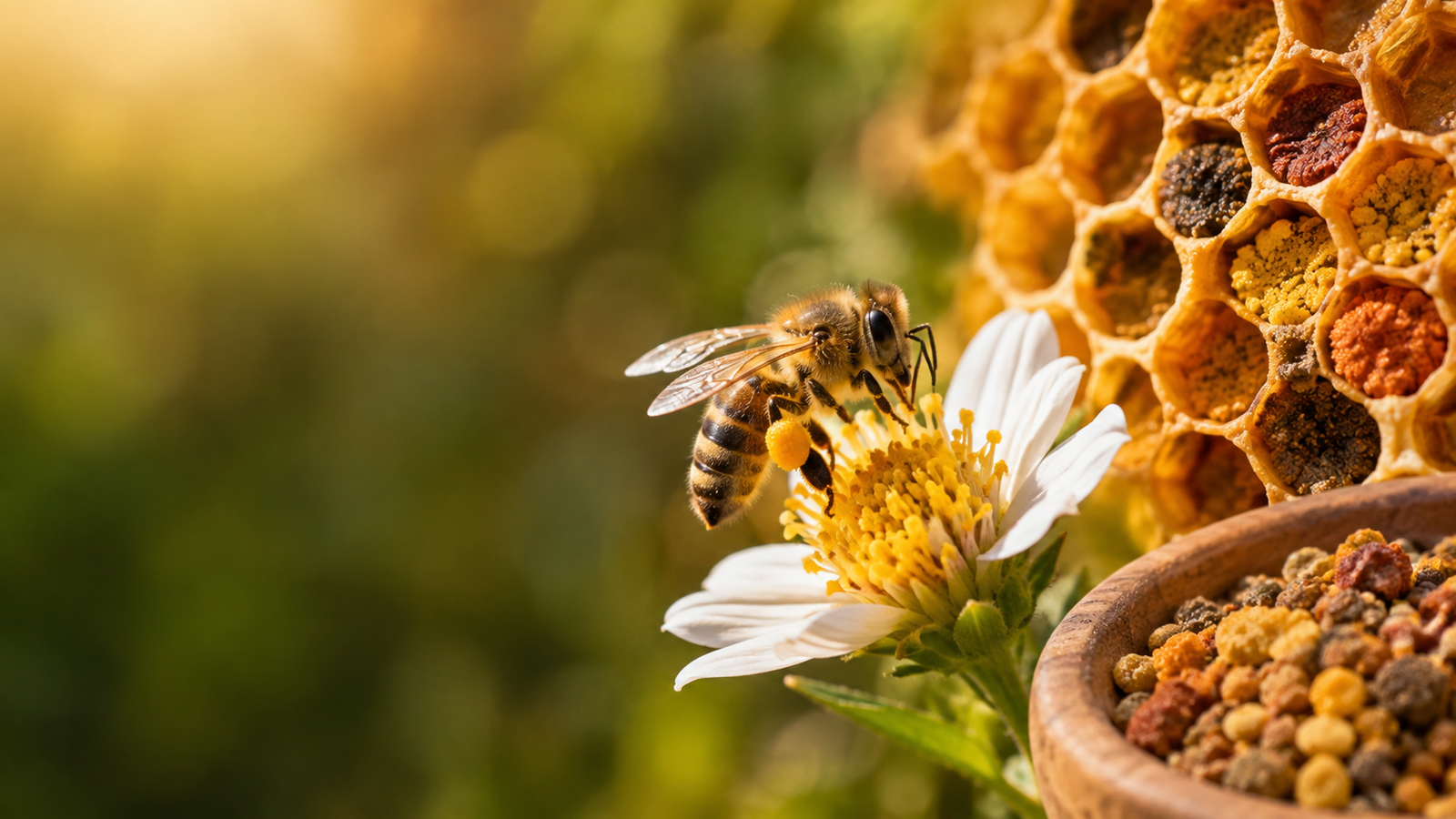
Bee bread is fermented pollen that honey bees store inside honeycomb cells. Bees collect pollen from flowers, pack it into cells, mix it with small amounts of honey or nectar and bee secretions, and allow it to undergo natural fermentation. This process changes the pollen, helps preserve it, and makes it an important food source for the bee colony.
Unlike ordinary bread, bee bread contains no flour and is not baked. The name refers to the way bees prepare and store this pollen-based food inside the hive.
In this guide, you’ll learn what bee bread is, how bees make it, what it contains, why bees need it, how it differs from bee pollen, whether humans can eat it, and how beekeepers can harvest it.
What Is Bee Bread?
Bee bread is pollen that honey bees collect, pack into honeycomb cells, mix with honey or nectar and bee secretions, and allow to ferment.
Worker bees collect pollen from flowers and bring it back to the hive. They then place the pollen into cells, compact it, and add small amounts of honey or other substances. The stored material undergoes lactic acid fermentation over the following days.
During fermentation, the chemical characteristics of the pollen change. Acidity increases, the pH falls, and compounds such as soluble proteins and free amino acids can change or increase. The acidic environment also helps preserve the stored food.
The result is what beekeepers and researchers call bee bread.
In simple terms:
Flower pollen + honey or nectar + bee secretions + fermentation = bee bread
Why Do Bees Make Bee Bread?
Bees make bee bread because pollen provides nutrients that are essential to the colony.
Honey is primarily an energy-rich source of carbohydrates, while pollen provides important protein and other nutrients.
Bee bread is particularly important when bees are raising young and when fresh pollen is not immediately available.
Within the colony, pollen-derived food supports:
- Young worker bees
- Brood-rearing
- Nurse bees
- Production of food for developing larvae
- General colony growth and maintenance
Bee bread therefore acts as a stored nutritional resource inside the hive.
How Do Bees Make Bee Bread?
Making bee bread is a natural process carried out by worker bees and microorganisms associated with the hive.
1. Bees Collect Flower Pollen
Foraging worker bees visit flowers and collect pollen from plants.
They use their bodies and specialized structures on their hind legs called pollen baskets, or corbiculae, to transport pollen back to the colony.
2. Bees Bring the Pollen Back to the Hive
After collecting pollen, worker bees return to the colony.
The pollen is deposited into honeycomb cells, where other bees can process and compact it.
3. Bees Pack the Pollen Into Honeycomb Cells
The pollen is tightly packed into cells.
Compacting the pollen helps remove air spaces and creates suitable conditions for the fermentation process.
Bees commonly store pollen in cells near the brood area, where it can be accessed as needed.
4. Bees Add Honey, Nectar, and Secretions
Bees add small amounts of honey or nectar and substances produced by bees to the stored pollen.
The pollen and honey may be deposited in layers as the cell is gradually filled.
5. The Pollen Ferments
Once stored, microorganisms begin transforming the pollen.
Lactic acid fermentation is particularly important. As fermentation progresses, lactic acid and other organic acids are produced.
This causes the acidity of the material to increase and its pH to decrease.
6. The Fermented Pollen Becomes Bee Bread
After fermentation, the stored pollen has become the substance known as bee bread.
The fermentation process changes its chemical composition and helps preserve it inside the hive.
What Happens to Pollen During Fermentation?
Fermentation is what makes bee bread different from freshly collected pollen.
Pollen grains have a tough outer structure that can make their nutrients difficult to access. During fermentation, microorganisms help transform the stored material.
The process can result in:
- Increased acidity
- Lower pH
- Changes in proteins
- Changes in amino acids
- Production of organic acids
- Improved preservation
- Changes in the digestibility of pollen
Research and nutritional comparisons have found substantial differences between collected pollen and fermented bee bread, although the exact composition varies depending on the pollen source and other conditions.
The important point is that bee bread is not simply pollen sitting in a honeycomb cell. It is pollen that has undergone fermentation.
Why Does Fermentation Help Preserve Bee Bread?
One important result of fermentation is increased acidity.
Lactic acid and other organic acids lower the pH of the stored pollen. The more acidic environment helps discourage the growth of some unwanted microorganisms.
This allows bees to maintain bee bread as a stored food resource inside the hive.
The uploaded reference reports a lower pH and substantially greater lactic acid and free acidity in bee bread compared with collected pollen, illustrating the chemical changes associated with fermentation.
What Does Bee Bread Look Like?
Bee bread is normally found inside honeycomb cells rather than as a loose pile.
Its color can vary depending on the plants from which the bees collected pollen.
It may appear:
- Yellow
- Orange
- Brown
- Green
- Red
- Purple
- Multicolored
Because bees may collect pollen from many different plants, a single section of comb can contain bee bread with several different colors.
What Does Bee Bread Taste Like?
Bee bread does not taste exactly like honey.
Honey is generally sweet because it contains a high concentration of sugars. Bee bread contains fermented pollen, so its flavor can be more complex.
Depending on its botanical origin and fermentation, bee bread may taste:
- Tangy
- Sour
- Earthy
- Nutty
- Slightly bitter
- Mildly sweet
The taste can vary significantly from one colony or location to another.
What Is Bee Bread Made Of?
The exact composition of bee bread varies because bees collect pollen from different plants and because fermentation changes the material.
Bee bread can contain:
- Proteins
- Amino acids
- Carbohydrates
- Lipids
- Dietary fiber
- Vitamins
- Minerals
- Organic acids
- Plant compounds
- Fermentation-related compounds
The reference article provides broad ranges showing that bee bread can contain approximately 14–23% protein, 24–35% carbohydrates, 2–14% lipids, and 3–20% dietary fiber, although these values can vary substantially depending on the sample and pollen source.
For this reason, bee bread should not be assumed to have one fixed nutritional profile.
Bee Bread vs. Bee Pollen: What’s the Difference?
Bee bread and bee pollen are closely related, but they are not the same thing.
The simplest distinction is:
Bee pollen is collected pollen, while bee bread is pollen that bees have stored and fermented.
| Feature | Bee Pollen | Bee Bread |
|---|---|---|
| Origin | Pollen collected from flowers | Pollen collected from flowers |
| Processing by bees | Collected and transported | Packed, mixed, and fermented |
| Location | Can be collected at the hive entrance | Stored inside honeycomb cells |
| Fermentation | Generally not fermented | Naturally fermented |
| Acidity | Lower | Higher after fermentation |
| Digestibility | Limited by the pollen grain wall | Fermentation changes the pollen structure |
| Storage | Often dried for human use | Naturally stored in the hive |
The reference article similarly distinguishes collected pollen pellets from pollen that bees have packed and fermented in the comb.
Why is this distinction important?
The term “bee pollen” can sometimes be confusing because the pollen itself originates from flowers. Bees collect the pollen and use it as the raw material for bee bread.
Bee bread is therefore a processed form of pollen produced by the bees.
Is Bee Bread More Digestible Than Pollen?
Fermentation can make pollen-derived nutrients more accessible.
One reason is the structure surrounding pollen grains. The outer wall of pollen is highly resistant, which limits how easily digestive systems can access some of the material inside.
During fermentation, microbial activity partially changes this structure and alters the chemical composition.
The reference article describes bee bread as more digestible than raw collected pollen and associates fermentation with changes in soluble proteins and free amino acids.
However, digestibility can vary according to the plant source and processing conditions, so it is better to describe this as a general effect of fermentation rather than an absolute rule for every sample.
Bee Bread vs. Honey
Bee bread and honey are both important stored foods, but they serve different nutritional roles.
| Bee Bread | Honey |
|---|---|
| Made primarily from pollen | Made primarily from nectar |
| Fermented | Processed enzymatically and concentrated |
| Important source of protein and other nutrients | Primarily an energy source |
| Stored in honeycomb cells | Stored in honeycomb cells |
| Usually less sweet | Sweet and sugar-rich |
In simple terms:
Honey provides much of the colony’s carbohydrate energy, while bee bread provides pollen-derived protein and other nutrients.
Bee Bread vs. Royal Jelly
Bee bread is also different from royal jelly.
Bee bread is fermented pollen stored in honeycomb cells.
Royal jelly is a nutrient-rich secretion produced by worker bees and used to feed larvae and queen bees.
A developing queen larva receives royal jelly as part of her specialized diet, so it would be inaccurate to describe bee bread as the queen’s primary food.
Bee Bread vs. Propolis
Bee bread should not be confused with propolis.
Bee bread is a food made from fermented pollen.
Propolis is a resinous material collected from plants and used by bees in maintaining and protecting the hive.
Their purposes inside the colony are therefore very different.
What Do Bees Use Bee Bread For?
Bee bread is an important nutritional resource for the colony.
Supporting young worker bees
Young adult worker bees consume pollen-derived foods as they develop and begin performing tasks within the colony.
Supporting brood nutrition
Pollen-derived nutrients are important for producing food that worker bees provide to developing larvae.
Supporting nurse bees
Nurse bees need adequate nutrition to produce food for brood.
Supporting colony growth
A colony raising large amounts of brood needs a reliable supply of pollen-derived nutrients.
This is why pollen availability is closely connected with colony development.
Do Baby Bees Eat Bee Bread?
The answer requires some clarification.
Developing larvae are fed food prepared and delivered by worker bees. They do not simply eat stored bee bread directly in the same way an adult bee consumes stored food.
However, bee bread is an important part of the colony’s pollen-based nutritional system and provides nutrients that support brood rearing.
So it is more accurate to say that bee bread supports the nutritional needs of developing bees and the workers that feed them.
Do Queen Bees Eat Bee Bread?
Queen bees have a specialized diet.
A developing queen larva is fed royal jelly rather than ordinary bee bread.
Adult queens are fed by worker bees with glandular secretions and other food.
Therefore, bee bread is not the primary food associated with queen development.
Can Humans Eat Bee Bread?
Yes, bee bread is consumed by humans as an apiculture-derived food.
However, it is important to distinguish between being edible and having proven medical benefits.
Bee bread contains pollen from plants, and its composition can vary considerably.
People with known allergies to pollen or bee products should exercise particular caution before consuming it.
If you have a known allergy or concern about consuming bee products, seek advice from an appropriate healthcare professional.
What Are the Potential Benefits of Bee Bread?
Bee bread has attracted interest because of its nutritional composition and the changes that occur during fermentation.
It can provide:
- Protein
- Amino acids
- Fatty acids
- Vitamins
- Minerals
- Plant-derived compounds
- Fermentation-derived organic acids
Fermentation may also change the availability and digestibility of some pollen components.
However, bee bread should be regarded as a food rather than a medicine.
Claims that bee bread can prevent, treat, or cure specific diseases should not be presented as established facts without appropriate human evidence.
The reference article specifically cautions against unsupported therapeutic claims and notes that nutritional properties should be distinguished from medical claims.
Does Bee Bread Have Medicinal Properties?
Bee bread contains biologically active compounds and has been investigated for various nutritional and biological properties.
However, this does not automatically establish that eating bee bread can prevent or treat a disease.
The safest way to describe bee bread is as a fermented, nutrient-containing food produced by honey bees.
Its nutritional properties are better established than broad claims about treating medical conditions.
How Is Bee Bread Stored in the Hive?
Bees store bee bread inside honeycomb cells, generally in areas associated with the brood nest.
The pollen is packed tightly into the cells and undergoes fermentation.
As fermentation produces acids and lowers the pH, the resulting environment helps preserve the food.
The bees can then access the stored bee bread when the colony needs pollen-derived nutrients.
How Long Does Bee Bread Last?
Fermentation helps bee bread remain stable inside the hive.
However, its storage life depends on conditions such as:
- Moisture
- Temperature
- Fermentation
- Microbial activity
- Hive conditions
- Handling after removal from the hive
Bee bread should therefore not be assumed to remain fresh indefinitely once it has been removed from the colony.
Can Beekeepers Harvest Bee Bread?
Yes.
Beekeepers can harvest bee bread from honeycomb containing stored pollen.
The process is more specialized than harvesting honey because the bee bread is packed into wax cells.
The reference source describes bee bread as an additional harvest that can be obtained from combs that have already undergone honey extraction.
A simplified process involves:
- Selecting suitable comb containing bee bread.
- Removing any remaining honey.
- Cutting the comb into manageable sections.
- Freezing the comb so the wax becomes brittle.
- Separating the bee bread from the wax.
- Drying the extracted bee bread under controlled conditions.
The reference describes freezing the comb at approximately −18°C for about 12 hours, followed by mechanical separation and drying below 42°C.
These are processing details rather than requirements for understanding what bee bread is, so they are best treated as secondary information.
Why Is Bee Bread Sometimes Called Fermented Pollen?
Because that is essentially what it is.
Bees collect pollen from flowers and store it in the comb. They add substances such as honey or nectar and allow microorganisms to ferment it.
The resulting product is known as bee bread.
So:
Pollen → stored and fermented by bees → bee bread
Is Bee Bread Really Bread?
No.
Bee bread is not bread in the human culinary sense.
There is:
- No flour
- No baking
- No dough
- No oven
The word “bread” is simply part of the common name for this fermented pollen-based food stored by bees.
Is Bee Bread Made From Honey?
Bee bread is primarily made from pollen, not honey.
However, bees add small amounts of honey or nectar and bee secretions during the storage process.
Honey therefore contributes to the formation and fermentation environment, but pollen remains the primary raw material.
Is Bee Bread Vegan?
This depends on the definition of veganism being used.
Bee bread is produced by honey bees and is part of the colony’s food supply. Harvesting it involves obtaining a material produced and stored by bees.
For this reason, bee bread is generally not considered vegan by people who avoid all animal-derived products.
Frequently Asked Questions About Bee Bread
What is bee bread in simple terms?
Bee bread is pollen that honey bees collect, pack into honeycomb cells, mix with honey or nectar and bee secretions, and ferment. The fermentation helps preserve it and changes its nutritional characteristics.
Is bee bread the same as bee pollen?
No. Bee pollen refers to pollen collected by bees, while bee bread is pollen that bees have stored and fermented inside the hive.
Is bee bread fermented?
Yes. Natural bee bread undergoes fermentation inside honeycomb cells, with lactic acid bacteria and other microorganisms contributing to the process.
What is bee bread made of?
Bee bread is primarily made from pollen, with small amounts of honey or nectar and bee secretions. It also contains proteins, carbohydrates, lipids, amino acids, minerals, vitamins, organic acids, and other plant-derived compounds.
Why do bees make bee bread?
Bees make bee bread as a stored source of pollen-derived nutrients, particularly protein, which is important for colony development, brood rearing, and worker bee nutrition.
Is bee bread healthier than bee pollen?
Bee bread and collected pollen have different characteristics because fermentation changes pollen. Bee bread may be more digestible than unfermented pollen, but it is not accurate to say universally that one is simply “healthier” than the other.
Can humans eat bee bread?
Yes, bee bread is eaten by humans. However, people with pollen or bee-product allergies should be cautious.
Does bee bread contain protein?
Yes. Pollen is an important protein source for honey bees, and bee bread retains substantial pollen-derived protein.
Does bee bread taste like honey?
Not exactly. It can have a tangy, sour, earthy, nutty, or slightly bitter flavor depending on the pollen source and fermentation.
Is bee bread the same as royal jelly?
No. Bee bread is fermented pollen, while royal jelly is a secretion produced by worker bees and used to feed larvae and queens.
Is bee bread the same as propolis?
No. Bee bread is food. Propolis is a plant-resin-based material that bees use primarily for hive maintenance and protection.
Where is bee bread found in a hive?
Bee bread is stored inside honeycomb cells, often in areas near the brood nest.
How do bees preserve bee bread?
Natural fermentation produces acids that lower the pH and help create conditions that discourage the growth of some unwanted microorganisms.
Can beekeepers harvest bee bread?
Yes. Bee bread can be extracted from suitable comb, although separating it from the surrounding wax requires specialized processing.
Final Takeaway: What Is Bee Bread?
Bee bread is fermented pollen made and stored by honey bees inside honeycomb cells.
Worker bees collect pollen from flowers, bring it back to the hive, pack it into cells, add small amounts of honey or nectar and bee secretions, and allow it to undergo natural fermentation.
The fermentation process increases acidity, lowers the pH, changes the chemical composition of the pollen, and helps preserve the stored food.
For the colony, bee bread is an important source of protein and other pollen-derived nutrients that support worker bees, brood rearing, and colony development.
For humans, bee bread is an edible bee product that contains a range of nutrients and plant compounds, but claims about disease prevention or treatment should be approached cautiously.
In one sentence:
Bee bread is naturally fermented and stored pollen that honey bees make inside honeycomb cells as an important source of nutrition for the colony.
