

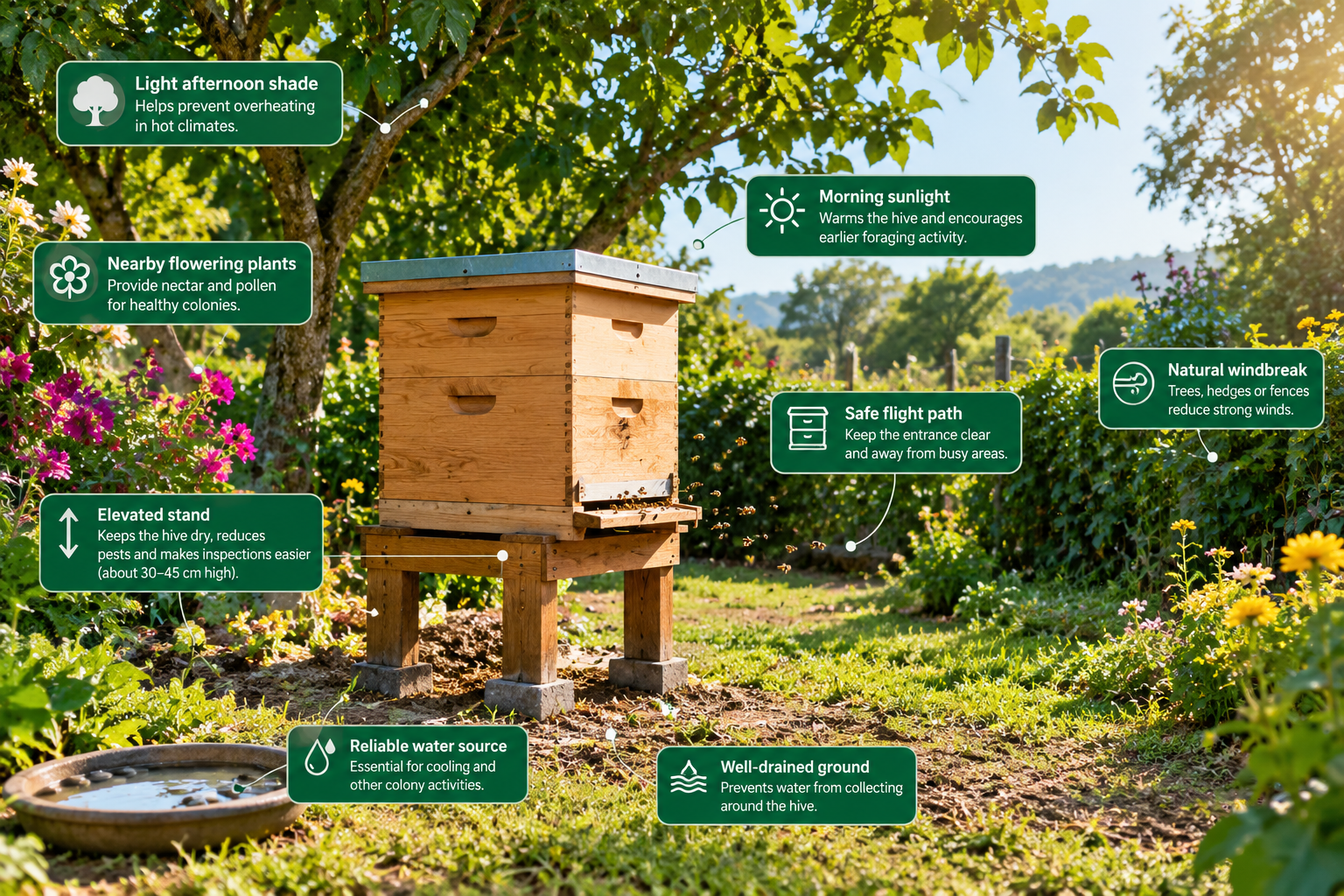
Knowing where to place bee hives is one of the most important decisions a beekeeper makes. The location affects how easily bees find food and water, how the colony handles heat and rain, how safely workers enter and leave the hive, and how conveniently the beekeeper can inspect and maintain the colony.
The best place to put bee hives is generally a quiet, well-drained location with suitable sunlight, protection from strong winds, nearby flowering plants, dependable water, and enough space for safe hive management. In hot climates such as Ghana, a location with morning sunlight and protection from intense afternoon heat can be particularly useful.
However, there is no single perfect location for every hive. The right choice depends on local weather, available vegetation, the type and number of colonies, surrounding human activity, and the beekeeper’s management practices.
Whether you are planning to keep bees in a backyard, garden, farm, forest edge, or dedicated apiary, this guide explains how to choose a suitable location, position your hives, avoid common placement mistakes, and assess a site before introducing a colony.
1. What Makes a Good Location for Bee Hives?
A good bee hive location provides the colony with the resources and environmental conditions it needs while allowing the beekeeper to work safely.
Before choosing a spot, consider these important factors:
| Placement factor | What to look for | Why it matters |
|---|---|---|
| Sunlight | Morning sun and suitable afternoon exposure | Helps create a suitable thermal environment |
| Shade | Protection from excessive heat where necessary | Reduces excessive solar heating |
| Drainage | Firm, dry ground that does not collect water | Reduces flooding and persistent dampness |
| Wind protection | Shelter from strong prevailing winds | Reduces exposure to harsh weather |
| Food sources | Flowering trees, shrubs, crops and wildflowers | Provides nectar and pollen |
| Water | A dependable natural or managed water source | Supports cooling and other colony functions |
| Safety | A location away from busy human activity | Reduces unwanted encounters |
| Accessibility | Space to approach and inspect the hive | Makes regular management easier |
| Security | Protection from theft, livestock and disturbance | Protects the colony and equipment |
These factors work together. A location with abundant flowers may still be unsuitable if it floods during heavy rainfall or exposes bees to pesticide spraying.
Similarly, a quiet shaded area may not be appropriate if it is permanently damp, difficult to access, or has very little flowering vegetation nearby.
The best location is one that remains suitable throughout the year, not simply one that looks attractive on the day you install the hive.
2. Should Bee Hives Be Placed in Full Sun or Partial Shade?
Bee hives can be kept in full sun, partial shade, or a combination of both. The most appropriate arrangement depends on the local climate, hive design, ventilation, colony strength and seasonal weather.
Sunlight can warm the hive and help dry its exterior after rain. However, excessive heat can increase the work required from the colony to maintain suitable conditions inside the nest.
Benefits of placing bee hives in sunlight
Sunlight can offer several advantages:
- Warms the hive during cooler mornings.
- Can encourage earlier daily foraging activity.
- Helps exposed hive surfaces dry after rainfall.
- May reduce persistently damp conditions around the entrance.
- In some environments, full-sun placement can discourage certain moisture-associated pests.
However, full sun is not automatically better. In very hot environments, intense solar exposure can increase the colony’s cooling workload.
Benefits of placing bee hives in partial shade
Partial shade can be particularly useful in hot climates.
It can:
- Reduce direct heating of the hive during the hottest hours.
- Provide protection from intense afternoon sunlight.
- Reduce the amount of water needed for evaporative cooling under some conditions.
- Make the apiary more comfortable to work in.
Honey bees regulate the temperature of their brood area through collective activities. Worker bees can fan their wings, distribute water and use evaporative cooling to remove excess heat.
Research on honey bee water collection explains that water is important for maintaining colony functions, including cooling, preparing food for brood and maintaining the colony’s internal balance.
This is why dependable water and appropriate hive placement are especially important during hot weather.
Full sun versus partial shade
| Consideration | Full sun | Partial shade |
|---|---|---|
| Cooler climates | Often beneficial | Can work, depending on exposure |
| Hot climates | May increase heat load | Can reduce excessive solar heating |
| Water requirements | Cooling demand may increase | May reduce some cooling demand |
| Damp conditions | Can help exposed surfaces dry | Requires adequate airflow |
| Hive management | Can be more exposed to heat | Can provide a more comfortable working environment |
How to choose the right amount of sunlight
Before installing a hive:
- Observe the location early in the morning.
- Check how much sunlight reaches the hive position around midday.
- Visit again during the hottest part of the afternoon.
- Observe whether nearby trees provide useful shade.
- Check whether the area remains ventilated.
- Consider how seasonal changes affect the shade pattern.
Practical example: A beekeeper in Ghana is choosing between two locations. The first receives direct sunlight throughout the afternoon, while the second receives morning sunlight and partial afternoon shade. If both locations have good drainage, ventilation and forage, the second may be a more manageable choice during periods of intense heat.
Avoid placing hives in deep, damp shade simply because the weather is hot. A site that receives little sunlight and has poor airflow can create other management problems.
3. Where to Place Bee Hives in a Garden or Backyard
A garden or backyard can be suitable for keeping honey bees, provided there is enough space to manage the colony without creating unnecessary risks for household members, visitors and neighbours.
The best backyard locations are usually quiet areas with good drainage, suitable vegetation, and a flight path that does not pass directly through frequently occupied spaces.
Suitable backyard locations
Consider:
- A quiet corner of a sufficiently large garden.
- A dedicated apiary area behind a suitable barrier.
- An unused section of land away from children’s play areas.
- A location near flowering trees and shrubs.
- A position with enough room for inspections and equipment handling.
Where should the entrance face in a backyard?
The entrance should face an area where bees can leave and return without immediately encountering people.
Avoid directing the entrance toward:
- House entrances and windows.
- Outdoor dining areas.
- Children’s playgrounds.
- Swimming pools.
- Neighbouring gardens.
- Public walkways.
- Areas where pets and livestock regularly move.
A hedge, fence or other suitable barrier may encourage bees to fly upward after leaving the hive. This can help redirect their flight path above people’s normal walking height.
However, barriers do not guarantee safety. Bees can fly around or over them, and a defensive colony can create problems even when the entrance is positioned carefully.
When is a backyard unsuitable?
A backyard may not be appropriate if:
- The property is very small.
- Neighbours are close to the proposed hive position.
- People regularly pass through the flight path.
- Children or pets cannot be kept away from the apiary.
- There is insufficient room for safe inspections.
- Local regulations or property restrictions prohibit the installation.
A suitable farm or dedicated apiary may be a better alternative.
4. Where to Place Bee Hives on a Farm
Farms can provide excellent opportunities for beekeeping because they may contain flowering crops, fruit trees, shrubs and natural vegetation.
However, not every agricultural area is suitable.
A beekeeper should assess the farm’s flowering calendar, pesticide practices, water availability, livestock activity and access before selecting an apiary position.
Choose a location near dependable flowering plants
Honey bees collect nectar and pollen from different flowering plants.
Nectar provides carbohydrates that supply energy, while pollen supplies proteins, fats and other nutrients needed for colony development.
Useful forage can include:
- Flowering fruit trees.
- Flowering shrubs.
- Wildflowers.
- Suitable flowering crops.
- Native trees and other locally important plants.
Do not assess forage only by looking at what is flowering on the day of your visit.
A farm may have abundant flowers during one season but very little food available during another. Observe the flowering calendar and identify plants that provide resources across different periods.
Avoid pesticide exposure
Pesticides are an important consideration when placing hives on agricultural land.
Honey bees may encounter harmful chemicals through direct contact with spray droplets or by collecting contaminated nectar, pollen and water.
Before installing hives:
- Speak with nearby farmers about their pest-control practices.
- Identify crops that receive regular pesticide applications.
- Ask about spraying schedules and the products used.
- Consider the direction of prevailing winds and potential spray drift.
- Follow applicable pesticide labels and local regulations.
- Seek advice from agricultural extension officers when necessary.
Do not assume that placing hives beside a flowering crop automatically guarantees good honey production.
A farm with abundant flowers but frequent pesticide exposure may be less suitable than a location with more diverse, untreated vegetation.
Practical farm example
Imagine two possible apiary locations.
Location A: A large flowering farm with frequent insecticide applications and limited protection from wind.
Location B: A smaller area beside fruit trees and natural vegetation, with dependable water, good drainage and lower pesticide exposure.
Location B may be the better choice, even though Location A has more visible flowers.
The important consideration is the overall suitability of the environment, not simply the amount of flowering vegetation.
5. Which Direction Should a Bee Hive Entrance Face?
The direction of a hive entrance influences how bees encounter sunlight, wind, rain and nearby human activity.
Many beekeepers prefer east-facing or southeast-facing entrances because they can receive morning sunlight. However, there is no compass direction that is universally best for every apiary.
The surrounding conditions should determine the final orientation.
East-facing entrances
An east-facing entrance receives sunlight earlier in the day.
This may be useful where morning warmth encourages early foraging and the location avoids strong prevailing winds.
Southeast-facing entrances
A southeast-facing entrance can provide a combination of morning sunlight and protection from some weather conditions, depending on the landscape.
West-facing entrances
A west-facing entrance may receive stronger afternoon sunlight. This can be suitable in some cooler environments but may increase heat exposure in hot locations.
North-facing entrances
A north-facing entrance may be appropriate in certain climates and landscapes, but it should be assessed for wind, rain and sunlight exposure rather than automatically rejected.
Entrance direction comparison
| Direction | Potential advantage | What to consider |
|---|---|---|
| East | Early morning sunlight | Wind and rain exposure |
| Southeast | Morning sunlight | Local afternoon heat |
| South | Longer sun exposure in some climates | Excessive heat in hot regions |
| West | May suit cooler environments | Strong afternoon sun |
| North | May work in sheltered locations | Prevailing winds and limited sunlight |
Practical entrance-positioning tips
- Avoid pointing the entrance directly into strong prevailing winds.
- Reduce exposure to wind-driven rain.
- Keep the flight path clear.
- Direct bee traffic away from busy pedestrian areas.
- Prevent vegetation from blocking the entrance.
- Ensure the beekeeper can approach the hive safely.
The goal is not to follow a compass direction blindly. It is to create a safe and suitable entrance environment for the colony.
6. How Far Apart Should Bee Hives Be Placed?
There is no single compulsory distance that applies to every apiary.
The appropriate spacing depends on the hive design, available land, number of colonies, inspection methods and the space needed to handle hive boxes safely.
For a small apiary, approximately 1–2 metres between hives can be a practical starting arrangement where space allows. This is a management suggestion, not a universal biological requirement.
Why hive spacing matters
Appropriate spacing helps:
- Provide room for inspections.
- Reduce accidental disturbance of neighbouring colonies.
- Make individual colonies easier to identify.
- Allow convenient removal of hive boxes.
- Provide access for feeding, pest management and harvesting.
How to arrange multiple hives
Avoid placing every hive in an identical straight row with entrances facing the same direction when a more varied arrangement is possible.
Bees can sometimes drift into neighbouring colonies, especially when hive entrances look similar and the colonies are arranged close together.
To reduce orientation confusion:
- Stagger the hive positions.
- Use different entrance orientations where practical.
- Give hives distinctive colours or markings.
- Use recognizable landmarks around the apiary.
- Keep inspection routes clear.
Recommended considerations for a small apiary
| Placement factor | Practical consideration |
|---|---|
| Hive spacing | Around 1–2 m can be a starting point |
| Entrance arrangement | Avoid identical entrances in repetitive rows |
| Working space | Allow room to lift and handle hive boxes |
| Access paths | Keep walking routes unobstructed |
| Expansion | Reserve space for additional colonies |
| Forage | Assess whether the surrounding landscape can support the planned colony numbers |
Remember that spacing alone does not prevent drifting, pests or disease transmission. Colony health also depends on hygiene, inspections, equipment management and appropriate disease control.
For larger apiaries, the available forage and carrying capacity of the surrounding landscape may become more important than the distance between individual hives.
7. How High Should a Bee Hive Be Off the Ground?
Bee hives are generally easier to manage when placed on stable stands rather than directly on the soil.
For many common hive arrangements, a stand approximately 30–45 cm (12–18 inches) above the ground can be a useful starting point.
However, the appropriate height depends on the hive type, beekeeper’s working position, local pests, terrain and the total weight of the colony.
Why elevate a bee hive?
1. Reduces exposure to ground moisture
A raised hive is less likely to be affected by splashing rain and direct contact with damp soil.
2. Makes inspections easier
A suitable stand reduces excessive bending and can make routine hive management more comfortable.
3. Improves access around the hive
The beekeeper can maintain the ground, remove weeds and inspect the stand more easily.
4. Helps with some pest-management measures
A stand can make it easier to install appropriate barriers against crawling pests. However, elevation alone does not prevent ants, termites or other insects from reaching a colony.
What makes a good hive stand?
A suitable stand should:
- Support the fully occupied hive, including stored honey.
- Remain stable on the ground.
- Resist corrosion or decay.
- Be properly secured against tipping.
- Allow comfortable inspections.
- Keep the hive clear of standing water.
In areas where ants and termites are common, regularly inspect the stand and surrounding vegetation.
The Ghana Bee Health Manual also describes using hive stands and suitable barriers to limit crawling pests.
Do not apply harmful chemicals to hive supports where they could contaminate bees, comb, honey or other hive products.
8. How Close Should Bee Hives Be to Flowers and Water?
Honey bees need dependable access to nectar, pollen and water.
A good apiary location should provide access to these resources across different seasons rather than relying on one flowering tree or a temporary water source.
How close should bee hives be to flowering plants?
There is no fixed minimum distance between a hive and flowering plants.
Honey bees can forage across considerable distances, sometimes travelling several kilometres when necessary.
However, a location with abundant nearby forage can reduce the distance bees need to travel and may make resources easier to access.
Look for:
- Flowering trees.
- Fruit trees.
- Flowering shrubs.
- Wildflowers.
- Suitable agricultural crops.
- Native plants that provide nectar and pollen.
Why seasonal forage matters
Consider a farm with many flowering trees during the rainy season.
The location may look excellent in January, but if most of those trees stop flowering during the dry season, the colony may face a period of limited resources.
Before selecting the site, identify:
- Which plants flower during the rainy season.
- Which plants flower during the dry season.
- Whether flowering periods overlap.
- Whether nearby farms provide seasonal forage.
- Whether alternative vegetation is available when major crops finish flowering.
A variety of flowering plants can provide more dependable resources than relying on one crop.
Why do bee hives need water?
Water is important for several colony functions.
Worker bees collect water to:
- Help regulate the temperature inside the hive.
- Support brood-related food preparation.
- Dilute stored honey when necessary.
- Maintain normal physiological functions.
During hot weather, water collection can become particularly important because workers use water evaporation to help cool the colony.
Research published in the journal Journal of Comparative Physiology A examines the energetic demands of water-collecting honey bees and explains the importance of water for colony thermoregulation.
How to provide a safe water source
If a dependable natural source is unavailable, provide a water station before introducing the colony.
A suitable water station can include:
- A shallow container.
- Fresh water.
- Floating corks, stones or other stable landing materials.
- A location that can be cleaned and refilled regularly.
The landing materials are important because bees can drown in open containers of water.
Establish the water station early so bees can become familiar with it.
Avoid allowing colonies to depend on swimming pools, neighbouring properties or livestock drinking containers.
9. Where Should You Avoid Placing Bee Hives?
Some locations may appear convenient but create problems for colony health, safety or long-term management.
Avoid the following environments.
| Location to avoid | Why it can be unsuitable |
|---|---|
| Flood-prone depressions | Water can damage or destroy hives |
| Drainage channels | Heavy rain can cause sudden flooding |
| Busy footpaths | Increases unwanted encounters with bees |
| Children’s play areas | Creates unnecessary safety risks |
| House entrances | Concentrates bee traffic around people |
| Areas exposed to pesticide drift | Increases chemical exposure risk |
| Extremely windy hilltops | Exposes colonies to strong winds |
| Permanently damp areas | Can create moisture-related problems |
| Dense, poorly ventilated vegetation | Makes access and maintenance difficult |
| Livestock feeding areas | Creates disturbance and safety concerns |
| Frequently used machinery areas | Increases disturbance and accidental damage |
Avoid locations with poor drainage
A hive may stand on a raised platform and still be at risk if the surrounding land floods.
For example, a hive placed beside a seasonal stream may remain dry during most of the year but become surrounded by water during heavy rainfall.
Inspect the land after rain whenever possible.
Avoid locations with excessive pesticide exposure
A flowering field is not automatically a safe feeding area.
Investigate pesticide use, neighbouring agricultural activity and the potential for spray drift before selecting a site.
Avoid locations with uncontrolled human activity
Bees need a relatively undisturbed environment.
Do not position a hive where people regularly gather, children play, or workers must pass directly in front of the entrance.
A location that cannot be managed safely should be rejected even if its food and water resources are excellent.
10. Where to Place Bee Hives in Hot Climates Like Ghana
Beekeeping in tropical environments requires careful consideration of heat, rainfall, water, vegetation, pests and colony behaviour.
The Ghana Bee Health Manual provides useful local guidance on selecting apiary sites, protecting colonies from excessive heat, avoiding flood-prone locations and maintaining suitable hive stands.
For many locations in Ghana, morning sunlight with some protection from intense afternoon heat is a practical starting point.
Choose appropriate shade
Consider placing hives beneath suitable trees or a properly ventilated shade structure.
The shade should protect the hive during the hottest hours without creating a permanently damp environment.
Avoid:
- Dense vegetation that blocks airflow.
- Trees with unstable or dangerous branches.
- Locations where heavy branches can fall onto hives.
- Areas with persistent water dripping onto the hive.
Protect hives from heavy rainfall
Ghana experiences seasonal rainfall, although the timing and intensity vary by region.
A site that looks suitable during the dry season may become waterlogged during the rainy season.
Choose firm, well-drained ground and avoid:
- Drainage channels.
- Low-lying depressions.
- Flood-prone riverbanks.
- Areas where runoff collects.
- Unstable slopes.
Maintain dependable water
Water is particularly important when temperatures are high.
If natural water sources become unreliable during the dry season, establish a managed water station.
Check it regularly to ensure it remains clean and filled.
Manage ants, termites and other pests
Ants and termites can cause problems around poorly maintained apiaries.
Practical precautions include:
- Keeping unnecessary vegetation away from hive stands.
- Inspecting support legs regularly.
- Using appropriate pest barriers.
- Maintaining sound hive construction.
- Sealing unwanted openings where necessary.
- Keeping the area around the apiary manageable.
Do not use pesticides or oils in a way that could contaminate the hive or its products.
Consider African honey bee colony behaviour
African honey bee colonies can display defensive behaviour, but temperament varies between colonies.
A colony’s behaviour can be influenced by genetics, disturbance, environmental conditions, colony health and management.
This makes site selection particularly important in places where people, animals and neighbours may come into contact with the bees.
Choose a location with a safe flight path and sufficient separation from frequently occupied areas.
New beekeepers should seek guidance from an experienced local beekeeper when selecting their first apiary.
11. How Far Should Bee Hives Be From a House?
There is no single distance that guarantees safety for every property or colony.
The appropriate separation depends on:
- Property size.
- Hive entrance direction.
- Colony temperament.
- Nearby pedestrian activity.
- Fences and natural barriers.
- Neighbouring properties.
- Local regulations.
- The beekeeper’s ability to manage the colony.
A hive on a large property may be manageable near a house if the flight path is directed away from occupied areas.
On a small residential property, even a hive positioned farther from the house may be unsuitable if bees regularly fly across a shared walkway or neighbouring garden.
How to reduce conflict with neighbours
- Position entrances away from busy areas.
- Use a suitable barrier to encourage bees to fly upward.
- Avoid placing hives near doors and outdoor seating.
- Maintain safe access for inspections.
- Discuss the installation with affected neighbours where appropriate.
- Check applicable property and local beekeeping regulations.
A hedge or fence can help redirect flight activity, but it cannot replace adequate space and a proper safety assessment.
Important: Do not treat a general distance recommendation from another country as a legal requirement in Ghana or elsewhere. Always check the rules that apply to your location.
12. Can You Place Bee Hives on a Roof or Balcony?
Yes, rooftop beekeeping is possible, and some urban beekeepers use roofs when ground-level space is limited.
However, a rooftop is not automatically a suitable location.
It introduces additional structural, access, weather and safety considerations.
Important rooftop placement considerations
Structural capacity
The building must safely support the weight of the hive, stand, stored honey, equipment and any additional loads.
Wind exposure
Roofs can be exposed to stronger winds and gusts than ground-level locations. Hives must be properly secured.
Safe access
The beekeeper needs a safe route for inspections, feeding, maintenance and harvesting.
Flight paths
Bee traffic should not be directed toward neighbouring windows, balconies, terraces or occupied spaces.
Fall protection
The working area must allow the beekeeper to handle equipment without unnecessary fall risks.
Roof protection
Hive stands should not damage waterproofing or other roof surfaces.
Building permission
Check property rules, landlord requirements, building regulations and local beekeeping restrictions.
Never install a hive on an unstable balcony or an unassessed roof.
For occupied buildings, consult appropriate building professionals and experienced beekeepers before proceeding.
13. How to Choose the Best Apiary Location: A Step-by-Step Guide
One of the best ways to choose where to place bee hives is to inspect the proposed location before acquiring a colony.
Instead of relying on appearance alone, assess the site systematically.
Step 1: Identify two or three possible locations
Do not automatically choose the nearest or most convenient spot.
Identify a few possible areas and compare their:
- Drainage.
- Sunlight.
- Wind exposure.
- Vegetation.
- Water access.
- Human activity.
- Accessibility.
This gives you a better basis for making a decision.
Step 2: Visit at different times of the day
Visit each proposed location in the morning and afternoon.
Observe where sunlight falls, how much shade is available and whether the area becomes excessively hot.
Also identify the direction of prevailing winds and any exposed areas.
Step 3: Inspect the ground after rainfall
This is particularly important in tropical climates.
Check whether:
- Water collects around the proposed hive position.
- Soil becomes unstable.
- Runoff flows through the site.
- The access path becomes muddy.
- The area is affected by seasonal flooding.
A site that appears dry during the dry season may be unsuitable during heavy rainfall.
Step 4: Identify flowering plants
Walk around the proposed apiary and identify the plants that provide nectar and pollen.
Do not simply count the number of flowering plants.
Record which plants flower during different seasons and whether the surrounding landscape provides a reasonably continuous supply of resources.
Step 5: Assess pesticide and other chemical risks
If farms or gardens are nearby, find out whether pesticides are used.
Consider possible spray drift and whether the beekeeper can communicate with nearby land managers.
If chemical exposure cannot be reasonably managed, consider another location.
Step 6: Confirm dependable water
Identify a natural water source or establish a safe water station.
Make sure the water can be maintained throughout the year, especially during hot and dry periods.
Step 7: Plan the entrance and flight path
Choose an entrance direction that avoids people, animals, public paths and neighbouring properties.
Consider whether a suitable barrier can redirect bee traffic.
Step 8: Prepare the hive stand and working area
Install a strong, stable stand.
Clear enough space to inspect the hive, move equipment and harvest honey.
Keep the surrounding vegetation manageable without unnecessarily removing valuable flowering plants.
Step 9: Assess security and future expansion
Consider theft, livestock disturbance and vandalism.
If you plan to keep several colonies in the future, leave enough space for additional stands and working access.
Step 10: Review local requirements
Check whether permission, registration, setbacks or other requirements apply to your property and type of beekeeping.
Do not assume that a site is legally suitable simply because it is physically appropriate.
Example: Comparing three possible apiary locations
Imagine a beginner beekeeper evaluating three areas on a farm.
| Factor | Location A: Open field | Location B: Tree-lined area | Location C: Low-lying land |
|---|---|---|---|
| Morning sunlight | Excellent | Good | Moderate |
| Afternoon heat | High | Moderate | Moderate |
| Drainage | Good | Good | Poor |
| Water availability | Limited | Reliable | Seasonal |
| Flowering plants | Seasonal | Diverse | Limited |
| Wind protection | Poor | Good | Moderate |
| Human activity | Moderate | Low | Low |
| Overall assessment | Needs improvements | Most promising | Unsuitable without major changes |
Why Location B is the strongest option:
Location B offers a combination of dependable water, diverse flowering vegetation, suitable shade, wind protection and good drainage.
Location A may still work if additional water and suitable heat protection are provided.
Location C should be rejected if flooding and poor drainage cannot be corrected safely.
This example demonstrates an important principle: the best apiary location is the one with the best overall conditions, not necessarily the one with the most sunlight or flowers.
14. Common Bee Hive Placement Mistakes to Avoid
Even a suitable property can become a poor apiary if the beekeeper makes avoidable placement decisions.
1. Choosing a location based only on convenience
A hive beside your back door may be easy to inspect, but it could expose household members and visitors to unnecessary bee traffic.
Prioritize safety and colony requirements over convenience.
2. Ignoring seasonal weather
A site should be assessed during different weather conditions.
Consider heavy rainfall, intense sunlight, seasonal winds and dry-season water availability.
3. Choosing a location with limited forage
A large number of flowering plants during one season does not guarantee food availability throughout the year.
Study the local flowering calendar.
4. Placing hives directly on unstable ground
Weak or uneven support can cause a hive to lean, tip or collapse.
Use a stable stand appropriate for the weight of the occupied colony.
5. Ignoring the flight path
A poorly directed entrance can send bees across a busy walkway, neighbouring garden or livestock area.
Plan the entrance direction before placing the hive.
6. Overlooking pesticide exposure
Nearby farms and gardens may use chemicals that affect pollinators.
Discuss spraying practices before selecting an apiary site.
7. Neglecting water availability
A natural water source may dry up during certain months.
Provide a reliable alternative when necessary.
8. Forgetting future expansion
A site suitable for one hive may become difficult to manage when several colonies are added.
Plan the layout around realistic future needs.
9. Choosing deep shade without considering moisture
Shade can reduce heat exposure, but dense vegetation and poor airflow can create damp conditions.
Balance shade with ventilation and drainage.
10. Moving an established hive unnecessarily
Honey bees learn the location of their nest and use landmarks to navigate.
Moving an established colony can disrupt foraging and orientation. Plan the original location carefully and seek experienced guidance before relocating a hive.
15. Frequently Asked Questions About Where to Place Bee Hives
Where is the best place to put a bee hive?
The best place is generally a quiet, well-drained area with suitable sunlight, protection from strong winds, dependable water, nearby flowering plants and a safe flight path away from people and animals. The ideal arrangement depends on the local climate and apiary conditions.
Should bee hives be in full sun or shade?
Both can work. Full sun may be suitable in cooler environments, while partial afternoon shade can help reduce excessive heating in hot climates. Avoid permanently damp locations with poor airflow.
Which direction should a bee hive face?
East and southeast are common choices because they can provide morning sunlight. However, wind exposure, rain, afternoon heat and human safety are more important than following a fixed compass direction.
How far apart should two bee hives be?
Approximately 1–2 metres can be a practical starting arrangement for small apiaries where space permits. The actual distance depends on inspection access, hive arrangement, equipment handling and the number of colonies.
How high should a bee hive be off the ground?
A stand approximately 30–45 cm high can be suitable for many common hive setups. Choose a stable height that makes inspections comfortable and keeps the hive clear of ground moisture.
Can bee hives be placed under trees?
Yes. Suitable trees can provide protection from intense sunlight and harsh weather. Avoid unstable branches, excessive shade, poor ventilation and locations where water continually drips onto the hive.
Can I put a bee hive in my backyard?
Yes, if the property has enough space and the hive can be managed safely. Consider neighbours, children, pets, entrance direction, flight paths and local regulations before installing a colony.
How far should a bee hive be from a house?
There is no universal distance that guarantees safety. The appropriate separation depends on property layout, colony behaviour, entrance direction, barriers, human activity and local rules.
Should bee hives be near flowering plants?
Yes, dependable flowering vegetation is beneficial because it provides nectar and pollen. Consider seasonal availability rather than relying only on plants that are flowering when you inspect the location.
Do bee hives need a nearby water source?
Yes. Honey bees use water for cooling, brood-related functions and other physiological needs. If natural water is unreliable, provide a maintained water station with safe landing materials.
Where should bee hives be placed during the rainy season?
Choose firm, well-drained ground away from drainage channels, flood-prone areas and unstable slopes. Ensure that the stand is secure and the hive is protected against wind-driven rain.
Can bee hives be placed near a river or pond?
They can be placed near a suitable water source, but avoid unstable banks, flood-prone areas and permanently damp ground. Assess seasonal water levels before installing the hive.
Can bee hives be placed on a rooftop?
Yes, but only when the building can support the intended load and the beekeeper can work safely. Consider wind, access, fall protection, flight paths and building permission.
When should I choose a location for my bee hives?
Choose and prepare the site before acquiring the colony. Inspect it at different times of day and, where possible, during different seasons. This helps identify problems that may not be obvious during a single visit.
Conclusion: Choosing the Best Place to Put Bee Hives
Choosing where to place bee hives requires more than finding an empty area with plenty of flowers. The location must support the colony’s biological needs while allowing the beekeeper to manage the hive safely throughout the year.
Start by looking for firm, well-drained ground, suitable sunlight, protection from strong winds, dependable water and diverse flowering plants. Then assess the entrance direction, flight path, available working space, pesticide exposure and surrounding human activity.
For beekeepers in Ghana and other hot tropical regions, afternoon shade, reliable water, protection from heavy rainfall and appropriate pest management deserve particular attention.
Before installing a colony, compare possible locations, inspect the land after rainfall, observe seasonal flowering patterns and check applicable local requirements.
The best place to put bee hives is not necessarily the sunniest, shadiest or most flower-filled location. It is the location that provides the best balance of colony health, dependable resources, environmental protection and safe management.
References and Further Reading
- Ghana Veterinary Services Directorate and UK International Development. Ghana Bee Health Manual. Practical guidance on apiary selection, hive stands, shade, pests and seasonal management. https://vsd.gov.gh/wp-content/uploads/2025/03/Ghana-Bee-Health-Manual_Vol.-1_UK-Defra-AHSS_19th-March-2025.pdf
- Utah State University Extension. Setting Up and Placing a Hive. Guidance on hive orientation, flight paths, safety and hive stands. https://extension.usu.edu/beekeeping/research/setting-up-and-placing-a-hive
- Food and Agriculture Organization of the United Nations. Beekeeping in Africa: Site Selection for Bee Hives. https://www.fao.org/family-farming/detail/en/c/1062069/
- Texas A&M AgriLife Extension. Setting Up Your Apiary. Guidance on forage, water, hive placement and urban beekeeping. https://mytexas.ag.tamu.edu/publications/setting-up-your-apiary/
- Mississippi State University Extension Service. Choosing an Apiary Location. Guidance on sunlight, wind protection, drainage and hive orientation. https://extension.msstate.edu/publications/choosing-apiary-location
- Stabentheiner and colleagues. The Energetics and Thermoregulation of Water Collecting Honeybees. Journal of Comparative Physiology A. https://pmc.ncbi.nlm.nih.gov/articles/PMC6182700/
