

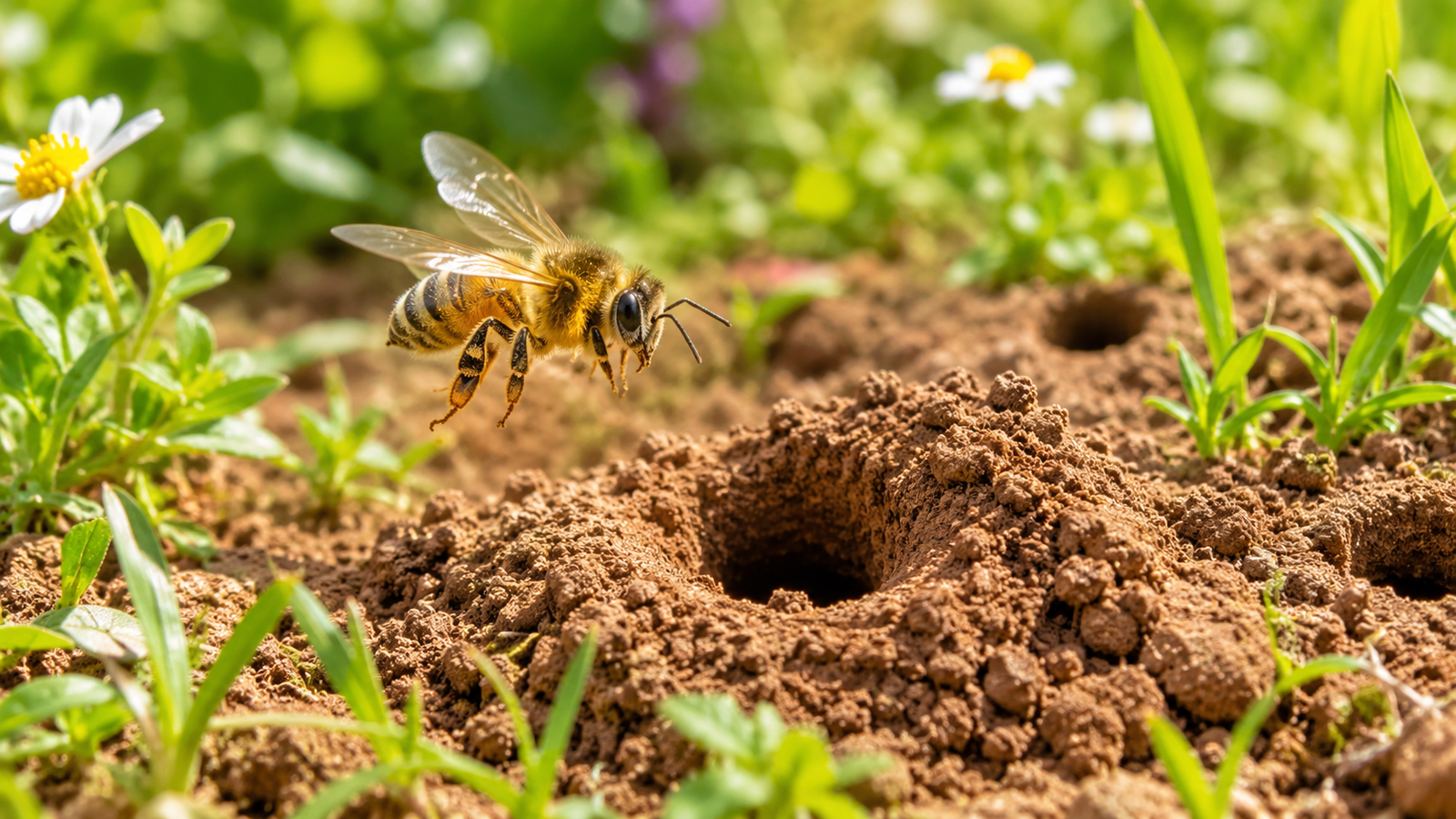
Have you noticed small holes in your lawn, garden, or bare soil with bees flying in and out? You may be looking at the nest of a ground-nesting bee. Several types of bees live underground, including mining bees, sweat bees, plasterer bees, squash bees, and certain other solitary species.
Ground-nesting bees use soil to create tunnels and individual chambers where they lay eggs and provide food for their developing young. Some species dig their own burrows, while others use existing underground cavities. Most ground-nesting bees are solitary, meaning each female manages her own nest, even when hundreds of bees occupy the same patch of ground.
Not every insect that enters a hole in the ground is a bee. Yellowjackets and other wasps also build underground nests, and their behavior can be considerably different.
Understanding what bee nests in the ground, what the entrances look like, and how different species behave can help you identify the insects in your yard and decide whether they need any attention.
What Bee Nests in the Ground?
Several types of bees nest in the ground, particularly mining bees, sweat bees, plasterer bees, digger bees, and squash bees. These bees generally use underground tunnels or chambers to protect their eggs and developing offspring.
Some common examples include:
- Mining bees (Andrena): Solitary bees that excavate individual tunnels in soil and create underground brood cells.
- Sweat bees (Halictidae): A diverse group containing many ground-nesting species, including solitary and social species.
- Plasterer bees (Colletes): Bees that line their underground brood cells with protective waterproof secretions.
- Digger bees: A common name for several groups of bees that excavate nests in soil or banks.
- Squash bees (Peponapis and Xenoglossa): Ground-nesting bees associated with squash, pumpkins, and other cucurbit plants.
- Bumblebees (Bombus): Some species establish social colonies in abandoned rodent burrows and other underground cavities.
An important distinction is that not every bee living below ground digs its own tunnel. Mining bees and many other solitary species excavate their nests, whereas bumblebees often occupy cavities that already exist.
Honey bees generally nest differently. They usually establish colonies inside enclosed spaces, such as hollow trees, wall cavities, and managed beehives, rather than excavating individual tunnels in soil.
The exact species you find depends on your geographical location, local climate, soil conditions, and available flowering plants.
Which Types of Bees Nest in the Ground?
Ground-nesting bees belong to several different groups. Although they share an association with underground nesting, they differ in their appearance, behavior, food requirements, and nest construction.
1. Mining Bees (Andrena)
Mining bees are among the most recognizable ground-nesting bees. They belong to the genus Andrena within the family Andrenidae.
Unlike honey bees, which live in large colonies, most mining bees are solitary. Each female excavates her own underground nest, creates brood cells, and collects pollen and nectar to feed her developing offspring.
A female mining bee usually searches for suitable soil before beginning excavation. She may select a sunny patch with good drainage and relatively little vegetation.
How to recognize mining bees:
- Usually small to medium-sized, although individual species vary.
- Often brown, black, dark reddish, or covered with pale hairs.
- Some species have noticeable bands or markings on their abdomens.
- Frequently fly low over the ground near their nesting sites.
- May leave small circular holes with loose soil around the entrance.
- Several females may nest close together in favorable locations.
Example: A homeowner notices numerous small holes in a sunny section of the lawn. Small, hairy bees repeatedly land near the openings and disappear underground. This could be a nesting aggregation of mining bees, with individual females maintaining separate nests.
Although these bees may appear to live in one large colony, each female generally manages her own underground nest.
2. Sweat Bees (Halictidae)
Sweat bees belong to the family Halictidae, a large and diverse family containing many species with different nesting habits.
Many sweat bees nest in the ground, excavating small tunnels and creating chambers for their offspring. Depending on the species, their nesting arrangements can be solitary, communal, or social.
Some sweat bees are particularly noticeable because of their metallic green, blue, or bronze coloration. Others are dark, brown, or less brightly colored.
How to recognize sweat bees:
- Many species are relatively small.
- Some have shiny metallic green or blue bodies.
- Others have dark or brown coloration.
- Frequently visit flowering plants for pollen and nectar.
- Many species nest in bare or sparsely vegetated soil.
- Their nesting and social behavior varies considerably.
The name sweat bee comes from the attraction some species show to perspiration, which provides salts and moisture. However, not every member of this family is attracted to human sweat.
Example: You may notice small metallic-green bees visiting flowers and repeatedly returning to tiny openings in a garden bed. Some species of sweat bees show this type of behavior.
Do not assume that every shiny green bee is a sweat bee. Accurate identification may require examining its body structure and other characteristics.
3. Plasterer Bees or Cellophane Bees (Colletes)
Plasterer bees, also known as cellophane bees, belong to the genus Colletes in the family Colletidae.
These bees are particularly interesting because of how they construct their underground brood cells.
A female excavates a tunnel in suitable soil and prepares individual chambers for her offspring. She lines the walls of these chambers with a protective secretion that hardens into a thin, waterproof membrane.
The lining helps protect the brood provisions and developing larvae from moisture.
How to recognize plasterer bees:
- Usually small to medium-sized.
- Often covered with short or moderately dense hairs.
- Some species have pale bands across their abdomens.
- Visit flowers to collect pollen and nectar.
- Frequently nest in soil or suitable banks.
- Some species form nesting aggregations.
Example: Several bees repeatedly enter separate holes in a sunny soil bank. Their body markings may resemble other solitary bees, so the entrance pattern alone cannot establish that they are plasterer bees.
The most distinctive feature of Colletes is not simply its appearance but the protective lining it constructs inside its brood cells.
4. Digger Bees
Digger bee is a common name rather than one scientific family. It is used for several types of bees that excavate their own nests in the ground.
Some species in the genus Anthophora, for example, dig nesting tunnels in soil, banks, and other suitable materials.
Their nesting structures vary. Some create relatively simple underground tunnels, while others may produce more noticeable entrance features.
How to recognize some digger bees:
- Often robust or hairy-bodied.
- May have brown, black, or pale body markings.
- Can fly rapidly around nesting locations.
- May use exposed soil, slopes, and banks.
- Some species create small mounds or raised structures around entrances.
Because the name covers different bee groups, it is important not to treat all digger bees as one species or assume that they have identical nesting habits.
5. Squash Bees (Peponapis and Xenoglossa)
Squash bees are an especially useful example of ground-nesting bees because of their close relationship with agricultural plants.
They belong to two genera, Peponapis and Xenoglossa, and are specialist pollinators of squash, pumpkins, and related plants in the cucurbit family.
Unlike honey bees, which visit many different flowering plants, squash bees are particularly associated with cucurbit flowers.
Females construct underground nests, often in soil near the plants they pollinate. They collect pollen from squash-family flowers to provision their brood cells.
How to recognize squash bees:
- Often resemble small or medium-sized honey bees.
- Usually have brown, black, or yellowish body markings, depending on species.
- Frequently visit squash and pumpkin flowers.
- May be active early in the morning.
- Nest in soil near suitable cucurbit crops.
Practical example: If you grow pumpkins or squash and notice bees visiting the flowers early in the morning, some may be squash bees. Their underground nesting activity may occur in nearby soil.
Squash bees are important because they help pollinate crops that provide food for people.
6. Bumblebees (Bombus)
Some bumblebees nest underground, but their nesting behavior is different from that of most solitary ground-nesting bees.
Bumblebees are social insects. A colony typically develops from a single queen that establishes a nest and raises the first workers.
Instead of excavating an extensive tunnel system, many bumblebee queens use existing underground cavities, including abandoned rodent burrows.
Other suitable locations may include sheltered spaces beneath grass tussocks, compost piles, or brush.
How to recognize a possible underground bumblebee nest:
- Large, fuzzy bees repeatedly enter and leave one location.
- Activity is concentrated around a particular opening.
- The entrance may be concealed by grass or other vegetation.
- Workers may carry visible pollen on their hind legs.
- The colony may become more active as it develops.
Example: You notice several large, fuzzy bees entering and leaving an opening beneath a patch of grass. Their repeated movement to one entrance may indicate a bumblebee colony.
Unlike a solitary mining bee nest, a bumblebee nest can contain a queen and multiple workers living together.
Do not approach or disturb a suspected bumblebee nest. Workers can sting when they feel their colony is threatened.
What Does a Ground Bee Nest Look Like?
A ground-nesting bee nest often appears as a small, round opening in bare soil. Some entrances have a little mound of loose earth around them, while others are almost level with the surrounding ground.
The appearance depends on the bee species, soil type, weather, and stage of nest construction.
Common features include:
- Small circular openings in the ground.
- Loose soil or tiny mounds around some entrances.
- Several separate holes within one patch of soil.
- Bees repeatedly entering and leaving particular openings.
- Nesting sites in sunny areas, slopes, garden borders, and exposed soil.
Not every ground bee nest has a visible mound. Rain, wind, foot traffic, and soil conditions can change the appearance of an entrance.
The size of an opening also varies between species. Therefore, hole diameter alone is not a reliable way to identify the bee.
Common appearances of ground-nesting bee sites
Small opening with loose soil
A small circular opening surrounded by freshly excavated soil may indicate a bee actively digging its nest.
Several holes in one area
Multiple entrances may indicate a nesting aggregation, with individual female bees maintaining separate underground nests.
One entrance with repeated large-bee activity
This pattern could indicate a bumblebee colony occupying an existing cavity, although other insects may use similar entrances.
A hole with no visible bee activity
An entrance without visible activity does not necessarily mean the nest is empty. The adult bees may be inactive, or immature stages may remain underground.
A photograph of an entrance can help document the site, but identifying the insect usually requires observing the bees themselves.
How to Identify a Bee Nest in the Ground
Finding a small hole in your lawn does not automatically mean you have a ground-nesting bee. The best way to investigate is to observe the insect, the entrance, the surrounding soil, and its activity.
Use the following identification steps.
1. Observe the insects entering and leaving
Watch the opening from a safe distance.
Look for insects repeatedly landing at the same entrance and disappearing into the soil.
Solitary bees may fly low over the ground, hover briefly, and enter individual holes. Bumblebee workers may repeatedly use one entrance to access a shared colony.
Wasps can also enter and leave underground openings, so repeated activity alone does not prove that the insects are bees.
2. Examine the surrounding soil
Ground-nesting bees use different soil conditions, but many favor relatively undisturbed, well-drained areas.
Look for:
- Bare or sparsely vegetated soil.
- Sunny patches in gardens and lawns.
- Soil banks and gentle slopes.
- Areas with suitable drainage.
- Ground near flowering plants.
Sandy or loose soil is suitable for some species, but it is not a universal requirement. Different bees have different soil preferences.
3. Look at the number and arrangement of entrances
The pattern of openings can provide useful clues.
A group of separate holes may indicate several solitary females nesting close together.
A single entrance with concentrated traffic may suggest a social colony, such as a bumblebee nest or a yellowjacket nest.
However, entrance patterns are not enough to confirm a species.
4. Observe the bees’ physical characteristics
If you can safely observe the insects, pay attention to:
- Body size.
- Body hair.
- Color and markings.
- Shape of the abdomen.
- Whether pollen is visible on their bodies or legs.
- Whether they visit flowers.
- Whether they appear to defend a shared entrance.
Many bees have hairy bodies that help collect pollen, but some bees are relatively smooth. Some wasps also have hairs.
For this reason, avoid identifying an insect from color alone.
5. Observe activity without disturbing the nest
A short observation period can help you understand the behavior.
For example, you might notice individual bees visiting flowers and returning to separate openings. That pattern is consistent with solitary nesting.
Alternatively, you might see large numbers of insects gathering around one underground entrance and reacting defensively when someone approaches. That behavior raises concern for a social wasp colony.
Never dig into a nest to investigate its structure.
Ground-nesting bee identification comparison
| Bee group | General appearance | Typical nesting behavior |
|---|---|---|
| Mining bees | Often hairy, brown or dark | Individual excavated tunnels |
| Sweat bees | Often small; some metallic green | Solitary, communal, or social nests |
| Plasterer bees | Often hairy with pale abdominal bands | Soil tunnels with lined brood cells |
| Digger bees | Varies by group | Excavated tunnels in soil or banks |
| Squash bees | Often similar to small honey bees | Individual nests near cucurbit crops |
| Bumblebees | Large and fuzzy | Social colonies in existing cavities |
These are general identification clues rather than a definitive field identification key.
For a more reliable identification, take a clear photograph of the insect from a safe distance and consult a local entomologist, university extension service, or pollinator specialist.
Ground-Nesting Bees vs. Ground-Nesting Wasps
One of the most important things to establish when you discover an underground insect nest is whether it belongs to a bee or a wasp.
Both groups can use soil for nesting, and their entrances may look similar.
Yellowjackets are particularly important to distinguish because many species establish large underground colonies and can defend their nests aggressively.
| Feature | Ground-nesting bees | Ground-nesting wasps |
|---|---|---|
| Body appearance | Many species are hairy | Many species are smoother |
| Food | Adults collect pollen and nectar; larvae receive provisions | Many hunt insects or spiders; some also scavenge |
| Nest structure | Often individual brood cells in tunnels | May contain shared chambers or paper nests |
| Social behavior | Solitary, communal, or social depending on species | Solitary or social depending on species |
| Pollination | Many are important pollinators | Some also visit flowers and pollinate |
| Nest defense | Many solitary species are not defensive | Social species may defend the colony strongly |
These are general tendencies, not absolute rules.
How to recognize a possible yellowjacket nest
Yellowjackets are wasps in genera including Vespula and Dolichovespula.
Some species establish underground nests in abandoned animal burrows or other cavities.
Possible warning signs include:
- Numerous yellow-and-black wasps using one entrance.
- Repeated flights to and from a shared opening.
- Several insects appearing to guard the entrance.
- Defensive behavior when people approach.
- Increased activity around the same location.
Do not approach the opening to check whether it is a yellowjacket nest.
Unlike most solitary ground-nesting bees, social yellowjackets may have hundreds or thousands of workers in a colony, depending on the species and stage of development.
If you suspect yellowjackets, keep people and pets away and contact a qualified local pest professional.
How Do Ground-Nesting Bees Build Their Nests?
Ground-nesting bees use underground spaces to protect their eggs and provide food for their developing young.
Although nest construction differs between species, many solitary ground-nesting bees follow a similar general process.
Step 1: Find suitable soil
A female searches for a location with soil conditions appropriate for excavation and brood development.
Depending on the species, this may be exposed ground, a sunny bank, or a patch of well-drained soil.
Step 2: Excavate an entrance and tunnel
The female uses her legs and other body structures to remove soil and create an underground passage.
The entrance may be visible as a small opening, sometimes accompanied by loose soil.
Step 3: Create brood cells
Inside the nest, the female prepares individual chambers where her offspring will develop.
The number, arrangement, and depth of these cells vary by species and soil conditions.
Step 4: Collect pollen and nectar
The female visits flowers to gather pollen and nectar.
She transports these resources back to the nest and prepares food provisions for her developing offspring.
Step 5: Lay an egg
After preparing a brood cell and its food supply, the female lays an egg and closes or seals the chamber.
The egg eventually develops into a larva, which feeds on the stored provisions.
Step 6: Development continues underground
The developing bee passes through its immature stages before eventually becoming an adult.
Depending on the species, it may emerge during the same season or remain underground through an extended period, including winter.
An important difference: Plasterer bees in the genus Colletes line their brood cells with protective secretions, while other ground-nesting bees construct their chambers differently. Not every ground-nesting bee produces the same type of underground structure.
Why Do Bees Nest in the Ground?
Bees use underground nesting sites because soil can provide suitable conditions for reproduction and the development of their offspring.
However, not every bee prefers the same type of soil or nesting environment.
1. Suitable soil for excavation
Many solitary ground-nesting bees need soil that can be excavated without collapsing.
The texture, moisture, drainage, and stability of the soil can influence where a female establishes her nest.
2. Protection for developing offspring
Underground brood cells provide a sheltered environment for eggs and larvae.
The surrounding soil helps protect developing bees from direct exposure to weather and some environmental disturbances.
3. Temperature and moisture conditions
Soil can reduce rapid temperature changes and provide a more buffered environment than the exposed ground surface.
However, excessive moisture and poor drainage can damage some nests.
4. Nearby flowering plants
Female bees need access to pollen and nectar.
Flowers provide food for adult bees and the pollen provisions required by developing offspring.
Some species have specialized relationships with particular flowering plants, which influences where they nest and forage.
5. Relatively undisturbed habitat
Repeated digging, tilling, heavy compaction, flooding, and unnecessary pesticide use can make an area unsuitable for nesting.
Ground-nesting bees often benefit from patches of soil that remain undisturbed during their nesting and development periods.
When Are Ground-Nesting Bees Active?
Ground-nesting bee activity varies considerably by species, geographical location, and climate.
Some species emerge early in the year, while others become active during warmer months.
In temperate regions, mining bees and other solitary species may be particularly noticeable during spring. Some squash bees are active around the flowering period of squash-family plants.
In tropical regions, including parts of West Africa, seasonal rainfall, local temperatures, flowering periods, and species biology can influence when bees nest and forage.
There is no single worldwide month when all ground-nesting bees become active.
What happens during the nesting season?
A typical solitary bee life cycle may include:
- Adult females emerge from their developmental stage.
- Females locate suitable nesting sites.
- They excavate tunnels and prepare brood cells.
- They collect pollen and nectar.
- They lay eggs and provision their offspring.
- Developing bees remain in the nest until their next emergence.
Some species have one generation per year, while others have different developmental schedules.
Bumblebee colonies have a different social life cycle. A queen establishes a colony, workers develop and maintain it, and reproductive individuals are produced later in the season.
Are Ground-Nesting Bees Dangerous?
Most solitary ground-nesting bees are generally not aggressive toward people when left undisturbed.
They are usually focused on collecting food, building nests, and raising their offspring rather than defending a large shared colony.
However, it is important not to assume that every underground nest is harmless.
Can ground-nesting bees sting?
Some female ground-nesting bees can sting, although many solitary species are reluctant to do so unless handled, trapped, or threatened.
Male bees cannot sting because they do not possess a functional stinger.
Bumblebees can sting when defending their colony, and social ground-nesting wasps such as yellowjackets can pose a greater risk when their nest is disturbed.
How to stay safe around a ground bee nest
If you discover a possible bee nest:
- Avoid stepping directly on the entrances.
- Do not pick up or handle the insects.
- Keep children and pets away from the nesting area.
- Avoid digging or disturbing the soil.
- Do not block the entrances.
- Do not pour chemicals, petrol, or other substances into the holes.
- Keep a safe distance if the insects appear defensive.
If you suspect a yellowjacket colony or another defensive social insect, do not attempt to investigate or remove it yourself.
People with a known severe insect-sting allergy should take particular care around stinging insects.
Medical emergency: Difficulty breathing, swelling of the tongue or throat, faintness, or collapse after an insect sting can indicate anaphylaxis. Use prescribed epinephrine immediately if available and seek emergency medical care.
What Should You Do If You Find a Bee Nest in Your Yard?
In most situations, the best response is to identify the insect and leave the nest undisturbed.
Many solitary ground-nesting bees are beneficial pollinators and do not cause significant damage to lawns or gardens.
Follow these steps.
Step 1: Observe the insects
Watch the nesting area from a safe distance.
Look at their size, appearance, flight behavior, and the number of entrances they use.
Do not dig into the soil to identify them.
Step 2: Determine whether the insects are bees or wasps
If you see hairy insects visiting flowers and entering individual holes, they may be solitary ground-nesting bees.
If you see numerous smooth-bodied yellow-and-black insects using one entrance and reacting defensively, consider the possibility of yellowjackets.
When uncertain, ask a qualified insect identification expert.
Step 3: Protect the nesting area
Avoid unnecessary disturbance.
If possible, reduce foot traffic around the entrances and avoid mowing directly over an active nesting patch.
You can use a temporary visual marker placed at a safe distance to help people recognize the area.
Step 4: Avoid filling the holes
Do not automatically fill the entrances with soil, sand, cement, or other materials.
A nest that appears inactive at the surface may still contain developing bees underground.
Filling or excavating it could kill immature insects.
Step 5: Avoid chemicals and flooding
Do not pour pesticides, petrol, detergents, or boiling water into suspected bee nests.
These methods can harm beneficial insects, contaminate soil, and fail to address the actual cause of the problem.
Step 6: Seek professional assistance when necessary
If the nest is close to a busy entrance, children’s play area, or another location where people cannot avoid it, seek advice from a qualified local professional.
If the insects behave defensively, treat the site as a potential social wasp nest until it has been properly identified.
The goal is to protect people while avoiding unnecessary destruction of beneficial pollinators.
Do Ground-Nesting Bees Make Honey?
Most ground-nesting bees do not produce harvestable honey.
Although they collect nectar and pollen, their food-storage behavior is different from that of honey bees.
Solitary ground-nesting bees usually collect enough pollen and nectar to provision individual brood cells. They do not normally produce the large communal honey reserves associated with honey bee colonies.
How are ground-nesting bees different from honey bees?
Ground-nesting solitary bees
- Usually maintain individual nests.
- Collect pollen and nectar for their offspring.
- Store food in relatively small brood-cell provisions.
- Generally do not construct large honeycomb reserves.
Honey bees (Apis mellifera)
- Live in social colonies.
- Construct wax combs.
- Store substantial quantities of honey.
- Use honey as a food reserve for the colony.
Bumblebees may store small quantities of nectar in their nests, but they do not produce and store honey in the same way as honey bees.
Therefore, finding bees entering a hole in the ground does not mean you have discovered a honey bee colony.
How Long Do Ground Bee Nests Last?
The lifespan of a ground bee nest depends on the species, its life cycle, and environmental conditions.
Many solitary ground-nesting bees have seasonal nesting periods. A female establishes a nest, provisions its brood cells, and lays eggs. The developing offspring may remain underground until they are ready to emerge.
Some species produce one generation each year, while others have different developmental schedules.
Do ground bees return to the same nest every year?
Not necessarily.
Some nesting sites may remain attractive to bees for several seasons because the soil and surrounding habitat continue to provide suitable conditions.
However, it is important to distinguish between the same nesting location being used repeatedly and the same individual bee returning to the exact tunnel.
A later generation may establish nests in the same general area without using the original burrow.
What happens when ground bees disappear?
If you stop seeing bees around an entrance, several things may have happened:
- The adult nesting period has ended.
- The females have completed their nesting activity.
- Developing offspring remain underground.
- Weather conditions have temporarily reduced activity.
- The nesting site is no longer suitable.
An inactive-looking entrance is not proof that the underground nest is empty.
Avoid digging up or filling the area simply because you no longer see adult bees.
Do Ground-Nesting Bees Damage Lawns?
Ground-nesting bees generally cause little significant damage to healthy lawns.
Their underground tunnels and entrances may make certain areas look uneven, especially when many females nest close together.
However, these bees do not normally feed on grass roots or damage lawns by eating vegetation.
What lawn changes might you notice?
- Small circular holes in bare soil.
- Tiny mounds of excavated earth.
- Increased bee activity in one section of the lawn.
- Small patches of exposed soil.
- Temporary changes in the appearance of the nesting area.
These signs do not necessarily indicate a pest infestation.
A large number of small holes can simply mean that the soil provides favorable nesting conditions for several solitary bee females.
If the area is not creating a safety concern, there is generally no reason to remove the nests.
How Can You Attract and Protect Ground-Nesting Bees?
Ground-nesting bees need suitable nesting soil, access to flowers, and relatively undisturbed habitat.
You can support them by making small changes to your garden or outdoor space.
1. Preserve suitable soil patches
Some ground-nesting bees require exposed or sparsely vegetated soil.
If you have suitable areas in your garden, consider leaving them undisturbed instead of covering every patch with paving, thick mulch, or dense vegetation.
Different species prefer different soil conditions, so a variety of suitable habitats can be helpful.
2. Grow flowering plants
Provide a variety of flowering plants that produce pollen and nectar.
Choose plants suited to your local climate and region, and aim for flowers that bloom at different times.
Native flowering plants can be especially valuable because they often support local pollinators.
3. Avoid unnecessary pesticide applications
Pesticides can harm bees directly or contaminate the flowers and other resources they depend on.
Avoid spraying flowering plants when bees are visiting them, and follow appropriate professional guidance when pest management is necessary.
4. Protect existing nesting sites
If you discover a ground-nesting bee aggregation, avoid disturbing the soil.
Repeated digging, tilling, and compaction can damage underground brood cells and make the habitat unsuitable.
5. Provide suitable water and forage
Flowering plants provide food, while a suitable, shallow water source can help support some pollinators.
Keep water sources clean and provide safe landing surfaces so insects are less likely to become trapped.
6. Avoid unnecessary artificial bee houses
Not every bee needs a wooden bee hotel.
Many solitary bees naturally nest in the ground, so protecting suitable soil and flowering habitat is more relevant to these species than installing above-ground nesting structures.
Frequently Asked Questions About What Bee Nest in the Ground?
1. What bee nests in the ground?
Several types of bees nest in the ground, including mining bees, sweat bees, plasterer bees, digger bees, and squash bees. Some bumblebees also establish colonies in underground cavities. Their nesting methods differ, with some excavating tunnels and others occupying existing spaces.
2. What are bees that live in the ground called?
They are commonly called ground-nesting bees or ground bees. The term describes bees that nest in soil or underground cavities rather than one particular bee species or scientific family.
3. Are ground bees the same as mining bees?
No. Mining bees are one group of ground-nesting bees, particularly species in the genus Andrena. Other ground-nesting bees include sweat bees, plasterer bees, and squash bees.
4. Why are there so many bee holes in my yard?
Your yard may contain a nesting aggregation. This happens when several female solitary bees establish individual nests close together because the soil and surrounding habitat are suitable.
Many holes do not necessarily mean one large colony.
5. How can I tell if a hole in the ground belongs to a bee?
Look for small circular openings, loose soil around some entrances, and bees repeatedly entering and leaving the holes. However, wasps, ants, and other insects also use underground openings. Observe the insects from a safe distance rather than relying on the hole’s appearance alone.
6. Do ground bees return to the same nest every year?
Some nesting areas remain suitable for several years, so later generations may establish nests nearby. However, this does not mean the same individual bee returns to the exact same tunnel.
7. Should I fill ground bee holes with dirt?
No, not if the holes may contain active nests or developing bees. Filling them can damage underground brood cells. Leave the area undisturbed unless a genuine safety concern requires professional intervention.
8. Do ground bees sting humans?
Some female ground-nesting bees can sting, but many solitary species are generally reluctant to sting unless handled or threatened. Male bees cannot sting. Bumblebees and social ground-nesting wasps can present different risks.
9. Can ground bees live in sandy soil?
Yes. Many species use sandy or loose soil, but preferences vary. Some bees favor other soil textures and well-drained locations. Sandy soil is not a universal requirement for all ground-nesting bees.
10. Are ground-nesting bees beneficial?
Yes. Many ground-nesting bees are important pollinators. They visit flowering plants, collect pollen and nectar, and contribute to the reproduction of wild plants and agricultural crops.
11. Do honey bees nest in the ground?
Honey bees (Apis mellifera) generally establish colonies inside enclosed cavities, such as hollow trees, wall spaces, and managed beehives. They do not normally excavate individual underground tunnels like mining bees.
12. What is the difference between a ground bee nest and a yellowjacket nest?
Many solitary ground-nesting bees create individual underground brood cells, even when several females nest close together. Yellowjackets are social wasps that can establish shared underground colonies with many workers. Yellowjackets may defend their nests aggressively, so an unidentified nest should never be approached or disturbed.
13. How deep are ground bee nests?
Nest depth varies by species, soil conditions, and the structure of the burrow. Some nests are relatively shallow, while others extend farther underground. There is no single depth that applies to all ground-nesting bees.
14. Do ground-nesting bees make holes in lawns?
Yes. Females of many ground-nesting species excavate small openings in suitable soil. These holes are usually minor and do not mean that the bees are eating grass roots or destroying the lawn.
15. What time of year do ground-nesting bees appear?
Their activity depends on the species and local climate. Some emerge in spring, while others are active during warmer parts of the year. Flowering periods, rainfall, temperature, and the bee’s life cycle influence when adults become visible.
Scientific Sources and Further Reading
The following educational and scientific resources provide additional information about ground-nesting bees, their identification, nesting behavior, and conservation.
- The Xerces Society – Nesting Resources
Explains ground-nesting bees, bumblebee nesting cavities, squash bees, and suitable pollinator habitats. - Utah State University Extension – Solitary/Ground Bees
Provides information about mining bees, plasterer bees, sweat bees, identification, and nesting habits. - University of Maryland Extension – Mining Bees in Lawns
Explains the solitary behavior of mining bees, their nesting aggregations, and their activity in lawns. - University of Maryland Extension – Insects and Mites in Home Lawns
Discusses ground-nesting bees and wasps and their ecological roles in lawns. - Penn State Extension – Nesting Behavior of Stinging Insects
Explains the different nesting strategies of bees, bumblebees, and wasps. - Cornell University – Yellowjackets and Bald-Faced Hornets
Provides information about yellowjacket identification, underground nesting, and colony behavior. - Antoine et al. – Nesting Habitat of Ground-Nesting Bees: A Review, Ecological Entomology (2021)
A scientific review of the nesting habitats and ecological requirements of ground-nesting bees.
Final Thoughts
So, what bee nests in the ground? Several types of bees live underground, including mining bees, sweat bees, plasterer bees, digger bees, and squash bees. Certain bumblebees also establish colonies in underground cavities, although they often use existing spaces rather than digging their own tunnels.
Most solitary ground-nesting bees create individual nests, even when many entrances appear close together. Their underground chambers protect developing offspring, while pollen and nectar collected from flowers provide food for the next generation.
If you discover small holes with bees flying in and out of your lawn or garden, observe the insects before deciding what they are. Remember that some underground nests belong to wasps, including yellowjackets, which can be more defensive.
When the insects are confirmed to be solitary ground-nesting bees and the location does not create a safety concern, leaving the nest undisturbed is usually the best approach.
Understanding what bee nests in the ground helps you identify unfamiliar insects, protect useful pollinators, and make better decisions about your outdoor space.

2 Comments
Pingback: Where to Put Bee House? Best Placement Tips for Your Garden - BeekeeperBase
Pingback: What Bee Is Black and White? 10 Types of Black-and-White Bees - BeekeeperBase