

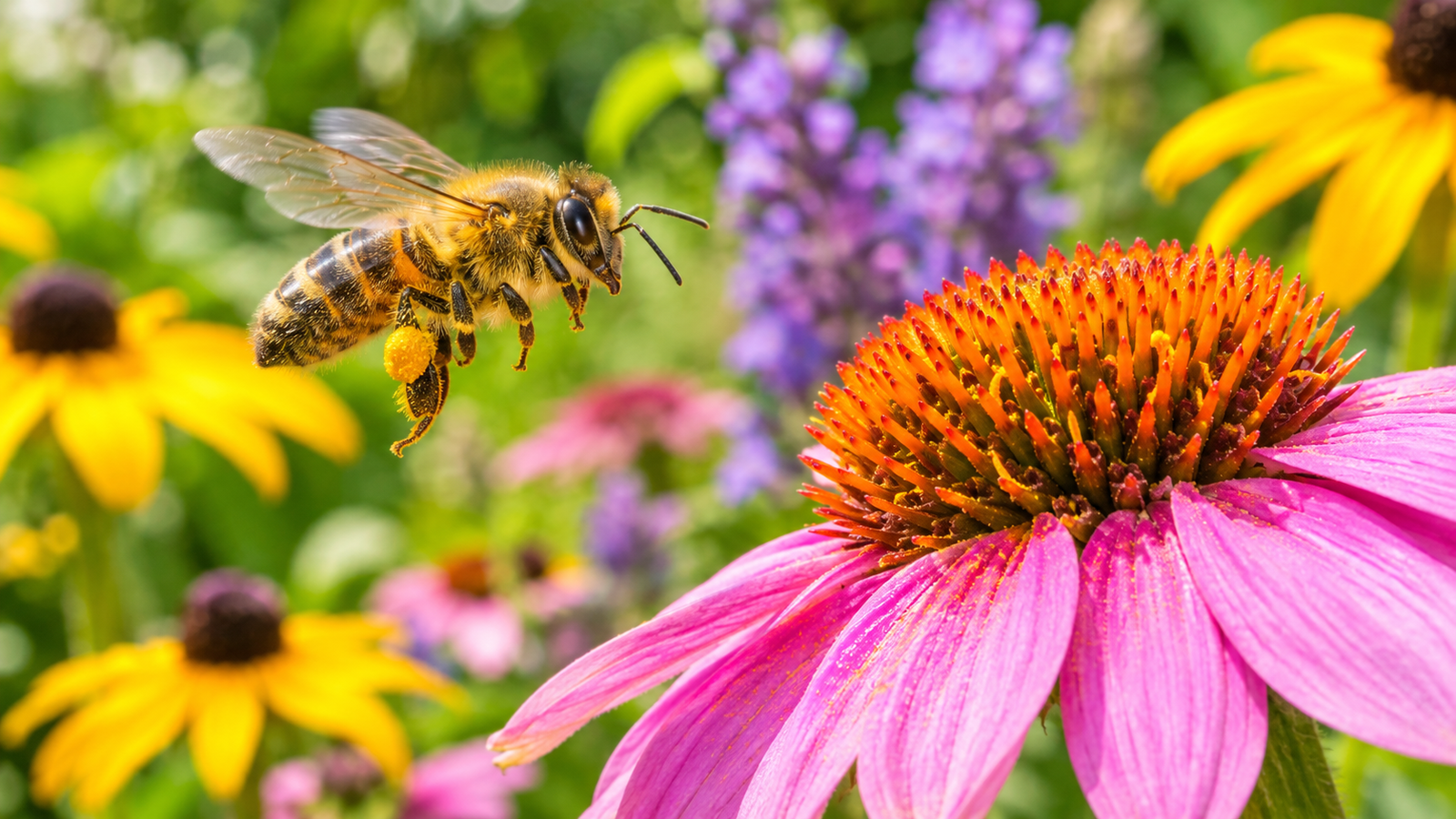
Bees find flowers using a combination of smell, sight, ultraviolet vision, memory, and navigation. They detect chemical scents released by flowering plants, recognize flower colors and patterns, and remember locations where they previously collected nectar and pollen. Some bees can also detect weak electrical fields around flowers, giving them additional information when searching for food.
But how do bees know where flowers are when they cannot see them? Can they smell flowers from a distance? Do they recognize particular flower colors, and how do honey bees tell other bees where to find food?
Bees use several specialized sensory abilities to answer these challenges. They combine visual and chemical signals to locate flowers, assess the available food rewards, and return to productive feeding locations.
Different bee species also have different foraging strategies. Honey bees communicate food locations through the waggle dance, while bumblebees and solitary bees rely more heavily on individual exploration, learning, and memory.
In this article, you will discover exactly how bees find flowers, how their senses work together, why they prefer certain flowers, how far they travel for food, and what you can do to attract more bees to your garden.
How Do Bees Find Flowers?
Bees find flowers by detecting visual and chemical signals from flowering plants. They use their eyes to recognize colors, shapes, and ultraviolet patterns, while their antennae detect floral scents. Once they approach a flower, they use additional sensory information and previous feeding experiences to identify potential sources of nectar and pollen.
The process generally involves these stages:
- Detecting flowers: Bees encounter floral scents and visual displays in their surroundings.
- Approaching flowers: They use visual information and chemical signals to move toward potential food sources.
- Recognizing flowers: They identify familiar colors, shapes, patterns, and scents.
- Inspecting flowers: They use close-range sensory information to locate feeding opportunities.
- Assessing food rewards: They collect nectar or pollen and learn whether the flower provides worthwhile food.
- Remembering locations: They learn which flowers are rewarding and remember where to find them.
- Communicating discoveries: Honey bees can advertise productive flower locations to other colony members through the waggle dance.
These stages are not always separate or strictly sequential. Bees combine different sensory signals depending on the flower species, environmental conditions, and their previous experiences.
1. Bees Use Their Sense of Smell to Find Flowers
One of the most important ways bees find flowers is through their sense of smell.
Flowers release airborne chemical compounds called volatile organic compounds (VOCs). These compounds create floral scents that attract pollinators and provide information about flowering plants.
Bees detect these chemical signals using specialized olfactory receptors, particularly on their antennae.
Different flowers release different combinations of scent compounds. Lavender, for example, produces a different scent profile from sunflower, borage, or clover.
Through experience, bees can learn to associate particular floral odors with rewarding sources of nectar and pollen.
Smell helps bees in several ways:
- Detecting floral odors carried through the air.
- Recognizing familiar flowering plants.
- Distinguishing between different floral scents.
- Identifying potential food sources.
- Remembering flowers associated with previous feeding experiences.
Example: A bee searching around a garden may encounter the scent of flowering lavender. It can use this odor as one clue when searching for the plant, then combine it with visual information to approach and inspect the flowers.
However, bees do not simply follow every floral scent they encounter. Wind direction, scent concentration, surrounding vegetation, and previous experience influence how useful an odor is.
2. Bees Use Color Vision to Recognize Flowers
Bees have specialized color vision that helps them recognize flowers and distinguish them from surrounding vegetation.
Unlike humans, bees have three types of color-sensitive photoreceptors that respond primarily to:
- Ultraviolet light.
- Blue light.
- Green light.
Humans have red-, green-, and blue-sensitive cone cells, but bees do not have a dedicated red-sensitive photoreceptor.
This means a flower may appear very different to a bee than it does to a human.
For example, a flower that looks uniformly yellow to us may contain ultraviolet markings that a bee can detect.
Bees can also learn to associate particular flower colors with rewarding food sources. If a bee repeatedly finds nectar in flowers with a particular color, it can learn to recognize that visual characteristic when searching for food.
Can bees see red flowers?
Yes, bees can visit red flowers even though they do not have a dedicated red-sensitive photoreceptor.
Some red flowers reflect ultraviolet, blue, or green wavelengths that bees can detect. Floral scent, shape, and other visual characteristics may also help attract them.
Therefore, it is incorrect to say that bees cannot visit red flowers. Their perception of red simply differs from ours.
Research into honey bee color vision demonstrates that bees can learn visual patterns and use their color memories when choosing between different targets. PMC
3. Bees Use Ultraviolet Vision to Find Nectar Guides
One of the most fascinating ways bees find flowers is through their ability to see ultraviolet (UV) light.
Humans cannot normally see ultraviolet light, but bees have specialized photoreceptors that allow them to detect it.
Many flowers have ultraviolet patterns that are invisible to human eyes. These markings are sometimes called nectar guides because they can help direct pollinators toward the center of a flower.
For example, a yellow flower may appear to have a uniform surface to a human. Under ultraviolet imaging, however, it may reveal dark markings or lines pointing toward its center.
These patterns can help bees:
- Recognize flowers more easily.
- Identify the center of a flower.
- Locate potential feeding areas.
- Position themselves for collecting nectar and pollen.
- Contact reproductive structures during feeding.
Not every flower has ultraviolet nectar guides, and the patterns do not always show the exact location of nectar.
Nevertheless, ultraviolet vision provides bees with additional visual information that humans cannot normally observe.
4. Bees Can Detect Electrical Fields Around Flowers
An interesting scientific discovery is that bees can detect weak electrical fields around flowers.
Flying bees commonly accumulate a positive electrical charge, while flowers often have a different electrical potential. This creates weak electrical fields around the plants.
Bees can detect these fields through mechanical stimulation of sensory hairs covering their bodies.
This ability is known as electroreception.
Research suggests that floral electrical fields can provide additional information about flowers and influence how bees respond to them.
For example, a flower’s electrical field may change after a bee visits it. These changes can provide information about previous visits and may influence whether another bee chooses to approach it.
Electrical sensing is particularly interesting because it shows that bee–flower interactions involve more than color and smell.
However, electrical fields are an additional sensory cue, not the primary way bees locate flowers. Researchers continue to investigate their precise importance under natural conditions.
5. Bees Use Taste to Evaluate Nectar and Pollen
Finding a flower does not necessarily mean that it contains enough food to make the visit worthwhile.
Bees must assess the nectar and pollen available to them.
They have specialized taste receptors on different body parts, including their antennae, mouthparts, and feet.
These receptors help bees detect chemical properties of substances they encounter.
Nectar contains sugars that provide energy for flying and other activities. Its sugar concentration and composition vary between flower species and environmental conditions.
Bees can respond to these differences and learn which flowers provide rewarding nectar.
Pollen supplies proteins, fats, vitamins, and minerals that support colony nutrition and the development of young bees.
Example: A bee may visit two flower varieties in the same garden. One provides abundant nectar, while the other provides very little. Through feeding experience, the bee may learn to spend more time visiting the more rewarding flower variety.
Taste and previous feeding experiences therefore help bees evaluate flowers and influence their future choices.
6. Bees Remember Flowers and Return to Productive Locations
Bees have impressive learning and memory abilities that help them find flowers efficiently.
They can remember flower characteristics and locations associated with previous feeding experiences.
These characteristics may include:
- Flower color and shape.
- Floral scent.
- Surrounding vegetation.
- Nearby trees and other landmarks.
- The location of productive flower patches.
- The time of day when flowers provide food.
Bees can learn to associate particular flower characteristics with rewarding food sources.
For example, a bee that repeatedly finds nectar in flowers with a particular appearance may learn to recognize similar flowers during future foraging trips.
This does not mean that every flower with the same color will contain nectar. Rather, bees learn from experience and use combinations of visual and chemical information to make better decisions.
Do bees remember individual flowers?
Bees can learn and remember visual and scent characteristics, as well as familiar locations. However, it is more accurate to say they recognize rewarding flower types and locations than to assume they remember every individual flower.
This learning ability saves energy because bees do not need to explore unfamiliar areas repeatedly.
7. Bees Use the Sun and Landmarks to Navigate to Flowers
Bees need more than good eyesight and a strong sense of smell to find flowers. They also need to navigate through their environment.
They use several navigation methods to travel between their nests and feeding locations.
The position of the sun
Bees use the sun as a compass to determine direction. They can compensate for the sun’s movement across the sky using their internal biological clock.
Polarized light
Bees can detect patterns of polarized light in the sky. This provides directional information even when clouds partly obscure the sun.
Visual landmarks
Trees, buildings, fences, rocks, and other recognizable features help bees remember familiar routes and feeding locations.
Optic flow
As bees fly, objects in their surroundings appear to move across their visual field. This movement is called optic flow.
Bees use optic flow to estimate how far they have travelled.
For example, a honey bee flying through a narrow tunnel may experience more visual movement than one travelling the same distance through an open environment. This can affect its estimate of distance.
Research has demonstrated that visual motion plays an important role in honey bee distance estimation and waggle dance communication. Nature+1
8. Honey Bees Communicate Flower Locations Through the Waggle Dance
One of the most remarkable ways honey bees find flowers involves communication inside the hive.
When a worker honey bee discovers a rewarding source of nectar or pollen, it can return to the colony and perform a special movement called the waggle dance.
The dance communicates important information about the food source’s location.
How does the waggle dance work?
Direction
The angle of the waggle run relative to vertical on the comb indicates the direction of the food source relative to the sun.
Distance
The duration of the waggle run communicates information about the distance travelled. Longer waggle runs generally indicate more distant food sources.
Food-source attractiveness
The intensity and repetition of dancing can provide information about the attractiveness of a food source.
Other worker bees observe the dancing bee and use the information to search for the advertised location.
An important scientific detail is that honey bees estimate distance partly through optic flow rather than simply measuring the number of meters they fly.
Do all bees use the waggle dance?
No. The waggle dance is particularly associated with honey bees.
Bumblebees can learn from flower visits and use scent-related information, but they do not communicate food direction and distance using the same honey bee waggle dance.
Most solitary bees forage independently and do not recruit large groups of nestmates to food locations.
9. How Different Bee Species Find Flowers
Although different bee species share several sensory abilities, they do not all find flowers in exactly the same way.
Their behavior depends on their species, feeding requirements, social organization, and environment.
| Bee type | How it finds flowers | Distinctive behavior |
|---|---|---|
| Honey bees | Smell, vision, UV patterns, memory and navigation | Communicate food locations through waggle dances |
| Bumblebees | Visual and chemical cues, memory and learning | Can learn rewarding flower patterns and use specialized flower-handling techniques |
| Mason bees | Visual and chemical signals | Independently locate flowers and provision their nests |
| Leafcutter bees | Flower recognition and learned foraging cues | Collect pollen and nectar for their offspring |
| Carpenter bees | Visual and chemical signals | Some obtain nectar through openings at the base of flowers |
Honey bees
Honey bees live in colonies and have a highly developed system for communicating food locations.
A worker can discover a productive flower patch, return to the hive, and recruit other workers through the waggle dance.
Bumblebees
Bumblebees generally forage independently, although they live in social colonies.
They learn which flower colors, shapes, and scents are associated with rewarding food.
Some bumblebees also perform buzz pollination, vibrating their flight muscles to release pollen from flowers such as tomatoes.
Mason bees
Mason bees are solitary bees that locate flowers independently.
They collect pollen and nectar to provision individual nest cells for their developing offspring.
They do not rely on a colony recruitment system like honey bees.
Leafcutter bees
Leafcutter bees are also solitary. They visit flowers to collect pollen and nectar while using pieces of leaves to construct their nest cells.
Carpenter bees
Carpenter bees visit flowers for nectar and pollen. Some species can obtain nectar through openings at the base of flowers, a behavior known as nectar robbing.
These differences explain why flower-finding behavior should not be described as identical across all bee species.
10. Why Do Bees Prefer Certain Flowers Over Others?
Bees do not visit every flower they encounter. They often develop preferences based on the food rewards and characteristics of different plants.
Several factors influence which flowers bees choose.
| Factor | Why it matters | Example |
|---|---|---|
| Nectar availability | Provides energy for flight and activity | Nectar-producing lavender |
| Pollen availability | Supplies nutrients for developing bees | Sunflower florets |
| Floral scent | Helps bees recognize flowering plants | Fragrant herbs |
| Color | Provides visual recognition signals | Blue and yellow flowers |
| Flower shape | Influences landing and feeding | Open and tubular flowers |
| Flower age | Can be associated with changing rewards | Lungwort |
| Distance | Influences the energy required to forage | Nearby flower patches |
| Weather | Affects bee activity and nectar availability | Warm, suitable foraging conditions |
Why does flower age matter?
Some flowers change color as they mature.
A useful example is lungwort (Pulmonaria), whose flowers can change from pinkish or reddish shades to blue as they age.
In some plants, these color changes are associated with changes in flower reward and reproductive condition.
Bees can use visual information to distinguish between different flower stages, although color alone does not guarantee that a flower contains nectar.
Why does flower shape matter?
Flowers have different structures. Some have open surfaces that make nectar easily accessible, while others have deep or tubular structures that require particular feeding techniques.
These differences influence which bee species can efficiently collect their rewards.
For example, bumblebees can reach nectar in some deeper flowers using their relatively long tongues, while other bees may prefer flowers with more accessible nectar.
Why do bees sometimes ignore flowers?
A flower may look attractive but provide little nectar or pollen. It may also have already been visited by another pollinator.
Bees learn from their feeding experiences and may spend less time visiting flowers that repeatedly provide poor rewards.
This ability to distinguish between rewarding and unrewarding flowers helps them use their time and energy more efficiently.
11. How Far Can Bees Travel to Find Flowers?
Bees can travel considerable distances when searching for flowers, but their foraging ranges differ according to species and environmental conditions.
Honey bees commonly forage within a few kilometers of their hives, although they can travel farther when necessary.
Bumblebees generally forage over shorter distances, often hundreds of meters to around a kilometer or more, depending on species and habitat.
Several factors influence how far bees travel:
- Food availability: Bees may travel farther when nearby flowers are scarce.
- Flower quality: Rich sources of nectar and pollen can make longer journeys worthwhile.
- Weather: Strong winds, rain, and unsuitable temperatures can affect flight.
- Species: Different bee species have different flight capabilities.
- Colony requirements: Honey bee workers respond to the nutritional needs of their colonies.
A nearby patch of abundant flowers may be more attractive than a distant patch offering similar rewards.
Bees therefore balance food quality against the energy and time required to reach a food source.
12. What Happens When Bees Cannot Find Flowers?
Bees depend on flowering plants for nectar and pollen. When flowers become scarce, finding enough food can become difficult.
Several environmental conditions can reduce the availability of flowers.
Seasonal changes: Some plants flower only during particular seasons, leaving fewer food sources at other times.
Drought: Dry conditions can reduce flowering and nectar production.
Habitat destruction: Removing natural vegetation and flowering plants reduces the number of available food sources.
Pesticide exposure: Certain pesticides can affect bee health, navigation, learning, and foraging behavior.
Limited plant diversity: Areas with very few flowering plant varieties may not provide enough food throughout the year.
When food becomes scarce, bees may travel farther to locate suitable flowers. Honey bee colonies can also rely on stored honey and pollen during periods of limited forage.
Providing diverse flowering plants throughout the year helps support local pollinators.
13. How Can You Help Bees Find Flowers in Your Garden?
You can make it easier for bees to find food by creating a garden with a variety of flowering plants.
Here are practical ways to support their foraging activities.
- Plant different flower varieties: Different colors, shapes, and scents provide food opportunities for various pollinators.
- Choose native flowering plants: Native plants can provide suitable food for local bee species.
- Plant flowers in groups: Large patches of flowering plants create noticeable visual displays.
- Provide flowers throughout the year: Choose plants with different flowering periods.
- Avoid harmful pesticides: Use safer pest-management methods and avoid spraying flowers while bees are visiting.
- Provide clean water: A shallow water source with stones or floating material provides safe drinking access.
- Allow some wildflowers to grow: Naturally occurring flowering plants can provide additional nectar and pollen.
Some useful bee-friendly flowers include:
- Sunflowers.
- Lavender.
- Borage.
- Cosmos.
- Clover.
- Zinnias.
- Suitable native wildflowers.
For tropical gardens, including gardens in Ghana, choose flowering plants adapted to the local climate and flowering seasons rather than relying exclusively on temperate garden varieties.
A diverse garden provides bees with more opportunities to locate food and supports other pollinators as well.
Frequently Asked Questions About How Bees Find Flowers
1. How do bees know where flowers are?
Bees locate flowers by using visual signals, floral scents, memory, and navigation. They recognize colors, shapes, and familiar odors and can remember productive flower locations.
2. Can bees smell flowers from far away?
Yes. Bees can detect floral odors carried through the air. However, detection distance depends on scent concentration, wind direction, environmental conditions, and the sensitivity of the bee.
3. Can bees find flowers without seeing them?
Yes. Bees can use their sense of smell to detect floral odors even when flowers are not immediately visible. They can also use remembered locations and other environmental cues.
4. Can bees see ultraviolet light?
Yes. Bees have ultraviolet-sensitive photoreceptors that allow them to see floral patterns invisible to humans. Some of these patterns help guide pollinators toward flower centers.
5. Can bees see red flowers?
Bees do not have a dedicated red-sensitive photoreceptor, but they can still visit certain red flowers. Some reflect ultraviolet or other wavelengths that bees can detect, while floral scents provide additional attraction signals.
6. Do bees remember where flowers are?
Yes. Bees can remember flower locations, visual characteristics, and scents associated with rewarding food sources. They use these memories to revisit productive areas.
7. Do bees follow other bees to find flowers?
Sometimes. Bees can use the activity of other foragers as information about food availability. Honey bees also recruit other workers through the waggle dance.
8. How do honey bees tell other bees where flowers are?
Honey bees perform the waggle dance, which communicates the direction and approximate distance of a food source. The direction is indicated relative to the sun, and the duration of the waggle run provides distance information.
9. Do bees prefer certain flower colors?
Bees can detect ultraviolet, blue, and green wavelengths. Many blue, violet, purple, and yellow flowers are noticeable to them, but they visit flowers of many colors depending on scent, shape, and food rewards.
10. Why do bees visit the same flowers repeatedly?
Bees return to familiar flowers because they remember locations where they found rewarding nectar and pollen. Repeated visits can reduce the energy spent searching for new food sources.
11. How far can bees travel to find flowers?
Honey bees commonly travel a few kilometers from their hives, although they can travel farther when necessary. Bumblebee foraging ranges are generally shorter and vary by species.
12. Do all bees find flowers in the same way?
No. Honey bees, bumblebees, mason bees, leafcutter bees, and carpenter bees share some sensory abilities, but their foraging behavior differs. Honey bees use the waggle dance, while most solitary bees forage independently.
13. Can bees find flowers at night?
Most bees forage during daylight because they rely heavily on visual information. However, some tropical bee species have adaptations that allow them to forage under very low-light conditions, including at night.
14. Do bees use electricity to find flowers?
Bees can detect weak electrical fields around flowers through sensory structures on their bodies. These signals provide additional information about flower conditions and interactions with previous visitors, but they are not the primary way bees locate flowers.
15. What attracts bees to flowers the most?
Bees respond to a combination of flower scent, color, shape, nectar availability, and pollen rewards. The importance of each signal varies with the bee species, flower type, and previous feeding experience.
Conclusion: How Bees Find Flowers
Bees find flowers by combining their sense of smell, color vision, ultraviolet detection, electrical sensing, memory, and navigation. They use these abilities to detect flowering plants, recognize potential food sources, evaluate nectar and pollen rewards, and return to productive locations.
Honey bees have an additional advantage because they communicate the direction and approximate distance of rewarding food sources through the waggle dance. Bumblebees and solitary bees also use their sensory abilities and learning experiences to locate suitable flowers, although their foraging strategies differ.
The ability of bees to find flowers is essential to pollination. As they move between plants collecting nectar and pollen, they transfer pollen between flowers, helping flowering plants reproduce.
Understanding how bees find flowers reveals just how sophisticated their behavior is and why protecting flowering plants and natural habitats is important for healthy bee populations.
References
- BuzzAboutBees – How Do Bees Locate Flowers? — floral signals, bee senses, navigation, and communication.
- Wisconsin Bee Company – How Do Bees Know Where to Find the Flowers? — flower recognition, electrical fields, and learning.
- BeeCastle – How Do Bees Find Flowers? — honey bee foraging and food rewards.
- The Bee, the Flower, and the Electric Field — scientific research on electrical interactions.
- Honeybee Dances Communicate Distances Measured by Optic Flow — scientific research on navigation and distance estimation.
- Mechanisms, Functions and Ecology of Colour Vision in the Honeybee — scientific explanation of bee color vision.
- Getting to the Start Line: Visual Guidance of Bumblebees and Honeybees — flower recognition and visual guidance.
