

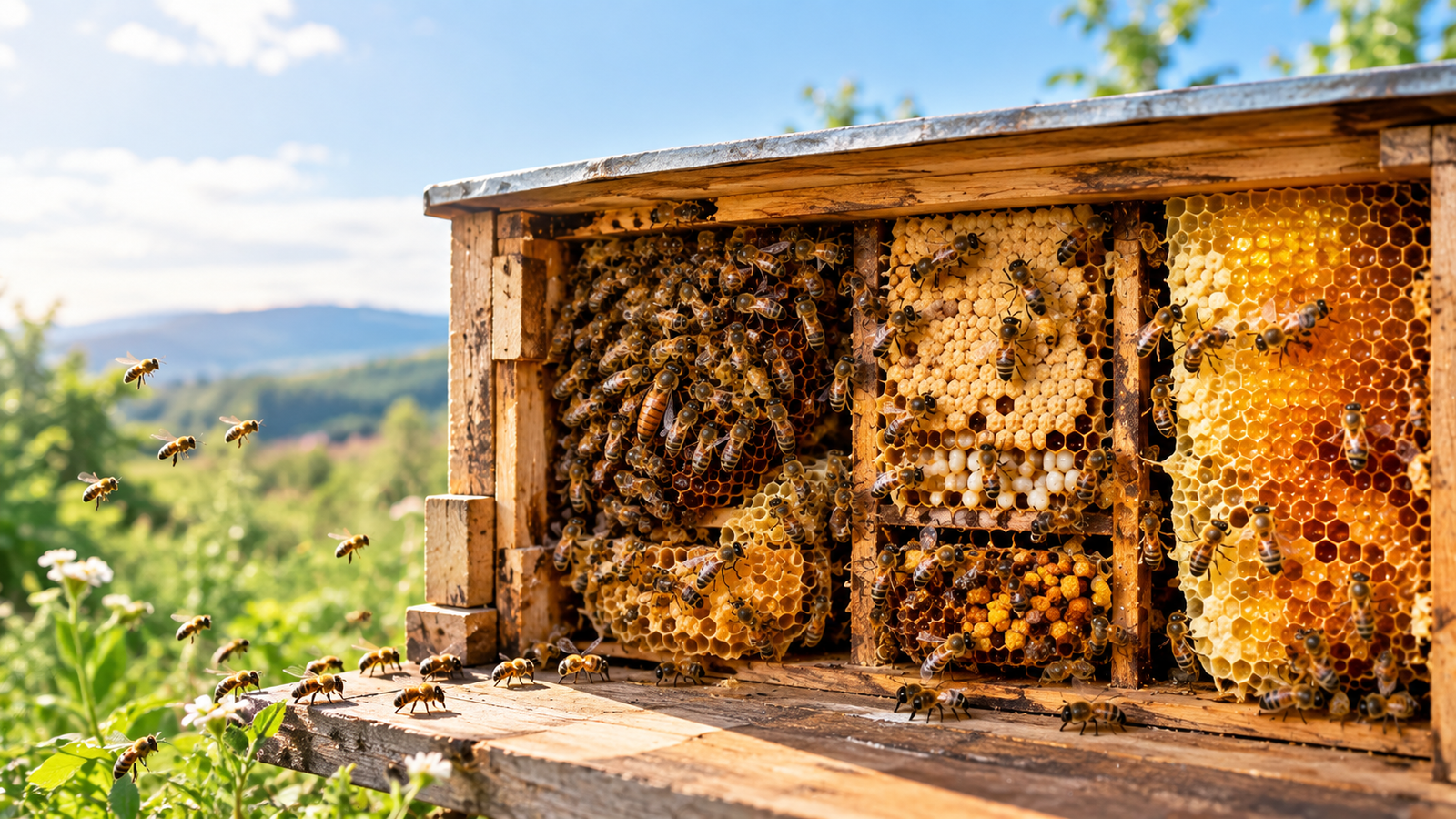
A bee colony works as a highly organized social system in which thousands of honey bees cooperate to survive, raise young, collect food, defend the nest, regulate temperature, and reproduce. Instead of one bee controlling the others, the colony coordinates its activities through division of labor, pheromones, physical contact, movement, environmental signals, and dances such as the waggle dance.
A typical honey bee colony consists of one queen, thousands of worker bees, and, during much of the breeding season, male drone bees. Each has a different role, but the colony’s survival depends on their activities working together.
In simple terms, the queen provides reproduction, workers maintain and operate the colony, drones reproduce with queens, and developing bees become the next generation. Food collection, brood care, defense, temperature control, communication, and reproduction all happen as interconnected parts of the colony’s life.
How Does a Bee Colony Work in Simple Terms?
A honey bee colony works through a continuous cycle of cooperation:
Queen lays eggs → workers care for developing bees → workers perform different jobs → foragers collect food and water → food is processed and stored → the colony protects and maintains the nest → new bees replace older ones → strong colonies can reproduce by swarming.
No individual worker performs every job.
Instead, thousands of bees respond to the colony’s needs. Young workers generally perform tasks inside the nest, while older workers are more likely to forage outside. However, this division of labor is flexible, and bees can change jobs when colony conditions require it.
This decentralized organization allows the colony to perform many tasks simultaneously.
What Are the Different Bees in a Colony?
A honey bee colony has three types of adult bees:
- Queen bee
- Worker bees
- Drone bees
They differ in appearance, biology, and function.
What Does the Queen Bee Do?
The queen is the colony’s primary reproductive female.
Her most important job is laying eggs. During periods of strong colony growth, a healthy queen can lay a large number of eggs each day.
The queen is larger and has a longer abdomen than worker bees. She normally remains inside the colony, where workers feed and care for her.
The queen also produces chemical signals called queen pheromones. These pheromones influence worker behavior and contribute to the colony’s social organization.
However, the queen does not act as a commander.
She does not tell individual workers where to forage, when to build comb, or which cells to clean. Instead, the colony’s behavior emerges from interactions between individual bees and their responses to chemical, physical, and environmental signals.
What Do Worker Bees Do?
Worker bees are female honey bees that perform most of the colony’s daily work.
Depending on their age and the colony’s needs, workers may:
- Clean empty cells
- Feed larvae
- Care for the queen
- Produce beeswax
- Build honeycomb
- Process nectar
- Store pollen
- Guard the entrance
- Remove waste
- Regulate temperature
- Collect water
- Collect nectar and pollen
- Defend the colony
Worker bees therefore form the main workforce of the colony.
Do Worker Bees Have Different Jobs?
Yes.
Worker bees often change jobs as they age. This is called age-related division of labor or temporal polyethism.
A simplified progression is:
Cleaning → brood care → food processing → comb building → guarding → foraging
This pattern is not completely rigid.
If the colony suddenly loses many foragers, for example, younger workers can begin performing outside tasks earlier than they normally would.
This flexibility helps the colony respond to changing conditions.
What Do Drone Bees Do?
Drone bees are the male members of the colony.
Their primary biological function is to mate with virgin queens.
Drones generally do not:
- Collect nectar
- Collect pollen
- Feed larvae
- Build honeycomb
- Guard the colony
Drones leave the colony to gather in areas where mating occurs.
A drone that successfully mates with a queen dies afterward because the mating process causes fatal physical injury.
When resources become scarce, particularly before or during winter, worker bees may remove drones from the colony because maintaining them requires food.
How Is a Bee Colony Organized Inside the Hive?
The colony’s nest is organized around the honeycomb.
Honey bees build comb from beeswax, which worker bees produce from wax glands.
The comb contains many hexagonal cells that are used for different purposes.
Cells can contain:
- Eggs and developing brood
- Honey
- Nectar
- Pollen
The arrangement of these resources allows the colony to raise young and store food within the same overall nest.
What Is the Brood Area?
The brood area is the part of the nest where developing bees are raised.
It contains:
- Eggs
- Larvae
- Pupae
Worker bees continuously care for this area.
They feed larvae, clean cells, regulate temperature, and maintain the conditions needed for development.
Where Is Honey Stored?
Honey and other food resources are stored in honeycomb cells.
In a natural nest, bees organize storage around the brood area according to the colony’s needs and the available space.
In managed hives, beekeepers may use different boxes or frames for brood and honey storage, but the underlying biological purpose remains the same: the colony needs accessible food reserves to survive periods when flowers are unavailable.
How Do Bees Communicate With Each Other?
Communication is one of the most important parts of how a bee colony works.
Honey bees communicate through:
- Pheromones
- Touch
- Antennal contact
- Vibrations
- Movement
- Food exchange
- Dances
These signals help bees coordinate activities without requiring a central leader.
How Does the Waggle Dance Work?
One of the best-known examples is the waggle dance.
A foraging bee that discovers a profitable food source can return to the colony and perform a characteristic dance on the comb.
The direction and duration of the dance provide information that other bees can use to locate the food source.
The dance can communicate information about the direction and approximate distance of a resource relative to the position of the sun.
Other workers can then leave the colony and search for the reported food source.
This is one way the colony collectively gathers information about its environment.
How Do Pheromones Help a Bee Colony?
Pheromones are chemical signals produced by bees.
Different pheromones influence different behaviors.
For example, chemical signals can be involved in:
- Colony organization
- Reproduction
- Alarm responses
- Recognition
- Attraction or recruitment
- Communication between workers
Queen pheromones are particularly important to the social organization of the colony.
Alarm pheromones can also help recruit workers when the colony is threatened.
How Does a Bee Colony Collect Food?
Worker bees leave the colony to search for resources.
The main resources they collect include:
Nectar
Nectar provides carbohydrates and is processed into honey.
Pollen
Pollen supplies proteins, lipids, vitamins, minerals, and other nutrients needed by the colony, particularly for brood development.
Water
Water is important for several colony processes, including cooling the nest.
Plant Resins
Bees collect plant resins and use them to make propolis, a material used to seal and protect parts of the nest.
How Do Bees Bring Nectar Back to the Colony?
A forager collects nectar and carries it back in a specialized part of its digestive system called the crop, commonly known as the honey stomach.
Inside the colony, the nectar can be transferred to other bees.
Workers process the nectar and place it into honeycomb cells.
They also fan their wings to help remove water.
As the nectar becomes more concentrated and undergoes chemical changes, it becomes honey.
The honey is then stored as an energy reserve.
How Does a Bee Colony Make Honey?
Honey production involves several stages.
Flower nectar → collection → transfer between bees → enzymatic processing → water removal → storage → sealing
Worker bees place processed nectar into comb cells.
They use wing movements to increase airflow and help evaporate excess water.
When the honey reaches an appropriate condition for storage, bees seal the cell with a wax capping.
The stored honey provides an important energy source when fresh nectar is unavailable.
How Does a Bee Colony Raise Baby Bees?
Raising the next generation is one of the colony’s most important responsibilities.
The queen lays an egg in a prepared cell.
The development of a honey bee proceeds through four major stages:
Egg → larva → pupa → adult
Worker bees care for the developing bee throughout this process.
They provide food, clean the cells, and maintain appropriate conditions in the brood area.
This means the colony must constantly balance two major activities:
maintaining the current population while producing the next generation.
How Does the Colony Control Temperature?
Temperature regulation is essential, particularly for developing brood.
Worker bees use several behaviors to control conditions inside the colony.
When the nest becomes too warm, bees can:
- Fan their wings
- Increase ventilation
- Bring water into the colony
- Promote evaporative cooling
When temperatures become cold, bees can:
- Cluster together
- Generate heat through muscle activity
- Reduce exposed surface area
- Protect the brood and queen within the cluster
The colony therefore actively modifies its internal environment instead of simply accepting outside temperatures.
What Is a Winter Cluster?
During cold weather, honey bees form a winter cluster.
The bees gather closely together around the queen and available food.
Bees on the outside of the cluster provide insulation, while bees inside can generate heat through muscular activity.
The cluster changes its density and shape according to conditions.
The colony also consumes stored honey for energy during periods when foraging is limited or impossible.
This allows the colony to survive periods of cold weather and food scarcity.
How Does a Bee Colony Protect Itself?
A bee colony contains valuable food stores and developing young, so defense is essential.
Some worker bees act as guard bees around the entrance.
They can inspect bees approaching the colony and respond to potential threats.
When the colony is attacked or disturbed, bees can release alarm pheromones that help recruit other workers.
Defensive workers may:
- Guard the entrance
- Chase intruders
- Release alarm signals
- Sting threats
- Remove unwanted organisms from the nest
The colony’s defense is therefore a coordinated group response.
How Do Bees Recognize Their Colony Members?
Honey bees use chemical cues to distinguish members of their colony from outsiders.
Bees belonging to the same colony share a characteristic colony odor influenced by chemical interactions within the nest.
Guard bees can use these cues when evaluating incoming bees.
This helps protect the colony’s food and brood from unrelated bees attempting to enter.
How Does a Bee Colony Reproduce?
There are two related levels of reproduction to understand.
Individual reproduction
A queen mates with drones and uses stored sperm to fertilize eggs throughout her reproductive life.
Colony reproduction
A colony can reproduce by swarming.
When a colony becomes sufficiently strong and crowded, workers may raise new queens.
The old queen can leave with a large group of worker bees.
This group is called a swarm.
The swarm temporarily clusters while scout bees search for a suitable nesting location.
If a suitable site is selected, the swarm establishes a new colony.
The original colony remains behind and can continue under a new queen.
This allows one colony to give rise to another colony.
How Do Bees Choose a New Nesting Site?
When a swarm needs a new home, scout bees search the surrounding environment for potential nesting locations.
Scouts can return and communicate information about potential sites.
Other scouts may inspect these locations, and recruitment behavior can increase around sites that meet the colony’s requirements.
Eventually, the swarm reaches a collective decision and moves to the selected location.
The process is an example of distributed decision-making: individual bees gather information, but no single bee controls the final decision.
What Happens If the Queen Dies?
A colony can sometimes produce a replacement queen if its existing queen dies or becomes unable to perform her reproductive role.
Workers can select suitable young female larvae and provide the specialized care required for queen development.
One or more new queens may emerge.
If a new queen successfully mates and begins laying eggs, the colony can restore normal reproduction.
However, if the colony fails to replace its queen, its population can eventually decline because new worker bees are no longer being produced normally.
Can a Bee Colony Survive Without a Queen?
A queenless colony can survive temporarily, but long-term survival becomes difficult if it cannot successfully replace its queen.
Without a functioning queen, the colony eventually loses its ability to produce enough normal worker replacements.
As existing workers die, the population declines.
Successful queen replacement is therefore essential for maintaining a healthy colony over the long term.
How Does a Bee Colony Survive Through the Seasons?
A colony’s behavior changes throughout the year as temperature, flowering, food availability, and population size change.
Spring: Colony Growth
As temperatures rise and flowering plants become available, colonies can increase brood production.
The queen lays more eggs, workers raise young, and foragers begin collecting larger quantities of nectar and pollen.
The colony’s population can grow rapidly.
Summer: Maximum Activity
Summer can be a period of intense colony activity.
Large numbers of workers may forage for nectar and pollen.
Colonies may build comb, raise large amounts of brood, store honey, and, when conditions are appropriate, reproduce through swarming.
Autumn: Preparing for Scarcity
As flowering declines, the colony begins adjusting to reduced food availability.
The colony relies increasingly on stored food and may reduce its brood production.
Drones may be expelled as the colony conserves resources.
Winter: Conservation and Survival
During cold periods, foraging may be greatly reduced or stop entirely.
Bees remain clustered and consume stored food.
The colony’s objective is to conserve energy while protecting the queen and maintaining enough warmth for survival.
When conditions improve, the cycle begins again.
Why Don’t Bees Need a Leader to Run the Colony?
A honey bee colony does not require a central commander because much of its organization comes from local interactions and feedback.
Individual bees respond to immediate information.
For example:
- A nurse bee responds to brood that needs care.
- A guard bee responds to an approaching intruder.
- A forager responds to available flowers.
- A returning forager can recruit other workers to a food source.
- Bees respond to temperature changes.
- Workers respond to changes in the queen’s chemical signals.
- Scout bees respond to potential nesting sites.
When thousands of individual responses occur together, organized colony-level behavior emerges.
This is one reason scientists sometimes describe social insect colonies as superorganisms.
How Does the Colony Balance Its Different Needs?
A colony constantly has to balance competing demands.
It needs to:
- Feed itself
- Raise young
- Maintain its nest
- Collect food
- Store reserves
- Defend itself
- Control temperature
- Replace aging bees
- Reproduce
Resources are limited, so the colony adjusts its behavior according to conditions.
For example, when flowers are abundant, more workers can forage and the colony can build food reserves.
When food becomes scarce, the colony reduces some activities and relies more heavily on stored resources.
This flexibility is essential to survival.
How Many Bees Are in a Colony?
The number of bees in a colony changes throughout the year.
A strong honey bee colony can contain tens of thousands of individual bees, with the population increasing during favorable periods and decreasing during periods of scarcity or cold.
The number of workers, drones, eggs, larvae, and pupae can all change depending on the colony’s condition and season.
Therefore, there is no single population size that applies to every bee colony.
What Happens Inside a Bee Colony Every Day?
A colony is constantly performing many tasks simultaneously.
At any given time, different bees may be:
- Feeding larvae
- Cleaning cells
- Feeding the queen
- Producing wax
- Building comb
- Processing nectar
- Storing pollen
- Fanning their wings
- Guarding the entrance
- Removing waste
- Collecting water
- Foraging for nectar
- Foraging for pollen
- Defending the colony
- Regulating temperature
This simultaneous activity is what makes the colony so efficient.
A single bee has limited abilities, but thousands of bees working together can accomplish complex tasks.
Why Is Division of Labor Important to a Bee Colony?
Division of labor allows the colony to perform different tasks at the same time.
Imagine if every bee had to leave the colony to collect food whenever the colony needed nectar.
There would be too few bees available to:
- Feed larvae
- Protect the entrance
- Maintain the nest
- Process food
- Regulate temperature
Instead, different groups of workers perform different jobs.
This allows the colony to maintain its internal operations while simultaneously gathering resources outside.
What Makes a Bee Colony Different From a Group of Individual Bees?
The key difference is cooperation.
Individual bees depend heavily on the colony, while the colony depends on the combined actions of its members.
A worker bee cannot reproduce on its own under normal colony conditions. Its role is connected to the queen, brood, food stores, and other workers.
Likewise, the queen depends on workers for food, protection, temperature regulation, and brood care.
The colony therefore functions as an interconnected system rather than simply a collection of independent bees.
Frequently Asked Questions About How a Bee Colony Works
How does a bee colony work?
A bee colony works through division of labor and communication. The queen lays eggs, workers perform tasks such as brood care, foraging, food storage, defense, and temperature regulation, while drones primarily mate with queens. Chemical signals, dances, physical contact, and environmental information help coordinate the colony.
What are the three types of bees in a colony?
The three adult types are queen bees, worker bees, and drone bees. The queen is the primary reproductive female, workers perform most colony-maintenance tasks, and drones are males whose main function is mating.
Does the queen control the bee colony?
No. The queen does not directly command the workers. Her primary role is reproduction, while colony behavior emerges from interactions among bees and their responses to chemical and environmental signals.
How do bees communicate?
Honey bees communicate through pheromones, physical contact, vibrations, movement, food exchange, and dances. The waggle dance can provide other foragers with information about the direction and distance of a food source.
How do bees know what job to do?
Worker behavior is influenced by age, physiological condition, interactions with other bees, and the colony’s current needs. Younger workers commonly perform jobs inside the nest, while older workers are more likely to forage, although these roles are flexible.
How does a bee colony get food?
Worker bees collect nectar, pollen, water, and plant resins. Nectar is processed into honey, while pollen supplies important nutrients. These resources help support the colony and its developing brood.
How does a bee colony make honey?
Bees collect nectar, transfer and process it, place it into honeycomb cells, and remove excess water through evaporation and ventilation. Once sufficiently concentrated, the honey is stored and often sealed with wax.
How does a bee colony protect itself?
Guard bees monitor the entrance, while other workers respond to threats using alarm pheromones and defensive behavior. Bees may chase, bite, or sting threats to protect the colony.
How does a bee colony reproduce?
Individual bees reproduce when queens mate with drones. At the colony level, honey bee colonies can reproduce through swarming, when a queen and a large group of workers leave to establish a new colony.
What happens when a bee colony loses its queen?
Workers may raise a replacement queen from suitable young female larvae. If the replacement queen successfully mates and begins laying eggs, the colony can restore normal reproduction. If replacement fails, the colony’s population can eventually decline.
Can a bee colony survive winter?
Yes. Honey bee colonies can survive winter by clustering together, generating and conserving heat, and consuming stored food. Their activity and population generally change as temperatures and food availability change.
How many bees live in a colony?
A strong honey bee colony can contain tens of thousands of bees, but colony population varies considerably with season, food availability, reproduction, and colony health.
Final Answer: How Does a Bee Colony Work?
A bee colony works through cooperation, communication, division of labor, and adaptation.
The queen provides the colony’s primary reproductive function. Worker bees perform the majority of tasks needed for survival, including raising young, collecting food, producing wax, processing nectar, defending the nest, and regulating temperature. Drones primarily contribute to reproduction by mating with queens.
The bees coordinate these activities through pheromones, physical interactions, environmental information, and behaviors such as the waggle dance.
The colony continuously adjusts to changing conditions. When flowers are abundant, workers collect and store food. When temperatures fall, bees cluster and conserve energy. When the colony becomes strong and crowded, it can reproduce through swarming.
So, how does a bee colony work?
It works because thousands of individual bees perform specialized but interconnected tasks, allowing the entire colony to function as a coordinated living system.
