

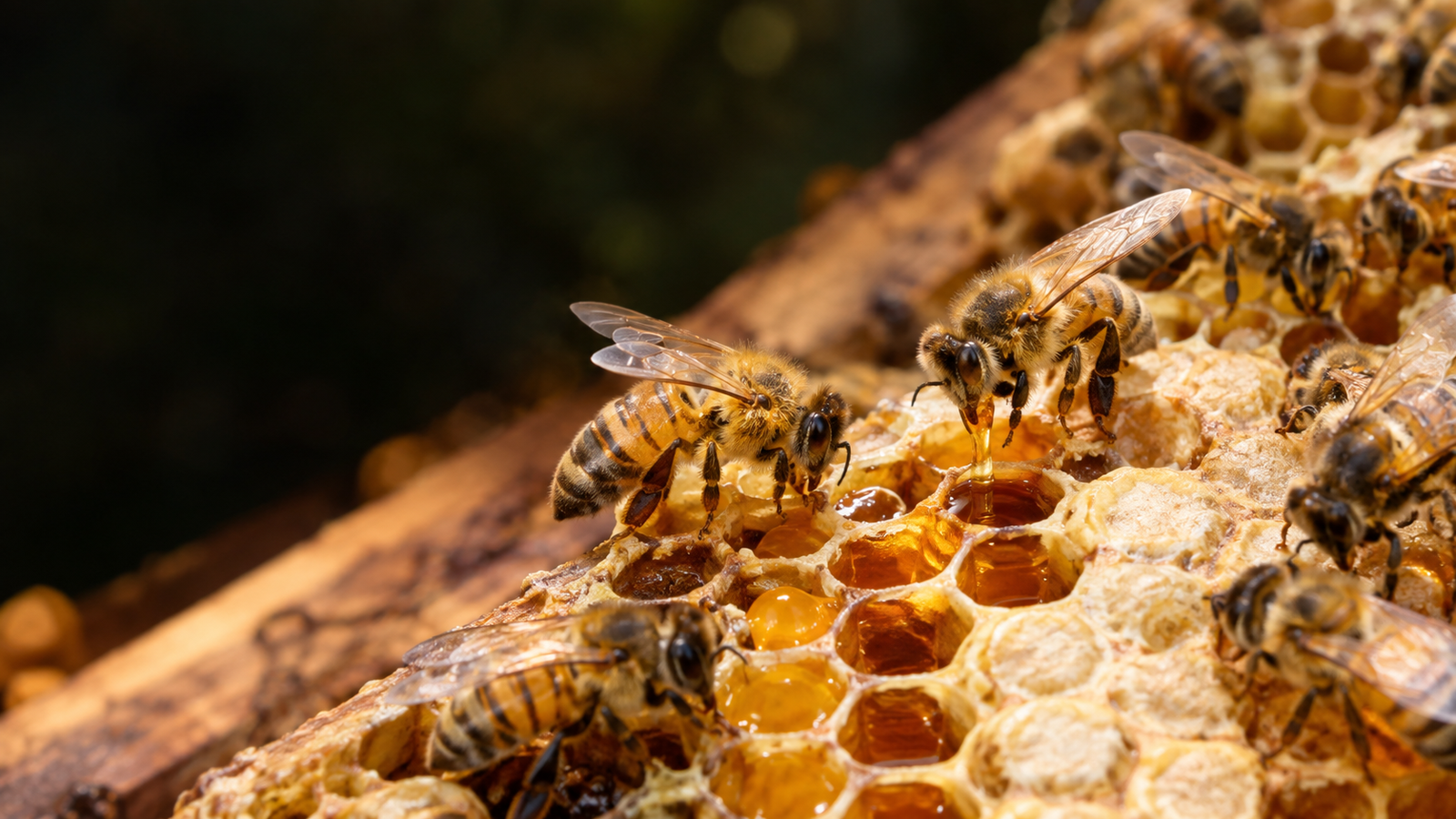
Bees make honey to store food for their colony. Honey gives honey bees a concentrated source of energy that can be kept in the hive and eaten when fresh nectar is unavailable, including during cold weather, rainy periods, and other times when bees cannot forage effectively.
Honey is not made for humans. It is an important food reserve that helps a honey bee colony survive throughout the year.
But how does flower nectar become honey, and why don’t bees simply eat the nectar they collect?
Let’s take a closer look at why bees make honey, how they make it, what they use it for, and why honey is so important to the colony.
Why Do Bees Make Honey?
Honey bees make honey primarily because they need a long-lasting supply of energy-rich food.
Flowers do not produce nectar continuously. The amount of nectar available changes with the season, weather, temperature, rainfall, and the availability of flowering plants.
When flowers are producing large amounts of nectar, honey bees collect as much as they can. Instead of consuming all of it immediately, they process some of the nectar into honey and store it inside the hive.
The stored honey can then be eaten when:
- Flowers are not producing enough nectar
- Rain prevents bees from foraging
- Temperatures are too cold for normal foraging
- The colony needs additional energy
- Fresh food is temporarily unavailable
- The colony is overwintering in colder climates
In temperate regions, stored honey is especially important because honey bees remain active inside the colony during winter rather than hibernating. They consume stored honey to obtain the energy needed to maintain the colony and generate heat.
In simple terms:
Bees make honey because honey is their stored food supply.
It is similar to putting food in a pantry for later, except the bees collect the ingredients themselves and transform nectar into a form that is much better suited for storage.
What Is Honey Made From?
The main raw material used to make honey is nectar.
Nectar is a sugary liquid produced by flowering plants. Honey bees collect it with a specialized tube-like mouthpart called a proboscis.
Nectar provides bees with carbohydrates, which give them energy for activities such as flying, foraging, and working inside the colony. Pollen serves a different nutritional role, providing important protein, fats, vitamins, minerals, and other nutrients.
So, bees collect both nectar and pollen, but they process them differently:
Nectar → honey
Pollen → stored pollen and bee food
Why Don’t Bees Just Store Nectar?
Fresh nectar is not ideal for long-term storage.
One major reason is its relatively high water content. Freshly collected nectar can contain a large amount of water, creating conditions that are much less suitable for long-term preservation.
Bees solve this problem by processing nectar and removing much of its water.
As the nectar becomes more concentrated, it becomes better suited for storage in the honeycomb.
The honey bee colony therefore has a remarkable food-preservation system:
Collect nectar → process nectar → remove water → store honey → seal the cell.
Honey’s high sugar concentration and low moisture content help make it resistant to spoilage under suitable conditions.
How Do Bees Make Honey?
Honey production involves several stages.
1. Worker Bees Collect Nectar
Foraging worker bees visit flowers and use their proboscises to collect nectar.
A bee may visit many flowers during a foraging trip. It stores the collected nectar in a specialized storage organ called the honey stomach, or crop.
The honey stomach is different from the bee’s digestive stomach. Its main purpose is to transport nectar back to the colony.
2. Bees Begin Processing the Nectar
While nectar is being carried, enzymes associated with the bee’s digestive system begin changing its chemical composition.
The nectar is not simply stored unchanged.
Instead, the bees begin transforming it into a more suitable food for long-term storage.
3. Nectar Is Passed Between Bees
When a forager returns to the colony, it transfers the nectar to other worker bees.
This exchange of food between bees is called trophallaxis.
The nectar can be passed from one bee to another as it continues to be processed.
This is one reason honey production is a colony-level process rather than something a single bee does from beginning to end.
4. Bees Put the Nectar Into Honeycomb
The partially processed nectar is placed into the wax cells of the honeycomb.
At this stage, it still contains too much water for ideal long-term storage.
The bees therefore need to dry it.
5. Bees Remove Water by Fanning Their Wings
Worker bees fan their wings to increase air movement around the hive.
This helps water evaporate from the nectar.
The process gradually changes the thin nectar into thicker, concentrated honey. The Natural History Museum notes that nectar stored in the comb can initially contain around 70% water, while finished honey is typically much lower in moisture, around 18%.
6. Bees Seal the Honeycomb
Once the honey is sufficiently processed, bees cover the cell with a thin layer of beeswax.
This is called capping.
The sealed honey can remain stored in the comb until the colony needs it.
What Do Bees Use Honey For?
Honey provides the colony with an important source of carbohydrate energy.
Bees use this energy for many activities.
Honey Gives Bees Energy for Flight
Flying requires substantial energy.
Foraging bees use energy from carbohydrates to travel between the colony and flowering plants.
They also need energy to perform other activities inside the hive.
Honey Helps Bees Maintain the Colony
Worker bees perform many tasks throughout their lives, including caring for brood, producing wax, ventilating the hive, guarding the entrance, and foraging.
These activities require energy.
Stored honey provides an important carbohydrate source that helps support this work.
Honey Helps Bees Survive Food Shortages
Flowers do not always provide enough nectar.
A rainy period, drought, cold weather, or a gap between flowering periods can reduce the amount of food available.
Stored honey gives the colony a reserve to rely on during these periods.
Honey Is Especially Important During Winter
In colder climates, winter can create a major food challenge for honey bees.
Honey bees do not simply hibernate and become completely inactive. Instead, they form a cluster inside the hive and use stored food as fuel.
The bees consume honey and use the resulting energy to support their metabolism and generate heat.
If a colony runs out of food before suitable forage becomes available again, starvation can occur.
How Do Bees Stay Warm in Winter?
Honey is particularly important because bees need energy to maintain their winter cluster.
When temperatures fall, honey bees gather together in a cluster around the colony’s central area.
Bees can generate heat by vibrating their flight muscles.
This activity requires energy, and carbohydrates from stored honey provide that fuel.
As the colony consumes its stores, bees move through the honeycomb to reach additional food.
This means honey isn’t simply sitting unused in the hive throughout winter. It can become a critical energy reserve for the colony.
Do Bees Make Honey Only for Winter?
No.
Winter is one of the most important reasons honey storage matters, particularly for honey bees living in temperate climates, but honey is also useful whenever fresh nectar is unavailable.
Bees may consume stored honey during:
- Cold weather
- Rain
- Periods of poor flowering
- Temporary nectar shortages
- Times when the colony’s energy requirements are high
- Winter
The exact importance of stored honey varies according to climate and local conditions.
In warm regions where flowers and suitable weather are available for much of the year, colonies may not face the same winter food shortage as colonies in colder climates.
Why Do Bees Store So Much Honey?
Bees cannot predict exactly when flowers will stop producing nectar.
A colony may experience an abundance of flowers one week and a shortage the next.
Therefore, when nectar is plentiful, bees take advantage of the opportunity to build food reserves.
This is an example of food storage as a survival strategy.
The colony essentially turns a temporary abundance of flowers into a longer-lasting supply of stored energy.
The cycle looks like this:
Flowering plants produce nectar → bees collect nectar → bees process nectar → honey is stored → nectar becomes scarce → bees eat stored honey.
This ability to store food allows honey bee colonies to survive periods when they cannot collect enough fresh food.
Do Bees Eat the Honey They Make?
Yes.
Honey bees consume honey as a source of carbohydrates and energy.
They may use stored honey when they need energy and cannot obtain enough fresh nectar from flowers.
During winter in colder climates, stored honey becomes particularly important because bees spend much more time inside the colony and have fewer opportunities to forage.
Do Bees Make Honey for Humans?
No.
Honey bees evolved to collect nectar and store honey for the benefit of their colony, not for human consumption.
Humans harvest some of the honey produced by managed colonies, but the original biological purpose of honey production is to provide food for bees.
When beekeepers harvest honey, responsible hive management requires ensuring that the colony retains adequate food resources.
Why Can Honey Be Stored for So Long?
Honey has several properties that make it well suited to long-term storage.
1. High Sugar Concentration
Honey contains a high concentration of sugars.
This provides bees with a concentrated source of energy.
2. Low Moisture
Bees remove much of the water from nectar before storing mature honey.
The resulting low moisture environment makes it difficult for many microorganisms to grow.
3. Acidity and Other Chemical Properties
Honey is naturally acidic and contains compounds that contribute to its resistance to spoilage.
Together, these characteristics help honey remain stable for long periods when properly stored.
Why Do Bees Cap Honey With Wax?
Bees seal mature honey with a thin layer of wax.
This is called a wax cap or capping.
Capping helps keep the stored honey enclosed within the honeycomb until the colony needs it.
The capped cells are therefore similar to sealed food containers inside the hive.
What Is the Difference Between Nectar and Honey?
Nectar is the raw material. Honey is the processed product.
| Nectar | Honey |
|---|---|
| Produced by flowers | Produced by bees from nectar |
| Contains more water | Contains much less water |
| Collected from flowers | Processed inside the colony |
| Thin and liquid | Thicker and concentrated |
| Not ideal for long-term storage | Well suited to food storage |
| Provides carbohydrates | Provides concentrated carbohydrates |
The important point is that bees do not collect honey from flowers.
They collect nectar and transform it into honey.
What Is the Difference Between Honey and Pollen?
Honey and pollen serve different nutritional purposes.
Honey is primarily an energy source.
Pollen provides important nutrients including protein, fats, vitamins, and minerals.
Honey therefore helps fuel the colony, while pollen plays an important role in nutrition and brood rearing.
Both are important parts of the colony’s food resources.
Do All Bees Make Honey?
No.
Not every bee species produces and stores honey like honey bees do.
There are thousands of bee species, and many have very different nesting and feeding behaviors.
Honey bees are social insects that maintain perennial colonies and store substantial quantities of honey and pollen.
This long-term colony lifestyle makes food storage especially important.
Many other bee species are solitary or have different colony structures and do not produce large honey stores.
What Happens If Bees Run Out of Honey?
If a honey bee colony cannot find enough food and its stored reserves run out, the bees can starve.
This is especially dangerous when there are few flowering plants available and weather prevents foraging.
Winter starvation is therefore an important reason honey bees need adequate food stores before entering periods of limited forage.
A colony’s food requirements depend on factors such as:
- Colony population
- Climate
- Length of the food shortage
- Availability of flowering plants
- Weather
- Amount of stored honey
- Brood-rearing activity
Why Do Bees Make More Honey Than They Immediately Need?
Bees don’t know exactly how long a period of food scarcity will last.
When flowers are abundant, collecting extra nectar gives the colony an opportunity to build reserves.
Those reserves can later be used when environmental conditions change.
In other words, bees make and store honey because future food availability is uncertain.
This is particularly important for colonies that must survive seasons with little or no nectar.
Is Honey the Same in Every Hive?
No.
Honey can differ depending on the plants from which bees collect nectar.
The plant species available to bees can influence the honey’s:
- Color
- Flavor
- Aroma
- Texture
- Sugar composition
For example, honey produced when bees forage primarily on one major floral source can have noticeably different characteristics from honey collected from many different plants.
This is why the floral environment around a colony can influence the honey produced.
Frequently Asked Questions About Why Bees Make Honey
Why do bees make honey?
Bees make honey to store a concentrated source of energy for the colony. They can eat it when fresh nectar is unavailable, including during periods of poor weather and winter in colder climates.
Do bees make honey for humans?
No. Honey is made for the bees themselves. Humans harvest some of the surplus honey from managed colonies.
Why can’t bees just eat nectar?
Nectar contains much more water and is not as suitable for long-term storage. Bees process nectar, remove water, and convert it into honey, which can be stored more effectively.
Do bees eat the honey they make?
Yes. Honey provides carbohydrates that give bees energy for activities such as flying, working inside the hive, and maintaining the colony.
Why do bees make honey in the summer?
Summer often provides abundant flowering plants and nectar. Bees take advantage of this abundance by collecting nectar and building food stores that can be used later when food becomes less available.
Why is honey important in winter?
In colder climates, bees have limited opportunities to forage during winter. They consume stored honey for energy while remaining inside the hive and maintaining their winter cluster.
Do all bees make honey?
No. Honey production and large-scale honey storage are characteristic of honey bees. Many other bee species have different life cycles and do not make honey stores like honey bees.
How do bees turn nectar into honey?
Bees collect nectar, begin processing it with enzymes, transfer it among worker bees, place it in honeycomb, remove much of its water through evaporation, and eventually seal the mature honey with wax.
Why do bees seal honey with wax?
Bees cover mature honeycomb cells with wax to enclose the stored honey until the colony needs it.
How long can honey last?
Honey can remain stable for very long periods when its moisture level and storage conditions are suitable. Its high sugar concentration, low moisture, and acidic environment make it unusually resistant to spoilage.
Conclusion
So, why do bees make honey?
The simple answer is that bees make honey to store food for their colony.
Worker bees collect nectar from flowers and transform it into honey through a remarkable process of enzymatic processing, water removal, and storage in wax honeycomb. The finished honey provides a concentrated source of carbohydrates that bees can use when fresh nectar is unavailable.
For honey bees, honey is especially important during periods of food scarcity and, in colder climates, throughout winter. Bees consume their stored honey to obtain energy for maintaining the colony and generating heat.
Honey therefore isn’t something bees make for humans. It is a survival food—a carefully processed reserve that allows a honey bee colony to turn periods of abundant flowering into food that can be saved for the future.
