
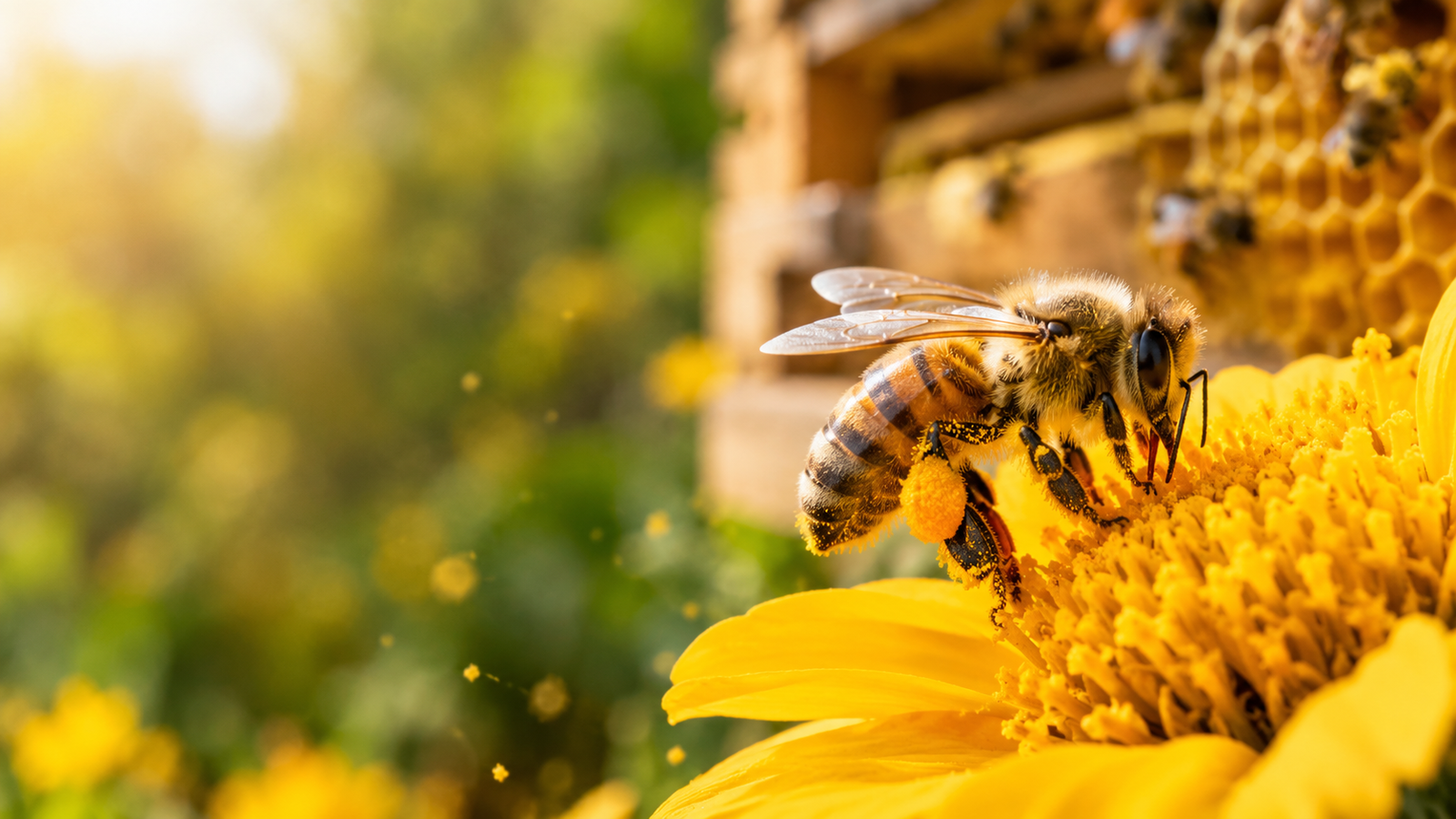
Bee pollen is flower pollen collected by honey bees and carried back to the hive in compact pellets on their hind legs. It is an important source of nutrients for a honey bee colony and provides proteins, amino acids, lipids, vitamins, minerals, and other compounds that support bee growth and development.
But what exactly is bee pollen, how do bees collect it, and what happens to it after it reaches the hive?
In this guide, we’ll explain what bee pollen is, how bees collect and store it, why bees need it, what it looks like, how it differs from flower pollen and bee bread, and what people should know about consuming bee pollen.
What Is Bee Pollen?
Bee pollen is pollen collected from flowering plants by honey bees and transported back to the colony in pollen pellets.
As worker bees visit flowers, pollen grains stick to the hairs covering their bodies. The bees groom the pollen from their bodies and use their legs to gather and compress it.
The pollen is eventually packed into small pellets and placed in special structures called pollen baskets, or corbiculae, on the bees’ hind legs.
When the bees return to the hive, the pollen is removed from their legs and stored in honeycomb cells.
Bee pollen can vary considerably in its color, size, texture, flavor, and nutritional composition, depending on the plants from which it was collected.
How Do Bees Collect Pollen?
Honey bees collect pollen while visiting flowers.
When a worker bee lands on a flower, pollen grains become attached to the tiny hairs covering its body. The bee then uses its legs and mouthparts to groom the pollen from its body.
The bee moves the pollen toward its hind legs and packs it into compact pellets.
The hind legs contain specialized structures called corbiculae, commonly known as pollen baskets. These structures allow worker bees to transport pollen efficiently back to the hive.
Bees may collect pollen from one plant species or from many different plants during the same period.
This means pollen collected by a colony can contain a mixture of different botanical sources.
Why Do Bees Collect Pollen?
Bees collect pollen because it provides nutrients that are essential to the colony.
Honey is primarily an energy source because it contains large amounts of sugar. Pollen, in contrast, provides nutrients such as protein, amino acids, lipids, vitamins, and minerals.
These nutrients are particularly important when a colony is raising young bees.
Worker bees consume pollen and use nutrients from their diet to produce food for developing larvae. As a result, pollen plays an important role in brood production and colony development.
A shortage of suitable pollen can make it more difficult for a colony to meet its nutritional needs.
What Does Bee Pollen Look Like?
Bee pollen usually appears as small, compact pellets attached to the hind legs of returning worker bees.
The pellets can have many different colors, including:
- Yellow
- Orange
- Red
- Brown
- Green
- Cream
- Purple
The color depends largely on the plant species from which the pollen originated.
A single honey bee colony can collect pollen of several colors because bees may visit many different flowering plants.
What Is Bee Pollen Made Of?
Bee pollen contains a variety of nutrients and naturally occurring plant compounds.
Its composition can vary depending on the plant species, geographical location, season, and other environmental factors.
Bee pollen can contain:
- Proteins
- Amino acids
- Carbohydrates
- Lipids and fatty acids
- Vitamins
- Minerals
- Plant pigments
- Other naturally occurring plant compounds
There is therefore no single nutritional profile that applies to every sample of bee pollen.
Pollen collected from different plants can differ substantially in its nutritional composition.
Is Bee Pollen the Same as Flower Pollen?
Not exactly.
Flower pollen is the fine reproductive material produced by flowering plants. It contains microscopic pollen grains involved in plant reproduction.
Bee pollen refers to pollen that honey bees have collected from flowers and transported back to the hive.
The bee gathers the pollen from its body, compresses it into pellets, and carries it using its pollen baskets.
So, bee pollen originates as flower pollen, but the term bee pollen generally describes pollen after it has been collected and transported by bees.
Is Bee Pollen the Same as Honey?
No. Bee pollen and honey are different bee products.
Honey is produced primarily from flower nectar. Bees collect nectar, process it, and store it in honeycomb, where it becomes honey.
Bee pollen comes from pollen grains produced by flowers.
The two products also serve different nutritional roles in the colony.
| Bee product | Main source | Primary role |
|---|---|---|
| Honey | Flower nectar | Energy |
| Bee pollen | Flower pollen | Nutrients, including protein |
| Bee bread | Stored and fermented pollen | Colony nutrition |
| Beeswax | Secretions of worker bees | Building honeycomb |
Although pollen can be found in honey, bee pollen should not be described as simply another form of honey.
What Happens to Bee Pollen in the Hive?
When worker bees return to the hive, the collected pollen is removed from their hind legs.
The pollen is packed into empty honeycomb cells. Worker bees may add additional material and compress the pollen inside the cells.
Over time, stored pollen can undergo fermentation.
The resulting stored food is commonly called bee bread.
Bee bread provides an important source of nutrition for the colony and is particularly valuable when bees are raising brood.
What Is Bee Bread?
Bee bread is pollen that honey bees have stored and fermented inside honeycomb cells.
Bees pack collected pollen into cells and may add nectar, honey, and glandular secretions. The stored pollen then undergoes microbial fermentation.
This process changes the characteristics of the stored pollen and helps preserve it for use by the colony.
Bee pollen and bee bread are therefore related but not identical.
Bee pollen
- Collected from flowers
- Packed into pellets
- Carried on the hind legs of worker bees
- Transported back to the hive
Bee bread
- Stored inside honeycomb cells
- Made from packed pollen
- Undergoes fermentation
- Used as an important food source inside the colony
Why Is Bee Pollen Important to a Honey Bee Colony?
Bee pollen is essential to honey bee nutrition.
It provides nutrients that bees cannot obtain from a diet based primarily on nectar and honey.
Pollen is especially important during periods when the colony is producing and raising large numbers of young bees.
Nurse bees consume pollen and obtain nutrients that help them produce food for developing larvae.
This makes pollen an important part of the colony’s reproductive and developmental system.
Do Bees Eat Bee Pollen?
Yes. Honey bees consume pollen and stored pollen products such as bee bread.
Adult bees obtain important nutrients from pollen, while developing bees depend on food provided by nurse bees.
Pollen is particularly important for young bees because protein and other nutrients are required for growth and development.
The amount and quality of pollen available to a colony can therefore influence its ability to raise brood successfully.
Where Does Bee Pollen Come From?
Bee pollen comes from the flowers visited by honey bees.
The exact sources depend on the plants growing around the colony and which plants are flowering at a particular time.
Potential pollen sources include:
- Clover
- Sunflowers
- Dandelions
- Fruit trees
- Wildflowers
- Eucalyptus
- Acacia
- Lavender
- Other flowering plants
Because different plants flower at different times, the types of pollen entering a hive can change throughout the year.
Why Does Bee Pollen Have Different Colors?
Different plants produce pollen with different colors.
As a result, bee pollen can range from bright yellow and orange to green, brown, red, or purple.
A colony visiting several plant species can bring back a mixture of differently colored pollen pellets.
The color of bee pollen can provide clues about its botanical source, but color alone is not enough to reliably identify the plant species from which pollen came.
Can Bees Collect Too Much Pollen?
Honey bees collect pollen according to the needs and conditions of the colony.
Beekeepers can use specialized pollen traps to collect some pollen from returning bees. However, pollen is an essential food resource, so removing too much can reduce the colony’s available nutritional stores.
Responsible beekeeping therefore requires consideration of the colony’s nutritional needs before harvesting pollen.
Is Bee Pollen Good for Bees?
Yes. Bee pollen is an important nutritional resource for honey bees.
It supplies protein, amino acids, lipids, vitamins, minerals, and other nutrients needed by the colony.
The nutritional quality of pollen varies among plant species. For this reason, access to diverse flowering plants can provide bees with a wider range of pollen sources.
A healthy forage environment can therefore be important for supporting honey bee colonies.
Can Humans Eat Bee Pollen?
Bee pollen is sold as a food and dietary supplement in some markets.
However, the fact that bee pollen contains nutrients does not mean that every health claim made about bee pollen has been scientifically established.
Research has not provided strong evidence that bee pollen can prevent or treat most of the medical conditions for which it is sometimes promoted.
People should therefore distinguish between bee pollen as a nutritious food and claims that it can treat a disease or medical condition.
Is Bee Pollen Safe for Humans?
Bee pollen can cause allergic reactions in some people.
Because it contains pollen from plants, people with pollen allergies may be at risk of an allergic reaction. Reactions can potentially be serious.
People taking medications, those with known pollen or bee-related allergies, children, pregnant people, and breastfeeding people should seek appropriate medical advice before consuming bee pollen products.
Bee pollen should not be treated as a proven medical treatment simply because it is marketed as a natural product.
If someone develops symptoms of a serious allergic reaction after consuming bee pollen, such as difficulty breathing, swelling, or widespread hives, they should seek emergency medical attention.
Bee Pollen vs. Bee Bread: What Is the Difference?
The main difference is what happens after pollen enters the hive.
Bee pollen is pollen collected from flowers and carried back to the colony by worker bees.
Bee bread is pollen that has been packed into honeycomb cells and undergone fermentation.
In simple terms:
Flower pollen → collected by bees → bee pollen → stored and fermented in the hive → bee bread
This distinction is useful when learning how honey bee colonies obtain and preserve their food.
Bee Pollen vs. Honey: What Is the Difference?
Bee pollen and honey have different origins and functions.
Honey comes primarily from flower nectar and is an important source of energy for bees.
Bee pollen comes from pollen grains and provides nutrients such as protein and amino acids.
Both are important to the colony, but they serve different nutritional purposes.
Why Is Pollen Important for Beekeepers?
Understanding bee pollen is important for anyone interested in beekeeping.
A colony needs access to suitable pollen throughout the year, especially during periods of active brood production.
Beekeepers can support natural pollen availability by protecting and planting flowering plants around apiaries.
Growing a variety of plants that flower at different times can help provide bees with access to pollen over a longer period.
However, the presence of pollen does not automatically mean that a colony has everything it needs. Pollen quality and diversity also matter.
Frequently Asked Questions About Bee Pollen
What is bee pollen?
Bee pollen is flower pollen collected by honey bees and carried back to the hive in compact pellets on their hind legs. It provides important nutrients that support colony growth and development.
How do bees collect bee pollen?
Bees collect pollen grains from flowers, groom them from their bodies, and compress them into pellets. They then carry the pellets in pollen baskets on their hind legs.
Why do bees collect pollen?
Bees collect pollen because it provides nutrients such as protein, amino acids, lipids, vitamins, and minerals. These nutrients are especially important for raising young bees.
Do bees eat pollen?
Yes. Honey bees consume pollen and stored pollen products such as bee bread.
What color is bee pollen?
Bee pollen can be yellow, orange, red, green, brown, purple, or other colors depending on the plants from which it was collected.
Is bee pollen the same as honey?
No. Honey is produced primarily from flower nectar, while bee pollen consists of pollen collected from flowers.
What is bee bread?
Bee bread is pollen that bees have stored in honeycomb cells and allowed to undergo fermentation. It is an important food source for the colony.
Can humans eat bee pollen?
Bee pollen is sold as a food and dietary supplement. However, people with pollen allergies may experience allergic reactions, and health claims about bee pollen should not be assumed to be scientifically proven.
Is bee pollen safe for everyone?
No. People with pollen or bee-related allergies may be at risk of allergic reactions. Anyone considering bee pollen as a supplement, particularly people taking medication or those who are pregnant or breastfeeding, should seek appropriate professional advice.
Does bee pollen come from honey?
No. Bee pollen comes from flower pollen, while honey is produced primarily from flower nectar.
Why is bee pollen important to a hive?
Bee pollen supplies nutrients needed for bee growth, development, and brood production. It is one of the colony’s most important nutritional resources.
Final Thoughts: What Is Bee Pollen?
Bee pollen is flower pollen collected by honey bees and carried back to the hive in compact pellets on their hind legs. It is an important nutritional resource for honey bee colonies because it provides protein, amino acids, lipids, vitamins, minerals, and other nutrients.
The pollen bees collect can come from many different flowering plants, which explains why bee pollen varies in color and composition.
After returning to the hive, worker bees store pollen in honeycomb cells. Stored pollen can undergo fermentation and become bee bread, an important food source for the colony.
For bees, pollen is much more than something they accidentally pick up while visiting flowers. It is a critical part of their diet and plays an important role in raising young bees and maintaining a healthy colony.
For humans, bee pollen is sold as a food and supplement, but it should not automatically be considered a treatment for medical conditions. People with pollen allergies or other concerns should use caution.
In short, bee pollen is flower pollen collected, packed, and transported by honey bees—and it is one of the key nutritional resources that helps a honey bee colony grow and survive.

1 Comment
Pingback: How Many Flowers Do Bees Pollinate a Day? Bee Facts & Foraging - BeekeeperBase