

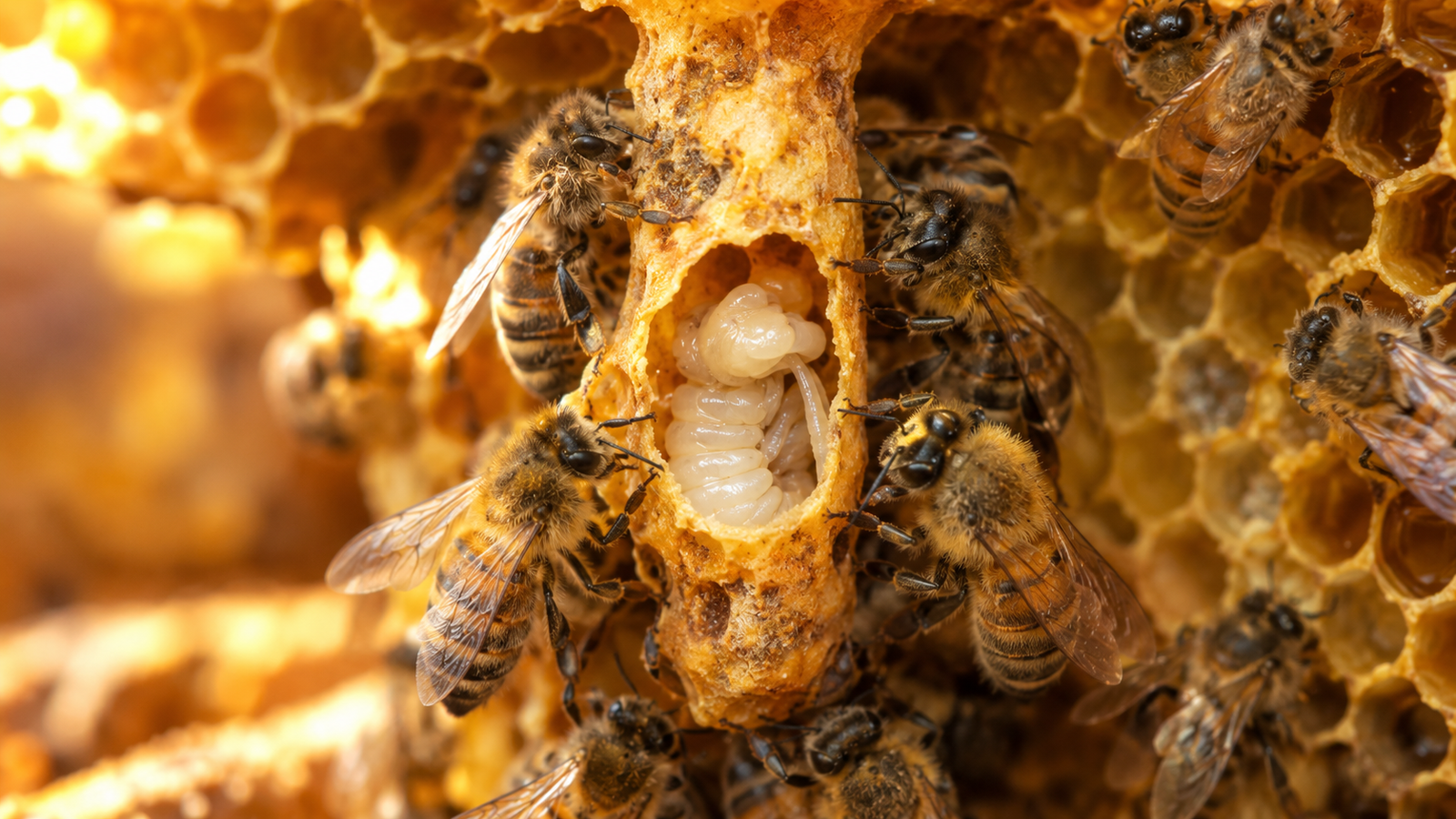
How do bees make a queen bee? Honey bees make a queen by selecting a very young female larva and raising her under special conditions. The larva starts as a fertilized egg, just like a worker bee, but worker bees place her in a queen cell and provide abundant, specialized food that changes how she develops.
As a result, the larva develops into a queen with fully developed reproductive organs rather than a worker.
A honey bee colony may raise a new queen when it loses its queen, when the existing queen becomes less productive, or when the colony prepares to swarm. The entire process—from egg to adult queen—normally takes about 16 days.
How Do Bees Make a Queen Bee?
Bees make a queen through a carefully coordinated process:
- The queen lays a fertilized egg.
- The egg hatches into a female larva.
- Worker bees select a very young larva for queen development.
- The larva is raised in a special queen cell.
- Nurse bees provide abundant royal jelly and other glandular food.
- The larva develops differently from a worker larva.
- The queen cell is capped as the larva changes into a pupa.
- An adult virgin queen emerges at about 16 days.
- She takes mating flights and mates with drones.
- After mating, she returns to the colony and eventually begins laying eggs.
The important point is that a queen does not come from a special kind of egg. Queen bees and worker bees both begin as fertilized female eggs. The difference is largely created during larval development.
Does a Queen Bee Come From a Special Egg?
No. A queen bee begins life as a fertilized egg, just like a female worker bee.
The queen lays fertilized eggs that can develop into females. When the colony needs a new queen, worker bees can select a suitable young female larva and provide the conditions required for queen development.
This is one of the most remarkable features of honey bee colonies: the same basic type of fertilized female egg can develop into either a worker or a queen.
The difference is established through development, especially nutrition and the way the larva is raised.
Step 1: The Queen Lays a Fertilized Egg
The process begins with the colony’s existing queen.
She lays an egg in a brood cell. Because the egg is fertilized, it is capable of developing into a female bee.
Under normal circumstances, the colony raises the larva as a worker. But when the colony needs a replacement queen, worker bees can select a suitable young female larva and begin treating her differently.
This must happen early in development because the larva’s developmental pathway becomes increasingly specialized as she grows.
Step 2: Worker Bees Select a Young Female Larva
Nurse bees are responsible for feeding and caring for developing brood.
When a colony needs a queen, they select very young female larvae and begin raising them as potential queens.
The younger the larva, the better suited it is for this developmental change.
A colony may raise several potential queens at the same time rather than depending on only one.
This provides insurance in case one queen fails to develop, emerges unsuccessfully, or does not become a productive queen.
Step 3: Bees Build a Queen Cell
A developing queen needs more room than a worker larva, so the colony creates a special structure called a queen cell.
Queen cells are much larger than ordinary worker brood cells and have a distinctive elongated shape that often resembles a peanut.
They usually hang downward from the comb.
Worker bees construct these cells from wax and modify the surrounding area as the queen develops.
Different types of queen cells can appear depending on why the colony is producing the queen.
Swarm Queen Cells
When a colony becomes strong and prepares to reproduce through swarming, workers may build several queen cells.
The old queen eventually leaves with a large portion of the colony, while a new queen develops in the original colony.
Supersedure Queen Cells
A colony may also replace an existing queen when she becomes less productive, damaged, or otherwise unsuitable.
In this situation, the old queen may remain in the colony while her daughter develops.
Emergency Queen Cells
If the colony suddenly loses its queen, workers can use suitable young female larvae to raise replacement queens.
They may modify existing worker brood cells to create emergency queen cells.
This allows the colony to respond quickly to an unexpected loss of its queen.
Step 4: The Larva Receives Specialized Food
One of the most important parts of queen development is nutrition.
Young worker bees called nurse bees feed developing larvae. Royal jelly is a secretion produced by worker bees and is an important part of the diet of developing queen larvae.
It is important, however, to understand that royal jelly is not simply a food that queens receive while worker larvae receive none.
Very young bee larvae also receive royal jelly. The critical difference is the amount, timing, and duration of specialized feeding during development.
Queen-destined larvae receive abundant queen-rearing food throughout their larval development.
This specialized nutritional environment contributes to the major differences between queens and workers.
How Does Royal Jelly Help Make a Queen?
Royal jelly contains nutrients and biologically active compounds that influence larval development.
The specialized diet affects processes involved in growth, metabolism, gene regulation, and reproductive development.
As a result, the queen larva develops characteristics that a worker larva does not.
A mature queen develops:
- Fully developed ovaries
- A larger abdomen
- A longer body
- A highly developed reproductive system
- Physiological characteristics suited to egg laying
A worker develops a body specialized for tasks such as nursing, cleaning, food collection, comb building, and colony defense.
Therefore, it is more accurate to say that nutrition helps direct the developmental pathway of a female larva toward becoming a queen rather than saying that royal jelly simply turns a worker into a queen.
Step 5: The Queen Larva Grows Inside the Cell
The queen larva grows rapidly inside the enlarged queen cell.
Nurse bees continue feeding and caring for her during the larval stage.
As development progresses, her body begins taking on the characteristics of a queen rather than a worker.
Her reproductive organs become fully developed, while a worker’s reproductive system remains greatly reduced.
Eventually, the queen cell is sealed with a wax covering.
Step 6: The Queen Cell Is Capped
Once the larval stage is complete, worker bees cap the queen cell.
Inside the capped cell, the larva undergoes a dramatic transformation into a pupa and then an adult queen.
During this stage, the developing bee is protected while her body changes.
The queen remains inside the cell until she is sufficiently developed to emerge.
How Long Does It Take to Make a Queen Bee?
A honey bee queen normally takes about 16 days from egg to adult.
A simplified timeline is:
| Development stage | Approximate time |
|---|---|
| Egg | About 3 days |
| Larva | About 5–6 days |
| Pupa | About 7–8 days |
| Adult queen emerges | Around day 16 |
The exact timing can vary somewhat with colony conditions and other factors.
For comparison, worker bees generally take about 21 days from egg to adult.
The queen’s faster development is one reason a queenless colony can produce a replacement relatively quickly when suitable young larvae are available.
Step 7: The Virgin Queen Emerges
When development is complete, the new queen emerges from her queen cell.
At this point she is called a virgin queen because she has not yet mated.
She is not immediately ready to perform her full reproductive role.
She first needs to mature and complete her mating flights.
What Happens After a Queen Bee Hatches?
After emerging, the virgin queen may spend time inside the colony while she matures.
She may encounter other developing queens or virgin queens depending on the colony’s circumstances.
The colony ultimately needs a reproductively capable queen, so competition between queens can occur.
In some situations, one queen may kill another developing or emerged queen.
The exact outcome depends on whether the colony is preparing to swarm, replacing its queen, or responding to queen loss.
How Does a New Queen Mate?
A virgin queen eventually leaves the hive on mating flights.
During these flights, she mates with drones from one or more colonies.
She can mate with multiple drones, and the sperm is stored inside her body in a specialized organ called the spermatheca.
This stored sperm allows her to fertilize eggs over a long period.
The queen’s mating flights are therefore extremely important because successful mating determines whether she can become a productive egg-laying queen.
When Does the New Queen Start Laying Eggs?
After mating and completing her development, the queen returns to the colony.
She eventually begins laying eggs.
The queen can produce two types of eggs:
- Fertilized eggs, which normally develop into females
- Unfertilized eggs, which develop into males called drones
Fertilized eggs can ultimately become either workers or queens depending on how the larvae are raised.
This means the queen provides the genetic starting point for the colony’s next generation, while worker bees determine much of the developmental pathway of female larvae.
Why Do Bees Make a Queen Bee?
Honey bees make new queens for several important reasons.
1. The Colony Has Lost Its Queen
If the queen dies unexpectedly, the colony can become queenless.
Worker bees can respond by raising a replacement queen from suitable young female brood.
This is essential because the colony needs a reproductive female to maintain its population over time.
2. The Queen Is Becoming Less Productive
A colony may replace a queen when her reproductive performance declines.
The workers can raise a daughter queen while the existing queen is still present.
This process is called supersedure.
3. The Colony Is Preparing to Swarm
When a colony becomes large and conditions are favorable, it may reproduce by swarming.
The colony raises new queens before the old queen leaves with a portion of the worker population.
The remaining colony eventually receives a new queen.
4. The Existing Queen Is Damaged or Otherwise Failing
A colony may also replace a queen if she becomes damaged or unable to maintain normal reproduction.
The workers can begin raising replacement queens from young female larvae.
How Do Bees Make a Queen When the Old Queen Dies?
If the queen suddenly disappears or dies, workers inspect the available brood and select suitable young female larvae.
They then create or modify cells for queen development and provide the larvae with the specialized food required for queen development.
Because several queen cells may be produced, the colony has multiple opportunities to obtain a viable replacement.
This is an example of how honey bee colonies can respond collectively to a major change in their social environment.
How Do Bees Make a Queen When They Swarm?
Swarming is another important form of queen production.
When a colony becomes crowded and reaches conditions favorable for reproduction, workers may build multiple queen cells.
The existing queen may leave the hive with a large portion of the worker population in a swarm.
Meanwhile, queen cells remain in the original colony.
After a new queen emerges and successfully mates, she can become the reproductive queen of the remaining colony.
This process allows one colony to reproduce and establish another colony.
Can a Worker Bee Become a Queen?
A fully developed worker bee cannot simply transform into a queen.
However, a very young female larva that would otherwise become a worker can be raised as a queen if the colony changes how she is fed and developed.
This is why queen production is sometimes described as the colony “making” a queen.
The colony does not genetically create a new type of bee. Instead, worker bees alter the developmental environment of a young female larva.
Are Queen Bees Genetically Different From Worker Bees?
Generally, no.
Queens and workers are both female offspring that develop from fertilized eggs.
They can be sisters and share the same parents.
The dramatic difference between them comes primarily from how they develop.
A queen receives a specialized developmental environment that produces a reproductive female, while a worker develops a body adapted for the many tasks required to maintain the colony.
This is an example of caste differentiation in social insects.
Queen Bee vs. Worker Bee
| Feature | Queen bee | Worker bee |
|---|---|---|
| Sex | Female | Female |
| Origin | Fertilized egg | Fertilized egg |
| Development | Queen-rearing conditions | Worker-rearing conditions |
| Reproductive organs | Fully developed | Greatly reduced |
| Main role | Reproduction | Colony maintenance |
| Body shape | Longer abdomen | More compact body |
| Egg laying | Primary reproductive role | Normally does not reproduce |
| Development time | About 16 days | About 21 days |
The differences are established during development rather than because queens come from a fundamentally different kind of egg.
How Many Queen Cells Do Bees Make?
A colony may produce several queen cells at once.
The number depends on the reason for queen production and the colony’s condition.
Swarming colonies can produce multiple queen cells, while a colony replacing a queen may produce fewer.
Producing multiple queens gives the colony a form of biological insurance because not every developing queen will necessarily become the final reproductive queen.
Can a Hive Have Two Queen Bees?
A honey bee colony normally operates with one primary reproductive queen, but two queens can sometimes coexist temporarily.
For example, during certain periods of queen replacement, an old queen and her daughter may both be present.
Eventually, the colony’s social organization usually settles around a single primary reproductive queen.
Multiple queens can also occur under unusual colony conditions, so it is better not to treat one-queen-per-hive as an absolute rule in every circumstance.
What Happens If Two Queens Hatch?
If two queens emerge, they may compete.
A queen can sometimes seek out other queens and attack them, particularly when the colony is not in a situation where multiple queens are being tolerated.
Queen-to-queen competition can determine which queen survives and becomes the colony’s reproductive queen.
This is one reason colonies can produce several queen cells but ultimately settle on one primary queen.
How Does a Queen Control the Colony?
Although the queen is often called the “head” of the hive, she does not command the colony like a human leader.
Honey bee colonies are organized through communication, chemical signals, and the coordinated behavior of thousands of individuals.
The queen produces pheromones that influence worker behavior and communicate information about her presence and reproductive condition.
Workers respond to these signals while performing tasks that keep the colony functioning.
The queen’s primary biological role is reproduction.
How Do Bees Know When to Replace Their Queen?
The queen’s pheromonal signals help workers assess her condition.
When the queen’s influence changes or becomes insufficient, workers may begin raising replacement queens.
This can happen when the queen is aging, injured, poorly mated, or otherwise failing to maintain the colony’s reproductive needs.
The workers can therefore respond to changes in the queen’s condition before the colony completely loses her.
What Happens to the Old Queen?
The fate of an old queen depends on the circumstances.
During supersedure, the old queen may remain in the colony while the replacement queen develops.
During swarming, the old queen usually leaves with the swarm.
If the queen has died unexpectedly, of course, there is no old queen to replace.
The colony’s response depends on why a new queen is being produced.
Frequently Asked Questions About How Bees Make a Queen Bee
Do bees make a queen from a worker egg?
No. A queen develops from a fertilized female egg, just as a worker does. The difference is the developmental conditions provided to the young larva.
Is royal jelly what makes a queen bee?
Royal jelly and the specialized feeding regime of queen-destined larvae play an important role in queen development. However, queen development is more complex than simply feeding a larva royal jelly.
How long does it take for a queen bee to develop?
A honey bee queen normally develops from egg to adult in about 16 days.
Can bees make a queen if the old queen dies?
Yes. If suitable young female larvae are available, worker bees can raise replacement queens.
Why do bees make several queen cells?
Producing several potential queens increases the colony’s chances of successfully obtaining a viable queen, particularly during swarming or queen replacement.
Can a worker bee become a queen?
A mature worker cannot transform into a queen. However, a young female larva that would normally become a worker can be raised as a queen.
Do queen bees mate inside the hive?
No. Virgin queens generally leave the colony on mating flights and mate with drones outside the hive.
How many drones does a queen bee mate with?
A queen can mate with multiple drones during her mating flights. The exact number varies, and mating with several drones helps create genetic diversity within the colony.
Does the queen lay all the eggs in a hive?
In a healthy colony with a functioning queen, she is normally responsible for almost all egg laying. However, workers can sometimes lay unfertilized eggs when a colony remains queenless.
Why do queen bees live longer than worker bees?
The queen’s specialized development, physiology, nutrition, and reproductive role contribute to her much longer potential lifespan compared with worker bees.
Conclusion: How Do Bees Make a Queen Bee?
So, how do bees make a queen bee?
Bees make a queen by taking a very young female larva and raising her under specialized queen-rearing conditions. The process begins with a fertilized egg, just as it does for a worker bee. Worker bees select a suitable young larva, raise her in a larger queen cell, and provide abundant specialized food, including royal jelly, throughout her larval development.
This developmental environment causes her body to develop differently from a worker, including fully developed reproductive organs and other queen-specific characteristics.
The queen then develops inside the capped cell and emerges at about 16 days after the egg was laid. After maturing, she takes mating flights, mates with drones, and returns to the colony to begin laying eggs.
Bees may make a new queen because the colony is queenless, the existing queen is declining, or the colony is preparing to swarm.
The most important fact to remember is this:
A queen bee is not produced from a special egg. She is made when worker bees give a young female larva the specialized nutrition and developmental conditions needed to become a queen.
