

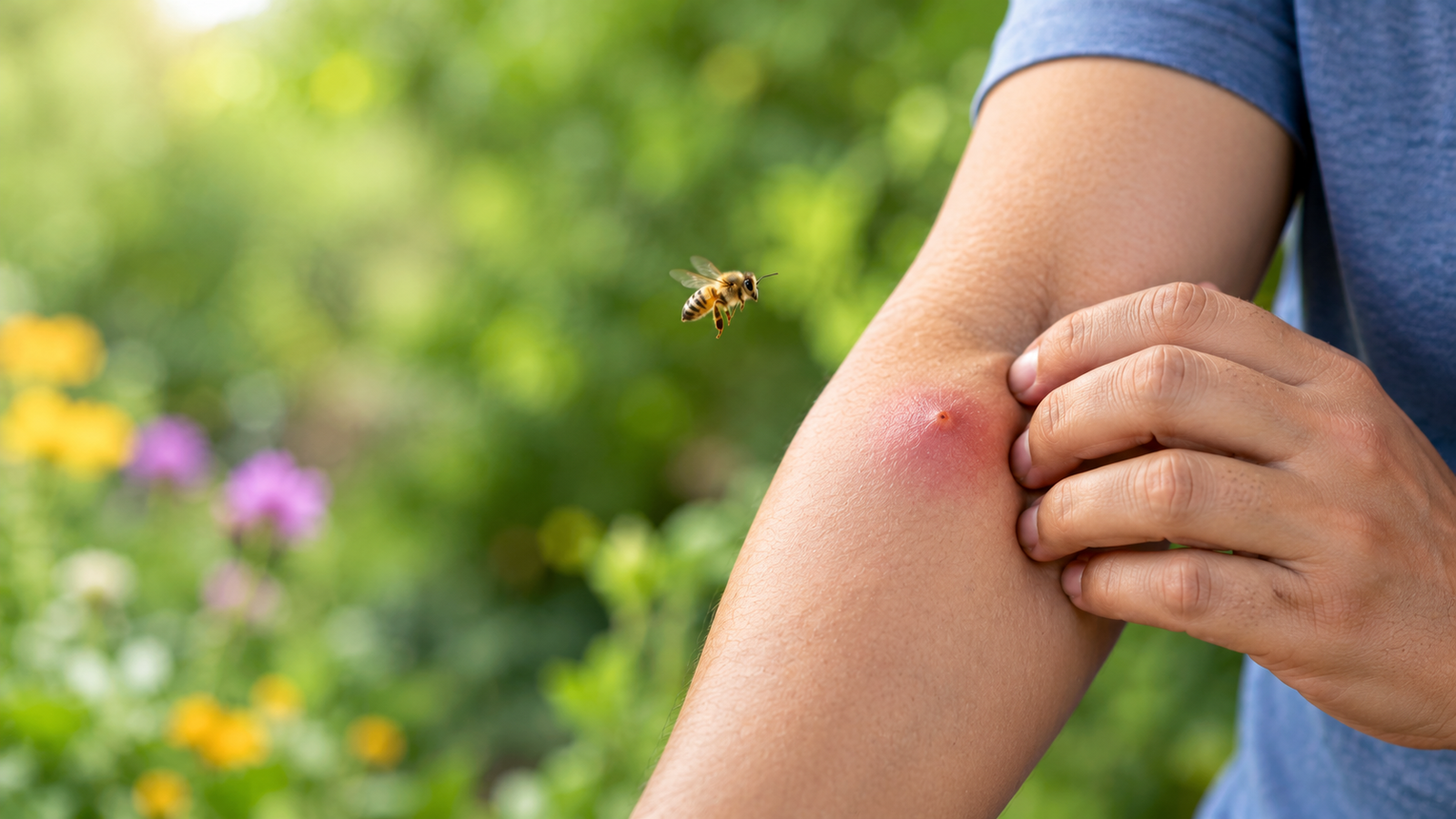
A bee sting can hurt immediately, producing a sharp, burning sensation that may last several seconds or minutes. However, the discomfort does not always disappear when the initial pain fades. Redness, tenderness, itching, and swelling can continue for several hours or days.
For most people, mild bee sting pain improves within a few hours, and minor swelling settles within one or two days. However, a larger local reaction can cause swelling that increases over 24–48 hours and takes a week or longer to disappear.
How long a bee sting hurts depends on the type of bee, the amount of venom injected, the location of the sting, and how your immune system responds.
Understanding the difference between immediate pain, lingering soreness, and swelling can help you recognize what is normal during recovery and when medical attention is necessary.
How Long Does Bee Sting Pain Last?
For most people, the sharp pain from a bee sting is strongest immediately after the insect stings. The intense burning sensation usually begins to ease within seconds or minutes, although tenderness and discomfort can continue afterward.
A mild reaction may improve considerably within a few hours. However, the surrounding skin can remain red, itchy, warm, or swollen for one or two days.
People who develop a large local reaction may experience discomfort for several days, even when the initial sharp pain has disappeared.
Here is a general guide:
| Reaction or symptom | Typical duration |
|---|---|
| Sharp, immediate pain | Seconds to several minutes |
| Burning sensation | Several minutes to hours |
| Mild tenderness | Several hours to 1–2 days |
| Local redness | Several hours to a few days |
| Mild swelling | Usually 1–2 days |
| Persistent itching | Several hours to several days |
| Large local swelling | Often 3–10 days |
| Severe allergic reaction | Can develop within minutes and requires emergency treatment |
These are approximate ranges, not guaranteed recovery times. Individual reactions vary, and pain does not necessarily last as long as swelling.
Bee Sting Pain and Swelling: Recovery Timeline
A bee sting does not always follow the same recovery pattern. Some people experience immediate pain followed by gradual improvement, while others notice that swelling becomes more pronounced the following day.
The following timeline explains what may happen after a typical sting.
| Time after the sting | Possible symptoms |
|---|---|
| First few minutes | Sharp pain, burning, redness and initial swelling |
| First 1–6 hours | Immediate pain begins easing; tenderness and itching may remain |
| 6–24 hours | Redness and swelling may become more noticeable |
| 24–48 hours | A larger local reaction may continue increasing |
| 48–72 hours | Large local swelling may reach its greatest extent |
| Days 3–5 | Pain, redness and swelling generally begin improving |
| Days 6–10 | Larger local reactions may continue settling |
Not everyone experiences every stage. A minor sting may resolve much sooner, while a person with a large local reaction may have noticeable swelling for more than a week.
The important distinction is that increasing swelling during the first two or three days can occur as part of the body’s inflammatory response. It does not automatically mean the wound is infected.
Why Does a Bee Sting Hurt?
A bee sting hurts because the insect injects venom into the skin through its stinger.
Honey bee venom contains several biologically active substances that affect cells, tissues and the body’s immune response.
One important component is melittin, a peptide that contributes to pain and tissue irritation. Another is phospholipase A2, an enzyme that affects cell membranes and is also important in allergic responses.
Hyaluronidase is another venom component that helps venom spread through surrounding tissues.
Together, these substances contribute to the burning sensation, inflammation, redness and swelling associated with a bee sting.
The body’s response to the venom also plays an important role. Inflammatory chemicals released around the sting site contribute to tenderness, warmth, itching and swelling.
This explains why a bee sting can remain uncomfortable after the initial sharp pain has faded.
What Happens Inside Your Skin After a Bee Sting?
When a honey bee stings, its stinger penetrates the skin and delivers venom into the surrounding tissue.
The body immediately begins responding to the injury and venom.
Several processes take place:
- Venom enters the skin: The stinger delivers venom beneath the skin’s surface.
- Pain receptors are stimulated: Venom components and tissue irritation activate pain-sensing nerves, producing the immediate burning sensation.
- Inflammation develops: The immune system responds to the injury and venom.
- Blood vessels become more permeable: Fluid moves into surrounding tissues, contributing to swelling.
- Itching and tenderness continue: Inflammatory processes may remain active after the strongest pain has disappeared.
The result is a combination of pain, redness, warmth, itching and swelling.
Not every symptom develops at the same speed. For example, the sharp pain may disappear within minutes, but swelling can continue increasing for another day or two.
Why Does My Bee Sting Still Hurt After 24 Hours?
A bee sting that still hurts after 24 hours is not necessarily abnormal.
The initial pain may have improved, but the affected tissue can remain inflamed. This can cause tenderness when you touch the area, move an affected joint, or put pressure on the skin.
Several explanations are possible.
1. The inflammatory response is continuing
Your immune system responds to the venom even after the stinger has been removed.
This response can cause localized redness, warmth, itching and tenderness.
2. Swelling is putting pressure on surrounding tissue
If the sting is on your finger, hand, foot or ankle, swelling can make ordinary movements uncomfortable.
For example, a sting near a finger joint may make gripping a cup or closing your hand painful.
3. You have developed a large local reaction
Some people experience swelling that extends beyond the immediate sting site.
A sting on the back of the hand, for example, may produce swelling across much of the hand and sometimes toward the wrist.
These reactions can become more noticeable during the first 24–48 hours and may take seven days or longer to settle.
4. The affected area has been irritated
Repeated scratching, rubbing or pressure can make an already inflamed area more uncomfortable.
Try to avoid scratching the sting site, even when it becomes itchy.
When should you be concerned?
Pain that continues after 24 hours deserves attention if it is getting progressively worse rather than gradually improving.
Seek medical advice if you notice increasing warmth, spreading redness, pus, fever, chills or worsening pain, particularly several days after the sting.
These symptoms may indicate a secondary infection.
How Long Does Bee Sting Swelling Last?
Bee sting swelling can last longer than the initial pain.
For a mild reaction, swelling generally improves within one or two days. However, a large local reaction may continue increasing for 24–72 hours and take approximately 7–10 days to resolve.
The amount of swelling depends on the person’s immune response, the sting location and other individual factors.
Mild bee sting swelling
A mild reaction usually involves:
- A small area of redness.
- Slight swelling around the sting.
- Mild tenderness.
- Some itching or warmth.
For example, someone stung on the forearm may notice a small raised area that becomes less noticeable over the following day.
Large local bee sting reaction
A large local reaction produces more extensive swelling around the sting site.
For example, a sting on one finger may cause swelling across the hand. A sting on the ankle may produce swelling that extends across part of the foot.
These reactions can look alarming but do not automatically indicate a dangerous allergic reaction.
The swelling may peak after two or three days and take a week or longer to disappear.
If swelling is severe, restricts movement, affects the face or eye, or continues worsening, seek medical assessment.
Why Do Some Bee Stings Hurt Longer Than Others?
Two people can be stung by similar bees and experience different recovery times.
Several factors help explain this difference.
Location of the sting
The location affects how noticeable pain and swelling become.
- Finger: Swelling may interfere with gripping and bending.
- Hand: Swelling can make ordinary activities uncomfortable.
- Foot: Walking may become painful when the affected area is swollen.
- Ankle: Swelling may make shoes uncomfortable.
- Face: Swelling can be particularly noticeable, especially around the eyes.
A sting near the eye, inside the mouth or in the throat requires prompt medical assessment because swelling in these locations can cause serious complications.
Individual immune response
Some people develop only a small red bump, while others experience extensive swelling.
This happens partly because individuals differ in their inflammatory and allergic responses to venom.
Previous uneventful stings do not guarantee that a person will never develop an allergic reaction.
Amount of venom injected
The amount of venom delivered can influence the severity of a local reaction.
Multiple stings can expose someone to a much greater total amount of venom than a single sting.
People who have received multiple stings, especially children, should receive prompt medical advice.
Previous allergic sensitization
A person who has become sensitized to insect venom may develop an allergic reaction after another sting.
A severe allergic reaction can occur even after a single sting and is different from ordinary local inflammation.
Does the Type of Bee Affect How Long a Sting Hurts?
Yes, the insect responsible for the sting can make a difference.
However, the type of insect alone cannot predict exactly how long pain will last. The amount of venom, location and individual response also matter.
Honey bee
Honey bees, particularly worker honey bees, have barbed stingers that commonly remain embedded in human skin after a sting.
The stinger and attached venom apparatus can continue delivering venom for a short time, so removing a visible stinger promptly is important.
Worker honey bees generally die after losing their stingers during a sting against human skin.
Bumblebee
Female bumblebees can sting when threatened or handled.
Unlike the typical worker honey bee stinger, a bumblebee’s stinger is not strongly barbed and generally does not remain embedded in human skin.
A female bumblebee can therefore sting more than once.
Wasps and yellow jackets
Wasps and yellow jackets are not bees, although their stings can produce similar symptoms.
Their stingers generally do not remain in the skin, allowing them to sting repeatedly.
Their venom also has a different chemical composition from honey bee venom.
| Insect | Can it sting more than once? | Does the stinger usually remain in skin? |
|---|---|---|
| Worker honey bee | Usually one sting against human skin | Yes |
| Female bumblebee | Yes | No |
| Wasp | Yes | No |
| Yellow jacket | Yes | No |
Remember that this is a general comparison. Not all bees have identical stinger structures, and the absence of an embedded stinger does not establish which insect caused the injury.
What to Do When a Bee Sting Continues to Hurt
If you have a mild local reaction, a few simple first-aid steps can help relieve discomfort and reduce swelling.
Step 1: Move away from the bees
Leave the area where the sting occurred to avoid being stung again.
Do not attempt to disturb a hive or swarm.
Step 2: Check for an embedded stinger
Look carefully at the affected skin.
A honey bee stinger may appear as a small dark object or black dot.
If you see one, remove it as quickly as possible. You can scrape it out using a fingernail or the edge of a clean card.
Avoid delaying removal to decide which removal technique is best.
Step 3: Wash the affected area
Clean the sting site gently with soap and clean water.
This removes dirt and helps reduce the risk of secondary infection.
Step 4: Apply a cold compress
Place a cold, damp cloth or an ice pack wrapped in a towel over the affected area.
Keep it in place for approximately 10–20 minutes.
Do not place ice directly against the skin.
You can repeat the process as needed to reduce discomfort and swelling.
Step 5: Elevate the affected limb
If the sting is on your hand, arm, foot or leg, elevate the affected area when practical.
For example, someone with a swollen hand can rest it on a pillow while sitting or lying down.
Step 6: Remove tight jewellery
If you were stung on your finger or hand, remove rings and tight jewellery before swelling increases.
A swollen finger can make removing a ring difficult.
Step 7: Consider suitable medication
Depending on your age, health conditions and other medicines, an over-the-counter pain reliever such as paracetamol or ibuprofen may help.
An antihistamine may help relieve itching, while a suitable hydrocortisone cream or calamine lotion may help with local itching and irritation.
Follow the product instructions and ask a pharmacist or healthcare professional if you are unsure which treatment is appropriate.
Do not use medication as a substitute for emergency treatment when symptoms suggest anaphylaxis.
How to Relieve Bee Sting Pain at Home
For a minor sting, the following measures can make recovery more comfortable.
| Relief method | How it helps |
|---|---|
| Cold compress | Helps reduce pain and swelling |
| Elevation | Helps limit swelling in an affected limb |
| Soap and water | Cleans the sting site |
| Paracetamol | Can relieve pain |
| Ibuprofen | Can relieve pain and inflammation when suitable |
| Antihistamine | Can reduce itching associated with an allergic response |
| Calamine lotion | May soothe itchy skin |
| Hydrocortisone cream | May reduce localized itching and inflammation |
Avoid applying irritating substances, undiluted essential oils, toothpaste or harsh chemicals to the sting.
Do not cut the skin, attempt to suck out venom, or apply excessive pressure to the affected area.
Home remedies cannot neutralize venom that has already entered the skin.
Normal Bee Sting Reaction vs. Infection vs. Allergic Reaction
One of the most important things to understand is that not every swollen bee sting is an allergic emergency, and not every red sting site is infected.
The following comparison explains the differences.
| Condition | Common signs | What to do |
|---|---|---|
| Normal local reaction | Pain, redness, warmth and swelling near the sting | Basic first aid and observation |
| Large local reaction | Extensive swelling that may increase over 1–3 days | Monitor closely and seek medical advice if severe |
| Possible infection | Increasing pain, spreading redness, pus, fever or chills | Seek medical assessment |
| Systemic allergic reaction | Hives away from the sting, swelling elsewhere, vomiting or other body-wide symptoms | Seek urgent medical assessment |
| Anaphylaxis | Breathing difficulty, throat swelling, fainting or collapse | Emergency treatment immediately |
How to recognize a possible infection
A bee sting can occasionally become infected, particularly if scratching damages the skin.
Possible warning signs include:
- Redness that continues spreading.
- Increasing pain rather than gradual improvement.
- Skin that becomes increasingly hot and tender.
- Pus or discharge from the wound.
- Fever or chills.
- Red streaks extending from the affected area.
A large local reaction can resemble an infection, so appearance alone may not establish the cause.
If these symptoms develop, seek medical assessment rather than assuming that the swelling is a normal part of recovery.
How to recognize an allergic reaction
An allergic reaction can affect areas beyond the sting site.
Possible symptoms include:
- Hives or widespread itching.
- Swelling of the lips, tongue or face.
- Abdominal cramps.
- Nausea or vomiting.
- Difficulty swallowing.
- Wheezing or breathing difficulties.
Anaphylaxis is a life-threatening allergic reaction that can develop within minutes of a sting.
Call your local emergency number immediately if someone develops breathing difficulty, throat or tongue swelling, fainting, collapse or other signs of anaphylaxis.
If the person has a prescribed adrenaline (epinephrine) auto-injector, use it according to their emergency action plan. Do not wait to see whether the symptoms disappear.
Is It Normal for a Bee Sting to Hurt for Three Days?
Yes, a bee sting can remain uncomfortable for three days, particularly when a person develops a large local reaction.
The initial burning pain should generally have eased considerably by this stage, but tenderness, itching and swelling may remain.
For example, someone stung on the ankle might experience:
- Day 1: Burning pain and redness.
- Day 2: More noticeable swelling and tenderness.
- Day 3: Less burning but continuing swelling and itching.
This can be consistent with a large local reaction.
However, pain that becomes progressively worse, especially with fever, pus or spreading redness, should be medically assessed.
Can a Bee Sting Hurt for a Week?
Yes, although it depends on what you mean by pain.
A mild sting generally improves much sooner. A larger local reaction may cause tenderness, itching and swelling for approximately a week or longer.
It is important to distinguish between lingering inflammation and continuing severe pain.
For example, a person may no longer experience sharp burning pain but may still notice tenderness when touching the affected skin.
If significant pain persists without improvement, becomes worse, or is accompanied by signs of infection, consult a healthcare professional.
Why Is My Bee Sting Swollen but No Longer Painful?
This can happen because pain and swelling are produced by related but different processes.
The sharp pain comes from the immediate effects of venom and stimulation of pain-sensitive nerves.
Swelling develops as fluid and inflammatory cells accumulate in the surrounding tissue.
The initial pain can therefore disappear while inflammation remains.
For example, a person stung on the back of the hand may feel much better the following morning but still notice that the hand looks swollen.
If the swelling is gradually improving and there are no concerning symptoms, it may simply be part of the normal recovery process.
However, rapidly increasing swelling, swelling involving the face or throat, or other systemic symptoms require medical attention.
Does a Bee Sting Hurt Longer If the Stinger Stays in the Skin?
An embedded honey bee stinger can continue delivering venom for a short period after the bee has flown away.
That is why prompt removal is important.
Leaving a visible stinger in place may increase venom delivery and contribute to discomfort.
However, removing the stinger does not immediately stop the body’s inflammatory response. Pain, redness, itching and swelling can continue after the stinger has been removed.
Do not dig deeply into the skin to retrieve a fragment that is no longer visible. Seek medical advice if you suspect a retained fragment is causing persistent problems.
When Should You Seek Medical Attention?
Most minor bee stings can be managed with basic first aid.
However, some situations require medical assessment.
Seek medical advice when:
- Pain continues worsening rather than improving.
- Swelling becomes extensive or interferes with normal movement.
- The sting is near the eye or inside the mouth.
- Redness spreads or pus develops.
- You develop fever or chills.
- You have a history of serious insect-sting allergies.
- You receive multiple stings.
Seek emergency help immediately if you experience difficulty breathing, throat or tongue swelling, fainting, collapse or symptoms suggesting anaphylaxis.
Do not wait for all symptoms to appear before seeking emergency assistance.
Frequently Asked Questions
1. How long does bee sting pain last on average?
The sharp burning pain usually lasts seconds to several minutes, although mild soreness and tenderness can continue for several hours or a couple of days.
2. Why does a bee sting still hurt after 24 hours?
The venom triggers an inflammatory response that can continue after the initial pain disappears. Swelling, tenderness and itching may remain for one or more days.
3. Is it normal for a bee sting to hurt after 48 hours?
Yes. A large local reaction may continue developing during the first 48–72 hours. However, worsening pain accompanied by fever, pus or spreading redness should be assessed.
4. Can a bee sting hurt for a week?
A large local reaction can cause lingering tenderness, itching and swelling for approximately a week or longer. Persistent severe pain should not be ignored.
5. Why does a bee sting hurt more the next day?
Inflammation can increase after the initial sting. Fluid accumulation and immune activity may make the affected area more swollen and tender the following day.
6. When should bee sting pain completely disappear?
Most mild reactions improve considerably within hours to a couple of days. Larger local reactions can take longer, and there is no exact recovery time for everyone.
7. Does a bee sting hurt longer if the stinger stays in the skin?
A retained honey bee stinger can continue delivering venom briefly. Prompt removal is recommended, although inflammation may continue afterward.
8. Why is my bee sting swollen but no longer painful?
Pain and swelling do not resolve at the same rate. The initial nerve irritation may settle while the inflammatory response continues.
9. Can a bee sting become infected after several days?
Yes, although infection is not the usual explanation for persistent swelling. Increasing warmth, spreading redness, pus, fever and worsening pain are reasons to seek medical assessment.
10. Does a honey bee sting hurt longer than a bumblebee sting?
There is no reliable rule that one always hurts longer. Both can produce painful local reactions, and the duration depends on venom exposure and individual response.
11. Does ice help a bee sting stop hurting?
A cold compress can reduce discomfort and swelling. Apply it through a cloth for 10–20 minutes at a time rather than placing ice directly on the skin.
12. When should I see a doctor for a bee sting?
Seek medical advice for severe or worsening pain, extensive swelling, suspected infection or a sting near sensitive areas. Breathing difficulty, throat swelling, fainting or collapse require immediate emergency assistance.
Final Thoughts: How Long Bee Sting Hurt?
So, how long bee sting hurt?
For most people, the sharp burning pain lasts seconds to minutes, while mild soreness and tenderness can continue for several hours or a day or two.
Swelling and itching may last longer. A large local reaction can become more noticeable over the first two or three days and take approximately 7–10 days or longer to resolve.
The most important thing is to understand that pain, swelling and inflammation do not necessarily disappear at the same time.
For a minor sting, prompt stinger removal when necessary, gentle cleaning, cold compresses and appropriate pain relief can make recovery more comfortable.
However, do not ignore progressively worsening symptoms, possible infection or signs of a serious allergic reaction. Breathing difficulty, throat swelling and fainting require immediate emergency treatment.
Understanding the normal recovery process helps you respond appropriately without confusing ordinary inflammation with a medical emergency.
Medical References and Further Reading
The following medical and scientific resources support the information in this article:
- American College of Allergy, Asthma & Immunology (ACAAI) – Insect Sting Allergies: Symptoms and Treatment. Guidance on normal local reactions, large local reactions, venom allergies and anaphylaxis.
- Mayo Clinic – Insect Bites and Stings: First Aid. First-aid recommendations, cold compresses and emergency warning signs.
- Mayo Clinic – Bee Sting: Diagnosis and Treatment. Stinger removal, cleaning, elevation and symptom relief.
- Merck Manual Professional Edition – Insect Stings. Clinical information about venom, local reactions, inflammation and allergic complications.
- DermNet – Bee and Wasp Stings. Dermatological information about local reactions, pain, swelling and allergic manifestations.
- American Academy of Dermatology – How to Treat a Bee Sting. Practical advice on stinger removal, wound cleaning and symptom relief.
Medical disclaimer: This article provides general educational information and is not a substitute for professional medical diagnosis or treatment. Seek appropriate medical care when symptoms are severe, unusual or worsening.
