

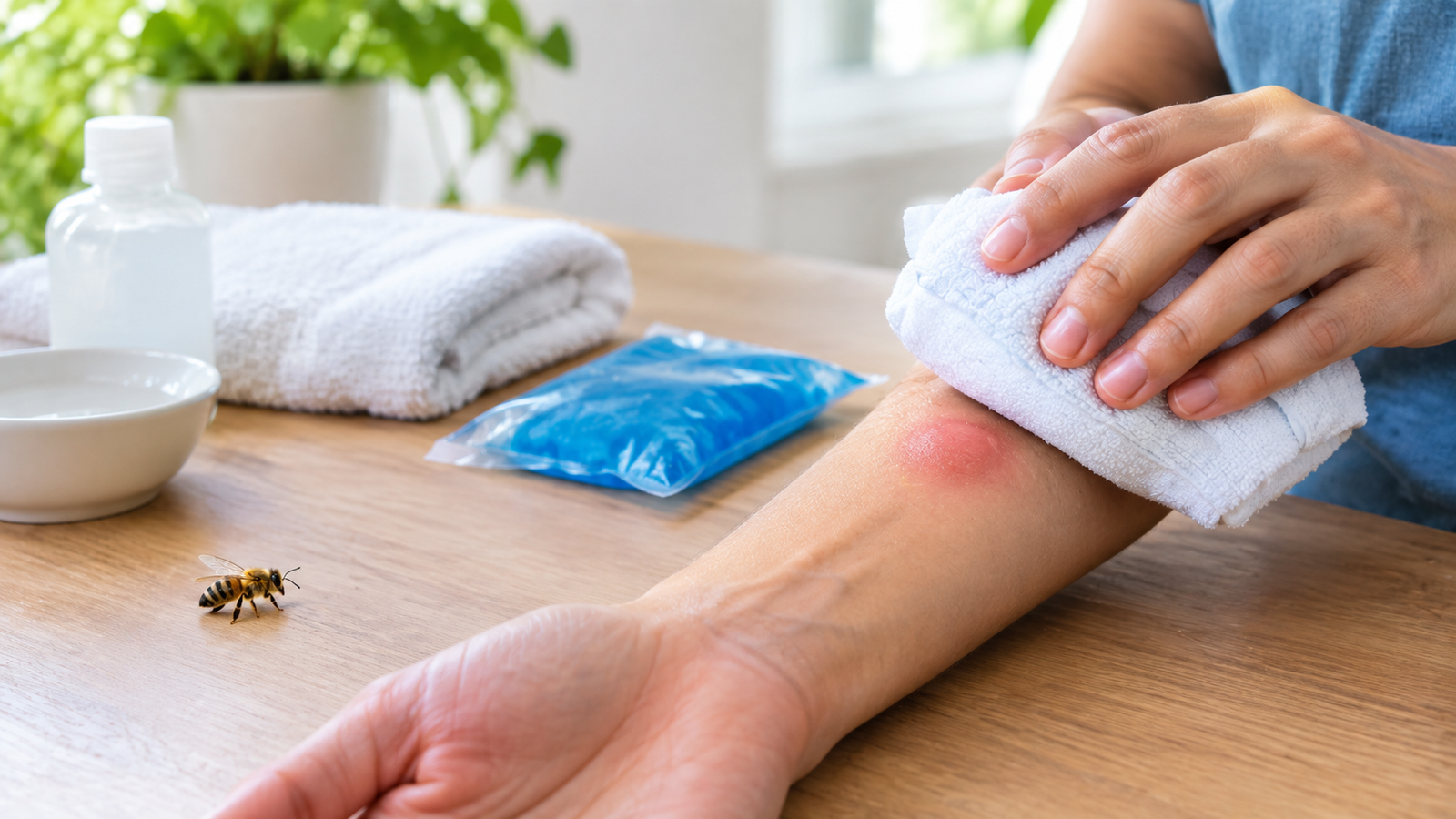
If you have just been stung by a bee, remove the stinger if it is still in your skin, wash the area with soap and water, and apply a cold compress for 10–20 minutes. You can also use appropriate over-the-counter treatments to relieve pain, itching, and swelling.
Most single bee stings cause a temporary local reaction that can be treated at home. However, a bee sting can sometimes cause a serious allergic reaction called anaphylaxis. If you develop difficulty breathing, swelling of your tongue or throat, widespread hives, dizziness, or fainting, seek emergency medical care immediately.
This guide explains how to treat a bee sting at home, what to put on a bee sting, how to reduce pain and swelling, which popular home remedies have limited evidence, and when a bee sting needs medical attention.
Quick Answer: How to Treat a Bee Sting at Home
For a typical mild bee sting:
- Move away from the bees to avoid additional stings.
- Check for a stinger and remove it promptly if it remains in your skin.
- Wash the sting with soap and water.
- Apply a cold compress wrapped in a cloth for about 10–20 minutes.
- Elevate the affected area if your arm or leg is swollen.
- Use an appropriate pain reliever if needed.
- Use an antihistamine, hydrocortisone cream, or calamine lotion for itching when appropriate.
- Monitor yourself for signs of an allergic reaction.
If symptoms become severe or affect your breathing, throat, circulation, or multiple areas of your body, do not rely on home treatment. Seek emergency medical care.
What Happens When a Bee Stings You?
A bee sting injects venom into the skin, which triggers pain and an inflammatory response.
A typical local reaction may cause:
- Immediate sharp or burning pain
- Redness
- Mild swelling
- Itching
- Warmth around the sting
These symptoms usually remain close to the sting site and gradually improve.
Some people develop a large local reaction, in which swelling becomes much more pronounced and may spread beyond the immediate area of the sting. This type of reaction can take several days to settle.
A much more serious reaction can occur when the immune system reacts throughout the body. This is called anaphylaxis and requires emergency treatment.
Step 1: Move Away From the Bees
Before treating the sting, move to a safe location away from the bee or other bees.
This is especially important if you were stung near a hive, nest, or area where many bees are present.
Additional stings can increase the amount of venom entering your body and can create a more serious situation.
Once you are safely away from the bees, you can examine the sting.
Step 2: Remove the Bee Stinger
If a honey bee stinger is still visible in your skin, remove it as soon as possible.
A honey bee can leave its barbed stinger behind after stinging. The venom apparatus attached to the stinger can continue releasing venom for a period of time after the bee has flown away.
A simple way to remove a visible stinger is to gently scrape it sideways using your fingernail or the edge of a bank card.
The most important thing is to remove the stinger promptly rather than spending a long time deciding which removal method is perfect.
Should you pull out a bee stinger?
Guidance commonly emphasizes scraping or brushing a visible stinger away rather than deliberately squeezing the venom sac.
If the stinger is difficult to remove or is completely beneath the skin, do not dig into the skin trying to retrieve it.
Do all bees leave a stinger?
No.
Honey bees are well known for leaving their barbed stinger behind after stinging a person. Other stinging insects, including wasps, generally can sting repeatedly without leaving the same type of stinger behind.
Step 3: Wash the Bee Sting With Soap and Water
After removing the stinger, wash the affected area gently with soap and water.
Cleaning the area helps remove dirt and contaminants and helps keep the irritated skin clean.
Do not aggressively scrub the sting.
If the sting is on your hand or finger, remove rings, bracelets, or other tight jewelry as soon as possible because swelling may develop.
Step 4: Apply a Cold Compress
A cold compress is one of the simplest ways to reduce discomfort after a bee sting.
Wrap an ice pack or ice cubes in a clean cloth and place it over the sting for approximately 10–20 minutes at a time.
Do not put ice directly on your skin.
Cold can help reduce pain and swelling around the sting.
You can repeat the cold treatment as needed.
Step 5: Elevate the Affected Area
If the bee sting is on your arm, hand, leg, or foot and the area is swollen, keeping it elevated may help reduce swelling.
For example, if your hand is swollen, rest it on a pillow while sitting or lying down.
Elevation works particularly well when combined with a cold compress.
Step 6: Relieve Bee Sting Pain
The pain from a bee sting is usually strongest shortly after the sting.
A cold compress may provide significant relief. If additional pain relief is needed, an appropriate over-the-counter medicine such as acetaminophen (paracetamol) or ibuprofen may help.
Follow the product’s instructions and make sure the medicine is appropriate for you.
Ibuprofen and other nonsteroidal anti-inflammatory drugs (NSAIDs) are not suitable for everyone. People with certain medical conditions, allergies, medication interactions, or other contraindications should ask a healthcare professional or pharmacist before using them.
For children, use medicines appropriate for their age and weight and follow the product instructions or advice from a healthcare professional.
Step 7: Reduce Itching From a Bee Sting
Itching may become more noticeable after the initial pain begins to settle.
Several treatments can help relieve itching.
Antihistamines
An appropriate oral antihistamine may help reduce itching associated with an insect sting.
Common antihistamines include medicines containing:
- Cetirizine
- Loratadine
- Fexofenadine
Some antihistamines can cause drowsiness. Check the label before driving or operating machinery.
An antihistamine should not be relied upon as a substitute for epinephrine when someone is experiencing anaphylaxis.
Hydrocortisone cream
An over-the-counter hydrocortisone cream may help relieve itching and inflammation around a mild sting.
Follow the product directions and avoid applying it to the eyes or other sensitive areas.
Calamine lotion
Calamine lotion may also provide relief from itching and irritation.
Step 8: Keep the Sting From Getting Infected
Try not to scratch the bee sting.
Scratching can damage the skin and potentially introduce bacteria.
Instead:
- Keep the area clean.
- Keep your fingernails away from the sting.
- Use an appropriate anti-itch treatment if necessary.
- Monitor the area as it heals.
A little redness, warmth, swelling, and tenderness immediately after a sting can be normal. However, symptoms that continue getting worse may require medical evaluation.
What Can You Put on a Bee Sting?
For a typical mild bee sting, the most useful treatments are simple.
You can use:
- A cold compress
- Hydrocortisone cream for itching
- Calamine lotion for itching and irritation
- An appropriate oral antihistamine
- Appropriate pain medication
You do not need to put numerous substances on the sting.
Some popular home remedies are discussed below, but many have limited scientific evidence for treating bee stings.
Home Remedies for a Bee Sting: What Actually Helps?
People have used many household substances to soothe bee stings, including baking soda, honey, toothpaste, vinegar, aloe vera, and witch hazel.
Some may feel soothing on irritated skin, but evidence for many of these remedies specifically treating bee stings is limited.
For that reason, they should not replace basic first aid or emergency treatment.
Honey
Honey is sometimes applied to irritated skin because honey has properties that can be useful in certain wound-care situations.
However, that does not mean ordinary household honey has been proven to treat bee venom or make a bee sting heal faster.
If you choose to use a topical product, use a clean product intended for skin and avoid applying substances to broken or infected skin without appropriate advice.
For a normal bee sting, honey is not necessary.
Baking Soda
Baking soda is a popular traditional remedy for insect bites and stings.
You may find recommendations for mixing baking soda with water to create a paste.
However, the idea that baking soda reliably “neutralizes bee venom” is not well established, and it should not be considered a replacement for standard first aid.
There is no need to use baking soda when a cold compress and appropriate symptom treatment can be used instead.
Toothpaste
Toothpaste is another popular internet remedy.
There is limited evidence that toothpaste treats bee stings, and its ingredients can sometimes irritate sensitive skin.
It is therefore not a necessary treatment.
Apple Cider Vinegar
Apple cider vinegar is sometimes recommended for insect stings.
However, evidence supporting it as an effective treatment for bee stings is limited, and vinegar can irritate already inflamed skin.
It is safer to rely on standard first aid rather than applying acidic substances to the sting.
Aloe Vera
Aloe vera gel can have a soothing effect on irritated skin for some people.
If you use aloe vera, choose a clean topical product and stop using it if it causes burning, redness, or irritation.
Aloe vera is optional and does not replace cleaning the sting, applying a cold compress, or seeking emergency care when necessary.
Witch Hazel
Witch hazel is another traditional topical remedy for irritated skin.
Evidence specifically supporting it as a treatment for bee stings is limited.
If it causes irritation, discontinue its use.
What Should You NOT Put on a Bee Sting?
You don’t need to experiment with multiple household substances after being stung.
Avoid:
- Applying ice directly to the skin
- Scratching the sting
- Applying dirty substances such as mud
- Using irritating substances that cause burning
- Digging into the skin to find a stinger that cannot be seen
- Delaying emergency treatment to try a home remedy
The goal of home treatment is to reduce pain and inflammation while keeping the area clean, not to chemically neutralize the venom.
How Long Does a Bee Sting Last?
The duration depends on how your body reacts.
Mild bee sting
Pain and burning may be strongest immediately after the sting and then gradually improve.
Redness, itching, and mild swelling may persist for a few days.
Large local reaction
A large local reaction can produce substantial swelling.
The swelling may increase during the first day or two before gradually improving. It can take several days to completely resolve.
Severe allergic reaction
Anaphylaxis can develop rapidly and requires emergency medical treatment.
Do not wait for a severe reaction to disappear on its own.
What Does a Normal Bee Sting Look Like?
A typical local reaction may include:
- A small red area
- A raised welt
- Local swelling
- Burning or stinging pain
- Itching
- Warmth
These symptoms generally remain near the sting site.
A local reaction does not necessarily mean that you are having a dangerous allergy.
What Is a Large Local Reaction to a Bee Sting?
Some people experience considerably more swelling than others.
A large local reaction may involve swelling that extends well beyond the immediate sting site.
For example, a sting on a finger could cause substantial swelling across part of the hand.
The swelling can become worse during the first day or two before gradually improving.
A large local reaction can be uncomfortable and may last several days.
If the swelling is severe, continues worsening, or you are uncertain whether your symptoms are an allergic reaction, contact a healthcare professional.
When Is a Bee Sting an Emergency?
A bee sting becomes an emergency when it causes symptoms of anaphylaxis, a potentially life-threatening allergic reaction.
Seek emergency medical help immediately if you develop:
- Difficulty breathing
- Wheezing
- Tightness in the throat or chest
- Swelling of the tongue
- Swelling of the throat
- Swelling of the lips or face
- Widespread hives
- Severe dizziness
- Fainting
- Weakness or collapse
- Confusion
- Rapid or weak pulse
- Severe vomiting or diarrhea together with other allergic symptoms
These symptoms can indicate a reaction affecting multiple systems of the body.
Do not try to treat anaphylaxis with home remedies.
What to Do if You Have Anaphylaxis After a Bee Sting
If you have a prescribed epinephrine (adrenaline) auto-injector and develop symptoms of anaphylaxis, use it according to your emergency action plan.
Then seek emergency medical care immediately.
Epinephrine is the first-line emergency treatment for anaphylaxis.
Do not rely on an antihistamine alone for a severe allergic reaction. Antihistamines may help some allergy symptoms but do not replace epinephrine for anaphylaxis.
Even if symptoms improve after epinephrine, emergency medical evaluation is still necessary because symptoms can return.
Can a Bee Sting Cause an Allergic Reaction Later?
Yes.
An allergic reaction can develop shortly after a sting, and serious symptoms can progress quickly.
If you develop symptoms involving your breathing, throat, circulation, or multiple parts of your body, treat the situation as an emergency.
People who have previously experienced anaphylaxis from an insect sting should speak with a healthcare professional about prevention and an emergency treatment plan.
What if You Are Stung by Multiple Bees?
Multiple bee stings deserve extra caution.
A large number of stings can expose the body to substantially more venom.
If you have received numerous stings, contact a healthcare professional for advice, particularly if you develop:
- Widespread swelling
- Vomiting
- Diarrhea
- Weakness
- Dizziness
- Difficulty breathing
- Severe pain
- Other unusual symptoms
If severe symptoms occur, seek emergency medical care.
Can a Bee Sting Become Infected?
Most bee stings heal without infection.
However, repeatedly scratching the area can damage the skin and increase the risk of infection.
Contact a healthcare professional if you develop signs such as:
- Increasing redness
- Increasing warmth
- Increasing pain
- Pus or other drainage
- Fever
- Redness spreading away from the sting
- Symptoms that continue getting worse rather than improving
A normal inflammatory reaction immediately after a sting can look red and swollen, so the important factor is how the area changes over time.
When Should You See a Doctor for a Bee Sting?
Home treatment is usually sufficient for a mild single sting.
Contact a healthcare professional if:
- The reaction is unusually large.
- Swelling continues to worsen significantly.
- Symptoms do not begin improving.
- You develop signs of infection.
- You have been stung many times.
- You have concerns about your reaction.
- You have previously experienced a serious allergic reaction to an insect sting.
Seek emergency medical care immediately for symptoms of anaphylaxis.
How to Prevent Another Bee Sting
If you spend time around bees, reducing your exposure can lower your chance of being stung.
When outdoors:
- Avoid disturbing bee colonies or nests.
- Be cautious around flowering plants where bees are actively feeding.
- Wear shoes outdoors rather than walking barefoot.
- Keep food and sweet drinks covered when outside.
- Avoid swatting at bees.
- Move away calmly if bees are nearby.
- If you keep bees, use appropriate protective equipment.
People with a known severe venom allergy should follow their healthcare professional’s emergency plan and carry prescribed epinephrine.
Frequently Asked Questions About Treating a Bee Sting at Home
How do you treat a bee sting at home?
Remove the stinger if it remains, wash the area with soap and water, and apply a cold compress for 10–20 minutes. You can use appropriate pain relievers or anti-itch treatments if necessary. Monitor for symptoms of an allergic reaction.
What should I put on a bee sting?
A cold compress can reduce pain and swelling. Hydrocortisone cream or calamine lotion may help relieve itching. An appropriate oral antihistamine may also help with itching.
How do you reduce swelling from a bee sting?
Apply a cold compress wrapped in a cloth for about 10–20 minutes at a time. If the sting is on an arm or leg, elevating the affected area may also help.
Should I remove the bee stinger?
Yes. If a honey bee stinger remains visible, remove it promptly. Gently scrape it sideways with a fingernail or blunt edge such as a bank card.
Is ice good for a bee sting?
Yes. A cold pack or wrapped ice pack can help reduce pain and swelling. Never place ice directly on your skin.
Is baking soda good for a bee sting?
Baking soda is a popular traditional remedy, but there is limited evidence that it neutralizes bee venom or provides a significant benefit. Basic first aid and appropriate symptom treatment are preferable.
Is toothpaste good for a bee sting?
There is limited scientific evidence supporting toothpaste as a bee-sting treatment. It can also irritate sensitive skin, so it is not necessary.
Can I put honey on a bee sting?
Honey has properties that can be useful in some wound-care settings, but ordinary honey has not been established as a necessary treatment for bee stings. Standard first aid is more important.
How long does bee sting swelling last?
Mild swelling often improves within a few days. A large local reaction can last longer and may become more pronounced during the first day or two.
Can a bee sting become infected?
Yes, although infection is not inevitable. Scratching can damage the skin and increase the risk. Increasing pain, spreading redness, pus, fever, or worsening symptoms can indicate infection.
When should I go to the hospital for a bee sting?
Seek emergency medical care if you develop difficulty breathing, swelling of the tongue or throat, widespread hives, severe dizziness, fainting, or other signs of anaphylaxis.
What should I do if I am allergic to bee stings?
If you have a known severe bee-venom allergy, follow your healthcare professional’s emergency plan. If anaphylaxis develops and you have a prescribed epinephrine auto-injector, use it according to your plan and seek emergency medical care immediately.
How to Treat a Bee Sting at Home: The Bottom Line
Most mild bee stings can be treated at home with simple first aid.
Remember these steps:
- Move away from the bees.
- Remove a visible stinger promptly.
- Wash the area with soap and water.
- Apply a cold compress for 10–20 minutes.
- Elevate a swollen arm or leg.
- Use appropriate pain relief if necessary.
- Treat itching with an appropriate antihistamine, hydrocortisone, or calamine lotion.
- Avoid scratching the sting.
- Monitor your symptoms.
- Seek emergency medical care if signs of anaphylaxis appear.
Popular remedies such as baking soda, toothpaste, vinegar, honey, aloe vera, and witch hazel are often discussed for bee stings, but evidence for many of them is limited. They should never replace proper first aid or emergency treatment.
The most important distinction is between a mild local reaction that can usually be managed at home and a systemic allergic reaction that requires emergency medical attention.
If you develop trouble breathing, swelling of your tongue or throat, widespread hives, severe dizziness, fainting, or other symptoms suggesting anaphylaxis, seek emergency medical care immediately.

6 Comments
Pingback: Which Bee Doesn't Have a Stinger? Meet Stingless Bees - BeekeeperBase
Pingback: Which Bee Sting Hurts the Most? The Most Painful Bee Stings Explained - BeekeeperBase
Pingback: Which Bee Dies After Stinging? The Science Behind Honey Bee Stings - BeekeeperBase
Pingback: Which Bee Is the Most Dangerous? 5 Bees You Should Know - BeekeeperBase
Pingback: How Bee Sting Look Like? Signs, Pictures, Symptoms, and Healing Stages - BeekeeperBase
Pingback: How Many Bee Stings Can a Human Take? A Complete Guide - BeekeeperBase