

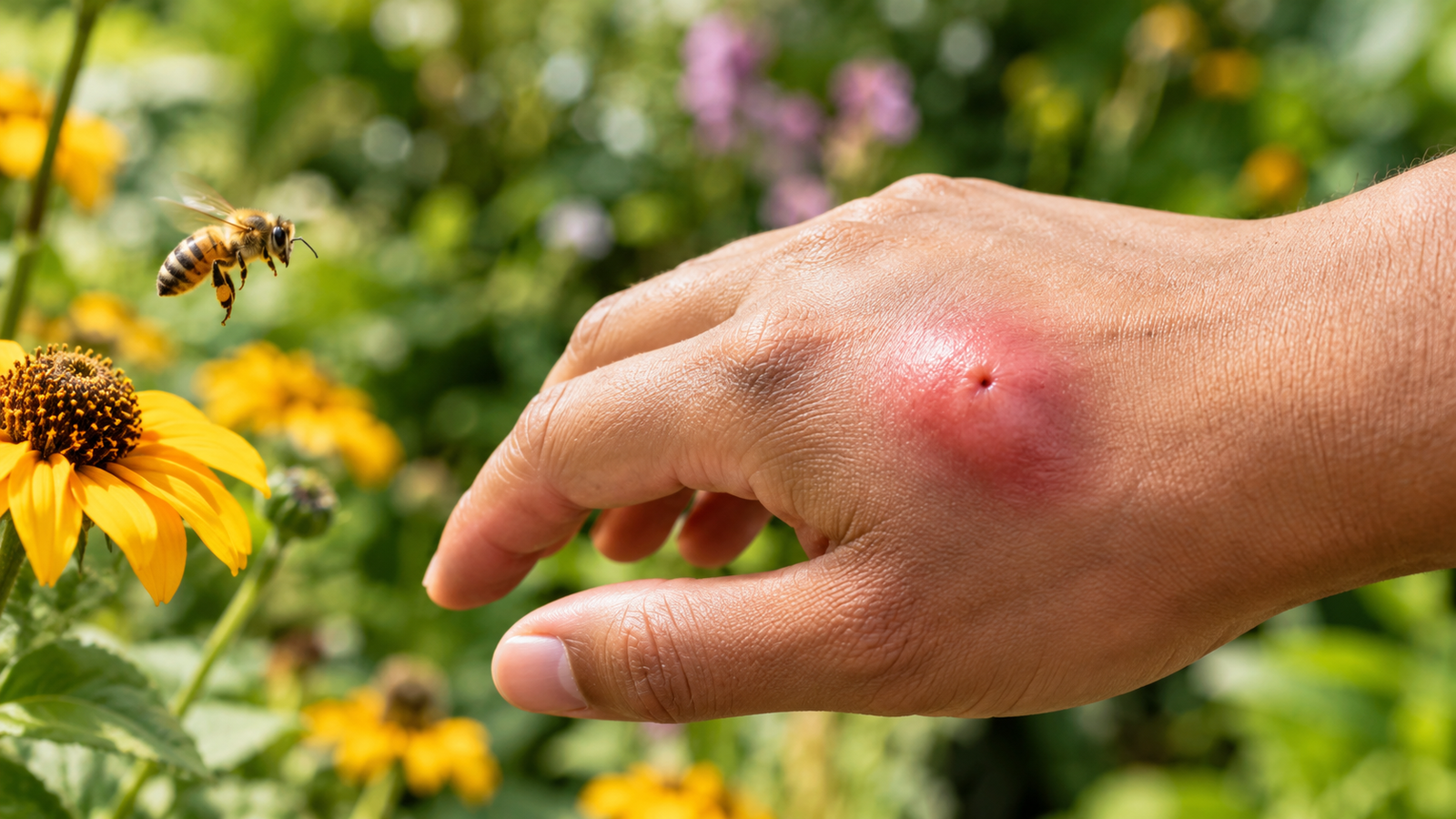
A bee sting allergic reaction can last from several hours to several days, depending on the type and severity of the reaction. A mild local reaction usually improves within a few hours to 1–2 days, while a large local reaction can take approximately 3–10 days to resolve. A severe allergic reaction, called anaphylaxis, can develop within minutes and become life-threatening. Although emergency treatment can control anaphylaxis, symptoms may sometimes return after initially improving.
Not every swollen or itchy bee sting is a true allergy. Most people experience a local inflammatory response caused by bee venom. Others develop an exaggerated local allergic reaction, while a smaller number experience a systemic reaction that affects other parts of the body.
Understanding the difference matters because a swollen hand that takes several days to recover is very different from an allergic reaction that causes breathing difficulties, throat swelling or a dangerous drop in blood pressure.
This guide explains how long different bee sting reactions last, when symptoms appear, why swelling sometimes gets worse the following day, how to recognize anaphylaxis and what treatment is appropriate for each situation.
How Long Does a Bee Sting Allergic Reaction Last?
A bee sting reaction can last anywhere from a few hours to approximately 10 days or longer. The duration depends on whether the reaction is a normal local response, a large local reaction or a systemic allergic reaction.
Here is a comparison of the main types:
| Type of reaction | Common symptoms | Approximate duration |
|---|---|---|
| Normal local reaction | Pain, redness and small swelling | Hours to a few days |
| Mild local allergic symptoms | Itching, redness and localized swelling | Several hours to a few days |
| Large local allergic reaction | Extensive swelling, itching and warmth | Approximately 3–10 days |
| Systemic allergic reaction | Hives, swelling away from sting site, digestive or respiratory symptoms | Variable; requires medical assessment |
| Anaphylaxis | Breathing difficulty, throat swelling, dizziness or circulatory problems | Can progress rapidly; recurrence is possible |
These time frames are estimates, not guarantees. The duration of symptoms alone cannot establish whether a reaction is dangerous.
An important distinction: A normal local reaction is primarily an inflammatory response to venom. A large local reaction may involve an allergic mechanism, while anaphylaxis is a potentially life-threatening systemic reaction.
If someone develops difficulty breathing, tongue or throat swelling, collapse, faintness or other signs of anaphylaxis, use their prescribed epinephrine auto-injector immediately and contact emergency medical services. Do not wait to see how long the symptoms last.
How Quickly Does a Bee Sting Allergic Reaction Start?
The timing depends on the type of reaction.
Normal pain and localized swelling can begin almost immediately. Large local reactions may continue developing over the next 24–48 hours. Systemic allergic reactions commonly begin within minutes, although their onset can vary.
Immediately After the Sting
A person usually experiences sharp pain, burning or tenderness where the bee’s stinger enters the skin.
The affected area may become red, warm and slightly swollen.
These symptoms alone do not establish that the person is allergic to bee venom. They are common consequences of a sting.
If a honeybee’s barbed stinger remains in the skin, remove it promptly. Do not delay removal while trying to decide which removal technique is best.
Move away from the bees to prevent additional stings.
During the First 30 Minutes
This is an important period for recognizing a potentially serious allergic reaction.
Warning signs may include:
- Widespread hives or itching away from the sting site.
- Swelling of the lips, tongue or throat.
- Wheezing or difficulty breathing.
- Persistent coughing or a change in voice.
- Dizziness, faintness or collapse.
- Severe abdominal pain or vomiting, particularly alongside other allergic symptoms.
Anaphylaxis does not always cause a skin rash. Serious breathing or circulatory symptoms must be treated as an emergency even when hives are absent.
If anaphylaxis is suspected, administer prescribed epinephrine immediately and call emergency services.
During the Following Hours
A mild reaction may settle, while a large local reaction can continue increasing in size.
Some people notice more redness, itching and swelling several hours after the sting.
New symptoms affecting other parts of the body should not automatically be attributed to ordinary swelling. Seek emergency assistance if signs of anaphylaxis appear.
During the Following Days
Localized pain and swelling usually begin improving, although a large local reaction may take several days to settle.
Some people notice that the sting area looks worse on the second day than it did immediately after the sting.
This can happen because inflammation develops over time rather than reaching its maximum immediately.
However, worsening pain, increasing warmth, pus, fever or spreading redness may indicate infection or another complication requiring medical assessment.
How Long Does a Mild Bee Sting Reaction Last?
A normal mild local reaction usually improves within a few hours to a few days.
Common symptoms include:
- Pain or tenderness at the sting site.
- A small red bump.
- Mild swelling.
- Localized itching.
- Slight warmth around the affected skin.
For example, imagine someone being stung on the forearm while working in a garden.
The area immediately becomes painful and develops a small red bump. Several hours later, the pain decreases, although mild itching remains. By the following day, the swelling is smaller.
This is a typical example of an uncomplicated local sting reaction.
Why Does a Normal Bee Sting Cause Swelling?
When a honeybee stings, it injects venom containing biologically active substances, including melittin, phospholipase A2 and other compounds.
These substances can cause tissue irritation, pain and inflammation.
The body’s inflammatory response increases blood flow and allows fluid and immune substances to enter the surrounding tissue. This produces redness, warmth and swelling.
The reaction does not necessarily mean the person’s immune system has developed a dangerous allergy.
How to Treat a Mild Reaction
Most uncomplicated local reactions can be managed with basic first aid:
- Move away from the bees.
- Remove any remaining stinger promptly.
- Wash the affected area with soap and water.
- Apply a cold pack wrapped in a cloth for approximately 10–15 minutes at a time.
- Elevate the affected arm or leg when practical.
- Consider an appropriate pain reliever or antihistamine if needed, following medical or pharmacist advice.
Avoid scratching the area because this can further irritate the skin.
If symptoms spread beyond the sting site or new symptoms develop, seek medical advice.
How Long Does a Large Local Bee Sting Allergic Reaction Last?
A large local reaction generally takes approximately 3–10 days to resolve.
Unlike a small reaction, swelling may extend well beyond the immediate sting site. It can affect an entire hand, foot or part of an arm or leg.
For example, a person stung on one finger may wake up the following morning with swelling across much of the hand.
Someone stung near the ankle may develop swelling extending across the foot.
This can look alarming, but a large local reaction does not automatically mean the person is experiencing anaphylaxis.
Why Does Swelling Get Worse 24–48 Hours After a Bee Sting?
This happens because the inflammatory response continues after the initial sting.
Bee venom triggers local tissue inflammation. Blood vessels become more permeable, allowing fluid and immune cells to move into the surrounding tissues.
As this process continues, swelling may become more extensive.
In a large local reaction, the swelling commonly increases over the first 24–48 hours before gradually improving.
This explains why someone can feel relatively comfortable immediately after a sting but experience a much larger swollen area the following morning.
How Can You Recognize a Large Local Reaction?
Common features include:
- Swelling extending beyond the immediate sting site.
- Redness and warmth.
- Persistent itching.
- Tightness or discomfort.
- Swelling that increases during the first one or two days.
A reaction measuring approximately 10 cm or more is commonly used in clinical descriptions of a large local reaction, although the size alone does not determine severity.
Large Local Reaction vs. Anaphylaxis
| Feature | Large local reaction | Anaphylaxis |
|---|---|---|
| Swelling | Mainly around the sting area | May affect distant body parts |
| Hives | Usually absent or localized | May be widespread, but can be absent |
| Breathing problems | Not typical | May occur |
| Dizziness or collapse | Not typical | May occur |
| Development | Often worsens over 24–48 hours | Usually develops rapidly |
| Medical response | Symptom management and assessment when necessary | Immediate emergency treatment |
Seek medical assessment if swelling is extremely large, interferes with movement, continues worsening or affects a sensitive area.
Swelling of the tongue or throat, breathing difficulties, faintness or collapse requires emergency treatment.
How Long Does a Severe Bee Sting Allergic Reaction Last?
A severe bee sting allergic reaction can begin within minutes and become life-threatening rapidly.
The most dangerous allergic response is anaphylaxis.
Anaphylaxis occurs when the immune system produces a widespread reaction to an allergen, such as honeybee venom. Chemical mediators released during the reaction can affect blood vessels, the airways, the skin and the digestive system.
Symptoms of Anaphylaxis After a Bee Sting
Warning signs include:
- Difficulty breathing or wheezing.
- Swelling of the tongue or throat.
- Difficulty swallowing.
- A sudden change in voice.
- Persistent coughing.
- Dizziness or fainting.
- Collapse or signs of low blood pressure.
- Widespread hives or flushing.
- Severe abdominal pain or vomiting, particularly with other systemic symptoms.
Anaphylaxis can sometimes occur without visible hives or other skin symptoms.
How Long Does Anaphylaxis Last?
There is no single recovery time for anaphylaxis.
The initial reaction can progress rapidly. Appropriate emergency treatment may improve symptoms, but the person still needs medical assessment and observation.
Some patients recover after initial treatment, while others need repeated medication, intravenous fluids or additional hospital care.
In some cases, symptoms return after the first reaction has completely resolved. This is known as biphasic anaphylaxis.
Therefore, the duration of anaphylaxis should never be estimated at home by waiting for symptoms to disappear.
What Should You Do During Anaphylaxis?
Anaphylaxis is a medical emergency.
- Use the person’s prescribed epinephrine auto-injector immediately, following their emergency action plan.
- Contact local emergency medical services.
- Keep the person lying flat with their legs raised if possible. If breathing is difficult, help them adopt a position that makes breathing easier without allowing them to stand or walk.
- If symptoms persist and another prescribed auto-injector is available, follow the emergency plan and emergency medical advice regarding another dose.
- Do not leave the person alone.
- Ensure they receive emergency medical assessment even if symptoms improve.
Antihistamines may help itching and hives, but they do not treat the dangerous airway and circulatory problems of anaphylaxis. They must never replace epinephrine.
Can a Bee Sting Allergic Reaction Come Back After It Goes Away?
Yes. In some cases, a person can experience a second episode of anaphylaxis after the first episode has resolved.
This is called biphasic anaphylaxis.
Unlike a continuing local reaction, biphasic anaphylaxis involves a recurrence of systemic allergic symptoms without another sting or new allergen exposure.
How Long After the First Reaction Can Symptoms Return?
A second episode can occur hours after the initial reaction has improved. Recurrences have been reported within 48 hours.
However, not everyone who experiences anaphylaxis develops a second episode.
The risk is influenced by factors such as the severity of the initial reaction and the treatment required.
People who experience severe or recurrent anaphylaxis may require longer hospital observation.
According to the Australasian Society of Clinical Immunology and Allergy (ASCIA), observation for at least four hours after the last adrenaline dose is recommended in its acute management guideline, with longer observation for certain higher-risk patients.
This is a clinical decision, not a recommended waiting period for someone experiencing symptoms at home.
A person who has experienced anaphylaxis should follow their treating clinician’s instructions and receive appropriate allergy follow-up.
What Factors Affect How Long a Bee Sting Allergic Reaction Lasts?
Several factors influence the duration and severity of a reaction.
1. Type of Reaction
A small local reaction usually settles faster than an extensive local reaction.
Anaphylaxis is different because it affects body systems beyond the sting site and requires emergency treatment.
2. Previous Exposure to Bee Venom
A person may become sensitized to bee venom after previous stings.
Sensitization means the immune system has developed an allergic response to substances in the venom.
However, being stung previously does not automatically mean someone will develop an allergy.
A person may experience several uncomplicated stings before developing a systemic allergic reaction.
Previous mild reactions also do not guarantee that a future sting will be mild.
3. Number of Stings
Multiple stings increase the total amount of venom entering the body.
This can cause a toxic reaction known as systemic envenomation, which is different from an allergic reaction.
A person may develop serious symptoms from a large venom exposure even without having an allergy to bee venom.
Anyone who receives numerous stings, particularly a child or someone who feels unwell afterward, should receive prompt medical assessment.
4. Location of the Sting
The location of a sting can influence the seriousness of its effects.
A sting on a finger may cause extensive swelling across the hand.
A sting on the foot may cause swelling around the ankle.
However, a sting inside the mouth or throat is particularly concerning because even localized swelling may interfere with breathing.
Stings involving the mouth, tongue, throat or eye require prompt medical assessment.
5. Individual Immune Response
People respond differently to bee venom.
One individual may experience temporary pain and a small bump, while another develops a large local reaction or anaphylaxis.
This variation is one reason why the number of days a previous sting lasted cannot reliably predict the duration or severity of the next reaction.
6. Other Medical Conditions and Treatment
A person’s medical history, medications and underlying health conditions can influence how healthcare professionals assess and manage anaphylaxis.
Appropriate treatment can reduce symptoms and complications, but it does not guarantee that a reaction will end immediately.
Allergic Reaction vs. Toxic Reaction From Multiple Bee Stings
One important distinction that is often overlooked is the difference between venom allergy and venom toxicity.
Both can cause serious illness, but they happen through different biological processes.
| Feature | Allergic reaction | Toxic venom reaction |
|---|---|---|
| Main cause | Immune system reacts to venom | Large venom exposure affects body tissues and organs |
| Number of stings | Can occur after one sting | More commonly associated with numerous stings |
| Onset | Often rapid | May develop immediately or over subsequent hours |
| Symptoms | Hives, airway swelling, breathing difficulty and circulatory problems | Pain, vomiting, muscle damage, blood-cell damage and kidney injury may occur |
| Treatment | Epinephrine for anaphylaxis and emergency care | Medical assessment and supportive treatment based on organ effects |
For example, a person with venom allergy may develop anaphylaxis after a single honeybee sting.
Another person who is not allergic may become seriously ill after receiving numerous stings because of the total venom exposure.
These are different medical emergencies, and both can require urgent treatment.
How to Treat a Bee Sting Allergic Reaction
Treatment depends on the type of reaction.
Treatment for a Mild Local Reaction
For uncomplicated local symptoms:
- Remove the stinger promptly if it remains in the skin.
- Clean the affected area with soap and water.
- Apply a wrapped cold pack.
- Elevate the affected limb.
- Use suitable pain relief if needed.
- Ask a pharmacist or healthcare professional about antihistamines if itching is troublesome.
Treatment for a Large Local Reaction
A large local reaction may benefit from:
- Cold compresses.
- Elevation of the affected limb.
- An appropriate oral antihistamine for itching.
- Pain relief when necessary.
A clinician may recommend additional medication, including a short course of corticosteroids, when swelling is particularly severe.
Do not take prescription corticosteroids without medical advice.
If swelling becomes increasingly painful, hot or associated with fever or pus, seek medical assessment to check for infection.
Treatment for Anaphylaxis
Anaphylaxis requires immediate intramuscular epinephrine (adrenaline).
An epinephrine auto-injector should be used promptly when prescribed and indicated by the person’s emergency action plan.
Emergency services must be contacted even if symptoms improve.
Antihistamines and corticosteroids are not substitutes for epinephrine.
Can Venom Immunotherapy Prevent Future Allergic Reactions?
Yes. Venom immunotherapy is a specialist treatment for appropriately diagnosed insect-venom allergy.
It involves administering gradually increasing doses of the relevant insect venom under medical supervision.
The aim is to reduce the immune system’s sensitivity and lower the risk of future systemic allergic reactions.
It is particularly important for people with a history of systemic reactions to bee or wasp stings.
An allergist determines whether treatment is appropriate after reviewing the patient’s reaction history and allergy test results.
How Can You Tell Whether a Bee Sting Reaction Is Getting Better?
A local reaction is generally improving when:
- Swelling stops increasing and gradually decreases.
- Redness becomes less noticeable.
- Pain and itching become milder.
- The affected area becomes easier to move.
- No new symptoms develop elsewhere in the body.
For example, someone with a large local reaction may notice that their hand is most swollen on the second day. By the fourth or fifth day, the swelling may begin decreasing, and normal movement gradually becomes easier.
Some large local reactions take around a week or longer to resolve completely.
However, increasing pain, fever, pus or spreading redness may indicate infection or another complication.
Breathing difficulty, throat swelling, faintness or collapse must never be treated as ordinary recovery symptoms.
When Should You See a Doctor After a Bee Sting?
The appropriate response depends on the symptoms.
Seek Emergency Medical Help Immediately If:
- You experience difficulty breathing.
- Your tongue or throat begins swelling.
- You develop wheezing or persistent coughing.
- You feel faint or collapse.
- You experience serious symptoms suggesting anaphylaxis.
Use prescribed epinephrine immediately if anaphylaxis is suspected.
Seek Prompt Medical Assessment If:
- You receive numerous bee stings.
- A sting occurs inside your mouth or throat.
- Swelling becomes extremely large or interferes with movement.
- The affected area becomes increasingly painful.
- You develop fever, pus or spreading redness.
- You feel unusually unwell after multiple stings.
Arrange an Allergy Assessment If:
- You have experienced anaphylaxis after a bee sting.
- You have developed widespread hives or systemic symptoms after a sting.
- You have concerns about your risk from future stings.
- You need advice about carrying an epinephrine auto-injector.
An allergy specialist may recommend venom testing, an emergency action plan or venom immunotherapy.
Frequently Asked Questions
How long does bee sting allergic reaction last?
A mild local reaction usually improves within a few hours to a few days. A large local allergic reaction can last approximately 3–10 days. Anaphylaxis can progress rapidly and requires immediate emergency treatment. Its recovery time varies, and symptoms can sometimes recur.
Can a bee sting allergic reaction last a week?
Yes. A large local reaction may last approximately a week or longer. Extensive swelling, itching and redness can take several days to disappear completely. However, anaphylaxis is an emergency and must not be monitored at home while waiting for symptoms to resolve.
How quickly does a bee sting allergic reaction start?
A severe systemic allergic reaction commonly begins within minutes of a sting, often within 5–30 minutes. However, timing can vary, and delayed symptoms should not be ignored.
Can you have a bee sting allergic reaction the next day?
Yes, but it is important to distinguish the type of reaction. Local swelling and itching can become more noticeable the following day, particularly with a large local reaction. A delayed systemic reaction is also possible, although it is less typical than rapid-onset anaphylaxis. New breathing problems, throat swelling or faintness require emergency treatment.
Is swelling the day after a bee sting normal?
Yes. A large local reaction can become more swollen during the first 24–48 hours. This occurs because the inflammatory response continues developing after the sting. However, worsening pain, fever, pus or spreading redness should be medically assessed.
How long does itching last after a bee sting?
Mild itching may settle within several hours to a few days. Itching associated with a large local reaction can persist for several days, sometimes alongside extensive swelling.
Does every bee sting cause an allergic reaction?
No. Most bee stings cause localized pain, redness and swelling rather than a dangerous allergic reaction. A true venom allergy involves an immune response that can sometimes affect the entire body.
Can a bee sting allergic reaction be fatal?
Yes. Anaphylaxis can be fatal without prompt treatment. Immediate epinephrine and emergency medical care are essential when anaphylaxis is suspected.
Should I take an antihistamine after a bee sting?
An antihistamine may help relieve itching and some mild skin symptoms. However, it cannot treat airway obstruction or dangerous circulatory problems caused by anaphylaxis. It must never replace epinephrine or emergency medical care.
Can you develop a bee sting allergy after being stung many times?
Yes. Previous exposure can sensitize the immune system to bee venom. However, repeated stings do not automatically cause an allergy, and the number of previous stings cannot reliably predict future reaction severity.
Is a swollen hand after a bee sting always an allergic reaction?
No. A swollen hand may result from a large local inflammatory or allergic reaction. If the swelling remains concentrated around the sting area, it is different from anaphylaxis. However, swelling of the tongue or throat, breathing difficulties or faintness requires emergency treatment.
Final Thoughts
How long a bee sting allergic reaction lasts depends on the type of reaction and how the body responds to the venom.
A normal local reaction may improve within a few hours to a few days. A large local reaction can take approximately 3–10 days to settle, sometimes longer. A severe allergic reaction called anaphylaxis can develop within minutes, affect breathing and circulation, and become life-threatening.
The most important distinction is that prolonged swelling around a sting does not automatically mean anaphylaxis, while a dangerous systemic reaction can occur even without visible skin symptoms.
Treat uncomplicated local symptoms with appropriate first aid, seek medical assessment for severe or worsening swelling, and use prescribed epinephrine immediately if anaphylaxis is suspected.
If you have experienced a systemic allergic reaction after a bee sting, consult an allergy specialist about testing, emergency preparedness and whether venom immunotherapy is appropriate.
Medical References and Further Reading
- American Academy of Allergy, Asthma & Immunology (AAAAI). Stinging Insect Allergy: Symptoms, Diagnosis, Treatment and Management.
- Australasian Society of Clinical Immunology and Allergy (ASCIA). Acute Management of Anaphylaxis Guidelines.
- ASCIA. Large Local Reactions to Insect Stings or Bites.
- American College of Allergy, Asthma & Immunology (ACAAI). Anaphylaxis: Causes, Symptoms and Treatment.
- National Center for Biotechnology Information (NCBI). Hymenoptera Envenomation.
- Canadian Paediatric Society. Stinging Insect Hypersensitivity: Evaluation and Management in Children and Youth.
- DermNet New Zealand. Bee and Wasp Stings.
Medical disclaimer: This article is for general educational purposes and does not replace professional medical advice, diagnosis or treatment. Suspected anaphylaxis requires immediate emergency care.
