

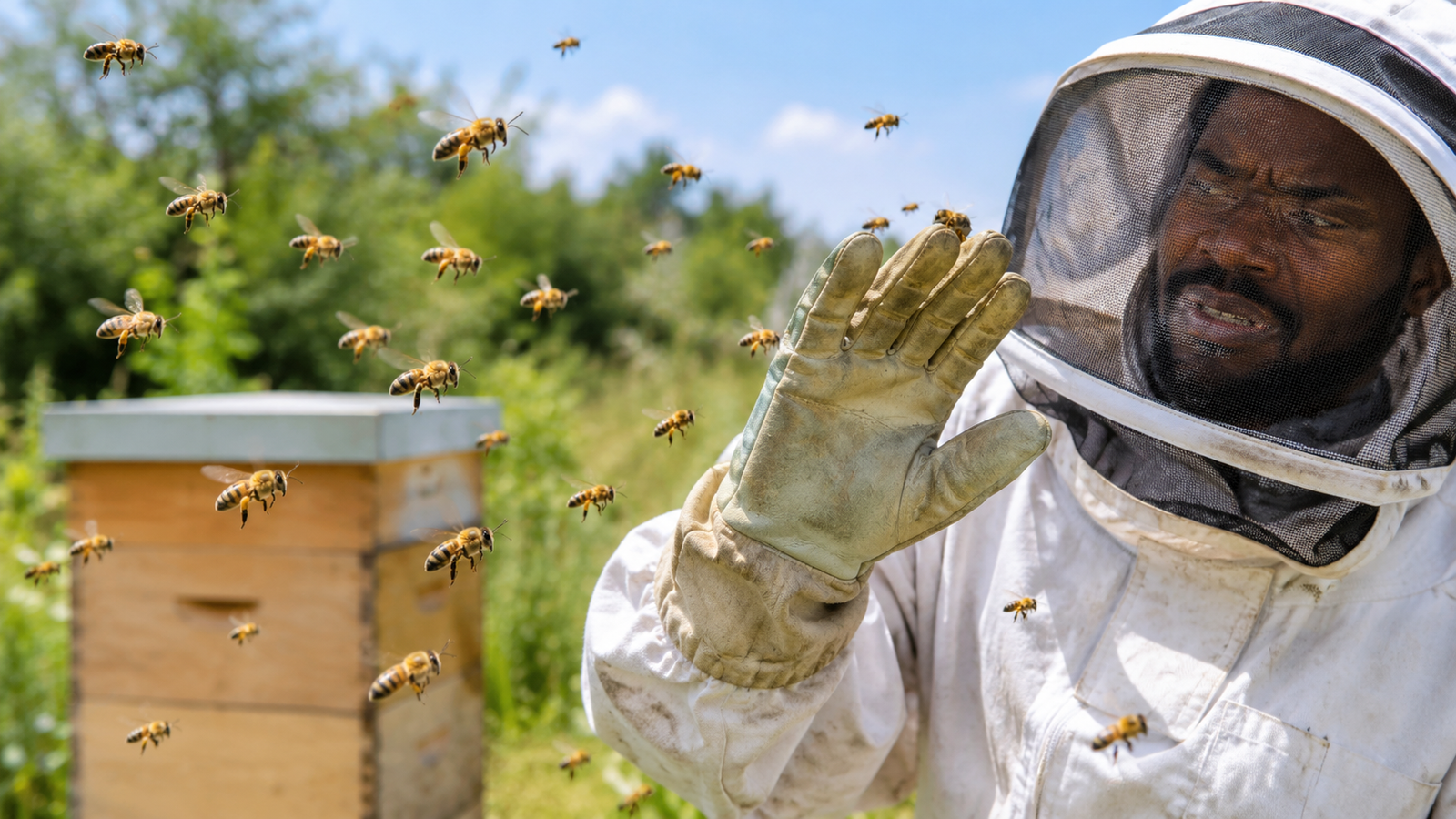
How many bee stings can a human take before it becomes dangerous? There is no fixed number that every person can safely withstand. Some people survive hundreds of bee stings, while others can experience a life-threatening allergic reaction after just one sting. The danger depends on several factors, including the amount of venom injected, body weight, individual health, the type of bee and whether the person is allergic to bee venom.
For someone without a venom allergy, receiving numerous stings can cause bee venom poisoning, also known as systemic envenomation. Large amounts of venom can damage muscles, blood cells, kidneys and other organs. For someone with a severe allergy, however, even a single sting can trigger anaphylaxis, a medical emergency that can cause breathing difficulties and dangerously low blood pressure.
Understanding these two different dangers is essential when assessing how many bee stings a human can take. This guide explains the science behind bee sting toxicity, the differences between bee species, what happens inside the body after multiple stings and what to do if someone is attacked by a swarm.
How Many Bee Stings Can a Human Take Before It Becomes Dangerous?
A person may survive many bee stings, but the risk of serious injury increases as the total amount of venom entering the body increases. There is no universally safe sting count or exact number that predicts whether someone will survive.
A few stings usually cause localized pain, redness and swelling in people who are not allergic. However, receiving numerous stings can expose the body to enough venom to cause systemic illness, even when the person has no history of allergic reactions.
The following table provides a general guide to possible reactions. These are descriptive exposure categories, not established medical thresholds.
| Number of stings | Possible effects and considerations |
|---|---|
| 1–5 stings | Usually localized pain, redness and swelling in people without an allergy. A single sting can still cause anaphylaxis in an allergic person. |
| 6–20 stings | More extensive pain and swelling. Some people may experience nausea, dizziness or other systemic symptoms. |
| 21–50 stings | Greater concern about accumulated venom exposure, particularly in children and smaller individuals. Medical assessment is advisable. |
| 51–100 stings | Significant concern for systemic venom toxicity, muscle injury and kidney complications. Urgent hospital assessment is important. |
| More than 100 stings | Potentially life-threatening mass envenomation. Serious complications and deaths have been documented. |
Important: These ranges do not establish safe or fatal limits. A person can become critically ill after fewer stings, and another person may survive a much larger number with appropriate medical treatment.
The Mayo Clinic notes that receiving more than a dozen bee stings can cause a significant illness involving symptoms such as nausea, vomiting, diarrhea, fever and lightheadedness. Multiple stings in children, older adults and people with existing heart or breathing problems deserve particular attention.
Source: Mayo Clinic, Bee Sting: Symptoms and Causes.
How Many Bee Stings Can Kill a Human?
Bee stings can kill through two major mechanisms: a severe allergic reaction and direct venom toxicity.
These mechanisms are different, and understanding the distinction explains why there is no single answer to how many bee stings can kill someone.
1. Anaphylaxis: When One Bee Sting Can Be Fatal
Anaphylaxis is a severe, potentially life-threatening allergic reaction that can develop after exposure to bee venom.
When someone who is sensitized to bee venom gets stung, their immune system can trigger a rapid reaction involving the release of inflammatory chemicals. This can cause swelling, airway narrowing, breathing difficulties and a dangerous drop in blood pressure.
A severe reaction can develop after just one sting.
Common warning signs include:
- Difficulty breathing or wheezing.
- Swelling of the tongue, throat or lips.
- Tightness in the chest or throat.
- Widespread hives or itching.
- Dizziness, fainting or collapse.
- Vomiting or abdominal symptoms accompanying other allergic signs.
Anaphylaxis can progress quickly. Anyone experiencing symptoms suggesting anaphylaxis needs emergency medical treatment.
If the person has a prescribed epinephrine auto-injector, it should be used immediately according to their emergency plan. Call the local emergency number and seek emergency care. Antihistamines are not a substitute for epinephrine.
2. Venom Toxicity: When Multiple Bee Stings Overwhelm the Body
A person does not need to be allergic to bee venom to suffer serious complications after numerous stings.
Every sting introduces venom containing biologically active substances. With enough stings, the accumulated venom can damage tissues and interfere with normal organ function.
Important venom components include:
- Melittin: A major venom peptide that damages cell membranes and contributes to tissue injury.
- Phospholipase A2: An enzyme involved in cell membrane damage and inflammatory reactions.
- Hyaluronidase: An enzyme that helps venom components spread through tissues.
- Apamin: A peptide that affects certain potassium channels in the nervous system.
A large venom exposure can cause muscle breakdown, destruction of red blood cells, low blood pressure and acute kidney injury.
A person may initially appear relatively stable but later develop serious complications.
A 2024 scientific review of honey bee envenomation describes cases involving kidney failure, blood abnormalities, respiratory complications and multiple-organ damage. It also emphasizes that the relationship between sting count and outcome is unpredictable.
Scientific source: Clinical Complications in Envenoming by Apis Honeybee Stings.
Can 10, 50 or 100 Bee Stings Kill a Human?
People often search for specific numbers because they want to understand how dangerous a particular bee attack can be.
However, the number of stings alone cannot determine whether someone will survive.
Can 10 bee stings kill a human?
Ten stings do not automatically mean someone will die. A healthy person without a venom allergy may experience pain, swelling and discomfort without developing severe poisoning.
However, even a relatively small number of stings can be dangerous if the person experiences anaphylaxis.
Age, body weight, existing medical conditions and individual sensitivity also influence the risk.
Can 50 bee stings kill a human?
Fifty stings represent a significant venom exposure and should not be dismissed.
Some people may develop widespread swelling, nausea, vomiting, muscle pain or other systemic symptoms. Serious complications are possible, including muscle injury and kidney damage.
A published clinical review describes toxic honey bee envenomation as typically involving many hundreds or more stings, but individual cases vary considerably.
Anyone receiving approximately 50 stings should receive urgent medical assessment rather than waiting for symptoms to become severe.
Can 100 bee stings kill a human?
Yes, 100 bee stings can cause life-threatening complications and have been associated with serious venom poisoning.
A 2020 published case report described a 90-year-old man who received more than 100 bee stings and developed rhabdomyolysis, a condition involving severe muscle breakdown, alongside acute kidney injury.
This illustrates why someone can be seriously ill even if they initially appear stable.
Scientific case report: A Case Report on Rhabdomyolysis After Multiple Bee Stings.
The important lesson is that 10, 50 and 100 stings are not guaranteed survival or fatality thresholds. Any substantial multiple-sting exposure requires appropriate medical assessment.
Is It True That Thousands of Bee Stings Can Kill a Human?
Yes. A large enough number of bee stings can deliver a massive venom dose capable of causing extensive tissue damage and multiple-organ failure.
However, thousands of stings are not necessary for a fatal outcome. Deaths have been documented after substantially fewer stings, particularly when anaphylaxis or other complications are involved.
What does the lethal-dose calculation mean?
Researchers sometimes use toxicology measurements to estimate how much venom could be dangerous.
One measurement is the median lethal dose, commonly written as LD50. It describes the dose that causes death in 50% of a studied test population under specified experimental conditions.
A 2024 review discusses an estimated honey bee venom LD50 of approximately 2.8–3.5 milligrams per kilogram and an average venom delivery estimate of approximately 140–150 micrograms per sting.
These figures can be used to illustrate why increasing venom exposure is dangerous.
However, an LD50 measurement is not a human survival formula. It should not be used to calculate an exact number of stings that will kill an individual.
The actual amount of venom delivered varies, and experimental toxicology measurements cannot account for every person’s immune response, health condition, treatment or biological differences.
For this reason, claims that a particular number, such as 3,831 stings, is the exact fatal number for an adult are misleading.
The more scientifically accurate conclusion is that a sufficiently large venom exposure can be fatal, but there is no dependable sting-count threshold that predicts an individual’s survival.
Scientific reference: Frontiers in Immunology – Clinical Complications in Envenoming by Apis Honeybee Stings.
How Does Body Weight Affect Bee Sting Toxicity?
Body weight influences how concentrated a given venom exposure may be in the body.
For example, imagine two people receive the same number of bee stings:
- Person A weighs 20 kilograms.
- Person B weighs 80 kilograms.
If both receive approximately the same total venom dose, that exposure represents a larger dose per kilogram of body weight for Person A.
This is one reason children and smaller individuals can be especially vulnerable to multiple bee stings.
A simple example
Imagine that two people receive an estimated total venom exposure of 5 milligrams.
| Factor | Person A | Person B |
|---|---|---|
| Body weight | 20 kg | 80 kg |
| Total venom exposure | 5 mg | 5 mg |
| Exposure per kilogram | 0.25 mg/kg | 0.0625 mg/kg |
Person A receives four times as much venom per kilogram of body weight as Person B.
This is a mathematical illustration, not a clinical prediction of injury or survival.
Body weight is only one factor. Allergic sensitivity, the actual amount injected, age, kidney function, cardiovascular health and access to medical treatment also influence the outcome.
A child should never be considered safe simply because the number of stings appears relatively small.
Does the Type of Bee Affect How Dangerous Its Stings Are?
Yes. Different bee species have different stinging behaviours, defensive characteristics and venom properties.
However, it is important to distinguish between a bee’s ability to sting repeatedly and the amount of venom it delivers.
1. Honey Bees
Honey bees belong to the genus Apis. The western honey bee, Apis mellifera, is among the most familiar species.
A worker honey bee has a barbed stinger. When it stings human skin, the stinger and associated venom apparatus often remain embedded in the skin.
The bee generally dies after losing this apparatus.
This means an individual worker honey bee normally cannot sting a person repeatedly in the same way a wasp can.
However, an entire colony contains thousands of workers, and many bees can attack during a defensive incident.
2. Africanized Honey Bees
Africanized honey bees are populations of Apis mellifera with ancestry from African honey bee lineages.
They are sometimes called killer bees, although this name can create unnecessary fear.
Their main concern is their defensive behaviour. Disturbed colonies can respond more aggressively, send out large numbers of attacking workers and pursue perceived threats farther than many other honey bee populations.
Because numerous workers can sting during a swarm attack, the victim may receive a substantial cumulative venom exposure.
The danger comes from the number of attacking bees and the resulting venom exposure, not from each individual sting necessarily being more poisonous.
3. Bumblebees
Bumblebees belong to the genus Bombus.
Unlike worker honey bees, bumblebees generally retain their stingers after attacking and can sting repeatedly.
They are usually not aggressive while collecting nectar and pollen, but they may defend themselves or their colony when threatened.
A person who disturbs a bumblebee nest may receive multiple stings.
Comparison of Bee Species
| Bee type | Can sting repeatedly? | Important characteristic |
|---|---|---|
| Worker honey bee | Generally no | Barbed stinger often remains embedded in the victim |
| Queen honey bee | Yes | Has a smoother stinger, primarily used against rival queens |
| Africanized honey bee worker | Generally no | Defensive colonies can attack in large numbers |
| Bumblebee | Yes | Retains its stinger and can sting again |
Male honey bees, known as drones, do not have stingers.
The ability to sting repeatedly does not automatically make one bee species more dangerous than another. The number of attacking insects, venom exposure and individual allergic sensitivity all matter.
Educational references:
How Much Venom Does a Bee Inject With Each Sting?
The amount of venom delivered depends on the insect species and the individual sting.
Honey bee venom contains a mixture of peptides, enzymes and other biologically active substances.
A 2024 scientific review reports an average honey bee venom delivery estimate of approximately 140–150 micrograms per sting.
That is an average estimate, not a fixed amount delivered by every bee.
The amount can vary according to the bee, its venom supply, the circumstances of the sting and how much venom is actually injected.
It is also important not to confuse the venom’s total mass with its toxicity. Two venoms with the same mass can have different biological effects because their chemical compositions differ.
This is why the number of stings alone cannot accurately predict the severity of an attack.
What Happens to Your Body After Multiple Bee Stings?
When a bee stings, its venom enters the skin and triggers an inflammatory response.
With a small exposure, the reaction usually remains around the sting site. With a large exposure, venom components can affect tissues and organs throughout the body.
Several complications are possible.
1. Severe Pain and Widespread Swelling
Each sting can cause localized pain, redness, warmth and swelling.
When many stings occur, the affected skin areas can become extremely painful and swollen.
2. Muscle Damage
High venom exposure can damage muscle cells.
This can lead to rhabdomyolysis, a medical condition in which damaged muscle tissue releases substances into the bloodstream.
Myoglobin, a protein normally stored inside muscle cells, can enter the bloodstream in large amounts.
3. Kidney Injury
The kidneys filter waste products from the blood.
When extensive muscle damage occurs, the released myoglobin can contribute to kidney injury. Bee venom can also damage the kidneys through other mechanisms, including direct toxic effects, destruction of red blood cells and reduced blood pressure.
Acute kidney injury can become serious and may require hospital treatment, including dialysis in some cases.
4. Destruction of Red Blood Cells
Certain venom components can damage red blood cells, a process known as hemolysis.
This can interfere with the body’s ability to transport oxygen and can contribute to kidney complications.
5. Multiple-Organ Failure
In severe cases, extensive venom exposure can affect several organs.
Possible complications include:
- Acute kidney injury.
- Liver damage.
- Cardiovascular complications.
- Blood-clotting abnormalities.
- Respiratory failure.
- Shock.
- Multiple-organ failure.
These complications explain why mass bee stings require serious medical attention.
Scientific reference: Acute Kidney Injury Complicating Bee Stings – A Review.
Why Can Bee Sting Poisoning Symptoms Appear Hours Later?
Not every complication develops immediately after a bee attack.
The initial symptoms may include pain, redness, swelling and discomfort. However, the biological effects of a large venom exposure can continue developing after the person leaves the scene.
For example, muscle damage can release myoglobin into the bloodstream. As the kidneys process the resulting substances, kidney injury may develop.
A review of acute kidney injury following bee stings describes cases in which kidney complications became apparent approximately 24–48 hours after the incident.
This is why someone who has received numerous stings should not assume that everything is fine simply because they initially feel better.
Medical professionals may recommend monitoring symptoms, kidney function, blood counts, muscle enzymes and other laboratory measurements depending on the exposure.
What Are the Warning Signs of Dangerous Bee Stings?
Recognizing serious symptoms early can make a major difference.
There are two important groups of warning signs: those associated with anaphylaxis and those associated with venom toxicity.
Warning Signs of Anaphylaxis
Seek emergency medical help immediately if someone develops:
- Difficulty breathing.
- Swelling of the tongue or throat.
- Tightness in the chest.
- Widespread hives accompanied by other allergic symptoms.
- Dizziness or fainting.
- A rapid, weak pulse.
- Sudden collapse.
Anaphylaxis can occur after a single sting.
Warning Signs of Venom Toxicity
After multiple stings, watch for:
- Severe or increasing muscle pain.
- Unusual weakness.
- Nausea and repeated vomiting.
- Dark or reddish-brown urine.
- Reduced urine output.
- Extensive swelling.
- Dizziness or confusion.
- Breathing difficulties.
- Signs of shock.
Dark urine and reduced urination can indicate serious complications, including muscle breakdown or kidney injury.
Do not wait for these symptoms before seeking help after a substantial swarm attack.
What Should You Do After Being Stung by Many Bees?
A multiple-bee-sting incident should be treated as a medical emergency or potential medical emergency, particularly when a child, older adult or person with an existing health condition is involved.
Step 1: Escape the Attacking Bees
Move away from the colony or swarm immediately.
If possible, enter an enclosed building or vehicle. Avoid remaining near the hive to remove stingers or inspect the injuries.
Protect your face and eyes while escaping.
Step 2: Seek Medical Attention
Anyone who has received numerous stings should receive urgent medical assessment.
Do not wait until the person develops severe symptoms.
If there are signs of anaphylaxis, breathing difficulty, collapse or other serious reactions, call emergency services immediately.
Step 3: Remove Embedded Stingers
Once the person is in a safe location, remove visible embedded stingers promptly.
A honey bee stinger can continue releasing venom briefly after the bee has left.
Scrape it out or remove it quickly using an appropriate method. Do not waste time debating whether scraping or pulling is better; prompt removal is the priority.
Step 4: Use Prescribed Emergency Medication
If the person has a prescribed epinephrine auto-injector and develops symptoms of anaphylaxis, use it immediately according to their emergency instructions.
Call emergency services even if symptoms improve after epinephrine.
A person with a severe allergic reaction needs emergency medical assessment because symptoms can return.
Step 5: Monitor the Person
Watch for:
- Changes in breathing.
- Dizziness or fainting.
- Increasing swelling.
- Vomiting.
- Severe muscle pain.
- Unusual weakness.
- Changes in urine colour or output.
Do not assume that the absence of immediate symptoms means that a large venom exposure is harmless.
Step 6: Follow Medical Instructions
Hospital treatment may include observation, blood and urine tests, intravenous fluids, treatment for anaphylaxis and management of kidney or muscle complications.
Treatment depends on the person’s condition and the severity of the exposure.
For ordinary isolated stings without serious allergic symptoms, washing the area and applying a cold pack can help relieve discomfort. However, home treatment is not appropriate for a serious allergic reaction or significant multiple-sting exposure.
Medical guidance: Mayo Clinic – Insect Bites and Stings: First Aid.
How Can You Reduce the Risk of Multiple Bee Stings?
Although bees generally sting to defend themselves or their colonies, certain precautions can reduce the risk of an attack.
1. Keep a safe distance from beehives.
Avoid approaching or disturbing wild colonies, especially when many bees are flying around the entrance.
2. Do not provoke bees.
Avoid throwing objects at hives, hitting bees or attempting to destroy a colony yourself.
3. Avoid disturbing underground nests.
Some bumblebee species establish nests in the ground. Mowing or digging near an active nest can provoke defensive behaviour.
4. Wear appropriate protective clothing.
Beekeepers should use properly fitted protective suits, gloves, veils and footwear when inspecting colonies.
5. Leave the area when bees become defensive.
If a large group of bees begins attacking, move quickly toward an enclosed shelter. Do not stop to collect belongings.
6. Have an allergy emergency plan.
People with a known severe bee venom allergy should discuss prevention, prescribed epinephrine and specialist allergy treatment with a qualified healthcare professional.
Frequently Asked Questions About How Many Bee Stings a Human Can Take
Can 5 bee stings kill a human?
Five bee stings will not usually cause fatal venom poisoning in a person without an allergy. However, even one sting can trigger anaphylaxis in someone with a severe bee venom allergy. Individual health and sensitivity matter.
Can 10 bee stings kill a human?
Ten stings do not automatically cause death, but they can cause significant symptoms in some people. Anaphylaxis remains possible, and children or people with underlying health conditions may be more vulnerable.
Can 50 bee stings kill a human?
Yes, 50 bee stings can cause serious complications, although they do not guarantee death. The person may experience significant venom exposure, muscle injury and other systemic effects. Urgent medical assessment is important.
Can 100 bee stings kill a human?
Yes. A hundred stings can cause potentially life-threatening venom toxicity. Published medical cases have documented severe muscle damage and acute kidney injury after exposures involving more than 100 bee stings.
Can 1,000 bee stings kill a human?
Yes. A thousand honey bee stings can deliver an extremely large venom exposure that may cause severe tissue damage, kidney failure, cardiovascular complications and multiple-organ failure. Survival depends on individual circumstances and medical treatment.
Can one bee sting kill someone who is not allergic?
A single sting is unlikely to cause fatal venom poisoning in an otherwise healthy person, but rare severe complications have been documented. A person who develops anaphylaxis can also have a life-threatening reaction after one sting.
How many bee stings can kill a child?
There is no reliable fatal sting count for children. Their smaller body weight means that the same venom exposure can represent a larger dose per kilogram than it would in an adult. Any substantial multiple-sting exposure in a child requires urgent medical assessment.
Can someone survive 500 bee stings?
Survival after 500 stings is possible, but this represents an extremely serious exposure. Severe poisoning, kidney injury and other complications can occur. Outcomes depend on venom exposure, the person’s health and the speed and quality of medical treatment.
How long does bee venom stay in your body?
There is no single duration that applies to every person or every sting. Local pain and swelling may improve over several days, while severe venom-related complications can develop or persist longer. Medical monitoring may be necessary after extensive exposure.
Can multiple bee stings cause kidney failure?
Yes. Large venom exposures can cause muscle breakdown, destruction of red blood cells, low blood pressure and direct kidney injury. These processes can lead to acute kidney failure.
Why are Africanized honey bee attacks dangerous?
Africanized honey bee colonies can respond more defensively to perceived threats. They may send out many attacking workers and pursue a person for a greater distance. This can result in numerous stings and substantial venom exposure.
Do all bee species inject the same amount of venom?
No. Different bee species have different venom compositions and venom delivery characteristics. Even individual stings from the same species can deliver different amounts of venom.
Conclusion: How Many Bee Stings Can a Human Take?
There is no exact number of bee stings that every human can safely withstand. Some people survive hundreds of stings, while others can experience a life-threatening allergic reaction after just one.
The most important distinction is between anaphylaxis, which is a severe allergic reaction, and venom toxicity, which occurs when a substantial amount of venom damages the body’s tissues and organs.
Body weight, age, health, bee species, venom exposure and access to medical treatment all influence the outcome.
If someone receives numerous bee stings, do not rely on a sting-count calculation to decide whether they need help. Seek urgent medical assessment, and treat breathing difficulties, throat swelling, fainting or collapse as an emergency.
Understanding these risks is more useful than memorizing a supposed lethal number because it helps people recognize danger and respond appropriately.
Scientific references
- 2024 Frontiers in Immunology – Clinical complications in honey bee envenomation. PMC+1
- Mayo Clinic – Bee sting symptoms and causes. Mayo Clinic
- PubMed – Clinical consequences of toxic envenomations by Hymenoptera. PubMed
- PubMed – Acute kidney injury complicating bee stings. PubMed+1
- Cornell University – Bumblebee identification and behaviour. Cornell IPM
