

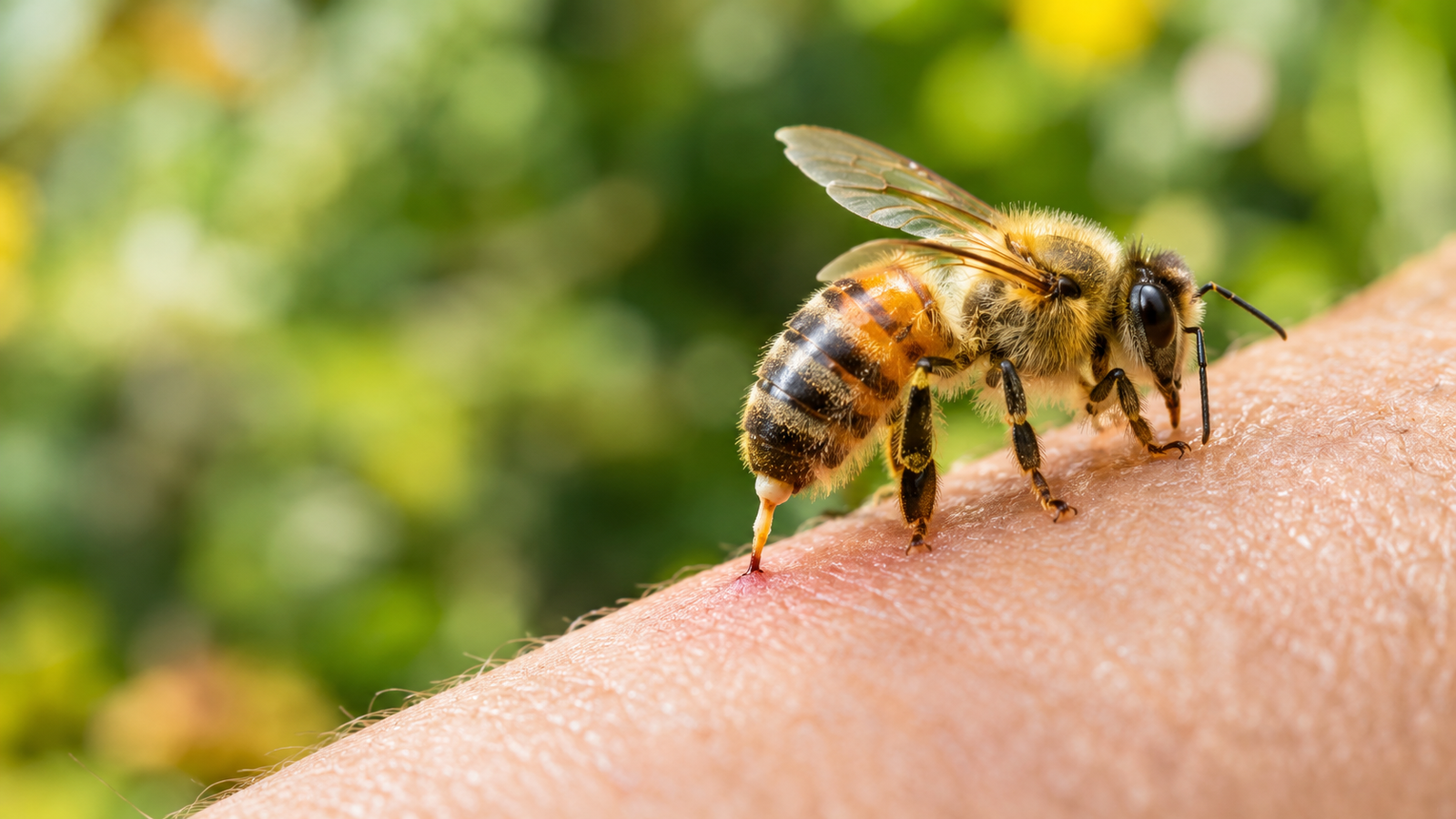
When bee stings does it die? Yes, a worker honey bee usually dies after stinging a human because its barbed stinger becomes trapped in the skin. When the bee tries to fly away, the stinger and attached abdominal tissue can tear away from its body, causing a fatal injury.
However, not all bees die after stinging. Bumblebees, carpenter bees, and many solitary bee species can generally withdraw their stingers and survive. Queen honey bees also have different stinger anatomy from workers, while male bees cannot sting at all.
The difference comes down to the bee’s species, the structure of its stinger, and what it stings. Understanding what happens inside a bee’s body explains why one honey bee may die after a single sting while another type of bee can sting more than once without suffering the same injury.
Do Bees Die After Stinging Humans?
Some bees die after stinging humans, while others survive. The worker honey bee (Apis mellifera) is the best-known example of a bee that usually dies after stinging a person.
Worker honey bees have barbed stingers with backward-facing points. When a worker inserts its stinger into human skin, these barbs can become lodged in the tissue. If the bee attempts to pull away, the stinger may remain embedded while part of its abdominal tissue tears away.
This injury damages the bee’s body and is generally fatal.
Other bees have different stinger structures. Bumblebees, for example, can usually withdraw their stingers after an attack. Female carpenter bees can also sting without normally leaving their stingers behind.
Here is the basic difference:
- Worker honey bees: Usually die after stinging humans because their barbed stingers become trapped in the skin.
- Bumblebees: Generally survive because they can withdraw their stingers.
- Carpenter bees: Females can sting and generally survive.
- Many solitary bees: Can withdraw their stingers, although some species cannot effectively sting humans.
- Male bees: Cannot sting because they lack a functional stinger.
Therefore, a bee does not automatically die whenever it stings something. Its survival depends largely on its anatomy and the circumstances of the sting.
Why Do Honey Bees Die After Stinging?
Worker honey bees die after many human stings because their stingers have backward-facing barbs that can become anchored in mammalian skin.
Unlike a smooth needle that can easily slide out, a barbed honey bee stinger can remain lodged in the victim. When the bee pulls away, the stinger apparatus can separate from its abdomen, causing severe physical damage.
The process happens in several stages.
1. The Honey Bee Inserts Its Stinger
When a worker honey bee perceives a threat, it may use its stinger to defend itself or its colony.
The stinger penetrates the skin and delivers venom through a narrow internal passage. The venom contains substances that cause pain and trigger inflammation around the sting site.
Honey bees generally use their stingers defensively, particularly when they or their colony are threatened.
2. The Barbed Stinger Becomes Trapped
A worker honey bee’s stinger has backward-facing barbs that help it remain embedded in the target.
When the target is human skin, the barbs can hold the stinger firmly in place. The bee may struggle to withdraw it because the surrounding tissue prevents the stinger from sliding out easily.
This is the critical difference between a honey bee stinging a person and a bee with a more easily withdrawn stinger.
3. The Bee Pulls Away
After inserting its stinger, the honey bee may attempt to fly away.
However, the embedded stinger can remain attached to the person’s skin. As the bee moves away, the force of separation can tear the stinging apparatus and associated abdominal tissue from its body.
The detached apparatus includes structures involved in venom delivery.
4. The Bee Suffers a Fatal Injury
Losing the stinging apparatus causes extensive damage to the worker honey bee’s abdomen.
The injury is generally fatal because the bee loses important internal tissues and cannot repair the damage.
The bee may remain alive briefly after the separation, but it cannot recover from this severe injury.
The important point is that the worker honey bee usually dies because of the physical damage caused by its trapped stinger, not simply because it has released venom.
What Happens Inside a Bee’s Body After It Stings?
The worker honey bee’s stinging apparatus is more complicated than a simple sharp needle.
It includes the pointed stinger, paired barbed structures, venom delivery passages, venom sac and associated muscles and tissues.
These structures work together to penetrate the victim and deliver venom.
When the stinger becomes detached, some of the associated muscles can continue contracting for a short time. This means the detached apparatus can continue delivering venom even after the bee has flown away.
This is why an embedded honey bee stinger should be removed promptly.
A useful way to understand the process:
- The worker honey bee inserts its barbed stinger into the skin.
- The backward-facing barbs become anchored in the tissue.
- The bee pulls away, leaving the stinger apparatus behind.
- The apparatus continues delivering venom briefly.
- The bee suffers severe abdominal damage and usually dies.
The venom delivery system is therefore capable of continuing to function briefly without the bee’s body.
Do All Types of Bees Die After Stinging?
No. Not all bees die after stinging humans.
There are more than 20,000 described bee species worldwide, and they have different physical characteristics, nesting habits and defensive behaviors.
The worker honey bee is unusual because its strongly barbed stinger can become lodged in mammalian skin.
Many other bees have stingers that they can withdraw without suffering the same fatal injury.
Comparison of Different Bee Species
| Type of bee | Can it sting? | Does it usually die? |
|---|---|---|
| Worker honey bee | Yes | Usually dies after stinging a human |
| Queen honey bee | Yes | Generally survives stinging rival queens |
| Bumblebee | Yes, females | No, generally survives |
| Female carpenter bee | Yes | No, generally survives |
| Male carpenter bee | No | Cannot sting |
| Mason bee | Yes, females | Generally survives |
| Mining bee | Yes, females | Generally survives if it stings |
| Leafcutter bee | Yes, females | Generally survives if it stings |
| Stingless bee | No conventional functional stinger | Cannot deliver a conventional sting |
These are general patterns rather than guarantees for every species. Some small solitary bees have stingers that cannot effectively penetrate human skin.
The most important distinction is that the worker honey bee’s barbed stinger can cause fatal damage when it becomes trapped in a person’s skin.
Do Bumblebees Die After They Sting You?
No. Bumblebees generally survive after stinging humans.
Bumblebees belong to the genus Bombus. They are often recognized by their relatively large, rounded bodies and dense covering of hairs.
Unlike worker honey bees, female bumblebees have stingers that they can generally withdraw after an attack. Their stingers do not normally become trapped in human skin in the same way as those of worker honey bees.
This allows a female bumblebee to sting, withdraw its stinger and potentially sting again if it continues to feel threatened.
Both worker bumblebees and queen bumblebees can sting.
Male bumblebees cannot sting because they do not possess functional stingers.
Bumblebees are generally not aggressive when left alone. They are more likely to sting when handled, trapped, stepped on or threatened near their nest.
If you find a bumblebee visiting flowers in your garden, the best response is to leave it undisturbed.
Do Carpenter Bees Die After Stinging?
Female carpenter bees generally do not die after stinging because they can usually withdraw their stingers.
Carpenter bees belong to the genus Xylocopa. They are known for making nesting tunnels in wood, where females lay their eggs and provision their developing young.
Carpenter bees are sometimes confused with bumblebees because both can have large bodies and dark coloration.
However, many carpenter bees have a relatively shiny, less hairy abdomen, while bumblebees typically have a densely hairy abdomen.
There is also an important difference between male and female carpenter bees.
- Female carpenter bees: Possess functional stingers and can sting when threatened.
- Male carpenter bees: Cannot sting because they lack functional stingers.
Male carpenter bees may hover close to people or fly defensively around nesting areas. This behavior can appear threatening, but they cannot deliver a sting.
Female carpenter bees are generally not aggressive toward people unless handled or directly threatened.
Do Solitary Bees Die After Stinging?
Most solitary bees do not die from stinging humans in the same way that worker honey bees do.
Solitary bees make up the majority of bee species. Unlike honey bees, which live in large colonies with a queen and thousands of workers, solitary bees generally build and provision their own nests.
Examples include mason bees, mining bees and leafcutter bees.
Their stinging abilities vary considerably.
Some female solitary bees have functional stingers that can be withdrawn without causing fatal abdominal damage. Other species are so small that their stingers cannot effectively penetrate human skin.
For example:
- Mason bees: Female mason bees can possess functional stingers, but they generally do not suffer the same fatal stinger loss as worker honey bees.
- Mining bees: Many species are small and rarely sting people. Females may sting when handled or threatened.
- Leafcutter bees: Female leafcutter bees possess stingers, although many species are unlikely to cause a noticeable sting.
Solitary bees generally avoid confrontation and are important pollinators. They are best observed without handling or disturbing their nests.
Do Queen Honey Bees Die After Stinging?
Queen honey bees generally do not suffer the same fatal injury as worker honey bees when they use their stingers against rival queens.
Although both workers and queens are female honey bees, their stingers are not identical.
A worker honey bee has a strongly barbed stinger that can become embedded in human skin. A queen’s stinger is less strongly barbed and is adapted for fighting other queens.
Queen honey bees primarily use their stingers during conflicts with rival queens, particularly when competing for reproductive control of a colony.
Unlike worker honey bees, queens can generally withdraw their stingers without tearing away the same amount of abdominal tissue.
Queens rarely sting humans, and their defensive behavior is different from that of worker bees.
This is an important distinction: the fact that worker honey bees usually die after stinging humans does not mean every female honey bee experiences the same outcome.
Do Male Bees Die After Stinging?
Male bees do not die after stinging because they cannot sting in the first place.
A bee’s stinger is a modified reproductive structure called an ovipositor. In female insects, an ovipositor is used for laying eggs. During evolution, this structure became adapted for defense in bees and other related insects.
Male bees do not lay eggs, so they do not possess a functional stinging apparatus.
This applies to male honey bees, bumblebees and carpenter bees.
For example, male honey bees are called drones. Their main reproductive role is to mate with a queen rather than defend the colony using a stinger.
Therefore, a bee that successfully stings a person is generally female.
There are exceptions among female bees, including stingless bees, which lack a functional conventional stinger.
Can a Honey Bee Sting More Than Once?
A worker honey bee usually cannot sting a human more than once without suffering a fatal injury.
When its barbed stinger becomes lodged in human skin, the bee generally cannot withdraw it safely. The resulting abdominal injury usually kills the worker.
However, there is an important exception.
A worker honey bee may sometimes sting another insect or a target with a different outer covering and withdraw its stinger without losing it.
For example, the outcome of a sting against another insect can differ from that of a sting against human skin. If the stinger is successfully withdrawn without severe injury, the bee may survive.
This is why saying that a honey bee can only sting once is a useful general explanation for human encounters, but not an absolute rule for every possible target.
Bumblebees and many other bees can generally sting multiple times because they can withdraw their stingers.
Does a Bee Die Immediately After Stinging?
No. A worker honey bee does not necessarily die the instant it stings a person.
The fatal injury occurs when the stinger apparatus and associated tissue tear away from the bee’s abdomen.
Although this injury is usually fatal, the bee may remain alive briefly after the separation. It may move its legs, flutter its wings or show other movements before dying.
There is also a difference between a bee that has lost its stinger and one that has successfully withdrawn it.
A worker honey bee that suffers severe abdominal damage is unlikely to survive. A bumblebee or another bee that withdraws its stinger can continue living normally.
Practical example:
Imagine seeing a honey bee sting someone’s arm and then fly away.
It might appear that the bee escaped unharmed. However, if its stinger remains embedded in the person’s skin, the bee may have suffered a fatal injury even though it was still flying briefly.
Therefore, seeing a bee fly away after stinging does not necessarily mean it will survive.
What Happens to a Bee After It Stings You?
When a worker honey bee stings a human, the following sequence generally occurs:
- The sting enters the skin: The bee inserts its barbed stinger and delivers venom.
- The stinger becomes embedded: Backward-facing barbs hold the stinger in the skin.
- The bee pulls away: The stinger apparatus can separate from the bee’s abdomen.
- The venom apparatus continues working: The detached apparatus can continue pumping venom briefly.
- The bee suffers severe injury: The loss of abdominal tissue makes survival unlikely.
For the person who has been stung, the affected area may become painful, red, itchy and swollen.
Some people experience only a small local reaction, while others develop more extensive swelling or a serious allergic reaction.
If you have been stung by a honey bee, remove any embedded stinger as quickly as possible. You can scrape or pull it out promptly; do not delay removal while deciding which technique to use.
Wash the affected area with soap and water and apply a cold pack wrapped in a cloth to help reduce discomfort.
Seek emergency medical assistance immediately if you experience difficulty breathing, swelling of the tongue or throat, faintness or other signs of a severe allergic reaction. If you have prescribed epinephrine for an allergic reaction, use it according to your emergency plan.
Why Do Honey Bees Die to Protect Their Colony?
Honey bees live in highly organized colonies where different groups of individuals perform specialized jobs.
Worker bees collect nectar and pollen, care for developing young, maintain the hive and defend the colony against threats.
A colony contains valuable resources, including:
- The queen, which produces eggs.
- Developing larvae and pupae.
- Stored honey and pollen.
- The comb and nesting structure.
When a threat approaches, worker bees may respond defensively to protect these resources.
A worker honey bee that stings a large mammal may die because its stinger becomes trapped in the victim’s skin. Nevertheless, the defensive behavior can help protect the colony.
Honey bees also use chemical communication to coordinate their defensive response.
When a worker stings, it releases alarm pheromones that can alert nearby workers to danger. These chemical signals may encourage other workers to investigate and defend the threatened area.
This is one reason why disturbing a honey bee colony can sometimes result in multiple stings.
The behavior has evolved through natural selection because defending the colony can improve the survival and reproductive success of the colony’s members.
It is more accurate to describe this as an evolved defensive response than to suggest that an individual bee consciously chooses to die.
Do Bees Know They Will Die After Stinging?
There is no good scientific evidence that honey bees consciously understand that stinging a human will cause their death.
A worker honey bee responds to threats through its nervous system, sensory information and evolved defensive behaviors.
When it detects danger, it may respond by attempting to sting the perceived threat.
The fatal injury that follows a sting against human skin is a consequence of its anatomy. The barbed stinger becomes trapped, and the bee can lose part of its abdomen when it tries to withdraw.
The bee does not need to understand the consequences of its actions for this behavior to have an evolutionary benefit.
In other words, honey bees sting to defend themselves and their colony, not because they understand human concepts of sacrifice or death.
Can a Bee Sting You and Fly Away?
Yes. Some bees can sting humans and fly away without suffering a fatal injury.
Bumblebees, female carpenter bees and many solitary bees can generally withdraw their stingers after an attack.
A worker honey bee can also appear to fly away briefly after stinging. However, if its stinger apparatus has become detached, the bee is unlikely to survive.
The important distinction is whether the bee has successfully withdrawn its stinger or lost it during the sting.
Therefore, a bee flying away after a sting does not automatically mean it has survived.
Do Wasps Die After Stinging Humans?
No. Most wasps do not die after stinging humans.
Although bees and wasps belong to the same insect order, Hymenoptera, their stingers have important structural differences.
Many wasps have relatively smooth stingers that can be withdrawn from human skin. This allows them to sting repeatedly without losing their stinging apparatus.
Worker honey bees, on the other hand, have strongly barbed stingers that can become lodged in mammalian skin.
For example, a yellow jacket wasp can sting a person, withdraw its stinger and potentially sting again. A worker honey bee usually suffers a fatal injury if its stinger becomes embedded in the same type of target.
Wasps are not bees, and the fact that both insects can sting does not mean their stinging mechanisms are identical.
Should You Kill a Bee After It Stings You?
No. Killing a bee after it stings you is generally unnecessary.
If a bee stings you, move away from the immediate area calmly and treat the sting. Avoid swatting at nearby bees, especially if you are close to a colony or nest.
If the insect is a worker honey bee and its stinger remains embedded in your skin, it may already have suffered a fatal injury.
Other bees may survive and fly away.
Bees are important pollinators that contribute to the reproduction of many flowering plants and the production of food crops.
If a bee nest is located in a busy area where people are frequently exposed to stings, seek assistance from an appropriate beekeeper or pest management professional rather than disturbing it yourself.
Frequently Asked Questions About Bees Dying After Stinging
When bee stings does it die every time?
No. Worker honey bees usually die after stinging humans because their barbed stingers become lodged in the skin. Bumblebees, carpenter bees and many solitary bees can generally withdraw their stingers and survive.
Why do bees die after stinging humans?
Worker honey bees often die because their barbed stingers become trapped in human skin. When the bee pulls away, the stinger apparatus and associated abdominal tissue can tear away, causing a fatal injury.
How long does a bee live after stinging?
There is no single exact survival time for every bee. A worker honey bee that loses its stinger apparatus usually dies from its injuries, but it may remain alive briefly after the sting. Other bees that successfully withdraw their stingers can survive normally.
Does a bee die after stinging another bee?
Not necessarily. The outcome depends on the bee species and where it stings. A worker honey bee may sometimes withdraw its stinger from another insect without suffering the fatal injury associated with stinging a human. Queen honey bees also use their stingers during conflicts with rival queens.
Can a honey bee sting twice?
A worker honey bee generally cannot sting a human twice without suffering a fatal injury because its barbed stinger usually remains embedded in the skin. However, it may sometimes withdraw its stinger from other targets and survive.
Do all female bees sting?
No. Many female bees possess functional stingers, but some species cannot effectively sting humans. Stingless bees lack a functional conventional stinger, while male bees do not possess functional stingers.
Do bees die after stinging animals?
Worker honey bees are especially likely to die when they sting mammals because their barbed stingers can become trapped in mammalian skin. The outcome may differ when they sting other insects or targets from which their stingers can be withdrawn.
Do bees die after stinging another person?
A worker honey bee usually suffers a fatal injury if its barbed stinger becomes embedded in another person’s skin. Other bee species can generally withdraw their stingers and survive.
Why does a bee leave its stinger in your skin?
A worker honey bee’s stinger has backward-facing barbs that can become anchored in human skin. When the bee tries to fly away, the stinger may remain behind because the surrounding tissue prevents it from being withdrawn safely.
Can a dead bee still sting you?
A detached honey bee stinger can continue delivering venom briefly because its associated muscles and venom apparatus can keep functioning after separation. Avoid handling bees or detached stingers with bare hands.
Final Answer: When Bee Stings Does It Die?
When bee stings does it die? A worker honey bee usually dies after stinging a human because its barbed stinger becomes trapped in the skin. When the bee pulls away, the stinger apparatus and associated abdominal tissue can tear away from its body, causing a fatal injury.
However, not every bee dies after stinging. Bumblebees, female carpenter bees and many solitary bees can generally withdraw their stingers and survive. Queen honey bees also have different stinger anatomy from workers, while male bees cannot sting because they lack functional stingers.
The most important distinction is that a worker honey bee usually dies because of the physical damage caused by its trapped stinger, not simply because it has released venom.
Understanding this difference helps explain why some bees die after a single sting while others can sting repeatedly and continue living.
Scientific and Educational References
The following sources provide additional information about bee anatomy, stinger structure, defensive behavior and sting treatment.
- University of Missouri Extension: Honey Bees as Pollinators, Their Habitats and Products — Honey bee anatomy, worker and queen stingers.
- Purdue University Extension: The Complex Life of the Honey Bee — Worker bee stingers, venom apparatus and colony defense.
- University of Minnesota Extension: Wasps and Bees — Differences in stinging behavior between honey bees, bumblebees and wasps.
- University of California Statewide IPM Program: Bee and Wasp Stings — Stinger removal and first-aid information.
- University of Florida IFAS Extension: European Honey Bee — Honey bee biology, colony behavior and alarm pheromones.
- Arizona State University, Ask A Biologist: Honey Bee Honey — Worker and queen stinger differences.
- Centers for Disease Control and Prevention: Honey Bee Stinger Anatomy — Scientific microscope image and explanation of the honey bee stinger apparatus.
