

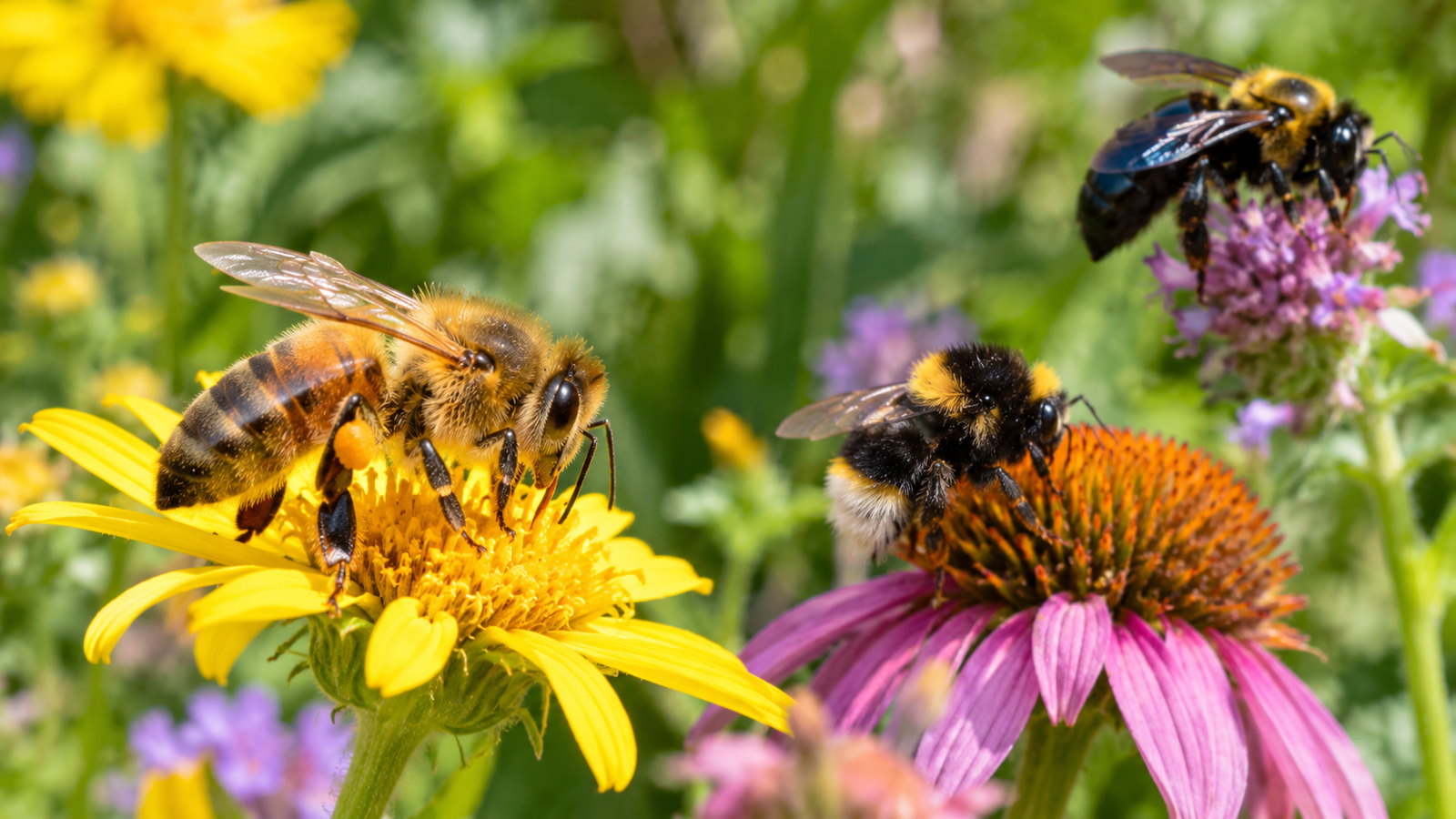
Which bee stings humans? Honey bees, bumblebees, carpenter bees, sweat bees, mason bees, leafcutter bees, mining bees and many other bee species can sting. However, not every bee can sting: male bees do not have functional stingers, while female bees in most stinging bee groups have stingers they use primarily for defence.
The likelihood of being stung depends on the bee species, its behaviour and the circumstances of an encounter. Honey bee workers can die after stinging human skin because their barbed stingers become lodged in the skin. Bumblebees and most other female bees can generally sting more than once.
Some bees, including stingless bees, cannot deliver a typical bee sting but may defend themselves by biting or using other defensive behaviours.
Understanding which bee stings, how to recognize different species and why bees defend themselves can help you avoid painful encounters without harming beneficial pollinators.
Which Bee Stings Humans?
Several types of bees can sting humans. The most familiar examples include honey bees, bumblebees, carpenter bees, sweat bees, mason bees, leafcutter bees and mining bees.
In most bee species that possess functional stingers, the females are capable of stinging. Their stingers evolved from the egg-laying apparatus, which is why male bees cannot sting.
Here is a quick comparison of common stinging bee groups.
| Type of bee | Can it sting humans? | Typical behaviour |
|---|---|---|
| Honey bee | Yes | Workers defend their colonies |
| Bumblebee | Yes | Females can sting repeatedly when threatened |
| Carpenter bee | Yes | Females rarely sting unless handled or trapped |
| Sweat bee | Yes | Females may sting when trapped against skin |
| Mason bee | Yes | Females are generally docile |
| Leafcutter bee | Yes | Females rarely sting people |
| Mining bee | Yes | Females usually avoid confrontation |
| Squash bee | Yes | Females have functional stingers |
| Long-horned bee | Yes | Females can sting when threatened |
An important distinction is that a bee’s ability to sting does not mean it is aggressive. Most bees spend their time collecting nectar, gathering pollen, nesting and raising their young. They generally prefer to avoid people.
1. Honey Bees
Honey bees are among the most familiar stinging bees. They belong to the genus Apis and live in organized colonies containing a queen, workers and drones.
The western honey bee (Apis mellifera) is one of the most widely managed species. It is kept for honey production, beeswax and crop pollination.
Worker honey bees are female and have barbed stingers that help them defend their colonies. When a worker stings human skin, the backward-facing barbs can prevent the stinger from being withdrawn.
As the bee pulls away, the stinger and associated venom apparatus may remain embedded in the skin. This usually causes fatal injury to the worker honey bee.
Honey bees generally sting when they perceive a threat to themselves or their colony. Examples include:
- Squeezing or stepping on a worker bee.
- Disturbing a hive or nest.
- Accidentally trapping a bee in clothing.
- Approaching or interfering with an agitated colony.
- Handling bees roughly during beekeeping activities.
A honey bee collecting nectar from a flower is usually focused on feeding and is unlikely to bother a nearby person who leaves it undisturbed.
Do all honey bees die after stinging?
No. The familiar explanation that every honey bee dies after stinging is inaccurate.
Worker honey bees usually die after their barbed stingers become lodged in human skin. Queen honey bees have a different stinger structure and can sting repeatedly. They primarily use their stingers during conflicts with rival queens inside the colony.
Male honey bees, called drones, cannot sting because they lack functional stingers.
This distinction is important because honey bee colonies contain individuals with different biological roles and defensive abilities.
2. Bumblebees
Bumblebees are large, hairy bees belonging to the genus Bombus. They are easily recognized by their rounded bodies, thick hair and often distinctive yellow, black or orange markings.
Unlike honey bees, bumblebees usually establish smaller seasonal colonies in protected cavities, including abandoned rodent burrows, underground spaces and other sheltered locations.
The common eastern bumblebee (Bombus impatiens) is one example of this group.
Female bumblebees, including queens and workers, have functional stingers. They can sting humans when threatened, trapped or handled.
Unlike worker honey bees, female bumblebees generally have stingers that can be withdrawn from human skin. This allows them to sting repeatedly.
Why do bumblebees sting?
Bumblebees are generally peaceful when left alone. They are more likely to sting when:
- Someone grabs or squeezes them.
- A person accidentally steps on one.
- Their nest is disturbed.
- A bee becomes trapped in clothing.
- A person interferes with their colony.
For example, walking barefoot across a lawn containing flowering clover can increase the chance of accidentally stepping on a foraging bumblebee.
Male bumblebees cannot sting. Some males may approach people or behave defensively around nesting areas, but they do not have functional stingers.
3. Carpenter Bees
Carpenter bees belong to the genus Xylocopa. They are large bees known for excavating nesting tunnels in wood.
They commonly visit flowers and may also be seen hovering around wooden fences, roof eaves, decks, sheds and other wooden structures.
The eastern carpenter bee (Xylocopa virginica) is a familiar example.
Carpenter bees are sometimes confused with bumblebees because both groups can have large, dark bodies and yellowish hair.
However, many carpenter bees have a relatively shiny, hairless abdomen, while bumblebees are generally hairy across their abdomens.
Do carpenter bees sting humans?
Female carpenter bees can sting humans, but they are generally reluctant to do so.
A female is more likely to sting when someone:
- Grabs or squeezes her.
- Traps her against their skin.
- Handles her while she is nesting.
- Disturbs her directly.
Male carpenter bees cannot sting. They may hover around people, fly close to their faces or patrol nesting areas. This behaviour can look intimidating, but it is generally territorial rather than an attempt to sting.
For example, a male carpenter bee hovering near a wooden fence may repeatedly approach someone walking past. Despite the intimidating flight behaviour, he cannot deliver a bee sting.
4. Sweat Bees
Sweat bees belong to the family Halictidae. Many species are relatively small, and some have beautiful metallic green, blue, bronze or dark-coloured bodies.
One example is the common eastern sweat bee (Agapostemon virescens).
These bees visit flowers to collect nectar and pollen. Some are also attracted to human sweat because it contains moisture and salts.
This explains why a small bee may land on someone’s arms, legs or face during hot weather.
Can sweat bees sting humans?
Yes. Female sweat bees in many species have functional stingers.
They are generally not aggressive, but a bee may sting if it becomes trapped against the skin, squeezed or brushed roughly.
Because sweat bees are small, people sometimes fail to notice them until they land on exposed skin.
If one lands on you, avoid swatting at it. Allow it to move away or gently brush it off without squeezing it.
5. Mason Bees
Mason bees belong to the genus Osmia and are solitary bees that use small cavities for nesting.
Some species nest in hollow stems, holes in wood, abandoned insect tunnels and specially prepared nesting blocks.
They are called mason bees because several species use mud to construct partitions between their individual nest cells.
The blue orchard bee (Osmia lignaria) is an example of a mason bee used in orchard pollination.
Can mason bees sting humans?
Female mason bees have functional stingers and can sting humans. However, they are generally docile and rarely sting when left undisturbed.
A sting is more likely when a female is caught, squeezed or pressed against someone’s skin.
Male mason bees cannot sting.
Mason bees are important pollinators, particularly in orchards and gardens. Their nesting activity should not automatically be considered a threat to people.
6. Leafcutter Bees
Leafcutter bees belong to the genus Megachile. They are solitary bees recognized by their habit of cutting rounded pieces from leaves.
The females use these leaf fragments to line their nests and protect their developing offspring.
One familiar example is the alfalfa leafcutter bee (Megachile rotundata), which is managed commercially in some agricultural regions for crop pollination.
Do leafcutter bees sting?
Female leafcutter bees have functional stingers and can sting humans.
However, they are generally peaceful and spend most of their time collecting pollen, cutting leaves and preparing nesting cells.
They are unlikely to sting unless they are trapped, squeezed or handled roughly.
Male leafcutter bees cannot sting because they lack functional stingers.
Although their leaf-cutting activity may leave small semicircular marks on garden plants, it is generally not a reason to destroy their nests.
7. Mining Bees
Mining bees are solitary bees belonging to the genus Andrena and other related groups within the family Andrenidae.
They commonly dig small nesting tunnels in bare or lightly vegetated soil.
You may notice them in lawns, gardens, fields and other areas with suitable nesting conditions.
One example is the ashy mining bee (Andrena cineraria), which has distinctive grey and black markings.
Can mining bees sting humans?
Female mining bees generally have functional stingers and can sting when threatened.
However, they are usually not aggressive toward people.
Unlike honey bees, mining bees do not defend large social colonies containing thousands of workers. Each female generally manages her own nest.
Their nesting activity may become noticeable when many bees emerge in the same area during the breeding season.
For example, several small holes surrounded by bees in a sunny garden may indicate a mining bee nesting aggregation.
Avoid disturbing the soil or handling the bees. They are useful pollinators and generally pose little risk when left alone.
8. Other Bees That Can Sting Humans
The seven groups above are not the only bees capable of stinging humans.
Many other bee species have females with functional stingers.
Examples include:
Squash bees (Peponapis and Xenoglossa): These solitary bees specialize in visiting flowers belonging to the squash family, including pumpkins, courgettes and related crops. Females can sting when threatened.
Long-horned bees (Melissodes and related genera): These bees are often recognized by the relatively long antennae of males. Females have functional stingers.
Wool-carder bees (Anthidium): Some species collect plant hairs to construct their nests. Females can sting, although these bees are generally not interested in attacking people.
Cuckoo bees: These bees lay their eggs in the nests of other bee species rather than collecting and storing pollen in the usual way. Female cuckoo bees generally have functional stingers, although their biology and behaviour vary between groups.
The important point is that bee diversity is much greater than the familiar honey bee and bumblebee groups. Many small solitary bees can sting even though people rarely encounter them as defensive insects.
How to Identify a Bee That Can Sting
Identifying a bee can help you understand its behaviour and whether it is likely to sting.
However, appearance alone cannot reliably tell you whether an individual bee is male or female.
The following guide highlights common differences between familiar bee groups.
| Bee | Identifying features | Common nesting location | Sting information |
|---|---|---|---|
| Honey bee | Brownish body with dark and golden bands | Hives and cavities | Female workers and queens can sting |
| Bumblebee | Large, rounded and hairy body | Protected cavities, often underground | Female workers and queens can sting |
| Carpenter bee | Large body, often with shiny abdomen | Wooden tunnels | Females can sting |
| Sweat bee | Often small and metallic green or dark | Soil and other nesting sites | Females can sting |
| Mason bee | Small to medium-sized, often dark or metallic | Hollow stems and cavities | Females can sting |
| Leafcutter bee | Medium-sized, often dark and hairy | Natural or artificial cavities | Females can sting |
| Mining bee | Small to medium-sized and often hairy | Underground soil tunnels | Females can sting |
How to distinguish a carpenter bee from a bumblebee
These two groups are often confused.
A carpenter bee commonly has a shiny, relatively hairless abdomen. A bumblebee generally has a hairy abdomen.
Their nesting habits also differ:
- Carpenter bees excavate tunnels in wood.
- Bumblebees usually establish colonies in existing protected cavities.
This distinction can help you identify which bee is visiting a wooden structure or flower garden.
Remember that species vary, so identification should not rely on a single feature.
Which Bees Cannot Sting?
Not all bees can sting humans. Two important categories are male bees and stingless bees.
1. Male Bees
Male bees cannot sting because they do not possess functional stingers.
A bee’s stinger evolved from structures associated with the female reproductive system, specifically the egg-laying apparatus.
Because males do not lay eggs, they do not possess this functional stinging structure.
This applies to male honey bees, bumblebees, carpenter bees, sweat bees and other bee groups.
Male bees may still fly toward people, compete with other males or defend a small territory. These behaviours do not mean they can sting.
2. Stingless Bees
Stingless bees belong to the tribe Meliponini, a diverse group of social bees found mainly in tropical and subtropical regions.
They occur in Africa, Asia, Australia, Central America and South America.
Stingless bees are particularly important in tropical ecosystems because they pollinate many wild plants and cultivated crops.
Unlike honey bees and bumblebees, stingless bees have a greatly reduced and generally nonfunctional sting apparatus.
They cannot deliver a typical bee sting.
However, this does not mean every stingless bee is completely harmless.
Some species defend their colonies by:
- Biting intruders.
- Clinging to hair or skin.
- Using sticky substances.
- Recruiting other workers to defend the nest.
Certain African stingless bees in the genus Meliponula have comparatively well-developed sting structures, although stingless bees generally cannot deliver a normal bee sting.
This is an important scientific exception to the simplified statement that every stingless bee has an entirely absent stinger.
Why Can Female Bees Sting but Male Bees Cannot?
The difference between male and female bees comes from their anatomy and reproductive biology.
A female bee’s stinger evolved from the ovipositor, the structure used by ancestral insects for laying eggs.
During evolution, this structure became adapted for injecting venom and defending the bee against threats.
In modern bees, the stinger is used primarily for defence rather than egg laying.
Male bees do not have this egg-laying apparatus and therefore cannot develop a functional stinger.
This explains why:
- Female honey bee workers can sting.
- Female honey bee queens can sting.
- Female bumblebees can sting.
- Female carpenter bees can sting.
- Male bees cannot sting.
There are differences in stinger structure and behaviour between species, but the basic biological explanation is the same.
Why Do Some Bees Die After Stinging?
Not all bees die after stinging. The outcome depends partly on the structure of their stingers and the target they sting.
Worker honey bees have barbed stingers that can become embedded in the thick skin of mammals, including humans.
When the worker tries to fly away, the embedded stinger may tear away from its abdomen, along with associated venom-delivery structures.
This usually causes the worker’s death.
Other bees have stingers that can generally be withdrawn from human skin, allowing them to sting again.
Which bees can sting more than once?
| Bee | What happens after stinging? |
|---|---|
| Worker honey bee | Usually dies if its barbed stinger becomes lodged in human skin |
| Queen honey bee | Can sting repeatedly |
| Female bumblebee | Can generally sting repeatedly |
| Female carpenter bee | Can generally sting repeatedly |
| Female solitary bees | Can generally sting repeatedly |
| Male bees | Cannot sting |
| Stingless bees | Cannot deliver a typical bee sting |
The distinction is especially important when comparing honey bees with bumblebees.
A bumblebee does not normally lose its stinger after stinging a person, so it can sting again if it remains threatened.
Are Wasps and Hornets Bees That Sting?
No. Wasps, hornets and yellow jackets are related to bees, but they are not bees.
They belong to the same broad insect order, Hymenoptera, but represent different groups.
Many people confuse them because some species have yellow and black markings.
There are several visible differences:
- Bees are usually hairier, particularly around the thorax.
- Many wasps have smoother, less hairy bodies.
- Wasps often have a narrower waist.
- Bees commonly collect pollen, while many wasps hunt other insects or scavenge food.
Female wasps and hornets can sting, and many species can sting repeatedly.
Honey bees, bumblebees and wasps should therefore not be treated as interchangeable insects.
If you are unsure which insect you have encountered, avoid handling it.
Why Do Bees Sting Humans?
Bees generally sting as a defensive response. They do not normally sting humans because they want to feed on human blood or attack people for food.
Several situations can trigger defensive behaviour.
1. Defending a colony
Social bees, especially honey bees and some bumblebees, may sting when they perceive a threat to their nest.
A person disturbing a hive or blocking the entrance may trigger defensive behaviour.
2. Being squeezed or handled
A bee that is grabbed, squeezed or pressed against the skin may sting to defend itself.
This can happen when someone tries to catch a bee with their hands.
3. Accidental contact
Stepping on a bee while walking barefoot through flowering grass can cause an accidental sting.
The bee may not have been attempting to approach or attack the person.
4. Disturbing a nest
Bees may become defensive when their nesting areas are disturbed.
This includes interfering with a honey bee hive, damaging a bumblebee nesting site or handling a solitary bee nest.
5. Being trapped in clothing
A bee trapped beneath a shirt, inside a shoe or against the skin may sting because it cannot escape.
The best approach is to avoid squeezing the insect and allow it to move away safely.
Which Bee Sting Is the Most Painful?
There is no single bee species whose sting is guaranteed to be the most painful for every person.
Pain depends on several factors:
- The species and its venom composition.
- The amount of venom injected.
- The location of the sting.
- Individual sensitivity.
- Whether the person has developed an allergic reaction.
Honey bee and bumblebee stings can cause immediate pain, redness, swelling and itching.
However, pain intensity should not be confused with medical danger.
A single sting can cause life-threatening anaphylaxis in someone with a serious venom allergy. Multiple stings can also cause significant venom-related illness, even in someone without an allergy.
What Happens When a Bee Stings You?
A bee sting usually produces a sharp or burning sensation at the point where the stinger enters the skin.
Common symptoms include:
- Immediate pain.
- Redness around the sting.
- Local swelling.
- Itching.
- Warmth or tenderness.
For most people, these symptoms improve gradually.
Some people develop larger local reactions, with swelling extending beyond the immediate sting site. These reactions can take several days to settle.
Can a bee sting cause an allergic reaction?
Yes. Some people are allergic to bee venom.
A serious allergic reaction, called anaphylaxis, can occur after a sting.
Warning signs include:
- Difficulty breathing.
- Swelling of the tongue or throat.
- Difficulty swallowing.
- Widespread hives.
- Dizziness or fainting.
- Repeated vomiting or severe abdominal symptoms.
Anaphylaxis is a medical emergency. Seek emergency medical help immediately if these symptoms develop after a sting.
If you have a prescribed epinephrine auto-injector, use it according to your emergency action plan and contact emergency services.
Multiple stings, especially in children or people with underlying health conditions, may also require urgent medical assessment.
How to Treat a Bee Sting
If a bee stings you, taking prompt first-aid steps can help reduce discomfort and prevent complications.
Step 1: Move away from the bee
Move away from the insect and its nest.
If several bees are behaving defensively, get inside a building or enclosed vehicle.
Step 2: Remove the stinger promptly
Check whether a stinger is visible in your skin.
If you see one, remove it immediately by scraping it away with a fingernail or the edge of a card.
Do not delay removal while deciding which technique is best. The important thing is to remove the stinger quickly.
Step 3: Wash the affected area
Clean the sting site using soap and water.
This helps remove dirt and reduce the risk of secondary skin infection.
Step 4: Apply a cold compress
Wrap an ice pack in a clean cloth and place it against the affected area.
A cold compress can help reduce pain and swelling.
Avoid placing ice directly against the skin for prolonged periods.
Step 5: Manage discomfort
An appropriate over-the-counter pain reliever or antihistamine may help with discomfort or itching.
Follow the product instructions and ask a healthcare professional if you are unsure whether a medicine is suitable for you.
Step 6: Monitor your symptoms
Observe the affected area and watch for signs of an allergic reaction.
Seek urgent medical attention if symptoms become severe, worsen significantly or suggest anaphylaxis.
How Can You Avoid Being Stung by a Bee?
The best way to avoid bee stings is to understand their behaviour and avoid situations that make them feel threatened.
Follow these precautions:
- Do not grab, squeeze or swat at bees.
- Wear closed shoes when walking through flowering grass.
- Avoid disturbing honey bee hives or other bee nests.
- Check flowers and outdoor seating areas before placing your hands or body on them.
- Keep sweet drinks and foods covered during outdoor activities.
- Move calmly away from individual bees.
- Avoid handling bees that have landed on your skin.
- Contact a qualified beekeeper or pest professional if a colony is nesting in a dangerous location.
If a group of defensive bees attacks, cover your face while moving quickly toward shelter. Do not stop to swat at them or attempt to collect them.
Remember that most bees are beneficial pollinators. Their presence in a garden or around flowers does not automatically mean people are in danger.
Frequently Asked Questions About Which Bee Stings
1. Which bee stings humans?
Honey bees, bumblebees, carpenter bees, sweat bees, mason bees, leafcutter bees, mining bees and many other bee species can sting humans. In these groups, females generally have functional stingers. The likelihood of being stung depends on the species and circumstances.
2. Do all bees sting?
No. Many female bees have functional stingers, but male bees cannot sting. Stingless bees also have greatly reduced, generally nonfunctional sting structures and defend themselves through other behaviours.
3. Can a male bee sting you?
No. Male bees do not possess functional stingers because the stinging structure evolved from the female reproductive apparatus. This includes male honey bees, bumblebees and carpenter bees.
4. Do carpenter bees sting humans?
Female carpenter bees can sting humans, but they are generally reluctant to do so. They are more likely to sting when grabbed, squeezed or trapped. Male carpenter bees cannot sting.
5. Do bumblebees sting more than once?
Yes. Female bumblebees can generally sting repeatedly because their stingers are not usually left embedded in human skin.
6. Does a honey bee die after stinging?
A worker honey bee usually dies after its barbed stinger becomes lodged in human skin and tears away from its abdomen. However, queen honey bees can sting repeatedly, and honey bees may sting other insects without necessarily dying.
7. Are stingless bees completely harmless?
No. Stingless bees cannot deliver a typical bee sting, but some species can bite, cling to skin or use other defensive behaviours. It is best to avoid disturbing their nests.
8. Do bees sting for no reason?
Bees generally sting when they perceive a threat. The trigger may not be obvious to a person, but accidental contact, handling, squeezing or disturbing a nest can provoke a defensive response.
9. Can small bees sting humans?
Yes. Some small sweat bees, mining bees and other solitary bee species have females with functional stingers. A bee does not need to be large to sting.
10. Can a bee sting through clothing?
A bee generally needs access to the skin to deliver a sting. Thin or tight-fitting clothing may not provide complete protection, particularly when a bee becomes trapped against the body. Protective clothing with sufficient coverage reduces the risk.
11. Can a dead bee still sting?
A dead bee cannot actively choose to sting, but its stinger may still puncture skin if someone handles or presses the body. Avoid picking up dead bees with bare hands.
12. Are African honey bees more dangerous?
Africanized honey bees, which are hybrids involving African honey bee ancestry, can be more defensive than many European honey bee populations. They may respond more quickly and in greater numbers when their colony is disturbed. They have the same general type of venom and stinger as other western honey bees, but their defensive behaviour can make encounters more dangerous.
Conclusion: Which Bee Stings Humans?
So, which bee stings? Honey bees, bumblebees, carpenter bees, sweat bees, mason bees, leafcutter bees, mining bees and many other bee species can sting humans.
However, not all bees have the same ability or likelihood of stinging.
Female bees in most stinging bee groups have functional stingers, while males cannot sting. Worker honey bees usually die after stinging human skin, whereas bumblebees and many other female bees can sting repeatedly.
Stingless bees are another important exception. They generally cannot deliver a typical bee sting, although some species defend their colonies by biting or using other defensive behaviours.
The most important thing to remember is that a bee’s ability to sting does not make it naturally aggressive. Most bees prefer to avoid people and focus on collecting nectar, gathering pollen and raising their young.
By recognizing different bee species, respecting their nesting areas and avoiding unnecessary contact, you can reduce the risk of being stung while helping protect these important pollinators.
Scientific References and Further Reading
The following scientific and educational sources support the bee biology, identification and safety information discussed in this article.
- University of California Agriculture and Natural Resources: Bee and Wasp Stings. Information about female stingers, defensive behaviour, honey bees and sting prevention.
- Cornell University: Bumble Bees. Information about bumblebee behaviour, colony defence and repeated stinging.
- Cornell University: Carpenter Bees. Information about carpenter bee identification and male and female behaviour.
- Minnesota Native Bees: Bee Identification. Information about anatomical differences between male and female bees.
- Engel, M. S., Rasmussen, C., Ayala, R. and de Oliveira, F. F. (2023): Stingless Bee Classification and Biology. Scientific review of stingless bee classification, anatomy and biology.
- University of Maryland Extension: Carpenter Bees. Information about carpenter bee nesting, identification and defensive behaviour.
- Cleveland Clinic: Bee Sting Symptoms, Treatment and Prevention. Medical information about sting reactions, treatment and emergency symptoms.

3 Comments
Pingback: Why Bee Stings Itch: Causes, Relief, and How Long It Lasts - BeekeeperBase
Pingback: When Bee Stings Does It Die? What Happens to a Bee After It Stings You? - BeekeeperBase
Pingback: Can a Black Bee Kill You? Risks, Symptoms and Sting Dangers - BeekeeperBase