

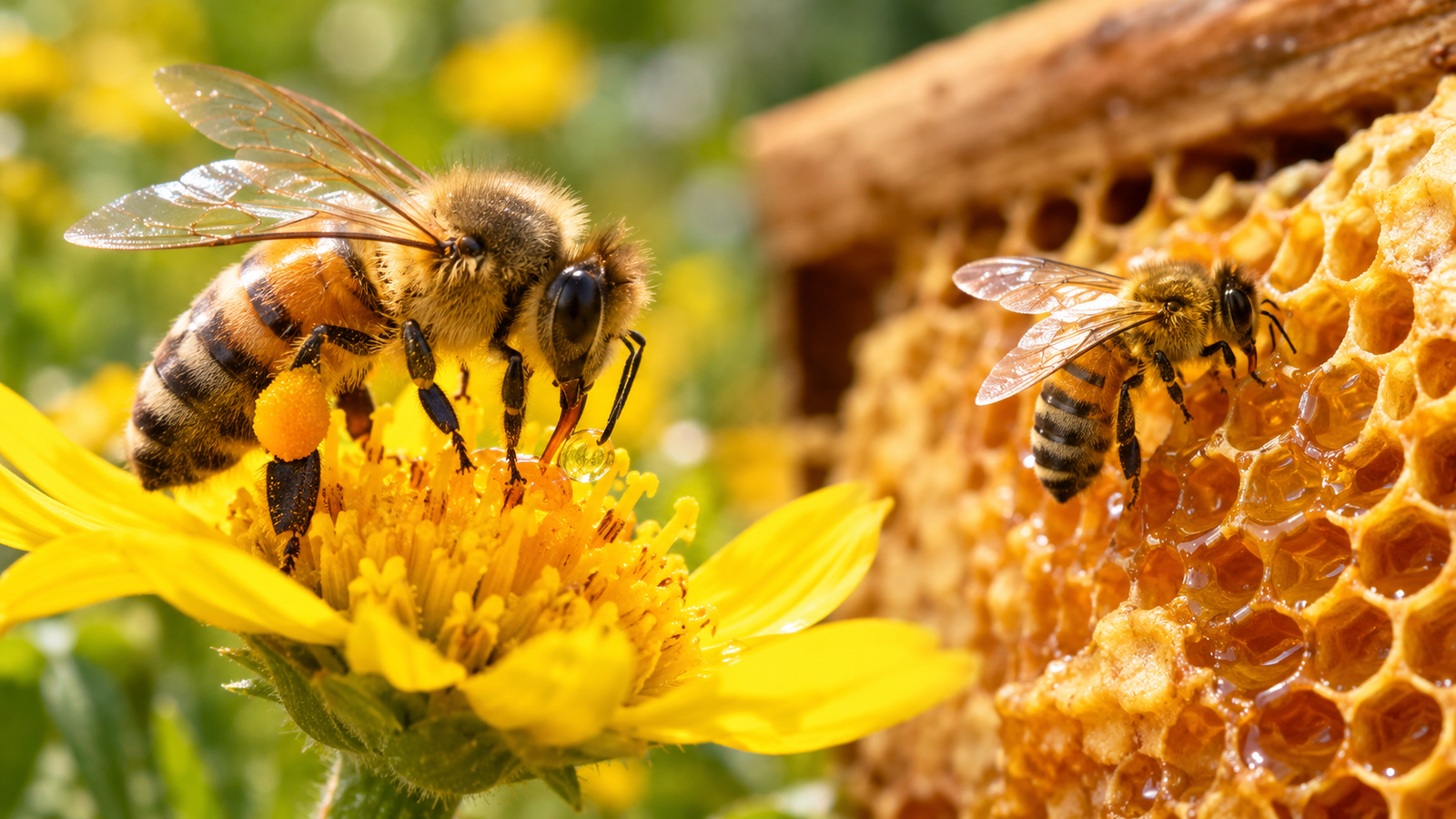
Have you ever wondered how bees make honey from a small amount of watery flower nectar? Honey production is one of the most remarkable activities in a honeybee colony. It involves thousands of worker bees collecting nectar, transporting it to the hive, changing its sugars with enzymes, removing excess moisture and storing the finished product in honeycomb cells.
Bees do not simply collect sweet liquid and turn it into honey immediately. They gradually transform nectar through a combination of biological processes, chemical reactions and evaporation. Each worker bee contributes to a different part of the process, allowing the colony to produce and preserve food for periods when flowers are not providing enough nectar.
Understanding how bee make honey also explains why honey has a different consistency, sugar composition and storage life from fresh flower nectar.
In this guide, you will discover exactly how bees make honey, what ingredients they use, what happens inside the hive, how long the process takes, and how different bee species produce and store honey.
How Bee Make Honey: The Short Answer
Bees make honey by collecting sugary nectar from flowers and transforming it into a concentrated food through enzyme activity and water evaporation.
Worker honeybees use their proboscises to collect nectar and store it temporarily in a special organ called the crop, commonly known as the honey stomach. They carry it back to the hive, where they transfer it to other worker bees for additional handling and processing.
During this process, enzymes help change some of the nectar’s sugars, while worker bees spread the liquid across honeycomb cells and circulate air through the hive to remove excess water.
When the nectar has matured into honey, the bees store it in honeycomb cells and cover many of the filled cells with thin beeswax caps.
The six main stages are:
- Collecting nectar from flowers.
- Transporting nectar back to the hive.
- Transferring and handling nectar between worker bees.
- Changing nectar sugars through enzymes.
- Removing excess moisture through evaporation.
- Storing and sealing mature honey in honeycomb cells.
Each stage contributes to turning perishable nectar into a concentrated food reserve that honeybees can use later.
What Do Bees Use to Make Honey?
The main raw material honeybees use to make honey is flower nectar. However, nectar is not the only sugary substance they can collect.
The main materials involved include:
| Material | Purpose in honey production |
|---|---|
| Flower nectar | Primary raw material for ordinary floral honey |
| Honeydew | Alternative sugary raw material for honeydew honey |
| Enzymes | Help transform the chemical composition of collected nectar |
| Beeswax | Used to construct honeycomb cells and seal mature honey |
| Air circulation | Helps remove excess moisture during honey ripening |
Flower nectar
Nectar is a sugary liquid produced by special glands in flowering plants called nectaries. It attracts pollinators, including honeybees, which collect it as a source of carbohydrates.
Its sugar concentration varies depending on the plant species, weather, soil conditions and other environmental factors.
For example, nectar collected from one flowering plant may contain a different proportion of sucrose, glucose and fructose from nectar collected from another.
This variation helps explain why honey produced from different flowers can have different flavours, colours, aromas and crystallisation patterns.
Honeydew
Honeybees can also collect honeydew, a sugary substance produced by certain sap-feeding insects, including aphids and scale insects.
These insects feed on plant sap and release excess sugary liquid, which bees may collect from leaves, stems and branches.
When honeybees process honeydew, they produce honeydew honey rather than ordinary floral honey.
This is an important exception because not all honey begins as flower nectar.
How Do Bees Make Honey? The Six Steps Explained
Step 1: Worker Bees Collect Nectar From Flowers
Honey production begins when worker bees leave their colony to search for flowering plants.
Flowers produce nectar to attract pollinators. When a honeybee finds a suitable flower, it uses its long, flexible tongue, called a proboscis, to draw up the sugary liquid.
The nectar enters a specialised storage organ called the crop.
The crop is sometimes called the honey stomach, but it is not the bee’s main digestive stomach. It temporarily holds liquid food while the bee transports it back to the colony.
Some of the collected nectar may be used by the foraging bee for energy during its journey. Much of the load, however, is transported back for further processing.
While visiting flowers, bees may also collect pollen. Pollen grains can stick to their hairy bodies and are often gathered into pollen baskets on their hind legs.
It is important to distinguish these two materials:
- Nectar provides the carbohydrates used to make honey.
- Pollen supplies protein, fats and other nutrients needed for brood development and colony health.
Practical example: A honeybee visiting a flowering mango tree may collect nectar from several flowers during one trip. When it returns to the hive, it carries the collected nectar in its crop rather than carrying finished honey.
The amount collected depends on nectar availability, flower structure, distance from the hive and weather conditions.
Step 2: Bees Transport Nectar Back to the Hive
After collecting nectar, the worker bee flies back to its colony.
The crop allows the bee to transport liquid food without immediately digesting the entire load.
Chemical changes may already begin during collection and transport because enzymes are introduced into the nectar.
The distance between the flowers and the hive affects the length of the foraging journey.
For example, a worker visiting flowers close to its hive can generally return more quickly than one travelling a longer distance.
When the forager reaches the hive, it searches for a worker involved in food handling and transfers its nectar load.
The returning bee may then leave again to collect more nectar if suitable flowers are available.
This division of labour allows the colony to collect nectar while other workers concentrate on processing food and maintaining the nest.
Step 3: Worker Bees Transfer and Process the Nectar
Inside the hive, the returning forager may transfer nectar to another worker bee through a process called trophallaxis.
Trophallaxis is the transfer of liquid food between bees through their mouthparts.
During this exchange, the nectar may be exposed to additional enzymes and undergo further handling before being deposited in a honeycomb cell.
This is not simply a matter of one bee passing liquid to another. It is part of the colony’s coordinated food-processing system.
Different worker bees perform different activities, including:
- Receiving nectar from returning foragers.
- Handling and redistributing the liquid.
- Depositing nectar into available honeycomb cells.
- Circulating air to support moisture evaporation.
- Maintaining the hive environment.
The number of bees involved and the exact sequence of handling can vary with colony conditions.
A strong colony receiving large amounts of nectar during a flowering season needs enough workers to collect, receive, process and store the incoming food.
This explains why honey production depends on teamwork rather than the activity of a single bee.
Step 4: Bees Use Enzymes to Transform Nectar Sugars
One of the most important stages in honey production is the chemical transformation of nectar.
Fresh flower nectar contains water and several types of sugar. These commonly include sucrose, glucose and fructose, although their proportions vary between plant species.
Honeybees introduce enzymes that help change the composition of the nectar.
Two important enzyme activities associated with honey processing are invertase-related activity and glucose oxidase.
How invertase helps change nectar
Invertase, also called sucrase, helps break down sucrose into two simpler sugars:
Sucrose → Glucose + Fructose
These sugars become major components of mature honey.
Glucose is important because it can form crystals as honey is stored. Fructose is generally more soluble in water and tends to remain liquid longer.
This difference helps explain why some honey crystallises faster than other varieties.
For scientific precision, researchers have also identified alpha-glucosidase activity in honeybees, so the enzyme chemistry is more complex than attributing every sucrose-breaking reaction to one enzyme alone.
What does glucose oxidase do?
Glucose oxidase contributes to another important chemical reaction.
Under suitable conditions, it helps convert glucose into gluconolactone, which can then form gluconic acid. The reaction also produces hydrogen peroxide.
Gluconic acid contributes to honey’s natural acidity.
Hydrogen peroxide can contribute to antimicrobial activity under certain conditions, although its concentration and activity depend on the honey’s composition and storage conditions.
These chemical changes help distinguish mature honey from the original nectar.
Important: Enzymes alone do not turn watery nectar into properly ripened honey. Bees must also remove a substantial amount of water.
Step 5: Bees Remove Excess Water From the Nectar
Water removal is one of the most important parts of making honey.
Fresh nectar can contain a large amount of water. Depending on its source, it may contain approximately 60–80% water.
If nectar were stored in this watery condition, naturally occurring yeasts could ferment its sugars.
Honeybees therefore reduce its moisture content before long-term storage.
They accomplish this through several related activities.
A. Spreading nectar across honeycomb cells
Worker bees deposit nectar into the hexagonal cells of their beeswax honeycomb.
Spreading the liquid across the cell increases its exposed surface area, allowing more water to evaporate.
The nectar gradually becomes more concentrated as moisture is lost.
B. Fanning their wings
Worker bees use their wings to circulate air inside the hive.
This movement helps remove humid air around the honeycomb and supports the evaporation of water from exposed nectar.
The ventilation activity is particularly important when large amounts of nectar are entering the colony.
C. Handling nectar with their mouthparts
Bees may repeatedly manipulate nectar with their mouthparts, exposing droplets to air and contributing to the ripening process.
Enzymatic processing and water removal can continue together as the nectar matures.
How much water remains in finished honey?
Ripe honey commonly contains around 17–20% water, although the actual amount varies.
The Codex Standard for Honey generally specifies a maximum moisture content of 20% for honey, with certain exceptions for particular varieties.
This is an important distinction: bees are not trying to remove every drop of water. They are concentrating the nectar sufficiently to produce a stable food reserve.
The high sugar concentration and low water availability help prevent most microorganisms from growing readily.
Water activity is also important. It measures how much water is available for microbial growth, rather than simply measuring the total amount of water present.
Step 6: Bees Store and Seal the Finished Honey
Once the nectar has been sufficiently processed and ripened, worker bees store it in honeycomb cells.
Honeycomb is made from beeswax produced by worker bees. Its hexagonal structure provides an efficient arrangement of storage and brood cells.
Not every cell has the same purpose. Some contain developing eggs, larvae and pupae, while others store pollen or honey.
When honey is sufficiently ripe, workers often cover the filled cells with thin beeswax caps.
This process is called capping.
The wax covering helps protect stored honey from moisture and contamination.
The colony can then use the stored honey when fresh nectar becomes difficult to find.
What happens if the honey is not ripe?
If the moisture content remains too high, the honey may be more susceptible to fermentation.
This is why beekeepers examine honey frames and sometimes measure moisture content before harvesting.
Capped cells are a useful indication of ripeness, but they do not guarantee that every cell has an acceptable moisture level.
What Is the Difference Between Nectar and Honey?
Nectar and honey may both taste sweet, but they are not the same substance.
Nectar is the sugary liquid collected from flowers. Honey is the processed and concentrated product stored by bees.
| Characteristic | Flower nectar | Mature honey |
|---|---|---|
| Source | Flower nectaries | Processed nectar or honeydew |
| Water content | Often relatively high | Commonly around 17–20% |
| Sugar concentration | More dilute | Highly concentrated |
| Consistency | Usually thin and watery | Usually thick and viscous |
| Enzymatic processing | Has not undergone the full honey-ripening process | Has undergone enzymatic processing |
| Storage stability | More susceptible to fermentation | More resistant to microbial growth |
| Location | Collected from flowers | Stored in hive cells or honey pots |
The biggest difference is that honey has undergone both chemical transformation and moisture reduction.
This allows the colony to preserve its food for much longer than it could preserve ordinary fresh nectar.
What Is Honey Made Of?
Honey is a complex natural food made mainly of sugars and water, with smaller amounts of organic acids, enzymes, minerals, amino acids and other compounds.
Its exact composition depends on the plants visited by the bees, the bee species and the conditions under which the honey matures.
The main components include:
| Component | Function or contribution |
|---|---|
| Fructose | Major sugar contributing sweetness |
| Glucose | Major sugar that can crystallise |
| Water | Present in a relatively small proportion |
| Other sugars | Contribute to the overall sugar composition |
| Organic acids | Contribute to acidity and flavour |
| Enzymes | Participate in chemical changes during processing |
| Minerals | Present in small and variable amounts |
| Amino acids | Contribute to honey’s minor nitrogen-containing components |
| Plant-derived compounds | Influence colour, aroma and flavour |
Fructose and glucose make up most of honey’s sugar content.
The remaining components are present in smaller quantities but contribute to the differences between honey varieties.
Why does honey from different flowers look different?
The plant source can influence the characteristics of the finished honey.
For example:
- Some floral honeys are pale and mild in flavour.
- Others are darker and have stronger aromas.
- Honey with relatively more glucose may crystallise more quickly.
- Honey with relatively more fructose may remain liquid longer.
These variations explain why two jars of natural honey can have noticeably different appearances and textures without either being artificial.
How Long Does It Take Bees to Make Honey?
There is no single amount of time required for bees to make honey.
The process depends on the nectar’s initial water content, the availability of flowers, colony strength, temperature, humidity and the amount of nectar entering the hive.
Once nectar is collected, its ripening may take several days, but this is not a fixed timetable for every nectar load.
It is also important to distinguish between three different periods:
- Nectar collection: Worker bees gather nectar repeatedly during suitable foraging conditions.
- Nectar ripening: Bees continue processing the liquid, changing sugars and reducing its water content.
- Honey accumulation: The colony gradually builds up stored honey reserves over a flowering season.
Factors that influence honey production time
1. Nectar concentration
Nectar containing more water generally requires more moisture removal before it becomes sufficiently concentrated.
2. Temperature and humidity
Environmental conditions affect evaporation and the hive’s ability to remove moist air.
3. Colony strength
A colony with many healthy workers can generally collect and process more nectar than a weak colony.
4. Flower availability
When many suitable plants are flowering, bees have more opportunities to collect nectar.
5. Hive ventilation
Air circulation helps remove moisture from the hive environment and supports honey ripening.
For these reasons, claims that all honey takes exactly 24 hours, 48 hours or a particular number of days to produce are misleading.
Why Do Bees Make Honey?
Bees make honey primarily to provide a concentrated food supply for their colony.
Flowering plants do not produce nectar continuously throughout the year. Rainfall patterns, drought, temperature changes and seasonal flowering cycles can all affect the availability of nectar.
By converting nectar into honey and storing it, honeybees create a reserve that helps their colony survive periods when fresh food is scarce.
1. To store food for periods of scarcity
Honey provides a reserve that worker bees can use when flowers are not producing enough nectar.
In colder climates, this is especially important during winter, when bees may be unable to forage regularly.
In tropical regions, including Ghana and other parts of West Africa, food shortages may be more closely connected to dry seasons, rainfall patterns and flowering cycles.
The exact timing depends on the local environment.
2. To provide energy for the colony
Honey contains concentrated carbohydrates that supply energy for essential activities.
Worker bees use this energy for:
- Flying and collecting food.
- Maintaining the hive.
- Producing and maintaining beeswax.
- Regulating the colony’s temperature.
- Performing other daily activities.
3. To maintain the colony during unfavourable weather
When rain, cold temperatures or other conditions prevent foraging, stored honey provides an alternative food source.
A colony with sufficient reserves is better equipped to survive periods when fresh nectar cannot be collected.
4. To support colony growth
A healthy honeybee colony requires carbohydrates, proteins, fats, minerals and other nutrients.
Honey supplies much of the colony’s carbohydrate energy, while pollen provides important proteins and other nutrients.
Both food sources contribute to the colony’s development and continued survival.
Do All Bees Make Honey?
No. Not all bee species produce and store honey in the same way.
Honey production is particularly associated with social honeybees, but some other bee groups also make and store honey.
Understanding the differences helps prevent the common misconception that every bee species produces harvestable honey.
1. Honeybees (Apis species)
Honeybees belonging to the genus Apis are well known for producing and storing substantial quantities of honey.
The western honeybee, Apis mellifera, is widely used in commercial beekeeping.
These bees collect nectar, process it and store mature honey in wax honeycomb cells.
2. Stingless bees (Meliponini)
Stingless bees are another group of social bees that can produce honey.
Unlike conventional honeybees, many stingless bee species store honey in small pots constructed from a mixture of wax and plant resins.
Their honey can differ considerably in moisture content, acidity, flavour and viscosity.
For example, honey from some stingless bee species is more liquid and acidic than typical Apis mellifera honey.
This is especially interesting in tropical regions where stingless bees are part of local ecosystems and traditional honey harvesting.
3. Solitary bees
Most solitary bees do not produce large honey reserves.
Instead, a female solitary bee collects nectar and pollen to prepare food provisions for her developing offspring.
She places these provisions in individual nest cells, lays an egg and seals the cell.
The stored food is intended to nourish the developing larva rather than serve as a large communal food reserve.
Comparison of different bee groups
| Bee group | Collects nectar | Produces honey | Typical storage |
|---|---|---|---|
| Honeybees (Apis) | Yes | Yes | Wax honeycomb |
| Stingless bees | Yes | Yes, in many species | Honey pots |
| Most solitary bees | Yes | Generally no substantial honey stores | Individual brood-cell provisions |
The important distinction is that collecting nectar does not automatically mean a bee produces honey in the same way as a honeybee.
How Is Honeydew Honey Different From Floral Honey?
Most familiar honey begins with flower nectar, but honeybees can also collect honeydew.
Honeydew is a sugary liquid released by insects that feed on plant sap.
When bees collect and process this material, the result is called honeydew honey.
| Feature | Floral honey | Honeydew honey |
|---|---|---|
| Main raw material | Flower nectar | Insect-associated honeydew |
| Collection location | Flowers | Leaves, stems and branches |
| Colour | Varies from very pale to dark | Often darker, depending on source |
| Flavour | Frequently floral or fruity | May be stronger and less floral |
| Mineral composition | Varies by floral source | Can contain relatively more minerals |
| Production | Nectar processing | Honeydew processing |
Both are genuine forms of honey, although their chemical characteristics can differ.
Honeydew honey is a useful example of why the answer to how bees make honey is not always limited to collecting flower nectar.
How Much Honey Can Bees Make?
The amount of honey produced by a colony varies considerably.
There is no universal production figure that applies to every hive because honey production depends on several biological and environmental factors.
A strong colony with access to abundant flowering plants may produce a substantial surplus, while a colony experiencing poor weather or limited nectar availability may struggle to maintain its own food reserves.
The main factors include:
1. Colony population: More healthy worker bees can increase the colony’s ability to collect and process nectar.
2. Flowering plants: The quantity, quality and duration of available nectar sources influence production.
3. Weather conditions: Rain, drought, temperature and humidity affect foraging activity and nectar availability.
4. Bee species: Different bee species have different nesting structures, behaviours and honey-storage capacities.
5. Hive management: Adequate space, suitable equipment and good colony health can support production.
6. Seasonal conditions: A long flowering season can provide more opportunities to collect nectar than a short or interrupted one.
Do bees make more honey than they need?
Sometimes, yes.
During favourable flowering periods, a strong honeybee colony may collect and store more food than it immediately requires.
Beekeepers can harvest some of this surplus, provided they leave enough honey for the colony’s survival.
The amount that can safely be harvested depends on the colony, local climate and expected availability of future food sources.
How Do Beekeepers Harvest Honey?
Honey harvesting begins after bees have stored sufficiently ripened honey in their combs.
Beekeepers should not remove all the honey from a colony because the bees depend on their reserves for food.
In conventional frame-hive beekeeping, harvesting generally involves the following steps.
Step 1: Inspect the hive
The beekeeper examines the colony and identifies frames containing stored honey.
Frames containing developing brood should be protected from unnecessary disturbance.
Step 2: Select suitable honey frames
The beekeeper chooses frames containing mature honey.
A large proportion of capped cells can indicate ripeness, but moisture measurement provides more reliable information.
Step 3: Remove the wax caps
A special uncapping knife or fork is used to remove the thin beeswax covering from the filled cells.
This exposes the honey for extraction.
Step 4: Extract the honey
Many beekeepers use a centrifugal honey extractor.
The frames are placed inside the extractor, which spins them so that honey is thrown out of the cells and collected in the container below.
Step 5: Strain and settle
The extracted honey is passed through an appropriate strainer to remove larger wax particles.
It may then be allowed to settle so that air bubbles and small particles can rise.
Step 6: Measure moisture and package the honey
A honey refractometer can be used to measure moisture content.
For ordinary honey, the general Codex maximum is 20%, although some recognised varieties have exceptions.
The honey is then placed in clean, food-safe, tightly sealed containers.
Why should beekeepers measure honey moisture?
Honey that contains too much water may be more susceptible to fermentation.
For example, a frame that looks fully capped may still contain honey with a higher moisture content than expected.
Measuring moisture helps beekeepers assess whether the honey is suitable for extraction and storage.
It is therefore better to combine visual inspection with proper moisture testing instead of relying on capped cells alone.
Frequently Asked Questions About How Bee Make Honey
1. How do bees make honey step by step?
Bees make honey through six main stages. Worker bees collect nectar from flowers, transport it in their crops, transfer it to other workers, introduce enzymes that change its sugars, remove excess water through evaporation and store the mature honey in honeycomb cells.
2. Do bees make honey from pollen?
No. Honeybees primarily make honey from flower nectar or, in some cases, honeydew.
Pollen is a separate food source that provides protein, fats and other nutrients required for brood development and colony health.
3. Do bees make honey from flowers?
Yes. Flower nectar is the main raw material used by honeybees to produce floral honey.
They collect the nectar, transport it to the hive, process it with enzymes and remove excess water before storing it.
4. Do bees swallow nectar to make honey?
Yes. Bees draw nectar through their proboscises and store most of the collected liquid temporarily in their crops.
Enzymatic changes can begin during collection and transport. The nectar is then transferred to other worker bees for further handling and processing.
5. Is honey bee saliva?
No. Honey is not simply bee saliva.
It begins as nectar or honeydew collected from plants and undergoes chemical changes through enzymes as well as physical changes through water removal.
Bee secretions contribute enzymes that help transform the collected material.
6. Why do bees fan their wings when making honey?
Bees fan their wings to circulate air through the hive.
This helps remove humid air around the honeycomb and supports the evaporation of excess water from the nectar.
7. Why do bees seal honeycomb with wax?
Worker bees cover sufficiently ripened honey with thin beeswax caps.
These coverings help protect the stored honey from moisture and contamination.
8. Can bees make honey without flowers?
Honeybees generally need access to sugary food sources to produce honey.
Although flower nectar is the main source, some bees also collect honeydew from plant-associated insects.
Without suitable sugary sources, bees cannot continue producing their usual honey reserves.
9. How long does it take bees to make honey?
There is no fixed production time.
Nectar ripening can take several days, but the time varies according to nectar concentration, temperature, humidity, colony strength and ventilation.
Building up a substantial honey reserve can take much longer because bees must collect nectar repeatedly.
10. Does every bee make honey?
No. Honeybees and many stingless bee species produce and store honey.
Most solitary bees do not make large communal honey reserves. They generally collect nectar and pollen to provision individual cells for their offspring.
11. Does honey ever spoil?
Properly ripened honey is resistant to microbial spoilage because it has a high sugar concentration and low water availability.
However, honey is not completely immune to spoilage. Moisture contamination can encourage fermentation, and storage conditions can affect quality.
Honey may also crystallise naturally over time. Crystallisation alone does not mean honey has spoiled.
12. Is it safe to give honey to babies?
No. Honey should never be given to babies younger than 12 months.
It may contain Clostridium botulinum spores that can cause infant botulism.
This warning applies to raw, processed and commercially packaged honey.
Conclusion: How Do Bees Make Honey?
Bees make honey by transforming flower nectar or, in some cases, honeydew into a concentrated food reserve.
The process begins when worker bees collect sugary liquid from flowers and carry it back to their colony in their crops. Other workers receive and handle the nectar, while enzymes help change its sugar composition.
The bees then spread the liquid across honeycomb cells and circulate air through the hive to remove excess water. Once the nectar has matured into honey, workers store it in the comb and often seal the cells with beeswax.
This entire process depends on cooperation, specialised bee behaviour and the chemical properties of the collected nectar.
Honey is much more than sweet liquid stored in a hive. It is the result of coordinated work that allows a colony to preserve energy for periods when flowers are no longer producing enough food.
The next time you enjoy a spoonful of honey, remember that it represents the work of many bees visiting flowers, transporting nectar and processing it together inside their colony.
Scientific References and Further Reading
The following educational and scientific sources support the biological, chemical and food-quality explanations in this article.
- Mississippi State University Extension Service: How Is Honey Made? — Explains nectar collection, the bee crop, enzymes and moisture reduction.
- NSW Department of Primary Industries and Regional Development: Nutritional Requirements of Honey Bees — Explains the importance of nectar, pollen, water and honey storage.
- Food and Agriculture Organization (FAO): Codex Standard for Honey — Provides international honey composition and quality requirements.
- Food Standards Agency: Honey Risk Profile — Discusses honey composition, honeydew, microbial stability and food safety.
- Food Standards Australia New Zealand: Application for Approval of Honey from Native Stingless Bees — Explains how native stingless bees process and store honey in honey pots.
