

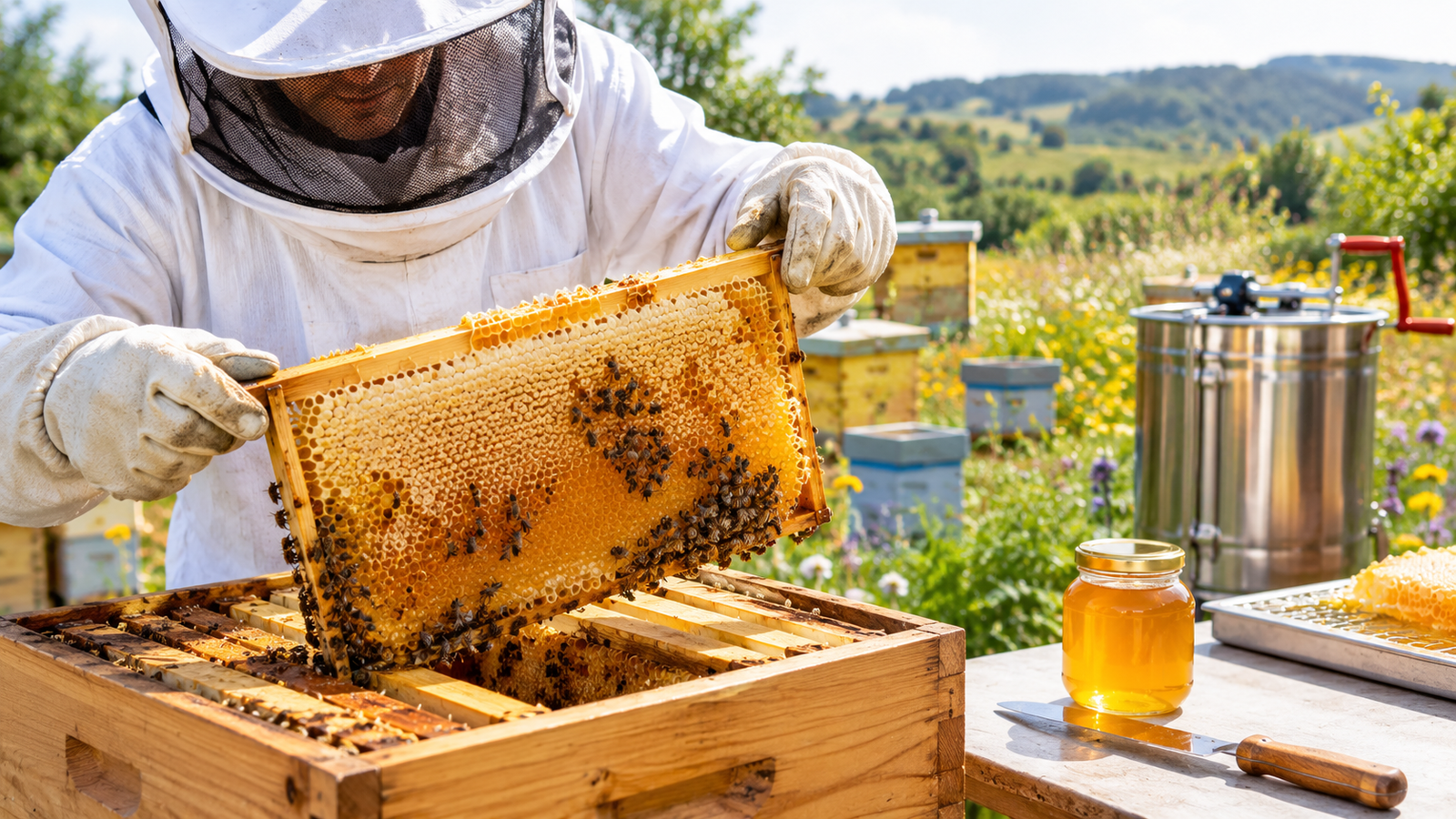
How is honey harvested? Honey is harvested by removing mature honey-filled frames from a beehive, removing the beeswax cappings, extracting the honey from the comb, filtering or straining it, and then bottling it. Before this happens, honey bees must first collect flower nectar, transform it into honey, reduce its moisture content, and seal the finished honey inside wax cells.
The harvesting process can be simple for a small backyard apiary or highly mechanized in a commercial honey operation. Regardless of the scale, responsible beekeepers harvest only surplus honey while leaving enough food for the colony.
How Do Bees Make Honey Before It Is Harvested?
Understanding how honey is harvested starts with understanding how bees make and store it.
Honey begins as flower nectar. Worker honey bees collect nectar from flowers using their long, tube-like tongues and store it temporarily in a specialized part of their digestive system called the honey crop.
When the bee returns to the hive, the nectar is transferred to other worker bees. During this process, enzymes are added to the nectar and its chemical composition begins to change.
The bees then place the processed nectar into honeycomb cells.
At this stage, the nectar still contains a considerable amount of water. Worker bees fan the comb with their wings, helping moisture evaporate. As the water content decreases, the nectar becomes thicker and develops into honey.
When the honey has reached a suitable condition for storage, the bees seal the cells with thin beeswax cappings.
This produces the mature honey that beekeepers can eventually harvest.
The basic journey is:
Flower nectar → worker bee → hive → honeycomb → moisture reduction → mature honey → wax capping → harvesting
When Is Honey Ready to Harvest?
Honey should generally be harvested when the bees have produced surplus mature honey.
One of the most visible signs is that many honey-filled cells are covered with a thin layer of beeswax. These capped cells indicate that the bees have stored and sealed the honey.
However, capped honey is not the only consideration.
Before harvesting, a beekeeper should consider:
- How much honey the colony has stored
- Whether the honey is mature
- The moisture content of the honey
- The strength and health of the colony
- The availability of flowers and nectar
- The local weather
- Whether the bees have enough food remaining
A refractometer can be used to check honey moisture, which is particularly useful when a beekeeper is uncertain whether honey is ready for extraction.
When Is Honey Harvested During the Year?
There is no single honey harvesting date that applies everywhere.
Honey harvesting depends on the local flowering season and climate. In areas with long or multiple nectar flows, beekeepers may harvest honey more than once in a year.
In other locations, there may be only one major harvest.
Weather also plays an important role. Good nectar availability, suitable temperatures, and favorable weather can help colonies build large honey stores.
The beekeeper should therefore focus less on a specific calendar date and more on whether the colony has surplus, mature honey that can safely be removed.
How Is Honey Harvested? Step-by-Step
The exact process varies between beekeepers, but modern honey harvesting generally follows these steps.
1. Inspect the Hive
The beekeeper begins by inspecting the hive.
The purpose is to determine which frames contain harvestable honey and whether the colony is healthy enough for harvesting.
Frames containing brood—such as eggs, larvae, or developing pupae—are generally not selected for honey extraction.
The beekeeper focuses on frames containing stored honey, particularly mature and capped honey.
2. Remove the Honey Frames
Once suitable frames have been identified, the beekeeper removes them from the hive.
Protective equipment such as a veil, gloves, jacket, or full bee suit may be used depending on the beekeeper and circumstances.
A hive tool helps separate frames and manipulate hive components.
A smoker may also be used to encourage bees to move away from the working area and make hive handling easier.
The beekeeper should work carefully to minimize unnecessary disturbance to the colony.
3. Remove Bees From the Frames
Before the honey frames are taken away for extraction, most of the bees need to be removed from them.
A beekeeper may use a bee brush or other bee-removal techniques.
The objective is to move the bees back toward the colony while keeping the honey frames as bee-free as practical.
The frames can then be transported to a clean extraction area.
4. Uncap the Honeycomb
Honey bees seal mature honey inside the comb using beeswax.
Before the honey can be extracted, the beekeeper removes these wax cappings.
This process is called uncapping.
Common uncapping tools include:
- Uncapping knives
- Uncapping forks
- Capping scratchers
- Heated or electric uncapping knives
- Commercial uncapping machines
The beekeeper carefully removes the thin wax layer covering the honey cells.
The wax cappings can be collected separately because they contain honey and valuable beeswax.
5. Place the Frames in a Honey Extractor
After uncapping, the honey frames are placed into a honey extractor.
A honey extractor is a machine that uses centrifugal force to remove honey from the comb.
The frames are positioned inside the extractor and spun. As they rotate, honey is forced out of the cells and onto the inside of the extractor.
The honey then flows downward into the collection area.
There are both manually operated and electric honey extractors.
Small beekeepers may use a hand-powered extractor, while larger operations often use electric or automated equipment.
6. Collect the Extracted Honey
The honey flows from the extractor into a food-safe container.
At this stage, the honey may contain small pieces of beeswax, bits of comb, or other particles.
The honey therefore usually goes through a straining or filtering stage before bottling.
7. Strain or Filter the Honey
Filtering or straining removes unwanted particles from the extracted honey.
A simple strainer can remove larger pieces of wax and comb.
More extensive filtration can produce a clearer and more uniform-looking honey.
The amount of filtration depends on the type of honey being produced.
Some producers prefer minimal processing so that their honey retains more of its naturally occurring particles, while others use finer filtration for a clearer appearance.
8. Allow the Honey to Settle
After extraction and straining, honey can be placed in a settling tank or food-safe container.
Small air bubbles and remaining particles can gradually rise toward the surface.
The beekeeper can then draw the cleaner honey from the container for bottling.
This step is particularly useful for improving the appearance of extracted honey.
9. Bottle the Honey
Once the honey has been extracted, strained, and settled, it can be transferred into clean, food-safe containers.
Honey may be packaged as:
- Liquid honey
- Raw honey
- Comb honey
- Creamed honey
- Specialty floral honey
The final product depends on the beekeeper’s harvesting and processing methods.
What Equipment Is Used to Harvest Honey?
Honey harvesting equipment varies according to the size of the apiary.
Basic equipment can include:
- Protective bee suit or jacket
- Veil
- Gloves
- Hive tool
- Smoker
- Bee brush
- Honey frames
- Uncapping knife
- Uncapping fork
- Honey extractor
- Honey strainer
- Food-grade buckets
- Settling tank
- Bottling containers
- Refractometer
Commercial honey producers may use specialized equipment for uncapping, extracting, filtering, pumping, settling, and bottling honey.
What Does a Smoker Do During Honey Harvesting?
A smoker produces cool smoke that can help make bees less defensive while the beekeeper works inside the hive.
The smoke is not intended to drive bees away permanently. Instead, it can temporarily alter their behavior and make hive inspections and honey harvesting easier.
Beekeepers should use smoke carefully and avoid excessive or unnecessarily hot smoke.
Why Do Beekeepers Uncap Honey?
Bees seal mature honey cells with beeswax.
These wax cappings must be removed because they prevent the honey from escaping during extraction.
Once the cappings are removed, the exposed honey can be released from the comb using an extractor or another harvesting method.
Why Is a Honey Extractor Used?
A honey extractor removes honey from the comb using centrifugal force.
One of its biggest advantages is that it allows the beekeeper to harvest the honey while preserving much of the comb.
The extracted frames can often be returned to the hive, where bees can reuse the existing comb.
This saves the colony considerable effort because producing new beeswax requires energy and resources.
Can Honey Be Harvested Without an Extractor?
Yes.
Honey can be harvested without a centrifugal extractor.
One traditional approach is called crush-and-strain harvesting.
The beekeeper removes honey-filled comb, crushes it to release the honey, and then strains the crushed material through a suitable filter.
The honey is collected while pieces of wax and comb are separated.
The disadvantage is that the original honeycomb is destroyed.
The bees must then build new comb before they can refill it.
Another option is comb honey, where the honey is harvested and sold while still inside the beeswax comb.
What Is Comb Honey?
Comb honey is honey that remains inside the original beeswax comb when it is harvested.
Instead of removing the honey from the comb with an extractor, the beekeeper cuts sections of filled, capped honeycomb and packages them for consumption.
Comb honey provides a direct connection between the hive and the finished product because the honey is consumed along with its natural wax comb.
Do Beekeepers Take All the Honey From a Hive?
No. Responsible beekeepers generally do not remove every bit of honey from a colony.
Honey is the bees’ primary food reserve.
Bees need stored honey to provide energy for:
- Flying
- Feeding the colony
- Raising young bees
- Maintaining the hive
- Producing heat
- Surviving periods when flowers are unavailable
For this reason, beekeepers should determine how much honey the colony needs before removing surplus stores.
The amount that can safely be harvested varies according to climate, colony strength, available forage, and the length of periods when little nectar is available.
Does Harvesting Honey Hurt Bees?
Properly managed honey harvesting does not require intentionally killing bees.
The beekeeper removes surplus honey while attempting to minimize stress and disruption to the colony.
Good harvesting practices include:
- Handling frames carefully
- Avoiding unnecessary crushing of bees
- Using appropriate protective equipment
- Maintaining adequate food reserves
- Avoiding excessive hive disturbance
- Keeping extraction equipment clean
- Monitoring colony health
Honey harvesting is therefore part of a broader beekeeping system in which the beekeeper manages the colony while allowing the bees to remain healthy and productive.
What Happens to the Honeycomb After Harvesting?
The fate of the honeycomb depends on the harvesting method.
When a centrifugal extractor is used, much of the comb remains intact.
The empty frames can often be returned to the hive, allowing the bees to reuse them.
This is one reason extraction is so useful for beekeepers.
When crush-and-strain harvesting is used, the original comb is destroyed and the bees must rebuild it.
What Happens to the Beeswax Cappings?
The beeswax removed during uncapping does not have to be thrown away.
Beekeepers can collect, melt, clean, and reuse beeswax for products such as:
- Candles
- Beeswax foundation
- Cosmetics
- Soap
- Furniture polish
- Wax wraps
- Other beeswax products
Because beeswax is a valuable hive product, careful beekeepers often save the clean wax produced during harvesting.
How Is Honey Processed After Harvesting?
The amount of processing varies between producers.
Freshly extracted honey may be strained to remove larger particles of wax and comb.
Some honey is then allowed to settle before being bottled.
Other producers may use additional filtration or controlled warming to make honey easier to process and package.
The final product can therefore range from minimally processed honey to highly filtered commercial honey.
What Is Raw Honey?
Raw honey generally refers to honey that has undergone relatively limited processing.
Depending on the producer and labeling standards in a particular market, raw honey may retain more of the natural particles found in freshly harvested honey.
The exact meaning of the term can vary, so consumers should check how the producer defines and processes the product.
How Much Honey Can Be Harvested From a Hive?
There is no fixed amount of honey that every hive produces.
Honey production depends on many factors, including:
- Colony strength
- Bee genetics
- Weather
- Local flowering plants
- Length of the nectar flow
- Hive management
- Availability of forage
- Climate
- Pests and diseases
A strong colony in an area with abundant flowering plants can produce significant surplus honey.
A colony experiencing poor weather, limited flowers, or other challenges may produce little surplus honey.
For this reason, beekeepers should never assume that every hive will provide the same harvest.
How Long Does Honey Harvesting Take?
The time required depends on the size of the operation.
A hobby beekeeper harvesting a small number of frames may complete the extraction process relatively quickly.
A commercial beekeeper processing hundreds or thousands of frames may use automated equipment to speed up uncapping, extraction, filtering, and bottling.
The complete process can involve:
Hive inspection → frame removal → bee removal → uncapping → extraction → straining → settling → bottling
Is Honey Harvested From Every Hive?
No.
Not every hive will necessarily have enough surplus honey to harvest.
A colony may need all of its stored honey for its own survival, particularly during periods when nectar is scarce.
New colonies and weaker colonies may also require their honey stores to support population growth.
Beekeepers therefore assess individual colonies rather than assuming every hive is ready for harvesting.
What Is the Difference Between Honey Harvesting and Honey Production?
These terms describe different stages of the process.
Honey production primarily refers to the work done by bees to collect nectar, process it, reduce its moisture, and store it as honey.
Honey harvesting refers to the beekeeper’s process of removing mature surplus honey from the hive and preparing it for consumption or sale.
In simple terms:
Bees produce the honey. Beekeepers harvest the surplus.
Is Honey Harvesting Sustainable?
Responsible honey harvesting should prioritize the health of the bee colony.
Sustainable beekeeping involves maintaining healthy colonies, protecting bees from pests and diseases, providing appropriate hive management, and avoiding excessive removal of food stores.
Beekeepers can also reduce waste by reusing honeycomb and beeswax whenever practical.
Good honey harvesting is therefore not simply about obtaining as much honey as possible. It is about balancing honey production with the colony’s nutritional and biological needs.
Frequently Asked Questions About Honey Harvesting
How is honey harvested from a beehive?
Honey is usually harvested by removing mature honey frames from a hive, removing the beeswax cappings, placing the frames into a honey extractor, filtering the extracted honey, allowing it to settle, and bottling it.
How do bees make honey before it is harvested?
Worker bees collect flower nectar and bring it back to the hive. The nectar is processed with enzymes, placed into honeycomb, and gradually loses moisture as bees fan the comb. Once the honey is mature enough for storage, bees seal the cells with beeswax.
When is honey ready to harvest?
Honey is generally ready when the colony has surplus mature honey, often indicated by a substantial amount of capped honey. Moisture content and the colony’s remaining food supply should also be considered.
Do beekeepers harvest all the honey?
No. Responsible beekeepers leave enough honey for the colony’s food requirements and harvest only the surplus.
Do bees die when honey is harvested?
Honey harvesting does not require intentionally killing bees. Beekeepers use techniques designed to remove bees from harvestable frames while minimizing disturbance and injury.
Can honey be harvested without an extractor?
Yes. Honey can be harvested through methods such as crush-and-strain or by selling the honey as comb honey.
Why is honeycomb capped with beeswax?
Bees cap mature honey with beeswax to seal and protect it for storage. These cappings are removed by beekeepers before honey is extracted.
Can extracted honeycomb be reused?
Yes. When honey is removed with an extractor, the comb can often be returned to the hive for the bees to reuse.
What happens to beeswax after honey is harvested?
Beeswax from cappings and damaged comb can be collected, cleaned, and reused for products such as candles, cosmetics, soap, and beeswax foundation.
Is honey filtered after harvesting?
Honey is commonly strained or filtered to remove pieces of beeswax and other unwanted particles. The extent of filtration depends on the producer and the desired type of honey.
How much honey can one hive produce?
There is no universal amount. Honey production varies according to colony strength, weather, flowering plants, climate, bee genetics, and hive management.
Does honey have to be heated after harvesting?
No. Honey does not inherently need to be heated after harvesting. Some producers use controlled warming during processing because it can make honey easier to pump, filter, and bottle.
Final Thoughts
How is honey harvested? The process begins when a beekeeper identifies surplus mature honey in a healthy colony. Suitable honey frames are removed from the hive, the bees are cleared from the frames, and the wax cappings are removed. The frames are then placed in a honey extractor, where centrifugal force removes the honey from the comb.
The extracted honey is strained or filtered, allowed to settle when appropriate, and finally bottled.
But honey harvesting is only the final part of a much longer natural process. Bees first collect nectar from flowers, transform it inside the hive, remove excess moisture, and seal the finished honey in wax cells.
A responsible beekeeper does not simply remove as much honey as possible. The goal is to harvest surplus honey while leaving the colony enough food to remain healthy and productive.
From flower nectar to honeycomb and finally to the jar, honey harvesting combines the remarkable work of honey bees with careful beekeeping.

1 Comment
Pingback: Why Bee Produce Honey? The Real Reasons Bees Make Honey - BeekeeperBase