

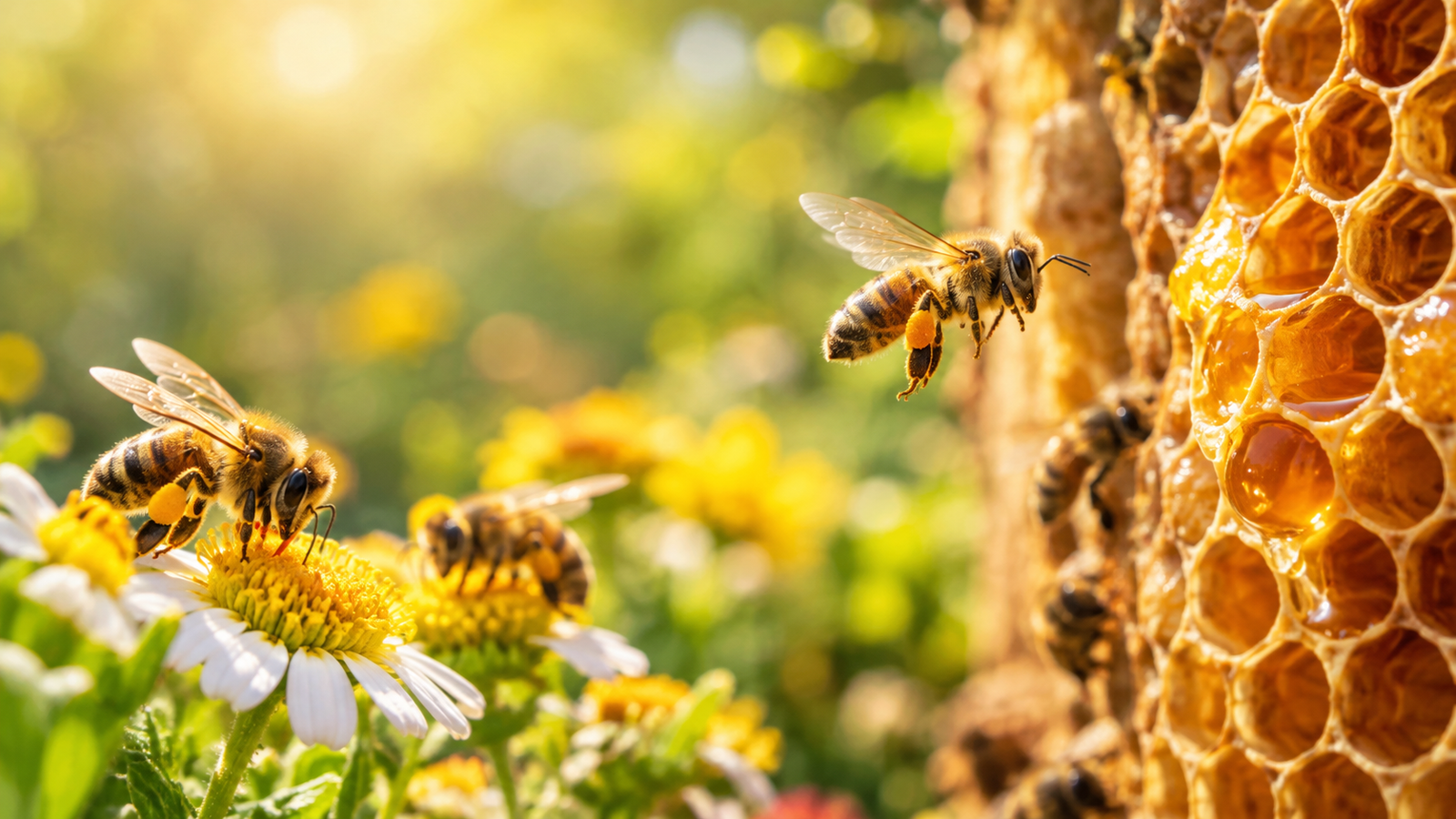
How is honey made? Honey is made by honey bees from flower nectar. Worker bees collect nectar, store it temporarily in their honey crops, add enzymes that change its sugars, and bring it back to the hive. The nectar is then placed in honeycomb cells, where bees remove much of its water through evaporation. Once the honey is sufficiently concentrated, the bees seal the cells with beeswax for storage.
In simple terms, flowers provide the nectar, honey bees transform it, and the honeycomb stores the finished honey.
But the process is more fascinating than it may seem. Honey does not come directly from flowers as the thick, sweet substance we eat. Bees must collect, chemically process, concentrate, and preserve the nectar before it becomes mature honey.
What Is Honey Made From?
Honey begins mainly as nectar, a sugary liquid produced by flowering plants.
Nectar contains water and sugars, particularly sucrose, as well as smaller amounts of amino acids, minerals, organic acids, and other compounds. Its exact composition varies depending on the plant species and environmental conditions.
Fresh nectar can contain a very high proportion of water, sometimes around 80%. Mature honey contains much less water, typically around 17–18%.
This reduction in water is one of the most important changes that occurs during honey production.
Honey is therefore not simply concentrated flower nectar. Bees also use enzymes to alter the nectar’s sugars as they transform it into a stable food that can be stored in the colony.
How Is Honey Made Step by Step?
The process of making honey can be broken down into several main stages:
- Bees find flowers containing nectar.
- Worker bees collect the nectar.
- The nectar is stored in the bee’s honey crop.
- Enzymes begin changing the nectar’s sugars.
- Bees transfer and process the nectar inside the colony.
- The processed nectar is placed into honeycomb cells.
- Bees remove excess water through evaporation.
- The mature honey is sealed with beeswax.
Let’s look at each stage in detail.
1. Bees Collect Nectar From Flowers
Honey production begins when worker bees leave the colony to search for food.
Worker bees visit flowers and use their long, tube-like proboscis to collect nectar. Nectar is produced by plants as a sugary reward that attracts pollinators.
A foraging bee can visit many flowers during a single trip.
The type of flowers visited can influence the eventual honey’s:
- Flavor
- Color
- Aroma
- Sugar composition
- Texture
- Crystallization rate
This is why honey from different floral sources can taste and look very different.
Although flower nectar is the primary raw material for most honey, honey bees can sometimes collect sugary secretions from sources other than flowers, such as honeydew produced by sap-feeding insects.
2. The Nectar Goes Into the Honey Crop
After collecting nectar, the worker bee stores it in a specialized internal storage chamber called the honey crop.
The honey crop is sometimes called the “honey stomach,” but it is not the bee’s true digestive stomach.
Instead, it functions mainly as a temporary storage container that allows the bee to transport nectar back to the colony.
The nectar is already beginning to change while it is inside the bee.
3. Bees Add Enzymes to the Nectar
One of the most important parts of honey production is the addition of enzymes.
As bees collect and process nectar, enzymes help break down some of the more complex sugars.
One important reaction involves sucrose, a sugar found in nectar, being broken down into simpler sugars, mainly:
- Glucose
- Fructose
This enzymatic processing is part of what makes honey chemically different from the original flower nectar.
The enzymes involved also contribute to honey’s characteristic properties and help prepare it for long-term storage.
4. Bees Bring the Nectar Back to the Hive
Once a worker bee has collected enough nectar, it returns to the colony.
The nectar is then transferred to other worker bees.
The receiving bees continue processing the nectar before it is eventually stored in the honeycomb.
This means that honey production is a colony-wide process, rather than something performed by a single bee from beginning to end.
Different worker bees perform different tasks depending on the needs of the colony.
5. Bees Place the Nectar Into Honeycomb
After being collected and processed, the nectar is placed into the hexagonal cells of the honeycomb.
Honeycomb is made from beeswax, which worker bees produce from special glands on the underside of their abdomens.
The six-sided cells provide an efficient storage system for the colony.
At this point, however, the substance inside the cells is still relatively watery and is not yet fully mature honey.
The bees must remove much of that water.
6. Bees Remove Water From the Nectar
Water removal is one of the most important steps in making honey.
Fresh nectar can contain a large amount of water. If it remained highly watery, it would be more susceptible to fermentation and spoilage.
Worker bees help reduce the water content by spreading the nectar through the honeycomb cells and creating airflow with their wings.
As air moves through the hive, water evaporates from the nectar.
The bees may also manipulate and redistribute the nectar within the cells, helping increase its exposure to air.
As water is removed, the concentration of sugars increases.
The thin nectar gradually becomes thicker and more viscous.
7. Nectar Becomes Mature Honey
As the water content falls and the nectar’s sugars become concentrated, the substance develops the characteristics of mature honey.
Mature honey typically contains around 17–18% water, although the exact moisture content can vary.
This low water content is important because it makes honey much less favorable for the growth of many microorganisms.
The combination of concentrated sugars, relatively low water availability, and honey’s naturally acidic environment helps honey remain stable for long periods.
8. Bees Seal the Honey With Beeswax
Once the honey has reached a suitable level of maturity, worker bees seal the honeycomb cells with thin layers of beeswax.
This process is called capping.
The wax cap helps protect the stored honey from moisture and contamination.
The colony can then keep the honey as a food reserve and use it when fresh nectar is unavailable.
Why Do Bees Make Honey?
Bees make honey primarily as a long-term food supply for the colony.
Flowers do not produce nectar continuously throughout the year. Cold weather, drought, rain, seasonal changes, and periods of limited flowering can make food difficult to find.
Honey allows the colony to store energy-rich carbohydrates when food is abundant and use those reserves when foraging becomes difficult.
Bees use the energy from honey for activities such as:
- Flying and foraging
- Feeding and caring for larvae
- Maintaining the colony
- Producing beeswax
- Regulating the temperature inside the hive
- Surviving periods when flowers are scarce
For honey bees, honey is essentially a stored energy reserve.
Why Do Bees Reduce the Water Content of Honey?
Reducing water is crucial because highly watery food is more likely to ferment.
Fresh nectar is too dilute to be safely stored as long-term honey.
By evaporating much of the water, bees produce a concentrated sugar solution that is considerably more stable.
This is why the transformation can be thought of as:
Watery nectar → concentrated nectar → mature honey
The bees’ ability to control the moisture content allows them to preserve a food source for future use.
How Do Bees Make Honey Thicker?
Bees make honey thicker primarily by removing water.
They place nectar into honeycomb cells and use their wings to create air movement around the comb. This encourages evaporation.
As water leaves the nectar, the remaining sugars become increasingly concentrated.
The result is the thick, sticky honey familiar to humans.
Is Honey Just Nectar?
No. Honey begins as nectar, but nectar and honey are not the same thing.
Nectar is a relatively watery plant secretion.
Honey is the processed and concentrated product created after bees:
- Collect nectar
- Add enzymes
- Modify its sugars
- Transfer and process it
- Remove much of its water
- Store it in honeycomb
So, honey is best understood as a bee-processed form of nectar.
Do Bees Make Honey From Pollen?
No. Honey is primarily made from nectar, not pollen.
Bees collect both nectar and pollen, but the two have different roles.
Nectar
Nectar is mainly used as a carbohydrate source and is processed into honey.
Pollen
Pollen provides bees with important nutrients, including proteins, fats, vitamins, minerals, and other compounds.
Bees may mix pollen with nectar and other substances to make bee bread, which is used as food within the colony.
Therefore, pollen is important to bees, but it is not the primary ingredient in honey.
Does Every Type of Honey Come From the Same Flowers?
No.
Honey can come from many different plants.
If bees collect nectar predominantly from one type of flowering plant, the resulting honey may have distinctive characteristics associated with that floral source.
Other honey is produced from nectar collected from many different plants and is often called multifloral or wildflower honey.
The floral source can affect the honey’s:
- Color
- Flavor
- Aroma
- Texture
- Sugar balance
- Crystallization behavior
This explains why honey from different regions can look and taste dramatically different.
Why Does Honey Have Different Colors?
Honey can range from nearly clear and pale yellow to golden, amber, reddish-brown, or very dark brown.
One of the major factors affecting color is the floral source.
The plant species from which bees collect nectar can influence the natural compounds present in the resulting honey.
In general, color does not simply determine whether honey is good or bad. Different varieties naturally have different colors and flavors.
Why Does Honey Crystallize?
Honey can naturally crystallize when some of its glucose forms solid crystals.
Crystallization is not necessarily a sign that honey has spoiled.
Some types of honey crystallize quickly, while others can remain liquid for a long time.
The rate of crystallization depends on factors including:
- Floral source
- Glucose-to-fructose ratio
- Temperature
- Water content
- Tiny particles present in the honey
Crystallized honey is still honey and can generally be returned to a more liquid consistency through gentle warming.
Why Doesn’t Honey Spoil Easily?
Mature honey has several characteristics that make it difficult for many microorganisms to grow.
Its high sugar concentration limits available water, while its naturally acidic environment provides another barrier to microbial growth.
This is why properly stored honey can remain stable for a very long time.
However, honey can absorb moisture from its surroundings. If its water content becomes sufficiently high, fermentation can occur.
This is another reason bees carefully reduce water before sealing honey in the comb.
How Do Bees Store Honey?
Bees store honey inside the hexagonal cells of their honeycomb.
Honeycomb is made from beeswax produced by worker bees.
Once a cell contains sufficiently mature honey, the bees cover it with a wax cap.
The colony can then access this stored food when needed.
Honey is only one of the materials stored in a hive. Bees also store pollen and other food resources in different parts of the comb.
How Do Beekeepers Harvest Honey?
Beekeepers can harvest surplus honey from managed colonies when the colony has adequate food reserves.
A typical honey-harvesting process may include:
- Removing honey-filled frames from the hive.
- Removing the bees from the frames.
- Uncapping the wax covering the honey cells.
- Extracting honey from the comb, often using centrifugal force.
- Filtering out pieces of wax and other debris.
- Allowing the honey to settle.
- Bottling the finished honey.
Good beekeeping practice requires consideration of the colony’s food needs. Bees need enough stored food to maintain the colony, especially during periods when nectar is scarce.
How Much Honey Can Bees Make?
Honey production varies greatly from colony to colony and from season to season.
It depends on factors such as:
- Colony strength
- Weather
- Available flowers
- Length of the flowering season
- Temperature
- Rainfall
- Hive conditions
- Bee health
- Availability of nectar
A strong colony in an area with abundant flowering plants can collect and store large amounts of nectar.
During drought, cold weather, heavy rainfall, or periods with few flowering plants, honey production may be much lower.
Do All Bees Make Honey?
No.
There are more than 20,000 known bee species, but only a relatively small group are true honey-making bees.
Honey bees belong to the genus Apis.
The western honey bee, Apis mellifera, is the species most commonly associated with commercial honey production.
Other species of honey bees are native primarily to parts of Asia.
Many other bee species, including solitary bees and bumblebees, collect nectar and pollen but do not produce and store honey in the same way honey bees do.
Is Honey Made Inside the Bee?
Partly.
The transformation begins while nectar is being carried by the bee because enzymes are introduced and processing starts.
However, honey is not simply manufactured entirely inside one bee.
The process continues after the nectar reaches the colony, where worker bees transfer, process, spread, dry, and store it in honeycomb.
So honey production is best understood as a cooperative process carried out by many worker bees.
Is Honey Bee Vomit?
No. Calling honey “bee vomit” is an oversimplification.
The nectar is stored in the bee’s honey crop, which is a specialized storage structure and is separate from the digestive stomach.
When bees transfer nectar to other bees, the material comes from this storage system rather than being digestive waste.
The distinction is important because the honey crop allows bees to transport nectar without using it as their normal digestive food pathway.
How Long Does It Take Bees to Make Honey?
There is no fixed amount of time required to make honey.
The process depends heavily on:
- Nectar availability
- Flower type
- Temperature
- Humidity
- Weather
- Colony strength
- Ventilation
- Amount of nectar entering the hive
When flowers are producing abundant nectar and weather conditions are favorable, bees can process and store nectar rapidly.
However, producing mature honey requires enough time for the bees to reduce its water content to a suitable level.
What Happens to Nectar During Honey Production?
The transformation can be summarized as follows:
1. Flower produces nectar
↓
2. Worker bee collects nectar
↓
3. Nectar enters the honey crop
↓
4. Enzymes begin changing its sugars
↓
5. Bees transfer and process the nectar
↓
6. Nectar is placed into honeycomb
↓
7. Bees evaporate excess water
↓
8. Nectar becomes mature honey
↓
9. Bees cap the cell with beeswax
This is the basic process behind the production of honey.
Frequently Asked Questions About How Honey Is Made
How is honey made?
Honey is made when honey bees collect flower nectar, add enzymes that modify its sugars, transfer and process it within the colony, remove much of its water through evaporation, and store the concentrated honey in wax honeycomb.
What is the main ingredient in honey?
The main starting material for honey is flower nectar. Nectar contains water and sugars, which bees chemically process and concentrate to produce honey.
How do bees turn nectar into honey?
Bees turn nectar into honey by adding enzymes, modifying its sugars, repeatedly processing it, and removing much of its water. The concentrated product is then stored in honeycomb and sealed with beeswax.
How do bees remove water from honey?
Bees spread nectar in honeycomb cells and use their wings to create airflow through the hive. This encourages water to evaporate from the nectar and helps concentrate the sugars.
Why do bees put wax over honey?
Bees cap mature honey with beeswax to protect their stored food from moisture and contaminants and preserve it for future use.
Do bees eat the honey they make?
Yes. Honey is an important energy source for honey bees. The colony stores honey so it can use it when flowers are unavailable or when weather prevents foraging.
Is honey made from nectar or pollen?
Honey is made primarily from nectar. Pollen is a separate food resource that supplies bees with nutrients such as protein and fats.
Why does honey crystallize?
Honey crystallizes when some of its glucose separates from the liquid and forms crystals. The speed of crystallization depends on the honey’s floral source, sugar composition, temperature, water content, and other factors.
Does honey come directly from flowers?
No. Flowers produce nectar, not finished honey. Honey bees collect the nectar and transform it through enzymatic processing and water removal before storing it as honey.
Can bees make honey without flowers?
Honey bees normally obtain the raw material for honey from nectar, primarily from flowers. They can also collect other sugary sources such as honeydew, but these are not the typical floral nectar source.
The Bottom Line: How Is Honey Made?
How is honey made? Honey is made by honey bees from nectar collected from plants.
Worker bees collect watery nectar and store it in their honey crops. Enzymes begin changing the nectar’s sugars, including breaking down sucrose into simpler sugars such as glucose and fructose. After returning to the colony, the nectar is transferred and further processed by worker bees.
The bees then place the processed nectar into wax honeycomb cells and use airflow to help evaporate excess water. As the water content falls, the nectar becomes concentrated and develops into mature honey. The bees finally seal the honey-filled cells with beeswax.
The complete process can therefore be summarized as:
Flower nectar → collection → enzyme processing → bee-to-bee transfer → honeycomb storage → water evaporation → mature honey → beeswax capping
What looks like a simple sweet substance is actually the result of a complex biological process involving plants, enzymes, worker bees, evaporation, and honeycomb.
And that is how honey is made.
