

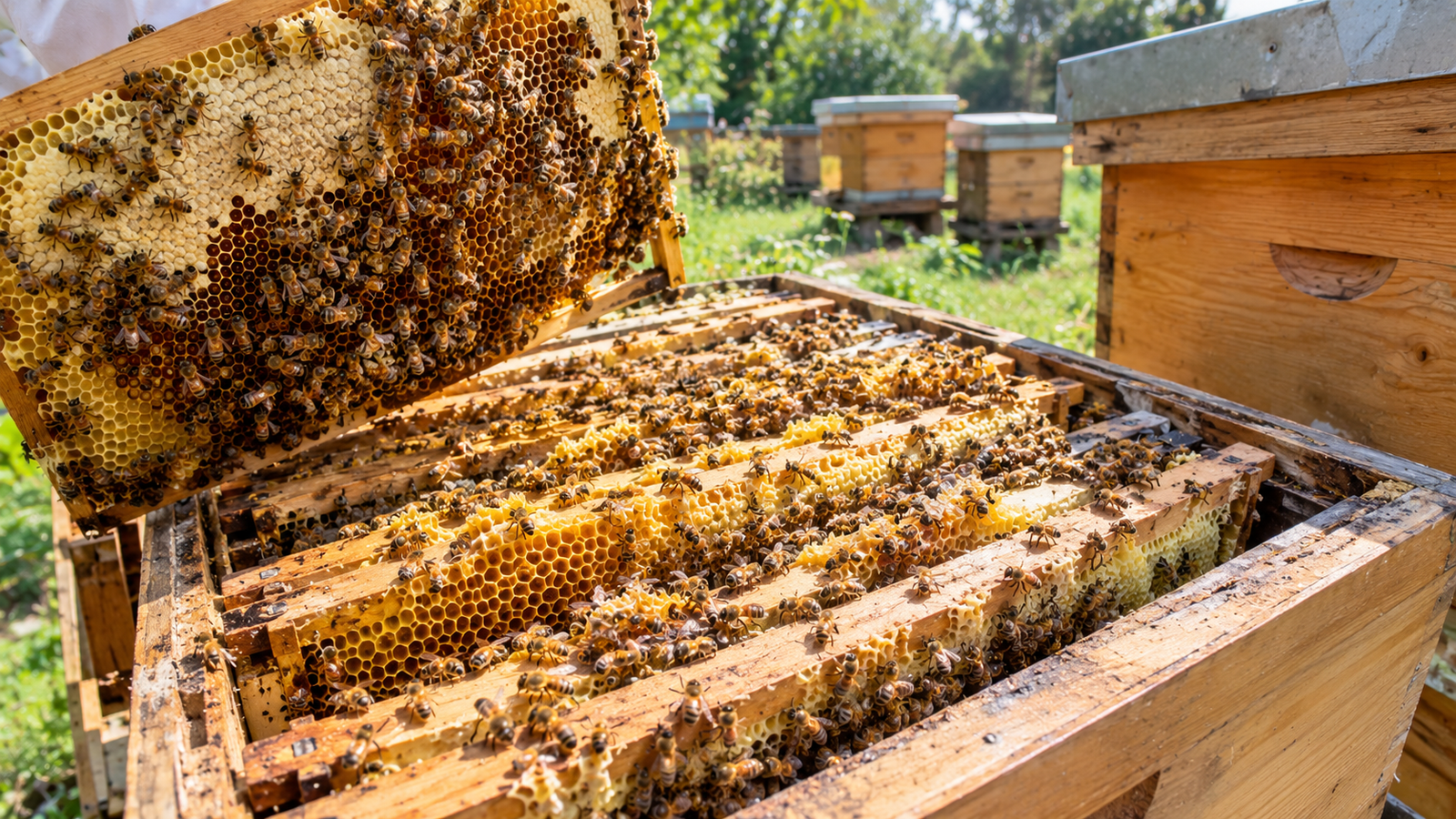
A bee hive works through the coordinated activities of thousands of honey bees that collect food, raise young, build honeycomb, regulate temperature, defend the colony and maintain the resources needed for survival. Each bee performs tasks that support the entire colony, allowing the hive to function as an organized living system.
Inside a typical honey bee hive, the queen lays eggs, worker bees perform nearly all the daily maintenance and food-collection activities, and drones contribute to reproduction by mating with queens from other colonies. Workers also communicate through chemical signals, physical contact and movements such as the waggle dance.
However, a beehive is more than a home containing different types of bees. Its internal systems are interconnected. Food collection supports brood development, brood development replaces aging workers, and worker activities help maintain the temperature and conditions necessary for the colony to survive.
Understanding how bee hives work means looking at how these activities fit together, from the organization of the colony to the movement of food and the development of new bees.
What Is a Bee Hive?
A bee hive is the structure where a colony of bees lives, raises its young, stores food and carries out activities necessary for survival.
In honey bees, a hive usually contains several sheets of wax comb made up of small cells. These cells provide space for raising developing bees and storing honey and pollen.
A hive is not the same thing as a colony. The hive is the physical nest, while the colony consists of the living bees occupying it.
Honey bees can establish nests in natural cavities, including hollow trees, rock spaces and sheltered openings in buildings. Beekeepers also provide manufactured structures designed to house and manage colonies.
Natural bee nests
Wild honey bee colonies often choose protected cavities that provide shelter from rain, excessive heat, wind and predators.
Inside these cavities, workers construct wax combs that hang from the upper part of the available space. The colony uses the comb for brood rearing and food storage.
Natural nests are not arranged according to the exact dimensions of a manufactured beehive. Bees build their comb according to the available cavity and the colony’s needs.
Managed bee hives
Beekeepers use different hive designs to provide colonies with a suitable place to live.
Common examples include:
- Langstroth hives: Use removable frames that allow beekeepers to inspect comb and manage honey production.
- Top-bar hives: Use horizontal bars from which bees build hanging comb.
- Warre hives: Use vertically stacked boxes designed to accommodate natural comb building.
Although these structures look different, the colony still performs the same essential biological activities: raising brood, collecting food, maintaining the nest and reproducing.
How Do Bee Hives Work as a Colony?
A honey bee hive works because individual bees cooperate to perform tasks that would be difficult or impossible for one bee to accomplish alone.
Scientists describe this type of organization using the term superorganism.
A superorganism is a group of individuals that cooperate so closely that the entire group performs functions resembling those of a single organism.
For example, a human body has different organs that perform specialized functions. The heart circulates blood, the lungs exchange gases and the digestive system processes food.
A honey bee colony has a comparable division of responsibilities, although it is not biologically identical to an individual animal.
Different bees perform different activities, but their combined efforts maintain the colony.
Consider how these activities depend on one another:
- Forager bees collect nectar, pollen and water from the environment.
- Other workers receive and process incoming food.
- Nurse bees use available nutrients to feed developing larvae.
- New adult workers emerge and eventually contribute to colony maintenance.
- Workers regulate the brood nest’s temperature and help protect the colony.
- The queen produces eggs that replace workers and produce future reproductive bees.
If one important activity is disrupted, other parts of the colony can be affected.
For example, a colony with insufficient pollen may struggle to feed developing larvae. This can reduce the number of young workers available to replace older bees.
This interconnected organization is one of the main reasons honey bee colonies can function for years under suitable conditions.
What Are the Roles of Bees Inside a Hive?
A typical honey bee colony contains three types of adult bees: the queen, workers and drones.
Each has a different biological role.
1. Queen bee
The queen is the colony’s primary reproductive female.
Her main responsibility is laying eggs, which develop into the next generation of bees.
A healthy, well-established queen can lay hundreds or sometimes more than a thousand eggs in a day during periods of strong colony activity. Her actual egg production depends on factors such as age, available food, colony population and environmental conditions.
The queen also produces chemical signals called pheromones. These signals influence worker behavior and help maintain the colony’s social organization.
However, the queen does not personally supervise every activity inside the hive.
Workers respond to colony conditions and carry out the tasks needed to maintain the nest.
2. Worker bees
Worker bees are female bees that perform nearly all the daily labor of the colony.
They clean cells, feed larvae, care for the queen, build comb, process nectar, collect pollen, defend the entrance and maintain the internal environment.
Most worker bees do not reproduce under normal colony conditions because their ovaries remain underdeveloped.
Their activities commonly change as they grow older.
For example:
- Young workers clean brood cells and feed larvae.
- Other workers help maintain the comb and receive food from returning foragers.
- Older workers commonly guard the entrance and collect nectar, pollen, water and plant resins.
This age-related division of labor is called temporal polyethism.
However, workers do not follow a strict timetable. If the colony loses many foragers, younger workers can begin collecting food earlier than they normally would.
3. Drone bees
Drones are the male honey bees.
Their primary biological function is mating with virgin queens during mating flights.
Unlike workers, drones do not have stingers, pollen baskets or wax-producing glands used for ordinary colony maintenance.
They do not collect nectar or pollen for the colony.
Drone numbers vary with colony condition and season. Colonies commonly produce more drones when reproductive activity is favorable.
After mating, a drone dies. Drones that do not mate may survive for some time, although workers in many colonies drive them out when resources become limited.
Queen, worker and drone comparison
| Feature | Queen | Worker | Drone |
|---|---|---|---|
| Sex | Female | Female | Male |
| Main function | Reproduction | Colony maintenance | Mating |
| Collects nectar | No | Yes | No |
| Collects pollen | No | Yes | No |
| Builds comb | No | Yes | No |
| Has a stinger | Yes | Yes | No |
| Normally lays eggs | Yes | No | No |
One important exception is that workers in a queenless colony can sometimes develop functional ovaries and lay unfertilized eggs. These eggs produce drones rather than replacement worker bees.
How Is a Beehive Organized Inside?
A honey bee hive contains different areas used for brood rearing, food storage and colony maintenance.
The exact arrangement depends on the nest structure, available space and colony condition.
1. Brood nest
The brood nest is the area where the queen lays eggs and young bees develop.
It contains:
- Eggs.
- Larvae.
- Capped pupae.
Workers maintain this area carefully because developing bees need appropriate temperatures and regular feeding.
In many honey bee nests, the brood is concentrated in the central comb region.
2. Pollen storage
Pollen is commonly stored in cells near the brood area.
Worker bees collect pollen from flowers and transport it back to the hive in specialized structures on their hind legs called corbiculae, or pollen baskets.
Other workers help pack pollen into cells.
Pollen supplies protein, fats, vitamins and minerals that support the colony, particularly the development of young bees.
Stored pollen is often mixed with nectar and bee secretions and undergoes microbial and chemical changes to form bee bread.
3. Honey storage
Honey is stored in wax cells and serves as an important carbohydrate energy source.
Bees use stored honey to fuel activities such as flying, producing heat, building comb and caring for brood.
In many natural nests, honey is stored above and around the brood area, although the arrangement is not identical in every colony.
4. Honeycomb
Honeycomb is the main internal structure of the hive.
It consists of closely arranged wax cells that serve different purposes.
Worker-sized cells are commonly used for worker brood and food storage, while larger drone cells are used to raise drones.
Queen cells are different. They are larger, elongated structures generally built when the colony needs to produce replacement queens or prepare for swarming.
5. Hive entrance
The entrance provides access between the hive and the outside environment.
Foragers use it when returning with food, while other workers leave to collect resources or remove waste.
Guard bees may remain near the entrance to identify and challenge intruders.
In a managed hive, the entrance is also an important area for observing colony activity.
How Do Bees Build and Maintain Honeycomb?
Honeycomb is constructed from beeswax produced by specialized glands on the underside of worker bees’ abdomens.
Young adult workers commonly produce wax when the colony needs additional comb.
How bees produce wax
Worker bees consume carbohydrates from honey or nectar and use the energy to produce wax.
The wax emerges as small flakes from specialized abdominal glands.
Other workers collect these flakes, chew and soften the material, and shape it into cells.
Why does honeycomb have hexagonal cells?
Honeycomb is made of closely packed hexagonal cells.
This arrangement provides a strong structure while making efficient use of building material and available space.
The hexagonal shape allows neighboring cells to fit together without leaving unnecessary gaps.
The comb serves several purposes:
- Providing space for eggs and developing larvae.
- Storing honey.
- Storing pollen.
- Supporting the colony’s internal organization.
What is bee space?
Bee space is the natural gap that honey bees generally maintain between combs and other nest surfaces.
In managed beekeeping, the concept is important because hive equipment is designed around the spacing bees can move through without filling the space with unwanted comb or sealing it with excessive propolis.
If a beekeeper provides incorrect spacing, bees may build additional comb in unwanted locations or fill gaps with propolis.
How Does Food Move Through a Bee Hive?
Food collection is one of the most important activities inside a honey bee colony.
However, returning foragers do not simply deposit everything in storage and leave. Food is transferred, processed and distributed among different workers.
1. Collecting nectar
Forager bees visit flowers and use their proboscis to collect nectar.
The nectar is stored temporarily in a specialized internal organ called the crop, sometimes known as the honey stomach.
When a forager returns to the hive, she can transfer nectar to another worker through mouth-to-mouth food exchange.
This process is called trophallaxis.
2. Processing nectar into honey
Nectar contains substantial water and naturally occurring sugars.
Workers process it using enzymes and repeated handling.
They also spread nectar into cells and fan their wings to increase air movement.
Evaporation reduces the water content.
When the honey reaches a sufficiently low moisture level for stable storage, workers seal the cell with a wax capping.
Honey is therefore not simply nectar placed in a cell. It is a processed food reserve.
3. Collecting and storing pollen
Pollen is collected from flowers and carried back to the hive in pollen baskets.
Workers pack it into cells, commonly around the brood area.
Pollen provides nutrients needed for brood development and the maintenance of adult bees.
4. How honey and pollen support the colony
Honey and pollen perform different nutritional functions.
| Feature | Honey | Pollen |
|---|---|---|
| Main role | Energy supply | Protein and other nutrients |
| Main source | Flower nectar | Flower pollen |
| Storage | Wax cells | Wax cells |
| Important users | Adult bees and developing colony members indirectly | Nurse bees and developing brood indirectly |
A practical example is a colony raising many larvae.
Nurse bees require protein-rich food to develop and maintain the glands that produce brood food. Pollen supplies important nutrients for these activities.
At the same time, honey provides energy for the workers performing those tasks.
If a colony has plenty of honey but very little pollen, it may have adequate carbohydrate reserves but insufficient protein resources for sustained brood production.
This demonstrates why both food sources matter.
How Do Bees Raise Baby Bees Inside a Hive?
Honey bees reproduce through a process involving egg laying, larval feeding and development inside individual wax cells.
The young developing stages are collectively called brood.
1. Egg laying
The queen moves across the comb and inspects individual cells before laying eggs.
She usually places one egg in each suitable cell.
The egg remains in the cell for approximately three days before hatching into a larva.
2. Feeding larvae
After hatching, larvae are fed by worker bees.
Young worker bees called nurse bees produce food from specialized glands.
The food supplied to developing larvae depends on their caste and stage of development.
Female larvae that develop into queens receive a different feeding regime from larvae that develop into workers.
The quantity and composition of larval food are important factors in caste development.
3. Capping the cells
As larvae grow, workers eventually cover their cells with wax cappings.
The developing bees then undergo metamorphosis.
During this stage, the larva transforms into a pupa and develops the body structures of an adult bee.
4. Emerging adult bees
When development is complete, the young adult chews through the wax capping and emerges from the cell.
New workers gradually begin performing colony tasks.
How long does it take different honey bees to develop?
Development time differs between queens, workers and drones.
| Development stage | Approximate time from egg laying to adult emergence |
|---|---|
| Queen | 16 days |
| Worker | 21 days |
| Drone | 24 days |
These are standard approximate development periods for the western honey bee, Apis mellifera. Actual development can vary with environmental and colony conditions.
The queen develops fastest because of differences in larval nutrition and development.
How Do Bees Communicate Inside a Hive?
Honey bees use several communication methods to coordinate activities and respond to changing colony conditions.
These include pheromones, physical contact, food exchange, vibrations and movements.
1. The waggle dance
The waggle dance is one of the best-known honey bee communication behaviors.
A returning forager may perform this dance on the comb to communicate information about a food source.
The dance includes a straight waggle run followed by return movements.
The angle of the waggle run relative to gravity communicates the direction of the food source relative to the sun.
The duration of the waggle run provides information about distance.
Other bees can use this information when deciding where to forage.
For example, a worker that discovers a productive group of flowering trees may communicate their location to other workers through repeated dances.
The dance does not provide a perfectly precise map, but it helps direct foragers toward promising resources.
2. Pheromones
Pheromones are chemical signals used by bees to influence the behavior of other colony members.
The queen produces a mixture of pheromones that helps regulate aspects of colony organization.
Other pheromones communicate alarm, brood-related information and other behavioral signals.
For example, alarm pheromones can help recruit workers to defend the hive when an intruder threatens the colony.
3. Food exchange
Workers also communicate through trophallaxis.
When one bee transfers food to another, the exchange can provide both nutrition and chemical information.
Food sharing helps distribute resources within the colony.
What Happens Inside a Beehive During the Day?
A honey bee colony is active throughout the day, although activity levels change according to weather, food availability, temperature and colony needs.
There is no single daily schedule that every hive follows.
Morning activity
As suitable flying conditions develop, foragers begin leaving the hive to collect nectar, pollen and water.
Other workers remain inside to care for brood, clean cells and process food.
Midday activity
During periods of strong flowering and favorable weather, foraging activity may become intense.
Returning workers transfer food to other bees.
Some workers continue building comb, feeding larvae and ventilating the nest.
Afternoon activity
Foraging continues while suitable resources and weather conditions remain available.
Workers may also increase water collection and ventilation when the hive becomes warm.
Evening activity
As daylight fades, many foragers return to the hive.
Internal activities continue, including food processing, brood care and communication.
The colony does not simply stop functioning at night. Many workers continue performing necessary tasks inside the nest.
How Do Bees Control the Temperature Inside a Hive?
Temperature regulation is essential for honey bee colonies, particularly in the brood nest.
Developing brood requires a relatively stable environment.
Honey bees regulate this environment through collective behavior.
For western honey bees, the brood area is generally maintained close to 34–35°C under normal brood-rearing conditions.
How bees cool a hive
When the nest becomes too warm, workers can collect water and distribute droplets inside the hive.
Other workers fan their wings to increase air movement.
Evaporation removes heat and helps cool the surrounding area.
This is especially important when colonies are raising substantial amounts of brood.
How bees warm a hive
When temperatures become too low, workers gather around the brood area.
They can generate heat by activating their flight muscles without flying.
The cluster helps reduce heat loss and maintain suitable conditions for developing brood.
Why temperature regulation matters
If brood temperatures remain outside suitable limits for too long, development can be disrupted.
The colony’s ability to regulate its internal environment is therefore a major part of how a hive works.
This collective activity is another example of a honey bee colony functioning as a superorganism.
How Do Bees Protect Their Hive?
A honey bee colony needs to protect its brood, food reserves and queen from threats.
Worker bees perform most defensive activities.
Guard bees
Some workers remain near the entrance and inspect bees and other animals approaching the hive.
They may use smell, appearance and behavioral signals to distinguish colony members from potential intruders.
Alarm signals
When a threat is detected, workers can release alarm pheromones.
These chemicals help alert other bees and may increase defensive behavior.
Stinging and defense
Worker honey bees can sting to defend the colony.
The sting of a worker western honey bee is barbed and usually remains embedded in the skin of a mammal, causing the worker to die after stinging.
Queens have a different sting structure and generally use it in conflicts with rival queens rather than ordinary hive defense.
Propolis and nest maintenance
Workers also collect plant resins and use them to make propolis.
Propolis is used to seal small openings, cover some unwanted spaces and maintain the nest environment.
It contributes to the physical and hygienic defense of the colony.
How Does a Bee Colony Grow and Reproduce?
A colony grows by raising new workers and producing reproductive bees when conditions are suitable.
The queen lays eggs, workers feed the brood, and new adults emerge to replace aging or lost colony members.
When a colony becomes sufficiently strong and conditions favor reproduction, it may prepare to swarm.
What is swarming?
Swarming is the natural process through which a honey bee colony reproduces by dividing into two groups.
Before swarming, workers may begin raising new queens.
The old queen then leaves with a substantial portion of the worker population.
The departing bees temporarily gather in a cluster, often on a tree branch or another exposed surface.
Scout bees search for a suitable permanent nest location.
Once a suitable location is selected, the swarm moves to establish a new colony.
The original colony remains behind with brood, workers and usually developing queen cells.
After a new queen emerges, she may mate and begin laying eggs, allowing the original colony to continue.
Swarming is not the same as absconding. In swarming, the colony divides to reproduce. In absconding, the colony abandons its nest entirely.
What Happens When Something Goes Wrong Inside a Hive?
Honey bee colonies are adaptable, but they cannot always recover from major disruptions.
Understanding common problems helps explain how the different hive systems depend on one another.
1. What happens when a hive loses its queen?
If a colony loses its queen, it may attempt to raise a replacement from suitable young female larvae.
Workers feed selected larvae a queen-producing diet and construct special queen cells.
If suitable young larvae are unavailable, the colony may be unable to raise a new queen.
After an extended period without a queen and appropriate brood signals, some workers may develop functional ovaries and lay unfertilized eggs.
These eggs produce drones, not replacement workers.
A colony with laying workers can become increasingly difficult to recover.
2. What happens when a hive loses its foragers?
If many foragers die or disappear, the colony may temporarily struggle to bring in nectar, pollen and water.
Younger workers can move into foraging roles earlier than usual.
However, if food collection remains insufficient, brood production and colony growth may decline.
3. What happens when pollen becomes scarce?
Pollen is essential for supplying protein and other nutrients.
When pollen availability declines, nurse bees may have fewer resources for brood rearing.
The colony may reduce brood production to match available resources.
4. What happens when a hive becomes overcrowded?
A growing colony may run short of suitable space for brood rearing and food storage.
If conditions favor reproduction, overcrowding can contribute to preparations for swarming.
Beekeepers monitor available space and colony development to reduce unwanted congestion and manage swarming where appropriate.
5. What happens when brood development is disrupted?
Brood development can be affected by unsuitable temperatures, poor nutrition, pests, parasites and diseases.
If many developing bees fail to survive, the colony may struggle to replace older workers.
The resulting population decline can affect food collection, brood care and defense.
How Do Bee Hives Survive Different Seasons?
Honey bee colonies adjust their activities according to local environmental conditions and food availability.
The exact pattern differs between temperate and tropical regions.
Honey bee colonies in colder climates
In cold regions, colonies may spend extended periods with limited or no foraging activity.
Workers gather into a cluster and consume stored honey to generate heat.
Brood production may decrease, depending on colony conditions and the severity of the season.
Honey bee colonies in tropical climates
In tropical regions, colonies do not necessarily experience the same long winter dormancy.
Foraging and brood production are influenced by rainfall, flowering patterns, drought, temperature and local food availability.
For example, in Ghana, seasonal changes in rainfall and flowering can affect the availability of nectar and pollen.
During periods when flowers are scarce, colonies may depend more heavily on previously collected food reserves.
The important distinction is that honey bee colonies respond to local conditions rather than following one universal seasonal calendar.
How Does a Managed Beehive Work?
A managed beehive provides a structured environment where a colony can build comb, raise brood and store food.
The beekeeper provides the equipment, but the bees perform the biological work.
Langstroth hive
The Langstroth hive uses vertically stacked boxes and removable frames.
Its main components commonly include:
- Bottom board: Forms the floor of the hive.
- Entrance: Provides access for bees.
- Brood box: Contains comb used mainly for raising young bees and storing food.
- Frames: Support removable comb.
- Queen excluder: An optional device that restricts the queen from entering honey supers.
- Honey supers: Additional boxes used to provide space for honey storage.
- Inner cover: Provides a protective layer above the hive boxes.
- Outer cover: Protects the hive from weather.
Not every beekeeper uses every component.
What does the beekeeper do?
A beekeeper does not normally feed every bee or direct every worker individually.
Instead, the beekeeper manages the conditions in which the colony operates.
Common activities include:
- Inspecting brood and queen condition.
- Monitoring honey and pollen stores.
- Checking for pests and diseases.
- Providing additional space when necessary.
- Managing swarming.
- Harvesting surplus honey without unnecessarily damaging the colony.
A managed hive should allow the bees to perform their natural activities while giving the beekeeper access for inspection and maintenance.
How Can You Tell Whether a Bee Hive Is Functioning Properly?
You can learn a great deal about a colony by observing its entrance and inspecting its comb.
No single observation proves that a colony is healthy, but several signs together can provide useful information.
| What you observe | What it may indicate |
|---|---|
| Eggs in suitable cells | Recent egg laying |
| Healthy-looking larvae | Active brood development |
| Capped worker brood | Developing workers approaching emergence |
| Bees carrying pollen | Active pollen collection |
| Returning bees with full abdomens | Possible nectar collection |
| Workers fanning near the entrance | Ventilation or temperature regulation |
| Stored honey and pollen | Available food reserves |
| Queen cells | Possible queen replacement or swarming preparation |
| Declining adult bee population | Possible brood, queen, food or health problems |
For example, seeing bees carrying pollen into a hive is evidence that pollen collection is taking place. However, it does not automatically prove that the colony has enough pollen for its current brood population.
Similarly, seeing many bees flying at the entrance does not necessarily mean the colony is healthy. A proper assessment requires looking at brood, food stores, queen condition, pests and overall population.
How Do Honey Bee Hives Differ From Other Bee Nests?
Not every bee species lives in a large social colony like a honey bee colony.
This distinction is important because the term beehive is sometimes used too broadly.
Western honey bees (Apis mellifera) form perennial social colonies with queens, workers and drones.
Bumble bees also form social colonies, but their colony structure and seasonal life cycle differ. In many bumble bee species, a new queen establishes a colony, raises workers and eventually produces new reproductive individuals. The original colony generally dies as the season ends.
Most bee species are solitary.
A solitary female generally builds or occupies a nest, provisions it with food and lays eggs without maintaining a large worker colony.
Honey bees, bumble bees and solitary bees compared
| Feature | Honey bees | Bumble bees | Solitary bees |
|---|---|---|---|
| Social structure | Large perennial colony | Smaller seasonal colony | Usually individual nesting females |
| Queen | Yes | Yes in social species | No colony queen |
| Workers | Yes | Yes in social colonies | No worker caste |
| Drones or males | Yes | Yes | Males are present |
| Honey storage | Large colony food reserves | Small food stores | Usually no substantial communal honey stores |
| Nest type | Large wax-comb nest | Often underground or sheltered cavities | Soil, stems, wood or other cavities |
Therefore, the explanations in this article primarily describe social honey bee colonies, not every bee species.
Frequently Asked Questions About How Bee Hives Work
1. How do bee hives work?
Bee hives work through the coordinated activities of a colony of honey bees. The queen lays eggs, workers collect food, raise brood, build comb, regulate temperature and defend the nest, while drones contribute to reproduction. Together, these activities maintain the colony.
2. How does a bee hive function without human help?
A healthy honey bee colony can collect food, build comb, raise young, regulate its internal environment and defend its nest without human assistance. Wild colonies perform these activities using natural cavities and available resources.
However, survival depends on environmental conditions, food availability, colony strength, pests and diseases.
3. How many bees live in a hive?
A strong honey bee colony may contain tens of thousands of workers, sometimes around 20,000 to 60,000 or more, depending on the season, species, colony condition and available resources.
Smaller colonies may contain considerably fewer bees.
4. Can a beehive survive without a queen?
A colony may survive temporarily after losing its queen if it has suitable young female brood from which to raise a replacement.
However, if it cannot produce a new queen, it eventually loses the ability to replace its worker population normally.
Laying workers may produce drones, but they cannot restore a normal worker-producing colony.
5. Do all bees inside a hive have the same job?
No. Honey bee colonies have a division of labor.
Queens mainly reproduce, workers perform most maintenance and food-collection activities, and drones contribute to mating.
Worker responsibilities also change with age and colony needs.
6. Do bees sleep inside their hive?
Honey bees have periods of rest and reduced activity. They do not sleep in exactly the same way humans do, but they show regular rest periods and changes in behavior.
Some workers rest inside the hive between tasks, while foragers may rest after returning from flights.
7. How do bees make honey inside a hive?
Foragers collect nectar and transfer it to other workers. The nectar is processed with enzymes, spread into wax cells and gradually loses water through evaporation. Once sufficiently concentrated, it is sealed with wax for storage.
8. How do bees keep their hive cool?
Workers collect water, distribute droplets inside the nest and fan their wings to increase air movement. Evaporation helps remove heat and cool the hive.
9. How do bees keep their hive warm?
Workers gather around the brood area and generate heat by activating their flight muscles. Their collective behavior helps maintain suitable temperatures for brood development.
10. Do bees leave the hive at night?
Most honey bee foraging takes place during daylight. Many workers return before nightfall, although some internal activities continue after sunset.
The timing of activity depends on environmental conditions and the availability of resources.
11. What happens when a bee hive gets too crowded?
A colony may begin preparing to swarm when population growth and available space create favorable reproductive conditions. Workers may raise new queens, and the old queen may leave with a large group of workers to establish another colony.
12. Do all bee species live in hives?
No. Honey bees live in large social colonies, but many bee species are solitary. Bumble bees also form colonies, although their organization and life cycles differ from those of honey bees.
Conclusion: How Do Bee Hives Work?
Bee hives work because thousands of honey bees cooperate to maintain a shared nest, raise young, collect food, regulate temperature and protect the colony.
The queen produces eggs, workers perform the activities necessary for daily survival, and drones contribute to reproduction. Meanwhile, the comb provides space for brood and food storage, and communication helps coordinate the colony’s activities.
These systems depend on one another. Food collection supports brood development, new workers replace older bees, and collective temperature regulation protects developing young.
A honey bee hive is therefore not simply a structure filled with insects. It is an organized biological system in which individual bees work together to maintain the survival and reproduction of the entire colony.
Scientific References and Further Reading
The following educational and scientific sources support the biological explanations in this article.
- University of Florida IFAS Extension – The Social Organization of Honey Bees. Explains worker division of labor, colony organization, the superorganism concept and temperature regulation.
https://ask.ifas.ufl.edu/publication/IN1102 - University of Arizona Cooperative Extension – Honeybee Series: Inside the Colony. Explains colony members, worker responsibilities and how tasks change according to colony needs.
https://extension.arizona.edu/publication/honeybee-series-inside-colony - Mid-Atlantic Apiculture Research and Extension Consortium – The Colony and Its Organization. Covers queen, worker and drone biology, brood development and laying workers.
https://canr.udel.edu/maarec/honey-bee-biology/the-colony-and-its-organization/ - University of Georgia Cooperative Extension – Honey Bee Biology. Provides information about honey bee development, colony members and worker activities.
https://bees.caes.uga.edu/beekeeping-resources/getting-started-topics/getting-started-honey-bee-biology.html - Wright, G. A., Nicolson, S. W., and Shafir, S. – Nutritional Physiology and Ecology of Honey Bees. Annual Review of Entomology. A scientific review of honey bee nutrition, nectar, pollen and colony food distribution.
https://doi.org/10.1146/annurev-ento-020117-043423

1 Comment
Pingback: When to Split Bee Hives? Best Time, Signs, and How to Decide - BeekeeperBase