

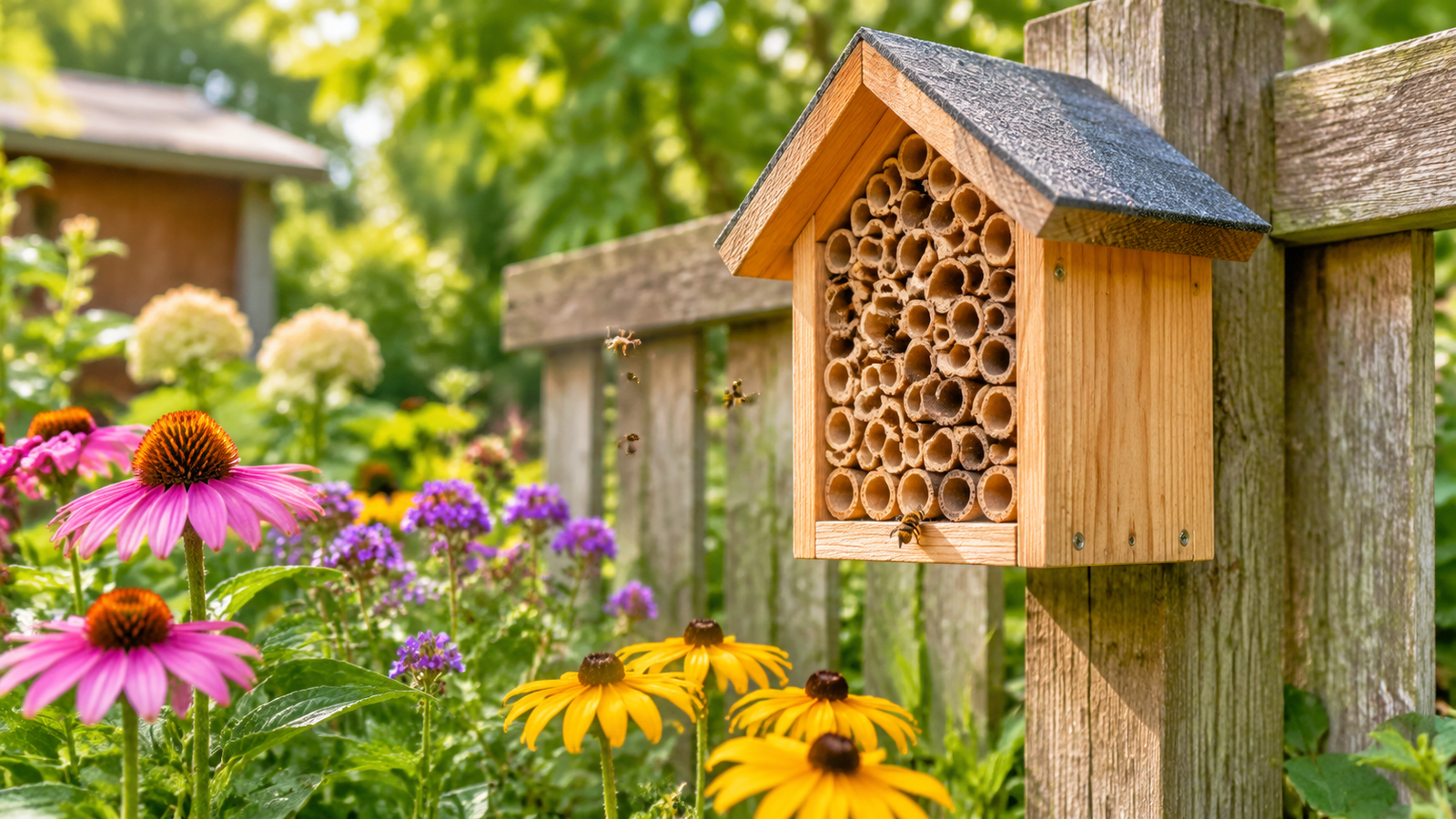
Choosing the right location for a bee house is just as important as choosing the house itself. The best place to put a bee house is a stable, sheltered position where nesting bees can access the entrance easily, find suitable nesting conditions, and reach nearby flowering plants. For many cavity-nesting solitary bees, a firmly mounted fence, wall, or garden post is a practical choice.
Ideally, choose a location that receives suitable morning sunlight, stays protected from heavy rain and strong winds, and does not become excessively hot during the afternoon. Keep the entrance clear of vegetation and avoid areas exposed to pesticides or frequent human disturbance.
However, the best location depends on the type of bee house, local climate, and bee species you want to attract. Mason bees and leafcutter bees can use artificial nesting cavities, while mining bees need suitable soil. Honey bees require a different type of nesting environment altogether.
This guide explains where to put a bee house, how high to mount it, which direction it should face, how close it should be to flowers, and which placement mistakes to avoid.
Where Is the Best Place to Put a Bee House?
The best place to put a bee house is on a secure fence, garden wall, sturdy post, or suitable sheltered building surface. Choose a position with good access to flowering plants, protection from heavy rain, and an unobstructed entrance.
For many solitary bee houses, approximately 3–6 feet (0.9–1.8 metres) above the ground is a useful starting point. An east- or southeast-facing entrance can provide morning sunlight in suitable climates, although the ideal direction depends on local temperatures and prevailing winds.
A good location should have these characteristics:
- Stable support: The house should remain firmly attached and should not swing in the wind.
- Suitable sunlight: Provide enough warmth without exposing nesting cavities to dangerous overheating.
- Weather protection: Keep rain from entering and soaking the nesting materials.
- Nearby food: Flowering plants should provide pollen and nectar throughout the active season.
- Clear entrance: Bees should be able to approach and leave without hitting vegetation or other obstacles.
- Low pesticide exposure: Avoid locations where insecticide sprays or chemical drift can reach the nesting area.
- Limited disturbance: Choose somewhere people, pets, and garden equipment will not constantly interfere with nesting activity.
For example, a wooden bee house attached to a stable garden fence near flowering herbs may be more suitable than one placed on a loose branch or directly above a frequently used doorway.
Remember that these recommendations mainly apply to cavity-nesting solitary bee houses. Ground-nesting bees need appropriate soil habitat rather than a wooden nesting box.
1. Choose a Location With Suitable Sunlight
Sunlight affects the temperature inside a bee house and can influence when nesting bees become active.
Many solitary bees use the warmth of sunlight to support their daily activity. Morning sunlight can warm nesting cavities after cooler nighttime conditions, making the site more suitable for some species.
However, more sunlight is not always better.
A nesting cavity can become considerably hotter than the surrounding air. Research discussed by North Carolina State University Extension shows that temperatures inside bee hotel nests can sometimes become substantially higher than outdoor air temperatures.
This matters because female bees can leave a nest to escape uncomfortable conditions, but developing larvae and pupae inside sealed nesting cells cannot move away from excessive heat.
Morning sunlight versus afternoon sunlight
For many conventional solitary bee houses in temperate climates, morning sunlight is a useful starting point.
It can warm the nesting area earlier in the day without necessarily exposing it to the strongest afternoon heat.
Consider the following conditions:
| Location | Potential advantage | Possible problem |
|---|---|---|
| Morning sunlight | Helps warm nesting cavities | May still become hot in warm climates |
| Afternoon sunlight | Provides additional warmth | Can cause excessive heating |
| Full-day shade | Reduces direct solar heating | May leave some nesting sites too cool |
| Morning sun with afternoon shade | Balances warmth and heat protection | Suitability still depends on species and climate |
In particularly hot climates, including tropical gardens, monitor how hot the nesting materials become rather than automatically following recommendations developed for cooler regions.
A bee house under a suitable roof overhang or in a position receiving gentle morning sunlight may be more appropriate than one exposed to intense afternoon sunshine.
Practical example: If your garden receives strong afternoon sunlight from the west, consider mounting the bee house where a building, tree canopy, or roof provides some protection during the hottest part of the day. Make sure the structure does not block the entrance or create persistent dampness.
2. How High Should You Put a Bee House?
For many solitary bee houses, a mounting height of approximately 3–6 feet (0.9–1.8 metres) above ground is a practical starting point.
This height makes the house relatively easy to observe, inspect, and maintain. It can also help keep the entrance clear of some ground-level obstructions.
However, there is no single height that every bee species requires.
The University of Nebraska–Lincoln Extension recommends placing bee hotels approximately 3–5 feet above the ground in its solitary bee hotel guidance.
Recommended mounting locations
Suitable mounting options include:
- A strong wooden fence post.
- A stable garden wall.
- The side of a shed or garden building.
- A firmly attached wooden post.
- A suitable tree trunk.
The important consideration is stability.
A bee house should not swing or move whenever the wind blows. Movement can interfere with a nesting bee’s ability to recognize and return to its nest entrance.
Why should the bee house not hang loosely?
Solitary bees use visual landmarks to recognize their nesting locations.
If a nesting structure moves repeatedly, its appearance and position may become less predictable. This can make returning to the correct entrance more difficult.
Attach the house securely using appropriate screws or mounting brackets.
Also make sure the entrance is not blocked by tall grass, leaves, branches, or nearby objects.
3. Which Direction Should a Bee House Face?
An east- or southeast-facing entrance is a common recommendation for solitary bee houses in many temperate regions.
These orientations can provide morning sunlight while reducing exposure to some intense afternoon sunlight.
However, compass direction should not be treated as a universal biological requirement.
Different bee species, climates, and weather conditions can produce different nesting preferences.
For example, research summarized by North Carolina State University Extension describes differences in bee hotel occupancy and orientation preferences between regions. Some studies in Brazil and Costa Rica found greater occupancy in shaded locations, unlike findings from certain temperate urban environments.
Comparing different orientations
| Direction | Potential characteristics |
|---|---|
| East | Receives morning sunlight |
| Southeast | Often provides a balance of morning warmth and reduced afternoon exposure |
| South | Can receive substantial sunlight, depending on location |
| Southwest | May experience strong afternoon heating |
| West | Can receive intense afternoon sunshine |
| North | Often receives less direct sunlight in some regions |
These are general patterns, not guaranteed outcomes. The actual exposure depends on the hemisphere, nearby buildings, trees, and seasonal sun angles.
What about tropical gardens?
In hot tropical environments, including parts of West Africa, a bee house should not automatically be positioned in full sun simply because some temperate-region guides recommend it.
Instead:
- Observe where morning sunlight reaches your garden.
- Check how hot the location becomes in the afternoon.
- Avoid placing nesting materials against surfaces that become extremely hot.
- Protect the entrance from prevailing rain and strong winds.
- Monitor the nesting structure after installation.
A partially sheltered position may be more appropriate in an exceptionally hot garden.
The goal is to provide suitable nesting temperatures, not simply maximize sunlight.
4. Protect the Bee House From Rain and Moisture
A bee house should be positioned where heavy rain cannot repeatedly soak its nesting materials.
Excessive moisture can encourage mold and deterioration, damage nesting materials, and create unsuitable conditions for developing bees.
This is particularly important for houses made with hollow stems, reeds, and wooden nesting blocks.
How to protect a bee house from rain
Consider these measures:
- Install the house beneath a suitable roof overhang.
- Choose a structure with a protective roof.
- Position it away from areas directly exposed to driving rain.
- Keep the entrance slightly protected from water runoff.
- Avoid locations where sprinklers regularly spray the nesting materials.
- Use durable, untreated nesting materials designed for bee nesting.
A roof should extend sufficiently beyond the entrance to reduce direct rainfall without blocking the bees’ approach.
Some small bee houses are designed with slightly downward-facing openings or drainage features to help water escape. Follow the design recommendations for the particular structure.
Avoid damp locations
Do not place a bee house:
- Directly beneath a leaking roof.
- Against a wall that remains persistently wet.
- In an area where water regularly collects.
- Beside a sprinkler that repeatedly wets the entrance.
- In dense vegetation with poor airflow and persistent moisture.
Practical example: A bee house attached to a garden shed beneath a suitable roof overhang may receive protection from rainfall while remaining accessible to nesting bees.
5. How Close Should a Bee House Be to Flowers?
A bee house should be placed reasonably close to flowering plants because nesting females need access to pollen and nectar.
Pollen provides much of the protein needed by developing bee larvae, while nectar provides an important energy source for adult bees.
However, different bee species have different foraging ranges. There is no universal maximum distance that applies to every solitary bee.
A house located near a diverse selection of flowering plants is a useful starting point.
Which flowers should be near a bee house?
Choose plants that provide accessible pollen and nectar.
Examples include:
- Lavender.
- Rosemary.
- Sunflowers.
- Clover.
- Cosmos.
- Basil flowers.
- Fruit tree blossoms.
- Suitable native wildflowers.
The best plants depend on your local climate and the bee species in your area.
Why flowering diversity matters
A garden that produces flowers for only a short period may provide food during one part of the season but leave a shortage later.
A better approach is to grow different plants that flower at different times.
| Flowering period | Garden planting examples |
|---|---|
| Early flowering | Rosemary and suitable fruit trees |
| Middle of the season | Lavender, cosmos and sunflowers |
| Later flowering | Clover and suitable late-season wildflowers |
These examples are not a universal planting calendar. Local flowering periods vary with climate and growing conditions.
Practical example: If you install a bee house on a fence near a vegetable garden, consider planting flowering herbs and other bee-friendly plants nearby. This creates a more useful habitat than providing nesting holes without a reliable food supply.
6. Should a Bee House Be Near Water or Mud?
Some nesting bees benefit from having suitable water or mud resources nearby, but the requirements differ between species.
Mason bees are particularly well known for collecting mud. They use it to construct partitions between brood cells and seal nest entrances.
Leafcutter bees behave differently. They use pieces of leaves to construct and separate their nesting cells.
Therefore, a garden that provides mud and water may benefit certain mason bees, but these resources are not equally important to every bee house visitor.
How to provide suitable mud
If you want to support mason bees:
- Maintain a small area of accessible, suitable moist soil.
- Avoid soil contaminated with pesticides or chemicals.
- Keep the area from becoming permanently flooded.
- Allow access without creating a large pool of standing water.
Should you provide a water source?
A shallow water source can be useful for some visiting bees, especially during dry weather.
However, bees can drown in deep water.
If you provide water, use a shallow dish with stones or other landing surfaces that allow insects to reach the water safely.
Do not place a water container where it will constantly soak the nesting house.
7. Choose a Sheltered Location Away From Strong Winds
Wind can affect how easily bees approach their nesting entrances and can expose loosely mounted houses to unnecessary movement.
A sheltered position near a stable fence, wall, or building can help reduce these problems.
However, shelter should not mean enclosing the bee house in a dark, damp space.
Choose a location that offers:
- A firm mounting surface.
- Protection from strong prevailing winds.
- An unobstructed flight path.
- Suitable airflow.
- Protection from driving rain.
Can you put a bee house on a tree?
Yes, provided the tree offers a suitable mounting surface.
A stable tree trunk can provide useful support and shelter.
Avoid attaching the house to a thin branch that moves excessively.
Also consider whether the tree canopy blocks too much sunlight or allows heavy rain to fall directly onto the entrance.
8. Where NOT to Put a Bee House
Choosing the wrong location can make an otherwise suitable bee house less attractive or expose developing bees to unnecessary risks.
Here are common placement mistakes.
| Poor location | Why it may be unsuitable | Better alternative |
|---|---|---|
| Directly above a hot concrete surface | Heat may increase around the nesting structure | Choose a position with more moderate exposure |
| Loose tree branch | The house may swing in the wind | Attach it securely to a trunk |
| Permanently damp corner | Moisture can encourage mold | Choose a drier, sheltered position |
| Dense vegetation | Can block the entrance | Trim obstructing growth |
| Near frequent pesticide spraying | Chemicals may expose visiting bees | Choose a pesticide-free area |
| Busy doorway | Frequent human activity can disturb nesting | Use a quieter garden location |
| Unstable balcony railing | Movement may interfere with nesting | Use a secure mounting structure |
| Beside a sprinkler | Repeated water exposure can damage nesting materials | Move it away from the sprinkler’s range |
Avoid placing a bee house where insecticides are routinely applied. Even products marketed for garden pest control can pose risks to non-target insects.
9. Where to Put Different Types of Bee Houses
Not every bee species uses the same type of nesting environment.
This is one of the most important distinctions to understand before choosing a location.
A conventional bee hotel is generally designed for selected cavity-nesting solitary bees. It is not a universal home for all bees.
Mason bees
Mason bees use suitable pre-existing cavities, such as hollow stems and artificial nesting tunnels.
They are called mason bees because many species use mud to construct partitions between their brood cells.
Suitable placement:
- Secure fence posts.
- Sheltered garden walls.
- Suitable wooden nesting blocks.
- Locations with accessible mud and flowering plants.
Leafcutter bees
Leafcutter bees use suitable nesting cavities and cut pieces of leaves to line or divide their nesting cells.
They do not generally construct their nests using mud in the same way as mason bees.
Suitable placement:
- Stable bee hotels.
- Appropriate hollow nesting tubes.
- Wooden nesting blocks with suitable cavities.
- Gardens containing appropriate flowering plants and vegetation.
Mining bees
Mining bees are ground-nesting solitary bees.
They dig tunnels in suitable soil rather than occupying conventional wooden bee hotels.
Suitable habitat:
- Areas of suitable exposed or sparsely vegetated soil.
- Well-drained ground appropriate for local species.
- Undisturbed garden spaces.
- Areas free from routine pesticide applications.
Do not cover active nesting areas with paving, heavy mulch, or frequent digging.
Bumblebees
Bumblebees are social bees that establish colonies.
Some species nest in sheltered cavities, including abandoned rodent burrows and other suitable spaces. Their nesting requirements differ from those of cavity-nesting solitary bees.
A conventional drilled-hole bee hotel is generally not appropriate for them.
Suitable habitat:
- Suitable sheltered ground-level spaces.
- Natural vegetation.
- Appropriate cavities and nesting cover.
- Gardens with a continuous supply of flowering plants.
Honey bees
Honey bees are social insects that live in colonies containing a queen, workers, and drones.
They do not normally use small solitary bee hotels.
Honey bee colonies may occupy large natural cavities, while managed colonies are kept in purpose-designed hives.
If your intention is to keep honey bees, research appropriate hive management, local regulations, colony requirements, and safe apiary placement rather than purchasing a conventional solitary bee house.
Bee nesting comparison
| Bee type | Typical nesting environment | Suitable provision |
|---|---|---|
| Mason bees | Pre-existing cavities | Appropriate tubes or nesting blocks |
| Leafcutter bees | Pre-existing cavities | Suitable nesting tunnels |
| Mining bees | Underground soil | Suitable undisturbed soil |
| Bumblebees | Sheltered cavities | Appropriate natural nesting habitat |
| Honey bees | Large cavities or managed hives | Properly designed honey bee hive |
These are general nesting patterns. Exact requirements differ among species.
10. How to Install a Bee House Correctly
Once you have selected a suitable location, installation should be straightforward.
Follow these steps.
Step 1: Choose a suitable nesting structure.
Select a bee house designed for the cavity-nesting species you want to support.
Look for suitable nesting materials, smooth entrances, closed tunnel ends, and a design that can be inspected and maintained.
Step 2: Select a stable mounting surface.
Choose a firm fence, wall, post, or suitable building structure.
Avoid loose branches and structures that move excessively.
Step 3: Check sunlight and temperature.
Observe the location throughout the day.
Look for suitable morning sunlight and protection against excessive heat.
Step 4: Protect the entrance from rainfall.
Position the house beneath suitable shelter or use a design with an effective protective roof.
Step 5: Mount it securely.
Use appropriate screws or mounting brackets to prevent movement.
Step 6: Keep the entrance clear.
Remove vegetation that blocks the nesting holes.
Make sure the bees have an unobstructed approach.
Step 7: Improve the surrounding habitat.
Plant suitable flowers and provide any additional resources required by the target species.
Step 8: Observe the house.
Watch for nesting activity without touching, opening, or repeatedly moving the structure.
A newly installed bee house may not attract occupants immediately. Local bee populations, nesting materials, season, and surrounding habitat all influence occupancy.
11. How to Tell Whether Bees Are Using Your Bee House
You can often identify nesting activity by observing the entrance holes.
Different solitary bee species use different materials to close their nesting cavities.
Signs of mason bee activity
Some mason bees use mud to divide brood cells and seal completed nesting tunnels.
You may notice individual openings becoming covered with mud plugs.
Signs of leafcutter bee activity
Leafcutter bees use cut pieces of leaves to construct their brood cells.
Some completed nesting entrances have plugs made from plant material.
Other signs of activity
Look for:
- Female bees repeatedly entering and leaving the same holes.
- Bees carrying pollen into nesting cavities.
- Mud or leaf material around nesting entrances.
- Newly completed plugs.
- Small emergence openings after developing bees have completed their life cycle.
<ins>Important:</ins> A sealed entrance does not always prove that a healthy bee is developing inside. Other insects may also occupy artificial nesting cavities.
Avoid opening sealed nesting tunnels just to check their contents.
12. How to Maintain a Bee House
Installing a bee house is only the beginning. Artificial nesting structures can accumulate parasites, predators, damaged materials, and pathogens.
Poorly maintained bee hotels may become less suitable for the insects they were designed to support.
Keep nesting materials in good condition
Check the house periodically for:
- Cracked or damaged nesting materials.
- Persistent moisture.
- Mold.
- Blocked entrances.
- Signs of predators or parasites.
- Loose mounting brackets.
Do not repeatedly handle occupied nesting tubes.
Avoid unnecessary disturbance
Once nesting activity begins, avoid moving the bee house or rearranging its nesting materials.
Solitary bees use visual landmarks to find their nests. Moving the structure while adults are foraging can confuse returning bees.
If relocation is essential, seek species-specific advice and plan the change carefully rather than moving an active nest casually.
Replace unsuitable nesting materials
Some nesting structures have replaceable tubes or removable nesting blocks.
These can make responsible inspection and maintenance easier.
Follow the manufacturer’s or an appropriate university extension’s guidance on when and how to replace or manage nesting materials.
Do not assume that every bee hotel should be completely discarded or cleaned in the same way every year.
Good maintenance depends on the species, nesting design, and life cycle.
13. Common Bee House Placement Problems and How to Fix Them
Even when a bee house is installed correctly, you may encounter problems.
The following table explains common situations and what to investigate.
| Problem | Possible explanation | Recommended action |
|---|---|---|
| No bees visit the house | Few suitable nesting bees nearby | Improve local nesting habitat and flowering resources |
| Nesting holes remain empty | Unsuitable cavity dimensions or materials | Check whether the house matches local species |
| Nesting materials become wet | Poor rain protection | Improve the roof or shelter |
| Nesting structure becomes very hot | Excessive direct sunlight | Evaluate afternoon exposure and temperature |
| Vegetation blocks entrances | Plants have grown around the house | Carefully clear the flight path |
| Mold develops | Persistent moisture or unsuitable materials | Address the moisture source and inspect the design |
| Bees visit but do not nest | They may be foraging or investigating | Observe activity and avoid assuming occupancy |
| Holes become sealed | Bees may have completed nesting cells | Monitor without opening the cavities |
What if bees never use your bee house?
Do not assume that the house has failed after a few days.
First, check whether the nesting materials are suitable for local species.
Then consider:
- Is the house securely mounted?
- Is the entrance visible and unobstructed?
- Is the nesting area excessively hot or damp?
- Are suitable flowering plants available?
- Are there cavity-nesting bee species in the surrounding area?
- Is the nesting structure exposed to pesticides?
The Natural History Museum recommends allowing time for bees to discover a new hotel and considering a different location if it remains unused.
A house that attracts no bees may also be a sign that your garden needs better natural nesting habitat rather than another artificial structure.
Frequently Asked Questions
1. Where is the best place to put a bee house?
The best place is a stable, sheltered location with suitable sunlight, protection from heavy rain, nearby flowering plants, and an unobstructed entrance. A secure garden fence, wall, or post is a good starting point for many cavity-nesting solitary bee houses.
2. Should a bee house be in the sun or shade?
It depends on the climate and bee species. Many temperate-region guides recommend morning sunlight, but excessive heat can harm developing bees inside nesting cavities. In hot climates, evaluate afternoon temperatures and consider a position with partial shade.
3. Which direction should a bee house face?
East or southeast is a common recommendation because these directions can provide morning sunlight. However, local climate, wind exposure, and species preferences may make another direction more suitable.
4. How high should a bee house be off the ground?
Approximately 3–6 feet (0.9–1.8 metres) is a practical starting range for many solitary bee houses. Secure mounting and a clear entrance are more important than achieving an exact height.
5. Can I put a bee house on a tree?
Yes. A stable tree trunk can provide a suitable mounting surface. Avoid thin branches that swing in the wind, and check that the tree canopy does not block the entrance or create excessive shade.
6. Can I put a bee house on a balcony?
Yes, provided you have a secure mounting surface, appropriate weather protection, and access to suitable flowering plants. Avoid exposed balcony positions that experience excessive heat or strong winds.
7. Should a bee house be near flowers?
Yes. Nearby flowers provide pollen and nectar for visiting bees. Choose a range of suitable flowering plants that provide food throughout the active season.
8. Should I put a bee house near water?
A shallow water source may help some visiting bees, but it should not be placed where it repeatedly wets the nesting materials. Mason bees may also benefit from access to suitable mud for constructing brood-cell partitions.
9. Can I put a bee house in full shade?
You can experiment with a shaded location, especially in hot climates or where local species prefer cooler nesting conditions. However, a permanently dark, damp location may be unsuitable for some cavity-nesting bees.
10. Why are bees not using my bee house?
Possible reasons include unsuitable nesting materials, excessive heat, persistent moisture, a lack of suitable local bee species, and insufficient nesting habitat. Check the location and house design before moving it.
11. Can I put a bee house near my front door?
It is generally better to choose a quieter location away from busy entrances and frequently used walkways. This reduces disturbance and gives nesting bees a clearer flight path.
12. Do honey bees use bee houses?
No, conventional solitary bee hotels are not designed for honey bee colonies. Honey bees require much larger nesting spaces or purpose-designed managed hives.
13. When is the best time to put up a bee house?
Ideally, install it before the local nesting season begins so that emerging or searching solitary bees can discover it. The timing depends on the climate and species in your area.
14. Should I move my bee house after bees start nesting?
Avoid moving an occupied bee house. Adult bees use familiar landmarks to return to their nesting entrances, and disturbing the structure can interfere with their navigation.
Conclusion
Knowing where to put a bee house can make a significant difference to whether suitable solitary bees use it. Choose a stable fence, wall, or garden post, provide appropriate sunlight, protect the nesting materials from heavy rain, and keep the entrance clear. Nearby flowering plants and suitable nesting resources can make the surrounding garden more attractive to local bees.
However, the best position depends on the species and climate. A location that works well in a cooler temperate garden may become excessively hot in a tropical environment. Similarly, ground-nesting bees need suitable soil rather than a wooden bee hotel, while honey bees require a different type of nesting structure.
Start with a secure, sheltered location, observe how the conditions change throughout the day, and avoid disturbing the house once nesting begins. A well-positioned and properly maintained bee house can provide valuable nesting opportunities for appropriate cavity-nesting solitary bees.
References and Further Reading
- North Carolina State University Extension – Bee Hotel Design and Placement
- University of Nebraska–Lincoln Extension – Creating a Solitary Bee Hotel
- Utah State University Extension – Making and Managing Wild Bee Hotels
- Natural History Museum – How to Make a Bee Hotel
- Oregon State University Extension – Nurturing Mason Bees in Your Backyard
- University of Florida IFAS Extension – Pollinator Hotels

2 Comments
Pingback: What Bee Nest in the Ground? Types and How to Identify Them - BeekeeperBase
Pingback: Why Do Bees Come to My House? 9 Common Reasons and What to Do - BeekeeperBase