

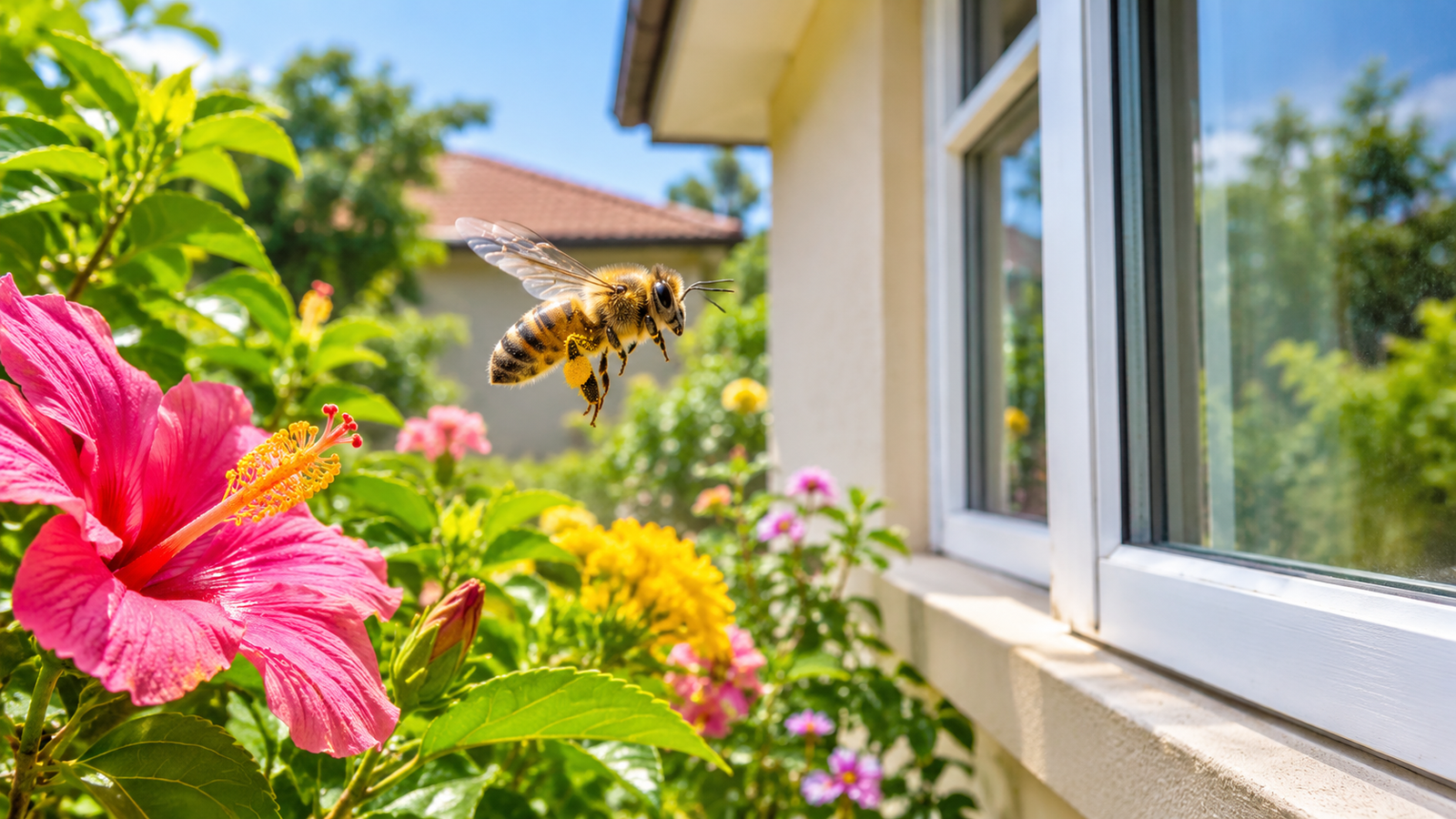
Bees come to your house because they are searching for food, water, shelter, or suitable places to build nests. Flowering plants, ripe fruit, sugary drinks, leaking taps, wooden structures, and openings in roofs or walls can all attract different types of bees. Sometimes, bees are simply passing through your garden while travelling between their colony and nearby food sources.
However, not every bee visiting your property is looking for the same thing. Honey bees may collect nectar, pollen, and water, while carpenter bees may investigate wooden structures for nesting sites. Other species, including solitary bees, may dig small tunnels in the soil around your garden.
Understanding why bees come to your house can help you decide whether they are simply visiting, searching for resources, or establishing a nest. This guide explains nine common reasons bees visit residential properties, how to identify their behaviour, and what you can do to manage unwanted activity without unnecessarily harming beneficial pollinators.
Why Do Bees Come to My House?
Bees usually visit houses because they find something useful in the surrounding environment. Your property may provide flowering plants, sugary food, accessible water, sheltered nesting spaces, or suitable materials for building nests.
The nine most common reasons include:
- Your garden has flowers that provide nectar and pollen.
- Sweet foods, ripe fruit, and sugary spills attract foraging bees.
- Your property provides accessible water.
- Bees are searching for suitable nesting locations.
- Gaps in your roof, walls, and windows provide potential shelter.
- Nearby colonies and flowering trees increase bee activity.
- A honey bee swarm may be temporarily gathering nearby.
- Wooden structures may attract carpenter bees.
- Seasonal changes affect local bee activity and resource availability.
The important distinction is whether bees are visiting your property to collect resources or repeatedly using a particular location as a nesting site.
1. Your House Has Flowers That Attract Bees
One of the most common reasons bees come to your house is the presence of flowering plants.
Bees depend on flowers for two important food resources: nectar and pollen. Although they collect both from flowers, these resources serve different nutritional purposes.
- Nectar: Provides sugars that give bees energy for flying and other activities. Honey bees process and store much of the collected nectar as honey.
- Pollen: Supplies protein, fats, vitamins, and minerals needed for bee development and colony nutrition.
When flowers produce abundant nectar and pollen, bees may visit them repeatedly throughout the day.
Plants that can attract bees include:
- Sunflowers
- Cosmos
- Lavender
- Clover
- Basil flowers
- Pumpkin and squash flowers
- Mango and other fruit tree blossoms
- Other nectar-producing garden plants
For example, if you have flowering basil or sunflowers near your front entrance, you may notice honey bees visiting the flowers throughout the morning. They are not necessarily attracted to your house itself. They are collecting food from the plants growing around it.
The same thing can happen when mango, citrus, or other fruit trees begin flowering.
Why do bees visit the same flowers repeatedly?
Honey bees can develop consistent foraging patterns. When a bee discovers a productive source of nectar or pollen, it may return to that location repeatedly while the flowers remain rewarding.
Other worker bees may also be recruited to productive food sources through communication within the colony.
This explains why you may notice increasing bee activity around one flowering plant even when other parts of your garden receive little attention.
What should you do?
You generally do not need to remove flowering plants simply because bees visit them. Their presence usually indicates that your garden is providing useful food for pollinators.
If bees are gathering around a doorway or outdoor seating area, consider moving frequently flowering container plants farther from those locations.
Avoid spraying flowering plants with insecticides simply to discourage visiting bees.
2. Bees Are Attracted to Sweet Foods and Sugary Spills
Another reason bees come to your house is the availability of exposed sugary substances.
Honey bees are particularly likely to investigate accessible sweet liquids and food residues when they encounter them outside their usual flower-foraging activities.
Possible attractants include:
- Ripe or overripe fruits
- Exposed fruit juice
- Sweetened drinks
- Sugar syrup
- Honey
- Jam
- Sticky food residues
- Spilled sugary beverages around outdoor tables
For example, imagine cutting a ripe mango or pineapple and leaving the pieces uncovered on a table outside. As the fruit becomes exposed and releases juice, honey bees may investigate the sugary material.
You may also notice bees around an outdoor drink after sweetened juice or soft drinks have been spilled.
This behaviour is different from ordinary flower visiting. Instead of collecting nectar directly from a flower, the bees are accessing another available source of sugar.
However, not every bee species regularly scavenges sugary food. Many solitary bee species obtain their food primarily from flowers.
How to reduce food-related visits
You can make your outdoor space less attractive to bees searching for exposed sugary food by:
- Covering fruit and sweet drinks when eating outside.
- Cleaning juice and sugary spills immediately.
- Keeping rubbish bins properly closed.
- Storing ripe fruit in covered containers.
- Cleaning outdoor tables after meals.
- Avoiding uncovered containers of honey or sugar syrup.
These steps reduce unnecessary food-related visits without requiring you to kill bees.
3. Your House Provides Water for Bees
Water is another important reason honey bees visit residential properties.
Honey bee colonies need water for several biological functions, including cooling the nest and diluting stored food when necessary.
During hot weather, worker bees collect water and distribute it within the colony. Other workers help cool the nest by fanning their wings, encouraging evaporation.
This process helps regulate the temperature inside the colony, particularly around developing brood.
Research published in the Journal of Experimental Biology found that honey bee colonies can rapidly increase water collection when brood-nest temperatures become too high.
Where do bees find water around houses?
Bees may collect water from:
- Bird baths
- Leaking outdoor taps
- Garden fountains
- Swimming pools
- Puddles
- Wet soil
- Plant containers
- Drainage outlets
- Water bowls left outdoors
For example, if you notice several honey bees repeatedly landing around a leaking outdoor tap, they may be collecting the water rather than searching for food.
Some bees also collect water from damp soil or other sources containing dissolved minerals.
Why do bees collect more water during hot weather?
When temperatures rise, honey bee colonies may need more water to regulate internal temperatures.
If the surrounding environment becomes hot and dry, bees may repeatedly visit the few reliable water sources available.
This can explain why bees suddenly begin gathering around your water container, tap, or swimming pool.
What should you do?
If you do not want bees gathering around a particular location:
- Repair leaking taps.
- Remove unnecessary standing water.
- Keep water containers covered when they are not needed.
- Maintain swimming pool covers where appropriate.
- Keep outdoor drainage areas clean.
If you want to provide water for pollinators, use a shallow container with stones or other stable landing surfaces. Make sure bees can reach the water without falling into a deep container.
Place the water source away from busy entrances and outdoor seating areas.
4. Bees May Be Looking for a Place to Build a Nest
Sometimes, bees come to your house because they are investigating possible nesting locations.
Different bee species have different nesting requirements. Some live in large colonies, while others nest individually or in small groups.
Your property may provide suitable nesting opportunities through hollow trees, roof spaces, wall cavities, exposed soil, or wooden structures.
Where do different bees build their nests?
Honey bees
Honey bees (Apis mellifera) are social insects that live in colonies. A colony may establish a nest in a hollow tree, wall cavity, roof space, or another protected opening large enough to accommodate its combs and population.
Bumble bees
Bumble bees belong to the genus Bombus. Depending on the species, queens may establish colonies in abandoned rodent burrows, sheltered cavities, or other protected locations.
Carpenter bees
Carpenter bees belong to the genus Xylocopa. Females excavate tunnels in suitable wood and create chambers for their developing offspring.
Solitary ground-nesting bees
Many solitary bees dig individual nesting tunnels in well-drained soil. They may use bare ground, sandy patches, garden slopes, or areas with limited vegetation.
Some species nest close to one another, even though each female maintains her own nest.
Does a bee hovering around your roof mean it is building a nest?
Not necessarily.
A bee flying around a roof, wall, or window may simply be exploring the area or passing through while searching for food.
However, repeated entry and exit from the same opening is more suggestive of nesting activity.
Signs that bees may be nesting around your house
Look for these clues from a safe distance:
- Bees repeatedly entering and leaving one opening.
- Consistent flight activity around the same roof gap.
- Several bees appearing indoors near the same location.
- Repeated activity around a round hole in wooden structures.
- Bees flying close to a particular patch of bare soil.
- A large cluster of bees gathering around a sheltered outdoor location.
These signs can help you identify possible nesting activity, but they do not always confirm the species or prove that a colony has become established.
If you suspect bees are nesting inside your home, arrange an inspection with a qualified local beekeeper or bee-removal professional.
Never block an active nest entrance or spray chemicals into a suspected colony.
5. Your House Has Gaps, Cracks, or Protected Spaces
Bees may investigate openings around your property because some of these spaces can provide protection from rain, wind, excessive heat, and predators.
Potential locations include:
- Gaps underneath roof edges.
- Openings around pipes.
- Cracks in exterior walls.
- Spaces behind exterior cladding.
- Gaps around window frames.
- Uncovered vents.
- Openings around roof structures.
- Hollow sections of exterior walls.
However, it is important to distinguish between a bee investigating an opening and an established colony living inside it.
For example, one bee hovering near a roof edge may be exploring the structure. A steady stream of bees repeatedly entering and leaving the same opening is a stronger indication of possible nesting activity.
Why can roof spaces and wall cavities attract honey bees?
Honey bees need a protected cavity where they can construct wax comb, store food, raise young, and maintain their colony.
A suitable cavity can provide protection from environmental conditions and reduce exposure to predators.
Unfortunately, the spaces inside roofs and walls can sometimes provide these conditions.
How can you prevent bees from nesting in structural openings?
Inspect your property periodically for:
- Damaged window screens.
- Uncovered openings around vents.
- Gaps around pipes.
- Damaged roof edges.
- Unused openings in exterior walls.
- Other potential entry points.
Repair suitable openings before they become occupied.
Important: If bees are already entering a particular opening, do not seal it immediately. Blocking an active entrance may trap bees inside the structure and complicate removal.
An established honey bee colony may require professional extraction, including appropriate handling of comb, honey, and damaged materials.
6. Bees Are Visiting Because of Nearby Hives or Flowering Trees
Your house may attract bees even when you do not have flowers, fruit, or water in your immediate surroundings.
The reason may be a nearby bee colony or a productive flowering area elsewhere in your neighbourhood.
Honey bees travel away from their nests to collect nectar, pollen, and water. Consequently, the bees visiting your property may belong to a colony located some distance away.
Why might nearby colonies increase bee activity around your house?
A nearby colony may have workers actively searching for:
- Flowering trees.
- Garden plants.
- Fruit blossoms.
- Water sources.
- Other productive food sources.
For example, if several mango trees in your neighbourhood begin flowering, you may notice more bees flying through nearby gardens and residential compounds.
The bees are following available food rather than necessarily looking for a new home.
Can you identify where the bees are coming from?
Sometimes, bees appear to travel repeatedly in the same direction.
This may suggest that they are following a route between their colony and a food or water source.
However, observing their flight direction alone cannot reliably identify the exact location of their hive.
What should you do?
If bees are simply visiting flowers or passing through your garden, there may be no reason to intervene.
Focus on managing specific attractants only when they create a practical problem around your home.
7. A Honey Bee Colony May Be Swarming Nearby
A sudden increase in bee activity around your property may be caused by honey bee swarming.
Swarming is a natural form of colony reproduction. It happens when a honey bee colony divides and part of the population leaves with the old queen to establish another colony.
The departing swarm contains the queen and many worker bees.
Why do honey bees swarm?
As a colony develops, its population may increase and available nesting space may become limited.
Under suitable conditions, the colony raises replacement queens and prepares to divide.
The old queen eventually leaves with a large group of workers.
The swarm may temporarily gather on a tree branch, fence, wall, or another outdoor object while scout bees search for a suitable permanent nesting location.
What does a honey bee swarm look like?
A typical swarm may appear as:
- A dense cluster of bees hanging from a branch.
- A large group of bees gathered around a tree trunk.
- A temporary mass of bees attached to a fence or sheltered structure.
- Hundreds or sometimes thousands of bees clustered close together.
The cluster may change shape depending on the surface where the bees gather.
A swarm resting on a tree branch is different from a colony that has already established itself inside a wall or roof.
Are swarming bees dangerous?
Swarming bees are often less defensive than an established colony because they do not have a permanent nest containing brood and stored resources to protect.
However, they can still sting, and their behaviour should never be tested.
Do not assume a swarm is harmless simply because it is clustered together.
What should you do if bees swarm near your house?
- Keep children and pets away.
- Avoid touching or disturbing the cluster.
- Do not throw stones or objects at the bees.
- Do not spray the swarm with pesticides or water.
- Do not attempt to collect the bees yourself.
- Contact a local beekeeper or qualified swarm-removal professional.
A temporary swarm may move on after scout bees identify a suitable nesting location.
However, if bees begin repeatedly entering a roof or wall opening, arrange a professional assessment because they may be establishing a permanent colony.
8. Your Wooden Structures May Attract Carpenter Bees
If you frequently notice large bees hovering around your wooden fence, roof, pergola, deck, or outdoor furniture, carpenter bees may be responsible.
Carpenter bees belong to the genus Xylocopa. Unlike honey bees, which build wax comb inside a cavity, female carpenter bees excavate tunnels directly into suitable wood.
They use these tunnels to create nesting galleries where they lay eggs and provide food for their developing offspring.
Do carpenter bees eat wood?
No. Carpenter bees do not eat wood.
They obtain food from flowers, including nectar and pollen. They excavate wood to create protected nesting spaces.
This distinction is important because carpenter bee activity can be mistaken for termite damage.
How can you identify carpenter bee activity?
Look for the following signs:
- Large, robust bees hovering around wooden surfaces.
- Neat, circular openings in exposed timber.
- Bees repeatedly entering the same hole.
- Fine wood debris beneath an entrance.
- Staining below an active nesting opening in some cases.
Some carpenter bee species have a shiny, relatively hairless abdomen, while bumble bees generally have a hairy abdomen.
This can help with identification, although appearance varies between species.
Why do carpenter bees hover around people?
In some carpenter bee species, males defend territories around nesting locations and may fly close to people or other moving objects.
Their large size and loud buzzing can appear threatening.
However, males do not have stingers. Females can sting but generally do not sting unless handled or threatened.
How can you manage carpenter bees?
- Inspect exposed timber for nesting holes.
- Maintain and protect untreated wooden surfaces.
- Use suitable exterior paint or protective finishes.
- Repair damaged timber after confirming nesting activity has been addressed.
- Seek professional advice if numerous galleries are present or structural wood is affected.
Carpenter bees are also pollinators, so avoid unnecessary destruction of nests.
9. Seasonal Changes May Bring More Bees to Your House
Bee activity changes according to the availability of food, water, suitable nesting locations, and favourable weather.
You may notice more bees during certain periods even though you have not changed anything around your property.
How does weather affect bee activity?
Warm, suitable flying conditions can increase the number of bees visiting flowers.
Rainfall can also influence flowering patterns, plant growth, and the availability of water.
When many plants begin flowering, bees may have more opportunities to collect nectar and pollen.
During hot or dry periods, honey bees may concentrate their water-collection activities around the remaining accessible water sources.
What about bee activity in tropical countries such as Ghana?
In tropical environments, bee activity should not always be explained using the traditional four-season calendar.
Rainfall patterns, dry periods, local flowering cycles, temperature, and the availability of water can all influence when and where bees forage.
For example, if several fruit trees begin flowering after favourable rainfall, bees may become more noticeable around residential gardens.
During dry periods, you may notice increased visits to leaking taps, pools, and other reliable water sources.
The exact timing varies by location, plant species, and local environmental conditions.
What should you do?
Observe whether the increased activity is associated with flowering plants, water sources, or a possible nesting location.
If bees are simply responding to seasonal resources, you may not need to take any action.
If they are repeatedly entering your home or establishing a colony in a building, arrange a professional inspection.
How to Identify the Bees Coming to Your House
Not every bee visiting your property is a honey bee. Identifying the type of bee can help you understand why it is there and what action is appropriate.
Here is a practical comparison:
| Type of bee | Common appearance or behaviour | Possible nesting location |
|---|---|---|
| Honey bee | Usually smaller and slender, often visiting flowers or collecting water | Hollow trees, roof spaces, wall cavities |
| Carpenter bee | Large, robust, sometimes with a shiny abdomen; may hover around timber | Wooden structures and branches |
| Bumble bee | Fuzzy body, often relatively large, visits flowers | Burrows and protected cavities |
| Solitary ground-nesting bee | Often small to medium-sized; may fly close to bare soil | Individual tunnels in the ground |
These are general clues rather than definitive identification rules. Species differ in size, colour, behaviour, and nesting preferences.
How to tell whether bees are visiting or nesting
| What you observe | What it may indicate |
|---|---|
| One or two bees visiting flowers | Normal foraging |
| Bees repeatedly visiting ripe fruit | Access to sugary food |
| Several bees drinking from one source | Water collection |
| Bees flying around a roof without entering | Exploration or passing activity |
| Repeated entry and exit through one opening | Possible established nest |
| A dense cluster hanging from a branch | Possible honey bee swarm |
| Large bees repeatedly entering round holes in wood | Possible carpenter bee nesting |
| Small bees flying around holes in bare soil | Possible ground-nesting bees |
Remember: The behaviour of the bees is often more useful than simply counting how many you see.
Why Do Bees Keep Coming Back to My House?
If bees repeatedly return to your property, they may have discovered a reliable source of food, water, or shelter.
Honey bees can develop consistent foraging routes and revisit productive resources.
For example, a group of bees may return to your garden every morning because a flowering plant continues producing nectar.
Other bees may repeatedly visit a leaking tap because it provides a convenient water source.
However, repeated activity around one structural opening may indicate something different.
Common reasons bees keep returning
1. A reliable food source
Flowering plants, exposed fruit, and sugary spills may encourage repeated visits.
2. A regular water source
Bees may revisit leaking taps, bird baths, pools, and damp ground.
3. A familiar foraging route
Some bees repeatedly travel between a productive resource and their colony.
4. A suitable nesting location
Bees may repeatedly investigate the same wall opening, roof cavity, or wooden structure.
5. A previously occupied nesting cavity
An old honey bee nest may leave behind comb and other materials. These remnants can attract renewed interest from bees and may create additional problems if not properly addressed.
How can you tell why bees keep returning?
Observe their behaviour from a safe distance.
- If they visit flowers and leave, they are probably foraging.
- If they repeatedly collect water, the source may be attracting them.
- If they enter and leave the same opening, investigate the possibility of nesting.
- If they gather in a dense cluster, they may be swarming.
Repeated visits alone do not confirm that a hive is present.
Why Do Bees Come to My Window or Door?
Bees near windows and doors can have several explanations.
1. Nearby flowers attract them
Flowering plants beside windows, balconies, and entrances can bring bees close to your home.
2. They may be following a foraging route
A bee travelling between its colony and a food source may pass your windows or entrance regularly.
3. They may be encountering glass
Transparent and reflective surfaces can affect how insects navigate around buildings. A bee repeatedly approaching a window does not necessarily mean it is trying to enter your home.
4. They may be investigating a sheltered opening
Small gaps around window frames, roof edges, and door structures may attract bees exploring possible nesting locations.
What should you do?
Keep window screens in good condition and close doors when practical.
If a bee enters through an open window, avoid swatting at it. Give it a safe opportunity to leave through an accessible exterior opening.
If multiple bees repeatedly appear around the same window or door frame, investigate whether there is an opening connected to a possible nest.
Why Are Bees Getting Inside My House?
Finding a bee indoors does not automatically mean you have a hive inside your home.
A single bee may enter through an open door, window, or damaged screen while searching for food or following a flight route.
However, repeated appearances in the same room or around the same ceiling area deserve more attention.
Common ways bees enter houses
- Open windows and doors.
- Damaged window screens.
- Gaps around pipes.
- Openings near roof edges.
- Wall cavities connected to indoor spaces.
- Gaps around vents or exterior structures.
How to investigate safely
- Observe where the bees appear.
- Check whether they are entering through an open window or door.
- Look for repeated flight activity near exterior openings.
- Avoid opening wall cavities or roof panels yourself.
- Contact a qualified professional if repeated activity suggests a colony inside the building.
Buzzing sounds near a ceiling may raise suspicion, but sound alone cannot confirm the presence of a hive.
Do not climb onto a roof or enter a confined space to investigate bees.
If a single bee is inside your room, keep your distance, open an accessible exterior exit if safe, and allow it an opportunity to fly outside.
People with a known severe bee-sting allergy should avoid approaching the insect and seek assistance.
What Does It Mean When a Bee Comes Into Your House?
A bee entering your house does not have a scientifically established universal spiritual meaning or predict a particular event.
Some cultures associate bees with prosperity, productivity, good fortune, or other symbolic meanings. These interpretations vary between traditions and are matters of belief rather than established biological facts.
From a biological perspective, a bee indoors is usually there because it has entered accidentally, encountered a possible food source, or found an opening while exploring its surroundings.
If a bee enters your home:
- Stay calm.
- Keep your distance.
- Open an accessible exterior window or door if safe.
- Allow the bee an opportunity to fly outside.
- Avoid grabbing, crushing, or provoking it.
If several bees keep appearing indoors, investigate the possibility of an entry point or nearby colony.
Are Bees Coming to My House Dangerous?
Most bees are focused on collecting food, water, or finding suitable nesting locations. They do not normally seek to sting people without a reason.
However, bees can sting when threatened, handled, trapped, or disturbed near a nest.
The risk depends on several factors, including the species, number of bees, proximity to a colony, and whether anyone has a sting allergy.
When should you be concerned?
| Situation | Appropriate response |
|---|---|
| One bee visiting a flower | Usually no action needed |
| A few bees around fruit | Remove exposed food and clean spills |
| Bees drinking from a puddle | Manage the water source if necessary |
| Bees repeatedly entering a wall | Arrange professional inspection |
| A large swarm on a branch | Keep away and contact a beekeeper |
| Several bees appearing indoors | Investigate possible entry points safely |
| Bees becoming defensive near a nest | Move away and seek professional help |
What should you do if a bee stings you?
If you are stung:
- Move away from the bee and any nearby colony.
- If a stinger remains in the skin, remove it promptly.
- Wash the affected area with soap and water.
- Apply a cold compress wrapped in a cloth to reduce pain and swelling.
- Avoid scratching the affected area.
Honey bees may leave a barbed stinger in human skin, while other bee species generally do not leave one behind.
When is a bee sting a medical emergency?
A severe allergic reaction, known as anaphylaxis, can develop quickly after an insect sting.
Warning signs include:
- Difficulty breathing.
- Swelling of the tongue or throat.
- Difficulty swallowing.
- Wheezing or a tight throat.
- Sudden dizziness or fainting.
- Severe confusion or collapse.
Seek emergency medical assistance immediately if these symptoms occur. Use prescribed epinephrine if available and do not delay emergency care.
Multiple stings, especially in children or vulnerable individuals, also warrant prompt medical assessment.
How to Keep Bees Away From Your House Without Killing Them
The best way to reduce unwanted bee activity is to understand what is attracting the bees and address that specific cause.
You do not need to eliminate every flowering plant or destroy beneficial pollinators.
1. Remove exposed sugary foods
Keep fruit, sweet drinks, and outdoor food covered.
Clean sticky spills and food residues promptly.
2. Manage unnecessary water sources
Repair leaking taps and remove unwanted standing water.
If you maintain a pollinator water source, keep it clean and provide stones or other safe landing surfaces.
3. Maintain window and door screens
Repair damaged screens and close doors when practical.
This reduces accidental entry into indoor spaces.
4. Maintain your roof and exterior walls
Inspect roof edges, vents, exterior walls, and other structural openings.
Repair suitable gaps before they become occupied.
Never seal an opening while bees are actively entering or leaving it.
5. Maintain exposed wooden structures
Carpenter bees may investigate untreated or weathered timber.
Use appropriate protective finishes on exposed wood and repair damaged structures after confirming that any nesting activity has been safely addressed.
6. Avoid unnecessary pesticides
Do not spray bees simply because they visit your garden.
Unnecessary pesticide use can harm pollinators and other beneficial insects.
7. Get professional assistance for established nests
If honey bees have established a colony inside your roof, wall, or another part of your home, contact an experienced local beekeeper or qualified bee-removal professional.
The appropriate method depends on the species, location, accessibility, and condition of the nest.
8. Address old nesting cavities properly
After an established colony has been removed, the cavity may need inspection, appropriate cleaning, repair, and sealing.
Old comb and honey left inside a building can attract other insects and create problems such as leaking honey, odours, and secondary pest activity.
This work should be completed safely and only after the colony has been properly addressed.
Frequently Asked Questions About Bees Coming to Your House
Why do bees suddenly appear around my house?
Bees may suddenly appear because nearby flowers have started blooming, fruit has ripened, a water source has become available, or a nearby colony is more active. A temporary swarm or newly established nesting site may also explain a sudden increase in activity.
Why do bees come to my house every day?
Daily visits usually mean that your property provides a reliable resource, such as flowers, water, or sugary food. Bees may repeatedly return to productive food sources or follow familiar routes between their colony and the resources they collect.
Why are bees attracted to my house when I have no flowers?
Your property may still provide water, exposed sweet foods, fruit, or suitable nesting cavities. Bees may also be visiting plants outside your immediate property or simply passing through your neighbourhood.
Why do bees keep flying around my roof?
Bees may be exploring roof openings, searching for shelter, or passing between a nearby colony and a food source. If they repeatedly enter and leave the same roof gap, an established nest may be present.
Does one bee mean there is a hive nearby?
No. A single bee can travel to your property from a distant colony. One bee is not enough evidence to conclude that a hive is nearby or inside your home.
Why are bees attracted to my balcony?
Bees may visit flowering balcony plants, potted herbs, exposed fruit, sweet drinks, or water containers. They may also investigate sheltered gaps in balcony structures.
Will bees go away on their own?
Bees that are simply foraging often leave when a food or water source is no longer attractive. A temporary honey bee swarm may also move on after finding a suitable nesting location. However, an established colony may remain inside a suitable cavity and require professional attention.
Should I kill bees that come into my house?
No. You should not kill bees simply because they visit your property. A single bee can often be guided outside safely. If you suspect an established nest, seek professional assistance rather than spraying chemicals or disturbing the colony.
Why are bees gathering around my water tap?
Honey bees collect water for their colonies. They may use it for cooling the nest and other colony functions. A leaking tap can provide a convenient and reliable water source, especially during hot or dry weather.
Are bees nesting in my walls or just visiting?
Bees repeatedly entering and leaving the same opening may indicate nesting activity. Occasional visits or hovering around a wall do not prove that a colony is established. Observe from a safe distance and arrange a professional inspection if the activity continues.
Conclusion: Why Do Bees Come to My House?
Bees come to your house mainly because they are searching for food, water, shelter, or suitable nesting locations.
Flowering plants, exposed fruit, sugary drinks, leaking taps, wooden structures, and openings in roofs or walls can all contribute to bee activity.
However, the most important thing is to understand what the bees are actually doing.
If they are visiting flowers or collecting water, they are probably foraging. If a large group gathers temporarily on a branch, it may be a honey bee swarm. If bees repeatedly enter the same roof or wall opening, an established colony may be present.
Identifying the type of bee and observing its behaviour will help you choose the right response.
By keeping food areas clean, managing unnecessary water sources, maintaining your property, and seeking professional help when necessary, you can reduce unwanted bee activity without unnecessarily harming beneficial pollinators.
Bees visiting your house are not always a problem. In many cases, they are simply collecting the resources they need to survive.
References and Further Reading
The following scientific and educational resources provide additional information about bee behaviour, nesting, water collection, and sting safety.
- Ostwald, M. M., Smith, M. L., and Seeley, T. D. (2016). The behavioral regulation of thirst, water collection and water storage in honey bee colonies. Journal of Experimental Biology. https://doi.org/10.1242/jeb.139824
- University of Florida IFAS Extension. The Benefits of Pollen to Honey Bees. https://ask.ifas.ufl.edu/publication/IN868
- Cornell University Integrated Pest Management. Carpenter Bees. https://cals.cornell.edu/integrated-pest-management/outreach-education/whats-bugging-you/bees-and-wasps/identifying-bees-and-wasps/carpenter-bees
- University of Maryland Extension. Carpenter Bees. https://extension.umd.edu/resource/carpenter-bees
- University of Georgia Cooperative Extension. Honey Bee Swarms and Bees in Walls. https://extension.uga.edu/publications/detail.html?number=C824
- University of California Statewide Integrated Pest Management Program. Removing Honey Bee Swarms and Established Hives. https://ipm.ucanr.edu/home-and-landscape/removing-honey-bee-swarms-and-established-hives/
- Xerces Society. Farming for Bees: Guidelines for Providing Native Bee Habitat on Farms. https://xerces.org/publications/guidelines/farming-for-bees
- NHS. Insect Bites and Stings. https://www.nhs.uk/conditions/insect-bites-and-stings/
