

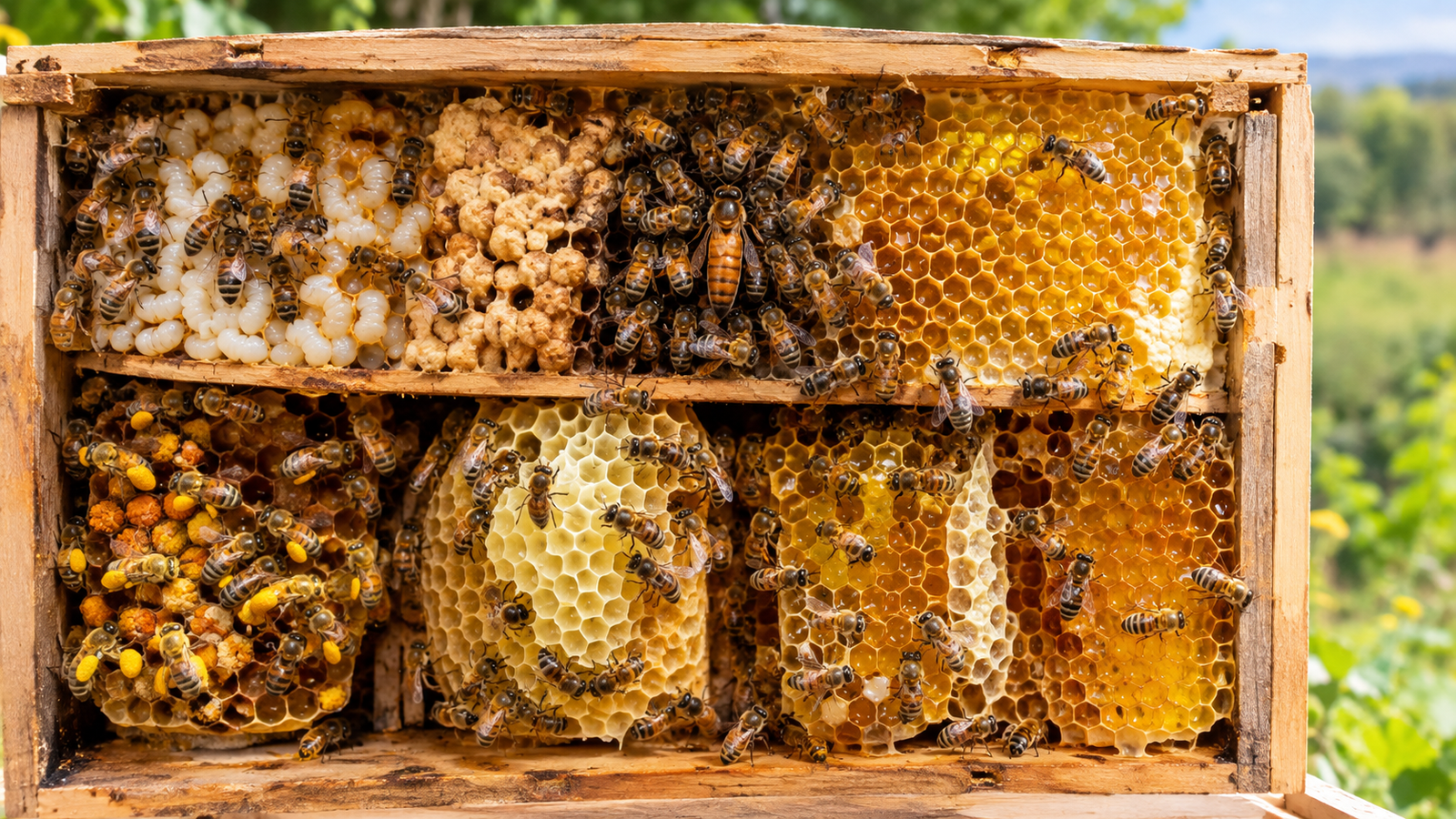
Honey bees perform many different jobs inside a hive to keep the colony alive, healthy, and productive. They care for young bees, feed the queen, build and repair honeycomb, process nectar into honey, store pollen, clean the hive, regulate temperature, guard the entrance, and prepare food for periods when flowers are unavailable.
These jobs are mainly performed by worker bees, and the tasks a worker performs can change as she ages and according to what the colony needs. The queen’s main role is reproduction, while drones primarily mate with queens.
A honey bee hive is therefore a highly organized colony in which thousands of bees cooperate and divide the work needed for survival.
What Do Honey Bees Do in a Hive?
Inside a hive, honey bees perform a wide range of jobs. These include:
- Caring for eggs and larvae
- Feeding developing bees
- Feeding and grooming the queen
- Producing beeswax
- Building and repairing honeycomb
- Receiving nectar from returning foragers
- Processing nectar into honey
- Storing honey
- Collecting and storing pollen
- Cleaning cells
- Removing dead bees and debris
- Ventilating the hive
- Controlling temperature and humidity
- Guarding the entrance
- Protecting the colony from threats
- Communicating information about food sources
- Preparing the colony for periods of food shortage
Not every bee performs every job. Honey bees have a flexible division of labor that allows the colony to respond to its changing needs.
What Are the Different Types of Honey Bees in a Hive?
A normal honey bee colony has three types of bees:
- Queen bee
- Worker bees
- Drones
Each has a different primary role.
Queen Bee
The queen is the colony’s primary reproductive female. Her main job is to lay eggs that develop into new members of the colony.
She also produces pheromones that influence the behavior and organization of the colony.
Although the queen is essential to reproduction, she does not perform most of the daily maintenance jobs carried out by worker bees.
Worker Bees
Worker bees are female bees that perform most of the work required to maintain the colony.
They clean the hive, care for developing bees, feed the queen, produce wax, construct honeycomb, process nectar, store food, regulate the hive environment, guard the entrance, and eventually forage outside the hive.
Worker bees are therefore responsible for the majority of activities that people associate with life inside a honey bee hive.
Drones
Drones are male honey bees.
Their primary biological role is to mate with queens from other colonies. Unlike worker bees, drones do not normally collect nectar, produce wax, care for larvae, or guard the hive.
What Do Worker Bees Do Inside the Hive?
Worker bees perform numerous jobs, and their responsibilities can change throughout their lives.
Important worker-bee jobs include:
1. Cleaning the Hive
Young worker bees help keep the hive clean.
They clean empty cells so they can be used again for eggs, larvae, honey, or pollen. Good hive hygiene helps maintain a healthy environment for the colony.
2. Caring for Eggs and Larvae
Worker bees care for developing young bees, collectively known as brood.
They feed larvae with appropriate food and maintain the brood area so developing bees have suitable conditions.
This nursing work is essential because the queen lays eggs, but worker bees are responsible for raising the resulting young.
3. Feeding and Caring for the Queen
Worker bees surround and attend to the queen.
They feed and groom her and maintain close contact with her. The queen’s pheromones are distributed throughout the colony partly through these interactions.
4. Producing Beeswax
Worker bees have wax-producing glands that become increasingly developed as they mature.
They produce small flakes of beeswax and use the material to construct honeycomb.
5. Building Honeycomb
Beeswax is shaped into the familiar hexagonal cells that make up the honeycomb.
These cells provide space for:
- Eggs and developing larvae
- Honey
- Pollen
- Other colony activities
Worker bees can also repair damaged comb and extend the nest when the colony requires more space.
6. Receiving Nectar
Foraging bees collect nectar outside the hive and return with it.
Other worker bees receive the nectar from the returning foragers and begin processing it.
This division of labor allows some bees to specialize in gathering resources while others handle them inside the hive.
7. Turning Nectar Into Honey
Worker bees process nectar using enzymes and other actions that change its composition.
The nectar is placed into honeycomb cells, where bees fan their wings to help remove excess water.
As the water content decreases, the nectar becomes concentrated into honey.
When the honey is sufficiently prepared for storage, worker bees seal the cell with beeswax.
8. Storing Honey
Honey is stored in honeycomb cells as an energy-rich food reserve.
The colony can use this stored food when fresh nectar is unavailable, including during cold weather or periods when few flowers are producing nectar.
9. Receiving and Storing Pollen
Foraging bees also bring pollen back to the hive.
Worker bees receive the pollen and pack it into cells for storage.
Pollen provides important nutrients, particularly protein, that are needed by the colony and developing bees.
Stored pollen may be mixed with nectar and other substances and is commonly referred to as bee bread.
10. Capping Honeycomb Cells
Once honey has been sufficiently processed and is ready for storage, worker bees cover the cell with a thin layer of beeswax.
This is called capping.
The wax capping helps protect the stored honey from exposure to the surrounding environment.
11. Removing Waste and Dead Bees
Worker bees also remove unwanted material from the colony.
They can carry dead bees, debris, and other waste out of the hive.
Some workers also remove unhealthy brood as part of the colony’s hygienic behavior.
12. Ventilating the Hive
Bees actively control airflow within the hive.
Worker bees can fan their wings to move air through the colony. This helps with ventilation and also assists with the evaporation of water from nectar during honey production.
13. Controlling Hive Temperature
Honey bees work together to maintain suitable temperatures inside the colony.
When the hive becomes too warm, bees can increase ventilation and use evaporative cooling.
When temperatures fall, bees cluster together and generate heat through muscle activity.
Maintaining appropriate conditions is especially important for developing brood.
14. Guarding the Hive
Some worker bees act as guard bees near the hive entrance.
They inspect incoming bees and may respond to unfamiliar insects or potential threats.
If the colony is threatened, bees can release alarm pheromones that help recruit other workers for defense.
15. Foraging
Older worker bees often leave the hive to collect resources.
They may forage for:
- Nectar
- Pollen
- Water
- Plant materials
Foragers return to the colony and transfer resources to other workers or place them where they can be stored.
Do Worker Bees Change Jobs as They Age?
Yes. Worker bees do not necessarily perform the same job throughout their lives.
A worker bee typically begins life performing tasks inside the hive. As she becomes older, her responsibilities can shift toward jobs that take her outside the colony.
This general pattern is known as age-related division of labor.
Younger workers may spend more time:
- Cleaning cells
- Caring for brood
- Feeding other bees
- Attending the queen
As they mature, workers may begin:
- Producing wax
- Building comb
- Processing and storing food
- Guarding the entrance
Older workers commonly become foragers.
However, this system is flexible. A colony can adjust the distribution of work depending on its condition and immediate needs.
For example, if many foragers are lost, younger bees can change their behavior and begin foraging sooner.
How Do Honey Bees Make Honey Inside the Hive?
Honey production begins outside the hive when foraging bees collect nectar from flowers.
After returning, the nectar is transferred to other worker bees.
The bees process the nectar and place it into honeycomb cells. Workers then fan their wings, helping water evaporate from the nectar.
As the nectar becomes more concentrated, it develops into honey.
Once the honey is ready for storage, bees seal the cell with beeswax.
This stored honey provides the colony with an important source of energy.
What Do Honey Bees Do With Pollen?
Pollen provides nutrients needed by the colony.
Foraging bees collect pollen from flowers and carry it back to the hive. Worker bees receive it and pack it into honeycomb cells.
The stored pollen can be used as food, particularly for feeding developing bees.
Honey bees may also process stored pollen into a substance commonly called bee bread.
How Do Honey Bees Build Their Hive?
Honey bees build their nest using beeswax produced by worker bees.
The wax is shaped into sheets of honeycomb containing thousands of individual cells.
The cells are used for different purposes depending on the colony’s needs.
Some contain brood, while others store honey or pollen.
Worker bees continually maintain the structure by repairing damaged areas and constructing additional comb when necessary.
How Do Honey Bees Keep Their Hive Clean?
Cleanliness is an important part of colony survival.
Worker bees clean cells, remove debris, and dispose of dead bees.
They can also identify and remove some unhealthy brood.
This behavior helps reduce sources of disease and keeps the nest suitable for raising new generations.
How Do Honey Bees Keep the Hive Warm?
Honey bees generate heat by using their flight muscles.
During cold conditions, they cluster together around the brood and other important areas of the colony.
Bees on the outside of the cluster form an insulating layer, while bees toward the center generate heat.
The colony can adjust the size and density of the cluster as temperatures change.
How Do Honey Bees Cool the Hive?
When temperatures rise, bees can use several cooling behaviors.
Worker bees may fan their wings to increase airflow through the hive.
They can also collect water and distribute it inside the colony. As the water evaporates, it can help cool the surrounding air.
These behaviors allow the colony to reduce excessive heat.
How Do Honey Bees Communicate in the Hive?
Honey bees use chemical signals, physical contact, movement, vibrations, and other forms of communication.
One of their best-known communication behaviors is the waggle dance.
A returning forager can perform a waggle dance on the comb to communicate information about the location of a food source.
The dance provides other bees with information about the direction and approximate distance of the resource.
Communication allows the colony to coordinate its activities rather than having every bee search independently.
How Do Honey Bees Protect Their Hive?
Protecting the colony is another important job.
Guard bees monitor the entrance and can identify potential intruders.
When a threat is detected, bees can release alarm pheromones that alert nearby workers.
Depending on the threat, workers may surround, bite, sting, or otherwise attempt to drive an intruder away.
The colony’s defensive response helps protect its brood, queen, food stores, and nest.
What Does the Queen Bee Do in the Hive?
The queen’s main job is reproduction.
She lays eggs that develop into new members of the colony and produces pheromones that influence colony organization.
The queen does not normally collect nectar, build honeycomb, clean the hive, or guard the entrance.
Those jobs are primarily performed by worker bees.
What Do Drones Do in the Hive?
Drones are male honey bees whose main role is reproduction.
They develop from unfertilized eggs and eventually leave the hive to seek queens from other colonies for mating.
Drones do not normally perform the extensive range of jobs carried out by worker bees.
Their role is therefore much more specialized.
What Happens Inside a Honey Bee Hive During Winter?
During periods of cold weather and limited flowering, honey bees rely heavily on stored food.
Instead of continuously leaving the hive to collect nectar, the colony reduces its outside activity.
The bees form a cluster and work together to conserve and generate heat.
They consume stored honey for energy and continue caring for the colony.
The ability to store food before periods of scarcity is one of the most important reasons honey bees collect and preserve large quantities of nectar.
Do All Honey Bees in a Hive Have the Same Job?
No.
Honey bees have a division of labor.
The queen primarily focuses on reproduction, drones primarily contribute to mating, and worker bees perform most of the colony’s maintenance and food-gathering activities.
Even among worker bees, jobs vary.
A worker may spend part of her life cleaning and caring for brood, later produce wax or process food, and eventually become a guard or forager.
The colony can also change this pattern according to its needs.
Why Do Honey Bees Work Together?
A honey bee colony depends on cooperation.
No individual worker bee can build and maintain the entire colony alone.
Instead, different bees perform different tasks.
For example:
Foragers collect nectar and pollen → receiving bees handle incoming resources → other workers process and store the food → nurse bees care for brood → housekeeping bees clean the nest → guard bees protect the entrance.
This division of labor allows the colony to operate as a coordinated social system.
Frequently Asked Questions About What Honey Bees Do in a Hive
What do honey bees do all day in a hive?
Honey bees perform different jobs depending on their age and the colony’s needs. They may clean cells, care for young bees, feed the queen, build honeycomb, process nectar, store pollen and honey, regulate temperature, guard the entrance, or forage outside the hive.
What is the main job of a worker bee?
The main role of worker bees is to perform the many tasks required to maintain the colony. These include caring for brood, producing wax, building comb, processing food, cleaning the hive, guarding the entrance, and foraging.
Do worker bees have different jobs?
Yes. Worker bees perform different jobs during their lives. Younger workers generally perform more tasks inside the hive, while older workers are more likely to guard the entrance or forage.
How do bees know what job to do?
A worker bee’s behavior is influenced by factors including age, hormones, chemical signals, interactions with other bees, and the colony’s current needs. The division of labor is flexible rather than permanently assigned.
What do bees do with nectar when they bring it into the hive?
Returning foragers transfer nectar to other worker bees. The nectar is processed, placed into honeycomb cells, dried through evaporation, and eventually stored as honey.
Why do honey bees store honey in the hive?
Honey is an important food reserve. Bees can use stored honey when fresh nectar is unavailable, particularly during cold weather or periods when flowers provide little food.
Why do bees store pollen?
Pollen provides nutrients, including protein, that are important for the colony. It is particularly important when feeding developing bees.
Do honey bees clean their hive?
Yes. Worker bees clean cells, remove debris, and remove dead bees and some unhealthy brood.
How do bees keep the hive at the right temperature?
Bees use several behaviors. They generate heat by muscle activity and cluster together when it is cold. When the hive becomes too warm, they increase airflow and can use water for evaporative cooling.
Do all bees in a hive leave to find food?
No. Only some bees, mainly foragers, leave the hive to collect resources. Many worker bees spend most of their time performing tasks inside the colony.
What does the queen bee do all day?
The queen primarily lays eggs and interacts with worker bees that care for her. She also produces pheromones that help influence colony organization.
What do male bees do in a hive?
Male bees, called drones, primarily have a reproductive role. Their main function is to mate with queens from other colonies.
Final Answer: What Do Honey Bees Do in a Hive?
Honey bees work together to maintain the colony, raise young, store food, build their nest, regulate the hive environment, and defend themselves.
Worker bees perform most of these tasks. They clean the hive, care for brood, feed the queen, produce beeswax, build honeycomb, process nectar into honey, store pollen, remove waste, regulate temperature, guard the entrance, and forage for resources.
The queen primarily lays eggs and helps coordinate the colony through pheromones, while drones primarily contribute to reproduction.
The remarkable part of a honey bee hive is its division of labor. Individual bees perform different tasks, and those tasks can change as workers age or as the colony’s needs change. Together, these activities allow the colony to survive, grow, reproduce, and store enough food for times when resources are scarce.

2 Comments
Pingback: Where to Put Bee House? Best Placement Tips for Your Garden - BeekeeperBase
Pingback: When to Start Bee Hives? The Best Time to Start Beekeeping - BeekeeperBase