
How do bees make bee bread? Honey bees make bee bread by collecting pollen from flowers, processing it with nectar, honey, and bee secretions, packing it tightly into honeycomb cells, and allowing naturally occurring microorganisms to ferment it.
Unlike ordinary bread, bee bread is not baked or cooked. It is created through a natural process of pollen collection, bee processing, honeycomb storage, and microbial fermentation.
In this guide, you’ll learn exactly how bees make bee bread, including how they collect pollen, what they add to it, how they pack it into honeycomb, how fermentation occurs, how long the process takes, and why bees make bee bread in the first place.
In simple terms: Flower pollen → bee processing → honeycomb storage → fermentation → bee bread
How Do Bees Make Bee Bread?
Bees make bee bread through several connected stages:
- Worker bees collect pollen from flowers.
- They transport the pollen back to the hive.
- Other worker bees unload and process the pollen.
- Bees add nectar, honey, and their own secretions.
- The processed pollen is packed tightly into honeycomb cells.
- Naturally occurring microorganisms ferment the stored pollen.
- The fermented pollen becomes a stored food reserve called bee bread.
The important point is that bee bread is not created by simply placing fresh pollen into a honeycomb cell. The pollen is processed, compacted, and naturally fermented before it becomes mature bee bread.
What Is Bee Bread?
Bee bread is the bee-processed and naturally fermented form of pollen stored inside honeycomb cells.
Bees collect pollen from flowers because it provides protein and other nutrients needed by the colony. After the pollen reaches the hive, worker bees process it and pack it into cells. They can add nectar, honey, and bee-derived secretions during this process.
Naturally occurring microorganisms then ferment the stored pollen.
This fermentation changes the stored material and produces organic acids that help create a more acidic environment.
For a detailed explanation of what bee bread is, its composition, appearance, uses, and differences from other bee products, see our separate guide on What Is Bee Bread?
The rest of this article focuses specifically on how bees turn collected pollen into bee bread.
1. Bees Collect Pollen From Flowers
The process begins when worker bees visit flowering plants.
Pollen is produced by the male reproductive parts of flowers and contains nutrients that are important to honey bees, particularly protein and lipids.
While visiting flowers, a worker bee collects pollen grains on her body.
She uses her legs and mouthparts to gather the pollen and may combine it with a small amount of nectar or another fluid, helping the grains stick together.
The bee then forms the collected pollen into compact pellets.
How do bees carry pollen?
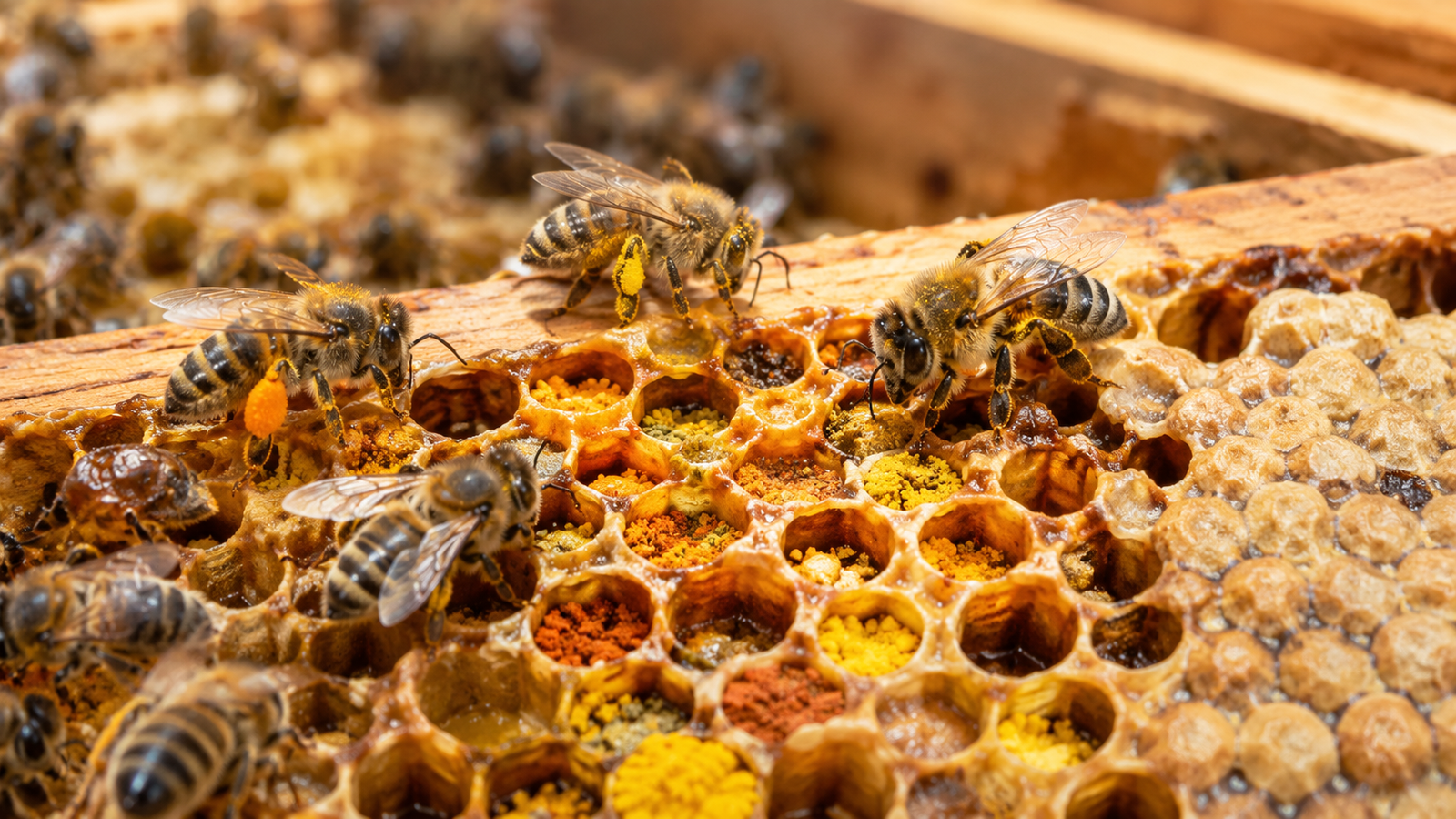
Worker bees have specialized structures on their hind legs called corbiculae, commonly known as pollen baskets.
These structures allow bees to carry pollen back to the colony.
The color of collected pollen can vary depending on the plant source. It may appear yellow, orange, red, brown, green, or other colors.
The pollen collected from different plants eventually becomes the raw material used to produce bee bread.
2. Worker Bees Bring the Pollen Back to the Hive
Once a pollen-carrying worker bee returns to the colony, the pollen becomes available for further processing.
The returning bee may release her pollen loads into honeycomb cells or transfer them to other worker bees.
This is an important part of the process because the bee that collects the pollen does not necessarily complete every stage of making bee bread.
Other worker bees can manipulate, process, and pack the pollen before it becomes fermented bee bread.
The colony therefore works together to transform freshly collected pollen into a stored food resource.
3. Worker Bees Process the Pollen
Freshly collected pollen is not simply placed into a cell and left untouched.
Worker bees process the pollen with their mouthparts and add small amounts of substances from the colony.
These additions can include:
- Nectar
- Honey
- Salivary or glandular secretions
- Other fluids produced by bees
The exact composition can vary depending on the pollen source, colony, and conditions inside the hive.
The bees’ processing helps turn loose pollen grains into a compact material that can be stored inside honeycomb.
This processing stage is important because it prepares the pollen for the next stages of storage and fermentation.
4. Bees Pack the Pollen Into Honeycomb Cells
After processing, worker bees place the pollen into empty honeycomb cells.
They repeatedly push and compress the pollen into the cell.
Why do bees pack pollen tightly?
Tightly packing the pollen reduces spaces between the particles and helps create conditions suitable for fermentation.
Bees commonly store pollen in cells near areas where brood is being raised.
A single cell may contain pollen from different plants, meaning the resulting bee bread can contain a mixture of botanical sources.
The material at this point is still undergoing transformation. It has not simply remained as the loose pollen originally collected from flowers.
5. Bees Add Nectar, Honey, and Bee Secretions
As the pollen is processed and packed, bees can add additional nectar, honey, and bee-derived substances.
These materials contribute moisture and carbohydrates and help create the conditions in which fermentation can occur.
The exact proportions can vary.
Therefore, bee bread should not be thought of simply as pollen mixed with honey.
The important process involves several stages:
Pollen collection → bee processing → packing → fermentation
It is the combination of bee processing and natural microbial fermentation that transforms stored pollen into bee bread.
6. Microorganisms Ferment the Stored Pollen
This is one of the most important stages in making bee bread.
Once pollen has been processed and packed into honeycomb, naturally occurring microorganisms associated with bees, pollen, and the hive environment begin to ferment it.
These microorganisms include various species of lactic acid bacteria and yeasts.
During fermentation, microorganisms metabolize available sugars and other compounds.
One important result is the production of organic acids, including lactic acid.
As these acids accumulate, the acidity of the stored material increases and its pH decreases.
Why is fermentation important?
Fermentation helps transform the stored pollen and creates an environment that can discourage the growth of many unwanted microorganisms.
This helps bees maintain pollen-derived food as a stored nutritional resource inside the hive.
Fermentation also changes some of the physical and chemical characteristics of the pollen.
So, the defining transformation can be summarized as:
Stored pollen + microbial fermentation = mature bee bread
7. The Fermented Pollen Becomes Bee Bread
After fermentation and maturation, the stored material is known as bee bread.
It remains inside the honeycomb until the colony needs the nutrients it provides.
Bee bread is particularly important because pollen supplies much of the protein and other nutrients that bees need.
Worker bees use pollen-derived food to support their nutritional needs and to produce food for developing larvae.
The finished product is therefore not simply freshly collected pollen. It is processed, packed, fermented, and stored pollen.
How Long Does It Take Bees to Make Bee Bread?
There is no single universal amount of time required to make bee bread.
The process depends on several factors, including:
- Pollen type
- Temperature
- Humidity
- Moisture content
- Microbial communities
- Colony conditions
- How tightly the bees pack the pollen
- Availability of nectar and other food sources
Fermentation begins after pollen is stored, and the material continues to change as it matures.
For that reason, bee bread production is better understood as a process of storage, fermentation, and maturation rather than a fixed recipe that always takes exactly the same number of days.
Why Do Bees Ferment Pollen?
Bees ferment pollen because fermentation helps turn collected pollen into a more suitable stored food reserve.
There are several important effects.
1. Fermentation helps preserve stored pollen
The production of lactic acid and other organic acids lowers the pH.
The resulting acidic environment can make it more difficult for many undesirable microorganisms to grow.
2. Fermentation changes the pollen
Microbial activity changes some of the physical and chemical characteristics of pollen.
This can affect the availability of nutrients within the stored material.
3. Fermentation creates a stable food reserve
Bees need access to pollen-derived nutrients even when fresh pollen is not immediately available.
Turning pollen into fermented bee bread allows the colony to maintain a stored nutritional resource inside the hive.
Why Do Bees Make Bee Bread?
Bees make bee bread primarily because pollen is an important source of protein and other nutrients for the colony.
Honey and nectar primarily provide carbohydrates and energy, while pollen supplies protein, lipids, and other nutrients.
Stored bee bread is particularly important when bees are raising brood.
It supports:
- Worker bee nutrition
- Nurse bee nutrition
- Brood rearing
- Production of food for developing larvae
- Colony growth and maintenance
In simple terms:
Honey and nectar → primarily energy
Pollen and bee bread → primarily protein and other nutrients
This is a simplified description because both food sources contain multiple nutrients, but it helps explain why bees need both.
What Happens If Bees Have Little Pollen?
A shortage of pollen can create nutritional challenges for a honey bee colony.
Because pollen supplies much of the colony’s protein, insufficient pollen can affect activities such as:
- Brood rearing
- Production of food for larvae
- Development of young bees
- Colony growth
- Worker bee functions
This is one reason bees actively collect and store pollen when floral resources are available.
Bee bread effectively serves as part of the colony’s stored pollen reserve.
Where Do Bees Store Bee Bread?
Bee bread is stored inside honeycomb cells, often near areas where brood is being raised.
This location allows worker bees to access pollen-derived food while caring for developing larvae.
The bees pack the pollen tightly into the cells and allow it to undergo fermentation.
Once mature, the bee bread can remain stored in the comb until the colony needs it.
Do Bees Add Honey to Bee Bread?
Yes, bees can add honey or nectar and other bee-derived substances to collected pollen during processing and storage.
However, bee bread is not simply pollen mixed with honey.
Pollen remains the fundamental raw material.
The important transformation occurs because bees:
- Collect pollen.
- Process it.
- Add substances such as nectar, honey, and secretions.
- Pack it into honeycomb.
- Allow microorganisms to ferment it.
The exact proportions of pollen, nectar, honey, water, and bee secretions can vary.
Is Bee Bread Just Fermented Pollen?
Essentially, bee bread is bee-processed and naturally fermented stored pollen.
However, the final product can contain more than pollen alone.
It may contain:
- Flower pollen
- Nectar
- Honey
- Bee secretions
- Proteins
- Lipids
- Carbohydrates
- Amino acids
- Vitamins
- Minerals
- Organic acids
- Microbial fermentation products
The exact composition varies because bees collect pollen from different plants and because fermentation changes the stored material.
Is Bee Bread the Same as Bee Pollen?
No.
Bee pollen generally refers to pollen collected by bees and brought into the hive, often in compact pellets.
Bee bread refers to pollen that has been processed, packed into honeycomb, and naturally fermented.
The major distinction is the fermentation stage.
Bee pollen
Pollen is collected and transported by bees.
Bee bread
Pollen is processed, packed, stored, and naturally fermented inside the hive.
For a broader comparison of bee bread and bee pollen, see our separate guide to What Is Bee Bread?
Do Bees Cook or Bake Bee Bread?
No.
Despite its name, bee bread is not cooked, baked, or heated like human bread.
There is:
- No flour
- No dough
- No oven
- No baking process
Instead, bees create bee bread through biological processing and natural microbial fermentation.
The word “bread” is simply part of the common name given to this compact, stored pollen food.
Is Bee Bread Made From Honey?
Not primarily.
Pollen is the fundamental raw material used to make bee bread.
Bees can add honey or nectar and their own secretions during processing and storage, but the resulting product is not simply honey-based.
The central transformation is:
Flower pollen → processing → packing → fermentation → bee bread
How Does Fermentation Preserve Bee Bread?
Fermentation is central to the storage process.
Lactic acid bacteria and other microorganisms consume available nutrients and produce acids and other fermentation products.
The resulting acidic environment makes it harder for many undesirable microorganisms to grow.
This helps the colony maintain bee bread as a stored food resource.
However, fermentation does not mean bee bread can never deteriorate. Storage conditions still matter.
Factors such as moisture, temperature, microbial activity, contamination, and hive conditions can affect how well the stored material is preserved.
Do All Bees Eat Bee Bread?
Different members of a honey bee colony have different nutritional requirements.
Bee bread is particularly important to worker bees, especially nurse bees involved in brood care.
Protein-rich pollen-derived food supports the development and functioning of the colony.
Adult bees also consume carbohydrates from nectar and honey, which provide energy.
Therefore, the colony uses different food resources for different nutritional purposes.
How Do Bees Turn Pollen Into Bee Bread? Simple Explanation
The entire process can be summarized in a few steps:
Step 1: Flowers provide pollen
Worker bees visit flowers and collect pollen.
↓
Step 2: Bees carry pollen to the hive
The pollen is transported back to the colony using the bees’ pollen baskets.
↓
Step 3: Worker bees process the pollen
Other worker bees manipulate and process the collected pollen.
↓
Step 4: Bees add nectar, honey, and secretions
These substances contribute to the stored mixture and fermentation environment.
↓
Step 5: Bees pack the pollen into honeycomb
The processed pollen is tightly compressed into cells.
↓
Step 6: Microorganisms ferment the pollen
Lactic acid bacteria, yeasts, and other microorganisms transform the stored material.
↓
Step 7: Organic acids accumulate
Fermentation increases acidity and lowers the pH.
↓
Step 8: Bee bread develops
The fermented and matured pollen becomes bee bread.
↓
Step 9: Bees store it for later use
The colony uses the stored food as a source of pollen-derived nutrients.
What Makes Bee Bread Different From Fresh Pollen?
The major difference is what happens after the pollen is collected.
Freshly collected pollen has not undergone the same storage and fermentation process.
Bee bread has been:
- Processed by bees
- Packed into honeycomb
- Stored inside the hive
- Exposed to natural microbial fermentation
- Changed chemically and physically during maturation
This is why bee bread should not simply be described as ordinary pollen sitting inside a honeycomb cell.
Can Humans Eat Bee Bread?
Bee bread is consumed by humans as a specialty bee product.
However, human consumption is different from its natural role in a honey bee colony.
Bee products can cause allergic reactions, particularly in people who are sensitive to pollen or other bee-derived substances.
People with known allergies or concerns about consuming bee products should seek appropriate professional advice.
Bee bread should also be described primarily as a food, rather than as a treatment for disease. Nutritional properties do not automatically establish medical benefits.
How Is Bee Bread Made? Frequently Asked Questions
How do bees make bee bread?
Bees make bee bread by collecting pollen from flowers, processing it with nectar, honey and bee secretions, packing it tightly into honeycomb cells, and allowing naturally occurring microorganisms to ferment it.
What is the first step in making bee bread?
The process begins when worker bees collect pollen from flowers and transport it back to the colony.
What do bees add to pollen to make bee bread?
Bees can add nectar, honey, salivary or glandular secretions, and other bee-derived fluids while processing and storing the pollen.
Do bees ferment pollen to make bee bread?
Yes. Naturally occurring microorganisms, including lactic acid bacteria and yeasts, contribute to the fermentation of stored pollen.
Why do bees ferment pollen?
Fermentation produces organic acids, lowers the pH, helps preserve the stored pollen, and changes some of its physical and chemical characteristics.
How long does it take bees to make bee bread?
There is no single fixed time. The process depends on factors such as pollen type, temperature, moisture, humidity, microbial communities, colony conditions, and how the pollen is packed.
Do bees bake bee bread?
No. Bees do not bake or cook bee bread. It is produced through bee processing, honeycomb storage, and natural microbial fermentation.
Do bees add honey to bee bread?
Yes. Bees can add honey or nectar and other bee-derived substances during pollen processing and storage.
Is bee bread the same as bee pollen?
No. Bee pollen is collected pollen, while bee bread is pollen that has been processed, packed, stored, and naturally fermented inside the hive.
Is bee bread made from every type of pollen?
Bees can collect pollen from many different plants, and bee bread may contain pollen from multiple botanical sources. Its composition therefore varies according to the plants available to the colony.
Where is bee bread stored?
Bee bread is stored inside honeycomb cells, often near the brood area where worker bees can access pollen-derived nutrients.
What happens if bees do not have enough pollen?
A lack of pollen can create nutritional challenges for a colony because pollen provides much of the protein and other nutrients bees need for brood rearing, development, and colony maintenance.
Can humans eat bee bread?
Yes, bee bread is consumed by humans. However, people with pollen or bee-product allergies should exercise caution.
The Bee Bread-Making Process in One Sentence
Bees make bee bread by collecting flower pollen, processing it with nectar, honey and bee secretions, packing it tightly into honeycomb cells, and allowing naturally occurring microorganisms to ferment it.
Final Answer: How Do Bees Make Bee Bread?
So, how do bees make bee bread?
Worker bees first collect pollen from flowers and transport it back to the hive. Other worker bees then process the pollen and add small amounts of nectar, honey, and bee-derived secretions.
The processed pollen is packed tightly into honeycomb cells, usually near the brood area. Naturally occurring microorganisms, including lactic acid bacteria and yeasts, then ferment the stored pollen.
During fermentation, organic acids are produced, acidity increases, and the pH decreases. This helps preserve the stored material and changes some of its physical and chemical characteristics.
After fermentation and maturation, the stored pollen becomes bee bread.
The complete process is:
Flower pollen → collection → transport → bee processing → nectar/honey and secretions → tight packing → microbial fermentation → maturation → bee bread
Bee bread is therefore not baked bread and not simply fresh pollen. It is a naturally fermented, bee-processed pollen food created and stored inside the honeycomb.
If you want to understand the broader question of what bee bread is, what it contains, what it looks like, how it differs from bee pollen, and how humans use it, see the separate “What Is Bee Bread?” guide.
