

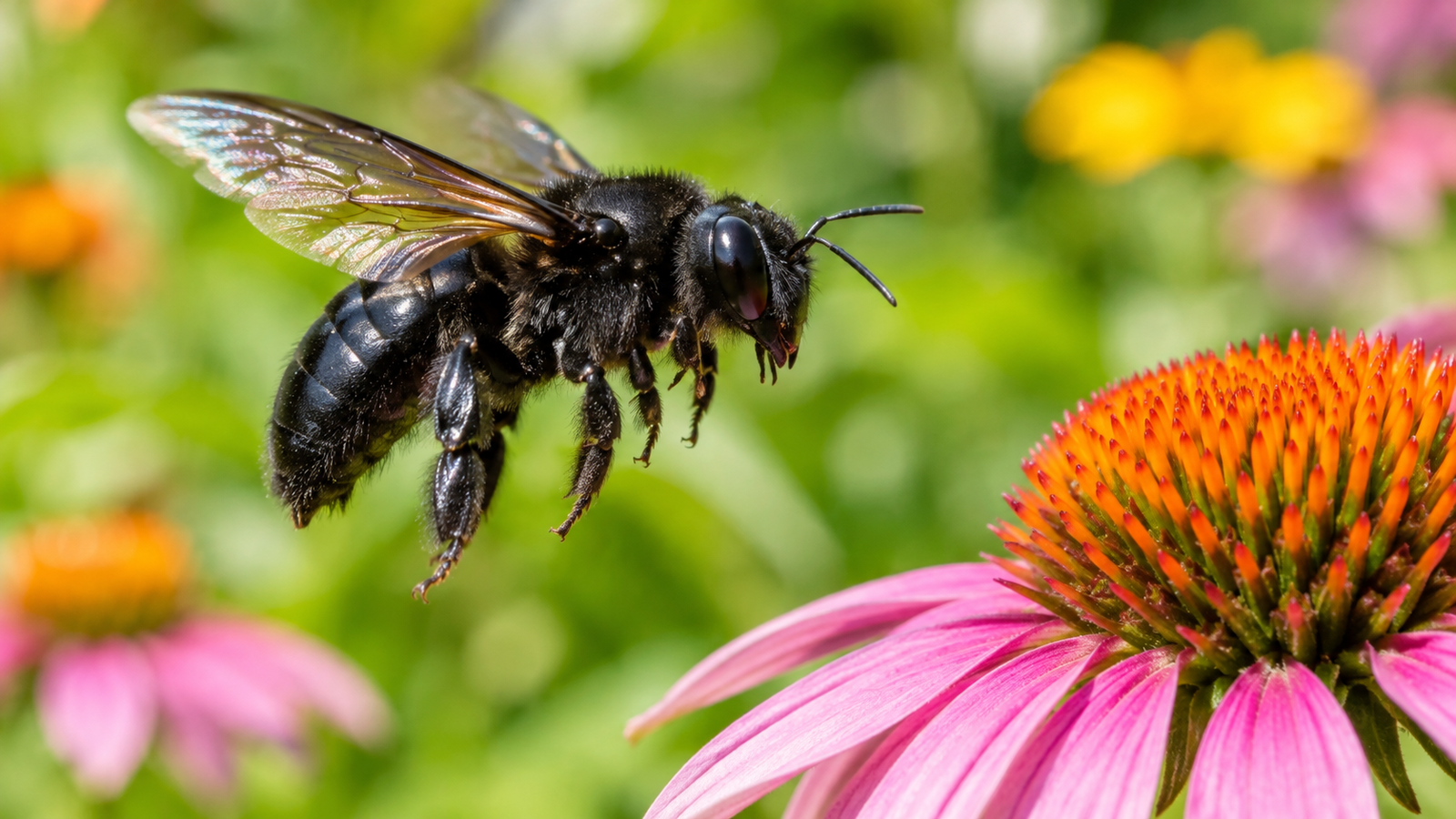
Yes, a black bee can kill you, but the risk depends on the type of bee, the number of stings and the person’s sensitivity to bee venom. A single sting can cause a life-threatening allergic reaction called anaphylaxis in someone who is severely allergic. Multiple stings can also cause serious venom poisoning, even in someone who has never experienced a bee allergy.
However, not every black bee is dangerous. Some large black bees, such as carpenter bees, are generally docile and rarely sting people. Others, including dark-coloured honey bees, can defend their colonies by stinging when they feel threatened.
The important thing to understand is that a bee’s black colour does not determine how poisonous, aggressive or dangerous it is.
If you have seen a large black bee around your home, garden or farm, you may be wondering whether it can sting you, whether its venom is deadly and how to recognise a dangerous encounter. This guide explains the different types of black bees, what happens when they sting, how serious the risks are and what to do if you are stung.
Can a Black Bee Really Kill a Human?
Yes. A black bee can cause a fatal injury, but this is uncommon. There are two main medical reasons a bee sting can become life-threatening: an allergic reaction to the venom and toxic effects from receiving numerous stings.
1. A severe allergic reaction (anaphylaxis)
Some people have an immune system that reacts dangerously to proteins in bee venom. Instead of producing only pain and swelling around the sting, the immune system triggers a widespread allergic reaction.
This condition is called anaphylaxis.
It can cause:
- Swelling of the tongue, lips or throat.
- Difficulty breathing or wheezing.
- Difficulty swallowing.
- Widespread itching or hives.
- Dizziness or fainting.
- A sudden drop in blood pressure.
- Collapse or loss of consciousness.
Anaphylaxis can develop within minutes of a sting and may progress rapidly.
For example, imagine two people are each stung once by the same honey bee. One experiences pain and a small swollen area, while the other develops throat swelling and difficulty breathing. The difference may be an underlying allergy rather than the amount of venom delivered.
This explains why even a single bee sting can be dangerous to a person with a severe venom allergy.
2. Venom poisoning from multiple stings
The second danger is receiving numerous stings within a short period.
Bee venom contains biologically active substances that can damage cells and tissues. In sufficiently large quantities, venom can cause systemic toxicity.
Possible complications include:
- Rhabdomyolysis: breakdown of muscle tissue that releases substances capable of damaging the kidneys.
- Hemolysis: destruction of red blood cells.
- Acute kidney injury or kidney failure.
- Abnormal heart function.
- Liver and other organ damage.
A person attacked by a large colony may receive dozens or hundreds of stings. Such an attack can be dangerous even without a pre-existing bee allergy.
There is no universal number of stings that guarantees a fatal outcome. Body weight, the amount of venom delivered, individual health and access to medical treatment all influence the risk.
The important distinction is that anaphylaxis is an allergic emergency, whereas multiple-sting toxicity is caused by the cumulative effects of venom.
What Kind of Bee Is a Black Bee?
Black bee is a general description, not the scientific name of one particular species.
Several different bees have dark or predominantly black bodies. Some live alone, while others form colonies containing thousands of individuals.
Here are four important examples.
1. Black carpenter bees (Xylocopa)
[Image recommendation: A large black carpenter bee with a shiny, hairless abdomen resting on a flower.]
Carpenter bees belong to the genus Xylocopa. They are often mistaken for bumblebees because of their large bodies and loud buzzing sounds.
One of their most recognisable features is their shiny black abdomen, which is usually less hairy than the abdomen of a bumblebee.
Carpenter bees excavate tunnels in wood to create nesting chambers for their offspring. You may find them around wooden fences, roof eaves, outdoor furniture, wooden posts and garden structures.
Are they dangerous?
Generally, no.
Male carpenter bees are territorial and may hover around people who approach their nesting areas. However, males cannot sting because they do not possess stingers.
Female carpenter bees can sting, but they are generally reluctant to do so unless handled, trapped or threatened.
This creates an interesting situation: a large black carpenter bee may repeatedly fly close to your head without actually being capable of stinging you if it is male.
2. Dark African honey bees (Apis mellifera)
[Image recommendation: A dark-coloured African honey bee worker collecting nectar from a flower.]
Some African honey bee populations have dark brown or nearly black colouring.
Unlike carpenter bees, honey bees live in organised colonies containing a queen, workers and drones.
Worker honey bees have stingers and use them to defend their colony. If someone accidentally steps on a bee or disturbs its nest, the workers may respond defensively.
A single honey bee sting usually causes temporary pain and swelling in someone without a venom allergy. However, repeated stings can produce dangerous venom exposure.
In parts of Africa, including Ghana, people may encounter African honey bees around farms, gardens, trees and buildings where colonies have established themselves.
Their dark appearance does not make them automatically more poisonous than other honey bees.
3. Dark-coloured bumblebees (Bombus)
[Image recommendation: A dark bumblebee with black and yellow body markings collecting pollen from a flower.]
Some bumblebee species have predominantly black bodies, sometimes with yellow, orange or white markings.
Bumblebees are usually larger and hairier than carpenter bees.
Unlike male carpenter bees, male bumblebees cannot sting because their stingers are modified egg-laying structures found only in females.
Female worker bumblebees and queens can sting, particularly when their nests are threatened or when they are handled.
Most bumblebees are not interested in attacking humans. They usually spend their time collecting pollen and nectar.
4. Black solitary bees
[Image recommendation: A small dark solitary bee collecting pollen from a wildflower.]
Several solitary bee species have black or dark-coloured bodies.
Unlike honey bees, solitary bees generally do not maintain large colonies with thousands of workers defending a shared nest.
Individual females establish nests in soil, hollow plant stems, dead wood or other suitable spaces, depending on the species.
Many solitary bees are relatively harmless to people because they rarely interact aggressively with humans.
Some females can sting, but encounters are generally low-risk when the bees are left undisturbed.
Are Black Bees More Dangerous Than Other Bees?
No. Black colour is not a reliable indicator of venom strength, aggressiveness or the likelihood of a fatal sting.
For example, a black carpenter bee may look frightening because of its large size and loud buzzing, but a male cannot sting at all.
A smaller honey bee may look less threatening, but a worker can sting and inject venom.
The danger therefore depends more on the species, its behaviour and the circumstances of the encounter than on its appearance.
| Bee type | Can it sting? | Typical behaviour around humans |
|---|---|---|
| Male carpenter bee | No | May hover or chase intruders near its nest |
| Female carpenter bee | Yes | Generally avoids confrontation |
| Worker honey bee | Yes | May defend its colony |
| Male honey bee (drone) | No | Does not defend the colony by stinging |
| Female bumblebee | Yes | Usually docile unless threatened |
| Male bumblebee | No | Cannot sting |
| Female solitary bee | Some can sting | Generally avoids people |
One important distinction is that social bees such as honey bees have colonies to protect. Solitary bees do not usually have thousands of nestmates available to defend a nesting site.
This does not mean solitary bees are incapable of stinging. It means the circumstances and scale of a potential attack are different.
Can One Black Bee Sting Kill You?
Yes, one sting can potentially kill someone who develops severe anaphylaxis.
However, a single sting is unlikely to cause fatal venom poisoning in an otherwise healthy person who is not allergic.
A normal local reaction may include:
- Immediate burning or sharp pain.
- Redness around the sting.
- Mild swelling.
- Itching.
- Warmth in the affected area.
These symptoms usually improve over several hours or days.
A large local reaction may produce much greater swelling, sometimes extending across an arm or leg. Although uncomfortable, this is not automatically anaphylaxis.
The important difference is whether symptoms remain local or begin affecting other parts of the body.
For example:
- A swollen finger after a sting may be a local reaction.
- Swelling of the tongue combined with difficulty breathing is a medical emergency.
Do not assume that someone is safe because they have received only one sting.
How Many Black Bee Stings Can Kill a Person?
There is no exact number of black bee stings that will kill every person.
The risk depends on:
- The person’s body weight.
- The amount of venom injected.
- The bee species.
- The number of stings.
- The person’s general health.
- Whether they have a venom allergy.
- How quickly they receive medical treatment.
Someone with a serious bee venom allergy may develop anaphylaxis after one sting.
Someone without an allergy may tolerate a small number of stings but develop serious complications following a much larger exposure.
For example, a beekeeper accidentally disturbing a large honey bee colony may receive numerous stings. Even if that beekeeper has never experienced an allergic reaction, the accumulated venom can cause muscle damage, kidney injury and other complications.
Children may be particularly vulnerable to a large number of stings relative to their body weight.
For this reason, do not use a supposed safe sting count to decide whether someone needs medical care.
What Makes Black Bee Venom Dangerous?
Bee venom is a biological mixture of peptides, enzymes and other active substances.
Honey bee venom is commonly called apitoxin. It contains several components, including melittin, phospholipase A2 and hyaluronidase.
These substances have different biological effects.
Melittin
Melittin is a major peptide in honey bee venom. It damages cell membranes and contributes significantly to the pain and tissue injury associated with bee stings.
Phospholipase A2
Phospholipase A2 is an enzyme and an important allergen in honey bee venom.
It can contribute to tissue damage and immune reactions.
Hyaluronidase
Hyaluronidase is an enzyme that helps venom components spread through surrounding tissues. It is also recognised as an allergenic component of honey bee venom.
These substances help explain why bee stings cause pain and swelling and why a sufficiently large venom exposure can damage the body.
However, an important distinction must be made: the amount of venom delivered and a person’s immune response are not the same thing.
Someone can experience a severe allergic reaction without receiving a large venom dose.
What Are the Symptoms of a Dangerous Black Bee Sting?
The symptoms depend on whether the person has experienced a local reaction, a systemic allergic reaction or toxic effects from multiple stings.
| Reaction | Common symptoms | What it means |
|---|---|---|
| Mild local reaction | Pain, redness, itching and limited swelling | Usually improves with basic first aid |
| Large local reaction | Extensive swelling around the sting | May require medical advice |
| Anaphylaxis | Breathing difficulty, throat swelling, dizziness or collapse | Medical emergency |
| Multiple-sting toxicity | Vomiting, muscle pain, weakness, dark urine or reduced urination | Requires urgent medical assessment |
Emergency warning signs
Call emergency medical services immediately if someone develops:
- Difficulty breathing.
- Swelling of the tongue or throat.
- Difficulty swallowing.
- Sudden dizziness or fainting.
- Collapse or severe weakness.
- Widespread hives accompanied by breathing problems or circulatory symptoms.
Anaphylaxis can progress rapidly. Do not wait for every symptom to appear.
A person can also experience anaphylaxis without developing visible skin symptoms.
What Should You Do If a Black Bee Stings You?
The correct response depends on the severity of the sting reaction.
Step 1: Move away from the bee
Move away from the immediate area to avoid further stings.
If several bees are attacking, cover your face and head and get inside an enclosed building or vehicle as quickly as possible.
Do not remain near a disturbed hive to inspect what happened.
Step 2: Remove the stinger
If a honey bee stinger remains in your skin, remove it as quickly as possible.
You can scrape it out with a fingernail or card, or carefully pull it out. Do not waste time searching for a particular removal tool.
The honey bee’s barbed stinger can remain embedded in human skin, continuing to deliver venom after the bee has flown away.
Step 3: Wash the affected area
Wash the sting site with soap and clean water.
This helps remove dirt and reduces the risk of infection.
Step 4: Apply a cold compress
Place a cold pack wrapped in a towel over the affected area for approximately 10–20 minutes.
This may reduce pain and swelling.
Step 5: Watch for allergic symptoms
Pay attention to breathing difficulties, throat swelling, dizziness, widespread hives and other symptoms that may indicate anaphylaxis.
Step 6: Seek emergency medical treatment when necessary
If anaphylaxis is suspected:
- Use an adrenaline (epinephrine) auto-injector immediately if one is available.
- Call emergency medical services.
- Do not allow the affected person to stand or walk around.
- Follow the emergency operator’s instructions.
Even if the person begins feeling better after using an auto-injector, they still need emergency medical assessment.
Anyone who receives numerous stings should also seek urgent medical evaluation, even if they initially feel normal.
How Can You Identify a Potentially Dangerous Black Bee?
You cannot reliably determine whether a bee is dangerous simply by looking at its colour.
However, certain physical characteristics and behaviours can help you understand what you may be dealing with.
| What you observe | Possible explanation | Recommended response |
|---|---|---|
| Large black bee with a shiny abdomen hovering near wood | Carpenter bee | Keep your distance and avoid handling it |
| Large black bee with a hairy abdomen visiting flowers | Possibly a bumblebee | Observe without disturbing it |
| Several dark bees entering and leaving one opening | Possible honey bee colony | Avoid the entrance and seek professional help if necessary |
| Many bees suddenly flying towards you | Defensive colony response or disturbed swarm | Protect your face and move into an enclosed shelter |
| A single small black bee visiting flowers | Possibly a solitary bee | Leave it undisturbed |
These are clues, not definitive identification methods. Accurate identification may require photographs, geographic information and examination of physical characteristics.
A particularly important warning is that Africanized and European honey bees cannot reliably be distinguished by casual visual inspection.
If you encounter a large colony of defensive honey bees, treat the situation seriously regardless of their exact identity.
Are African Black Bees the Same as Killer Bees?
No. African honey bees and Africanized honey bees are related, but the terms do not mean exactly the same thing.
African honey bees are naturally occurring honey bee populations native to Africa.
Africanized honey bees are hybrid populations that developed after African honey bees were introduced into Brazil and interbred with European honey bee populations.
Africanized honey bees are often called killer bees because of their defensive behaviour.
The most important difference is not that their venom is dramatically more poisonous. Their defensive response can involve more bees, more stings and longer pursuit of perceived threats.
University of Florida research explains that Africanized honey bee venom is not more potent than European honey bee venom. The greater danger comes from the colony’s stronger defensive response.
Another important point is that Africanized honey bees cannot reliably be identified by their black colour. Laboratory measurements are needed to distinguish them accurately.
For readers in Ghana and other African countries, encountering a naturally occurring African honey bee should not automatically be interpreted as encountering an Africanized honey bee.
Are Black Carpenter Bees Dangerous to Humans?
Black carpenter bees are generally not dangerous to humans.
They are particularly interesting because their behaviour can appear aggressive even when they pose little threat.
Male carpenter bees often patrol the area around nesting tunnels. They may hover close to a person’s face, fly towards moving objects or chase away other insects.
This behaviour is territorial.
The male does not have a stinger and therefore cannot sting you.
Female carpenter bees have stingers but usually avoid confrontation. They are more likely to sting when someone catches, squeezes or handles them.
You can often recognise a carpenter bee by its:
- Large, robust body.
- Shiny black abdomen.
- Relatively bare-looking abdomen compared with a bumblebee.
- Tendency to hover around wooden structures.
- Round holes excavated in untreated wood.
Carpenter bees are also valuable pollinators. They visit flowers to collect nectar and pollen and can perform buzz pollination, in which their flight muscles vibrate flowers to release pollen.
You generally should not kill them simply because they are large and black.
How Can You Avoid Dangerous Black Bee Attacks?
Most bees do not deliberately attack humans. Problems usually occur when people disturb their nests, accidentally trap them or approach defensive colonies.
To reduce your risk:
- Do not hit or shake a beehive.
- Avoid throwing stones or other objects at bee colonies.
- Do not attempt to remove an established honey bee colony yourself.
- Avoid swatting bees that fly close to you.
- Keep children away from nesting areas.
- Wear appropriate protective equipment when working with honey bees.
- If a swarm settles near your home, contact a qualified beekeeper or appropriate local professional.
- Move away from defensive bees rather than remaining nearby to observe them.
If bees begin attacking, protect your face and head and seek enclosed shelter. Do not jump into water as a way of escaping them, because you may need to surface while bees remain nearby.
Frequently Asked Questions About Black Bees
Can a black bee kill you with one sting?
Yes. A single black bee sting can trigger fatal anaphylaxis in someone with a severe bee venom allergy. However, most people who are not allergic experience temporary pain, redness and swelling rather than a life-threatening reaction.
Are black bees poisonous?
Black bees produce venom that they inject through their stingers. However, their black colour does not make their venom more poisonous. The effects depend on the species, the amount of venom delivered and the person’s immune response.
Are black bees aggressive?
Not all black bees are aggressive. Carpenter bees generally avoid confrontation, while honey bees may defend their colonies when threatened. Some male carpenter bees appear aggressive because they hover around nesting areas, but they cannot sting.
Can black bees sting more than once?
Some female bees can sting more than once. Honey bee workers usually lose their barbed stingers after stinging human skin, which generally kills the worker. Carpenter bees and many other bee species have different stinger structures and can potentially sting repeatedly.
Do black bees die after stinging humans?
Not all black bees die after stinging. Worker honey bees usually die after their barbed stingers become lodged in human skin. Female carpenter bees and many other bees can survive after stinging.
What happens if a black bee stings a child?
A child may experience pain, redness and swelling. However, an allergic reaction or multiple stings can be dangerous. Seek emergency help if the child develops difficulty breathing, throat swelling, dizziness or collapse. Multiple stings also require urgent medical assessment.
Are big black bees more dangerous than small black bees?
No. A large black carpenter bee may be unable to sting if it is male, while a smaller honey bee worker can sting. Size alone does not determine danger.
Should you kill a black bee if you see one?
No. Most black bees are beneficial pollinators and do not pose a significant threat when left undisturbed. Avoid handling them, and seek professional assistance if a colony creates a safety concern.
Conclusion: Can a Black Bee Kill You?
Yes, a black bee can kill you, but the risk depends on the circumstances rather than its colour.
A single sting can be fatal to someone who experiences severe anaphylaxis, while numerous stings can cause dangerous venom poisoning even in people without allergies.
Black carpenter bees are generally docile, male carpenter bees cannot sting, and dark-coloured honey bees may defend their colonies when threatened.
The safest approach is to avoid disturbing bee nests, stay away from defensive swarms and recognise the warning signs of a serious sting reaction.
If someone develops difficulty breathing, throat swelling, dizziness or collapse after a bee sting, seek emergency medical treatment immediately.
Remember: A black bee is not automatically a killer bee. Understanding the species and recognising the actual risks are much more useful than judging a bee by its colour.
References and Further Reading
The following medical, scientific and educational sources provide additional information about black bees, bee venom, stinging behaviour and the health risks associated with bee stings.
1. Penn State Extension – Carpenter Bees
https://extension.psu.edu/carpenter-bees
Information about carpenter bee identification, nesting behaviour and differences between male and female carpenter bees.
2. NC State Extension – Africanized Honey Bees: Questions and Answers
https://content.ces.ncsu.edu/africanized-honey-bees-questions-and-answers
Explains Africanized honey bee behaviour, colony defence and potential dangers to humans.
3. University of Florida IFAS Extension – Africanized Honey Bees
https://entnemdept.ufl.edu/creatures/misc/bees/ahb.htm
Information about Africanized honey bees, their defensive behaviour and differences from European honey bees.
4. Poison Control – Bee Stings: Is It an Allergic Reaction?
https://www.poison.org/articles/bee-stings
Explains bee sting reactions, allergic symptoms and when medical attention is necessary.
5. NCBI Bookshelf – Hymenoptera Envenomation
https://www.ncbi.nlm.nih.gov/books/
Medical information about venom exposure, allergic reactions and complications caused by multiple stings.
6. American Academy of Allergy, Asthma and Immunology – Stinging Insect Allergy
https://www.aaaai.org/
Medical guidance on allergic reactions to bee and other stinging insect venom.
7. MedlinePlus – Insect Bites and Stings
https://medlineplus.gov/ency/article/000033.htm
Information about symptoms, first aid and complications following insect stings.
8. University of California Agriculture and Natural Resources – Bee and Wasp Stings
https://ipm.ucanr.edu/
Educational information about stinging insects and their behaviour.

1 Comment
Pingback: What Kind of Bee Is Black? 8 Types of Black Bees and How to Identify Them - BeekeeperBase