

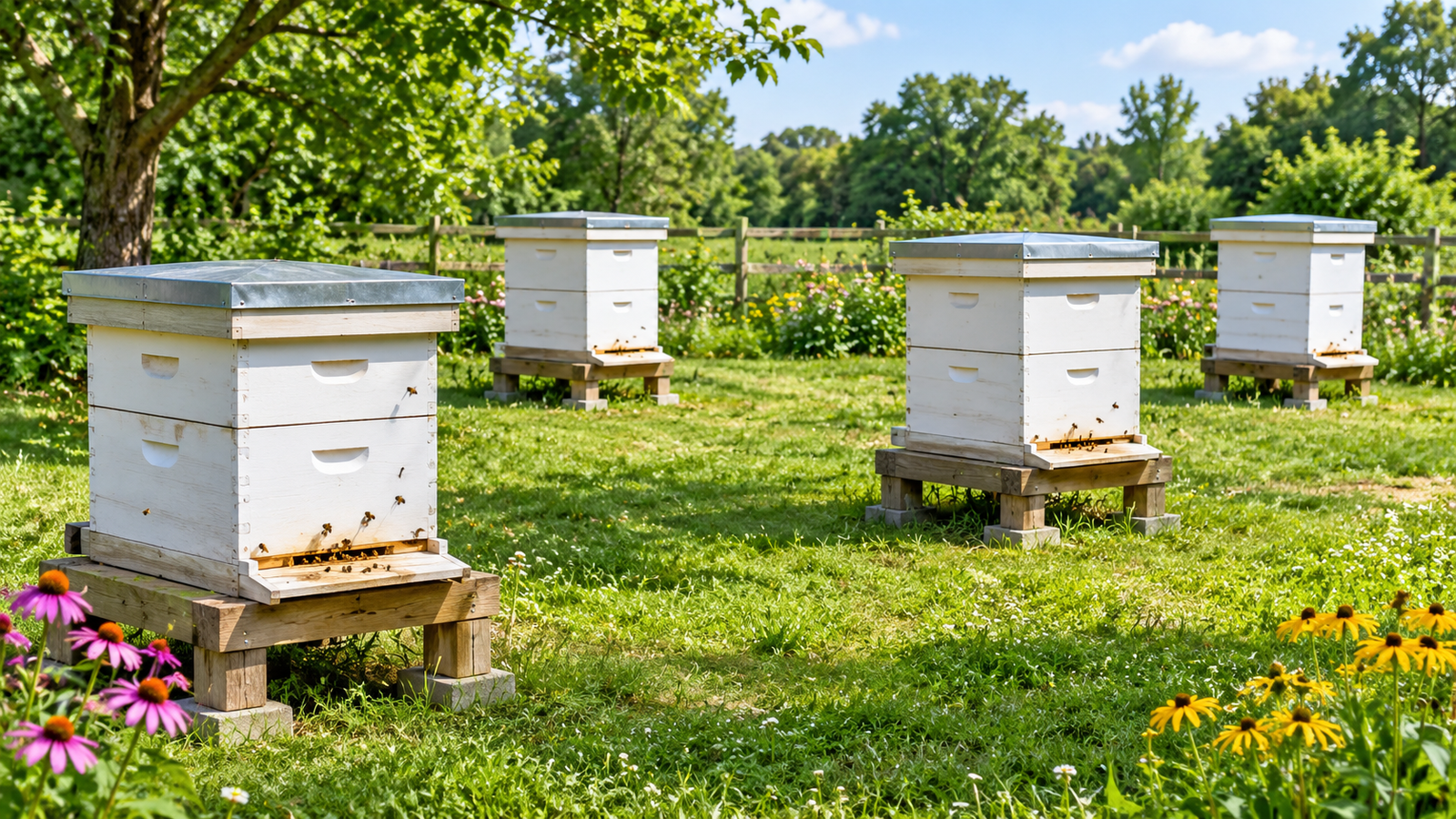
How far should bee hives be apart? If you are planning to keep multiple honey bee colonies, choosing the right distance between hives is an important part of establishing a manageable apiary.
The distance between neighbouring hives can influence how easily bees identify their colonies, how much room you have for inspections, and how efficiently you can manage individual hives. Poor positioning may also contribute to bee drifting, where returning workers enter neighbouring colonies instead of their own.
As a practical starting point, keep neighbouring honey bee hives approximately 3–6 feet (0.9–1.8 metres) apart when space allows. This is a useful working recommendation, not a compulsory biological minimum. Some commercial beekeepers use much closer arrangements, while beekeepers with sufficient land may separate colonies farther apart.
The ideal distance depends on the hive design, apiary size, entrance arrangement, local environment, and management practices.
In this guide, you will learn how far bee hives should be apart, why spacing matters, how different apiary arrangements work, and how to calculate the space needed for multiple colonies.
How Far Should Bee Hives Be Apart?
For most small-scale honey bee apiaries, a practical starting distance is 3–6 feet (0.9–1.8 metres) between neighbouring hive boxes.
This spacing provides some separation between colonies while leaving room for routine beekeeping activities.
However, there is no universal minimum distance that every beekeeper must follow. Mississippi State University Extension explains that apiary arrangement depends largely on practicality and management preferences. Its guidance recommends leaving a few feet between hives in straight rows and alternating entrance directions to help reduce returning workers drifting into neighbouring colonies.
The appropriate distance also depends on how the hives are arranged.
Recommended hive spacing for different apiaries
| Apiary situation | Practical spacing | Main purpose |
|---|---|---|
| Small backyard apiary | 3–6 feet | Convenient inspections and access |
| Medium-sized apiary | 4–10 feet | More working room |
| Commercial pallet arrangement | Compact, based on pallet and hive design | Efficient handling |
| Apiary prioritizing colony separation | Greater distances where land permits | Reduce close interactions and provide access |
| Hives in different locations | Determined by site conditions | Manage separate apiary sites |
These are planning guidelines, not scientifically established minimums. Commercial pallets can accommodate colonies close together, while widely separated colonies may still experience drifting or other forms of interaction.
The most important thing is to provide sufficient access and make neighbouring hive entrances recognizable.
What Is the Difference Between Hive Spacing and Apiary Spacing?
Before deciding how far apart to position your colonies, it is important to understand two different measurements.
Hive spacing refers to the distance between individual beehives within the same apiary.
For example, if you have four Langstroth hives positioned in a row, the distance between each neighbouring box is their hive spacing.
Apiary spacing refers to the distance between separate locations where colonies are kept.
For example, you may have five colonies on your farm and another ten colonies at a different location several kilometres away.
These two measurements serve different purposes. The recommended distance between neighbouring boxes should not be confused with the distance between separate apiary sites.
Why Is the Distance Between Beehives Important?
The distance between hives affects how conveniently you can manage colonies and how bees move around the apiary. Here are the most important considerations.
1. Helps Reduce Bee Drifting
Bee drifting happens when worker bees accidentally enter a colony other than their original hive.
Honey bees do not identify their colonies by distance alone. They use visual information and learned landmarks to navigate their surroundings.
Foragers learn the appearance and location of their hive entrance. However, when neighbouring hives have similar colours, shapes, and entrance positions, some returning bees may enter the wrong colony.
This is particularly relevant in apiaries where identical hives are arranged in long, uniform rows.
Drifting can cause an imbalance in colony populations because some colonies receive additional workers while others lose returning foragers.
It can also create opportunities for pests and pathogens to move between colonies.
How to reduce drifting:
- Leave a few feet between neighbouring hive boxes where possible.
- Use different hive colours.
- Paint recognizable patterns around entrances.
- Arrange colonies in staggered positions.
- Alternate entrance directions where practical.
- Use natural landmarks to distinguish hive locations.
A study published in the journal Apidologie investigated queen drifting at hive separations of 2 metres and 5 metres. It found no significant difference in drifting or queen relocation time between the two distances under the experimental conditions. This demonstrates that simply increasing the distance between hives does not guarantee that drifting will stop.
The study also identified worker activity at neighbouring entrances as an important factor in queen orientation.
2. Provides Room for Hive Inspections
Beekeeping involves more than placing hive boxes in an apiary. You must regularly open colonies, remove frames, inspect brood, examine food stores, and manage pests.
If hives are positioned too close together, you may struggle to perform these activities comfortably.
For example, a beekeeper using a Langstroth hive may need to remove several honey supers before reaching the brood chamber. Those supers must be placed somewhere while the inspection continues.
If another hive is directly beside the working area, moving equipment can become difficult.
Leave enough space to:
- Stand comfortably beside or behind the hive.
- Remove and temporarily place supers.
- Lift covers without hitting neighbouring equipment.
- Inspect frames without obstructing other entrances.
- Move feeders and other beekeeping supplies.
The required working space is not necessarily the same as the distance between boxes. A hive may be 4 feet from its neighbour but still have insufficient space behind it if it is positioned against a wall.
3. Makes Colony Management Easier
Different colonies do not always develop at the same rate.
One colony may have a large population and substantial honey stores, while another may have fewer workers and require feeding.
You may also need to treat one colony for Varroa mites, investigate queen problems in another, or add supers to a stronger colony.
Good spacing allows you to work on individual colonies without constantly disturbing neighbouring hives.
This becomes increasingly important as the number of colonies in your apiary increases.
4. Can Reduce Opportunities for Pest and Disease Movement
Honey bee colonies can exchange pests and pathogens through drifting, robbing, and the movement of infested equipment.
For example, Varroa destructor is a parasitic mite that reproduces in honey bee brood cells and feeds on developing and adult bees.
When infested workers drift into another colony, they can contribute to the movement of mites.
However, greater spacing alone does not control Varroa. Mites can move through other routes, and colonies kept several feet apart still require appropriate monitoring and treatment.
Good apiary management should combine sensible hive positioning with regular health inspections, hygienic equipment handling, and effective pest control.
5. Improves Safety Around the Apiary
Beekeepers need room to work without accidentally blocking hive entrances or disturbing neighbouring colonies.
Crowded apiaries can become difficult to manage when colonies are strong, particularly during inspections or honey harvesting.
If you keep bees near homes, farms, or public spaces, consider the direction of bee flight.
Position hive entrances away from busy paths, animal feeding areas, and places where people regularly gather.
Where necessary, a suitable fence or hedge can encourage bees to fly upwards when leaving the apiary. It should not block the entrance or restrict ventilation.
How Does Hive Entrance Orientation Affect the Distance Between Beehives?
The direction a hive entrance faces can be just as important as the distance between neighbouring boxes.
Imagine two identical white Langstroth hives positioned 3 feet apart, with both entrances facing the same direction.
A returning worker approaches the apiary and encounters two similar-looking entrances. It may enter the wrong colony.
Now imagine the same hives with different entrance colours and positions. Their visual appearance becomes easier to distinguish.
This is why entrance orientation and visual markings are useful tools in apiary design.
Practical ways to orient neighbouring hives
- Face neighbouring entrances in different directions where practical.
- Use different colours on adjacent hive boxes.
- Add distinctive geometric patterns near entrances.
- Stagger hive positions instead of placing every box in one straight line.
- Avoid making all neighbouring entrances look identical.
A 2023 study published in the Journal of Apicultural Research examined the effects of hive entrance direction on colony activity and temperature. The researchers found that entrance orientation affected daily flight activity and hive temperature under the conditions studied in southern Arizona.
This does not establish one universally best direction for every apiary. Local temperature, wind, shade, and climate should influence entrance orientation.
Best Ways to Arrange Multiple Beehives
There are several ways to position multiple colonies. The best arrangement depends on available land, the number of hives, and how you intend to manage them.
1. Straight-Row Arrangement
A straight-row arrangement positions all the hives along one line.
It is a straightforward design for small and medium-sized apiaries.
Advantages:
- Easy to organize.
- Convenient to inspect colonies.
- Makes hive numbering straightforward.
- Can simplify equipment movement.
Disadvantages:
- Identical entrances may increase confusion.
- Bees may drift between neighbouring colonies.
- The end colonies may experience different conditions from central colonies.
To improve this arrangement, leave a few feet between neighbouring hives and use different entrance colours or directions.
2. Staggered Arrangement
A staggered arrangement positions hives at slightly different distances forward and backward instead of keeping all entrances in one straight line.
This creates more distinctive hive locations.
Advantages:
- Helps distinguish neighbouring colonies.
- Provides alternative inspection positions.
- Reduces the repetitive appearance of identical entrances.
This is particularly useful for backyard and medium-sized apiaries.
3. Four-Hive Pallet Arrangement
Some commercial beekeepers place four colonies on a shared pallet.
The arrangement saves space and can make transporting several colonies easier.
However, the close proximity means entrance recognition is especially important.
Use different entrance directions, colours, and markings where practical. Ensure that the pallet design allows safe access for inspections and equipment handling.
4. Irregular or Scattered Arrangement
An irregular arrangement places colonies at different positions and orientations rather than in uniform rows.
Natural features such as trees, shrubs, and other landmarks can help make hive locations visually distinct.
Advantages:
- More varied visual surroundings.
- Can help reduce unwanted mixing of returning workers.
- Allows flexible use of available land.
The disadvantage is that inspecting many scattered colonies may require more walking and equipment transportation.
How Much Space Do You Need for 5, 10, or 20 Beehives?
Calculating hive spacing before establishing an apiary helps you avoid overcrowding.
For a simple example, assume you are positioning hives in a straight row and leaving 4 feet of clear space between neighbouring boxes.
The calculation is:
Total clear gap = (Number of hives − 1) × Distance between hives
| Number of hives | Clear space between boxes |
|---|---|
| 2 hives | 4 feet |
| 3 hives | 8 feet |
| 5 hives | 16 feet |
| 10 hives | 36 feet |
| 20 hives | 76 feet |
These figures represent the combined gaps only. They do not include the width of the hive boxes, the space needed at the ends of the row, or the working area behind the colonies.
For example, five hives with four-foot gaps require 16 feet of clear space between boxes. You must then add the combined width of the five hives and any additional access space.
This distinction is important when planning an apiary on a small property.
Does Hive Type Affect How Far Apart Beehives Should Be?
Yes. Different hive designs have different dimensions and require different amounts of working space.
Langstroth hives
Langstroth hives are made up of vertically stacked boxes containing removable frames.
Because beekeepers may need to lift several boxes during inspections, they should leave enough room to handle supers safely.
Top-bar hives
Top-bar hives are generally longer and horizontally arranged.
The beekeeper usually works along the top of the hive and removes individual bars rather than lifting multiple stacked boxes.
Their longer shape may require a different arrangement, particularly where several colonies are kept in a row.
Warre hives
Warre hives are vertically stacked and may require lifting entire boxes during certain management procedures.
Their arrangement should provide enough room to lift and handle the boxes safely.
Important: The recommended distance between colonies is not determined by the hive design alone. Working access, entrance positioning, and the surrounding environment remain important.
Do the Same Spacing Rules Apply to Other Bee Species?
No. The recommendations in this article primarily concern managed honey bee colonies, particularly European honey bees (Apis mellifera).
Other bee species have different social structures and nesting requirements.
| Bee type | Social behaviour | Typical nesting arrangement |
|---|---|---|
| Honey bees (Apis mellifera) | Highly social | Large colonies in managed hives or natural cavities |
| Bumblebees (Bombus spp.) | Social | Smaller seasonal colonies |
| Mason bees (Osmia spp.) | Solitary | Individual nesting cavities, sometimes grouped in bee hotels |
| Leafcutter bees (Megachile spp.) | Solitary | Individual cells in existing cavities or nesting blocks |
For example, mason bees can use closely aligned nesting tubes in a single bee hotel. They do not require the same separation between individual nests as managed honey bee colonies.
Leafcutter bees also nest individually, using materials such as cut leaf fragments to construct their brood cells.
Therefore, a recommendation of 3–6 feet between honey bee hives should not be treated as a universal spacing requirement for all bee species.
How Far Apart Should Beehives Be in Ghana and Other Tropical Countries?
Beekeepers in Ghana and other tropical regions should consider local weather, vegetation, forage availability, and the design of their apiaries.
Although the basic principles of hive access and bee orientation remain relevant, local conditions can influence the best arrangement.
Consider the following factors:
1. Heat and sunlight
Position hives where they receive suitable protection from excessive heat. Depending on the site, partial afternoon shade may be useful.
2. Seasonal rainfall
Choose well-drained ground and avoid locations where water collects around hive stands.
3. Vegetation
Trees and shrubs can provide landmarks and partial shade. However, they should not obstruct entrances or prevent inspections.
4. Forage availability
Do not assume that increasing the distance between hives will solve competition for food. Colony density should reflect the available flowering plants, water, and seasonal forage.
5. Human and livestock activity
Position entrances away from busy paths, homes, livestock feeding areas, and other locations where people or animals regularly gather.
6. Hive design
Whether you use Langstroth, top-bar, or locally constructed hives, leave enough room to inspect and manage every colony.
The most suitable arrangement is one that balances colony management, bee orientation, safety, and the resources available at the apiary.
Common Mistakes to Avoid When Spacing Beehives
When planning your apiary, avoid these mistakes:
- Using identical entrances: Neighbouring hives that look alike may be more difficult for returning bees to distinguish.
- Ignoring working space: A few feet between boxes does not automatically provide enough room for inspections.
- Blocking flight paths: Avoid positioning hive entrances directly towards busy walkways.
- Overcrowding colonies: Consider available forage and the number of colonies you can manage properly.
- Assuming more distance eliminates disease: Drifting is only one route through which pests and pathogens can spread.
- Ignoring local conditions: Heat, flooding, wind, and vegetation can affect hive placement.
- Moving established colonies carelessly: Returning foragers may continue searching for the previous hive location if a colony is moved without an appropriate relocation plan.
Frequently Asked Questions
1. Can I put two beehives next to each other?
Yes. Honey bee colonies can be kept close together, including on shared pallets. However, provide sufficient access for inspections and make neighbouring entrances visually distinguishable.
2. Is 2 feet enough space between beehives?
Two feet can work in a compact arrangement, but it may not provide enough working room for comfortable inspections. If space permits, 3–6 feet is a more convenient starting recommendation.
3. Can beehives be 10 feet apart?
Yes. Ten feet is a reasonable distance between neighbouring hives. It provides additional working room, although it does not guarantee that drifting will stop.
4. Does keeping beehives farther apart prevent drifting?
Greater separation can help in some situations, but drifting also depends on entrance appearance, hive position, worker activity, and surrounding landmarks. No particular distance guarantees that drifting will be eliminated.
5. How many beehives can I keep in one location?
There is no universal maximum. The appropriate number depends on available forage, water, land, colony strength, local conditions, and your ability to manage the colonies.
6. Should all beehive entrances face the same direction?
No. Varying entrance directions can help distinguish neighbouring colonies. However, orientation should also account for wind, sunlight, temperature, and safe flight paths.
7. Should beehives be placed in the shade or sunlight?
The answer depends on the climate and site. In hot tropical environments, some protection from intense afternoon sun may be beneficial. Avoid damp locations and ensure that hives remain well ventilated.
8. Can I keep four beehives on one pallet?
Yes. Four-hive pallets are used in commercial beekeeping. Make sure the entrances are distinguishable and that the pallet provides adequate access for colony management.
9. Is it better to arrange beehives in a straight line or staggered rows?
Both arrangements can work. Staggered arrangements can provide more distinctive hive positions, while straight rows may be easier to manage. Entrance markings and orientation are important in either design.
10. How far apart should separate apiaries be?
The distance between separate apiaries depends on the purpose of separating them, local forage, disease-management requirements, and landscape conditions. Do not confuse this with the distance between individual hives. There is no single universal separation distance that prevents all disease transmission.
Conclusion
So, how far should bee hives be apart?
For a small-scale honey bee apiary, 3–6 feet (0.9–1.8 metres) between neighbouring hive boxes is a practical starting point when sufficient space is available.
However, the best distance depends on how you arrange your colonies and how much room you need for inspections.
A straight-row arrangement may require more attention to entrance orientation, while a staggered arrangement can provide more distinctive hive positions. Commercial beekeepers may also use compact pallet systems to manage several colonies efficiently.
Remember that hive spacing alone does not determine colony health. Bee orientation, available forage, pest management, safe access, and local environmental conditions all contribute to a successful apiary.
Plan your hive arrangement before introducing colonies, and leave enough room to manage every hive comfortably as your apiary grows.
References
- Mississippi State University Extension – Choosing an Apiary Location. Useful for straight rows, pallet arrangements, entrance orientation, drifting, and safety.
- Perez-Sato et al. (2008), Apidologie – Effects of hive spacing, entrance orientation, and worker activity on nest relocation by honey bee queens. Particularly valuable for explaining why greater spacing does not automatically prevent drifting.
- Meikle et al. (2023), Journal of Apicultural Research – Effects of hive entrance orientation on honey bee colony activity. Supports the discussion of entrance direction and environmental conditions.
- Gray and Nieh (2019), Insect Science – Influence of visual targets and landmarks on honey bee foraging and waggle dancing. Supports the scientific explanation of visual navigation.
- Colorado State University Extension – Leafcutter Bees. Supports the distinction between solitary bees and social honey bee colonies.
- University of Missouri Extension – Native Insect Pollinators and Their Habitats. Useful for explaining mason bee nesting and other solitary bee behaviour.
