
Bee bread can be difficult to find in Nigeria because most beekeepers and honey retailers concentrate on selling honey, beeswax, and bee pollen rather than fermented pollen. However, you can look for it through local apiaries, specialist beekeepers, honey-processing businesses, natural food retailers, and online bee-product suppliers.
If you are looking for genuine bee bread in Nigeria, one of the best places to start is with beekeepers in Ogun State. Research conducted at Ahmadu Bello University documented bee bread production among beekeepers in Ogun State, showing that locally produced bee bread exists in Nigeria, even though it is not widely marketed. Kubanni Backend+1
You can also search in Lagos, Abuja, Oyo, Kaduna, Kwara, and other states by contacting beekeeping communities and asking for producers who harvest fermented pollen directly from honeycomb cells.
This guide explains where to buy bee bread in Nigeria, how to contact potential suppliers, how to distinguish genuine bee bread from ordinary bee pollen, and what to check before purchasing.
Where Can I Get Bee Bread in Nigeria?
You can get bee bread in Nigeria by contacting:
- Local beekeepers and commercial apiaries.
- Honey producers who harvest other beehive products.
- Beekeeping associations and cooperative groups.
- Specialist bee-product and apitherapy suppliers.
- Natural food and organic product retailers.
- Nigerian online marketplaces.
- International bee-product suppliers that deliver to Nigeria.
Not all these sellers will have bee bread in stock. Some may only sell honey or bee pollen, so you should confirm that they actually supply fermented bee bread before making payment.
The most reliable approach is to find a beekeeper who can explain how the product was harvested and processed.
1. Buy Bee Bread Directly From Beekeepers in Nigeria
Local beekeepers are among the most promising sources of genuine bee bread because they work directly with honeybee colonies and can potentially harvest products from their hives.
Honeybees collect pollen from flowering plants and carry it back to their colonies. They pack the pollen into honeycomb cells, add nectar or honey and glandular secretions, and allow it to undergo microbial fermentation. The resulting stored product is called bee bread.
Unlike honey harvesting, collecting bee bread requires separating the fermented pollen from the wax cells. This additional work helps explain why many Nigerian beekeepers sell honey but do not offer bee bread.
Nigerian research confirms local bee bread production
A particularly useful source is Ibukun Helen Ojo’s 2016 doctoral research at Ahmadu Bello University, titled Effect of Beekeeping on Poverty Status of Women in Ogun and Kaduna States, Nigeria.
The research investigated beekeepers in both states and documented the production of several hive products.
Among its findings:
- Beekeepers in Ogun State produced seven types of bee products.
- The study documented bee bread production among 13% of the sampled Ogun State beekeepers.
- Honey and beeswax were the main products produced.
- Lack of equipment, technical knowledge, and markets limited the production of less common bee products. Kubanni Backend+2
This research provides an important clue for Nigerian buyers: Ogun State is a sensible starting point when searching for locally harvested bee bread.
However, the study was conducted before 2016. It identifies a historical production area, not a current list of sellers or proof that those producers still have bee bread available.
How to find a beekeeper who sells bee bread
You can use the following process:
- Search for beekeepers, apiaries, and honey producers in your state.
- Contact them by telephone, WhatsApp, or through their business pages.
- Ask whether they harvest fermented bee pollen from honeycomb cells.
- Request photographs of the actual product.
- Ask about processing, storage, packaging, quantity, and delivery.
- Compare at least two suppliers before purchasing.
For example, if you live in Abeokuta, Ogun State, you could search for apiaries in Abeokuta and surrounding communities. Rather than asking whether a beekeeper sells honey, ask specifically whether they harvest bee bread.
This makes it easier to find the right supplier.
2. Look for Bee Bread in Honey-Producing Businesses
Honey-processing businesses are another place to investigate because some work directly with beekeepers who produce multiple hive products.
A business that sells raw honey may also have relationships with apiaries that harvest:
- Bee pollen
- Bee bread
- Beeswax
- Propolis
- Royal jelly
However, selling these products requires different harvesting and processing methods. A honey retailer should not automatically be considered a bee bread supplier.
When contacting a honey business, ask:
“Do you sell bee bread harvested from fermented pollen inside honeycomb cells, or do you only sell bee pollen?”
This distinction is particularly important when purchasing online.
What if the honey business does not sell bee bread?
Ask whether it can introduce you to a beekeeper who harvests it.
For instance, a honey retailer in Lagos may source honey from several apiaries but not process bee bread itself. One of its beekeeping partners may nevertheless produce it.
This referral approach can be more effective than searching only for shops advertising bee bread.
3. Contact Nigerian Beekeeping Associations and Cooperative Groups
Beekeeping associations can help you locate producers who harvest less common hive products.
Some beekeepers operate independently and do not advertise every product they produce. Others sell through cooperative groups or established networks.
You can start by investigating:
- Beekeeping Extension Society.
- Ogun State beekeeping networks and cooperative groups.
- Agricultural extension offices.
- Beekeeping training and research organisations.
- Local beekeeping associations in your state.
The Beekeeping Extension Society and Ogun-based beekeeping networks are mentioned in the Ahmadu Bello University research as part of the Nigerian beekeeping environment. Their current membership and contact details should be verified before relying on them. Kubanni Backend
You can also approach agricultural departments at universities and research institutions for referrals to active beekeepers.
What to ask an association: Request contact details for members who harvest bee bread, rather than a general list of honey producers.
4. Search for Bee Bread in Natural Food and Organic Shops
Natural food stores and specialist health-product shops may carry different bee-derived products.
Some common products include:
- Raw honey
- Bee pollen granules
- Propolis extracts
- Royal jelly
- Beeswax products
- Bee bread
However, bee bread is generally less commonly stocked than honey and pollen.
If you visit a natural food shop in Lagos, Abuja, Port Harcourt, Ibadan, or Enugu, ask whether it sells fermented bee pollen.
Do not rely on a product’s placement in the bee-products section. Read its description and ingredients to establish what you are buying.
A product labelled “100% bee pollen” is not automatically bee bread, even if the seller advertises both names in the product title.
5. Buy Bee Bread Through Nigerian Online Marketplaces
If you cannot find a physical supplier, online marketplaces offer another way to search for bee bread.
You can investigate the following platforms:
| Platform | What to search for |
|---|---|
| Jumia Nigeria | Bee bread, fermented bee pollen |
| Konga | Bee bread, natural bee products |
| Facebook Marketplace | Nigerian bee bread, local beekeeper |
| Bee bread Nigeria, Nigerian apiary | |
| WhatsApp business sellers | Fermented bee pollen, bee bread supplier |
These are search destinations, not confirmed retailers of genuine bee bread.
Search using the right product names
Try these search phrases:
- Buy bee bread in Nigeria.
- Bee bread suppliers in Lagos.
- Nigerian fermented bee pollen.
- Fresh bee bread for sale.
- Dried bee bread granules.
- Honeycomb bee bread.
Searching only for “bee pollen” may produce more results, but it can also lead you to the wrong product.
What to do before paying an online seller
Request:
- A photograph of the actual bee bread.
- A photograph of the original packaging.
- The product’s ingredients.
- Information about where it was harvested.
- Whether it is fresh, frozen, or dried.
- The production and expiry or best-before dates.
- The seller’s physical location and delivery arrangements.
Avoid paying for a product based entirely on a stock photograph or an attractive health claim.
6. Consider Imported Bee Bread if Local Suppliers Are Unavailable
If you have contacted several Nigerian beekeepers without finding a supplier, importing bee bread is another possibility.
International bee-product sellers may offer dried, frozen, or fresh bee bread.
Before ordering, consider:
- The country of origin.
- The type of bee that produced it.
- Whether the product is genuinely fermented bee bread.
- Its storage and transportation requirements.
- Shipping costs to Nigeria.
- Nigerian food-import and customs requirements.
- Whether the seller provides traceability and quality information.
Fresh bee bread can be particularly challenging to transport because it may deteriorate if temperature and moisture conditions are not controlled.
Dried products may be easier to transport, but drying methods and storage conditions still matter.
For this reason, do not assume imported bee bread is automatically better than locally produced bee bread.
7. Find Bee Bread Through Nigerian Agricultural Research and Extension Networks
Another approach is to contact institutions involved in agricultural research, apiculture, and beekeeping education.
Universities with agriculture-related programmes can sometimes provide referrals to beekeeping researchers, extension officers, and local producers.
Useful starting points include:
- Ahmadu Bello University, Zaria.
- Ladoke Akintola University of Technology, Ogbomoso.
- Agricultural extension services in your state.
- Research organisations involved in apiculture and pollinator studies.
For example, research at Ahmadu Bello University documented bee bread production in Ogun State, while research published by agricultural researchers at LAUTECH investigated awareness of bee products in the Ogbomoso area. Kubanni Backend+1
These institutions are research and referral starting points, not commercial bee bread shops.
Where Can You Find Bee Bread in Different Nigerian States?
The availability of bee bread differs across Nigeria. Some states have beekeeping activities and producers of several hive products, but that does not mean every beekeeper harvests bee bread.
The following table identifies practical places to begin your search.
| Nigerian state | Where to start looking | Suggested search |
|---|---|---|
| Ogun | Local apiaries and beekeeping networks | Bee bread producers in Abeokuta |
| Lagos | Honey processors and natural food retailers | Bee bread sellers in Lagos |
| Oyo | Beekeepers and agricultural networks | Bee bread suppliers in Ibadan and Ogbomoso |
| Abuja (FCT) | Commercial apiaries and specialist bee-product retailers | Bee bread in Abuja |
| Kaduna | Apiaries and beekeeping associations | Bee bread producers in Zaria |
| Kwara | Honey producers and local beekeepers | Bee bread in Ilorin |
| Enugu | Local apiaries and organic food shops | Bee bread suppliers in Enugu |
| Rivers | Beekeepers and natural product retailers | Bee bread in Port Harcourt |
| Delta | Apiaries and honey businesses | Bee bread in Asaba and Warri |
| Anambra | Beekeeping communities and honey producers | Bee bread in Awka and Onitsha |
Where should you start?
Ogun State deserves particular attention because Nigerian academic research has documented bee bread production there. For buyers elsewhere, contacting nearby beekeepers and requesting referrals is a practical alternative.
What Does Genuine Bee Bread Look Like?
Before buying bee bread, it helps to understand its appearance and how it differs from other bee products.
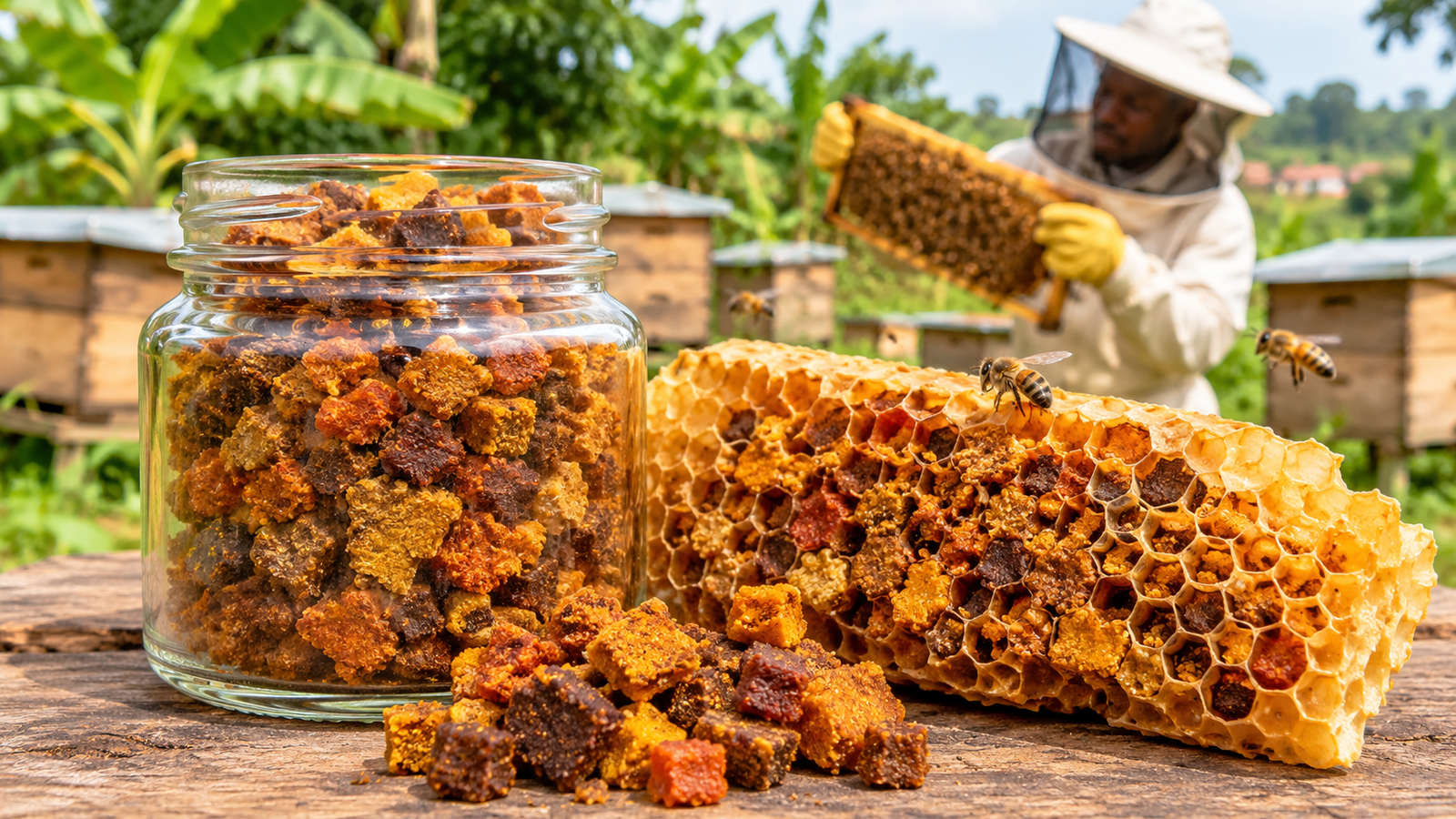
Bee bread is usually found as compacted pollen material inside honeycomb cells. Its colour can range from yellow and orange to brown, depending on the plants from which the pollen was collected and other factors.
Once removed from the comb, it may be sold as small pieces, granules, or a processed product.
Bee bread versus bee pollen: What are you actually buying?
This is one of the most important distinctions when shopping in Nigeria.
| Characteristic | Bee bread | Bee pollen |
|---|---|---|
| Original source | Flower pollen stored in the hive | Flower pollen collected by bees |
| Processing | Mixed with bee secretions and nectar or honey, then fermented | Often collected directly from bees’ pollen baskets |
| Location in the hive | Honeycomb cells | Not necessarily stored in the hive |
| Fermentation | Naturally undergoes microbial fermentation | Not necessarily fermented |
| Appearance | Compact, often darker or mixed-colour material | Usually colourful, individual pollen pellets |
| Common commercial form | Granules, pieces or dried material | Granules or powder |
Research published in Frontiers in Nutrition in 2022 explains that bee bread forms through pollen fermentation in honeycomb cells, involving microorganisms such as lactic acid bacteria and yeasts. This fermentation changes the pollen’s chemical composition. PubMed+1
How honeybees produce bee bread
The process can be understood in four stages:
- Pollen collection: Worker honeybees visit flowering plants and collect pollen grains.
- Transportation: They carry pollen back to the colony using specialised structures on their hind legs called corbiculae, commonly known as pollen baskets.
- Storage: Other worker bees pack the pollen into honeycomb cells and mix it with nectar or honey and glandular secretions.
- Fermentation: Naturally occurring microorganisms help ferment the stored pollen, producing bee bread.
The result is an important protein and nutrient source for developing honeybee larvae and the colony.
The process is not simply pollen drying inside a hive. It involves biological and chemical changes during storage. ScienceDirect+1
Does bee bread from different bee species look the same?
Not necessarily.
Most commercial bee bread research focuses on the western honeybee, Apis mellifera. However, other bee species can collect and store pollen in different ways.
For example, stingless bees also produce pollen-based stored food. Research on stingless-bee-collected pollen and bee bread has documented differences in composition, acidity, and microbial properties.
Therefore, if a Nigerian seller offers bee bread from stingless bees, ask for the bee species and harvesting method rather than assuming it is identical to conventional honeybee bee bread. PubMed Central (PMC)
How Much Does Bee Bread Cost in Nigeria?
There is no sufficiently reliable, verified national retail price for genuine bee bread that can be used as a current Nigerian price guide.
The price will depend on:
- Whether the product is locally harvested or imported.
- Whether it is fresh, frozen, or dried.
- Its moisture content and processing method.
- The quantity purchased.
- Packaging and storage requirements.
- Delivery location.
Instead of relying on an advertised price for ordinary bee pollen, request quotations for genuine bee bread.
Quantities to ask suppliers about
| Quantity | Suitable purchasing purpose |
|---|---|
| 25–50 g | Small trial purchase |
| 100 g | Small personal purchase |
| 250 g | Larger personal purchase |
| 500 g | Bulk purchase |
| 1 kg | Wholesale or commercial enquiry |
These are suggested order sizes, not verified standard Nigerian package sizes.
When comparing suppliers, calculate the price per 100 g. For example, a 250 g package costing ₦20,000 works out to ₦8,000 per 100 g.
This helps you compare different package sizes fairly.
How to Identify Genuine and Good-Quality Bee Bread
A product’s appearance alone cannot establish that it is genuine or safe to eat. You should also examine its origin, processing, and storage history.
Here are six important checks.
1. Confirm that it was harvested from honeycomb cells
Ask the supplier whether the pollen was collected from the cells of an established bee colony.
This is one of the clearest ways to distinguish hive-produced bee bread from ordinary bee pollen.
2. Ask whether it is fresh or processed
Bee bread may be sold fresh, frozen, or dried.
The processing method affects moisture content, texture, storage requirements, and shelf life.
3. Check its smell and appearance
Genuine bee bread may have a slightly sour or fermented smell because of the fermentation process.
Its colour varies with pollen sources. There is no single colour that proves authenticity.
Reject products with visible mould, signs of spoilage, or unexplained contamination.
4. Examine the packaging
Choose food-grade, clean, sealed packaging with clear product identification.
The package should provide:
- Product name.
- Ingredients.
- Net weight.
- Producer or supplier information.
- Batch identification, where available.
- Production and best-before dates.
- Storage instructions.
5. Ask about quality testing
Where possible, request evidence of appropriate food-quality checks, including microbial testing and moisture or water-activity assessment.
Bee products are natural materials, and their quality can vary with environmental conditions and processing.
A 2024 review of food-safety risks in beekeeping products discusses potential contamination, naturally occurring plant toxins, and allergic reactions associated with bee products. Institute of Food Technologists
6. Do not confuse a health claim with proof of quality
A seller may advertise bee bread as an immunity booster, digestive treatment, or cure for a medical condition.
Such claims do not prove that the product is genuine, uncontaminated, or clinically effective.
Buy based on product identity, traceability, and quality rather than exaggerated medical promises.
How Should You Store Bee Bread After Buying It in Nigeria?
Nigeria’s warm climate makes storage particularly important, especially when purchasing fresh bee bread or transporting it over long distances.
The correct method depends on how the product has been processed.
| Product condition | Storage consideration |
|---|---|
| Fresh bee bread | Refrigeration or freezing according to supplier guidance |
| Frozen bee bread | Maintain the frozen temperature during storage and transport |
| Dried bee bread | Airtight, moisture-resistant packaging in a cool, dry location |
| Opened package | Follow the manufacturer’s instructions and protect against moisture and contamination |
Do not assume that all bee bread can safely be stored at room temperature.
Research on bee-product processing identifies moisture as an important factor in deterioration and recommends appropriate dehydration and controlled storage methods. PubMed Central (PMC)+1
If the product develops visible mould, an unusual deteriorating smell, or signs of contamination, do not consume it.
Common Mistakes to Avoid When Buying Bee Bread in Nigeria
| Mistake | What to do instead |
|---|---|
| Buying ordinary bee pollen advertised as bee bread | Ask whether it underwent fermentation in honeycomb cells |
| Assuming every honey seller stocks bee bread | Confirm availability before visiting |
| Buying from sellers using only stock photos | Request photographs of the actual product |
| Assuming imported products are automatically superior | Compare origin, quality, and processing |
| Ignoring storage instructions | Check whether refrigeration or freezing is required |
| Trusting exaggerated health claims | Prioritise traceability and food safety |
| Paying before verifying the seller | Check business identity and request product details |
One additional consideration is allergies. Bee pollen and related bee products can cause allergic reactions in susceptible individuals, occasionally including severe reactions. Anyone with a known pollen or bee-product allergy should seek medical advice before consuming them. Institute of Food Technologists
Message to Send a Bee Bread Supplier in Nigeria
If you find a beekeeper, honey producer, or natural product seller, you can use this message to establish whether they sell genuine bee bread.
Hello, please do you sell genuine bee bread (fermented bee pollen)?
I am interested in purchasing bee bread harvested from honeycomb cells, not ordinary bee pollen.
Please let me know:
- Is it locally produced in Nigeria or imported?
- Which bee species produced it?
- Is it fresh, frozen, or dried?
- What quantities are available?
- What is the price per 100 g, 250 g, and 500 g?
- Do you offer delivery within Nigeria?
Please also send photographs of the actual product, its packaging, and any available quality information.
Thank you.
Frequently Asked Questions About Getting Bee Bread in Nigeria
1. Where can I buy genuine bee bread in Nigeria?
You can search through local beekeepers, apiaries, specialist bee-product businesses, agricultural networks, and online marketplaces. Ogun State is a particularly useful starting point because Nigerian academic research has documented bee bread production there.
2. Where can I buy bee bread in Lagos?
Start with honey producers, apiaries, organic food shops, and natural product retailers in Ikeja, Lekki, Surulere, and other parts of Lagos. Ask for referrals to beekeepers who harvest fermented pollen.
3. Is bee bread produced in Nigeria?
Yes. Research conducted by Ahmadu Bello University documented bee bread production among beekeepers in Ogun State. This establishes that bee bread is produced locally, although it does not establish current commercial availability.
4. Is bee bread available in Abuja?
You can investigate commercial apiaries, honey businesses, and specialist bee-product retailers in Abuja. Ask specifically for fermented bee bread and request referrals if the business does not stock it.
5. Can I buy bee bread directly from Nigerian farmers?
Yes. Some Nigerian beekeepers harvest bee bread from honeycomb cells. However, not every beekeeper has the equipment, knowledge, or market connections required to sell it commercially.
6. Is bee bread the same as bee pollen?
No. Bee pollen is collected from flowers by bees. Bee bread is made when honeybees store pollen in honeycomb cells, mix it with nectar or honey and secretions, and allow it to ferment.
7. Does bee bread need refrigeration?
Fresh bee bread may require refrigeration or freezing, depending on moisture content and processing. Properly dried bee bread can have different storage requirements. Follow the producer’s instructions rather than assuming all forms can be stored in the same way.
8. Can I get bee bread from stingless bees in Nigeria?
Potentially, yes. Stingless bees also collect and store pollen-based food. However, products from stingless bees may differ in composition and processing from conventional honeybee bee bread. Ask the seller to identify the bee species.
9. Can I import bee bread into Nigeria?
You may be able to purchase bee bread from international suppliers, but check Nigerian import requirements, customs rules, food safety documentation, and transportation conditions before ordering.
10. Why is bee bread harder to find than honey in Nigeria?
Honey has a more established commercial market. Bee bread requires additional harvesting and processing, and fewer beekeepers specialise in producing it. Nigerian research has identified limited technical knowledge, equipment, and market access as constraints affecting the production of less common bee products.
Conclusion: Where Is the Best Place to Get Bee Bread in Nigeria?
The best starting point for finding bee bread in Nigeria is to contact local beekeepers and apiaries, particularly those involved in producing multiple hive products.
Ogun State is a promising place to begin because academic research from Ahmadu Bello University has documented local bee bread production. Buyers in Lagos, Abuja, Oyo, Kaduna, Kwara, and other states can also approach honey producers, beekeeping associations, natural food retailers, and online suppliers.
However, always confirm that the seller offers genuine fermented bee bread rather than ordinary bee pollen.
Ask about its harvesting method, bee species, processing, storage, packaging, and quality before purchasing.
With these steps, you can make a more informed buying decision and find a supplier without confusing bee bread with other bee products.
Scientific and educational references
1. Ojo, I. H. (2016). Effect of Beekeeping on Poverty Status of Women in Ogun and Kaduna States, Nigeria. PhD thesis, Ahmadu Bello University, Zaria. Relevant for documented bee bread production and constraints affecting Nigerian beekeepers.
2. Barta, D. G., Cornea-Cipcigan, M., Margaoan, R., and Vodnar, D. C. (2022). Biotechnological Processes Simulating the Natural Fermentation Process of Bee Bread and Therapeutic Properties—An Overview. Frontiers in Nutrition, 9, 871896. DOI: 10.3389/fnut.2022.871896.
3. Di Cagno, R., Filannino, P., Cantatore, V., and Gobbetti, M. (2019). Novel solid-state fermentation of bee-collected pollen emulating the natural fermentation process of bee bread. Food Microbiology, 82, 218–230. DOI: 10.1016/j.fm.2019.02.007.
4. Probiotics and in-hive fermentation as a source of beneficial microbes to support the gut microbial health of honey bees (2023). Journal of Insect Science. Useful for understanding microbial fermentation in honeybee colonies.
5. Stingless Bee-Collected Pollen (Bee Bread): Chemical and Microbiology Properties and Health Benefits (2021). Useful for explaining differences between conventional honeybee and stingless-bee pollen products.
6. Underexplored food safety hazards of beekeeping products: Key knowledge gaps and suggestions for future research (2024). Comprehensive Reviews in Food Science and Food Safety. Useful for food-safety considerations.
7. Odewole, A. F. and colleagues (2026). Awareness of Potential of Apicultural Products Among Beekeepers and Arable Farmers Familiar with Beekeeping in Ogbomoso Agricultural Area, Southwestern Nigeria. International Journal of Organic Agriculture Research and Development. Useful for Nigerian beekeeping and bee-product awareness.
