

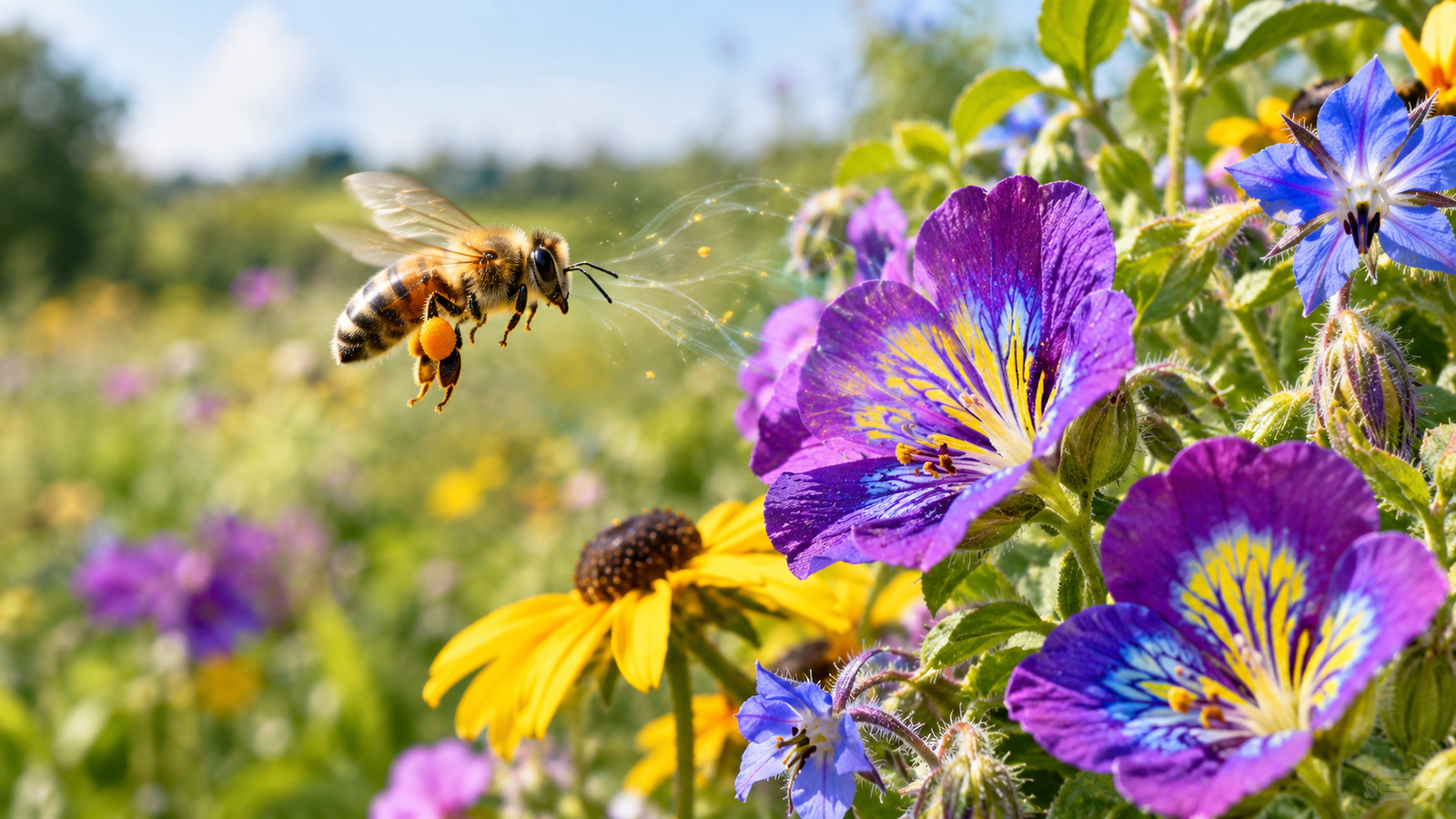
Bees find flowers using a combination of vision, smell, ultraviolet (UV) vision, memory, learning, and navigation. They are not simply flying around randomly until they happen to encounter a flower. Instead, bees use several sensory cues to identify promising flowers, determine which ones contain food, remember productive locations, and return to them.
Flowers provide bees with valuable resources, especially nectar and pollen. Nectar supplies energy, while pollen provides nutrients needed by bees and developing brood. Flowers have therefore evolved colors, shapes, scents, and patterns that can help attract pollinators such as bees.
For honey bees, the process can go even further. A successful forager can return to the hive and communicate information about a productive food source to other workers through the waggle dance.
How Do Bees Find Flowers?
Bees find flowers by combining visual and chemical information with learning and navigation.
At relatively long distances, visual characteristics such as the color and shape of a flower display can help bees identify potential food sources. As a bee gets closer, floral scent becomes increasingly useful for locating and recognizing individual flowers.
Bees can also detect ultraviolet patterns that humans cannot see. Some flowers have UV markings that act as visual guides toward areas containing nectar or pollen.
Once a bee finds a rewarding flower, it can learn characteristics such as its appearance, scent, and location. Honey bees can then communicate information about valuable flower patches to other workers.
In simple terms:
Vision helps bees notice flowers → scent helps them identify and approach them → the bee investigates the flower → nectar or pollen provides a reward → the bee learns the flower’s characteristics and location → successful honey bee foragers can share the information with the colony.
Do Bees Use Their Eyes to Find Flowers?
Yes. Vision is one of the important ways bees locate flowers.
Bees can distinguish colors, shapes, patterns, and other visual features. Their vision is different from human vision because bees can detect ultraviolet light.
Flower color can help a bee identify a large patch of flowering plants from a distance. The shape and arrangement of flowers can provide additional information.
However, color is not the only factor that determines whether a bee will visit a flower. Flower shape, the amount of nectar and pollen available, scent, the timing of flowering, and other characteristics can influence bee visitation.
What colors can bees see?
Bees have three types of color receptors that are sensitive to wavelengths centered around ultraviolet, blue, and green.
This means bees experience the colors of flowers differently from humans.
They are particularly sensitive to blue, violet, and ultraviolet portions of the spectrum. Some flowers that appear relatively ordinary to humans can have highly distinctive patterns when viewed using ultraviolet-sensitive vision.
Can Bees See Ultraviolet Light?
Yes. Bees can see ultraviolet (UV) light, which is outside the range of human vision.
Some flowers contain UV patterns on their petals. These patterns can create visual contrasts that help bees identify the center of the flower or locate areas where nectar is available.
These markings are often called nectar guides because they can help direct a visiting bee toward the rewarding parts of a flower.
From a human perspective, a flower may look like it has uniformly colored petals. To a bee, however, the same flower may have a much more noticeable pattern.
USDA pollination material describes some UV floral patterns as functioning like visual “landing lights” that guide bees toward rewarding parts of the flower.
How Do Bees Use Flower Color to Find Food?
Flower color can help bees recognize promising floral displays.
A large group of similarly colored flowers may stand out against green vegetation, making the resource easier to detect.
However, bees do not automatically assume that every flower of a particular color contains the same amount of food. They can learn from previous visits and adjust their behavior according to the rewards they encounter.
Flower color therefore works as one part of a larger system involving:
- Color
- Shape
- Scent
- Flower patterns
- Nectar
- Pollen
- Location
- Previous experience
Different bee species can also respond differently to particular flowers.
Do Bees Use Smell to Find Flowers?
Yes. Floral scent is another major cue bees use when foraging.
Flowers release volatile chemical compounds that produce their characteristic aromas. Bees detect these chemicals primarily with receptors on their antennae.
Floral scent can help bees identify flowers and distinguish between different plant species.
Research on plant-pollinator interactions has shown that floral odors can play an important role in attracting and structuring interactions between flowers and bees.
When is scent most useful?
Vision and scent can work together.
When a bee is still some distance from a flower patch, visual signals such as color and shape can help attract its attention. As the bee gets closer, the flower’s scent can become increasingly useful for identifying the individual flowers.
This means bees are not necessarily finding flowers using either sight or smell.
They can use both senses at different stages of the search.
How Do Bees Find Flowers That Are Hidden Among Other Plants?
Finding a flower becomes more challenging when it is surrounded by vegetation or by many other flowers with similar visual characteristics.
Bees can use multiple clues to distinguish potential food sources, including:
- Flower color
- Flower shape
- Floral scent
- UV patterns
- Location
- Previous experience
- The amount of nectar or pollen available
This is one reason bee foraging is more sophisticated than simply looking for the brightest flower.
A bee is effectively combining information from its surroundings with information it has learned from previous visits.
Do Flowers Give Bees Directions?
In a sense, yes.
Some flowers have nectar guides, which are visual patterns that can help direct bees toward nectar-producing areas.
These guides can be visible in ultraviolet wavelengths as well as in wavelengths humans can see.
The flower benefits because the bee is directed toward its reproductive structures, where pollen can be picked up or deposited.
The bee benefits by finding its food more efficiently.
This creates an important relationship between flower structure and bee behavior.
How Do Bees Know Which Flowers Have Nectar?
Bees learn from experience.
A bee may visit a flower and discover that it contains a useful amount of nectar. If similar flowers repeatedly provide a good reward, the bee can learn to recognize characteristics associated with that resource.
Those characteristics may include:
- Color
- Shape
- Scent
- Location
- Floral patterns
- Time of flowering
- Previous reward
Not every flower is equally valuable to a bee. The amount and quality of nectar and pollen can vary between plant species and even between individual flowers.
Studies of bee foraging have found that floral characteristics such as size, color, scent, nutritional quality, and flowering time can influence which plants bees visit.
Can Bees Remember Where Flowers Are?
Yes. Bees are capable of learning and remembering locations associated with successful foraging.
This is particularly important for honey bees because workers may repeatedly return to productive flower patches.
Research from the USDA Agricultural Research Service has demonstrated that both honey bees and bumble bees can return to previously visited foraging locations, indicating the importance of spatial memory in their foraging behavior.
A bee can use environmental information such as:
- Trees
- Buildings
- Other landscape features
- The position of the sun
- Familiar flight routes
- The location of previous food sources
This allows a bee to navigate through a complicated landscape instead of searching from scratch every time.
Do Bees Use the Sun to Find Flowers?
The sun can help bees with navigation.
Honey bees can use the sun as a directional reference and compensate for its changing position throughout the day.
This is particularly important when a bee needs to travel between the hive and a distant food source.
The bee does not simply memorize that a flower patch is “to the left” or “to the right.” Its navigation system can incorporate directional information and environmental landmarks.
The position of the sun is also important to the communication system used by honey bees.
How Do Honey Bees Tell Other Bees Where Flowers Are?
Honey bees have a remarkable communication system called the waggle dance.
When a worker returns to the hive after finding a valuable food source, it can perform a dance on the honeycomb.
The dance provides other workers with information about the location of the resource.
The direction of the waggle portion communicates the direction of the food source relative to the sun, while the duration of the waggle provides information related to distance.
Other worker bees can use this information to search for the same food source.
This means one successful forager can effectively help other bees locate a productive flower patch.
Do All Bees Use the Waggle Dance?
No.
The famous waggle dance is particularly associated with honey bees.
Other types of bees have different social structures and foraging behaviors.
For example, bumble bees do not use the same complex waggle dance system that honey bees use. Research has also found differences in how honey bees and bumble bees return to and exploit flower patches.
Solitary bees generally forage independently because they do not maintain large colonies of workers that can exchange food-location information in the same way honey bees do.
Therefore, it is important not to assume that every bee finds flowers or communicates about flowers in exactly the same way.
How Do Bumble Bees Find Flowers?
Bumble bees use their own combination of sensory cues and learning to locate flowers.
They can use:
- Vision
- Flower color
- Shape
- Scent
- Memory
- Spatial information
- Previous experience
Bumble bees can also show strong preferences for particular flower patches.
Their behavior is not identical to that of honey bees, however. Honey bees have a highly developed colony communication system centered around the waggle dance, whereas bumble bees generally rely more heavily on individual foraging and exploration.
How Do Solitary Bees Find Flowers?
Solitary bees also use sensory information such as vision and scent to locate suitable flowers.
Unlike honey bees, solitary bees generally do not have a large worker colony that shares information about food locations through a waggle dance.
They therefore depend more directly on their own ability to explore, recognize, and remember useful floral resources.
Different solitary bee species can also specialize in particular types of flowers or pollen sources.
Do Bees Know Which Flowers Are More Rewarding?
Bees can learn to prefer flowers that provide valuable rewards.
If a particular type of flower consistently provides abundant nectar or suitable pollen, a bee can learn its characteristics and return to it.
The reverse can also happen.
If a flower repeatedly provides little or no useful reward, a bee may spend less time exploiting it.
This helps bees use their limited energy efficiently.
For honey bees, returning repeatedly to productive flower patches can be especially important. A 2023 USDA study found that honey bees in its study revisited the same alfalfa flower plots more often than eastern bumble bees, illustrating differences in patch fidelity between the species.
Can Bees Recognize Different Flowers?
Yes. Bees can learn to distinguish flowers based on their visual and chemical characteristics.
They may learn associations involving:
- Color
- Shape
- Scent
- Patterns
- Location
- Reward
This ability allows bees to make more efficient choices while foraging.
For example, a bee that has repeatedly found nectar in a particular type of flower can use what it has learned to recognize similar flowers during future trips.
Can Bees Tell Whether a Flower Is Old or New?
Flower appearance can change as flowers age, and bees can use visual information when choosing flowers.
Some flowers change color or other characteristics as they mature. Such changes can potentially provide bees with information about the flower’s stage and its expected reward.
For example, certain flowers change color as they age, which can influence which flowers bees visit.
This is another example of how bees can use more than simply “flower versus no flower” when deciding where to forage.
Why Do Bees Visit Some Flowers More Than Others?
Bees do not treat every flower as equally valuable.
Their choices can be influenced by:
- Nectar availability
- Pollen availability
- Nectar quality
- Pollen nutritional quality
- Flower color
- Flower shape
- Floral scent
- Flower abundance
- Flower age
- Distance from the nest
- Previous experience
- Weather and environmental conditions
The nutritional value of pollen can also matter. Bees collect pollen for themselves and for developing brood, and pollen is an important source of nutrients for bee development.
Does Flower Shape Matter to Bees?
Yes.
Different bee species have different body sizes and tongue lengths, so they may be better suited to particular flower shapes.
Some flowers have open structures that make their nectar and pollen relatively accessible. Others have deeper or more specialized structures.
For example, bees with longer tongues can reach nectar in some deeper flowers more easily than bees with shorter tongues.
This means a flower’s shape can influence which bees are able to use it.
Can Bees Find Flowers From Far Away?
Bees can locate flowering areas from a distance, but they do not simply identify individual flowers from several kilometers away.
Instead, different cues become useful at different stages.
At greater distances, a bee may detect a large flowering display visually or use learned information about where productive resources are located.
As it gets closer, visual details and floral odors can help it locate individual flowers.
Wind can also affect how floral scents move through the environment.
Therefore, there is no single fixed distance at which a bee can “smell a flower.”
How Do Bees Find Flowers on Cloudy Days?
Bees can continue foraging under some cloudy conditions, although weather affects bee activity.
They can use visual information, landmarks, learned locations, and other navigational cues.
Honey bees can also use information related to the sun even when the sun itself is not directly visible.
However, heavy rain, strong winds, cold temperatures, and poor light can make flying and foraging more difficult.
The exact response also varies between bee species.
Do Bees Search Randomly for Flowers?
Not completely.
A bee may explore unfamiliar areas when searching for food, but successful foraging becomes more efficient once it has learned where useful flowers are located.
A bee can use previous experience to decide where to search and which flowers are worth investigating.
Honey bees have an additional advantage because successful foragers can communicate information about productive resources to other workers.
So bee foraging can involve both:
Exploration + learning + memory + navigation + communication
rather than random searching.
How Do Bees Find Flowers Step by Step?
The process can be summarized in several stages.
1. The bee leaves its nest or hive
A worker bee begins a foraging trip in search of nectar, pollen, or both.
2. The bee searches the surrounding environment
It uses visual information, odors, landmarks, and learned navigational information.
3. The bee detects potential flowers
Color, shape, floral displays, and scent can help identify promising plants.
4. The bee approaches the flowers
As the bee gets closer, details such as floral scent and visual patterns become increasingly useful.
5. The bee identifies the flower
UV patterns, nectar guides, scent, shape, and other characteristics can help the bee locate the rewarding parts of the flower.
6. The bee collects nectar or pollen
The bee obtains the food resource provided by the flower.
7. The bee learns from the visit
If the flower provides a valuable reward, the bee can learn its characteristics and location.
8. The bee returns to the nest or hive
The bee navigates back using learned environmental information.
9. Honey bees may communicate the discovery
A honey bee returning with information about a productive resource can perform the waggle dance.
10. Other bees can exploit the resource
Other foragers can use the available information to help locate the flower patch.
How Do Bees Find Flowers So Efficiently?
The remarkable part is that bees combine several systems at once.
A bee does not need to depend entirely on its sense of smell, and it does not depend entirely on its vision.
Instead, it can combine:
Vision
Helps detect colors, shapes, patterns, and flower displays.
Ultraviolet vision
Reveals patterns that humans cannot see.
Smell
Helps identify floral odors and individual flowers.
Memory
Helps bees remember successful flowers and locations.
Navigation
Helps bees travel between their nest and food sources.
Learning
Allows bees to associate particular flower characteristics with rewards.
Communication
Allows honey bees to share information about valuable food sources.
This combination makes bee foraging highly efficient.
Why Do Bees Need to Find Flowers?
Bees depend on flowers for food.
Nectar is primarily an energy source, while pollen provides nutrients needed for bees and developing brood.
During a flower visit, a bee may also pick up pollen from the flower’s reproductive structures. When it subsequently visits another flower, some of that pollen may be transferred, helping the plant reproduce.
This creates a mutually beneficial relationship:
Bee gets food → flower receives pollination.
Although not every bee visit results in successful pollination, bees are important pollinators for many flowering plants.
Frequently Asked Questions About How Bees Find Flowers
How do bees find flowers?
Bees find flowers using a combination of vision, smell, ultraviolet vision, memory, learning, and navigation. Honey bees can also receive information about productive flower locations from other workers through the waggle dance.
Do bees find flowers by smell or sight?
They use both smell and sight. Vision can help bees detect flower displays, colors, shapes, and patterns, while floral scent becomes especially useful as bees approach individual flowers.
Can bees smell flowers from far away?
Floral odors can help bees locate and recognize flowering plants, but the effective distance varies with the plant, wind, environmental conditions, and other factors.
Can bees see ultraviolet light?
Yes. Bees can detect ultraviolet wavelengths that humans cannot see. Some flowers have UV patterns that help guide bees toward rewarding parts of the flower.
Do bees use the sun to find flowers?
The sun can provide important directional information for bee navigation. Honey bees also use the sun’s position as part of the information encoded in their waggle dance.
How do honey bees tell other bees where flowers are?
Honey bee workers can perform a waggle dance that communicates information about the direction and approximate distance of a food source.
Do bees remember where flowers are?
Yes. Bees can learn and remember locations associated with successful foraging. This allows them to return to productive flower patches.
Do all bees use the waggle dance?
No. The complex waggle dance is characteristic of honey bees. Other bees, including bumble bees and solitary bees, use different foraging and communication strategies.
Why do bees visit some flowers more than others?
Bees may prefer flowers based on factors such as nectar and pollen availability, nutritional quality, color, shape, scent, abundance, previous experience, and distance from the nest.
Can bees recognize different types of flowers?
Yes. Bees can learn visual and chemical characteristics of flowers, allowing them to distinguish between different floral resources and return to rewarding ones.
Final Answer: How Do Bees Find Flowers?
So, how do bees find flowers?
Bees find flowers by combining vision, smell, ultraviolet perception, learning, memory, and navigation. From a distance, visual features such as color and the overall shape of a flower display can help bees identify potential food sources. As they approach, floral scents and detailed visual patterns can help them locate and recognize individual flowers.
Many flowers also provide nectar guides and ultraviolet patterns that help bees find rewarding areas within the flower. Once a bee discovers a useful source of nectar or pollen, it can learn the flower’s appearance, scent, and location and return to it later.
Honey bees have an additional advantage: successful foragers can communicate the location of valuable food sources to other workers using the waggle dance.
Different bees do not all use exactly the same strategy, but the overall process combines senses, learning, memory, navigation, and—especially in honey bees—communication.
In short:
Bees find flowers by seeing them, smelling them, recognizing their patterns, remembering productive locations, and learning which flowers provide the food they need.
That remarkable combination of abilities allows bees to efficiently locate flowers and helps connect flowering plants with one of nature’s most important pollination systems.
