

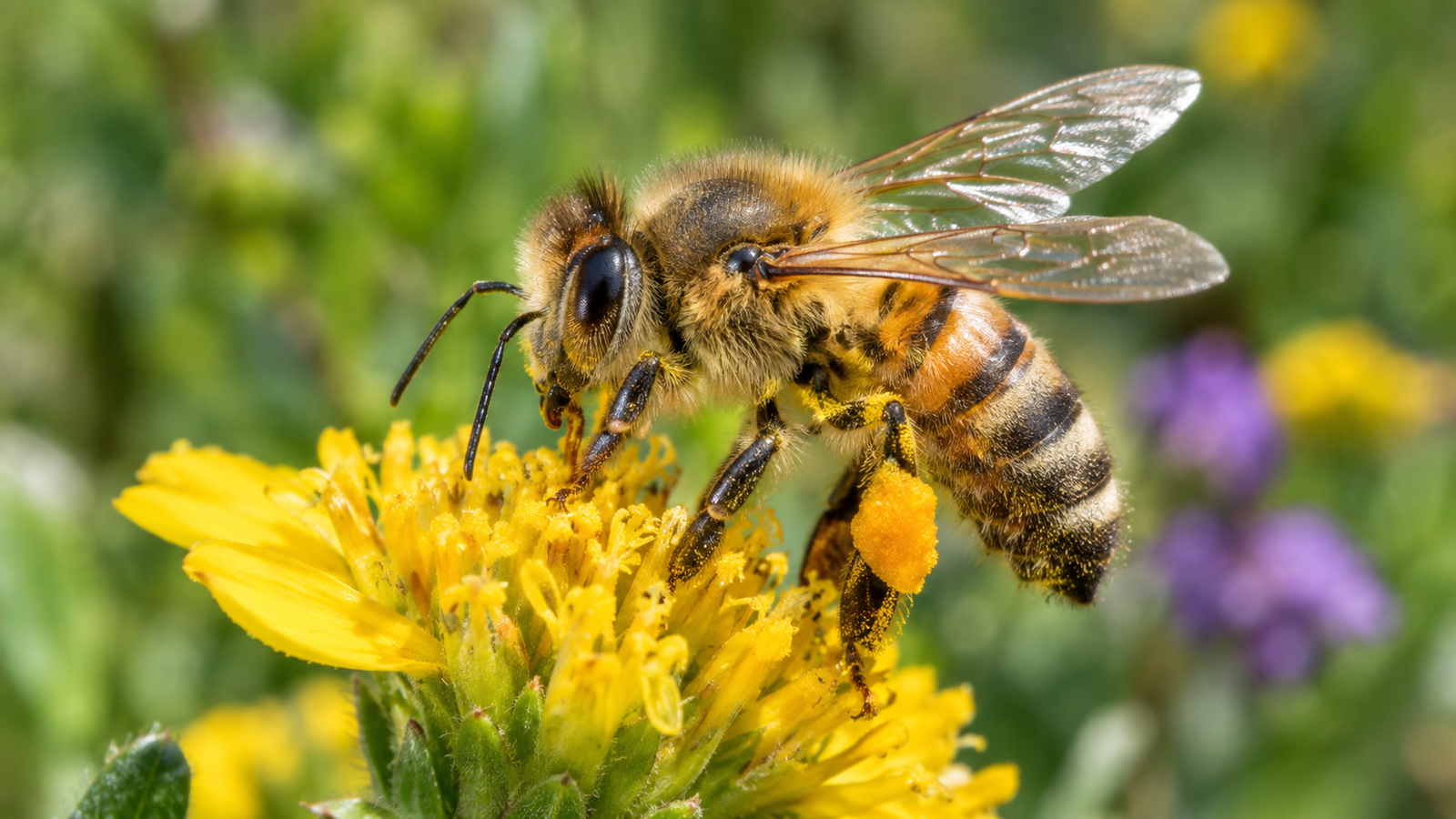
Knowing how to identify a honey bee can be surprisingly difficult because honey bees can look similar to bumble bees, wasps, yellowjackets, carpenter bees, and other insects. Their color can also vary, so simply looking for a yellow-and-black striped insect is not a reliable way to identify one.
A honey bee can usually be recognized by its medium-sized body, brown to golden-brown coloration, darker abdominal bands, hairy body, hairy compound eyes, and specialized pollen-carrying structures on the hind legs of workers. Worker honey bees also have broad, flattened hind-leg segments and lack hind tibial spurs.
The most familiar honey bee is the western honey bee, Apis mellifera. Adult workers are generally around 10–15 mm long, although queens and drones are larger.
This guide explains how to identify a honey bee using its appearance, body shape, eyes, wings, legs, pollen baskets, behavior, and differences from similar insects.
Quick Answer: How Do You Identify a Honey Bee?
To identify a honey bee, look for several characteristics together rather than relying on one feature.
A typical worker honey bee has:
- A brown, amber, or golden-brown body
- Darker bands across the abdomen
- A moderately hairy body
- Hairy compound eyes
- A compact, barrel-shaped abdomen
- Six legs and two pairs of wings
- Broad, flattened hind-leg segments
- Pollen baskets, called corbiculae, on the hind legs
- No hind tibial spurs
- A relatively narrow but not sharply pinched connection between the thorax and abdomen
When a worker is carrying pollen, the pollen may appear as a visible yellow, orange, cream, or reddish load on each hind leg.
The combination of these characteristics is much more useful than color alone.
What Does a Honey Bee Look Like?
A honey bee is a medium-sized bee with a relatively compact body and noticeable hairs, particularly around the head and thorax.
The western honey bee, Apis mellifera, commonly has:
- Brown or amber body coloration
- Golden or yellowish hairs
- Darker abdominal bands
- Dark legs
- A hairy thorax
- Hairy compound eyes
- Transparent wings
- A pollen basket on each hind leg of workers
Color can vary considerably between honey bees, so an individual may look darker or lighter than another.
Some honey bees can appear quite dark, while others have more obvious golden or amber coloration.
Therefore, do not reject an insect as a honey bee simply because it is too dark or because it does not have bright yellow stripes.
Honey Bee Identification at a Glance
| Feature | What to look for |
|---|---|
| Scientific name | Apis mellifera |
| Typical worker size | About 10–15 mm |
| Body color | Brown, amber, golden-brown, or darker |
| Abdomen | Dark and light bands |
| Body hair | Moderate, especially on the thorax |
| Eyes | Compound eyes are hairy |
| Hind legs | Workers have pollen baskets |
| Tibial spurs | Absent on the hind legs |
| Wings | Two pairs of transparent wings |
| Nesting | Managed hives or suitable cavities |
| Social behavior | Large colonies |
| Main food collected | Nectar and pollen |
1. Check the Honey Bee’s Body Color
Color is one of the first things people notice, but it should not be the only identification feature.
Honey bees are commonly brown, reddish-brown, amber, or golden-brown, with darker bands across the abdomen.
Their appearance can vary among different populations and subspecies.
A honey bee may therefore look:
- Light golden-brown
- Amber
- Reddish-brown
- Dark brown
- Almost black in some individuals
This variation explains why the familiar cartoon image of a bright yellow-and-black bee can be misleading.
Don’t identify a honey bee by color alone
If an insect is bright yellow and black, that does not automatically make it a honey bee.
Likewise, a very dark bee is not automatically something other than a honey bee.
Instead, combine color with body hair, body shape, eyes, wings, and hind legs.
2. Look at the Body Hair
Honey bees have noticeable body hairs, especially around the thorax and head.
The hair helps collect pollen as the bee visits flowers.
However, honey bees are not usually as extremely fuzzy as many bumble bees.
A useful comparison is:
Honey bee: moderately hairy
Bumble bee: usually much larger and fuzzier
Wasp: generally smoother and shinier
The amount of visible hair can vary depending on the bee’s condition and the quality of the photograph, so it should be used together with other features.
3. Check the Abdomen
The abdomen is another useful feature.
A honey bee generally has an abdomen with alternating darker and lighter areas or bands.
The abdomen tends to look relatively broad and compact rather than extremely long and narrow.
The exact banding pattern varies, so there is no single abdominal stripe pattern that every honey bee must have.
When identifying a bee, look at:
- The overall abdominal shape
- The color pattern
- The amount of hair
- The relationship between the abdomen and thorax
Together, these features can help distinguish a honey bee from a wasp or another bee.
4. Look at the Honey Bee’s Eyes
One of the more distinctive identification features of honey bees is their hairy compound eyes.
This feature is difficult to see with the naked eye but can become obvious in a close photograph or under magnification.
The eyes are large compound structures located on either side of the head.
If you have a clear close-up photograph, inspect the eyes carefully.
What about male honey bees?
Male honey bees, called drones, have particularly large eyes. Their eyes meet at the top of the head, giving them a distinctive appearance.
This is useful when identifying a drone rather than a typical worker.
5. Examine the Hind Legs
The hind legs are among the most useful parts of a honey bee to examine.
Worker honey bees have specialized structures for collecting and transporting pollen.
The outer surface of the hind tibia contains a pollen basket, known scientifically as a corbicula.
A pollen basket looks like a relatively smooth or concave area surrounded by hairs.
When filled with pollen, it becomes much easier to recognize.
What Does a Honey Bee Pollen Basket Look Like?
A worker honey bee may return to its colony with small masses of pollen attached to the outside of its hind legs.
The pollen may appear:
- Yellow
- Orange
- Cream
- Red
- Brown
- Greenish, depending on the plants visited
If you see a bee carrying organized pollen loads on its hind legs, that is an important clue that you are looking at a worker bee.
However, not every worker honey bee will have visible pollen.
A worker may be collecting nectar instead, traveling between locations, or performing another task.
Therefore, the absence of pollen does not mean the insect is not a honey bee.
6. Look for Broad, Flattened Hind-Leg Segments
A closer examination of a worker honey bee’s hind legs reveals another useful characteristic.
The hind tibia and basitarsus are relatively broad and flattened compared with many other bees.
These structures help the bee collect, compress, and transport pollen.
The pollen basket is located on the hind tibia.
This feature is particularly useful when examining a clear photograph of the bee from the side or above.
7. Check for Hind Tibial Spurs
Another specialized identification feature is the absence of hind tibial spurs.
Many other bees have spurs at the end of the hind tibia.
Honey bees lack these hind tibial spurs.
This is a more advanced identification characteristic and is usually easier to observe with a close-up photograph or microscope than with the naked eye.
It is particularly useful when trying to distinguish a honey bee from another bee that looks superficially similar.
8. Examine the Wings
Honey bees have two pairs of transparent wings.
The wings attach to the thorax and can extend beyond parts of the abdomen when the bee is resting.
For advanced identification, the wing veins and cells can provide additional clues.
One distinctive feature of Apis is an unusually long marginal cell near the front edge of the wing.
You normally do not need to examine wing venation to identify an ordinary honey bee in a garden, but it can be useful for detailed identification from a specimen or high-quality photograph.
9. Look at the Head and Antennae
A honey bee has:
- Two large compound eyes
- Three small simple eyes, called ocelli
- Two antennae
- Specialized mouthparts
The antennae are used for sensing odors, touch, and other environmental information.
Honey bees also have mouthparts adapted for collecting and consuming nectar and other foods.
The head shape and antennae can help distinguish bees from flies and other insects that may resemble them.
10. Look at the Overall Body Shape
Body shape is one of the easiest ways to distinguish a bee from a wasp.
Honey bees generally have a compact body without the extremely narrow waist associated with many wasps.
A typical honey bee has three main body regions:
Head → Thorax → Abdomen
The connection between the thorax and abdomen is present, but it is not usually as sharply pinched as the waist of a typical wasp.
Worker, Queen, and Drone: Which Honey Bee Are You Seeing?
Not all honey bees in a colony look exactly alike.
A honey bee colony contains different types of adult bees, including workers, queens, and drones.
Worker Honey Bee
Worker bees are female and are the honey bees people most commonly see visiting flowers.
They are generally:
- Smaller than queens
- Around 10–15 mm long
- Responsible for foraging
- Able to collect pollen
- Equipped with pollen baskets
- Equipped with a functional sting
If you see a small honey bee visiting flowers, it is most likely a worker.
Queen Honey Bee
The queen is considerably larger and has a longer abdomen.
She normally spends most of her time within the colony rather than visiting flowers.
Her body is more elongated than that of a worker.
Drone Honey Bee
Drones are male honey bees.
They are generally:
- Larger and broader than workers
- Equipped with very large eyes
- Without pollen baskets
- Unable to sting
One of the easiest ways to recognize a drone is its large eyes, which meet at the top of the head.
How to Identify a Honey Bee by Sex
Sex can sometimes provide another identification clue.
Female honey bees have 12 antennal segments, while males have 13.
Drones also have noticeably larger eyes than workers and queens.
For ordinary garden identification, however, you usually do not need to count antennal segments. Body shape, eyes, wings, coloration, and hind-leg features are more practical.
Honey Bee vs. Bumble Bee
Honey bees and bumble bees are both important pollinators, but they usually look quite different.
Honey bees
- Medium-sized
- Moderately hairy
- Brown or amber
- Dark abdominal bands
- Pollen baskets on worker hind legs
- Relatively compact body
Bumble bees
- Usually larger
- Much fuzzier
- More robust
- Often covered in conspicuous bands of black, yellow, orange, red, or white hairs
- Also have pollen baskets
Both can carry pollen on their hind legs, so the pollen basket alone does not distinguish a honey bee from a bumble bee.
Body size, hairiness, coloration, and other anatomical characteristics should be considered together.
Honey Bee vs. Wasp
Wasps are among the most common insects confused with honey bees.
Honey bee
- Hairier body
- Brown or amber coloration is common
- More compact appearance
- Pollen baskets on worker hind legs
- No pronounced narrow waist
Wasp
- Usually smoother and shinier
- Often strongly yellow and black
- More slender
- Pronounced narrow waist
- Does not have the honey bee’s pollen basket
If an insect looks shiny, smooth, and extremely narrow between the thorax and abdomen, it may be a wasp rather than a honey bee.
Honey Bee vs. Yellowjacket
Yellowjackets are particularly easy to mistake for honey bees because of their yellow-and-black markings.
Look closely at the body.
A yellowjacket generally has:
- A smooth, shiny body
- Bright yellow and black markings
- A narrow waist
- A slender appearance
A honey bee generally has:
- More body hair
- Brown or amber coloration
- A stockier appearance
- Pollen baskets on worker hind legs
- Less sharply pinched body shape
The two insects can also behave differently, but physical characteristics are more reliable for identification.
Honey Bee vs. Carpenter Bee
Carpenter bees can be much larger and more robust than honey bees.
Many carpenter bees have a dark, relatively shiny abdomen and can lack the obvious banding associated with honey bees.
A honey bee is generally smaller and has a more visibly banded abdomen.
Looking at body size, abdominal appearance, and overall shape can help separate them.
Honey Bee vs. Other Bees
Not every bee visiting a flower is a honey bee.
There are many different bee species, and some can look remarkably similar.
Other bees may differ in:
- Size
- Color
- Hair patterns
- Pollen-carrying structures
- Leg shape
- Eye characteristics
- Nesting behavior
- Wing structure
This is why accurate identification should ideally be based on multiple characteristics.
Where Are Honey Bees Found?
Honey bees can live in managed colonies as well as suitable natural or human-made cavities.
You may encounter them:
- In beehives
- Inside hollow trees
- In wall cavities
- In roof spaces
- Around flowering plants
- In orchards
- In gardens
- Around farms
- In other locations where suitable food and nesting sites are available
Honey bees are social insects and can form large colonies.
A large group of honey bees gathered together may be a colony or a swarm, depending on the situation.
How to Identify a Honey Bee in a Hive
If you see bees living in a hive, several clues can help.
Honey bee colonies produce wax comb containing hexagonal cells and can contain large numbers of workers.
However, simply seeing a large group of bees does not automatically establish their species.
For individual identification, look at:
- Body coloration
- Hairiness
- Abdominal pattern
- Eyes
- Hind legs
- Pollen baskets
- Body shape
If you are dealing with a colony in a building or another location where the bees could pose a risk, avoid disturbing it.
How to Identify a Honey Bee From a Photograph
A photograph can be enough to identify many honey bees if the important body features are visible.
For the clearest identification photograph, try to capture:
- The entire body
- The side of the bee
- The head
- The hind legs
- The wings
- The abdomen
A close-up photograph of the head may reveal the hairy eyes.
A photograph of the hind legs may reveal the pollen basket.
A clear image of the wings may allow more advanced identification based on wing venation.
If the photograph is blurry or only shows the insect from a distance, identification may be much less certain.
Honey Bee Identification Checklist
When you encounter a bee, ask:
- Is it around 10–15 mm long if it appears to be a typical worker?
- Is the body brown, amber, golden-brown, or darker?
- Does the abdomen have darker bands?
- Is the thorax visibly hairy?
- Are the compound eyes hairy when viewed closely?
- Does the insect have a compact body?
- Does it have six legs?
- Does a worker have pollen baskets on its hind legs?
- Are the hind legs broad and flattened?
- Are hind tibial spurs absent?
- Does it lack the sharply pinched waist typical of many wasps?
- Is it visiting flowers or collecting nectar and pollen?
The more characteristics that match, the stronger the identification.
The Most Important Honey Bee Identification Features
If you only remember a few characteristics, remember these:
1. Brown or golden-brown body
Honey bees are not necessarily bright yellow and black.
2. Hairy body
They have visible hairs, especially around the thorax.
3. Hairy eyes
The compound eyes of honey bees are unusually hairy and can be seen clearly with magnification.
4. Pollen baskets
Worker honey bees carry pollen in corbiculae on their hind legs.
5. No hind tibial spurs
This is a useful advanced identification feature.
6. Flattened hind legs
Worker honey bees have broad, flattened hind-leg segments associated with pollen collection.
7. Compact body
Honey bees do not have the strongly pinched waist characteristic of many wasps.
Frequently Asked Questions
What does a honey bee look like?
A honey bee is a medium-sized, moderately hairy bee that is commonly brown, amber, or golden-brown with darker bands on the abdomen. Workers have pollen baskets on their hind legs.
How can you tell if a bee is a honey bee?
Look for a combination of brown or amber coloration, a hairy body, dark abdominal bands, hairy eyes, a compact body, and pollen baskets on the hind legs of workers.
Are honey bees yellow and black?
They can have yellowish or golden areas and dark bands, but honey bees are often more brown or amber than the bright yellow-and-black insects people commonly associate with wasps and yellowjackets.
How big is a honey bee?
Worker honey bees are generally around 10–15 mm long. Queens and drones are larger.
What color are honey bees?
Honey bees can range from light brown or amber to considerably darker shades. Their abdomen commonly contains darker bands.
Do honey bees have hair?
Yes. Honey bees have noticeable hairs, especially on the head and thorax. Their compound eyes are also hairy.
Do honey bees carry pollen on their legs?
Yes. Worker honey bees collect pollen and carry it in specialized pollen baskets called corbiculae on their hind legs.
What is a honey bee pollen basket?
A pollen basket, or corbicula, is a specialized area on the outside of a worker honey bee’s hind tibia that is used to carry collected pollen back to the colony.
Do honey bees have tibial spurs?
Honey bees lack the hind tibial spurs found in many other bees. This is an advanced but useful identification characteristic.
How can you tell a honey bee from a wasp?
Honey bees are generally hairier and more compact, while wasps are often smoother, shinier, and have a more sharply narrowed waist. Worker honey bees also have pollen baskets on their hind legs.
How can you tell a honey bee from a bumble bee?
Bumble bees are generally larger and much fuzzier. Honey bees are usually smaller, less fuzzy, and more brown or amber in appearance. Both can have pollen baskets, so size, hairiness, coloration, and other characteristics should be considered.
Can a honey bee be completely black?
Honey bee coloration varies, and some individuals can appear very dark. Color alone should not be used to rule out a honey bee.
Can you identify a honey bee from its eyes?
The hairy compound eyes are a useful identification characteristic, especially when examining a close-up photograph or specimen.
How can you identify a male honey bee?
A male honey bee, or drone, is generally larger and broader than a worker and has very large eyes that meet at the top of the head. Drones do not collect pollen and do not have pollen baskets.
How can you identify a worker honey bee?
A worker is a female honey bee that is generally smaller than a queen. Workers commonly visit flowers, collect nectar and pollen, and have pollen baskets on their hind legs.
Final Thoughts
Learning how to identify a honey bee is easier when you look at several characteristics instead of relying on color alone.
A typical worker honey bee is a medium-sized, brown or golden-brown, moderately hairy bee with darker abdominal bands, hairy compound eyes, and specialized hind legs for carrying pollen.
For more detailed identification, examine the pollen baskets, flattened hind-leg segments, absence of hind tibial spurs, hairy eyes, and wing structure.
The most important lesson is to use multiple features together. A bee that looks yellow is not necessarily a honey bee, and a dark or unusually colored bee is not necessarily a different species.
When you combine body shape, coloration, hairiness, eyes, legs, pollen-carrying structures, and behavior, you can make a much more reliable honey bee identification.
