

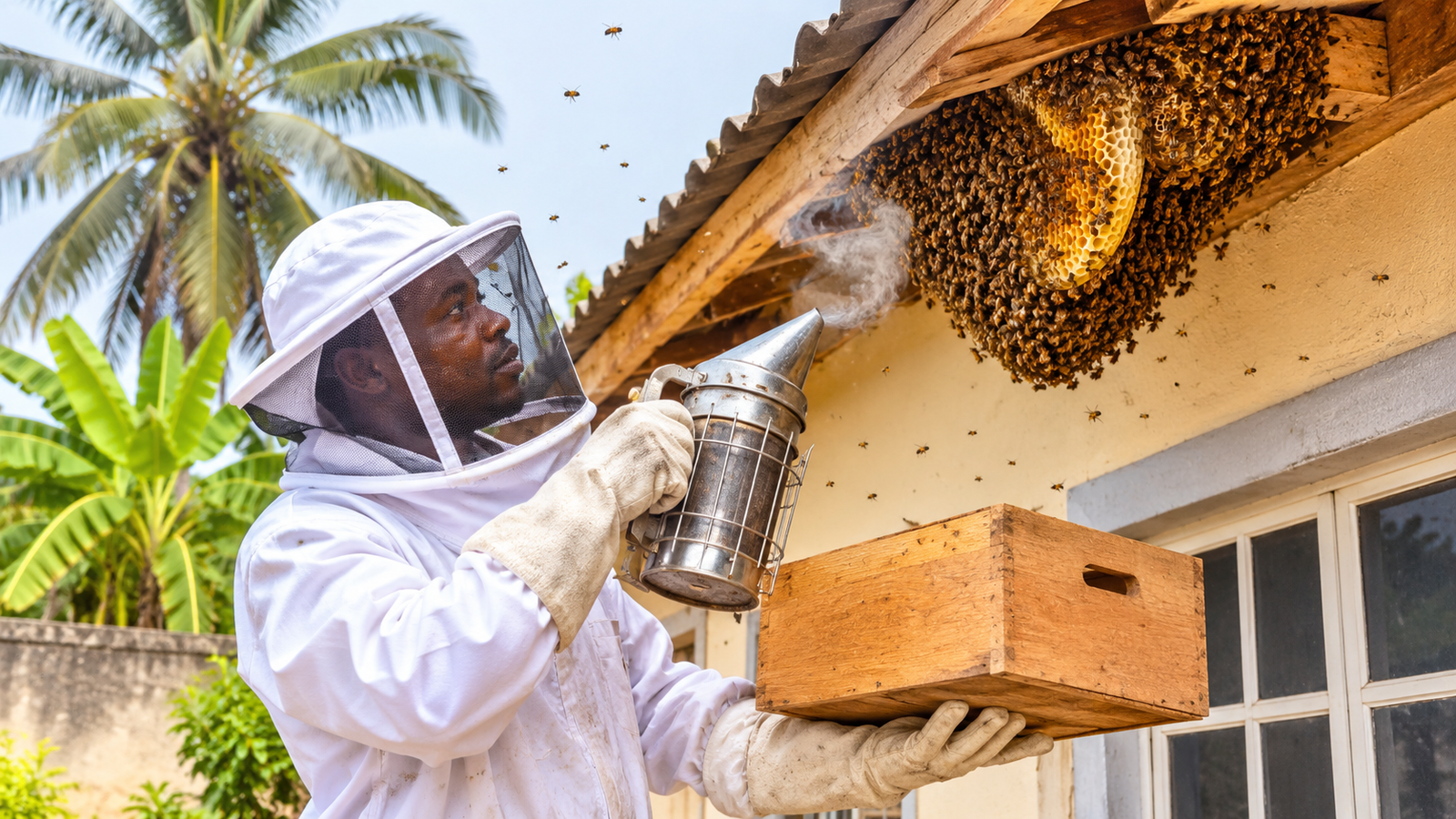
Bee removal in Nigeria does not have one fixed price. The amount you pay depends on the size of the colony, where the bees have built their nest, how difficult it is to reach, and whether you need live bee relocation or complete nest removal.
A beekeeper may collect a newly arrived honeybee swarm from a tree at a relatively low cost, or even without charging a removal fee. However, removing an established colony from inside a ceiling, roof or wall can be considerably more expensive because the work may involve opening the structure, extracting honeycomb, cleaning the cavity and repairing damaged areas.
There is no sufficiently verified nationwide Nigerian tariff that establishes an average bee removal price. Therefore, the most reliable way to determine your cost is to obtain a quotation based on an inspection of the actual colony.
This guide explains what determines bee removal costs in Nigeria, the services you may need to pay for, how to find qualified professionals and how to avoid unnecessary expenses.
1. How much does bee removal cost in Nigeria?
The cost of bee removal in Nigeria depends primarily on the type of removal required.
Rather than applying one price to every situation, it is useful to divide removal jobs into different categories.
| Type of removal | Work involved | Cost considerations |
|---|---|---|
| Small swarm on a tree | Collecting and transferring clustered bees | Collection, transportation and accessibility |
| Swarm on a building exterior | Capturing bees from an exposed surface | Height, equipment and labour |
| Colony beneath roof sheets | Accessing the nest and collecting bees | Roofing access and extraction |
| Colony inside a ceiling | Opening ceiling sections and removing the nest | Labour, extraction and ceiling repairs |
| Colony inside a wall | Opening the wall and removing comb | Structural work, cleaning and reconstruction |
| Large commercial colony | Managing a large or difficult infestation | Additional workers, equipment and safety arrangements |
The table describes relative job complexity, not fixed Nigerian market prices.
What should a bee removal quotation include?
A professional quotation should separate the different services involved.
For example:
| Service | What you are paying for |
|---|---|
| Inspection | Identifying the insect, nest location and colony condition |
| Transportation | Travel to and from your property |
| Labour | Time spent capturing or extracting the colony |
| Protective equipment | Appropriate protective clothing and specialist tools |
| Live relocation | Capturing and transporting the colony to a suitable location |
| Structural extraction | Opening the ceiling, roof or wall to access the nest |
| Honeycomb removal | Removing wax comb, stored honey and other nest material |
| Cleaning | Removing debris and cleaning the affected cavity |
| Repairs | Restoring roofing, ceilings or walls |
| Follow-up | Checking the property after removal |
Not every job requires all these services.
For instance, a swarm hanging from a low tree branch may not require carpentry, cleaning or structural repairs.
However, a colony that has lived inside a ceiling for several months may require most of them.
Important: Do not accept a quotation simply because it offers the lowest removal fee. Confirm whether it covers the complete job or only the removal of the visible bees.
2. Why does bee removal cost more in some Nigerian homes?
The location and condition of the colony can make a significant difference to the work involved.
Example 1: A swarm on a tree in Ibadan
A homeowner notices a cluster of honeybees hanging from a low mango tree. There is no visible honeycomb, and the bees have only recently arrived.
A beekeeper may be able to collect the swarm using a suitable hive box without cutting or damaging anything.
Main cost factors: Collection and transportation.
Example 2: Bees under a roof in Lagos
Bees repeatedly enter a small opening beneath the roofing sheets. The colony may have constructed comb inside the roof cavity.
The specialist must locate the nest and determine how to access it without causing unnecessary damage.
Main cost factors: Height, roofing access and colony extraction.
Example 3: A colony inside an Abuja apartment ceiling
The homeowner hears buzzing above the ceiling and notices bees entering through a small opening.
An established colony may contain several combs with brood, pollen and stored honey. The ceiling may need to be opened to remove the nest completely.
Main cost factors: Labour, structural extraction, cleaning and repairs.
Example 4: A colony near livestock on a farm in Ogun State
Bees have established a colony close to a livestock enclosure where workers and animals regularly pass.
The professional must consider the colony’s location, the animals’ movement and the safest way to manage the bees.
Main cost factors: Site preparation, safety arrangements, equipment and transportation.
These are illustrative Nigerian situations, not reports of actual customer quotations.
They demonstrate why two properties can receive very different removal estimates even when both have what the owners describe as a bee infestation.
3. What factors determine the cost of removing bees?
There are seven important factors to consider.
A. Size and maturity of the colony
A newly arrived swarm and a mature colony are not the same thing.
A honeybee swarm forms when an established colony reproduces through swarming. The old queen leaves with a large group of worker bees to establish a new colony.
The swarm temporarily gathers in a cluster while scout bees search for a suitable nesting location.
During this stage, the bees have not necessarily constructed a permanent nest.
Once they enter a suitable cavity, the workers begin building wax combs, and the colony can establish a permanent home.
This distinction matters because collecting a temporary swarm is usually much simpler than extracting a colony that has constructed extensive combs.
Cornell University’s swarm removal guidance explains the difference between temporary swarms and established colonies. CALS+1
B. Nesting location
The nest location determines how much work is needed to reach the bees.
For example:
- Trees: A low, accessible swarm may be collected without structural work.
- Roof spaces: Roofing materials may need to be removed to reach the colony.
- Ceilings: The contractor may need to open ceiling panels.
- Walls: Access may require removing part of the wall.
- Underground locations: The insect may be a ground-nesting bee or wasp rather than a honeybee colony.
A difficult-to-access colony generally requires more planning, equipment and labour.
C. Amount of honeycomb inside the structure
An established honeybee colony constructs wax combs made up of hexagonal cells.
These cells serve different purposes, including:
- Raising worker bee brood.
- Raising drone brood.
- Storing honey.
- Storing pollen.
The longer a colony occupies a suitable cavity, the more comb it may construct.
This creates additional work during removal.
For example, a colony inside a ceiling may contain several connected combs attached to the roof structure.
Removing only the adult bees while leaving the comb and stored honey behind is an incomplete solution.
The remaining material can attract ants, wax moths and other pests, and may cause staining and odour problems.
The University of Georgia’s bee-building guidance explains why the comb and other colony materials need to be removed from an established nest. Bee Program+1
D. Height and accessibility
A colony hanging two metres above the ground is different from one located several metres above a roof.
The specialist may need:
- Appropriate ladders.
- Safe access equipment.
- Additional workers.
- Protective clothing.
- Specialised extraction equipment.
Do not allow an inexperienced person to climb onto a roof or dismantle a ceiling simply to reduce the cost.
E. Transportation distance
Nigeria has different levels of access to professional beekeeping services.
A beekeeper operating in one part of Lagos may not be willing to travel to a remote community in another state without charging transportation.
Before hiring someone, ask whether the quotation includes:
- Travel to your property.
- Equipment transportation.
- Transportation of the captured colony.
- Disposal or handling of removed materials.
F. Live relocation versus extermination
The removal method can significantly affect the amount of work involved.
Live relocation requires capturing the colony and transferring it to a suitable hive or managed apiary.
Structural extraction may require removing comb and carefully handling the bees so that the colony can be preserved.
Extermination may involve treating the colony, but an established nest inside a building still requires attention to the remaining comb and debris.
G. Urgency and safety requirements
A colony close to a busy entrance, school, market, livestock enclosure or workplace may require prompt attention.
The professional may need to organise additional safety arrangements, restrict access to the affected area and schedule workers appropriately.
Emergency work may also involve additional call-out or transportation charges.
4. How to identify the bees before paying for removal
One of the most overlooked aspects of bee removal is identifying the insect correctly.
Not every insect that looks like a bee is a honeybee.
Some people pay for honeybee removal when the problem is actually a wasp nest or a solitary bee nesting in the ground.
Here is a useful identification guide.
| Insect | Common appearance | Nesting behaviour | Typical management |
|---|---|---|---|
| Honeybee | Brownish, hairy body | Large colonies with wax comb | Beekeeper or bee removal specialist |
| Bumblebee | Stout, hairy body | Usually smaller seasonal colonies | Specialist assessment |
| Solitary bee | Often small, sometimes metallic | Individual nests in soil, wood or cavities | Usually leave undisturbed unless necessary |
| Paper wasp | Slender body, relatively narrow waist | Paper-like open comb nest | Qualified pest professional |
Honeybees
Honeybees belong to the genus Apis.
They live in organised colonies containing a queen, workers and drones.
They produce wax combs and store honey and pollen.
In Nigeria, honeybees are important agricultural pollinators and are also managed for honey production.
An established honeybee colony inside a building may require specialist extraction.
Bumblebees
Bumblebees belong to the genus Bombus.
They are generally larger and more robust than honeybees and have dense body hair.
Their colonies are usually much smaller than honeybee colonies and often have seasonal life cycles.
Their management requirements differ from those of honeybees.
Solitary bees
Solitary bees do not establish large, permanent colonies like honeybees.
Many species nest individually in soil, hollow plant stems or small cavities.
Seeing several bees flying around a patch of bare soil does not necessarily mean that you have a dangerous bee infestation.
If they are not creating a safety problem, leaving them undisturbed may be the best option.
Wasps
Wasps are often mistaken for bees.
Many wasps have relatively smooth bodies and a noticeably narrow waist. Paper wasps construct nests from chewed plant material, producing a papery structure.
They are not honey-producing honeybee colonies, so a beekeeper’s swarm collection service may not be appropriate.
Important identification advice: Do not approach the nest to inspect the insects closely. Take a photograph from a safe distance if possible and send it to the professional.
5. Is live bee removal cheaper than extermination in Nigeria?
Not necessarily.
The cheapest option depends on the type of colony and its location.
For a newly arrived swarm, live collection may be relatively straightforward.
For a colony inside a wall, live extraction may require more specialised labour and careful removal of the comb.
However, extermination does not eliminate the need for structural cleaning when the colony is inside a building.
| Comparison | Live removal | Extermination |
|---|---|---|
| Main purpose | Preserve and relocate the colony | Kill or control the colony |
| Bee survival | Colony may survive | Colony does not survive |
| Honeycomb removal | Required for established structural nests | Also required |
| Specialist knowledge | Beekeeping and extraction skills | Appropriate pest-control expertise |
| Structural repairs | May be required | May be required |
| Best application | Suitable honeybee colonies that can be safely relocated | Situations where safe relocation is impractical or inappropriate |
Why live removal is valuable
Honeybees provide pollination services that support agricultural production and natural ecosystems.
They also produce honey, beeswax and other useful hive products.
When a healthy colony can be safely relocated, preserving it has ecological and potential economic benefits.
The FAO’s publication Beekeeping in Africa discusses African beekeeping practices, including catching wild swarms and transferring colonies into managed hives. FAOHome+1
Nevertheless, human safety comes first. Relocation should only be attempted by someone with appropriate experience and equipment.
6. Can you get free bee removal in Nigeria?
Yes, some beekeepers may collect honeybee swarms without charging a removal fee.
However, free collection depends on the circumstances.
A beekeeper may be interested in your colony because it could become an additional production hive.
For example, imagine a beekeeper operating an apiary outside Abeokuta who receives a call about a newly arrived swarm hanging from a low tree.
If the swarm is healthy, accessible and easy to transport, the beekeeper may agree to collect it without charging for the work.
The situation is different when a colony has occupied a ceiling for several months.
The beekeeper may have to:
- Inspect the structure.
- Locate the entire nest.
- Arrange safe access.
- Open the ceiling.
- Remove the bees and comb.
- Transfer the colony if relocation is possible.
- Clean the cavity.
This is a much more demanding service.
When might a beekeeper collect bees for free?
- The bees are honeybees.
- The colony is a newly arrived swarm.
- The swarm is accessible.
- The colony appears suitable for relocation.
- The beekeeper operates nearby.
- There is no significant structural work.
Remember that free collection does not necessarily mean free transportation, ceiling repairs or cleaning.
7. How to find bee removal services in Nigeria
Finding a suitable specialist is important because ordinary pest-control experience does not automatically mean someone knows how to extract an established honeybee colony.
Here are four practical ways to find help.
Contact local beekeepers
Start by looking for beekeepers in your state.
Search for:
- Beekeepers in Lagos State.
- Honeybee removal in Abuja.
- Bee relocation in Ogun State.
- Beekeepers in Ibadan.
- Bee removal in Port Harcourt.
- Beekeeping services in Enugu.
Ask whether they handle both temporary swarms and established colonies inside buildings.
Contact agricultural organisations
Agricultural extension officers and beekeeping organisations may know experienced beekeepers operating in your area.
You can ask whether there are people who provide colony collection, relocation or extraction services.
Search local agricultural communities
Nigerian farming and beekeeping communities on Facebook and other social platforms can help you find recommendations.
Include your state and town when requesting assistance.
Contact reputable pest-control companies
If the colony creates an immediate safety problem, a qualified pest-control company may be able to assess the situation.
Ask whether they have experience with honeybee colonies and whether they offer live relocation.
Do not assume that every company advertising pest control has the skills needed for structural bee extraction.
Questions to ask before hiring someone
Use this checklist before accepting a quotation.
- Have you removed honeybee colonies from buildings before?
- Can you identify honeybees and distinguish them from wasps?
- Do you offer live relocation?
- Does the price include transportation?
- Will you remove all honeycomb and stored honey?
- Does the service include cleaning?
- Are ceiling or wall repairs included?
- Do you provide a follow-up inspection?
- What happens if another swarm enters the same location?
A professional should be able to explain the work involved and identify which services are included in the price.
8. How to estimate your bee removal cost before contacting a professional
Although you cannot calculate an accurate quotation without an inspection, you can prepare the information that a professional needs.
Use the following guide.
| Information required | Example |
|---|---|
| Location | Ikeja, Lagos |
| Type of insect | Suspected honeybees |
| Nest location | Inside ceiling |
| Colony condition | Bees entering and leaving daily |
| Estimated duration | Approximately three months |
| Accessibility | Ceiling opening required |
| Preferred method | Live relocation if possible |
| Additional work | Honeycomb removal and ceiling restoration |
You can then ask the professional to provide an itemised quotation.
Example quotation structure
This is an illustrative quotation template, not a real market price.
| Cost item | Quotation |
|---|---|
| Inspection and assessment | ₦_____ |
| Transportation | ₦_____ |
| Labour and protective equipment | ₦_____ |
| Bee collection or treatment | ₦_____ |
| Honeycomb extraction | ₦_____ |
| Cleaning and waste handling | ₦_____ |
| Ceiling or wall restoration | ₦_____ |
| Follow-up visit | ₦_____ |
| Total | ₦_____ |
This structure helps you compare two service providers fairly.
For instance, one company might quote less because it only handles the bees, while another includes comb extraction, cleaning and restoration.
The second quotation could represent better overall value even if its initial price is higher.
9. What should you do when bees enter your house?
If you discover a colony inside your property, take precautions before the removal team arrives.
Step 1: Keep people and animals away.
Move children, pets and livestock away from the affected area.
Step 2: Do not disturb the colony.
Avoid throwing stones, hitting the nest, using fire or spraying household insecticides.
Step 3: Do not seal the entrance.
Blocking the opening can trap bees inside and may cause them to find alternative routes into the building.
Step 4: Observe from a safe distance.
Notice where bees enter and leave. Record the approximate height and location of the nest.
Step 5: Contact an experienced professional.
Provide photographs taken from a safe distance, your location and a description of the problem.
Step 6: Restrict access during removal.
Follow the specialist’s instructions and keep people away from the work area.
If someone is stung and develops breathing difficulty, throat or tongue swelling, faintness or other signs of a severe allergic reaction, seek emergency medical assistance immediately.
10. How to prevent bees from returning after removal
Removing an established colony without addressing the original nesting location can create another problem.
Honeybees are cavity-nesting insects. They search for protected spaces that provide suitable room, shelter and a defensible entrance.
A building with accessible cavities can attract another swarm.
After professional removal:
- Remove the remaining comb: Ensure that wax, honey and colony debris have been extracted from the cavity.
- Clean the nesting space: Remove residues that may attract other pests.
- Repair the structure: Restore damaged ceilings, walls and roofing.
- Seal suitable entry points: Close gaps once the colony has been completely removed.
- Inspect the property: Check for repeated bee activity around the former entrance.
- Arrange a follow-up: Ask the professional to check whether the area remains free of bee activity.
Do not simply seal the entrance while an active colony remains inside.
The University of California, Mississippi State University and the University of Georgia all emphasise the importance of dealing with the remaining nest material and closing access points after removal. UC IPM+2
Frequently asked questions about bee removal costs in Nigeria
1. How much does it cost to remove a beehive in Nigeria?
There is no reliably established nationwide average price. The cost depends on whether you have a temporary swarm or an established colony, its location, accessibility and the amount of extraction work required. Obtain a local quotation rather than relying on a single advertised price.
2. How much does it cost to remove bees from a ceiling in Nigeria?
Ceiling removal usually requires more work than collecting a swarm from a tree. The professional may need to open the ceiling, locate the comb, remove the bees and clean the cavity. Ceiling restoration may be charged separately.
3. Can a beekeeper remove bees for free?
Yes. Some beekeepers collect accessible honeybee swarms without charging because they can relocate the colony to their apiaries. Established colonies inside buildings are more complicated and may attract labour, transport and extraction fees.
4. Do pest-control companies remove honeybees?
Some do, but not all. Ask whether the company offers honeybee relocation, structural extraction or only extermination. A specialist with experience handling honeybee colonies is preferable.
5. How long does it take to remove a bee colony?
A simple swarm may be collected relatively quickly. An established colony inside a ceiling or wall can require several hours or multiple visits, depending on the size of the nest and structural work involved.
6. Can bees build another nest in the same location?
Yes. Another swarm can occupy a suitable cavity if its entrance remains accessible. Removing the old nest materials and properly repairing the opening helps reduce this risk.
7. Should I remove a bee colony if it is far away from people?
Not necessarily. If the colony is in a location where people and animals rarely pass and it does not create a safety concern, leaving it undisturbed may be reasonable.
A professional can help assess the risks before you decide.
8. Does bee removal include removing honey?
Not automatically. Some services only collect or treat the bees. Established colonies may require separate honeycomb and honey removal, cleaning and structural restoration. Confirm these details before paying.
9. Can I remove a bee nest myself?
It is not advisable to remove an active colony yourself. Disturbing a colony can provoke defensive behaviour and multiple stings. Use a qualified beekeeper or pest-control professional.
10. Are all bees dangerous?
No. Bees vary considerably in behaviour and nesting habits. Honeybees generally defend their colony when threatened, while many solitary bee species are unlikely to create a significant risk to people who leave them undisturbed. Wasps are a separate group of insects and require different identification and management.
Conclusion: How much does bee removal cost in Nigeria?
The cost of bee removal in Nigeria depends on the actual work required, not simply the number of bees visible around your property.
A temporary swarm hanging from a tree may be collected relatively easily, sometimes without a removal fee. An established colony inside a ceiling, roof or wall can require specialist extraction, honeycomb removal, cleaning and structural repairs.
Before hiring a professional, identify the type of insect, establish where the nest is located and request an itemised quotation.
Where safe and practical, consider live relocation for honeybees. It can protect a valuable pollinator colony while resolving the problem on your property.
The most important thing is to ensure that the entire nest is dealt with, not just the bees you can see.
References and scientific sources
1. Cornell University, College of Agriculture and Life Sciences: Swarm Removal. Guidance on identifying swarms, assessing colonies and contacting experienced beekeepers.
2. University of Georgia Cooperative Extension: Honey Bee Swarms and Bees in Walls. Information about colony swarming, nest establishment and removal from buildings.
3. University of California Agriculture and Natural Resources: Removing Honey Bee Swarms and Established Hives. Guidance on temporary swarms, established colonies and nest removal.
4. Mississippi State University Extension Service: Prevention and Treatment of Nuisance Honey Bees Around Your Home. Information about colonies in buildings and structural removal.
5. University of Florida IFAS Extension: Best Management Practices for Live Bee Removals in Florida: A Beekeeper’s Guide. Technical guidance on safe live colony relocation.
6. Food and Agriculture Organization of the United Nations: Beekeeping in Africa: Colonization of a Bee Hive (2011). African beekeeping practices and swarm collection.
7. Clemson University Cooperative Extension: Frequently Asked Questions About Honey Bee Swarms. Guidance on established colonies, comb removal and structural repairs.
