

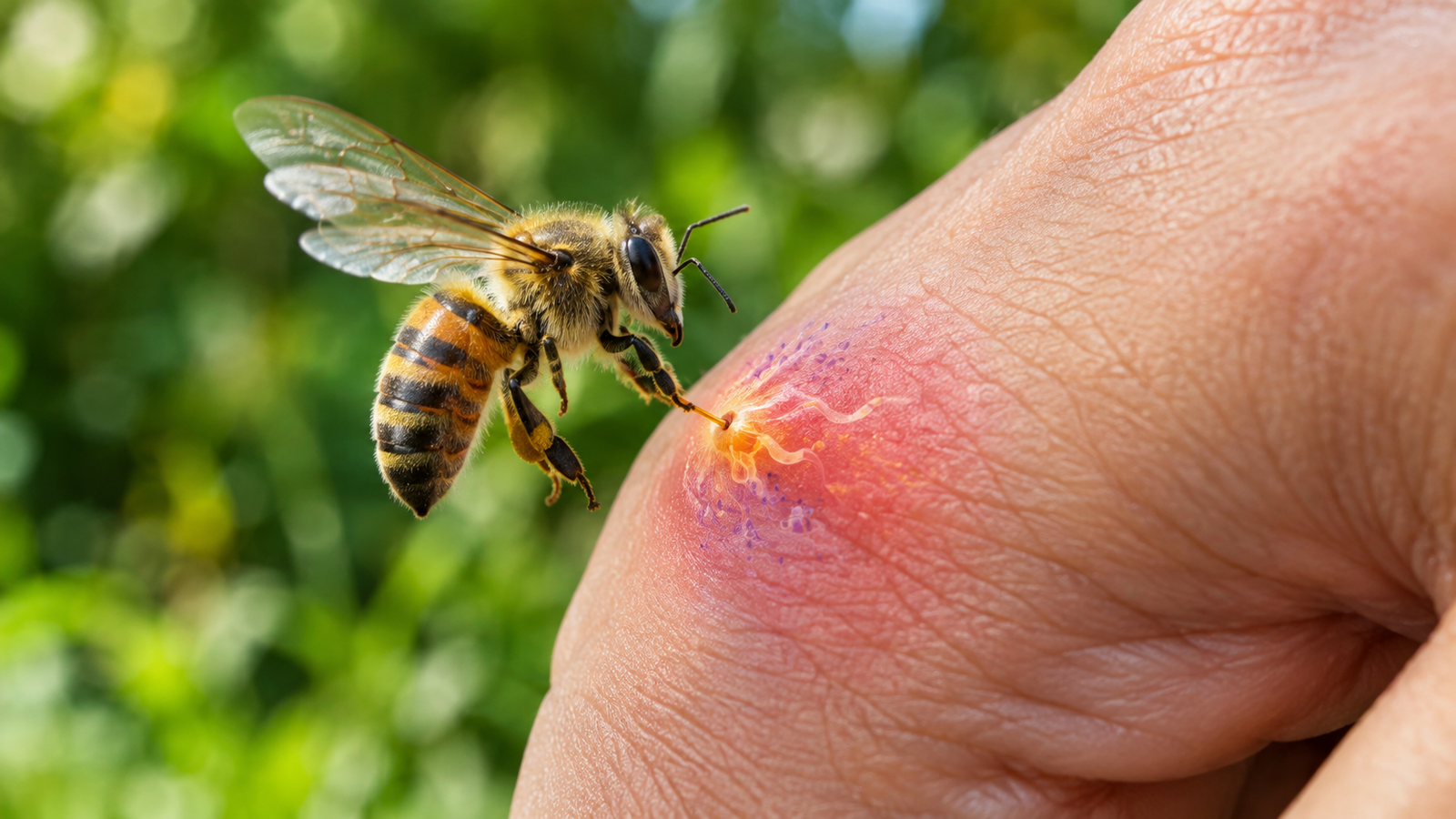
A bee sting happens when a bee pierces your skin with its stinger and injects venom into the surrounding tissue. What happens when a bee stings you depends on the type of bee, the amount of venom introduced, and how your body reacts to the sting.
For most people, a bee sting causes immediate sharp or burning pain followed by redness, swelling, tenderness, and itching around the sting site. These symptoms usually improve within a few days. However, some people can develop a severe allergic reaction called anaphylaxis, which requires immediate medical attention.
Understanding what happens after a bee sting can help you recognize a normal reaction, treat the sting properly, and identify symptoms that may be dangerous.
What Happens When a Bee Stings You?
When a bee stings you, several things happen in a short period of time:
- The stinger pierces your skin.
- Venom enters the surrounding tissue.
- Pain receptors are stimulated, causing immediate pain or burning.
- Your immune system responds to the venom and tissue injury.
- Inflammation develops, causing redness, warmth, swelling, and itching.
- Your body gradually breaks down and clears the venom, allowing the symptoms to subside.
With a typical local reaction, the discomfort is strongest soon after the sting and gradually improves as your body responds to the injury.
What Happens Immediately After a Bee Sting?
The first thing you usually notice is a sharp, burning, or stinging pain where the bee pierced your skin.
The sting creates a tiny puncture wound, while venom enters the tissue around it. The combination of the physical injury and venom triggers pain and inflammation.
Within minutes, you may notice:
- Sharp or burning pain
- Redness around the sting
- Mild swelling
- Tenderness
- Itching
The area can become more swollen over the next several hours.
What Does Bee Venom Do to Your Body?
Bee venom is a complex mixture of biologically active substances.
One important component is melittin, a peptide that can affect cell membranes and contribute to pain and inflammation. Other substances in the venom can influence the immune and inflammatory responses around the sting.
Your body recognizes the venom as a foreign substance and responds by activating inflammatory processes.
This is why a bee sting can become:
- Red
- Warm
- Swollen
- Painful
- Itchy
The body’s response is responsible for many of the symptoms you experience after the initial sting.
Why Does a Bee Sting Hurt?
A bee sting hurts because the stinger punctures your skin and the venom contains substances that stimulate pain and inflammatory responses.
The initial pain is often described as:
- Sharp
- Burning
- Stinging
- Throbbing
The most intense pain usually occurs shortly after the sting. As the initial pain decreases, swelling and itching may become more noticeable.
Why Does a Bee Sting Swell?
Swelling is part of your body’s inflammatory response.
After the venom enters your skin, your immune and inflammatory systems react to the injury. Changes in nearby blood vessels allow fluid and immune components to move into the surrounding tissue.
This causes the area around the sting to become swollen.
A small amount of swelling around the sting is generally a normal local reaction.
However, some people develop a large local reaction, in which swelling spreads well beyond the immediate sting site and can continue increasing for a day or more.
What Does a Bee Sting Look Like?
A typical bee sting may appear as a small raised, red, swollen area of skin.
You may see:
- A small puncture mark
- Red or discolored skin
- A raised bump
- Local swelling
- Redness
- Tenderness
If a honey bee stung you, you may also see its stinger embedded in your skin.
The appearance can change during the first several hours as inflammation develops.
What Happens to the Stinger?
Not every bee leaves its stinger behind.
Honey bees are particularly important here because their barbed stingers can become embedded in human skin.
When a honey bee pulls away after stinging a person, the stinger and associated venom apparatus can remain attached to the skin. The bee then usually dies because part of its abdomen is pulled away.
Other bees can have different types of stingers and may be capable of stinging more than once.
Do Bees Die After They Sting You?
Honey bee workers generally die after stinging a person or another mammal.
Their barbed stinger can become lodged in the skin. When the bee attempts to fly away, the stinger and attached abdominal tissue can be torn from its body.
However, not all bees die after stinging.
For example, some bees can retract their stingers and survive after stinging.
Wasps and hornets are different again: their stingers generally do not become stuck in human skin, allowing them to sting repeatedly.
Do All Bees Sting?
No.
Only female bees have functional stingers.
Different types of bees also behave differently when threatened.
Honey bees
Honey bees can sting defensively, particularly when they or their colony are threatened. A worker honey bee’s barbed stinger can become lodged in human skin.
Bumble bees
Bumble bees can sting when threatened, but they can generally retract their stingers and may sting more than once.
Carpenter bees
Carpenter bees can also sting, although males do not have functional stingers. Females are capable of stinging when threatened.
It is important to remember that bees generally sting defensively rather than because they are actively trying to attack people.
Why Do Bees Sting Humans?
Bees primarily sting as a defense mechanism.
A bee may sting when it feels threatened or when its nest or colony is disturbed.
Common situations that can provoke a sting include:
- Swatting at a bee
- Trying to catch a bee
- Stepping on a bee
- Disturbing a hive or nest
- Attempting to remove a bee colony
- Getting too close to a defensive colony
Staying calm and moving away from bees can reduce the likelihood of being stung.
What Are the Symptoms of a Bee Sting?
Most bee stings produce symptoms limited to the area where the bee stung you.
Common symptoms include:
- Sharp or burning pain
- Redness
- Skin discoloration
- Swelling
- Tenderness
- Itching
- Warmth around the sting
These symptoms usually begin shortly after the sting.
The pain generally decreases sooner than the swelling and itching.
How Long Does a Bee Sting Hurt?
For a mild reaction, the strongest pain usually lasts for a relatively short period.
After the initial pain decreases, the sting may remain tender or itchy.
The general progression can look like this:
Immediately: sharp or burning pain begins.
Minutes to hours: redness, swelling, and itching develop.
Several hours: inflammation may become more noticeable.
A few days: most local symptoms gradually improve.
The exact duration varies between people and depends on the individual’s reaction to the venom.
How Long Does Bee Sting Swelling Last?
Small amounts of swelling commonly improve within a few days.
According to the Cleveland Clinic source, symptoms can begin reducing within a couple of hours after the stinger is removed, with swelling and skin discoloration often resolving within two to three days. In some cases, symptoms can take seven to 10 days to completely clear.
A large local reaction can last longer than an ordinary small swelling response.
What Is a Large Local Reaction to a Bee Sting?
A large local reaction occurs when swelling extends significantly beyond the immediate sting site.
For example, if you are stung on your hand, swelling may spread toward your wrist or arm.
The reaction can be uncomfortable and may take several days to resolve.
A large local reaction is different from anaphylaxis. However, if you develop symptoms involving breathing, swallowing, dizziness, widespread hives, or other parts of your body, seek emergency medical attention.
Can a Bee Sting Cause an Allergic Reaction?
Yes.
Some people are allergic to bee venom and can develop a serious systemic reaction.
The most severe reaction is anaphylaxis, which can be life-threatening.
Unlike a normal local reaction, anaphylaxis can affect multiple parts of the body.
Possible symptoms include:
- Hives
- Widespread itching
- Difficulty breathing
- Wheezing
- Swelling of the tongue or throat
- Difficulty swallowing
- Dizziness or lightheadedness
- Fainting
- Stomach cramps
- Nausea
- Vomiting
- Diarrhea
- Rapid pulse
The Cleveland Clinic identifies difficulty breathing, tongue or throat swelling, dizziness, hives, gastrointestinal symptoms and other whole-body symptoms as warning signs requiring immediate medical attention.
When Is a Bee Sting an Emergency?
A bee sting requires emergency medical attention if you develop signs of a severe allergic reaction.
Seek emergency medical help immediately if you experience:
- Difficulty breathing
- Tightness in the chest
- Difficulty swallowing
- Swelling of the tongue or throat
- Hives or widespread rash
- Swelling throughout the body
- Severe dizziness or lightheadedness
- Fainting
- Vomiting or severe stomach symptoms
A severe allergic reaction can progress quickly.
If you have a prescribed epinephrine auto-injector and develop symptoms of anaphylaxis, use it according to your emergency action plan and seek emergency medical care immediately.
What Should You Do After a Bee Sting?
If the reaction is limited to the sting site, basic first aid can help.
1. Move Away From the Bees
Move away from the area where you were stung.
This is especially important if you were near a hive, nest, or swarm because additional bees may be nearby.
2. Remove the Stinger
If a honey bee’s stinger remains in your skin, remove it as soon as possible.
You can gently scrape it out using a fingernail, card, or gauze.
The Cleveland Clinic recommends removing a retained stinger promptly because continued venom exposure can occur while it remains embedded.
3. Wash the Area
Clean the affected skin with soap and water.
This removes dirt and helps keep the puncture wound clean.
4. Apply a Cold Pack
Apply an ice pack or cold compress wrapped in a cloth to the affected area.
Cold can help reduce swelling and discomfort.
Elevating the affected body part can also help reduce swelling.
5. Treat Pain and Itching
Depending on your individual circumstances, over-the-counter pain medication or antihistamines may help with pain and itching.
The Cleveland Clinic also lists options such as calamine lotion or hydrocortisone cream for itching.
Follow the product label and seek professional medical advice if you are unsure which medication is appropriate for you.
What Should You Not Do After a Bee Sting?
Avoid repeatedly scratching or irritating the sting.
You should also avoid deliberately disturbing a bee colony or trying to remove a hive yourself.
If the stinger is still present, focus on removing it promptly rather than repeatedly squeezing or manipulating the surrounding skin.
Can a Bee Sting Cause an Infection?
A bee sting creates a break in the skin, so keeping the area clean is important.
Most uncomplicated stings resolve without infection.
However, seek medical advice if the area becomes increasingly painful, increasingly red or hot, produces pus, or develops other concerning changes.
What Happens If You Are Stung by Many Bees?
Multiple bee stings can be more serious than one sting because your body is exposed to venom from multiple stings.
A person who receives numerous stings can become seriously ill even without a known venom allergy.
If you or someone else has been stung repeatedly—particularly by a large number of bees—seek urgent medical advice.
Emergency evaluation is especially important if symptoms such as weakness, dizziness, breathing difficulty, vomiting, or widespread swelling develop.
How Is a Bee-Sting Allergy Diagnosed?
If you have experienced a significant reaction to a bee sting, a healthcare professional may evaluate you for an insect-venom allergy.
The Cleveland Clinic describes two possible allergy-testing approaches:
- Blood allergy testing, which measures antibodies that react to an allergen.
- Skin allergy testing, in which a small amount of bee venom is introduced under the skin and the reaction is monitored.
People with suspected bee-venom allergies should discuss testing and future sting prevention with a healthcare professional.
Can You Prevent Bee Stings?
You cannot eliminate the risk completely, but you can reduce your chances of being stung.
Helpful precautions include:
- Avoid disturbing bee hives and nests.
- Do not swat aggressively at bees.
- Be careful around flowering plants where bees are feeding.
- Keep outdoor food and sweet drinks covered.
- Clean up food and drink spills outdoors.
- Wear closed-toe shoes when walking through grass.
- Wear protective clothing when working around bees.
- Avoid attempting to remove a hive yourself.
- Stay calm when a bee is nearby.
The Cleveland Clinic also recommends being aware of your surroundings, covering food, avoiding floral-scented products, wearing protective clothing, and remaining calm around bees.
Frequently Asked Questions About What Happens When a Bee Stings You
Does a bee sting inject venom?
Yes. When a bee stings, its stinger penetrates the skin and venom is introduced into the surrounding tissue.
Why does a bee sting burn?
The puncture and substances in bee venom stimulate pain and inflammatory responses, producing the characteristic sharp or burning sensation.
Why does a bee sting itch?
Itching occurs as your body responds to the venom and inflammation develops around the sting.
Why does a bee sting swell the next day?
Inflammation can continue developing after the initial sting, so swelling may become more noticeable several hours later or the following day.
How long does a bee sting last?
A mild bee sting may cause pain for a few hours, while redness, swelling, and itching can continue for several days. Some larger reactions can last longer.
Do all bees die after stinging?
No. Honey bee workers generally die after stinging mammals because their barbed stinger can remain embedded in the skin. Other bees can survive a sting.
Can a bee sting be dangerous?
Yes. Most bee stings cause only local symptoms, but severe allergic reactions can cause anaphylaxis, which is potentially life-threatening.
What are the first signs of a serious bee-sting allergy?
Possible warning signs include hives, widespread itching, swelling of the tongue or throat, difficulty breathing, dizziness, and gastrointestinal symptoms.
Should you remove a bee stinger?
If a honey bee’s stinger remains in your skin, remove it promptly. A fingernail, card, or gauze can be used to gently scrape it away.
When should you go to the hospital after a bee sting?
Seek emergency medical attention if you develop difficulty breathing, throat or tongue swelling, difficulty swallowing, widespread hives, severe dizziness, fainting, or other symptoms of anaphylaxis.
Final Thoughts: What Happens When a Bee Stings You?
So, what happens when a bee stings you?
A bee’s stinger punctures your skin and introduces venom into the surrounding tissue. Your nervous and immune systems respond to the injury and venom, producing the familiar pain, redness, swelling, warmth, and itching.
For most people, these symptoms remain localized and gradually disappear over the following days. If a honey bee stinger remains embedded in your skin, it should be removed promptly.
The most important thing to recognize is the difference between an ordinary local reaction and a severe allergic reaction. Difficulty breathing, swelling of the tongue or throat, widespread hives, severe dizziness, fainting, or other whole-body symptoms can indicate anaphylaxis and require immediate emergency medical attention.
Bees generally sting defensively, so avoiding nests and hives, staying calm around individual bees, and taking sensible precautions can reduce the chance of being stung.
