
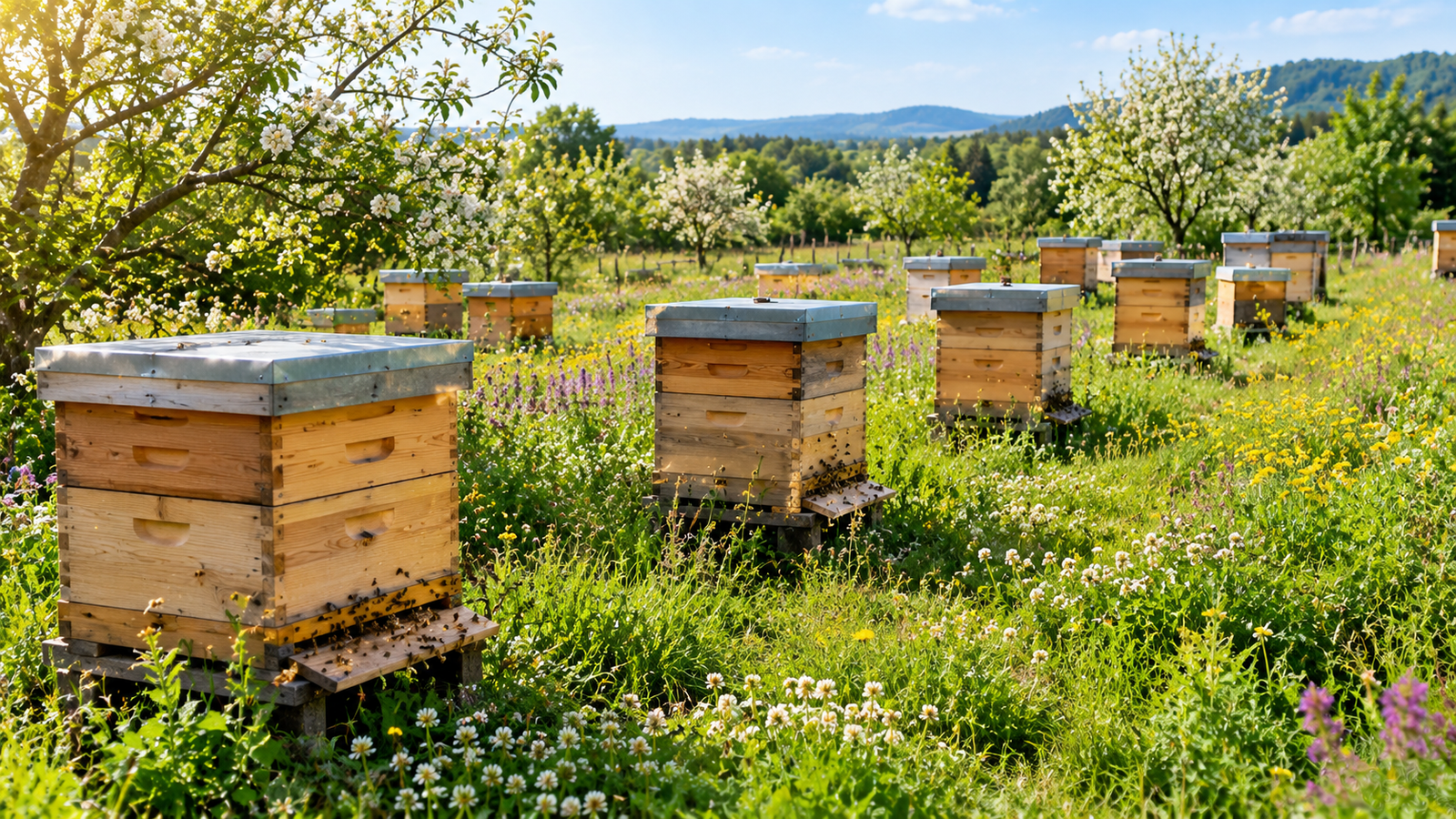
How many bee hives per acre can you keep without creating food shortages or reducing honey production? For a small apiary, starting with one or two honey bee colonies may be a practical approach when the surrounding landscape provides sufficient nectar and pollen. However, there is no fixed number of hives that every acre can support.
The number of colonies an area can sustain depends on more than the size of the property. Flowering plants, seasonal forage availability, rainfall, colony strength, neighbouring apiaries and the distance bees travel to collect food all influence how many hives can be maintained successfully.
For example, one acre surrounded by flowering trees, orchards and productive farmland may provide access to more food than five acres covered mainly by grass or buildings. This is because honey bees collect resources across the surrounding landscape rather than depending exclusively on the land directly beneath their hives.
Whether you want to produce honey, pollinate crops or establish a backyard apiary, understanding these factors will help you choose an appropriate number of colonies and avoid expanding too quickly.
How Many Bee Hives Per Acre Can You Keep?
There is no scientifically established universal limit for how many bee hives can be kept per acre. However, one or two honey bee colonies per acre can be a manageable starting point for a beginner, provided the surrounding area has adequate forage and the beekeeper can manage the colonies properly.
Some forage-rich locations can accommodate more colonies, while areas with limited flowering vegetation may struggle to support even a small apiary throughout the year.
The following table provides illustrative planning categories, not scientifically validated stocking limits.
| Number of hives per acre | Practical considerations |
|---|---|
| 1 hive | A manageable starting point for learning colony management and assessing local forage |
| 2 hives | A reasonable starting arrangement where flowering resources are available |
| 3–5 hives | May be manageable in areas with diverse and reliable forage |
| 6–10 hives | Requires careful assessment of surrounding vegetation, seasonal food supplies and colony management |
| More than 10 hives | May be physically possible, but requires evidence that the wider landscape can support the colonies |
These figures should not be interpreted as a guarantee that a particular acre can sustain that number of colonies.
Consider two different properties.
Property A: A one-acre plot surrounded by flowering trees, fruit farms, gardens and wildflowers. Bees have access to nectar and pollen from several sources throughout the year.
Property B: A five-acre property containing mostly short grass, buildings and bare ground, with very few flowering plants.
Although Property B is five times larger, Property A may offer better forage conditions for honey bees.
This illustrates an important principle: the number of hives an area can support depends more on the availability of food than on the amount of land owned.
For beginners, the sensible approach is to start with a manageable number of colonies, observe their performance through different seasons and expand only when there is evidence that additional colonies can be supported.
How Much Land Does One Bee Colony Need?
A honey bee colony does not need a separate acre of land exclusively for its own use.
Worker bees leave the hive to collect nectar, pollen, water and plant resins from flowers and other resources throughout the surrounding landscape.
One acre equals 43,560 square feet, or approximately 4,047 square metres. This may provide enough physical space for a small apiary, but it does not automatically provide enough food for the colonies placed there.
Honey bees commonly forage across several kilometres, depending on resource availability, weather and the needs of the colony. They may travel farther when nearby flowers are scarce.
Consequently, a colony placed on a small property can benefit from flowering vegetation growing on neighbouring farms, gardens, roadsides and natural areas.
Does one acre of flowering plants support one or two hives?
It may, but the answer depends on the plant species, the quantity of flowers, nectar production, pollen availability and flowering duration.
For example:
| Land type | Potential value to honey bees |
|---|---|
| One acre of diverse flowering vegetation | Can provide useful nectar and pollen if plants flower sufficiently and at different times |
| One acre of grass lawn | Usually offers limited forage unless flowering weeds or other plants are present |
| One acre of flowering fruit trees | Can provide seasonal nectar and pollen, depending on the tree species |
| One acre beside productive farmland | May benefit from crops and flowering vegetation outside the property |
| One acre in a dry environment | May provide food during flowering periods but experience shortages when vegetation dries out |
The important distinction is that flowering land is not automatically productive bee forage.
Some plants produce abundant nectar, others mainly provide pollen, and some produce relatively little of either. A property with many flowers may therefore offer less usable food than expected.
A beekeeper should evaluate the quality, quantity and timing of available forage rather than simply counting flowering plants.
How Far Do Honey Bees Travel to Find Food?
Honey bees do not restrict their foraging activities to the property where their hives are located.
Worker bees can travel several kilometres from their colonies to locate suitable flowers. When resources are abundant, they may concentrate their activities closer to the hive. When nearby forage becomes scarce, they may travel farther.
This behaviour explains why the surrounding landscape is important when determining how many bee hives per acre can be maintained.
For example, imagine placing three colonies on a one-acre property beside a large area of flowering farmland.
The bees may collect nectar and pollen from the surrounding farmland, flowering trees and other vegetation. The one-acre property provides the hive location, but the wider landscape contributes much of the food.
However, the beekeeper should not assume that every flower within several kilometres is equally accessible or useful. Other colonies, competing plants, weather, pesticide exposure and the distance to individual flowering resources can influence how much food the bees actually collect.
Practical tip: Walk or travel around your proposed apiary site during different seasons. Identify flowering plants, observe honey bee activity and record when major nectar and pollen sources become available.
Why the Surrounding Landscape Matters More Than Acreage
The surrounding landscape determines how much food honey bees can collect and whether that food remains available throughout the year.
A property may have abundant flowers during one month but very little forage during the following three months. If too many colonies depend on the same limited resources, competition may increase.
Here are the most important factors to consider.
1. Availability of nectar-producing plants
Nectar provides honey bees with carbohydrates that supply energy for flying, maintaining the colony and other activities.
Flowering trees, fruit trees, shrubs, wildflowers and agricultural crops can provide valuable nectar.
However, different plants produce different quantities of nectar, and their productivity varies with weather, soil conditions and plant health.
A landscape with several productive flowering species may offer a more dependable food supply than one dominated by a single plant that flowers briefly.
2. Availability of pollen-producing plants
Pollen provides proteins, fats, vitamins and minerals needed for brood development and colony growth.
Worker bees collect pollen from flowering plants and transport it back to the hive in pollen baskets on their hind legs.
A property may have abundant nectar but insufficient pollen diversity. This can affect the colony’s ability to raise healthy brood.
For this reason, beekeepers should consider both nectar and pollen when evaluating an apiary site.
3. Length of the flowering season
A major flowering period can produce large quantities of nectar within a short time, but colonies also need food when that flowering period ends.
Consider two locations:
- Location A has abundant flowers for four weeks followed by a long period with little forage.
- Location B has moderate flowering from several plant species throughout much of the year.
Location A may produce a strong honey flow, but Location B may provide more consistent food availability.
The best apiary location depends on the beekeeper’s objectives and the ability to manage periods of food shortage.
4. Competition from neighbouring colonies
Honey bees from different apiaries can visit the same flowering resources.
Wild honey bee colonies may also use the surrounding vegetation.
A scientific review by Visick and Ratnieks (2023), published in Ecology and Evolution, examined 40 studies covering 41 locations worldwide and found considerable variation in wild honey bee colony density.
This research demonstrates why beekeepers should consider existing colonies in the landscape rather than assessing their own hives in isolation.
Read the research: Density of wild honey bee, Apis mellifera, colonies worldwide.
5. Weather and climate
Weather influences both plant flowering and the ability of bees to collect food.
Heavy rain can prevent worker bees from flying. Drought can reduce flowering and nectar production, while extreme heat can increase the colony’s need for water and cooling.
A location that supports several colonies during a favourable season may become less productive during drought or prolonged unfavourable weather.
6. Water availability
Honey bees need water for several colony activities, including regulating hive temperature and preparing food for developing larvae.
A reliable, clean water source can help support colonies, particularly in hot environments.
Provide a safe water source with suitable landing surfaces, such as floating cork or stones, to reduce drowning.
Remember that water availability does not replace the need for adequate nectar and pollen.
How Many Bee Hives Per Acre for Honey Production?
If your primary goal is honey production, the appropriate number of hives is the number that allows colonies to remain healthy while collecting enough nectar to produce surplus honey.
More hives do not automatically mean more honey.
For example, suppose a beekeeper manages two strong colonies in an area with abundant flowering trees. Both colonies collect sufficient nectar, raise healthy brood and store surplus honey.
The beekeeper then adds eight more colonies without improving the available forage.
The additional colonies may increase the total number of bees competing for the same nectar sources. Depending on the landscape, this could reduce the surplus honey available to individual colonies.
Honey production depends on several factors:
- Colony population and strength.
- Queen health and egg-laying performance.
- Availability of nectar-producing plants.
- Pollen availability for brood development.
- Timing and duration of flowering.
- Weather during the nectar flow.
- Pest and disease management.
- Hive design and management practices.
Should you keep more small colonies or fewer strong colonies?
Colony strength is an important consideration.
A strong colony generally has more workers available for foraging than a weak colony. However, colony size alone does not guarantee high honey production because sufficient forage must also be available.
Oregon State University Extension explains that colony strength and the surrounding foraging environment influence pollination performance and colony productivity.
Its educational material also illustrates that a larger colony can produce more honey than several smaller colonies with the same combined worker population under the conditions studied.
Read: Evaluating Honey Bee Colonies for Pollination.
For a beginner, starting with one or two healthy colonies makes it easier to learn inspections, recognise problems, understand the local flowering calendar and develop suitable management practices.
Keep records of:
- Colony strength.
- Brood development.
- Honey and pollen stores.
- Major flowering periods.
- Supplementary feeding.
- Honey harvested.
- Pest and disease observations.
Use these records to determine whether adding colonies is likely to improve your operation.
Never harvest all the honey stored by a colony. Bees need adequate food reserves to survive periods when natural forage is unavailable.
How Many Bee Hives Per Acre for Crop Pollination?
The number of hives required for crop pollination is different from the number of colonies that can be maintained permanently for honey production.
In commercial pollination, beekeepers may temporarily move colonies into agricultural fields when crops are flowering.
The purpose is to provide enough active pollinators during a specific flowering period.
The required number depends on:
- The crop being pollinated.
- The size and density of the flowering area.
- The duration of flowering.
- The strength of each honey bee colony.
- Weather conditions.
- Competing flowering plants.
- The presence of wild pollinators.
Examples of crop-specific pollination requirements
Oregon State University Extension provides the following average hive numbers used for pollination in certain agricultural settings in the Pacific Northwest and California.
| Crop | Average colonies per acre |
|---|---|
| Almonds (California) | 2.5 |
| Apples | 0.5 |
| Blueberries | 3 |
| Blackberries | 2.5 |
| Cranberries | 3 |
| Cherries | 2 |
| Pears | 1.5 |
| Clover | 2 |
| Vegetable seed crops | 3 |
| Meadowfoam | 2 |
These figures are regional examples, not universal recommendations. Requirements can vary with crop variety, colony strength, weather, local growing conditions and pollination objectives.
For example, Oregon State University’s separate meadowfoam pollination guidance recommends three honey bee hives per acre under its stated production conditions. It also explains that additional colonies may be needed during extended flowering periods with cool, wet weather.
Source: Oregon State University – Pollination and Seed Set in Meadowfoam.
This demonstrates why one crop may require a different stocking rate from another.
Important: A temporary recommendation of three colonies per acre for a particular pollination contract does not mean that three colonies can be permanently maintained on every acre throughout the year.
If you provide pollination services, consult local agricultural extension specialists or crop advisers before deciding how many colonies to supply.
Can You Keep 10 Bee Hives on One Acre?
Yes. It may be physically possible to keep ten honey bee hives on a one-acre property.
However, physical space and forage capacity are two different things.
The first question is whether the hives can be positioned safely with enough room for inspections, equipment and harvesting.
The second question is whether the surrounding landscape provides enough nectar and pollen to support ten colonies.
Consider this example.
A beekeeper has a one-acre property surrounded by flowering orchards, farmland and natural vegetation. Ten colonies may be able to forage across this wider landscape.
Another beekeeper has a one-acre residential property surrounded by buildings and roads, with very little flowering vegetation.
Although both properties have the same size, their ability to support ten colonies may be very different.
What about keeping 20 or more hives on one acre?
It may also be physically possible, particularly in commercial apiaries where the hives are managed intensively and have access to forage across a large surrounding landscape.
However, keeping 20 colonies on one acre should not be treated as a standard recommendation.
Before establishing a large apiary, consider:
- The availability of nectar and pollen throughout the year.
- Existing managed and wild colonies in the area.
- The amount of space required for safe hive inspections.
- The beekeeper’s ability to manage pests and diseases.
- The possibility of food shortages during unfavourable seasons.
- Local regulations and potential conflicts with neighbours.
A beekeeper who can fit 20 hives onto a property has not necessarily demonstrated that the surrounding landscape can feed all 20 colonies.
How Much Space Should You Leave Between Bee Hives?
Hive spacing concerns the physical arrangement of an apiary. It should not be confused with the amount of forage available to the colonies.
There is no single spacing measurement suitable for every apiary. The arrangement depends on hive design, terrain, management methods, safety and the equipment used.
When positioning hives, consider the following:
- Leave enough room to open hives and remove frames safely.
- Place hives on stable stands with adequate drainage.
- Avoid positioning entrances directly towards busy walkways.
- Keep the apiary away from areas where children and livestock frequently gather.
- Arrange entrances to reduce unnecessary drifting between colonies.
- Use suitable vegetation or barriers to encourage bees to fly above head height where appropriate.
- Provide access for inspections, maintenance and honey harvesting.
- Protect colonies from flooding and strong winds.
Why does hive arrangement matter?
If hives are positioned too close together without a suitable layout, bees may drift into neighbouring colonies.
Drifting occurs when returning worker bees enter the wrong hive. This can affect colony populations and may contribute to the movement of pests and diseases between colonies.
A thoughtful arrangement, visible hive markings and differences in entrance orientation can help reduce this problem.
In residential areas, also consider neighbours, property boundaries, public access and local beekeeping requirements.
What Is the Best Location for a Bee Apiary?
A good apiary location combines suitable physical conditions with access to reliable forage.
Before placing hives, inspect the property and surrounding landscape.
Look for:
1. Flowering vegetation: A mixture of flowering trees, shrubs, crops and wildflowers that provides nectar and pollen.
2. Reliable water: A clean water source available during hot and dry periods.
3. Good drainage: Avoid locations where rainwater regularly collects around the hive stands.
4. Protection from strong winds: Natural vegetation or suitable barriers can help reduce exposure.
5. Appropriate sunlight and shade: Hive exposure should suit the local climate and the type of hive being used.
6. Safe access: Beekeepers need enough room to inspect colonies, carry equipment and harvest honey.
7. Suitable distance from people: Avoid locations where normal bee activity could create unnecessary risks for neighbours or visitors.
Do not assume that every forest, meadow or wetland provides good honey production. The value of a location depends on its actual flowering plants, their nectar and pollen production, and how long they remain available.
Can You Keep Too Many Bee Hives on One Acre?
Yes. An apiary can contain more colonies than the surrounding landscape can adequately support, even when there is plenty of physical space for the hives.
When forage is limited, excessive colony density may increase competition for available nectar and pollen.
Possible consequences include:
- Reduced surplus honey per colony.
- Increased supplementary feeding requirements.
- Greater pressure on flowering vegetation.
- Difficulty maintaining adequate food reserves.
- More inspection and management work.
- Increased disease-management challenges if hygiene and colony management are poor.
However, weak colonies and poor honey production do not automatically prove that an apiary contains too many hives.
Other problems can produce similar symptoms, including:
- Poor queen performance.
- Pest infestations.
- Diseases.
- Pesticide exposure.
- Unfavourable weather.
- Inadequate hive management.
- Poor-quality or insufficient forage.
Before reducing colony numbers, investigate the actual cause of poor performance.
If forage shortage is the main problem, reducing colony density, improving local flowering resources or moving colonies to a more suitable location may help.
Planting additional bee-friendly vegetation is useful, but a small garden alone should not be expected to feed a large commercial apiary.
How to Calculate Whether Your Land Can Support More Bee Hives
There is no dependable mathematical formula that converts the number of acres directly into a universal number of sustainable honey bee colonies.
However, you can make a much better decision by assessing the available forage, seasonal conditions and performance of existing colonies.
Use the following practical process.
Step 1: Assess the property and surrounding landscape
Identify flowering plants within the bees’ likely foraging area.
Look for:
- Flowering trees.
- Fruit trees.
- Agricultural crops.
- Wildflowers.
- Flowering shrubs.
- Natural vegetation.
- Gardens and hedgerows.
Record the major plant species and whether they provide nectar, pollen or both.
Step 2: Create a flowering calendar
Do not evaluate the apiary based on a single visit.
Observe the area throughout the year and record when important plants begin flowering and when their flowers disappear.
A simple example:
| Period | What to observe |
|---|---|
| Early season | Which trees and shrubs begin flowering? |
| Main flowering season | Are there abundant nectar and pollen sources? |
| Late season | Are alternative flowering plants available? |
| Dry or unfavourable season | Is natural forage becoming scarce? |
The calendar will help identify periods when colonies may need additional attention.
Step 3: Investigate neighbouring apiaries
Ask nearby beekeepers how many colonies they manage and whether they experience seasonal forage shortages.
You may not be able to identify every wild colony, but information from local beekeepers can help you understand the pressure on available resources.
Step 4: Start with a manageable number of colonies
If you are a beginner, one or two colonies may be a sensible starting point when local conditions are suitable.
This gives you an opportunity to learn colony management without immediately committing to a large apiary.
Step 5: Monitor colony performance
Inspect your colonies regularly and record:
- Adult bee population.
- Brood development.
- Queen performance.
- Honey stores.
- Pollen availability.
- Signs of pests and diseases.
- Supplementary feeding requirements.
A healthy colony should maintain adequate food reserves and continue developing appropriately for the local season.
Step 6: Expand gradually
Consider adding colonies only after you have observed adequate forage and satisfactory colony performance through relevant seasonal conditions.
For example, if two colonies remain healthy and collect surplus honey during the main flowering period but struggle during a seasonal forage shortage, adding more colonies may not be appropriate.
You should first investigate the shortage and determine whether additional forage or a different management strategy is needed.
The objective is not to reach the highest possible number of hives per acre. It is to maintain healthy, productive colonies without placing excessive pressure on the available resources.
How Many Bee Hives Per Acre in Ghana?
For beekeepers in Ghana, the number of bee hives per acre should reflect local vegetation, rainfall patterns, flowering seasons and the availability of nectar and pollen throughout the year.
Ghana has different ecological zones, including forest, transition and savannah environments. These areas do not provide identical forage conditions, so a stocking recommendation suitable for one district may not work in another.
The Ghana Bee Health Manual, developed through the UK International Development and animal health support programme, provides useful information about local beekeeping, flowering plants and seasonal forage.
According to the manual, important nectar flows in many regions occur during parts of the dry season, with flowering and nectar availability varying by location.
For example, the manual identifies several plants visited by honey bees in Kumasi, including:
| Plant | Common name | Resource collected |
|---|---|---|
| Anacardium occidentale | Cashew | Nectar |
| Ceiba pentandra | Kapok | Nectar |
| Moringa oleifera | Moringa | Nectar |
| Manihot esculenta | Cassava | Pollen |
| Citrus sinensis | Sweet orange | Nectar and pollen |
| Psidium guajava | Guava | Nectar and pollen |
| Parkia clappertonia | African locust bean | Nectar and pollen |
These examples show why identifying actual local flowering plants is more useful than relying on acreage alone.
Source: Ghana Bee Health Manual – UK International Development.
How seasonal changes affect Ghanaian apiaries
The Ghana Bee Health Manual describes important seasonal differences in honey bee foraging.
It reports that many regions experience significant nectar flows during the dry season, with some flows beginning around October and reaching a peak around December or January. These timings should be treated as regional observations, not a fixed calendar for every part of Ghana.
Rainfall, local vegetation, agricultural activity and flowering patterns can change the timing and strength of nectar flows.
For Ghanaian beekeepers, this means that the same apiary may perform differently during different parts of the year.
A site with productive flowering vegetation during the dry season may provide a useful honey harvest, while the rainy season may bring different forage conditions.
Practical recommendations for beekeepers in Ghana
Before deciding how many hives to establish:
- Identify flowering trees, crops and wild plants around the proposed apiary.
- Observe when the main nectar and pollen sources flower.
- Investigate seasonal forage shortages.
- Consider bushfires and land clearing that may destroy flowering vegetation.
- Coordinate with nearby farmers to reduce pesticide exposure.
- Ask experienced local beekeepers about seasonal nectar flows in your district.
- Monitor colony health and food reserves before expanding.
For example, a beekeeper in a farming community with flowering cashew trees, citrus, guava and other vegetation may have different forage opportunities from a beekeeper in an area with little flowering vegetation.
Likewise, a property in one ecological zone should not automatically use the same stocking assumptions as a property in another.
For Ghanaian beekeepers, the best approach is to start with a manageable number of colonies, study local flowering patterns and increase hive numbers only when actual colony performance supports expansion.
Frequently Asked Questions About How Many Bee Hives Per Acre
Is one acre enough for one bee hive?
Yes. One acre can provide sufficient physical space for a honey bee hive. Whether it provides enough food depends on the flowering vegetation within the surrounding landscape and the availability of nectar and pollen throughout the year.
Can I keep two bee hives on one acre?
Yes. Two colonies may be manageable on one acre when there is sufficient forage nearby. However, the beekeeper should consider seasonal food availability, neighbouring apiaries and colony strength.
How many bee hives can I keep on five acres?
Five acres can physically accommodate multiple hives, but there is no universal number that five acres can support. The sustainable number depends on flowering vegetation, surrounding forage, seasonal conditions and competition from other colonies.
Do not simply multiply a suggested one-acre figure by five.
Does one acre of flowers feed two bee hives?
It may provide useful forage for two colonies, but the result depends on the plant species, flowering density, nectar production, pollen availability and length of the flowering period.
Bees may also collect food from plants outside the acre.
How many bee hives should a beginner start with?
One or two colonies can be a manageable starting point for a beginner when the location is suitable.
Starting small allows you to develop inspection skills, monitor colony health and understand local forage conditions before expanding.
Does having more bee hives produce more honey?
Not necessarily. More colonies can increase total honey production when sufficient nectar is available. However, if forage is limited, additional colonies may increase competition and reduce the surplus honey available to each colony.
How far do honey bees travel from their hives?
Honey bees commonly forage within several kilometres of their colonies, although actual distances vary with the availability of food, weather and colony requirements. They may travel farther when nearby resources are scarce.
Can I keep 20 bee hives on one acre?
It may be physically possible, but it cannot be recommended based on acreage alone. Twenty colonies require careful assessment of surrounding forage, existing colonies, management capacity, safety and local regulations.
Do I need one acre for every bee hive?
No. Honey bees do not require a separate acre for each hive. Several colonies can share an apiary and collect food across the surrounding landscape, provided adequate resources are available.
Should I feed bees if there are too many hives?
Supplementary feeding may help during a temporary shortage when appropriate, but it does not replace the need for adequate natural forage. If the apiary consistently has insufficient food, review the number of colonies and consider improving forage or relocating some hives.
What is the difference between the number of hives per acre and the number of hives an area can support?
The number of hives per acre can describe how many colonies are physically placed on a particular property. The number an area can support refers to how many colonies can obtain adequate food and remain healthy.
These are not the same measurement. A small property may accommodate many hives physically, but the surrounding landscape must provide sufficient forage to sustain them.
Do all bee species need the same amount of land?
No. The numerical guidance in this article concerns managed honey bee colonies, particularly the western honey bee (Apis mellifera).
Bumblebees, carpenter bees, leafcutter bees and other solitary bees have different nesting and foraging behaviours. Their habitat requirements cannot be calculated using the same hive-per-acre approach.
Final Answer: How Many Bee Hives Per Acre?
There is no fixed number of bee hives that every acre can support.
For a beginner, one or two honey bee colonies per acre may be a sensible starting arrangement when the surrounding landscape provides sufficient nectar and pollen. However, some locations can accommodate more colonies, while others may struggle to support even a small apiary during periods of limited forage.
The most important factors are:
- Availability of flowering plants.
- Nectar and pollen production.
- Seasonal flowering patterns.
- Distance to surrounding forage.
- Competition from neighbouring colonies.
- Weather and climate.
- Colony strength and management.
If your goal is honey production, focus on maintaining healthy colonies with adequate food supplies. If your goal is crop pollination, follow recommendations for the particular crop and growing conditions. If you are a beginner, start with a manageable number of hives and monitor their performance before expanding.
Ultimately, the best number of bee hives per acre is the number your surrounding landscape can support without creating persistent food shortages or compromising colony health.
Below is the complete updated article for BeekeeperBase. I’ve retained your exact primary search query, “How Many Bee Hives Per Acre?”, and kept the existing URL intent.
The rewrite strengthens the scientific explanations, adds practical examples, includes a Ghana-specific section, improves the comparison tables, introduces a step-by-step forage assessment guide, and uses identifiable scientific and educational references.
SEO publishing details
SEO title: How Many Bee Hives Per Acre? A Complete Guide for Beekeepers
Primary keyword: How Many Bee Hives Per Acre
URL: Keep the existing URL.
Search intent: Informational – beekeepers wanting to determine how many honey bee colonies they can keep on a given property.
Suggested meta description: Discover how many bee hives per acre you can keep, what determines apiary capacity, how forage availability affects colony numbers, and how to plan a healthy, productive apiary.
How Many Bee Hives Per Acre? A Complete Guide for Beekeepers
How many bee hives per acre can you keep without creating food shortages or reducing honey production? For a small apiary, starting with one or two honey bee colonies may be a practical approach when the surrounding landscape provides sufficient nectar and pollen. However, there is no fixed number of hives that every acre can support.
The number of colonies an area can sustain depends on more than the size of the property. Flowering plants, seasonal forage availability, rainfall, colony strength, neighbouring apiaries and the distance bees travel to collect food all influence how many hives can be maintained successfully.
For example, one acre surrounded by flowering trees, orchards and productive farmland may provide access to more food than five acres covered mainly by grass or buildings. This is because honey bees collect resources across the surrounding landscape rather than depending exclusively on the land directly beneath their hives.
Whether you want to produce honey, pollinate crops or establish a backyard apiary, understanding these factors will help you choose an appropriate number of colonies and avoid expanding too quickly.
How Many Bee Hives Per Acre Can You Keep?
There is no scientifically established universal limit for how many bee hives can be kept per acre. However, one or two honey bee colonies per acre can be a manageable starting point for a beginner, provided the surrounding area has adequate forage and the beekeeper can manage the colonies properly.
Some forage-rich locations can accommodate more colonies, while areas with limited flowering vegetation may struggle to support even a small apiary throughout the year.
The following table provides illustrative planning categories, not scientifically validated stocking limits.
| Number of hives per acre | Practical considerations |
|---|---|
| 1 hive | A manageable starting point for learning colony management and assessing local forage |
| 2 hives | A reasonable starting arrangement where flowering resources are available |
| 3–5 hives | May be manageable in areas with diverse and reliable forage |
| 6–10 hives | Requires careful assessment of surrounding vegetation, seasonal food supplies and colony management |
| More than 10 hives | May be physically possible, but requires evidence that the wider landscape can support the colonies |
These figures should not be interpreted as a guarantee that a particular acre can sustain that number of colonies.
Consider two different properties.
Property A: A one-acre plot surrounded by flowering trees, fruit farms, gardens and wildflowers. Bees have access to nectar and pollen from several sources throughout the year.
Property B: A five-acre property containing mostly short grass, buildings and bare ground, with very few flowering plants.
Although Property B is five times larger, Property A may offer better forage conditions for honey bees.
This illustrates an important principle: the number of hives an area can support depends more on the availability of food than on the amount of land owned.
For beginners, the sensible approach is to start with a manageable number of colonies, observe their performance through different seasons and expand only when there is evidence that additional colonies can be supported.
How Much Land Does One Bee Colony Need?
A honey bee colony does not need a separate acre of land exclusively for its own use.
Worker bees leave the hive to collect nectar, pollen, water and plant resins from flowers and other resources throughout the surrounding landscape.
One acre equals 43,560 square feet, or approximately 4,047 square metres. This may provide enough physical space for a small apiary, but it does not automatically provide enough food for the colonies placed there.
Honey bees commonly forage across several kilometres, depending on resource availability, weather and the needs of the colony. They may travel farther when nearby flowers are scarce.
Consequently, a colony placed on a small property can benefit from flowering vegetation growing on neighbouring farms, gardens, roadsides and natural areas.
Does one acre of flowering plants support one or two hives?
It may, but the answer depends on the plant species, the quantity of flowers, nectar production, pollen availability and flowering duration.
For example:
| Land type | Potential value to honey bees |
|---|---|
| One acre of diverse flowering vegetation | Can provide useful nectar and pollen if plants flower sufficiently and at different times |
| One acre of grass lawn | Usually offers limited forage unless flowering weeds or other plants are present |
| One acre of flowering fruit trees | Can provide seasonal nectar and pollen, depending on the tree species |
| One acre beside productive farmland | May benefit from crops and flowering vegetation outside the property |
| One acre in a dry environment | May provide food during flowering periods but experience shortages when vegetation dries out |
The important distinction is that flowering land is not automatically productive bee forage.
Some plants produce abundant nectar, others mainly provide pollen, and some produce relatively little of either. A property with many flowers may therefore offer less usable food than expected.
A beekeeper should evaluate the quality, quantity and timing of available forage rather than simply counting flowering plants.
How Far Do Honey Bees Travel to Find Food?
Honey bees do not restrict their foraging activities to the property where their hives are located.
Worker bees can travel several kilometres from their colonies to locate suitable flowers. When resources are abundant, they may concentrate their activities closer to the hive. When nearby forage becomes scarce, they may travel farther.
This behaviour explains why the surrounding landscape is important when determining how many bee hives per acre can be maintained.
For example, imagine placing three colonies on a one-acre property beside a large area of flowering farmland.
The bees may collect nectar and pollen from the surrounding farmland, flowering trees and other vegetation. The one-acre property provides the hive location, but the wider landscape contributes much of the food.
However, the beekeeper should not assume that every flower within several kilometres is equally accessible or useful. Other colonies, competing plants, weather, pesticide exposure and the distance to individual flowering resources can influence how much food the bees actually collect.
Practical tip: Walk or travel around your proposed apiary site during different seasons. Identify flowering plants, observe honey bee activity and record when major nectar and pollen sources become available.
Why the Surrounding Landscape Matters More Than Acreage
The surrounding landscape determines how much food honey bees can collect and whether that food remains available throughout the year.
A property may have abundant flowers during one month but very little forage during the following three months. If too many colonies depend on the same limited resources, competition may increase.
Here are the most important factors to consider.
1. Availability of nectar-producing plants
Nectar provides honey bees with carbohydrates that supply energy for flying, maintaining the colony and other activities.
Flowering trees, fruit trees, shrubs, wildflowers and agricultural crops can provide valuable nectar.
However, different plants produce different quantities of nectar, and their productivity varies with weather, soil conditions and plant health.
A landscape with several productive flowering species may offer a more dependable food supply than one dominated by a single plant that flowers briefly.
2. Availability of pollen-producing plants
Pollen provides proteins, fats, vitamins and minerals needed for brood development and colony growth.
Worker bees collect pollen from flowering plants and transport it back to the hive in pollen baskets on their hind legs.
A property may have abundant nectar but insufficient pollen diversity. This can affect the colony’s ability to raise healthy brood.
For this reason, beekeepers should consider both nectar and pollen when evaluating an apiary site.
3. Length of the flowering season
A major flowering period can produce large quantities of nectar within a short time, but colonies also need food when that flowering period ends.
Consider two locations:
- Location A has abundant flowers for four weeks followed by a long period with little forage.
- Location B has moderate flowering from several plant species throughout much of the year.
Location A may produce a strong honey flow, but Location B may provide more consistent food availability.
The best apiary location depends on the beekeeper’s objectives and the ability to manage periods of food shortage.
4. Competition from neighbouring colonies
Honey bees from different apiaries can visit the same flowering resources.
Wild honey bee colonies may also use the surrounding vegetation.
A scientific review by Visick and Ratnieks (2023), published in Ecology and Evolution, examined 40 studies covering 41 locations worldwide and found considerable variation in wild honey bee colony density.
This research demonstrates why beekeepers should consider existing colonies in the landscape rather than assessing their own hives in isolation.
Read the research: Density of wild honey bee, Apis mellifera, colonies worldwide.
5. Weather and climate
Weather influences both plant flowering and the ability of bees to collect food.
Heavy rain can prevent worker bees from flying. Drought can reduce flowering and nectar production, while extreme heat can increase the colony’s need for water and cooling.
A location that supports several colonies during a favourable season may become less productive during drought or prolonged unfavourable weather.
6. Water availability
Honey bees need water for several colony activities, including regulating hive temperature and preparing food for developing larvae.
A reliable, clean water source can help support colonies, particularly in hot environments.
Provide a safe water source with suitable landing surfaces, such as floating cork or stones, to reduce drowning.
Remember that water availability does not replace the need for adequate nectar and pollen.
How Many Bee Hives Per Acre for Honey Production?
If your primary goal is honey production, the appropriate number of hives is the number that allows colonies to remain healthy while collecting enough nectar to produce surplus honey.
More hives do not automatically mean more honey.
For example, suppose a beekeeper manages two strong colonies in an area with abundant flowering trees. Both colonies collect sufficient nectar, raise healthy brood and store surplus honey.
The beekeeper then adds eight more colonies without improving the available forage.
The additional colonies may increase the total number of bees competing for the same nectar sources. Depending on the landscape, this could reduce the surplus honey available to individual colonies.
Honey production depends on several factors:
- Colony population and strength.
- Queen health and egg-laying performance.
- Availability of nectar-producing plants.
- Pollen availability for brood development.
- Timing and duration of flowering.
- Weather during the nectar flow.
- Pest and disease management.
- Hive design and management practices.
Should you keep more small colonies or fewer strong colonies?
Colony strength is an important consideration.
A strong colony generally has more workers available for foraging than a weak colony. However, colony size alone does not guarantee high honey production because sufficient forage must also be available.
Oregon State University Extension explains that colony strength and the surrounding foraging environment influence pollination performance and colony productivity.
Its educational material also illustrates that a larger colony can produce more honey than several smaller colonies with the same combined worker population under the conditions studied.
Read: Evaluating Honey Bee Colonies for Pollination.
For a beginner, starting with one or two healthy colonies makes it easier to learn inspections, recognise problems, understand the local flowering calendar and develop suitable management practices.
Keep records of:
- Colony strength.
- Brood development.
- Honey and pollen stores.
- Major flowering periods.
- Supplementary feeding.
- Honey harvested.
- Pest and disease observations.
Use these records to determine whether adding colonies is likely to improve your operation.
Never harvest all the honey stored by a colony. Bees need adequate food reserves to survive periods when natural forage is unavailable.
How Many Bee Hives Per Acre for Crop Pollination?
The number of hives required for crop pollination is different from the number of colonies that can be maintained permanently for honey production.
In commercial pollination, beekeepers may temporarily move colonies into agricultural fields when crops are flowering.
The purpose is to provide enough active pollinators during a specific flowering period.
The required number depends on:
- The crop being pollinated.
- The size and density of the flowering area.
- The duration of flowering.
- The strength of each honey bee colony.
- Weather conditions.
- Competing flowering plants.
- The presence of wild pollinators.
Examples of crop-specific pollination requirements
Oregon State University Extension provides the following average hive numbers used for pollination in certain agricultural settings in the Pacific Northwest and California.
| Crop | Average colonies per acre |
|---|---|
| Almonds (California) | 2.5 |
| Apples | 0.5 |
| Blueberries | 3 |
| Blackberries | 2.5 |
| Cranberries | 3 |
| Cherries | 2 |
| Pears | 1.5 |
| Clover | 2 |
| Vegetable seed crops | 3 |
| Meadowfoam | 2 |
These figures are regional examples, not universal recommendations. Requirements can vary with crop variety, colony strength, weather, local growing conditions and pollination objectives.
For example, Oregon State University’s separate meadowfoam pollination guidance recommends three honey bee hives per acre under its stated production conditions. It also explains that additional colonies may be needed during extended flowering periods with cool, wet weather.
Source: Oregon State University – Pollination and Seed Set in Meadowfoam.
This demonstrates why one crop may require a different stocking rate from another.
Important: A temporary recommendation of three colonies per acre for a particular pollination contract does not mean that three colonies can be permanently maintained on every acre throughout the year.
If you provide pollination services, consult local agricultural extension specialists or crop advisers before deciding how many colonies to supply.
Can You Keep 10 Bee Hives on One Acre?
Yes. It may be physically possible to keep ten honey bee hives on a one-acre property.
However, physical space and forage capacity are two different things.
The first question is whether the hives can be positioned safely with enough room for inspections, equipment and harvesting.
The second question is whether the surrounding landscape provides enough nectar and pollen to support ten colonies.
Consider this example.
A beekeeper has a one-acre property surrounded by flowering orchards, farmland and natural vegetation. Ten colonies may be able to forage across this wider landscape.
Another beekeeper has a one-acre residential property surrounded by buildings and roads, with very little flowering vegetation.
Although both properties have the same size, their ability to support ten colonies may be very different.
What about keeping 20 or more hives on one acre?
It may also be physically possible, particularly in commercial apiaries where the hives are managed intensively and have access to forage across a large surrounding landscape.
However, keeping 20 colonies on one acre should not be treated as a standard recommendation.
Before establishing a large apiary, consider:
- The availability of nectar and pollen throughout the year.
- Existing managed and wild colonies in the area.
- The amount of space required for safe hive inspections.
- The beekeeper’s ability to manage pests and diseases.
- The possibility of food shortages during unfavourable seasons.
- Local regulations and potential conflicts with neighbours.
A beekeeper who can fit 20 hives onto a property has not necessarily demonstrated that the surrounding landscape can feed all 20 colonies.
How Much Space Should You Leave Between Bee Hives?
Hive spacing concerns the physical arrangement of an apiary. It should not be confused with the amount of forage available to the colonies.
There is no single spacing measurement suitable for every apiary. The arrangement depends on hive design, terrain, management methods, safety and the equipment used.
When positioning hives, consider the following:
- Leave enough room to open hives and remove frames safely.
- Place hives on stable stands with adequate drainage.
- Avoid positioning entrances directly towards busy walkways.
- Keep the apiary away from areas where children and livestock frequently gather.
- Arrange entrances to reduce unnecessary drifting between colonies.
- Use suitable vegetation or barriers to encourage bees to fly above head height where appropriate.
- Provide access for inspections, maintenance and honey harvesting.
- Protect colonies from flooding and strong winds.
Why does hive arrangement matter?
If hives are positioned too close together without a suitable layout, bees may drift into neighbouring colonies.
Drifting occurs when returning worker bees enter the wrong hive. This can affect colony populations and may contribute to the movement of pests and diseases between colonies.
A thoughtful arrangement, visible hive markings and differences in entrance orientation can help reduce this problem.
In residential areas, also consider neighbours, property boundaries, public access and local beekeeping requirements.
What Is the Best Location for a Bee Apiary?
A good apiary location combines suitable physical conditions with access to reliable forage.
Before placing hives, inspect the property and surrounding landscape.
Look for:
1. Flowering vegetation: A mixture of flowering trees, shrubs, crops and wildflowers that provides nectar and pollen.
2. Reliable water: A clean water source available during hot and dry periods.
3. Good drainage: Avoid locations where rainwater regularly collects around the hive stands.
4. Protection from strong winds: Natural vegetation or suitable barriers can help reduce exposure.
5. Appropriate sunlight and shade: Hive exposure should suit the local climate and the type of hive being used.
6. Safe access: Beekeepers need enough room to inspect colonies, carry equipment and harvest honey.
7. Suitable distance from people: Avoid locations where normal bee activity could create unnecessary risks for neighbours or visitors.
Do not assume that every forest, meadow or wetland provides good honey production. The value of a location depends on its actual flowering plants, their nectar and pollen production, and how long they remain available.
Can You Keep Too Many Bee Hives on One Acre?
Yes. An apiary can contain more colonies than the surrounding landscape can adequately support, even when there is plenty of physical space for the hives.
When forage is limited, excessive colony density may increase competition for available nectar and pollen.
Possible consequences include:
- Reduced surplus honey per colony.
- Increased supplementary feeding requirements.
- Greater pressure on flowering vegetation.
- Difficulty maintaining adequate food reserves.
- More inspection and management work.
- Increased disease-management challenges if hygiene and colony management are poor.
However, weak colonies and poor honey production do not automatically prove that an apiary contains too many hives.
Other problems can produce similar symptoms, including:
- Poor queen performance.
- Pest infestations.
- Diseases.
- Pesticide exposure.
- Unfavourable weather.
- Inadequate hive management.
- Poor-quality or insufficient forage.
Before reducing colony numbers, investigate the actual cause of poor performance.
If forage shortage is the main problem, reducing colony density, improving local flowering resources or moving colonies to a more suitable location may help.
Planting additional bee-friendly vegetation is useful, but a small garden alone should not be expected to feed a large commercial apiary.
How to Calculate Whether Your Land Can Support More Bee Hives
There is no dependable mathematical formula that converts the number of acres directly into a universal number of sustainable honey bee colonies.
However, you can make a much better decision by assessing the available forage, seasonal conditions and performance of existing colonies.
Use the following practical process.
Step 1: Assess the property and surrounding landscape
Identify flowering plants within the bees’ likely foraging area.
Look for:
- Flowering trees.
- Fruit trees.
- Agricultural crops.
- Wildflowers.
- Flowering shrubs.
- Natural vegetation.
- Gardens and hedgerows.
Record the major plant species and whether they provide nectar, pollen or both.
Step 2: Create a flowering calendar
Do not evaluate the apiary based on a single visit.
Observe the area throughout the year and record when important plants begin flowering and when their flowers disappear.
A simple example:
| Period | What to observe |
|---|---|
| Early season | Which trees and shrubs begin flowering? |
| Main flowering season | Are there abundant nectar and pollen sources? |
| Late season | Are alternative flowering plants available? |
| Dry or unfavourable season | Is natural forage becoming scarce? |
The calendar will help identify periods when colonies may need additional attention.
Step 3: Investigate neighbouring apiaries
Ask nearby beekeepers how many colonies they manage and whether they experience seasonal forage shortages.
You may not be able to identify every wild colony, but information from local beekeepers can help you understand the pressure on available resources.
Step 4: Start with a manageable number of colonies
If you are a beginner, one or two colonies may be a sensible starting point when local conditions are suitable.
This gives you an opportunity to learn colony management without immediately committing to a large apiary.
Step 5: Monitor colony performance
Inspect your colonies regularly and record:
- Adult bee population.
- Brood development.
- Queen performance.
- Honey stores.
- Pollen availability.
- Signs of pests and diseases.
- Supplementary feeding requirements.
A healthy colony should maintain adequate food reserves and continue developing appropriately for the local season.
Step 6: Expand gradually
Consider adding colonies only after you have observed adequate forage and satisfactory colony performance through relevant seasonal conditions.
For example, if two colonies remain healthy and collect surplus honey during the main flowering period but struggle during a seasonal forage shortage, adding more colonies may not be appropriate.
You should first investigate the shortage and determine whether additional forage or a different management strategy is needed.
The objective is not to reach the highest possible number of hives per acre. It is to maintain healthy, productive colonies without placing excessive pressure on the available resources.
How Many Bee Hives Per Acre in Ghana?
For beekeepers in Ghana, the number of bee hives per acre should reflect local vegetation, rainfall patterns, flowering seasons and the availability of nectar and pollen throughout the year.
Ghana has different ecological zones, including forest, transition and savannah environments. These areas do not provide identical forage conditions, so a stocking recommendation suitable for one district may not work in another.
The Ghana Bee Health Manual, developed through the UK International Development and animal health support programme, provides useful information about local beekeeping, flowering plants and seasonal forage.
According to the manual, important nectar flows in many regions occur during parts of the dry season, with flowering and nectar availability varying by location.
For example, the manual identifies several plants visited by honey bees in Kumasi, including:
| Plant | Common name | Resource collected |
|---|---|---|
| Anacardium occidentale | Cashew | Nectar |
| Ceiba pentandra | Kapok | Nectar |
| Moringa oleifera | Moringa | Nectar |
| Manihot esculenta | Cassava | Pollen |
| Citrus sinensis | Sweet orange | Nectar and pollen |
| Psidium guajava | Guava | Nectar and pollen |
| Parkia clappertonia | African locust bean | Nectar and pollen |
These examples show why identifying actual local flowering plants is more useful than relying on acreage alone.
Source: Ghana Bee Health Manual – UK International Development.
How seasonal changes affect Ghanaian apiaries
The Ghana Bee Health Manual describes important seasonal differences in honey bee foraging.
It reports that many regions experience significant nectar flows during the dry season, with some flows beginning around October and reaching a peak around December or January. These timings should be treated as regional observations, not a fixed calendar for every part of Ghana.
Rainfall, local vegetation, agricultural activity and flowering patterns can change the timing and strength of nectar flows.
For Ghanaian beekeepers, this means that the same apiary may perform differently during different parts of the year.
A site with productive flowering vegetation during the dry season may provide a useful honey harvest, while the rainy season may bring different forage conditions.
Practical recommendations for beekeepers in Ghana
Before deciding how many hives to establish:
- Identify flowering trees, crops and wild plants around the proposed apiary.
- Observe when the main nectar and pollen sources flower.
- Investigate seasonal forage shortages.
- Consider bushfires and land clearing that may destroy flowering vegetation.
- Coordinate with nearby farmers to reduce pesticide exposure.
- Ask experienced local beekeepers about seasonal nectar flows in your district.
- Monitor colony health and food reserves before expanding.
For example, a beekeeper in a farming community with flowering cashew trees, citrus, guava and other vegetation may have different forage opportunities from a beekeeper in an area with little flowering vegetation.
Likewise, a property in one ecological zone should not automatically use the same stocking assumptions as a property in another.
For Ghanaian beekeepers, the best approach is to start with a manageable number of colonies, study local flowering patterns and increase hive numbers only when actual colony performance supports expansion.
Frequently Asked Questions About How Many Bee Hives Per Acre
Is one acre enough for one bee hive?
Yes. One acre can provide sufficient physical space for a honey bee hive. Whether it provides enough food depends on the flowering vegetation within the surrounding landscape and the availability of nectar and pollen throughout the year.
Can I keep two bee hives on one acre?
Yes. Two colonies may be manageable on one acre when there is sufficient forage nearby. However, the beekeeper should consider seasonal food availability, neighbouring apiaries and colony strength.
How many bee hives can I keep on five acres?
Five acres can physically accommodate multiple hives, but there is no universal number that five acres can support. The sustainable number depends on flowering vegetation, surrounding forage, seasonal conditions and competition from other colonies.
Do not simply multiply a suggested one-acre figure by five.
Does one acre of flowers feed two bee hives?
It may provide useful forage for two colonies, but the result depends on the plant species, flowering density, nectar production, pollen availability and length of the flowering period.
Bees may also collect food from plants outside the acre.
How many bee hives should a beginner start with?
One or two colonies can be a manageable starting point for a beginner when the location is suitable.
Starting small allows you to develop inspection skills, monitor colony health and understand local forage conditions before expanding.
Does having more bee hives produce more honey?
Not necessarily. More colonies can increase total honey production when sufficient nectar is available. However, if forage is limited, additional colonies may increase competition and reduce the surplus honey available to each colony.
How far do honey bees travel from their hives?
Honey bees commonly forage within several kilometres of their colonies, although actual distances vary with the availability of food, weather and colony requirements. They may travel farther when nearby resources are scarce.
Can I keep 20 bee hives on one acre?
It may be physically possible, but it cannot be recommended based on acreage alone. Twenty colonies require careful assessment of surrounding forage, existing colonies, management capacity, safety and local regulations.
Do I need one acre for every bee hive?
No. Honey bees do not require a separate acre for each hive. Several colonies can share an apiary and collect food across the surrounding landscape, provided adequate resources are available.
Should I feed bees if there are too many hives?
Supplementary feeding may help during a temporary shortage when appropriate, but it does not replace the need for adequate natural forage. If the apiary consistently has insufficient food, review the number of colonies and consider improving forage or relocating some hives.
What is the difference between the number of hives per acre and the number of hives an area can support?
The number of hives per acre can describe how many colonies are physically placed on a particular property. The number an area can support refers to how many colonies can obtain adequate food and remain healthy.
These are not the same measurement. A small property may accommodate many hives physically, but the surrounding landscape must provide sufficient forage to sustain them.
Do all bee species need the same amount of land?
No. The numerical guidance in this article concerns managed honey bee colonies, particularly the western honey bee (Apis mellifera).
Bumblebees, carpenter bees, leafcutter bees and other solitary bees have different nesting and foraging behaviours. Their habitat requirements cannot be calculated using the same hive-per-acre approach.
Final Answer: How Many Bee Hives Per Acre?
There is no fixed number of bee hives that every acre can support.
For a beginner, one or two honey bee colonies per acre may be a sensible starting arrangement when the surrounding landscape provides sufficient nectar and pollen. However, some locations can accommodate more colonies, while others may struggle to support even a small apiary during periods of limited forage.
The most important factors are:
- Availability of flowering plants.
- Nectar and pollen production.
- Seasonal flowering patterns.
- Distance to surrounding forage.
- Competition from neighbouring colonies.
- Weather and climate.
- Colony strength and management.
If your goal is honey production, focus on maintaining healthy colonies with adequate food supplies. If your goal is crop pollination, follow recommendations for the particular crop and growing conditions. If you are a beginner, start with a manageable number of hives and monitor their performance before expanding.
Ultimately, the best number of bee hives per acre is the number your surrounding landscape can support without creating persistent food shortages or compromising colony health.
References
- Visick, O. D. and Ratnieks, F. L. W. (2023). Density of wild honey bee, Apis mellifera, colonies worldwide. Ecology and Evolution.
- Oregon State University Extension. Evaluating Honey Bee Colonies for Pollination.
- Oregon State University Extension. Pollination and Seed Set in Meadowfoam.
- Ghana Bee Health Manual. UK International Development and animal health support programme. Read the manual (PDF).
