

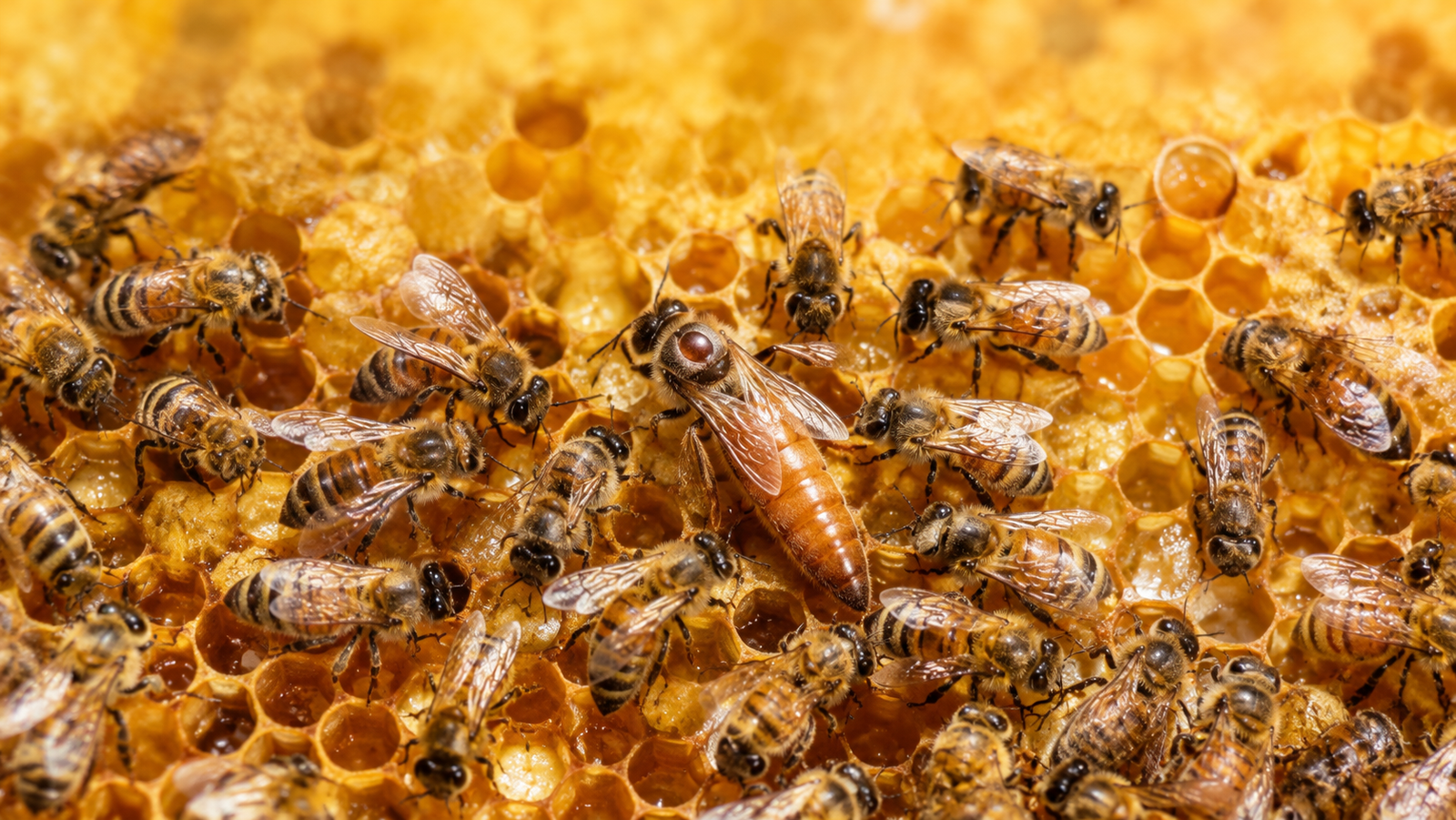
Most established honey bee colonies have one primary reproductive queen at a time. She is responsible for laying the eggs that develop into worker bees, drones and future queens. However, a colony can temporarily contain more than one adult queen during certain stages of queen replacement and swarming. Some beekeepers also deliberately manage colonies with two laying queens.
The exact number depends on the colony’s condition, reproductive stage and management system.
Understanding how many queen bees are in each hive helps beekeepers recognize normal colony behavior, identify queen-related problems and avoid confusing developing queen cells with living adult queens.
In this guide, you will learn how many queens normally live in a honey bee hive, why multiple queens sometimes appear, whether two queens can lay eggs in the same colony, and how to identify the different situations during a hive inspection.
How Many Queen Bees Are in Each Hive Normally?
A typical established honey bee colony (Apis mellifera) normally has one primary laying queen.
She lives alongside thousands of worker bees and, depending on the season and colony condition, hundreds or sometimes thousands of male drones.
The queen is the colony’s main reproductive female. Her most important responsibility is producing eggs that maintain the population and allow the colony to replace aging or dying bees.
Her main functions include:
- Laying eggs: Fertilized eggs generally develop into female workers or queens, while unfertilized eggs develop into male drones.
- Producing pheromones: Chemical signals from the queen help regulate colony organization and influence worker behavior and queen rearing.
- Maintaining colony reproduction: Her egg-laying activity supplies the developing brood needed to replace older bees and support colony growth.
The queen does not perform all the daily activities inside the hive. Worker bees collect nectar and pollen, feed larvae, build wax comb, clean cells, defend the entrance and care for the queen.
A colony normally maintains one primary laying queen because its reproductive and social organization is built around a functioning queen and the worker population that supports her.
However, this arrangement is not completely fixed. Temporary exceptions occur during queen replacement, swarming and other colony transitions.
Can a Beehive Have More Than One Queen?
Yes. A honey bee colony can temporarily contain two or occasionally more adult queens under particular circumstances.
However, it is important to distinguish between three situations:
- A colony containing one laying queen and several developing queens inside queen cells.
- A colony containing more than one emerged adult queen during a reproductive transition.
- A deliberately managed two-queen colony in which two laying queens are maintained using specialized beekeeping equipment.
These situations are not the same.
For example, a beekeeper inspecting a frame may find five queen cells. This does not mean five adult queens are living in the hive. The cells may contain developing queens that have not yet emerged.
The following situations explain why a honey bee colony may temporarily have multiple queens.
1. Queen Replacement or Supersedure
Supersedure is the natural process through which a honey bee colony replaces an existing queen that is becoming less productive, damaged or otherwise unsuitable.
Worker bees detect changes in the queen’s condition and may respond by raising a daughter queen.
They select suitable young female larvae and feed them the special diet required for queen development. The workers also construct enlarged queen cells to accommodate the developing queens.
When the new queen emerges, she is called a virgin queen. She must normally complete mating flights before she can become a fully functioning laying queen.
An interesting feature of supersedure is that the old queen does not always disappear immediately.
In some colonies, the mother queen and her daughter may remain alive in the same hive for a period. The old queen may continue laying eggs while the daughter develops or begins establishing herself.
This temporary overlap is called mother-daughter queen coexistence.
Eventually, the daughter may replace the mother, although the timing and outcome vary between colonies.
Practical example:
Imagine inspecting a colony whose marked queen has been laying eggs for an extended period. During an inspection, you discover a developing replacement queen and later find that the young queen has emerged.
If the older queen is still alive, both may temporarily be present. This does not mean the colony has permanently changed to a two-queen system. It is part of the natural replacement process.
Supersedure is one reason a beekeeper may occasionally encounter two adult queens in the same colony.
2. Swarming
Swarming is a natural form of honey bee reproduction in which one colony divides and establishes a new colony elsewhere.
It commonly occurs when a colony becomes strong, population growth increases and conditions encourage reproduction at the colony level.
Before swarming, worker bees begin preparing replacement queens by constructing queen cells and feeding selected larvae.
A colony may produce several queen cells because it needs a successor after the original queen leaves.
The process generally follows these stages:
Before the swarm leaves
The established queen is usually still laying eggs. Several developing queens may be present inside queen cells.
At this stage, the colony can contain one adult laying queen and several immature queens, but not necessarily several adult queens.
When the primary swarm departs
The old queen generally leaves with a large group of workers to establish a new nest.
The original colony remains behind with brood, food stores, workers and developing queen cells.
When virgin queens emerge
One or more virgin queens may emerge from their cells.
The first queen to emerge may attack other developing queens by stinging through their queen cells. Workers may also influence which queens survive.
However, the process does not always follow exactly the same pattern.
During secondary swarming
Sometimes another swarm, called an afterswarm, leaves the parent colony with a virgin queen.
Further swarms may also occur under certain conditions.
Eventually, a queen remains in the parent colony and, after successful mating, can begin laying eggs.
This explains why the number of adult queens can temporarily vary during swarming.
Importantly, several developing queen cells should never be counted as several adult queens.
3. Temporary Coexistence of Mother and Daughter Queens
Mother-daughter coexistence is a particular situation in which an older queen and her daughter remain in the same colony temporarily.
It is closely associated with supersedure.
The older queen may continue laying eggs while the daughter develops and eventually becomes capable of laying.
This overlap can help maintain brood production during the transition from one queen to another.
However, it is not guaranteed to happen in every colony.
Some old queens disappear before the daughter begins laying. In other colonies, the mother and daughter remain together for a period before the colony settles around one primary reproductive queen.
The duration depends on the colony and the circumstances surrounding queen replacement.
Why this matters to beekeepers:
Finding an old queen and a young queen during the same inspection does not automatically mean something is wrong.
The beekeeper should assess whether both queens are healthy, whether eggs and larvae are present, and whether the colony is progressing normally through queen replacement.
4. A Beekeeper Introduces a New Queen
Another situation in which a hive may temporarily contain two adult queens occurs during artificial requeening.
Requeening means replacing the existing queen with a new queen, often to improve colony performance or replace an aging or failing queen.
Beekeepers may purchase a queen from a breeder or raise one in another colony.
If the old queen has not yet been removed when the new queen is introduced, two adult queens may briefly be present.
However, queen introduction must be managed carefully.
Worker bees do not necessarily accept an unfamiliar queen immediately. They may reject or kill her if the introduction process is unsuccessful.
For this reason, beekeepers generally follow an appropriate queen-introduction procedure and monitor acceptance before considering the replacement complete.
This situation is different from natural supersedure because the beekeeper deliberately controls the replacement process.
How Many Queen Bees Are in a Hive During Swarming?
There is no fixed number of adult queens in every hive during swarming. The number depends on the stage of colony reproduction.
The following table explains what a beekeeper may find.
| Stage | Queen situation |
|---|---|
| Normal colony activity | Usually one laying queen |
| Swarming preparation | One laying queen and several developing queen cells |
| Primary swarm departure | Old queen usually leaves with the swarm |
| Queen emergence | One or more virgin queens may emerge |
| Secondary swarming | A virgin queen may leave with another swarm |
| After the transition | Usually one established reproductive queen remains |
Can a Hive Have Three or More Queens During Swarming?
Yes, three or more adult queens may occasionally be present temporarily during unusual colony transitions.
For example, several virgin queens may emerge at different times while the colony is undergoing swarming.
However, this is not the normal long-term arrangement of an established honey bee colony.
It is also important to remember that the presence of three queen cells does not prove that three adult queens are alive.
A queen cell may contain an egg, larva or pupa, depending on its developmental stage. It may also be empty after the queen has emerged.
The beekeeper must distinguish these conditions before estimating how many adult queens are present.
Can Two Queen Bees Live in the Same Hive Permanently?
Two queens can be maintained in a managed beekeeping system for extended periods, but this requires specialized colony organization.
Most ordinary honey bee colonies naturally operate with one primary reproductive queen.
However, some experienced beekeepers use a system called two-queen management.
In this system, two laying queens are maintained within a specially arranged colony, often using separate brood areas and equipment that controls how the bees interact.
The aim is to increase the colony’s combined brood production and create a larger worker population.
Potential Benefits of Two-Queen Management
A properly managed two-queen system may provide:
- Greater combined egg production.
- Faster growth of the worker population.
- More workers available for nectar collection.
- Stronger colony development before major nectar flows.
- Potentially higher honey production under favorable conditions.
However, these benefits are not guaranteed.
Challenges of Managing Two Queens
Two-queen systems require additional equipment, sufficient food supplies, good colony organization and more demanding inspections.
Other challenges include:
- Maintaining suitable brood-nest space.
- Preventing overcrowding.
- Managing the interaction between the queen-right sections.
- Maintaining adequate food and brood-rearing conditions.
- Monitoring pests, diseases and colony health.
For beginners and most small-scale beekeepers, a healthy single-queen colony is generally easier to manage.
A two-queen system should be considered a specialized management technique rather than the normal arrangement of a honey bee hive.
What Is the Difference Between a Queen Bee, Virgin Queen and Queen Cell?
This distinction is particularly important when answering how many queen bees are in each hive.
A queen bee is an adult female. However, not every adult queen is already capable of laying fertilized eggs.
A virgin queen has emerged from her queen cell but has not yet completed successful mating.
A laying queen is a reproductive adult that has mated successfully and is producing eggs.
A queen cell is not an adult queen at all. It is the enlarged wax structure in which a queen develops.
| Term | Meaning | Can it lay eggs? |
|---|---|---|
| Developing queen | An immature queen inside a queen cell | No |
| Virgin queen | An emerged adult queen that has not completed mating | She may lay unfertilized eggs in some circumstances, but cannot produce normal fertilized worker brood |
| Mated queen | A queen that has completed mating and has stored sperm | Yes |
| Queen cell | Wax structure containing a developing queen | No |
How Long Does It Take a Queen Bee to Develop?
A honey bee queen generally takes about 16 days to develop from egg to adult emergence under normal conditions.
Her development includes:
- Egg stage.
- Larval stage.
- Pupal stage.
- Adult emergence.
After emerging, the virgin queen needs time to mature and complete mating flights when weather and drone availability permit.
Only after successful mating can she normally begin producing fertilized eggs that develop into female workers.
This is why a colony may contain a young adult queen but still have no fresh worker eggs.
What Happens If a Hive Has No Queen?
A queenless hive is a colony without a functioning reproductive queen.
This can happen when the queen dies, disappears, is accidentally injured or leaves with a swarm.
A colony can survive temporarily without a laying queen because worker bees may attempt to raise a replacement.
How Do Worker Bees Replace a Missing Queen?
When a colony loses its queen, workers can select suitable young female larvae and raise them as emergency queens.
They modify the cells containing these larvae into queen cells and provide the developing larvae with the nutrition required for queen development.
If suitable young larvae are unavailable, the colony may be unable to raise a replacement naturally.
A beekeeper may then need to introduce a new queen or provide suitable brood from another healthy colony.
Signs That a Hive May Be Queenless
The following signs can indicate a queen-related problem:
- No fresh eggs or young larvae after a suitable period.
- No functioning queen found during careful inspections.
- Emergency queen cells developing on brood comb.
- A declining population of developing worker brood.
- Unusual brood patterns or signs of laying-worker activity.
However, none of these signs should be interpreted in isolation.
For example, a newly emerged virgin queen may need time to complete mating flights before she starts laying. A temporary absence of fresh eggs does not necessarily mean the colony has lost its queen.
What Are Laying Workers?
If a colony remains queenless for an extended period and cannot establish a replacement, some workers may develop functional ovaries and begin laying eggs.
These bees are called laying workers.
Because they have not mated, their eggs are generally unfertilized and develop into drones.
They cannot normally replace the colony’s reproductive queen or restore the production of female worker bees.
This makes a prolonged laying-worker situation particularly difficult for beekeepers to correct.
How Can You Tell How Many Queen Bees Are in a Hive?
Counting queens is not always easy because queens move among thousands of workers and may be hidden on brood frames.
A careful inspection should focus on identifying adult queens and assessing the colony’s reproductive condition.
1. Look for Adult Queens
A queen usually has a longer abdomen and a larger body than worker bees.
Her abdomen extends noticeably beyond the wings, making her easier to recognize when she is exposed on the comb.
However, body size alone is not a completely reliable identification method.
Some beekeepers mark queens with a small spot of paint on the thorax to make them easier to locate during inspections.
2. Check for Fresh Eggs
Fresh eggs appear as tiny white structures standing at the bottom of brood cells.
Their presence indicates recent egg-laying activity.
However, eggs alone do not prove that a queen is present.
Laying workers can also produce eggs, often with a less regular arrangement and sometimes with several eggs in one cell.
Therefore, eggs should be considered alongside the brood pattern and other signs of queen activity.
3. Examine the Brood Pattern
A healthy laying queen often produces a reasonably consistent brood pattern when the colony has adequate food and favorable conditions.
A scattered or irregular pattern can indicate a failing queen, but it can also result from disease, poor nutrition, chilled brood or other colony problems.
The beekeeper should examine the wider condition of the colony rather than assuming every irregular pattern means the hive has multiple queens or no queen.
4. Inspect Queen Cells
Queen cells are enlarged wax structures used for raising queens.
They are usually elongated and hang vertically from the comb.
Their presence may indicate:
- Swarming preparation.
- Supersedure.
- Emergency queen rearing.
However, several queen cells do not necessarily mean several adult queens are present.
Some may contain developing queens, others may have already been opened, and some may be empty.
A beekeeper should inspect their contents and condition rather than simply count the visible structures.
5. Avoid Excessive Disturbance
Repeatedly opening and dismantling a hive to search for queens can disrupt normal colony activity.
Inspect when necessary, handle frames carefully and avoid damaging queen cells.
If the queen’s status remains unclear, an experienced beekeeper can help assess the brood and colony condition.
Does Every Hive Need a Queen Bee?
An established honey bee colony normally needs a fertile queen or a successful replacement process to maintain its population over time.
Without a functioning queen, the colony cannot continue producing fertilized eggs that develop into female workers.
A queenless colony may survive temporarily while worker bees raise a replacement. However, if the replacement process fails, the worker population gradually declines as older bees die without enough new workers to replace them.
There is also an important difference between a colony with no queen and a colony containing a virgin queen.
A virgin queen may already be present even when the beekeeper cannot find fresh eggs.
Therefore, it is important to understand the colony’s stage of development before deciding that a replacement queen must be introduced.
Do All Bee Species Have Only One Queen?
No. The familiar one-queen arrangement applies most directly to typical honey bee colonies, and social organization differs among bee species.
Honey Bees
Honey bees in the genus Apis normally maintain one primary reproductive queen in an established colony.
Temporary queen coexistence may occur during supersedure and swarming.
Bumblebees
Bumblebees also have queens, but their colony life cycle is different from that of honey bees.
In many bumblebee species, a colony begins with a founding queen. She produces workers, and later the colony produces males and new queens.
Most workers and males die toward the end of the colony cycle, while successfully mated new queens may survive to establish colonies in the following season.
Therefore, the presence of multiple reproductive females in a bumblebee nest must be understood in the context of its seasonal life cycle.
Stingless Bees
Stingless bees are another important group of social bees.
Their reproductive arrangements vary among species. Some species have different queen-rearing and queen-replacement behaviors, and the presence or survival of additional queens depends on the species and colony circumstances.
It is therefore inaccurate to assume that every social bee colony follows exactly the same queen system as the western honey bee.
Solitary Bees
Solitary bees generally do not form large, long-lasting colonies organized around a queen and thousands of workers.
Each female typically establishes and provisions her own nest.
Although solitary bees reproduce, they do not have the same queen-and-worker social structure found in honey bee colonies.
This is why the answer to how many queen bees are in each hive depends partly on the species being discussed.
Frequently Asked Questions
1. How many queen bees are in a honey bee hive?
Most established honey bee hives have one primary laying queen. However, two or occasionally more adult queens may temporarily coexist during certain stages of supersedure or swarming.
2. Can two queen bees live in the same hive?
Yes. Two queens may temporarily coexist during natural queen replacement. Beekeepers can also maintain specialized two-queen colonies using appropriate management techniques.
3. Can a hive have three queen bees?
Yes, three or more adult queens may occasionally be present temporarily during unusual reproductive transitions. However, this is not the normal long-term arrangement of an established honey bee colony.
4. Why does a hive have more than one queen?
Multiple adult queens may occur during supersedure, swarming or artificial requeening. Specialized beekeeping systems can also maintain two laying queens.
5. Can two queen bees lay eggs in the same hive?
Yes, this can happen temporarily when an older queen and her daughter coexist during supersedure. Both may lay eggs during an overlapping period. In managed two-queen systems, both queens may also be maintained as reproductive queens.
6. Do worker bees choose their queen?
Worker bees influence queen development by selecting suitable young larvae and providing the nutrition needed for queen development.
During supersedure and swarming, queen emergence, interactions between queens and worker behavior help determine which queen becomes established.
7. How many queen cells can a hive have?
A colony can have several queen cells, especially during swarming or queen replacement. The number varies between colonies and circumstances.
A queen cell is a developing queen’s chamber, not an adult queen.
8. Does a hive always have a queen?
No. A colony can temporarily become queenless when its queen dies, disappears or leaves with a swarm. Workers may raise a replacement if suitable young larvae are available.
9. Can a virgin queen lay eggs?
A virgin queen has not completed mating and cannot produce normal fertilized worker brood. She may sometimes lay unfertilized eggs, which generally develop into drones.
10. How long does a queen bee live?
A honey bee queen can live for several years, although her productive lifespan varies with genetics, colony conditions and management. Beekeepers sometimes replace queens before the end of their natural lifespan to maintain colony performance.
11. What is the difference between a queen bee and a queen cell?
A queen bee is an adult female. A queen cell is an enlarged wax chamber in which a queen develops. A hive can contain several queen cells without having several adult queens.
12. What happens if two queen bees fight?
When multiple virgin queens emerge during swarming, competition can occur. A queen may attack rival queens before they emerge from their cells or fight another emerged queen. The colony generally progresses toward establishing a replacement reproductive queen, although secondary swarms and other outcomes can complicate the process.
Conclusion: How Many Queen Bees Are in Each Hive?
So, how many queen bees are in each hive?
Most established honey bee colonies have one primary reproductive queen at a time. She lays the eggs that maintain the colony’s population and produces chemical signals that help coordinate worker behavior.
However, two or occasionally more adult queens may temporarily coexist during queen replacement, supersedure and swarming. Some beekeepers also maintain specialized two-queen colonies to increase brood production and potentially improve honey yields.
It is equally important to understand that several queen cells do not mean several adult queens are living in a hive. Developing queens, virgin queens and mated laying queens are different stages of queen development and reproductive activity.
For beekeepers, the most important question is not simply how many queens are present, but whether the colony has a healthy, functioning reproductive queen or is successfully developing a replacement.
Understanding these differences makes hive inspections more informative and helps beekeepers make better decisions about colony management.
Scientific and Educational References
The following educational and extension resources support the honey bee biology and management explanations in this article.
- Mid-Atlantic Apiculture Research and Extension Consortium (MAAREC). The Colony and Its Organization. Information on colony structure, queen biology, supersedure and queen development.
- Purdue University Extension. The Complex Life of the Honey Bee. Explanation of queen-cell development, swarming and queen succession.
- University of Florida IFAS Extension. Swarm Control for Managed Beehives. Information on swarm preparation, queen cells, virgin queen emergence and secondary swarming.
- University of Florida IFAS Extension. The Basics of Queen Management in Beekeeping Operations. Practical information on queen replacement and management.
- University of Georgia Cooperative Extension. Honey Bees and Beekeeping. Educational information about honey bee colony organization, castes and queen development.
- University of Arizona Cooperative Extension. Honeybee Basic Biology. Background on honey bee anatomy, colony organization and reproductive biology.
