
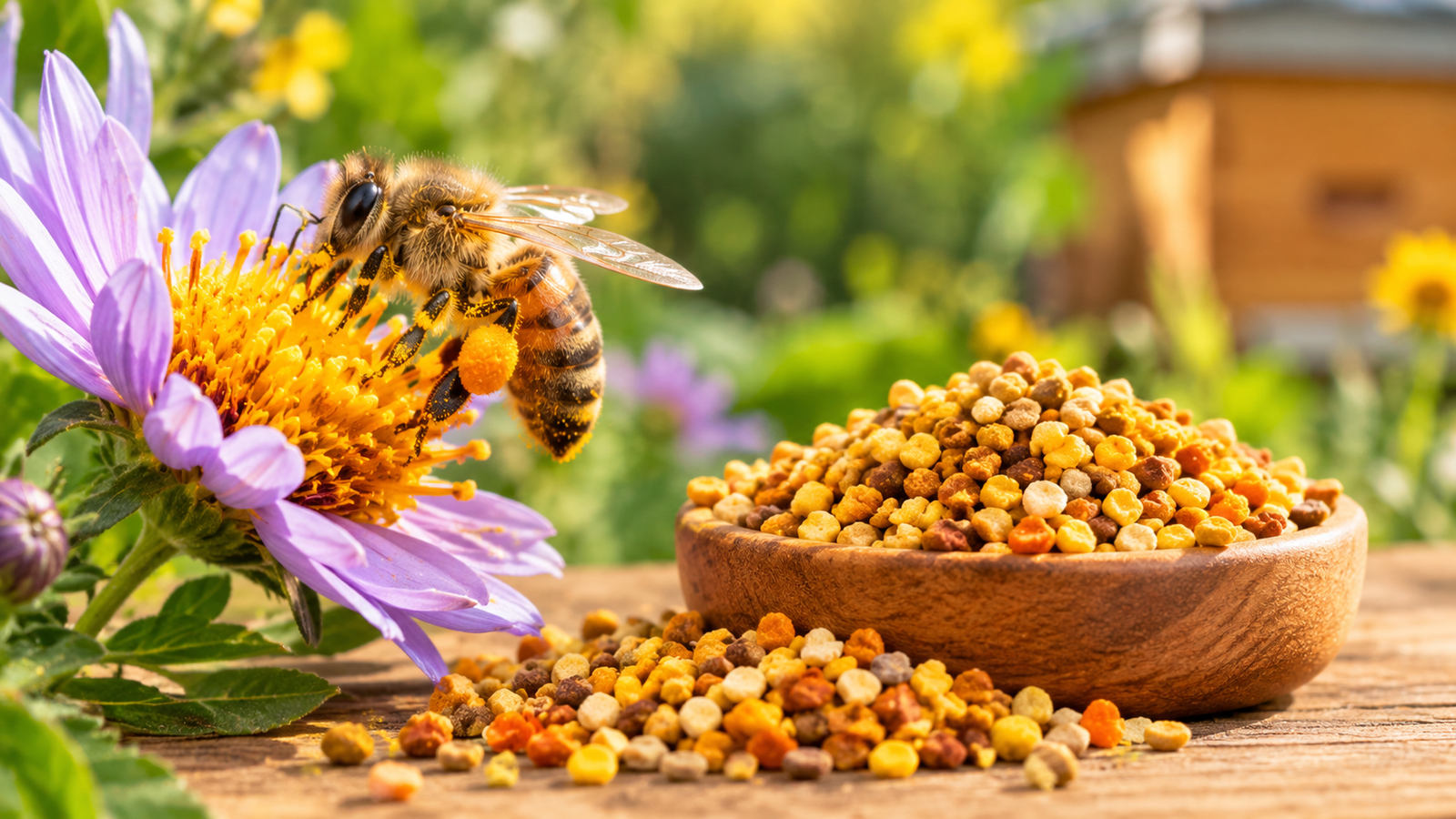
Bee pollen is a natural mixture collected by honey bees from flowering plants. It is made primarily from plant pollen, but the small granules found in beehives are not simply loose pollen from flowers. Bees mix pollen with small amounts of nectar or honey and their own secretions, then pack it into pollen baskets on their hind legs before bringing it back to the hive.
Because pollen comes from many different plants, the exact composition of bee pollen can vary considerably depending on the flowers available, season, location, and bee colony.
What Is Bee Pollen Made Of?
Bee pollen is mainly made of plant pollen grains, combined with small amounts of nectar, honey, and substances contributed by honey bees.
Its composition generally includes:
- Proteins and amino acids
- Carbohydrates
- Lipids and fatty acids
- Vitamins
- Minerals
- Plant compounds and pigments
- Enzymes and other bioactive compounds
- Small amounts of nectar or honey
- Small amounts of bee-derived secretions
The pollen itself is produced by flowering plants as part of their reproductive process. Bees collect these microscopic grains from flowers and transport them back to the colony.
The main components of bee pollen
| Component | What it contributes |
|---|---|
| Plant pollen | The main raw material |
| Protein | Provides amino acids |
| Carbohydrates | Includes sugars and other carbohydrates |
| Lipids | Includes fats and fatty acids |
| Vitamins | Various vitamins in differing amounts |
| Minerals | Elements such as potassium, calcium, magnesium and phosphorus |
| Plant compounds | Pigments, phenolic compounds and other substances |
| Nectar or honey | Helps bind and moisten collected pollen |
| Bee secretions | Help bees handle and pack the pollen |
The proportions are not fixed. Two samples of bee pollen from different regions can have noticeably different nutritional profiles.
1. Plant Pollen Is the Main Ingredient
The most important answer to what is bee pollen made of is simple: plant pollen.
Pollen consists of microscopic grains produced by the male reproductive structures of seed-producing plants. Each pollen grain contains genetic material and nutrients that help support the development of a new plant.
Honey bees collect pollen from flowers using their bodies and legs. As they move between flowers, pollen sticks to their hairy bodies. The bees then groom themselves and transfer the pollen toward their hind legs.
They compress the collected pollen into small masses called pollen pellets, which are carried back to the hive.
The botanical source of the pollen can affect its color, flavor, texture, and nutritional composition.
2. Protein and Amino Acids
Protein is one of the major nutritional components of pollen.
Pollen contains proteins made up of amino acids. Bees need pollen because it supplies important nutrients required for growth and development, particularly for developing bees and young workers.
The amount and type of protein can vary between pollen collected from different plant species.
This is one reason bee pollen should not be considered a nutritionally identical product from one batch to another.
3. Carbohydrates
Bee pollen also contains carbohydrates.
These carbohydrates can include sugars and other carbohydrate compounds. Some come naturally from the pollen itself, while small amounts of nectar or honey may also become incorporated into the pellets during collection.
Carbohydrates provide an important source of energy for honey bees.
The exact carbohydrate profile depends heavily on the plants from which the pollen was collected.
4. Lipids and Fatty Acids
Pollen contains lipids, including various fatty acids.
Although they are present in smaller quantities than many carbohydrates, lipids are an important part of pollen’s overall composition.
The lipid content can differ substantially depending on the botanical source.
This means that pollen collected primarily from one group of flowers may have a different nutritional profile from pollen collected from another group.
5. Vitamins
Bee pollen can contain a variety of vitamins, although the amounts are highly variable.
Depending on its botanical origin, pollen may contain different quantities of vitamins such as:
- Vitamin B-group compounds
- Vitamin C
- Vitamin E
- Carotenoid compounds that can contribute to vitamin A activity
It is important not to assume that every bee pollen product contains the same vitamins in the same amounts.
Processing and storage can also affect some nutrients.
6. Minerals
Minerals are another component of pollen.
Depending on the plant source and environmental conditions, bee pollen may contain minerals such as:
- Potassium
- Calcium
- Magnesium
- Phosphorus
- Iron
- Zinc
- Copper
- Manganese
However, the mineral content is not standardized. Soil composition, plant species, geography, and other environmental factors can influence the mineral profile.
7. Plant Pigments and Other Compounds
The colorful appearance of many bee pollen pellets comes partly from natural plant pigments.
Pollen can contain compounds such as carotenoids and flavonoids, as well as other plant-derived substances.
These compounds contribute to differences in:
- Color
- Aroma
- Flavor
- Chemical composition
For example, bee pollen can range from yellow and orange to green, brown, red, or other shades depending on its botanical sources.
8. Nectar and Honey
Bee pollen is not made exclusively of dry pollen grains.
While collecting pollen, bees can introduce small quantities of nectar and other hive materials. Nectar provides sugars and moisture that can help the bees form pollen into compact pellets.
Once the pollen reaches the hive, it may also be processed further and stored in honeycomb cells.
This is why the material commonly called bee pollen is better understood as a bee-collected pollen mixture rather than simply pollen removed directly from flowers.
9. Bee Secretions
Bees also contribute small amounts of substances from their own bodies while collecting and handling pollen.
These secretions help bees manipulate the pollen and form it into pellets that can be transported efficiently.
The exact composition of these bee-derived substances can vary, and they represent only a small part of the overall material.
Is Bee Pollen the Same as Flower Pollen?
No.
Flower pollen and bee pollen are closely related, but they are not exactly the same thing.
Flower pollen is produced by plants and exists naturally on flowers.
Bee pollen is pollen that honey bees have collected, mixed with small amounts of nectar or other substances, formed into pellets, and transported back to the colony.
This distinction is important because the composition of bee pollen reflects both its plant origin and the way bees collect and process it.
Why Does Bee Pollen Have Different Colors?
Bee pollen can have many different colors because bees collect pollen from different plants.
A single pollen pellet may contain pollen from one plant species or a mixture of sources. Different plants produce pollen with different pigments and chemical compositions.
Common colors include:
- Yellow
- Orange
- Cream
- Green
- Brown
- Red
- Dark purple
Therefore, color alone cannot tell you exactly what nutrients are present in a particular sample.
Does All Bee Pollen Have the Same Composition?
No. Bee pollen does not have one fixed chemical composition.
Its composition can be affected by:
- Plant species — Different plants produce different types of pollen.
- Geography — Soil and environmental conditions influence plants.
- Season — The flowers available to bees change throughout the year.
- Weather — Temperature, rainfall, and other conditions affect flowering and pollen production.
- Bee colony behavior — Bees may collect pollen from many different plants.
- Processing and storage — Drying, heating, and storage conditions can affect some components.
This variability is one of the most important things to understand when discussing the nutritional composition of bee pollen.
What Makes Bee Pollen Nutritionally Interesting?
Bee pollen contains a broad mixture of nutrients and plant compounds rather than one dominant substance.
Its nutritional profile can include protein, carbohydrates, lipids, vitamins, minerals, amino acids, pigments, and other plant compounds.
However, the amounts vary considerably between samples.
For this reason, bee pollen should not automatically be treated as a standardized source of a particular nutrient. A nutritional label or laboratory analysis of a specific product is more useful when you need exact quantities.
How Do Bees Collect and Make Bee Pollen?
The process begins when a worker bee visits flowers.
Step 1: The bee visits flowers
Pollen sticks to the bee’s hairy body as it moves among flowers.
Step 2: The bee gathers the pollen
The bee uses its legs and mouthparts to groom pollen from its body.
Step 3: The pollen is packed
The bee mixes and compresses pollen into pellets that are placed in structures called corbiculae, commonly known as pollen baskets, on its hind legs.
Step 4: The bee returns to the hive
The pollen pellets are carried back to the colony.
Step 5: The colony uses the pollen
Worker bees can process and store pollen in the hive. Stored pollen can become bee bread, a fermented food used by the colony.
Bee Pollen vs. Bee Bread
Bee pollen and bee bread are related but different.
Bee pollen refers to pollen collected and transported by bees, typically in compact pellets.
Bee bread is pollen that has been stored inside the hive and undergoes further processing and fermentation. Bees mix stored pollen with secretions and honey, pack it into honeycomb cells, and allow it to undergo fermentation.
Bee bread therefore has a different composition and characteristics from freshly collected bee pollen.
Is Bee Pollen Made by Bees?
Not entirely.
This is a common misconception.
Bees do not produce the pollen itself. Plants produce pollen. Bees collect that pollen and modify, mix, pack, and transport it.
So the simplest way to describe its origin is:
Plants make the pollen; bees collect and process it into bee pollen.
Is Bee Pollen a Source of Protein?
Yes. Bee pollen naturally contains protein and amino acids, although the amount varies depending on its botanical origin.
The protein content is one reason pollen is an important food resource for honey bee colonies. Nurse bees use pollen-derived nutrients to support the development of young bees.
For humans, however, the nutritional value of a particular bee pollen product depends on its actual composition and serving size.
Frequently Asked Questions About What Bee Pollen Is Made Of
What is bee pollen made of?
Bee pollen is primarily made of plant pollen collected by honey bees. It also contains smaller amounts of nectar or honey and bee-derived substances. Nutritionally, it can contain proteins, carbohydrates, lipids, vitamins, minerals, amino acids, pigments, and other plant compounds.
Is bee pollen just pollen?
No. Bee pollen starts as plant pollen, but bees collect, mix, compress, and transport it. Small amounts of nectar and bee secretions can become part of the resulting pollen pellets.
Where does bee pollen come from?
Bee pollen comes from flowering plants. Honey bees collect pollen from flowers and transport it back to their hive.
Do bees make pollen?
No. Plants produce pollen. Bees collect the pollen and turn it into compact pellets for transportation.
Why is bee pollen different colors?
Different plants produce pollen containing different pigments and compounds. Because bees collect pollen from different flowers, bee pollen can appear yellow, orange, green, brown, red, or other colors.
Does bee pollen contain protein?
Yes. Plant pollen naturally contains protein and amino acids, and these are important nutrients for honey bee colonies.
Is bee pollen made of nectar?
No. Nectar is not the main ingredient. Plant pollen is the main component, while small amounts of nectar or honey may become incorporated during collection and processing.
Is bee pollen the same as bee bread?
No. Bee pollen is collected and transported by bees, while bee bread is pollen that has been stored in the hive and undergone further processing and fermentation.
Final Answer: What Is Bee Pollen Made Of?
Bee pollen is mainly made of plant pollen collected from flowers by honey bees. During collection, bees combine and compress the pollen into pellets and may add small amounts of nectar, honey, and bee-derived secretions.
Its nutritional composition can include protein, amino acids, carbohydrates, lipids, vitamins, minerals, pigments, flavonoids, and other plant compounds. However, there is no single composition for all bee pollen because its makeup changes according to the plants visited by the bees, location, season, environmental conditions, and processing.
In simple terms, plants make the pollen, bees collect and process it, and the resulting material is what we call bee pollen.

1 Comment
Pingback: How Is Bee Pollen Good for You? Benefits and Risks - BeekeeperBase