

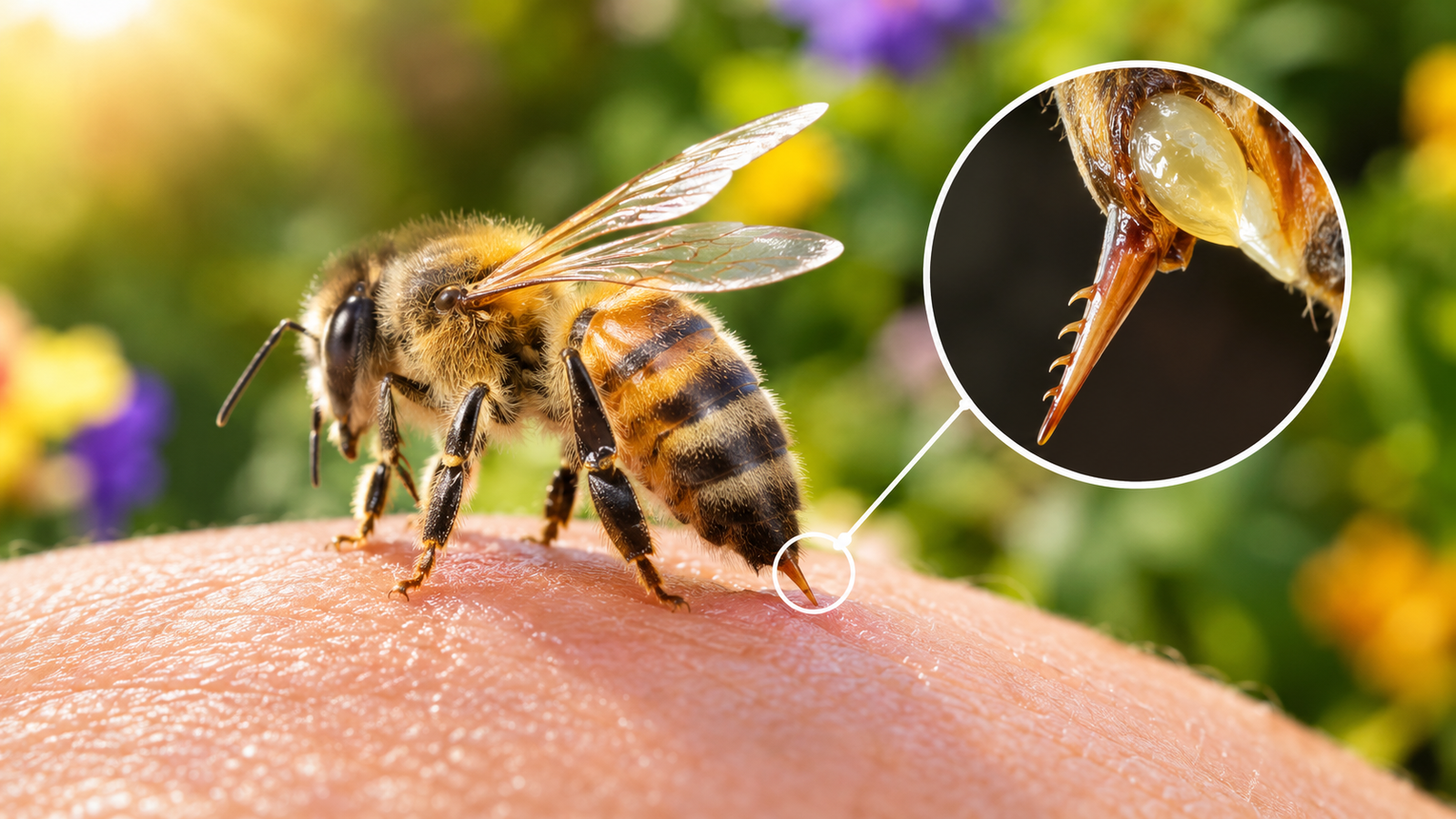
Why bee die after sting? It is a question many people ask after discovering that a honey bee can lose its life while defending itself.
Worker honey bees often die after stinging humans because their stingers have tiny backward-facing barbs that can become lodged in human skin. When the bee tries to pull away, the stinger may remain embedded, tearing away part of the bee’s abdomen along with important muscles, glands, and other tissues connected to its venom-delivery system.
This injury is generally fatal because the bee loses essential body structures that it cannot replace.
However, an important detail is often overlooked: not all bees die after stinging. Bumblebees, carpenter bees, and many solitary bee species can withdraw their stingers and survive. Even honey bees do not necessarily die every time they use their stingers. The outcome depends on the bee’s anatomy and what it stings.
Understanding why bee die after sting requires looking closely at the structure of a honey bee’s stinger, what happens when it becomes trapped, and how different bees defend themselves.
Why Do Honey Bees Die After Stinging Humans?
The main reason worker honey bees die after stinging humans is the structure of their stingers.
Unlike a smooth needle that can easily slide back out, a worker honey bee’s stinger has backward-facing barbs. These small projections help anchor the stinger in the target’s tissue.
When a worker honey bee stings a person, the barbs can become caught in the skin. If the bee tries to fly away, its body pulls against the embedded stinger. Instead of withdrawing cleanly, the stinging apparatus can tear away from the bee’s abdomen.
The injury may remove:
- The stinger itself.
- The venom sac.
- Muscles associated with the stinging apparatus.
- Glands and associated tissues.
- Nerve connections and other abdominal structures.
The resulting abdominal wound is severe. The bee may continue moving briefly, but it generally cannot survive such extensive damage.
What Happens When a Honey Bee Stings a Human?
The process can be understood in six stages.
1. The bee detects a threat.
A worker honey bee may become defensive when a person approaches or disturbs its colony. It can respond by using its stinger to protect itself and the hive.
2. The stinger penetrates the skin.
The pointed stinger enters the skin. Its backward-facing barbs help it grip the surrounding tissue.
3. The stinger becomes lodged.
Human skin can hold the barbed stinger firmly enough to prevent the bee from withdrawing it easily.
4. The bee attempts to escape.
The worker tries to fly away, but the stinger remains anchored in the person’s skin.
5. The stinging apparatus separates from the abdomen.
As the bee pulls away, the tension can tear the stinging apparatus and attached abdominal tissues from its body.
6. The bee eventually dies.
The extensive injury leaves the worker honey bee unable to survive. The detached stinger may also continue delivering venom briefly after the bee has separated from it.
This explains why the death of a worker honey bee is not simply caused by using its venom. The main cause is the severe physical damage associated with losing its embedded stinging apparatus.
How Does a Honey Bee’s Stinger Cause Its Death?
To understand why the injury is so serious, it helps to examine the anatomy of a honey bee’s stinger.
A worker honey bee’s stinger is not just a sharp point. It is a specialized defensive structure connected to a venom-delivery system.
1. The stinger contains two lancets
The worker honey bee’s stinger contains two slender structures called lancets.
These lancets have small backward-facing teeth and move against each other as the stinger penetrates tissue. Their alternating movements help the stinger advance into the target.
This arrangement is sometimes compared to a tiny harpoon because the backward-facing barbs make withdrawal difficult once the stinger becomes firmly embedded.
2. The barbs hold the stinger in place
The backward-facing projections help anchor the stinger in the target’s tissue.
When the stinger enters human skin, these barbs can catch in the surrounding tissue. The bee may struggle to pull free, but the stinger remains attached to the skin.
This is the crucial difference between a worker honey bee stinging a person and stinging many smaller insects.
3. The venom sac and muscles become detached
The stinger connects to a venom-delivery apparatus that includes the venom sac and associated muscles.
When the bee pulls away from an embedded stinger, these structures can be torn from its abdomen.
The damage is much more serious than losing a small body part. It involves an interconnected system responsible for delivering venom and supporting the stinging mechanism.
4. The bee suffers a fatal abdominal injury
The separation leaves a substantial wound in the bee’s abdomen.
The loss of essential tissues and the resulting internal damage make recovery extremely unlikely.
The bee does not die because it has run out of venom. It dies because the physical injury is generally too severe for its body to survive.
Why Does a Honey Bee’s Stinger Get Stuck in Human Skin?
The answer is largely related to the difference between human skin and the bodies of many insects.
Human skin is relatively thick and elastic compared with the outer body covering of many insects. When a worker honey bee inserts its barbed stinger into human skin, the surrounding tissue can grip the backward-facing barbs.
The bee may therefore be unable to withdraw the stinger without tearing its own abdomen.
Consider two examples:
Example 1: A worker honey bee stings a person.
The stinger enters the person’s skin and becomes lodged. When the bee pulls away, its stinging apparatus may detach, causing a fatal injury.
Example 2: A worker honey bee attacks another insect.
The stinger may penetrate the insect’s outer body covering without becoming permanently trapped. Depending on the target and the circumstances, the bee may withdraw its stinger and survive.
This is why a worker honey bee does not necessarily die after every defensive encounter.
The important factor is not simply whether the bee has stung something. It is whether the stinger becomes trapped and causes severe injury when the bee attempts to withdraw it.
Do All Bees Die After Stinging?
No. The belief that every bee dies after stinging is incorrect.
There are approximately 20,000 known bee species, and their stinging structures and defensive abilities vary considerably.
Worker honey bees are particularly well known for losing their stingers after stinging humans. Many other bees can withdraw their stingers and survive.
The following comparison explains the important differences.
Which Bees Die After Stinging?
| Type of bee | Does it die after stinging? | Explanation |
|---|---|---|
| Worker honey bee | Usually, after stinging a person | Its barbed stinger can become lodged in human skin, tearing away abdominal tissues. |
| Queen honey bee | Usually survives | Her stinger can generally be withdrawn, and she may sting rival queens repeatedly. |
| Bumblebee | Usually survives | Its stinger can generally be withdrawn without causing fatal abdominal injury. |
| Carpenter bee | Usually survives | Female carpenter bees can sting but can generally withdraw their stingers. |
| Solitary bees | Depends on the species | Many female solitary bees can sting and withdraw their stingers. |
| Male honey bee (drone) | Cannot sting | Drones do not possess a functional stinger. |
| Stingless bees | Cannot deliver a conventional sting | These bees lack a functional stinging apparatus used to inject venom. |
The table highlights an important distinction: the death of a worker honey bee after stinging a human is not a universal feature of all bees.
Why Do Queen Honey Bees Survive After Stinging?
Queen honey bees have stingers, but their stinging apparatus differs from that of worker honey bees.
A queen can generally withdraw her stinger without suffering the same abdominal injury that commonly kills a worker after stinging a human.
Queens primarily use their stingers during encounters with rival queens, particularly when competing for dominance inside or around a colony.
Unlike worker honey bees, queens can potentially sting more than once.
Why Don’t Male Honey Bees Sting?
Male honey bees are called drones.
Drones do not have stingers because the stinger is a modified egg-laying structure called an ovipositor. Since males do not lay eggs, they do not possess this structure.
Their main reproductive role is to mate with a queen.
This means a drone cannot sting a person, regardless of whether it feels threatened.
Can Bumblebees Die After Stinging?
Bumblebees generally survive after stinging because their stingers can usually be withdrawn.
Unlike the worker honey bee’s strongly barbed stinger, a bumblebee’s stinger is not normally trapped in human skin in a way that causes the same fatal abdominal injury.
A female bumblebee can potentially sting repeatedly if she continues to feel threatened.
Can Carpenter Bees Die After Stinging?
Female carpenter bees have functional stingers and can sting when threatened.
However, their stingers can generally be withdrawn after an attack, allowing them to survive.
Male carpenter bees cannot sting because they do not have functional stingers.
An important identification detail is that male carpenter bees may appear threatening when they hover close to people, but they cannot deliver a sting.
Why Do Honey Bees Have Barbed Stingers?
If losing a stinger can kill a worker honey bee, why does the species have this type of defensive structure?
The answer lies in colony protection.
A honey bee colony contains a queen, developing young, food stores, and thousands of workers performing different tasks. These resources are valuable to the survival of the colony.
Worker bees defend the hive against potential predators and other threats.
Their barbed stingers help anchor a sting in an attacker, making it difficult for the target to remove the stinger immediately.
The venom can cause pain and discourage further attacks. The stinging process also releases alarm chemicals that can alert nearby workers to danger.
How Do Alarm Pheromones Help Honey Bees Defend Their Colony?
When a worker honey bee stings an intruder, chemical signals associated with the sting can alert other workers.
These chemicals are known as alarm pheromones.
They help communicate that the colony is under threat and can encourage nearby workers to become defensive.
For example, if a person disturbs a hive and receives a sting, the alarm signals may attract additional defensive workers.
This is one reason why it is important to move away from a disturbed colony rather than remaining close to it.
The worker that stings a person may die, but its defensive response can help protect the rest of the colony.
Can Honey Bees Survive After Stinging Other Insects?
Yes. Worker honey bees can survive some encounters in which they use their stingers against other insects.
The reason is that the stinger does not become permanently lodged in every target.
Many insects have an outer body covering that differs considerably from mammalian skin. Depending on the insect’s size, structure and the location of the sting, the honey bee may be able to withdraw its stinger without losing its stinging apparatus.
For example, a worker honey bee defending its colony against a smaller insect may be able to sting and retreat without suffering the fatal abdominal injury associated with stinging a human.
However, this does not mean every insect sting is harmless to the bee. Some targets have hard or protective body structures that can make withdrawal difficult.
The outcome depends on the interaction between the bee’s stinger and the target’s anatomy.
How Long Does a Honey Bee Live After Stinging?
A worker honey bee does not necessarily die at the exact moment its stinger becomes detached.
The bee may continue moving or displaying brief activity after the injury.
However, when the stinging apparatus and attached abdominal tissues have been torn away, the damage is generally fatal.
The exact time until death can vary. It is therefore misleading to claim that every worker honey bee dies within a fixed number of seconds or minutes.
The process can be understood in three stages:
| Stage | What happens |
|---|---|
| Immediately after separation | The bee may still move despite its severe injury. |
| Following the injury | The loss of abdominal tissues and the resulting damage make survival extremely unlikely. |
| Eventually | The bee dies from the consequences of the injury. |
The important distinction is that a bee can remain active briefly without having a realistic chance of recovering.
Can a Detached Bee Stinger Still Inject Venom?
Yes. A detached honey bee stinger can continue delivering venom for a short period after it separates from the bee.
This happens because parts of the stinging apparatus can continue operating independently.
The detached apparatus contains structures that help pump venom from the venom sac into the wound.
Research and educational guidance describe continued venom delivery for approximately 45–60 seconds after the sting.
This is important for anyone who has been stung.
If a honey bee stinger remains embedded in the skin, remove it as soon as possible. Do not wait for the venom delivery to stop naturally.
The longer an embedded stinger remains in the skin, the more venom may enter the wound.
Do Bees Know They Will Die After Stinging?
There is no conclusive scientific evidence that worker honey bees consciously understand that stinging a human may cause their death.
A worker honey bee’s defensive behavior is best understood through its biology, nervous system, and evolved responses to threats.
When a bee detects danger near its colony, it may respond by using its stinger.
This behavior does not establish that the bee has consciously decided to sacrifice its life.
Honey bees are capable of learning, communicating and responding to environmental information. However, these abilities do not prove that they understand death or future consequences in the same way humans do.
The most scientifically responsible explanation is that the bee’s death is a consequence of its anatomy and defensive behavior, not a proven conscious decision to die.
What Should You Do If a Honey Bee Stings You?
Although the bee may die after stinging, the sting can cause pain, swelling and, in some people, a serious allergic reaction.
If a honey bee stings you, take the following steps.
1. Move Away From the Bee
Calmly move away from the bee and its colony.
Avoid swatting at other bees or remaining close to a disturbed hive, as additional stings may occur.
2. Remove the Stinger Quickly
Look for an embedded stinger.
Remove it as soon as possible by scraping it out or carefully pulling it out.
Do not waste time deciding which removal technique is best. Prompt removal is more important than choosing between scraping and pulling.
3. Wash the Affected Area
Clean the sting site using soap and water.
This helps remove dirt and reduces the risk of introducing bacteria into the affected area.
4. Apply a Cold Compress
Place a cold pack wrapped in a clean cloth over the affected area.
This can help reduce pain and swelling.
Avoid placing ice directly against the skin for prolonged periods.
5. Watch for Allergic Reactions
Most bee stings cause localized symptoms such as:
- Pain.
- Redness.
- Itching.
- Swelling around the sting.
However, some people develop a severe allergic reaction called anaphylaxis.
Warning signs include:
- Difficulty breathing.
- Swelling of the tongue or throat.
- Widespread hives.
- Dizziness or fainting.
- A sudden feeling of weakness or collapse.
Important: Anaphylaxis is a medical emergency. Use prescribed epinephrine immediately if available and seek emergency medical assistance. Do not wait for symptoms to disappear.
People who receive multiple stings, especially children, should also receive prompt medical assessment.
Frequently Asked Questions About Why Bee Die After Sting
1. Why bee die after sting?
Worker honey bees often die after stinging humans because their backward-facing barbed stingers become lodged in the skin. When the bee tries to fly away, the stinging apparatus can tear away from its abdomen, taking essential tissues and venom-delivery structures with it. The resulting injury is generally fatal.
2. Do all bees die after stinging humans?
No. Worker honey bees commonly die after stinging humans, but bumblebees, carpenter bees and many other bee species can withdraw their stingers and survive.
3. Does a honey bee die immediately after stinging?
Not necessarily. A worker honey bee may continue moving briefly after losing its stinging apparatus. However, the extensive abdominal injury is generally fatal.
4. Why does a honey bee leave its stinger in human skin?
A worker honey bee has a barbed stinger that can become trapped in human skin. When the bee attempts to fly away, the stinger may remain embedded rather than withdrawing with the bee.
5. Can a honey bee survive after stinging?
Yes, under some circumstances. If its stinger can be withdrawn without causing severe abdominal injury, the bee may survive. However, a worker that loses its stinging apparatus after stinging a person generally cannot recover.
6. Can a dead bee still sting?
A dead bee cannot actively choose to sting. However, its detached stinger may still puncture skin and deliver venom if handled or pressed against the body. Avoid picking up dead bees with bare hands.
7. Do male honey bees sting?
No. Male honey bees, known as drones, do not have functional stingers. Their reproductive anatomy does not include the modified egg-laying structure that forms the female bee’s stinger.
8. Can queen honey bees sting more than once?
Yes. Queen honey bees can generally withdraw their stingers and may sting rival queens repeatedly during encounters over reproductive dominance.
9. Why do honey bees sting if they can die afterward?
Worker honey bees sting to defend themselves and protect their colonies. Their barbed stingers are effective defensive structures, even though becoming trapped in human skin can cause fatal injuries.
10. Do bumblebees die after stinging?
Bumblebees generally survive after stinging because they can usually withdraw their stingers without tearing away their abdominal tissues.
11. Do wasps die after stinging?
Most wasps can withdraw their stingers and sting repeatedly. Their stingers generally do not become trapped in human skin in the same way as those of worker honey bees.
12. Why does a bee’s stinger keep pumping venom after it flies away?
The detached stinging apparatus contains structures that can continue operating briefly after separating from the bee. These structures can continue pumping venom into the wound.
Conclusion: Why Bee Die After Sting?
Why bee die after sting? The main reason is the unique structure of the worker honey bee’s barbed stinger.
When a worker honey bee stings a human, its backward-facing barbs can become trapped in the skin. As the bee tries to escape, the stinger may tear away from its abdomen, taking the venom sac, muscles and other essential tissues with it.
The resulting injury is generally fatal because the bee cannot survive the extensive damage.
However, not all bees share this fate. Queen honey bees, bumblebees, carpenter bees and many other bee species can generally withdraw their stingers and survive. Male honey bees cannot sting at all.
The next time you see a honey bee, remember that its stinger is not simply a weapon. It is a specialized defensive structure that plays an important role in protecting the colony, even though its use against humans can cost a worker bee its life.
Understanding this difference helps explain the remarkable relationship between bee anatomy, defensive behavior and colony survival.
Scientific References and Further Reading
The following scientific and educational resources support the explanations in this article.
- University of California Agriculture and Natural Resources. Why Do Honey Bees Die When They Sting?
https://ucanr.edu/blog/bug-squad/article/why-do-honey-bees-die-when-they-sting - PBS NewsHour. Why Do Honeybees Die When They Sting?
https://www.pbs.org/newshour/science/honeybee-sting-kill-bee - University of Wollongong. Most Bees Don’t Die After Stinging – and Other Surprising Bee Facts.
https://www.uow.edu.au/media/2024/most-bees-dont-die-after-stinging—and-other-surprising-beefacts.php - Texas A&M Honey Bee Lab. Bee Frequently Asked Questions.
https://honeybeelab.tamu.edu/beekeeper-resources/bee-frequently-asked-questions/ - American Heart Association and American Red Cross. 2024 Guidelines for First Aid.
https://cpr.heart.org/en/resuscitation-science/2024-first-aid-guidelines - University of Arizona Cooperative Extension. Wild Honey Bees in Community Environments: Identification, Biology, and Reducing Risks.
https://extension.arizona.edu/sites/default/files/2024-08/az1846-2020.pdf - Live Science. Do Bees Really Die If They Sting You?
https://www.livescience.com/do-bees-die-after-stinging
These sources provide additional information about honey bee anatomy, stinger detachment, bee diversity, colony defense and appropriate first aid.
