

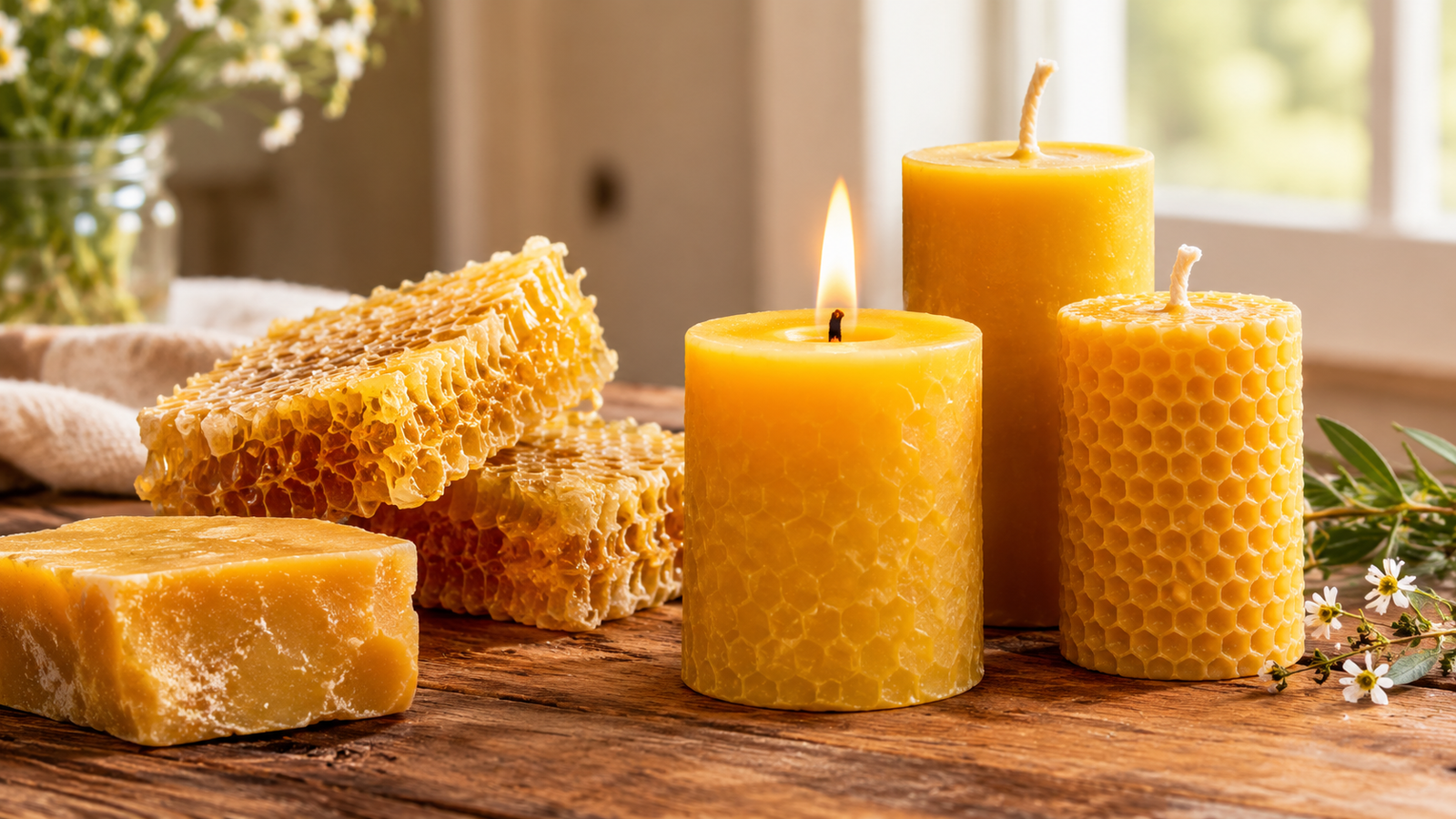
Why beeswax candles are better is a common question among people looking for natural alternatives to conventional candles. Beeswax candles are popular because they are made from wax produced by honey bees, often have a subtle honey-like fragrance, and create a warm, attractive glow. They can also appeal to consumers who prefer renewable materials and products connected to traditional beekeeping.
But are beeswax candles actually better than soy or paraffin candles?
Beeswax candles have several advantages, including their natural origin, distinctive aroma, attractive appearance, and potential to support beekeeping businesses. However, they also have disadvantages, such as higher prices, limited fragrance options, and the possibility of producing soot and other combustion emissions.
Importantly, beeswax candles are not automatically healthier, cleaner-burning, longer-lasting, or more environmentally friendly than every other type of candle. Their performance depends on the quality of the wax, wick construction, manufacturing process, and burning conditions.
In this guide, you will discover why beeswax candles are better for certain purposes, their scientifically supported benefits and drawbacks, how they compare with soy and paraffin candles, and how to choose and use them properly.
1. What Makes Beeswax Candles Special?
Beeswax candles are made from beeswax, a natural substance produced by worker honey bees. Unlike petroleum-derived paraffin wax and plant-derived soy wax, beeswax originates from the honey bee colony.
Worker honey bees produce wax through specialized glands located on the underside of their abdomens. The wax initially appears as small flakes, which bees manipulate using their legs and jaws before shaping it into honeycomb.
Honeycomb consists of hexagonal cells that serve several important purposes within the colony. Honey bees use these cells to store honey and pollen and to raise developing bees.
Beekeepers can recover beeswax from suitable hive materials, including the wax cappings removed during honey extraction and old comb removed during appropriate hive management.
The recovered wax is then cleaned, filtered, melted, and processed into products such as candles, cosmetics, furniture polish, and other household materials.
Why does beeswax have a natural honey-like smell?
Pure beeswax often has a mild, sweet aroma that people describe as honey-like. This characteristic comes from naturally occurring compounds and residual substances in the wax.
The strength of the fragrance varies depending on the wax’s origin, processing, and storage conditions.
Beeswax can also vary in appearance. Freshly processed wax may have a golden-yellow color, while thoroughly filtered or refined beeswax can appear pale yellow, cream-colored, or nearly white.
These characteristics make beeswax particularly attractive to candle makers and consumers who appreciate traditional, naturally derived materials.
2. Seven Benefits of Beeswax Candles
There are several reasons people choose beeswax candles over conventional alternatives. However, understanding what each benefit actually means is important when deciding whether they are worth purchasing.
1. Beeswax Candles Are Made From Naturally Produced Wax
One of the biggest reasons people prefer beeswax candles is their natural origin.
Beeswax is produced by honey bees rather than manufactured from petroleum. This makes it an appealing alternative for consumers who prefer naturally derived household products.
A basic beeswax candle can contain just two main components:
- Beeswax.
- A suitable candle wick.
However, some commercial products contain additional waxes, fragrances, colorants, or other ingredients.
For example, someone looking for a simple candle without added perfume may prefer an unscented candle made from pure beeswax.
It is important to remember that natural origin does not automatically mean a product is healthier or harmless. The substances released when a candle burns depend on its composition and combustion conditions.
2. Beeswax Candles Have a Pleasant Natural Fragrance
Many people appreciate beeswax candles because of their naturally sweet, honey-like aroma.
Unlike candles that depend entirely on added perfumes, pure beeswax can have its own recognizable fragrance.
This makes it attractive to people who prefer a subtle scent rather than a strong artificial fragrance throughout their homes.
For example, someone using candles during dinner may prefer the mild fragrance of beeswax because it is less likely to compete with the smell of food.
However, the aroma is not equally strong in every beeswax candle. Some have a noticeable honey-like scent, while others have a very mild fragrance.
People who are sensitive to smells should also remember that natural fragrance does not necessarily mean fragrance-free.
3. Beeswax Candles Create a Warm and Attractive Glow
Beeswax candles are also valued for their appearance.
Their natural golden-yellow or cream-colored wax gives them a distinctive look that works well with traditional, rustic, and minimalist decorations.
They are available in different shapes and styles, including:
- Pillar candles.
- Taper candles.
- Rolled beeswax candles.
- Small decorative candles.
- Votive candles.
For example, beeswax taper candles can create an attractive arrangement on a dining table, while larger pillar candles can provide decorative lighting in a living room.
Their appearance is an important advantage for people who want candles that serve both decorative and functional purposes.
4. Beeswax Candles May Have a Long Burning Time
Beeswax candles are frequently promoted as long-burning alternatives to other candles.
A properly designed beeswax candle can provide many hours of use. However, its actual burning time depends on several factors.
These include:
- Total wax weight.
- Candle diameter.
- Wick thickness and material.
- Wax composition.
- Air movement around the flame.
- Manufacturing quality.
- Burning and maintenance practices.
Why does this matter?
Consider two candles: one weighing 100 grams and another weighing 250 grams. Even if both are made from beeswax, the larger candle has more available fuel.
Similarly, a candle with an unsuitable wick may consume its wax inefficiently or develop an unstable flame.
Therefore, beeswax should not automatically be assumed to burn longer than soy or paraffin candles.
When comparing products, check the manufacturer’s estimated burn time and compare candles of similar weight and construction.
5. Beeswax Is a Renewable Material
Another reason beeswax candles appeal to environmentally conscious consumers is that beeswax is a renewable biological material.
Honey bees continuously produce wax as part of their normal colony activities. Beekeepers can recover suitable wax during honey extraction and other appropriate hive-management activities.
This makes beeswax different from paraffin, which is derived from petroleum.
However, renewable does not automatically mean environmentally harmless.
The sustainability of beeswax depends on how it is collected, processed, transported, and manufactured.
Responsible beekeeping should prioritize:
- Healthy and adequately fed colonies.
- Appropriate hive management.
- Responsible harvesting of hive products.
- Avoiding unnecessary disturbance of colonies.
- Maintaining suitable honeycomb and colony resources.
For example, using clean wax cappings recovered during honey extraction can provide an additional use for a material that might otherwise require further processing or storage.
However, beekeepers should not remove essential colony resources simply to increase candle production.
6. Buying Beeswax Candles Can Support Beekeepers
Beeswax candles also create an opportunity for consumers to support beekeeping businesses.
Beekeepers produce several valuable products, including honey, beeswax, pollen, propolis, and other hive-derived materials.
Processing suitable recovered beeswax into candles can create an additional source of income.
This is particularly useful for small-scale beekeepers who want to diversify their businesses beyond honey production.
For example, a local beekeeper who sells honey may also produce rolled beeswax candles, decorative candles, and taper candles from properly processed wax.
Consumers who purchase these products may help support local producers and small candle-making businesses.
To make a more informed purchase, look for manufacturers who explain where their beeswax comes from and how it is processed.
7. Beeswax Candles Can Have Simple Ingredients
A basic beeswax candle can have a relatively short ingredient list.
Some products contain only beeswax and a suitable wick, while others include additional ingredients such as fragrances, essential oils, colorants, or blended waxes.
For consumers who prefer products with fewer added ingredients, pure beeswax candles can be an appealing option.
However, a simple ingredient list does not mean the candle releases no pollutants when burned.
Combustion produces emissions even when the original material is natural.
Therefore, it is important to distinguish between the ingredients used to manufacture a candle and the substances produced when it burns.
3. Beeswax Candles vs. Soy and Paraffin Candles
Are beeswax candles better than soy or paraffin candles?
The answer depends on what you value most.
Beeswax, soy, and paraffin candles differ in their material sources, fragrance characteristics, prices, and environmental considerations.
Here is a comparison.
| Feature | Beeswax candles | Soy candles | Paraffin candles |
|---|---|---|---|
| Main material | Bee-produced wax | Soybean-derived wax | Petroleum-derived wax |
| Renewable potential | Yes | Yes, depending on sourcing | Generally no |
| Natural aroma | Often honey-like | Usually mild | Depends on formulation |
| Natural color | Golden yellow or cream | Often cream or white | Available in many colors |
| Price | Often relatively expensive | Varies | Often relatively affordable |
| Burning time | Depends on design | Depends on design | Depends on design |
| Fragrance options | Natural aroma and fragranced versions | Many fragranced options | Many fragranced options |
| Vegan suitability | No | Generally yes, if other ingredients are suitable | Generally yes, depending on formulation |
| Main appeal | Natural character and beekeeping connection | Plant-derived wax | Affordability and versatility |
Beeswax vs. soy candles
Beeswax and soy candles are both alternatives to petroleum-derived paraffin candles, but they have different characteristics.
Beeswax is produced by honey bees, while soy wax is manufactured from soybean oil.
Beeswax often has a recognizable natural fragrance, whereas soy wax is generally mild in smell before additional fragrance is introduced.
Soy candles may be attractive to people who prefer plant-derived materials or avoid animal-derived products.
Beeswax may be more appealing to consumers who appreciate its traditional appearance, honey-like aroma, and connection to beekeeping.
Neither option is automatically better for indoor air quality or the environment. Product formulation, agricultural sourcing, wick selection, and manufacturing practices all matter.
Beeswax vs. paraffin candles
The main difference between beeswax and paraffin candles is their material source.
Beeswax comes from honey bees, while paraffin is derived from petroleum refining.
Beeswax may appeal to people who prefer naturally produced and renewable materials.
Paraffin candles, however, are widely available and often more affordable. They also offer manufacturers considerable flexibility in producing different colors, shapes, and fragrances.
It is not scientifically accurate to assume that every beeswax candle produces fewer emissions than every paraffin candle.
The actual emissions depend on the wax, wick, additives, and burning conditions.
Which candle is better for different needs?
| Your priority | Candle to consider |
|---|---|
| Naturally honey-scented wax | Beeswax |
| Plant-derived wax | Soy |
| Lower purchase price | Compare paraffin options |
| Traditional golden appearance | Beeswax |
| Strong fragrance options | A suitable fragranced candle |
| Avoiding animal-derived ingredients | Soy or another suitable plant-based wax |
| Supporting beekeeping businesses | Responsibly sourced beeswax |
| Reducing candle-related indoor emissions | Consider not burning candles |
The important lesson is that the best candle depends on the consumer’s priorities rather than the wax category alone.
4. Do Beeswax Candles Burn Cleaner Than Other Candles?
Beeswax candles are often advertised as clean-burning candles.
However, the meaning of clean-burning needs to be explained carefully.
When a candle burns, heat melts the wax near the wick. The liquid wax travels up the wick through capillary action, vaporizes near the flame, and reacts with oxygen during combustion.
When combustion is incomplete, the candle can produce soot and other airborne particles.
Soot consists largely of carbon-rich particles formed during incomplete combustion.
Several factors influence how much soot a candle produces:
- Wax composition.
- Wick material and thickness.
- Wick condition.
- Flame stability.
- Air movement.
- Added fragrances and other ingredients.
- Candle manufacturing quality.
What does scientific research say about candle emissions?
A 2021 scientific study published in the journal Indoor Air investigated emissions from five types of pillar candles with different wax and wick compositions.
The researchers found that wax and wick composition influenced emissions of black carbon, PM2.5, and particle-phase polycyclic aromatic hydrocarbons under disturbed burning conditions.
They also observed that emissions varied during the burning period and that unstable airflow could produce short-lived increases in soot emissions.
This research demonstrates why it is difficult to rank candles simply by their wax type.
Importantly, the study was not a direct comparison of all beeswax, soy, and paraffin candles. It should not be used to claim that one wax category is universally cleaner than another.
Scientific reference:
Andersen et al. (2021), Emissions of soot, PAHs, ultrafine particles, NOx, and other health relevant compounds from stressed burning of candles in indoor air.
https://doi.org/10.1111/ina.12909
How can you reduce soot when burning beeswax candles?
You can reduce avoidable burning problems by following these practices:
- Choose a well-manufactured candle with a suitable wick.
- Follow the manufacturer’s wick-trimming instructions.
- Keep the candle away from fans and open windows.
- Avoid burning a candle with a persistently flickering flame.
- Follow the recommended burning duration.
- Stop using a candle that repeatedly produces excessive smoke or soot.
Remember that a candle that produces little visible smoke is not necessarily emission-free.
5. Do Beeswax Candles Purify the Air?
One of the most popular claims about beeswax candles is that they purify indoor air.
Some sellers claim that beeswax candles release negative ions that attract airborne particles such as dust, pollen, and other pollutants.
According to this explanation, the particles become attached to surfaces instead of remaining suspended in the air.
However, there is insufficient reliable evidence that ordinary burning beeswax candles produce enough negative ions to meaningfully purify indoor air.
This claim should not be treated as an established scientific benefit.
Furthermore, burning candles introduces combustion products into indoor environments.
Research on candle emissions has identified particles and gases produced during burning, with the amount depending on candle composition and operating conditions.
If your goal is to remove airborne dust, pollen, or other pollutants, more appropriate options include:
- Using an appropriately sized air purifier with an effective particle filter.
- Improving ventilation when outdoor air quality is suitable.
- Reducing indoor sources of dust and pollution.
- Maintaining heating and ventilation systems.
Beeswax candles should be purchased for their material, appearance, aroma, and decorative qualities rather than as an air-purification device.
6. Are Beeswax Candles Better for Your Health?
Beeswax candles are sometimes marketed as healthier alternatives to conventional candles because they are made from natural wax.
However, natural does not automatically mean harmless.
Burning any candle can release combustion products into indoor air.
These may include particulate matter and various gases, depending on the wax, wick, fragrance, and burning conditions.
A 2021 study published in Environment International examined emissions from scented and unscented candles made using different waxes and fragrances.
The researchers detected a variety of gaseous and particulate emissions. Their calculated indoor exposure scenarios were generally below the relevant guidance and reference values, although some exceptions were discussed.
This shows that the presence of emissions does not automatically mean that normal candle use creates a dangerous exposure. The amount, duration, ventilation, and actual product characteristics matter.
Scientific reference:
Salthammer et al. (2021), Measurement and evaluation of gaseous and particulate emissions from burning scented and unscented candles.
https://doi.org/10.1016/j.envint.2021.106590
Who should be cautious when using beeswax candles?
People who experience respiratory irritation, asthma symptoms, or sensitivity to fragrances may prefer to avoid burning candles or limit their exposure.
Even an unscented beeswax candle can produce combustion emissions.
If you choose to burn one:
- Use it in a reasonably ventilated room.
- Avoid placing it near strong airflow.
- Do not allow excessive smoke to accumulate.
- Avoid prolonged or unnecessary burning.
- Stop using it if it causes irritation.
Beeswax candles should not be considered treatments for asthma, allergies, respiratory conditions, or other medical problems.
7. What Are the Disadvantages of Beeswax Candles?
Although beeswax candles have several attractive qualities, they are not perfect.
Understanding their disadvantages can help you decide whether they are worth the additional cost.
1. Beeswax Candles Can Be Expensive
One of the biggest disadvantages is their price.
Beeswax production involves maintaining bee colonies, harvesting suitable wax, cleaning it, processing it, and manufacturing the final product.
These activities can make beeswax candles more expensive than many mass-produced paraffin alternatives.
For example, someone purchasing several large candles for regular household use may find paraffin candles more affordable.
However, the actual value depends on the candle’s weight, quality, construction, and estimated burning time.
2. Their Natural Fragrance May Be Too Mild
Beeswax often has a subtle honey-like smell.
While some people appreciate this characteristic, others prefer stronger fragrances such as lavender, vanilla, rose, or citrus.
If you enjoy strongly scented candles, an unscented beeswax candle may not meet your expectations.
You can find fragranced beeswax candles, but added ingredients may change the candle’s fragrance and emissions profile.
3. Poorly Designed Candles Can Burn Unevenly
Beeswax candles can experience problems such as tunneling, uneven burning, and wick-related difficulties.
These problems are not exclusive to beeswax.
They can occur when the wick is unsuitable for the candle’s diameter, the candle is poorly manufactured, or burning conditions are inappropriate.
For example, a large pillar candle with an undersized wick may create a narrow pool of melted wax while leaving substantial solid wax around the edges.
This is known as tunneling.
Choosing a properly designed candle and following its burning instructions can help reduce these problems.
4. Not All Beeswax Candles Contain Pure Beeswax
Some candles advertised as beeswax candles are made from blends.
A manufacturer may combine beeswax with other waxes to change the candle’s hardness, appearance, fragrance retention, or burning characteristics.
Blended candles are not automatically poor quality.
However, someone who specifically wants pure beeswax should check the product description and ingredient information.
Look for clear labeling that identifies the percentage of beeswax rather than relying only on the product name or marketing photographs.
5. Beeswax Candles Are Not Vegan
Beeswax is produced by honey bees.
Therefore, it is an animal-derived material and is not suitable for people who follow a strict vegan lifestyle.
Consumers who avoid animal-derived materials may prefer plant-based waxes such as appropriately formulated soy wax.
6. Beeswax Candles Still Produce Combustion Emissions
Another important disadvantage is that beeswax candles are not emission-free.
Even when the original wax is natural, burning it involves combustion.
The flame can release particulate matter and gases into the surrounding air.
People who want to avoid candle-related indoor emissions may prefer alternatives that do not involve burning wax, such as electric candles.
7. Their Environmental Benefits Depend on Responsible Sourcing
Beeswax is renewable, but that does not mean every beeswax candle has a low environmental impact.
The production of beeswax depends on healthy honey bee colonies and responsible hive management.
Processing, packaging, transportation, and manufacturing also contribute to the environmental footprint.
For this reason, it is better to evaluate the entire production process instead of assuming that natural materials are always environmentally superior.
8. Are Beeswax Candles Worth the Extra Cost?
Beeswax candles can be worth purchasing if their distinctive qualities match your preferences.
However, their higher price does not automatically make them a better investment.
Consider the following examples.
Example 1: Someone who enjoys natural fragrances
A person who likes mild honey-like aromas may appreciate a pure beeswax candle because it offers a fragrance that does not depend entirely on added perfume.
Example 2: Someone looking for affordable decorative candles
A person who needs several candles for an event may prefer paraffin candles because they are often available at lower prices.
Example 3: Someone who prefers plant-derived materials
A consumer who avoids animal-derived ingredients may choose soy candles instead of beeswax candles.
Example 4: Someone who values beekeeping products
A consumer who wants to support local beekeepers may prefer beeswax candles made from responsibly sourced local wax.
The best purchasing decision depends on the balance between price, ingredients, fragrance, appearance, sourcing, and performance.
9. How to Choose Quality Beeswax Candles
If you decide that beeswax candles are suitable for your needs, choosing a good-quality product is important.
Here are the main things to examine before buying.
Check the beeswax content
Look for clear information about the wax used.
If you want pure beeswax, choose a candle explicitly labeled as 100% beeswax and check whether the manufacturer identifies any additional waxes or ingredients.
Examine the wick
The wick plays an important role in candle performance.
An unsuitable wick can produce an unstable flame, excessive melting, or poor burning behavior.
Choose a candle from a manufacturer that pays attention to wick selection and provides appropriate burning instructions.
Consider the candle’s weight and size
Do not compare candles using price alone.
A larger candle naturally contains more wax than a smaller one.
Compare the weight, dimensions, and estimated burn time to determine which product offers better value.
Look for transparent sourcing
If supporting beekeepers matters to you, choose producers who explain where their beeswax comes from.
Some manufacturers use locally recovered beeswax, while others purchase wax from commercial suppliers.
Transparency helps you make a more informed decision.
Decide whether you want additional fragrance
Pure beeswax already has a natural aroma.
If you prefer a candle with additional fragrance, check the product information to understand what has been added.
Inspect the candle’s construction
Look for a stable candle with an appropriately centered wick and a well-finished surface.
Avoid products with obvious manufacturing defects or unclear ingredient descriptions.
A well-made candle with transparent labeling is generally a better choice than one supported mainly by exaggerated claims such as completely toxin-free or guaranteed to purify the air.
10. How to Burn Beeswax Candles Properly
Proper candle use helps reduce avoidable burning problems and improves the overall experience.
Follow these recommendations.
1. Prepare the wick
Follow the manufacturer’s instructions for trimming the wick before lighting.
A wick that is too long may produce a larger, less stable flame and additional soot.
2. Use a stable surface
Place your candle on a level, heat-resistant surface.
This helps prevent tipping and protects furniture from hot wax.
3. Avoid strong airflow
Keep candles away from fans, air conditioners, open windows, and other sources of moving air.
Strong airflow can make the flame flicker and contribute to unstable combustion.
4. Follow the recommended burning time
Different candles have different burning requirements.
Follow the manufacturer’s instructions and avoid leaving a candle burning longer than recommended.
5. Extinguish the candle safely
Use an appropriate candle snuffer or follow the manufacturer’s recommended extinguishing method.
Allow the candle to cool before handling or moving it.
6. Store unused candles properly
Keep unused beeswax candles in a cool, dry place away from direct sunlight and excessive heat.
This helps preserve their appearance and reduces the risk of unwanted softening or deformation.
Important candle safety precautions
- Never leave a burning candle unattended.
- Keep candles away from children and pets.
- Keep them away from curtains, paper, and other flammable materials.
- Never burn a candle while sleeping.
- Do not move a burning candle.
- Stop using candles that become unstable or produce persistent excessive smoke.
Frequently Asked Questions About Why Beeswax Candles Are Better
1. Why are beeswax candles better than regular candles?
Beeswax candles may be better for people who prefer naturally produced wax, a subtle honey-like aroma, attractive golden color, and products connected to beekeeping.
However, they are not automatically superior in price, health effects, burning time, or indoor air emissions.
2. Are beeswax candles better than soy candles?
Neither is universally better.
Beeswax offers a distinctive natural fragrance and traditional appearance, while soy wax offers a plant-derived alternative.
Your choice should depend on your ingredient preferences, budget, fragrance requirements, and the quality of the finished candle.
3. Are beeswax candles better than paraffin candles?
Beeswax candles may be preferable to consumers who want naturally produced and renewable wax instead of petroleum-derived paraffin.
However, paraffin candles are often more affordable and widely available.
Neither wax type can be declared universally better for indoor air quality without considering the actual candle formulation and burning conditions.
4. Do beeswax candles burn longer than paraffin candles?
Some beeswax candles can have long burning times, but this is not guaranteed.
Burning time depends on the candle’s weight, dimensions, wick, formulation, and burning conditions.
Compare actual manufacturer estimates for candles of similar sizes rather than assuming beeswax always lasts longer.
5. Do beeswax candles smell like honey?
Many pure beeswax candles have a mild, sweet aroma that resembles honey.
The strength varies depending on the source and processing of the wax.
6. Are beeswax candles healthier than other candles?
There is insufficient evidence to conclude that all beeswax candles are healthier than soy or paraffin candles.
Burning beeswax candles can release combustion products, including particles and gases.
People who are sensitive to indoor air pollutants or fragrances may prefer to avoid burning candles.
7. Do beeswax candles purify the air?
There is insufficient reliable evidence that ordinary burning beeswax candles meaningfully purify indoor air through negative-ion production.
They should not replace air filtration or proper ventilation.
8. Are beeswax candles environmentally friendly?
Beeswax is a renewable material when responsibly sourced.
However, the environmental impact of a finished candle also depends on beekeeping practices, processing, transportation, manufacturing, and packaging.
Therefore, beeswax candles are not automatically the most environmentally friendly option in every situation.
9. Do beeswax candles produce soot?
Yes. Beeswax candles can produce soot, particularly when combustion is incomplete or the flame is disturbed.
Wick selection, candle composition, and airflow all influence emissions.
10. Are beeswax candles suitable for people with asthma?
Beeswax candles are not automatically suitable for people with asthma.
Burning them can release airborne particles and gases, which may irritate some individuals.
People with asthma or respiratory sensitivities should consider their individual triggers and may prefer to avoid burning candles.
11. Are all beeswax candles 100% pure?
No. Some candles contain a mixture of beeswax and other waxes.
If you want a candle made entirely from beeswax, check the manufacturer’s ingredient information and product labeling.
12. Are beeswax candles worth buying?
They can be worth buying if you appreciate their natural material, subtle fragrance, traditional appearance, and connection to beekeeping.
However, if your main priorities are affordability, strong fragrance, or vegan ingredients, another candle type may be more suitable.
Conclusion: Why Beeswax Candles Are Better
Beeswax candles can be an excellent choice for people who appreciate naturally produced wax, a subtle honey-like fragrance, warm candlelight, and traditional beekeeping products.
Their distinctive appearance, renewable material potential, simple ingredient possibilities, and connection to beekeeping make them attractive alternatives to many conventional candles.
However, their advantages should be considered realistically.
Beeswax candles can be more expensive than paraffin alternatives, their natural fragrance may be too mild for some people, and their burning performance depends on candle construction and wick selection.
They also produce combustion emissions and should not be considered automatic air purifiers or completely harmless alternatives.
Ultimately, why beeswax candles are better depends on what you value most. If you prefer naturally produced materials, a traditional appearance, and a product connected to honey bees, beeswax candles may be worth the extra cost.
If affordability, plant-derived ingredients, or strong fragrance is more important, soy or paraffin candles may better suit your needs.
The best candle is the one that meets your preferences while being properly manufactured, responsibly sourced, and safely used.
Scientific References and Further Reading
- Andersen, C. et al. (2021). Emissions of soot, PAHs, ultrafine particles, NOx, and other health relevant compounds from stressed burning of candles in indoor air. Indoor Air, 31(6), 2033–2048. https://doi.org/10.1111/ina.12909
- Salthammer, T. et al. (2021). Measurement and evaluation of gaseous and particulate emissions from burning scented and unscented candles. Environment International, 155, 106590. https://doi.org/10.1016/j.envint.2021.106590
- Utah State University Extension. Thriving Hives: Processing and Using Beeswax – Candles and Cosmetics. https://extension.usu.edu/beekeeping/research/processing-and-using-beeswax
- Food and Agriculture Organization of the United Nations (FAO). Value-added Products from Beekeeping – Candle Making. https://www.fao.org/4/W0076e/w0076e13.htm
- National Candle Association. Your Foolproof Guide to Burning a Candle Correctly. https://candles.org/your-foolproof-guide-to-burning-a-candle-correctly/
