

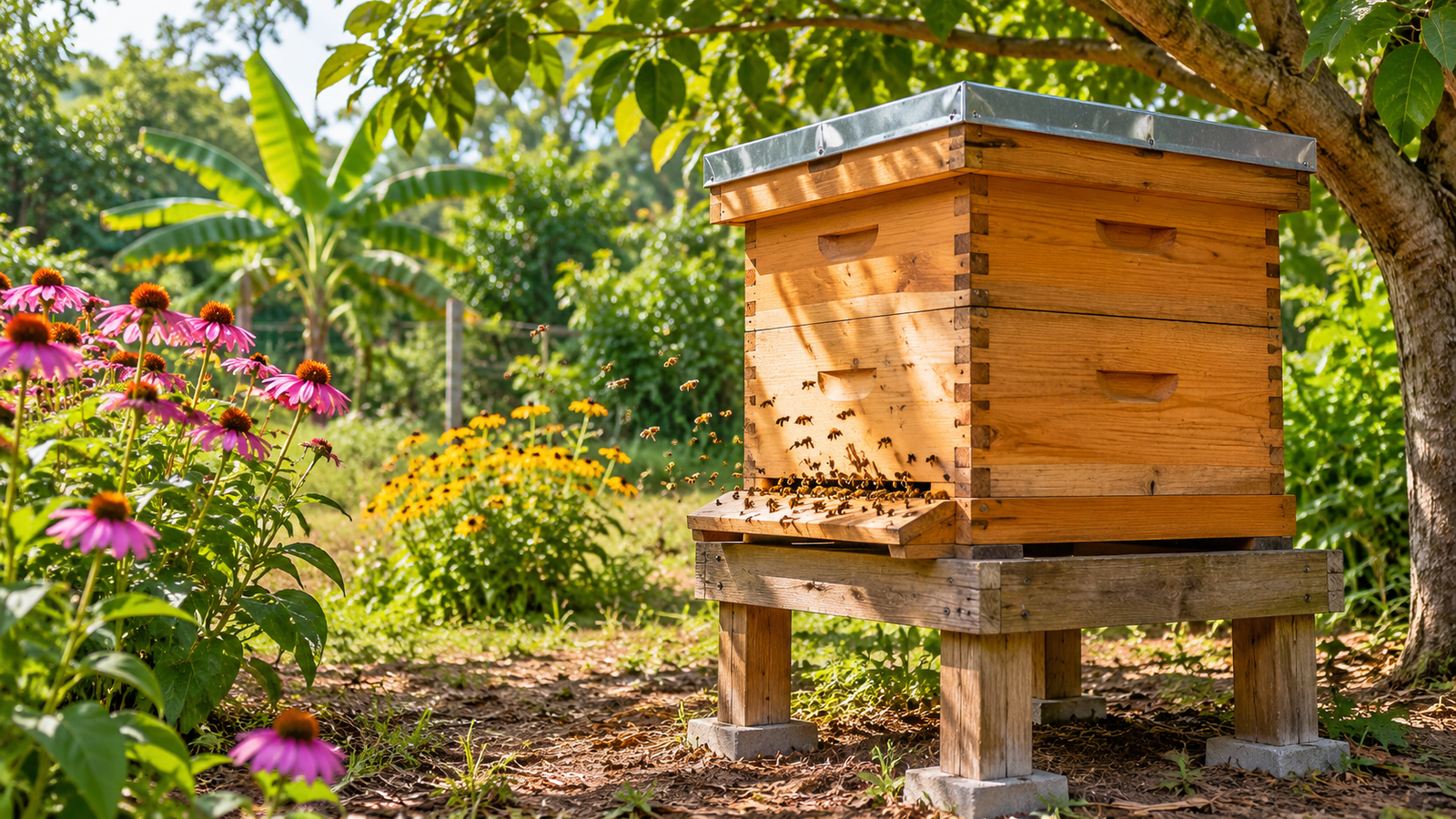
The best place to put a bee box is a quiet, dry, well-drained location with morning sunlight, protection from excessive afternoon heat, nearby flowering plants, and a clear flight path. For honey bee hives, the box should also sit on a stable raised stand, have access to clean water, and be positioned away from busy walkways, livestock, and areas where pesticides are frequently used.
However, the ideal location depends on the type of bee box. A honey bee hive needs enough space for a colony, regular inspections, and safe flight activity. A solitary bee house, such as one designed for mason bees or leafcutter bees, requires suitable nesting cavities, shelter from rain, and access to appropriate nesting materials.
Choosing the right location is not simply about finding a place where bees can fly. It involves understanding how bees regulate temperature, find food, select nesting sites, and respond to environmental conditions.
This guide explains exactly where to put a bee box, how to assess a location, which conditions to avoid, and how placement differs between honey bees and solitary bee species.
1. What Is the Best Place to Put a Bee Box?
For a conventional honey bee hive, the best location is usually an open or lightly shaded area with good drainage, morning sunlight, protection from strong winds, and nearby flowering vegetation.
The entrance should face a safe, unobstructed area where bees can fly without regularly crossing people’s paths.
A suitable location should provide these seven conditions:
| Requirement | What to look for | Why it matters |
|---|---|---|
| Sunlight | Morning sun and appropriate afternoon shade | Helps with warmth and reduces excessive heat exposure |
| Drainage | Firm, elevated ground that does not flood | Keeps the hive dry |
| Wind protection | Shelter from strong prevailing winds | Reduces weather exposure |
| Food | Flowers and trees that provide nectar and pollen | Supports colony nutrition |
| Water | A dependable, safe water source | Supports cooling and colony activities |
| Flight space | An unobstructed entrance and flight corridor | Allows safe movement |
| Accessibility | Enough working room around the hive | Makes inspections and maintenance easier |
These conditions work together. For example, a garden may contain hundreds of flowering plants but still be a poor location if it floods during heavy rain or exposes the hive to dangerous pesticide applications.
The best location is therefore not necessarily the place with the most flowers. It is the place that provides the most suitable combination of food, shelter, water, safety, and manageable hive conditions.
2. Why Sunlight and Shade Matter When Choosing a Bee Box Location
Sunlight affects the temperature and moisture conditions around a bee box. The ideal exposure depends on the climate, hive design, and bee species.
Honey bees are ectothermic insects, meaning their body temperature is influenced by their surroundings. However, a honey bee colony can regulate the temperature of its brood nest through collective behavior.
Worker bees maintain suitable brood temperatures by clustering, fanning their wings, and collecting and distributing water when cooling is necessary.
This means the beekeeper should choose a location that helps the colony manage temperature without making it work unnecessarily hard.
Morning sunlight
Morning sunlight can warm the hive and entrance after cooler nighttime conditions. It can also help bees begin their daily activities earlier when weather conditions permit.
An east-facing entrance can receive this early sunlight.
Afternoon shade
In hot tropical environments, including Ghana, partial shade during the hottest hours can reduce the amount of solar heat entering the hive.
For example, a hive beneath the edge of a tree canopy may receive morning sunlight while remaining protected from intense afternoon exposure.
However, shade should not create a permanently damp environment.
Does full sunlight always harm honey bees?
No. Full sunlight is not automatically harmful. In some climates and apiary management systems, sunny sites can be beneficial, including because certain hive pests do less well under hot, dry conditions.
The important consideration is the balance between temperature, humidity, airflow, and the colony’s ability to regulate its nest.
Practical recommendation: In hot tropical areas, start with a location that offers morning sunlight and light afternoon shade. Observe the colony during the hottest part of the day and adjust the site or shading if necessary.
For further guidance, see the University of Florida’s Honey Bee 4-H Project Book and the Mississippi State University Extension guide on apiary location.
3. Which Direction Should a Bee Box Face?
For a honey bee hive, east or southeast is often a useful entrance orientation because it allows the entrance to receive morning sunlight.
However, the direction should not be chosen without considering the local wind and weather.
Consider these orientations:
| Entrance direction | Potential advantage | Consideration |
|---|---|---|
| East | Receives early morning sunlight | Often a good starting choice |
| Southeast | Combines early sunlight with a sheltered exposure | Useful where afternoon heat is intense |
| South | May provide substantial sunlight in the Northern Hemisphere | Can increase heat exposure in some locations |
| North | May reduce direct solar heating in some climates | Could expose the entrance to unfavorable winds |
| West | Can receive afternoon sunlight | May increase heat exposure in hot regions |
These are general guidelines rather than universal rules.
For example, a beekeeper in Ghana should not automatically choose a south-facing entrance simply because that direction is recommended in some Northern Hemisphere guides.
Instead, consider:
- Which direction receives morning sunlight?
- Which direction receives the strongest afternoon heat?
- Where does the prevailing wind come from?
- Does rain blow directly into the entrance?
- Will the entrance direct bees toward people or livestock?
The entrance should face a relatively open flight path, preferably away from regular human activity.
Important distinction: The compass direction of the entrance is less important than providing appropriate sunlight, shelter, drainage, and safe access.
4. How High Should You Place a Bee Box?
A conventional honey bee hive should be placed on a stable stand rather than directly on soil.
A practical starting height for many managed hives is approximately 12–18 inches (30–45 cm) above the ground. This is a convenient working height, not a biological requirement shared by every hive system.
Raising the hive helps:
- Reduce direct contact between the hive and damp soil.
- Make inspections more convenient.
- Reduce exposure to splashing rainwater.
- Make it easier to clear vegetation around the entrance.
- Create space for some types of pest barriers.
What makes a good hive stand?
A suitable stand should:
- Support the weight of the hive when all boxes are full.
- Remain stable on the ground.
- Resist termites, rot, and corrosion, depending on the material.
- Keep the entrance clear.
- Allow the beekeeper to work safely.
Concrete blocks, treated timber, and metal stands can all be used.
In areas where ants are a problem, appropriate ant barriers may help. However, avoid creating barriers that could trap water or expose bees to harmful chemicals.
Should the hive be tilted?
A slight forward tilt, where compatible with the hive design, can help rainwater drain toward the entrance rather than collecting at the back of the bottom board.
The hive should remain stable, and the tilt should not interfere with frames or internal equipment.
5. How Close Should a Bee Box Be to Flowers?
A bee box should be located within a landscape that provides sufficient nectar and pollen throughout the year.
Honey bees collect nectar for carbohydrates and pollen for proteins, lipids, vitamins, and minerals. These resources support adult workers, brood development, and colony growth.
A flowering garden near the hive is helpful, but the entire surrounding landscape matters more than the number of flowers immediately beside the box.
The Mid-Atlantic Apiculture Research and Extension Consortium recommends considering forage resources within approximately one mile of an apiary. This is a practical planning guideline, not a maximum foraging distance. Honey bees can travel much farther when local food is scarce.
Examples of useful flowering plants
| Plant | Potential benefit |
|---|---|
| Sunflower | Nectar and pollen, depending on variety |
| Clover | Nectar and pollen |
| Citrus | Flower resources during flowering |
| Mango | Seasonal flowers that may attract foraging bees |
| Eucalyptus | Flower resources, depending on species |
| Acacia | Potential nectar and pollen resources |
| Wildflowers | Diverse food resources across seasons |
Why flowering diversity matters
Imagine two possible apiary locations.
- Location A has a large field of sunflowers that flowers for only a few weeks.
- Location B has mango trees, citrus trees, wildflowers, and other flowering vegetation that bloom at different times.
Location B may offer a more dependable food supply throughout the year.
This is because a honey bee colony needs food beyond a single flowering period.
However, the actual value of each plant depends on its flowering season, nectar production, pollen quality, local weather, and competing colonies.
A useful way to assess forage
Before installing a hive, observe the area during different seasons.
Record:
- Which plants flower during the rainy season?
- Which plants flower during the dry season?
- Are there periods when very few plants flower?
- Are flowering crops treated with pesticides?
- Are there other apiaries competing for the same resources?
This simple observation can help you determine whether the location can support a colony throughout the year.
6. Should a Bee Box Be Near Water?
Yes. A honey bee colony needs access to water, particularly during hot weather.
Water helps worker bees cool the hive through evaporative cooling. They distribute water inside the colony while other workers fan their wings, helping remove heat and moisture.
Water is also involved in other colony activities, including diluting stored food.
A practical starting point is to provide water close to the apiary rather than making bees travel long distances.
The Mid-Atlantic Apiculture Research and Extension Consortium suggests providing a water source when one is not available within approximately one-quarter mile of the hives.
How to build a safe bee watering station
You can use:
- A shallow basin.
- A large tray.
- A small container with stones.
- Floating pieces of wood or other safe landing materials.
Fill the container with enough water to keep the landing materials accessible.
Do not use a deep, open bucket without landing supports. Bees can drown if they fall into water and cannot climb out.
Why bees sometimes prefer dirty water
Honey bees do not necessarily choose the cleanest-looking water.
They may visit damp soil, puddles, livestock watering areas, or other mineral-containing water sources.
This behavior can become inconvenient when bees start visiting a neighbor’s swimming pool.
Establishing a dependable water source near the hive can encourage bees to use it, although it does not guarantee they will abandon other sources.
7. Is It Good to Put a Bee Box Under a Tree?
A suitable tree can improve the conditions around a honey bee hive, especially in a hot environment.
Trees may provide partial shade and reduce direct exposure to wind. Flowering trees can also contribute to the surrounding forage supply.
However, there is a difference between placing a hive near a tree and placing it in dense woodland.
A good location should have:
- Light or partial shade where needed.
- Sufficient airflow.
- Dry ground.
- No dangerous overhanging branches.
- An unobstructed flight path.
- Enough space for inspections.
Avoid putting the hive under trees that drip water continuously, have weak branches, or create a permanently damp environment.
Example: On a farm in Ghana, a hive placed near the edge of a mango tree canopy may benefit from partial afternoon shade. A hive placed deep beneath dense vegetation may receive too little sunlight and remain damp after rainfall.
The Ghana Bee Health Manual specifically identifies shaded, accessible, wind-protected apiary locations as important considerations.
8. Where Should You Avoid Putting a Bee Box?
Some locations create problems even when flowers and water are available.
| Avoid this location | Reason |
|---|---|
| Flood-prone land | Water can damage equipment and threaten the colony |
| Permanently wet ground | Encourages damp conditions and equipment deterioration |
| Deep, dense forest | May have insufficient sunlight and airflow |
| Exposed hilltops | Strong winds can disturb flight and destabilize hives |
| Near pesticide spraying | Increases the risk of toxic exposure |
| Busy walkways | Increases unwanted contact between bees and people |
| Children’s play areas | Creates avoidable sting risks |
| Livestock pathways | Animals may knock over or disturb hives |
| Near frequently used doors | Bees may cross human traffic |
| Under unstable branches | Falling branches can damage the hive |
Why pesticide exposure deserves special attention
Worker honey bees forage outside the hive and can bring contaminated nectar, pollen, dust, or water back to the colony.
Depending on the pesticide and exposure, effects can include disorientation, impaired navigation, death of foragers, and harm to brood or other colony members.
Therefore, do not select a site simply because it is close to a large flowering farm.
Discuss pesticide use with neighboring farmers and avoid locations where regular applications create unacceptable risks to bees.
Why low-lying land is unsuitable
Low-lying ground may collect rainwater, remain damp, or experience seasonal flooding.
A hive can be raised on a stand, but raising it does not make a flood-prone site safe if floodwater can reach the equipment.
Choose naturally well-drained ground above the expected flood level.
9. Where Is the Best Place to Put a Bee Box in a Backyard?
A backyard can support a honey bee hive if it provides sufficient space, suitable forage, and safe separation from people.
The best position is usually a quiet corner with a clear flight path, good drainage, and an entrance directed away from doors, windows, and frequently used outdoor spaces.
Before installing a hive, consider these five factors.
1. Distance from people: Avoid children’s play areas, patios, swimming pools, and busy garden paths.
2. Neighboring properties: Consider where neighboring families spend time and whether the bees’ flight path will cross their outdoor spaces.
3. Working space: Leave sufficient room to open the hive, remove frames, and carry equipment.
4. Security: Use appropriate barriers to prevent children, pets, and unauthorized visitors from approaching the hive.
5. Local regulations: Check applicable beekeeping rules, property restrictions, and any requirements for setbacks or notification of neighbors.
Can a fence make a backyard hive safer?
Yes. A solid fence or dense hedge can encourage bees to fly upward after leaving the entrance, reducing the likelihood of direct encounters with people.
The barrier should be positioned so that it does not obstruct the beekeeper’s access or prevent bees from entering and leaving freely.
Remember that a barrier does not eliminate sting risks or replace responsible colony management.
10. Where Is the Best Place to Put a Bee Box on a Farm?
A farm can be an excellent location for honey bee colonies because it may provide flowering crops, fruit trees, and natural vegetation.
However, agricultural activities introduce additional risks, particularly pesticide exposure, livestock disturbance, and seasonal changes in forage.
Consider these placement principles:
- Choose a location near diverse flowering vegetation.
- Avoid fields that receive frequent pesticide applications.
- Keep the hive away from livestock pathways.
- Provide protection against strong winds.
- Select accessible ground for inspections and honey harvesting.
- Avoid areas exposed to bushfires and seasonal flooding.
- Establish a dependable water source.
Practical example: A mango farm
Imagine a farmer in Ghana who wants to install five honey bee hives on a mango farm.
The farm has flowering mango trees, a water tank, and a frequently used tractor route.
The best position would not necessarily be directly among the mango trees. A more suitable location could be a quiet, well-drained area near the flowering trees but away from tractor movement and pesticide application zones.
The beekeeper could install a fenced apiary with raised stands, provide a shallow watering station, and maintain a clear entrance direction.
This arrangement provides access to forage while reducing disturbance and management problems.
11. Where Is the Best Place to Put a Bee Box in Ghana and Other Tropical Countries?
In Ghana and other tropical regions, site selection requires particular attention to intense sunlight, heavy rainfall, seasonal drought, and changing flowering patterns.
The Ghana Bee Health Manual, published through the Animal Health Systems Support programme, provides practical guidance for choosing and preparing apiary sites.
It identifies proximity to flowering plants, water availability, accessibility, shade, protection from strong winds, and avoidance of flooding and fire-prone locations as important considerations.
Recommended locations for different environments
| Environment | Suitable placement |
|---|---|
| Accra and coastal Ghana | Well-drained ground with suitable shade and protection from intense afternoon heat |
| Forest zones | Open or lightly shaded areas with good airflow |
| Savannah areas | Sheltered locations with reliable water and protection from dry-season winds |
| Agricultural zones | Near flowering vegetation, away from pesticide exposure |
| Rural compounds | Fenced, quiet locations away from houses and livestock |
Managing the rainy season
Heavy rainfall can create problems when hives are installed on low-lying ground.
Choose elevated, naturally drained land rather than relying only on a hive stand to prevent flooding.
Keep vegetation around the hive under control so that the entrance remains accessible and the beekeeper can inspect the colony.
Managing the dry season
During dry periods, flowering plants and natural water sources may become scarce.
Provide an artificial water station and assess whether the surrounding vegetation can provide sufficient forage.
A site that appears excellent during the rainy season may become unsuitable when most plants stop flowering.
Important: The best tropical apiary location is not necessarily completely shaded. It should receive sufficient light and airflow while protecting colonies from excessive heat and weather exposure.
12. Where Should You Put a Mason Bee Box or Solitary Bee House?
A solitary bee house is different from a conventional honey bee hive.
Honey bees are social insects that live in colonies with a queen, workers, and drones. Many solitary bees, including mason bees and leafcutter bees, do not establish large social colonies.
A solitary bee house provides individual nesting cavities where female bees lay eggs and provision their developing offspring.
Best location for a solitary bee house
Choose a position that:
- Receives suitable morning sunlight.
- Is protected from heavy rain.
- Has a stable mounting surface.
- Is not hidden by dense vegetation.
- Is close to flowering plants.
- Provides suitable nesting cavities for the local species.
For mason bee nesting houses in western Oregon, Oregon State University Extension recommends morning sunlight, protection from hot afternoon sun, and a mounting height of approximately 3–6 feet.
The Natural History Museum also recommends a sunny position protected from heavy rain, with southeast exposure often providing a useful balance.
These recommendations are regional examples, not universal requirements for all solitary bee species.
How high should a solitary bee house be?
A mounting height of approximately 3–6 feet (0.9–1.8 metres) is a useful starting point for many garden nesting houses.
The correct height depends on the design, species, accessibility, and protection from predators and rain.
Why solitary bee houses need different placement
Consider a mason bee house containing narrow nesting tubes.
A female mason bee enters an individual tube, collects pollen, lays an egg, and separates the developing brood cells using mud partitions.
A honey bee hive, by contrast, contains a large interconnected colony that stores food and raises brood on comb.
Therefore, placing both structures in exactly the same way may not produce the best results.
| Feature | Honey bee hive | Solitary bee house |
|---|---|---|
| Main purpose | Houses a social colony | Provides individual nesting cavities |
| Nest structure | Wax comb | Individual tunnels or cavities |
| Typical placement | Apiary or suitable garden | Garden, fence, or sheltered structure |
| Main location concerns | Forage, water, heat, access, safety | Nesting material, sunlight, rain protection |
| Management | Regular colony inspections | Nest monitoring and appropriate maintenance |
| Height | Often raised on a hive stand | Often mounted several feet above ground |
Important: Not every small wooden bee box is a honey bee hive. Identify the intended bee species and box design before deciding where to install it.
13. How Far Apart Should Bee Boxes Be Placed?
When keeping several honey bee colonies, spacing should allow bees to move freely and the beekeeper to inspect each hive comfortably.
There is no single spacing distance that is compulsory for every apiary.
For a small apiary:
- Leave sufficient working space around each hive.
- Avoid placing entrances directly opposite one another where practical.
- Keep entrances visible and unobstructed.
- Use recognizable landmarks or different orientations to help bees distinguish their colonies.
- Leave enough room to remove heavy honey boxes safely.
Does placing hives close together cause problems?
It can.
Crowded arrangements can make inspections difficult and may increase the consequences of drifting, where returning bees enter the wrong colony.
Drifting can contribute to the spread of parasites and diseases between colonies.
However, spacing alone does not prevent disease transmission. Proper inspections, hygienic equipment management, and responsible colony management remain necessary.
14. How to Choose the Best Bee Box Location: A Practical Site Assessment
Rather than choosing a location based on appearance, assess the actual conditions.
Here is a simple method you can use before installing a honey bee hive.
Step 1: Observe the location during the morning and afternoon
Check how much sunlight reaches the proposed site.
A location that is comfortable in the morning may become excessively hot in the afternoon.
Step 2: Observe the area after rainfall
Look for puddles, muddy ground, drainage channels, and evidence of flooding.
Choose a position that remains dry.
Step 3: Identify flowering plants
Look at the surrounding vegetation and determine whether it provides nectar and pollen during different seasons.
Step 4: Check water availability
Identify nearby natural water sources or plan to install a safe bee watering station.
Step 5: Observe wind direction
Look for natural windbreaks such as suitable trees, hedges, or buildings.
Do not place the hive where strong winds blow directly into its entrance.
Step 6: Check human and animal activity
Observe where people walk, where livestock move, and whether the hive entrance could create unnecessary encounters.
Step 7: Assess accessibility
Make sure you can reach the hive with your equipment and perform routine inspections without difficulty.
A practical bee box location scorecard
Use this scorecard to compare two or more possible locations.
Rate your proposed location
Give each condition 0 (poor), 1 (acceptable), or 2 (good). The weights emphasize the most important requirements.
Consider another site or address the major problems first.Reset assessmentEducational screening tool, not a scientific certification or substitute for a local site inspection. A serious pesticide, flooding, or safety hazard can disqualify a location regardless of its score.
This method is particularly useful when selecting between different corners of a farm or garden.
15. Common Mistakes to Avoid When Choosing a Bee Box Location
Even a location that looks suitable can create problems if important details are overlooked.
Here are mistakes to avoid:
- Choosing a site only because it has flowers: Food availability is important, but drainage, water, shelter, and safety are equally important.
- Placing the hive directly on the ground: This exposes the equipment to moisture and some pests.
- Providing too much shade: Deep shade can increase dampness and reduce suitable flying conditions.
- Ignoring afternoon temperatures: Excessive heat can increase the colony’s cooling workload.
- Ignoring wind direction: Strong winds can interfere with flight and expose the hive to harsh weather.
- Placing the entrance toward a busy walkway: This creates unnecessary encounters with people.
- Ignoring pesticide exposure: Bees can be harmed by chemicals used on nearby crops.
- Making inspections difficult: A hive that is difficult to access may receive inadequate management.
- Forgetting seasonal changes: A site may flood during the rainy season or lose flowering resources during the dry season.
- Assuming every bee box has the same requirements: Honey bee hives and solitary bee houses have different nesting needs.
16. Frequently Asked Questions
1. Where is the best place to put a bee box in a garden?
A quiet, well-drained garden corner with morning sunlight, appropriate afternoon shade, flowering plants, and a clear flight path is a good choice. Keep the box away from children’s play areas and frequently used walkways.
2. Should a bee box face east or west?
East or southeast is often a good starting orientation because it provides morning sunlight. West-facing entrances may receive more intense afternoon sunlight. However, prevailing winds, rainfall, and local climate should also influence the decision.
3. Can I put a bee box under a tree?
Yes. A suitable tree can provide shade and wind protection. Choose a position with enough airflow and avoid unstable branches, excessive shade, and locations where water continuously drips onto the hive.
4. How high should a bee box be off the ground?
For many conventional honey bee hives, 12–18 inches (30–45 cm) is a practical stand height. Solitary bee houses may be mounted higher, depending on their design and target species.
5. Can I put a bee box near my house?
Yes, provided local regulations and safety requirements allow it. Keep the hive away from doors, windows, patios, children’s play areas, and busy walkways. Consider neighbors and ensure that the bees’ flight path does not create unnecessary risks.
6. Do bees need direct sunlight?
Honey bees benefit from suitable sunlight, especially during cooler mornings. However, excessive heat can increase the work required to cool the colony. In tropical environments, partial afternoon shade can be helpful.
7. How far should a bee box be from water?
A dependable water source within approximately one-quarter mile (400 metres) is a useful guideline for honey bee apiaries. Providing water closer to the hive can help reduce unwanted visits to neighboring water sources.
8. Can I put a bee box in the forest?
Yes, but choose an open or lightly shaded area rather than a permanently dark, damp location. Ensure adequate airflow, flowering vegetation, drainage, and access for inspections.
9. Can I put a bee box on a rooftop?
Yes. Rooftop beekeeping is possible if the structure can support the hive’s weight and the location provides safe access, appropriate wind protection, water, and a suitable flight path. Consider neighboring buildings and local regulations.
10. What is the best place to put a bee box to attract wild bees?
It depends on the type of bees you want to attract. For solitary bees, place a suitable nesting house near flowers in a dry, sheltered location. For honey bee swarms, use an appropriately designed bait hive in a suitable location. An ordinary bee box does not automatically attract a colony.
11. Can I put a bee box in full shade?
It is possible in some circumstances, but permanent deep shade is generally not the first choice for a managed honey bee hive. It can increase dampness and reduce sunlight exposure. Choose a location with suitable light and airflow.
12. Does a bee box need to be near flowering trees?
Nearby flowering trees are beneficial, but bees can forage across a much larger landscape. What matters is the availability of diverse nectar and pollen sources throughout the seasons, not just the presence of one tree beside the hive.
Conclusion: Where Is the Best Place to Put a Bee Box?
The best place to put a bee box is a quiet, well-drained location with suitable sunlight, protection from excessive heat and strong winds, nearby flowering plants, access to water, and an unobstructed flight path.
For honey bee hives, use a stable raised stand and provide enough working space for inspections. In hot tropical regions such as Ghana, consider partial afternoon shade and protection against heavy rainfall.
For solitary bee houses, prioritize suitable nesting cavities, morning sunlight, and protection from rain.
Most importantly, assess the location throughout different seasons before installing your bee box. A site that provides good conditions during the rainy season may become too hot or lack flowering resources during the dry season.
Choosing the right location from the beginning gives bees a better environment for nesting, foraging, and maintaining a healthy colony.
References and Scientific Sources
The following educational and technical publications support the recommendations in this article. They are listed as source names rather than hyperlinks.
- Ghana Veterinary Services Directorate / AHSS (2025). Ghana Bee Health Manual, Volume 1. Apiary site selection, forage, shade, water, access, and protection from flooding and fire.
- Food and Agriculture Organization (FAO). Beekeeping in Africa: Site Selection for Bee Hives. African beekeeping and apiary management.
- University of Florida, Honey Bee Research and Extension Laboratory. Honey Bee 4-H Project Book. Characteristics of a suitable apiary location.
- Mississippi State University Extension Service. Choosing an Apiary Location. Hive orientation, sunlight, wind protection, and site conditions.
- Mid-Atlantic Apiculture Research and Extension Consortium (MAAREC). Apiary Location. Forage availability, water, drainage, and apiary accessibility.
- Purdue University Extension. Working with Honey Bees. Hive stands, drainage, sunlight, and wind protection.
- Oregon State University Extension Service. Nurturing Mason Bees in Your Backyard in Western Oregon. Solitary bee nesting house placement.
- North Carolina State University Extension. Bee Hotel Design and Placement. Nesting conditions and regional differences in solitary bee preferences.
- Natural History Museum, London. How to Make a Bee Hotel. Nesting house orientation, sunlight, and rain protection.
