

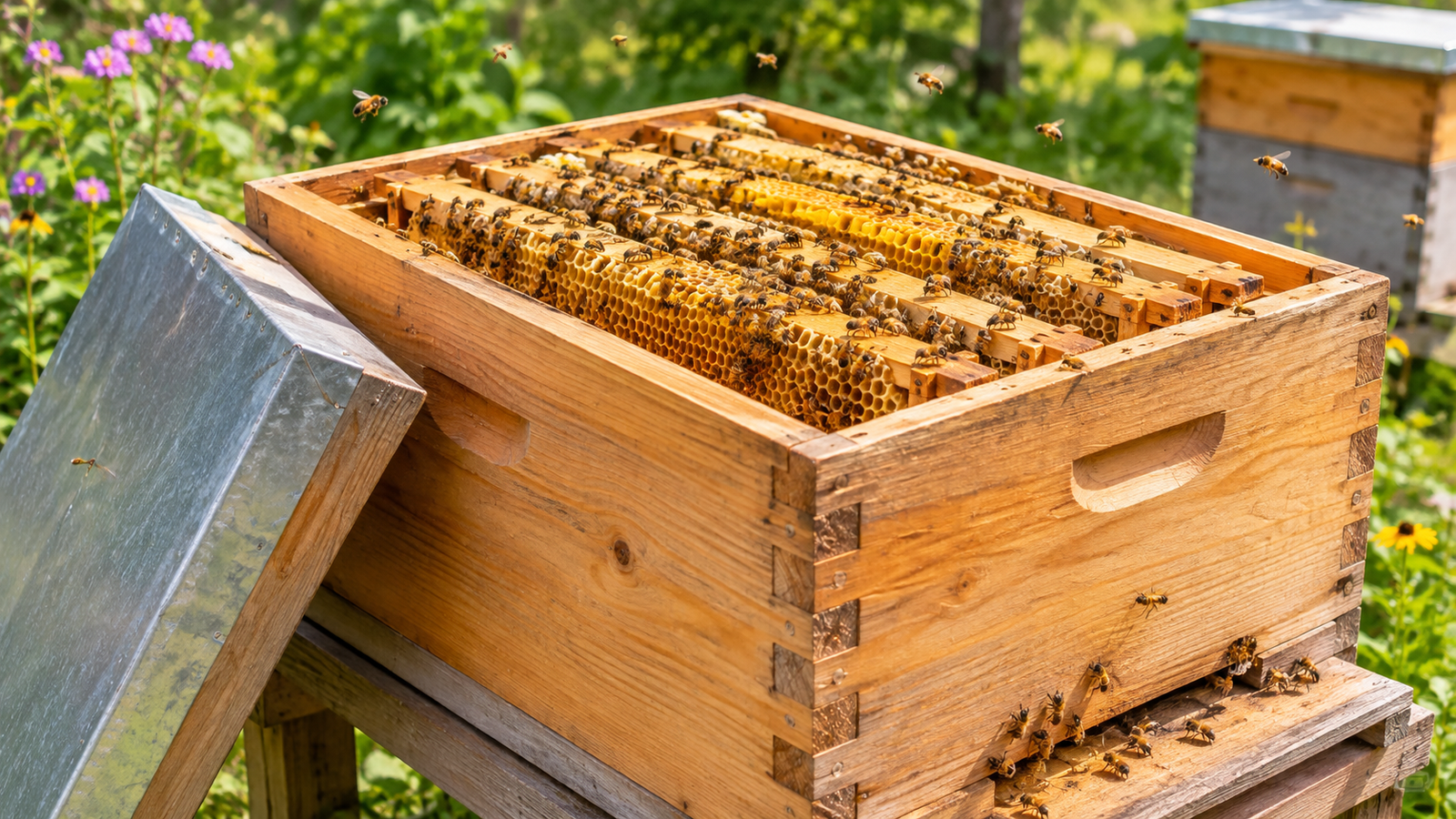
A bee box is a man-made structure designed to provide bees with a place to establish a nest, build honeycomb, raise their young, and store food. In beekeeping, the term commonly refers to a wooden or plastic compartment used to house a honey bee colony. Depending on its position and design, a bee box may serve as a brood chamber, a honey storage compartment, or part of a complete beehive.
Bee boxes are important in modern beekeeping because they provide controlled nesting spaces and make it easier to inspect colonies, manage their growth, monitor pests, and harvest surplus honey. They also come in different designs, including Langstroth boxes, top-bar hives, Warre hives, and traditional fixed-comb hives.
However, not every bee box is designed for honey production. Some smaller structures, commonly called bee hotels, provide nesting cavities for solitary bees such as mason bees and leafcutter bees.
Understanding what a bee box is, how it works, its different types, and what goes inside it will help you identify the right structure for your beekeeping or pollinator-support needs.
What Exactly Is a Bee Box?
A bee box is an artificial nesting structure that provides bees with an enclosed or partially enclosed space for nesting and colony activities.
In conventional honey bee beekeeping, a bee box is usually a rectangular container that holds removable frames or wooden top bars. These structures support the honeycomb that bees construct using wax produced by their bodies.
The comb contains individual hexagonal cells that serve different purposes:
- Brood cells: Used by the queen to lay eggs and by worker bees to raise developing bees.
- Honey storage cells: Used to store processed nectar as honey.
- Pollen storage cells: Used to store pollen collected from flowering plants.
- Empty cells: Available for future egg laying, food storage, and other colony activities.
A bee box also provides protection from rain, wind, excessive disturbance, and environmental conditions.
For example, a Langstroth brood box provides space for a honey bee colony to raise young bees and store food. When the colony becomes stronger and needs additional room, a beekeeper may add another compatible box above it.
An important distinction: A bee box is not always a complete beehive. A modern beehive may contain several boxes, frames, a bottom board, an entrance, and protective covers. The individual box is one component of that larger system.
What Does a Bee Box Look Like?
A typical modern honey bee box looks like a rectangular wooden container with an open top and bottom. It has internal ledges that support removable frames.
The outside may have handholds that make it easier to lift and move during inspections.
Inside, the frames hang vertically, with enough space between them and the box walls for bees to move around.
A typical wooden Langstroth box has:
- Four wooden walls joined to form a rectangular container.
- Frame rests along the inside walls.
- Removable frames that support honeycomb.
- Handholds for lifting.
- An opening at the bottom when assembled into a hive.
Photograph suggestion: Show an empty wooden Langstroth box from above, with several removable frames fitted inside. The image should clearly show the rectangular walls, frame rests, and spacing between the frames.
What Is a Bee Box Used For?
A bee box serves several purposes depending on its design and the species of bee occupying it.
1. Providing a Nesting Space
One of the main purposes of a bee box is to provide bees with a protected nesting environment.
Wild honey bees naturally establish colonies in enclosed spaces such as hollow trees and rock cavities. A managed bee box provides an artificial alternative.
The enclosed space helps the colony establish a nest and maintain its activities without being directly exposed to rain and other disturbances.
2. Providing Space for Honeycomb Construction
Honey bees produce beeswax through specialized glands on the underside of their abdomens.
Worker bees use this wax to construct honeycomb, which consists of connected hexagonal cells.
In a framed bee box, the frames guide where the bees build their comb. Some frames contain wax or plastic foundation that provides a starting pattern.
The resulting comb becomes the colony’s storage and brood-rearing structure.
3. Providing Space for Raising Young Bees
A brood box provides the main area where the queen lays eggs and worker bees raise developing bees.
The queen deposits eggs in individual cells. After hatching, the larvae are fed by nurse bees and eventually develop into pupae before emerging as adults.
A healthy brood area helps maintain the colony’s population.
4. Storing Honey and Pollen
Honey bees collect nectar and pollen from flowering plants.
Nectar is processed into honey and stored in honeycomb cells, while pollen supplies protein, fats, vitamins, and minerals needed by the colony.
A honey box or super provides additional space for storing surplus honey.
5. Making Beekeeping Easier
A properly designed bee box makes it possible to inspect the colony without destroying its nest.
Beekeepers can remove frames to examine brood, identify food reserves, monitor pests, and determine whether the colony needs additional space.
This is particularly useful in commercial and small-scale honey production.
What Are the Different Types of Bee Boxes?
Bee boxes differ according to their construction, internal arrangement, and intended use.
The following are common designs used in beekeeping.
1. Langstroth Bee Box
The Langstroth bee box is one of the most widely used designs in modern beekeeping.
It consists of rectangular boxes stacked vertically, with removable frames suspended inside each box.
The design uses a concept called bee space, which allows bees to move between frames without filling every available gap with comb or propolis.
A typical Langstroth hive may contain one or two brood boxes and additional honey supers.
How it works: Bees build comb on the frames. The queen lays eggs mainly in the brood chamber, while worker bees use other available comb for food storage. Additional boxes can be added as the colony develops.
Best suited for: Managed honey bee colonies, regular inspections, and honey production.
2. Top-Bar Bee Box
A top-bar hive is a horizontal structure that uses individual wooden bars instead of conventional rectangular frames.
Honey bees attach their comb to the underside of each bar and extend it downward.
Unlike a Langstroth hive, which expands vertically by adding boxes, a top-bar hive generally expands horizontally as the colony constructs more comb.
Some top-bar hives have sloping interior walls that discourage bees from attaching comb to the sides.
How it works: The beekeeper lifts individual bars to inspect the comb rather than removing complete framed structures.
Best suited for: Small-scale beekeeping and beekeepers who prefer a horizontal hive design.
3. Warre Bee Box
A Warre hive is a vertically stacked hive designed around smaller boxes and top bars.
The boxes are generally added underneath the existing hive as the colony expands.
This arrangement differs from the conventional Langstroth system, where additional honey supers are usually placed above the existing boxes.
Best suited for: Beekeepers interested in a top-bar-based hive with a vertically stacked arrangement.
4. Traditional Bee Box
Traditional bee boxes are locally constructed structures made from materials such as hollow logs, wooden planks, clay, or woven materials.
Their designs differ considerably between regions.
Some have fixed combs, meaning the beekeeper cannot remove individual combs without cutting them out. Others use simple bars or removable nesting structures.
Traditional hives can be useful where modern beekeeping equipment is expensive or unavailable.
In tropical African beekeeping, selecting a hive design should also consider local honey bee behavior, climate, construction materials, and established regional beekeeping practices.
Best suited for: Traditional and low-input beekeeping systems.
5. Solitary Bee Box or Bee Hotel
A solitary bee box is different from a honey bee hive.
It provides individual nesting cavities for certain solitary bees, including mason bees and leafcutter bees.
These structures usually contain hollow tubes, drilled wooden holes, or suitable plant stems.
A female solitary bee selects a cavity, creates individual nesting cells, deposits food, lays eggs, and seals the cells.
For example, a mason bee may use mud to separate nesting cells, while a leafcutter bee uses pieces of leaves.
Unlike honey bee colonies, these nesting structures do not house a single large social colony and are not designed for honey production.
Best suited for: Providing nesting opportunities for cavity-nesting solitary bees in suitable gardens and landscapes.
What Are the Main Parts of a Bee Box?
A Langstroth bee box is made up of several components that work together to support the colony.
1. Box Walls
The walls form the main body of the container.
They protect the comb and provide the structural support needed to hold frames and the weight of stored honey.
2. Frame Rests
These are ledges or grooves inside the upper edges of the box.
They support the frames and keep them suspended at the correct height.
3. Frames
Frames are removable rectangular structures that hold honeycomb.
They make it possible to inspect brood and food stores without removing the entire comb from the hive.
Frames may contain wax or plastic foundation, although some beekeepers allow bees to construct natural comb.
4. Entrance
The entrance is an opening that allows bees to enter and leave the hive.
It provides access for foraging workers and returning bees carrying nectar, pollen, and water.
5. Bottom Board
The bottom board forms the floor of the complete hive.
It supports the hive boxes and provides the entrance area.
6. Inner Cover
The inner cover sits between the upper hive box and the outer cover.
It helps prevent bees from attaching comb directly to the outer roof and may provide an insulating air space.
7. Outer Cover
The outer cover protects the hive from rain, sunlight, and other environmental conditions.
8. Queen Excluder
A queen excluder is an optional grid placed between the brood chamber and honey supers.
Its openings allow worker bees to pass through while restricting the larger queen.
This helps reduce the possibility of brood being raised in the honey supers.
How Does a Bee Box Work?
A bee box works by providing a suitable structure in which a colony can build comb, raise young bees, store food, and maintain its population.
Here is what happens inside a typical honey bee box.
Step 1: The colony occupies the box.
A beekeeper may introduce a nucleus colony, install a package of bees, or use an appropriate method to capture a swarm.
Step 2: Worker bees construct comb.
Worker bees produce beeswax and use it to build honeycomb on the available frames or bars.
Step 3: The queen lays eggs.
The queen lays eggs in suitable cells within the brood area. Fertilized eggs normally develop into female workers or queens, while unfertilized eggs develop into male drones.
Step 4: Nurse bees care for the brood.
Worker bees feed the larvae and maintain suitable conditions for their development.
The brood passes through egg, larval, and pupal stages before emerging as adult bees.
Step 5: Foragers collect food.
Worker bees visit flowering plants to collect nectar and pollen.
The nectar is processed into honey, while pollen is stored for the colony’s nutritional needs.
Step 6: The colony uses additional space.
As the population and food stores increase, the colony may require additional space.
The beekeeper can add another compatible box when the colony is strong enough to occupy it.
Step 7: The beekeeper inspects and manages the hive.
The beekeeper checks the colony’s condition, food supplies, brood development, and signs of pests or disease.
This management helps maintain a productive and healthy colony.
What Is Bee Space and Why Is It Important in a Bee Box?
Bee space is the natural passage that honey bees maintain between combs and other surfaces inside their nest.
In Langstroth-style equipment, the working bee-space range is approximately 6–9 mm, according to Texas A&M AgriLife Extension.
This measurement is important because honey bees respond differently to spaces that are too large or too small.
- If a gap is too large, bees may build additional comb across it.
- If a gap is too small, bees may fill it with propolis.
- If the space is suitable, bees can move through it without unnecessarily obstructing the passage.
Propolis is a sticky substance made by bees using plant resins mixed with their own secretions. It is used to seal small gaps and maintain the structure of the nest.
For example, if a beekeeper places a frame that is too short inside a deep box, bees may construct additional comb in the empty space below it. This is commonly called burr comb.
That additional comb can make frame removal and inspection difficult.
This is why accurate measurements are essential when constructing or purchasing a framed bee box.
What Is the Difference Between a Bee Box and a Beehive?
A bee box and a beehive are closely related, but they do not always refer to the same thing.
A bee box is an individual compartment or nesting structure, while a beehive usually refers to the complete housing arrangement occupied by a honey bee colony.
| Feature | Bee box | Beehive |
|---|---|---|
| Meaning | Individual housing compartment | Complete bee housing system |
| Structure | Usually one container | May contain multiple boxes |
| Function | Provides nesting, brood, or storage space | Supports the entire colony |
| Examples | Brood box, honey super | Complete Langstroth hive |
| Components | Walls, frame rests, frames | Boxes, frames, bottom board, covers |
For example, a Langstroth beehive may contain two brood boxes, one honey super, a bottom board, an inner cover, and an outer cover.
The individual boxes are therefore parts of the complete beehive.
What Is the Difference Between a Brood Box and a Honey Box?
A brood box and a honey box are both used in modern beekeeping, but they have different primary functions.
A brood box provides the main space for raising young bees, while a honey super provides additional storage space for surplus honey.
| Feature | Brood box | Honey super |
|---|---|---|
| Main purpose | Raising young bees | Storing surplus honey |
| Queen activity | Normally contains the main egg-laying area | Usually kept free of brood |
| Contents | Brood, pollen, nectar, honey | Primarily honey |
| Position | Lower part of a typical Langstroth hive | Above the brood chamber |
| Common size | Deep | Medium or shallow |
| Main management purpose | Colony development | Honey storage and harvesting |
One important exception is that a brood box is not exclusively used for raising young bees. Honey bees also store honey and pollen in the brood area.
The distinction refers to the main management purpose of each box, not an absolute separation of everything inside it.
What Materials Are Bee Boxes Made From?
Bee boxes are constructed from different materials depending on availability, cost, climate, and the intended use.
Wood
Wood is one of the most common materials used in modern beekeeping.
Pine, cedar, and other suitable timber species can be used to construct hive boxes.
Advantages include:
- Relatively easy construction and repair.
- Good structural strength.
- Some natural insulation.
- Availability in many regions.
However, wood can absorb moisture, rot, or become damaged by termites if poorly maintained.
Plastic
Plastic bee boxes are used in some modern beekeeping systems.
They are generally resistant to rot and can be easy to clean when properly designed.
However, their insulation and durability depend on the material and construction quality.
Polystyrene
Polystyrene boxes provide good insulation and can help reduce temperature fluctuations.
However, they need protection from physical damage and prolonged exposure to sunlight.
Clay and Locally Available Materials
Traditional hives may be constructed using clay, hollow logs, woven materials, and other local resources.
Their performance depends on the quality of construction and suitability for the local environment.
How Do You Choose the Right Bee Box?
Choosing the right bee box depends on what you want to achieve.
1. Decide Whether You Want Honey or Nesting Habitat
If you want to manage honey bee colonies and harvest honey, choose a suitable honey bee hive.
If your objective is to support solitary bees, a properly designed bee hotel may be more appropriate.
These structures have different designs and management requirements.
2. Choose a Suitable Hive Design
Consider whether you prefer a Langstroth, top-bar, Warre, or traditional hive.
For beginners, the availability of experienced local beekeepers and compatible replacement equipment is particularly important.
3. Consider the Climate
In tropical environments such as Ghana, excessive heat, heavy rainfall, moisture, and ventilation should influence your choice.
Choose a suitable location and ensure the hive has a protective roof and a well-drained base.
4. Check the Measurements
For framed hives, ensure that boxes and frames follow the same equipment standard.
Do not assume that every Langstroth-style box from different manufacturers will fit together perfectly.
5. Consider Maintenance
Choose a design that you can inspect, repair, and manage properly.
Removable-frame systems can make brood inspections and honey harvesting easier, while fixed-comb systems require different management techniques.
How Do You Make a Simple Bee Box?
You can construct a wooden bee box if you have suitable materials, accurate measurements, and basic woodworking tools.
However, the construction method depends on the hive design.
For a simple Langstroth-style box, the main materials include:
- Suitable timber.
- Measuring tape and carpenter’s square.
- Saw.
- Drill.
- Screws or nails.
- Sandpaper.
- Correctly sized frames.
Follow these important construction principles:
Use accurate measurements: Frame dimensions and internal spacing must match the chosen hive standard.
Use suitable timber: Avoid materials treated with chemicals that may expose bees to harmful substances.
Construct strong joints: The walls must support the weight of frames and stored honey.
Prevent water leakage: The completed hive needs a protective cover.
Allow proper ventilation: The hive should support appropriate air movement without creating excessive openings.
For a solitary bee hotel, construction is much simpler. The University of Nebraska–Lincoln recommends a wooden structure with an open front, protected back, and roof to prevent rain from soaking the nesting materials.
It also advises against pressure-treated wood because the chemicals may be harmful to nesting bees.
Importantly, a bee hotel and a Langstroth box should not be constructed using the same internal design.
Where Should You Place a Bee Box?
The location of a bee box influences colony development, safety, and productivity.
For a managed honey bee colony, consider the following:
- Place the hive on well-drained ground.
- Use a sturdy raised stand to reduce direct contact with ground moisture.
- Provide a clear entrance and flight path.
- Avoid areas where people and livestock regularly pass.
- Provide access to flowering plants and a suitable water source.
- Protect the hive from heavy rain and excessive afternoon heat.
- Keep the hive away from unnecessary disturbance.
In hot tropical regions, partial afternoon shade can help reduce overheating.
A solitary bee hotel requires a different arrangement. It should have a protected nesting area, suitable nesting materials, and regular maintenance to prevent moisture and pest problems.
How Do You Maintain a Bee Box?
Regular maintenance helps keep a bee box structurally sound and supports the health of the colony.
For honey bee boxes:
- Inspect the colony to assess brood development and food reserves.
- Check for signs of pests and diseases.
- Repair damaged frames and box walls.
- Check the roof for water leakage.
- Keep the entrance clear.
- Add additional space when the colony requires it.
- Record inspection dates and important colony observations.
Do not open the hive unnecessarily. Inspections should be conducted using appropriate protective equipment and sound beekeeping practices.
For solitary bee hotels, nesting materials should also be monitored and replaced or cleaned appropriately. Poorly maintained bee hotels can accumulate parasites, pests, and pathogens.
Frequently Asked Questions About Bee Boxes
1. What is a bee box used for?
A bee box provides a nesting space for bees. In honey bee beekeeping, it can be used for brood rearing, honey storage, pollen storage, and colony management. Other types provide nesting cavities for solitary bees.
2. Is a bee box the same as a beehive?
Not necessarily. A bee box is generally an individual housing compartment, while a beehive refers to the complete housing system. A modern beehive can contain several boxes and other components.
3. What is the best material for a bee box?
Wood is a popular option because it is strong, relatively easy to construct, and repairable. Plastic and polystyrene are also used. The best material depends on local conditions, cost, and availability.
4. Do bees make honey inside a bee box?
Yes. Honey bees collect nectar from flowers and convert it into honey, which they store in honeycomb cells inside the hive. Beekeepers can harvest surplus honey from appropriately managed honey supers.
5. How many bees can live in one bee box?
There is no fixed number. The population depends on the box size, colony strength, queen productivity, food availability, and season. A strong honey bee colony can contain tens of thousands of individuals.
6. Does a bee box need frames?
No. Langstroth hives use removable frames, while top-bar and Warre hives use different arrangements. Some traditional hives use fixed combs without removable frames.
7. Can I put a bee box in my garden?
Yes. A honey bee hive can be placed in a suitable garden with sufficient space, forage, and a safe flight path. A solitary bee hotel can also be installed to provide nesting opportunities for certain wild bee species.
8. Do empty bee boxes attract bees?
They sometimes do. An appropriately designed and positioned box may attract a honey bee swarm or solitary nesting bees, depending on its structure. However, placing an empty box outdoors does not guarantee that bees will occupy it.
9. What is the difference between a brood box and a honey super?
A brood box provides the main space for raising young bees, while a honey super provides additional space for storing surplus honey. Both can contain honeycomb, but their main management purposes differ.
10. What is the difference between a bee box and a bee hotel?
A honey bee box is generally used to house a colony or provide a compartment within a managed hive. A bee hotel provides individual nesting cavities for certain solitary bees. Bee hotels are not designed for commercial honey production.
Conclusion
A bee box is a man-made nesting structure that provides bees with a place to establish nests, build comb, raise young, and store food. In modern beekeeping, it commonly refers to an individual compartment of a hive, such as a brood box or honey super.
Different bee boxes serve different purposes. Langstroth boxes use removable frames, top-bar hives allow bees to construct comb beneath individual bars, and Warre hives use vertically stacked boxes. Traditional hives use locally available materials, while solitary bee boxes provide nesting spaces for individual cavity-nesting bees.
Understanding these differences helps you choose the right structure for your needs. If your goal is honey production, select a suitable managed honey bee hive. If your goal is to support solitary bees, choose an appropriately designed and maintained nesting structure.
References and Further Reading
- Texas A&M AgriLife Extension. Beekeeping Equipment – Hive Boxes (ENTO-100).
- University of Missouri Extension. Beekeeping Equipment and Hive Placement.
- University of Georgia Cooperative Extension. Honey Bees and Beekeeping.
- University of Nebraska–Lincoln Extension. Creating a Solitary Bee Hotel (G2256).
- University of Utah State Extension. Making and Managing Wild Bee Hotels.
- Access Agriculture / Agromisa Foundation. Beekeeping in the Tropics (Agrodok 32).
- Ergonomics in Apiculture. A Case Study Based on Inspecting Movable Frame Hives for Healthy Bee Activities.
