

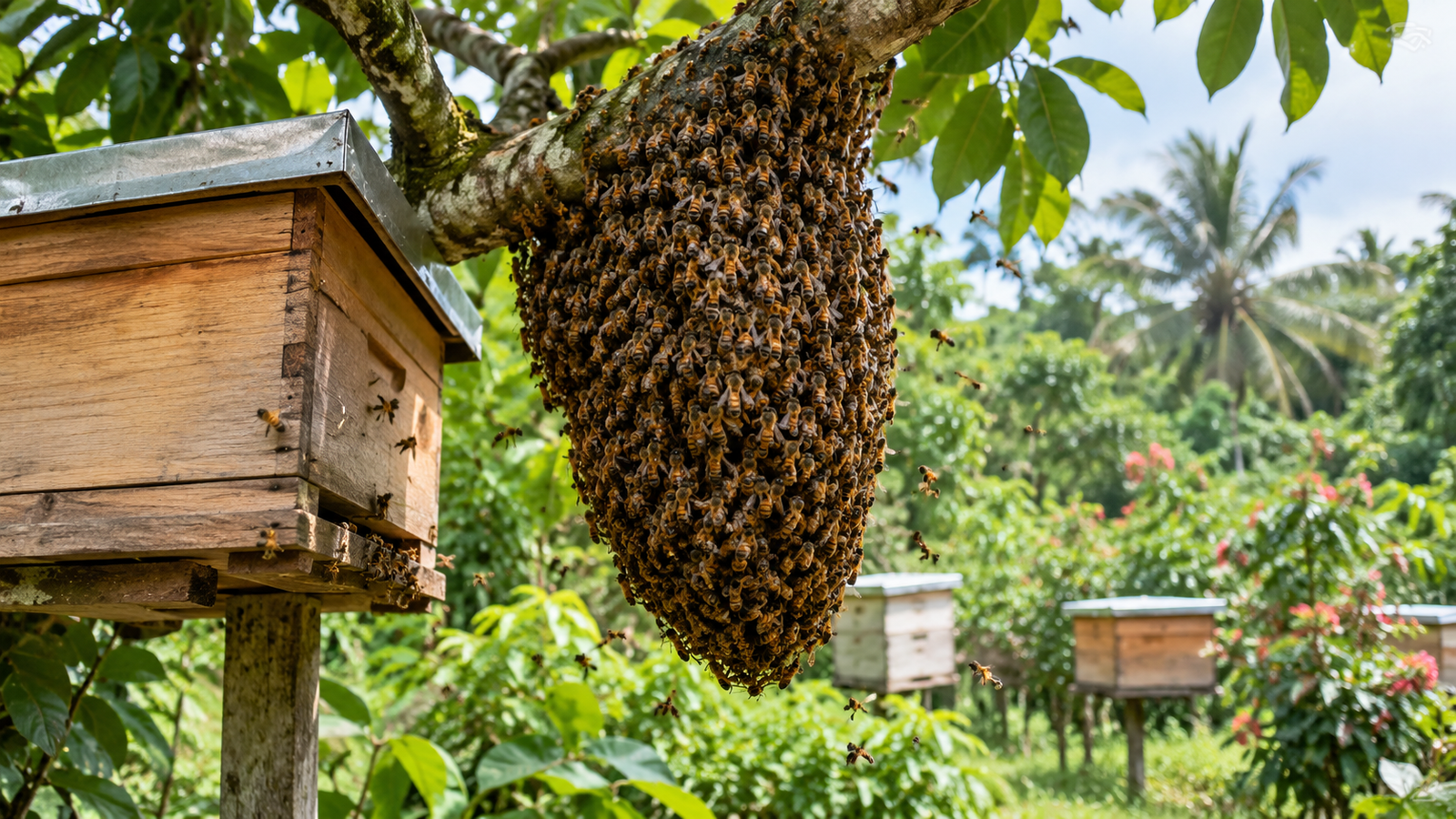
A honey bee colony can swarm more than once in a year, but there is no fixed number of times every hive will swarm. A strong colony may produce one major swarm, called a prime swarm, followed by one or more smaller swarms known as afterswarms. Other colonies may swarm only once or remain in their original hive without swarming for several years.
In Nigeria, the frequency of swarming depends on colony strength, queen condition, available food, hive space and seasonal changes. For example, research on West African honey bees in Awka, Anambra State, recorded August to October as an important period for new colonies to occupy empty hives. However, this does not mean every established colony in Nigeria swarms during those months.
Understanding how often bee hives swarm helps Nigerian beekeepers plan inspections, prevent unwanted colony losses, collect natural swarms and increase the number of colonies in their apiaries.
This guide explains how frequently honey bee colonies swarm, how many swarms one colony can produce, when to expect swarming in Nigeria, and how to manage colonies before and after a swarm leaves.
How Often Do Bee Hives Swarm in a Year?
A honey bee colony can swarm once or several times in a year, depending on its biological condition and the availability of resources.
There is no universal annual swarming frequency. Swarming is a reproductive process that occurs when a colony develops the conditions necessary to divide and establish another colony.
A strong colony may produce:
- One prime swarm containing the original queen and many worker bees.
- One or more afterswarms containing virgin queens and smaller groups of workers.
- No additional swarms if the remaining colony successfully establishes a new queen and settles down.
Consider three possible situations:
| Colony condition | Possible swarming outcome |
|---|---|
| Small or weak colony | May not swarm during the year |
| Strong, growing colony | May produce one prime swarm |
| Very strong colony with several developing queens | May produce a prime swarm and additional afterswarms |
These are possible outcomes, not guaranteed annual rates.
The important distinction is that a colony’s opportunity to swarm is not the same as the number of times it actually swarms. Even when environmental conditions favour reproduction, the colony may remain in its original hive.
Can one bee hive swarm three or more times?
Yes. A strong honey bee colony can produce a prime swarm followed by several afterswarms.
This usually happens when multiple queen cells develop and several virgin queens become available.
For example, imagine a large colony in a Nigerian apiary that has developed numerous queen cells.
- The old queen leaves with a large group of workers.
- The original hive retains workers, brood and developing queen cells.
- A virgin queen emerges.
- If other virgin queens remain and the colony continues producing afterswarms, additional groups of workers may leave.
This process can repeat, although it does not happen in every colony.
Repeated swarming can eventually leave the original hive with a much smaller workforce, reducing its ability to raise brood, collect food and produce surplus honey.
What Happens When a Bee Hive Swarms?
Swarming is the natural reproductive process through which a honey bee colony divides into separate colonies.
Unlike an individual bee laying eggs to reproduce, swarming involves thousands of workers leaving their established nest with a queen to establish a new home.
A typical reproductive swarm develops through several stages.
1. The colony prepares to reproduce
The original colony develops conditions favourable for reproduction.
Worker bees begin raising new queens in specially constructed queen cells. The colony may also experience brood-nest congestion and a reduction in the available space for the queen to lay eggs.
2. The old queen leaves with workers
The first major swarm is called the prime swarm.
It normally contains the old queen and a substantial proportion of the adult worker population.
The bees leave together, sometimes forming a large moving cloud around the apiary.
3. The swarm settles temporarily
After leaving the original hive, the bees often gather around a tree branch, fence, roof or another convenient structure.
Scout bees search the surrounding environment for a suitable permanent nesting location.
4. The original colony raises a replacement queen
The original hive is not necessarily abandoned.
It retains worker bees, brood, food stores and developing queen cells.
A virgin queen eventually emerges, mates with drones and, if successful, begins laying eggs.
5. Additional swarms may leave
If the original colony contains multiple developing queens and conditions favour further swarming, additional afterswarms may depart.
These secondary swarms are generally smaller than the prime swarm.
What Is the Difference Between a Prime Swarm and an Afterswarm?
Understanding this distinction is essential because it explains why one colony can swarm several times.
| Feature | Prime swarm | Afterswarm |
|---|---|---|
| Timing | First swarm from the colony | Follows the prime swarm |
| Queen | Usually the old, mated queen | Usually a virgin queen |
| Population | Generally larger | Generally smaller |
| Origin | Original colony divides | Remaining colony produces another swarm |
| Establishment | Often has more workers to build a new nest | May need more time and resources to establish |
| Frequency | Usually one first swarm | May be one or several |
A prime swarm is generally the most desirable swarm for a beekeeper collecting new colonies because its larger worker population can help establish a new nest.
Afterswarms are also useful, but their smaller population may make establishment more challenging.
When Do Bee Hives Swarm in Nigeria?
Nigeria does not have one nationwide swarming month.
The country has different ecological zones, rainfall patterns and flowering seasons. These differences affect the availability of nectar and pollen, which influence colony growth and reproductive activity.
The West African honey bee, Apis mellifera adansonii, is particularly relevant to beekeeping in Nigeria.
Southern Nigeria
Southern Nigeria includes Anambra, Imo, Enugu, Rivers, Delta, Edo, Ogun, Lagos and other states.
The region generally experiences a longer rainy season and a shorter dry season.
Seasonal flowering and changes in rainfall influence when colonies build up their populations and when natural swarms become available.
Research example: Awka, Anambra State
Ononye and Akunne published a 2017 study titled The Effects of Time and Beehive Entrance on Colony Establishment of African Honeybees, Apis mellifera adansonii.
The researchers installed experimental top-bar hives at Nnamdi Azikiwe University in Awka and monitored colony establishment.
They recorded August to October as the main colonisation period in their study.
Their recommendation was that beekeepers in Awka should install swarm traps before August. journal.bee.or.kr+1
This is useful information for local beekeepers, but there is an important scientific distinction: the researchers investigated the occupation of empty hives by honey bees, not how many times an established colony swarmed.
Research example: Rivers State
Research on seasonal colony colonisation in Rivers State also identified October as an important period for honey bee activity and hive occupation.
This supports the importance of observing seasonal changes in southern Nigeria rather than assuming all states have identical swarming patterns. Academia
Northern Nigeria
Northern Nigeria includes Kano, Kaduna, Katsina, Sokoto, Kebbi, Zamfara, Borno, Yobe, Bauchi and other states.
The region generally experiences a longer dry season and a shorter rainy season.
The timing of flowering vegetation, agricultural crops and wild plants influences when bees can collect sufficient food to expand their colonies.
A beekeeper in Kaduna may observe different colony activity from a beekeeper in Sokoto because rainfall, vegetation and flowering periods differ.
For northern Nigerian apiaries, it is better to monitor local flowering and colony development than to apply the August–October observations from Awka as a universal calendar.
Central Nigeria
The Middle Belt includes areas such as Benue, Kogi, Kwara, Nasarawa, Niger and the Federal Capital Territory.
Flowering crops, savannah vegetation and local rainfall patterns influence colony growth.
Beekeepers should pay attention to periods when flowering plants become abundant and colonies begin increasing their brood and adult populations.
Practical Nigerian swarm-monitoring calendar
| Nigerian region | Monitoring priority | Practical action |
|---|---|---|
| Southeast, including Awka | Before and during August–October | Prepare swarm traps and monitor colony growth |
| Niger Delta | Seasonal transition and local flowering | Observe colony population and natural swarm activity |
| Southwest | Local flowering and seasonal transitions | Record swarm arrivals and queen-cell development |
| Northern Nigeria | After seasonal rains and during flowering periods | Monitor food availability and colony strength |
| Middle Belt | Local rainfall and flowering cycles | Maintain colony records throughout the year |
This is a practical observation guide, not a scientifically established national calendar of established-colony swarming frequency.
Why Do Some Bee Hives Swarm More Frequently Than Others?
Two colonies located in the same apiary may behave differently. One may swarm while another remains in its hive.
This happens because swarming is influenced by several interacting biological and environmental factors.
1. Colony population and brood production
A colony with many adult workers and developing brood has a greater capacity to reproduce than a small colony.
When a queen lays eggs consistently and workers successfully raise large numbers of new bees, the colony population increases.
If the colony becomes sufficiently strong, it may begin preparing for reproductive swarming.
For example, a Nigerian beekeeper who notices a strong colony covering most of the available combs should monitor it more carefully than a newly established colony with only a few combs.
2. Congestion in the brood nest
The brood nest is the area where the queen lays eggs and workers raise developing bees.
When this area becomes congested with brood, pollen and stored honey, the queen may have fewer suitable empty cells for laying eggs.
This can contribute to conditions that encourage swarming.
However, a full hive does not automatically swarm. Colony reproduction is influenced by several factors, not simply the number of bees inside the box.
3. Queen condition
The queen produces the eggs that maintain the colony’s population.
Her age, egg-laying performance and pheromonal influence can affect colony organisation.
A colony may also raise replacement queens when the existing queen is failing.
It is important to distinguish this from reproductive swarming: replacing an old queen does not necessarily mean the colony intends to divide.
4. Nectar and pollen availability
Nectar provides energy, while pollen supplies protein and other nutrients needed for brood development.
When flowering plants are abundant, workers may bring enough food into the hive to support rapid colony growth.
This can create favourable conditions for swarming.
However, flowering alone does not guarantee swarming. The colony must also have sufficient workers and suitable reproductive conditions.
5. Hive design and available space
Hive design influences how much room a colony has for brood and food storage.
A colony in a small hive may experience congestion sooner than a colony in a larger hive.
For example:
- A top-bar hive may require additional space for comb construction.
- A Langstroth hive may require an additional box or super as the colony expands.
- A traditional fixed-comb hive may offer fewer opportunities for the beekeeper to manage individual combs.
Providing more space can reduce congestion, although it does not eliminate the natural tendency to swarm.
How Can You Identify a Bee Hive That Is About to Swarm?
A colony preparing to swarm may display several recognisable signs.
The most useful sign is the development of swarm queen cells, but other observations help confirm what is happening.
1. Developed swarm queen cells
Queen cells are larger than ordinary worker brood cells.
Swarm queen cells are commonly constructed along the lower edges of combs, although they can occur elsewhere.
When several developed swarm cells are present, the colony may be preparing for reproductive swarming.
2. Increased colony population
A strong colony may have thousands of workers covering the combs.
You may notice:
- Heavy traffic at the entrance.
- More bees covering the brood combs.
- Reduced empty comb space.
- Increased food storage.
These observations are more useful when considered alongside queen-cell development.
3. Bees gathering around the entrance
Bees sometimes gather outside the hive in large numbers.
This is called bearding.
However, bearding does not automatically indicate impending swarming.
In Nigeria, high temperatures can cause bees to cluster outside the hive to help regulate internal temperature.
4. Changes in the queen’s laying space
During inspections, the beekeeper may discover that the brood nest has become congested.
Stored honey and pollen may occupy cells that would otherwise be available for egg laying.
This can contribute to the conditions associated with swarming.
5. Increased preparation for queen replacement
The presence of queen cells requires interpretation.
Not all queen cells are swarm cells.
| Queen-cell type | Why bees produce them | Does it necessarily indicate swarming? |
|---|---|---|
| Swarm cells | Colony reproduction | Often indicates preparation for swarming |
| Supersedure cells | Replacing an existing queen | No |
| Emergency queen cells | Replacing a lost or failing queen | No |
This distinction prevents a common management mistake: destroying every queen cell without understanding why the bees constructed it.
How Long After Building Queen Cells Do Bees Swarm?
There is no single exact number of days between the construction of queen cells and swarming.
The timing depends on queen development and the condition of the colony.
A useful biological reference is the development of a honey bee queen.
| Development stage | Approximate time from egg laying |
|---|---|
| Egg stage | 3 days |
| Larval stage | Approximately 5–6 days |
| Capped queen-cell stage | Around day 8 |
| Queen emergence | Approximately day 16 |
These timings describe normal queen development, not a guaranteed swarm departure schedule.
A prime swarm often leaves before the first replacement queen emerges.
This is why discovering capped swarm cells should prompt a timely inspection and management decision.
How Many Bees Leave When a Hive Swarms?
A prime swarm may contain several thousand worker bees and the old queen.
The exact number varies with colony strength and environmental conditions.
A large swarm may contain enough workers to build comb, gather nectar and pollen, protect the new nest and raise brood.
An afterswarm is generally smaller because it comes from the remaining population after the first swarm has already departed.
This difference explains why afterswarms sometimes struggle more when establishing new colonies.
Does a Bee Hive Die After Swarming?
No. A honey bee colony does not automatically die after swarming.
The original hive usually retains:
- Some adult worker bees.
- Developing brood.
- Honey and pollen stores.
- Queen cells containing developing queens.
When a replacement queen emerges, mates successfully and starts laying eggs, the original colony can rebuild its population.
However, repeated swarming can weaken the colony.
A beekeeper may notice reduced worker numbers, less foraging activity and lower honey production after several swarms leave.
The colony may also take time to return to its previous strength.
How Can Nigerian Beekeepers Reduce Unwanted Swarming?
Swarming is natural, so completely preventing it is not always possible.
However, beekeepers can manage strong colonies to reduce the risk of losing valuable workers during important honey-production periods.
1. Provide adequate hive space
Give growing colonies enough room for brood development and food storage.
For Langstroth hives, add supers when the colony is strong enough to occupy them.
For top-bar hives, ensure there is sufficient space for additional comb construction.
Do not wait until the hive becomes severely congested.
2. Inspect strong colonies regularly
During active colony growth, inspect managed colonies approximately every 7–10 days when practical.
Look for:
- Swarm queen cells.
- Brood-nest congestion.
- Large adult populations.
- Limited empty comb.
- Food-storage patterns.
Use appropriate protective equipment and avoid unnecessary disturbance.
3. Use colony splitting
Colony splitting involves dividing a strong colony into two managed colonies.
For example, a beekeeper may transfer suitable brood combs, food stores and adult workers into a prepared hive.
The new colony must have a viable queen or appropriate queen-rearing arrangements.
Splitting can reduce congestion while increasing the number of colonies in the apiary.
However, it should be carried out by someone who understands queen development and colony management.
4. Maintain suitable hive conditions
In Nigeria’s hot climate, hive placement and ventilation are important.
Provide:
- Protection from excessive direct sunlight.
- Protection from heavy rainfall.
- Adequate ventilation.
- A stable hive stand.
- Protection from unnecessary human disturbance.
Good hive conditions support colony health, although they cannot guarantee that bees will not swarm.
Should You Allow Bees to Swarm or Prevent Them?
The decision depends on your beekeeping objectives.
A beekeeper interested in producing more colonies may welcome natural swarming.
A beekeeper focused on commercial honey production may prefer to manage reproductive swarming to retain a larger workforce.
| Beekeeping objective | Recommended approach |
|---|---|
| Increasing colony numbers | Capture suitable natural swarms |
| Commercial honey production | Monitor strong colonies and use swarm management |
| Establishing a new apiary | Prepare swarm traps before locally observed swarm periods |
| Maintaining strong colonies | Provide adequate space and monitor queen-cell development |
| Preventing colony losses | Inspect for swarming and absconding behaviour |
Neither approach is universally better. The important thing is to understand what the colony is doing before deciding how to manage it.
How Can You Use Natural Swarming to Increase Your Apiary in Nigeria?
Natural swarming provides Nigerian beekeepers with an opportunity to obtain additional colonies without buying every new colony.
A swarm trap is one practical way to attract bees looking for a new nesting location.
Follow these steps:
Step 1: Prepare suitable empty hives.
Use clean, dry top-bar or Langstroth hives with enough room for a new colony.
Step 2: Apply suitable swarm bait.
A small amount of clean beeswax or a commercially formulated swarm lure can make an empty hive more attractive.
Step 3: Select a suitable location.
Choose a relatively quiet location with flowering vegetation, access to water and limited human disturbance.
Step 4: Install traps before the expected local period.
For example, the Awka study supports installing swarm traps before August in that particular location.
Do not assume that the same timing applies to every part of Nigeria.
Step 5: Monitor occupied traps.
Look for regular bee traffic and signs of comb construction.
Step 6: Manage the new colony carefully.
Allow the bees to establish their nest and develop their population before expecting surplus honey.
A newly captured swarm needs time to build comb, raise brood and establish food reserves.
Swarming vs Absconding: What Is the Difference?
This distinction is particularly important for African beekeeping.
A beekeeper may open a hive and discover that most or all of the bees have disappeared.
It is tempting to describe this as swarming, but the colony may actually have absconded.
| Feature | Swarming | Absconding |
|---|---|---|
| Main purpose | Reproduction | Abandoning an existing nest |
| Old queen | Usually leaves in prime swarm | Usually leaves with the departing colony |
| Brood left behind | Yes, in the original colony | Most or all of the colony may leave |
| Original hive | Continues as a colony | Becomes abandoned |
| Common context | Strong colony preparing to reproduce | Unsuitable conditions, severe disturbance, food shortage or other stressors |
Swarming is a normal reproductive behaviour.
Absconding is a different colony response and can result from environmental or management problems.
Understanding the difference helps beekeepers investigate the correct cause of colony loss.
Do All Bee Species Swarm Like Honey Bees?
No. This is an important distinction that many general beekeeping articles overlook.
The word swarming is most commonly used in managed honey bee keeping to describe the reproductive division of a honey bee colony.
However, not all bee species reproduce in the same way.
1. Honey bees
Honey bees, including the West African honey bee Apis mellifera adansonii, live in social colonies with a queen and thousands of workers.
They reproduce at the colony level through swarming.
This is the type of swarming discussed throughout this article.
2. Stingless bees
Stingless bees are also social bees found in tropical regions, including West Africa.
Some species establish new colonies through a gradual process of colony reproduction and budding.
Unlike the typical honey bee prime swarm, the process can involve workers establishing connections between the parent colony and a new nesting site before the new colony becomes independent.
Therefore, honey bee swarming frequency should not automatically be applied to stingless bees.
3. Solitary bees
Many native bee species are solitary.
A female solitary bee generally builds and provisions her own nest rather than living in a large colony with a queen and thousands of workers.
These bees do not produce prime swarms and afterswarms in the same way as honey bees.
This means the question “How often do bee hives swarm?” is most accurately answered in relation to social honey bee colonies.
Frequently Asked Questions
1. How often do honey bees swarm in a year?
A honey bee colony may swarm once or several times in a year. Strong colonies can produce a prime swarm and additional afterswarms, while weaker colonies may not swarm at all.
2. Can a bee hive swarm twice in one year?
Yes. A colony can produce a prime swarm followed by a secondary swarm. This is more likely when multiple queens develop and the colony remains capable of producing additional swarms.
3. What month do bees swarm in Nigeria?
There is no single month for all Nigerian states. Research in Awka recorded August to October as an important period for honey bee colony establishment in empty hives. Other locations have different seasonal patterns.
4. Do bees swarm during the rainy season?
Yes. Honey bees can swarm during the rainy season if the colony has sufficient strength and resources. However, heavy rainfall can interfere with foraging and affect colony development.
5. Do bees swarm during the dry season?
Yes. Swarming can occur during the dry season when suitable flowering plants provide sufficient food. The timing depends on local vegetation and colony conditions.
6. How long does a swarm stay on a tree?
A swarm may remain on a tree branch for several hours, overnight or sometimes longer. It normally stays temporarily while scout bees search for a suitable nesting location.
7. Will bees return to their original hive after swarming?
The departing swarm normally establishes a new nest rather than returning to the original hive. The original colony remains behind and develops a replacement queen.
8. Does removing queen cells prevent swarming?
Not necessarily. Removing queen cells without correcting the conditions encouraging swarming is unreliable. The colony may construct new cells, and the beekeeper may accidentally remove cells needed for queen replacement.
9. Can a weak colony swarm?
A weak colony is generally less likely to swarm because it may not have sufficient workers and resources to divide successfully. However, colony strength alone does not determine every reproductive decision.
10. Is a swarm dangerous?
A swarm may appear intimidating because it contains thousands of flying bees. However, a newly departed swarm is often less defensive than a colony protecting an established nest. It should still be treated cautiously, particularly around people with bee-sting allergies. Do not attempt to handle or collect it without suitable experience and protective equipment.
Conclusion: How Often Do Bee Hives Swarm?
A honey bee colony can swarm once or several times in a year. A strong colony may produce a prime swarm followed by one or more afterswarms, while other colonies may not swarm at all.
For Nigerian beekeepers, the most important consideration is understanding how local environmental conditions influence colony development. Rainfall, flowering plants, nectar availability, queen condition and hive space all contribute to swarming behaviour.
Research in Awka, Anambra State, identifies August to October as an important period for new honey bee colonies to occupy empty hives. This provides a useful local reference for preparing swarm traps, but it should not be confused with a fixed swarming schedule for established colonies throughout Nigeria.
The best way to manage swarming is to monitor colony strength, recognise queen-cell development, provide sufficient hive space and maintain records of swarm activity.
Remember: A colony that swarms once is not necessarily finished reproducing, and a colony that does not swarm every year is not necessarily unhealthy. Swarming frequency depends on the colony’s biological condition and its environment.
6. Scientific references
1. Ononye, B. U., and Akunne, C. E. (2017). The Effects of Time and Beehive Entrance on Colony Establishment of African Honeybees, Apis mellifera adansonii. Korean Journal of Apiculture, 32(1), 19–26.
2. Ononye, B. U., Akunne, C. E., Ogbuefi, E. O., Okeke, T. E., Okafor, K. P., and colleagues (2023). Effect of Improved Hive Cover Designs on Internal Microclimate and Colony Establishment of West African Honeybees (Apis mellifera adansonii L.) in Awka, Nigeria. Journal of Applied Life Sciences International, 26(5), 1–16.
3. Ononye, B. U., Akunne, C. E., Edeh, I. C., and colleagues (2023). Influence of Hive Cover Modifications and Ambient Microclimate on Colonization of African Honeybees in Awka, Nigeria. Asian Journal of Research in Zoology, 6(1), 20–29.
4. University of Florida, Institute of Food and Agricultural Sciences. Swarm Control for Managed Beehives. Extension publication IN970.
