

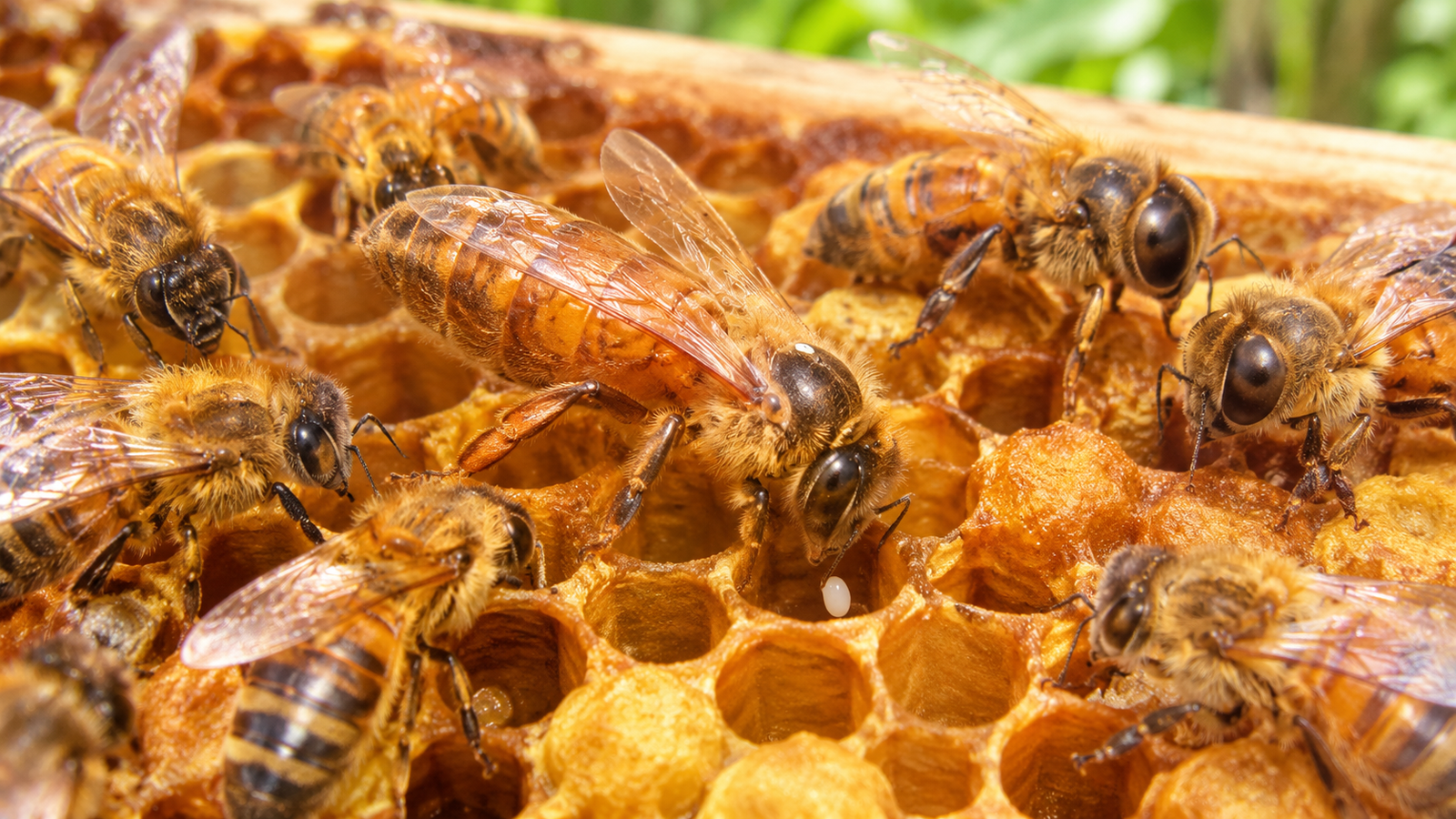
A queen honey bee reproduces by mating with male bees called drones during mating flights outside the hive. She receives sperm from several drones and stores it in an internal organ called the spermatheca. She later uses this stored sperm to fertilize eggs that develop into female worker bees or new queens. Eggs that are not fertilized develop into male drones.
Queen reproduction is responsible for maintaining the population of a honey bee colony. Through mating and egg laying, one queen can produce thousands of offspring, allowing the colony to replace ageing workers, raise new queens, and establish additional colonies through swarming.
In Nigeria, understanding how queen bees reproduce is particularly important for beekeepers managing African honey bees, including populations identified as Apis mellifera adansonii. Local research conducted in Lagos has documented the development of this honey bee and provides useful information for Nigerian apiculture.
This article explains the complete reproductive process, from queen development and mating to sperm storage, fertilization, egg laying, and colony reproduction. It also covers Nigerian environmental conditions, practical beekeeping examples, and how to identify reproductive problems.
1. How Does a Queen Bee Reproduce?
A queen honey bee reproduces sexually by mating with male drones. After mating, she stores sperm and uses it to fertilize eggs throughout much of her reproductive life.
Unlike many animals that need to mate repeatedly to produce offspring, a honey bee queen normally completes her mating flights early in adulthood. She then remains inside the colony and lays eggs using her stored sperm.
The reproductive process follows this sequence:
- Worker bees raise a new queen from a fertilized female egg or young female larva.
- The queen emerges from her queen cell.
- She matures and takes mating flights outside the hive.
- She mates with several drones.
- She stores viable sperm in her spermatheca.
- She returns to the colony and begins laying eggs.
- Fertilized eggs develop into female bees, while unfertilized eggs develop into males.
An important point is that the queen does not produce only queens. Most of her fertilized eggs become worker bees. Only some female larvae are raised as replacement queens.
2. How Is a Queen Bee Produced?
A new queen starts as a fertilized egg laid by the existing queen. This egg contains genetic material from both the mother queen and a drone.
The difference between a future queen and a worker is not that they come from different types of fertilized eggs. Both are female and develop from fertilized eggs.
Instead, the developing larvae receive different nutrition and care.
How worker bees raise a new queen
When a colony needs a replacement queen or prepares to swarm, worker bees select suitable young female larvae.
They construct larger, elongated queen cells and feed the selected larvae generous quantities of royal jelly throughout their larval development.
Royal jelly is a nutrient-rich secretion produced by young worker bees from glands in their heads.
The development process involves four stages:
- Egg: The queen lays a fertilized egg in a suitable cell.
- Larva: The egg hatches, and workers feed the larva royal jelly.
- Pupa: The queen cell is sealed, and the larva transforms into a developing adult.
- Adult: The young queen emerges from the cell.
A honey bee queen generally takes about 16 days from egg laying to adult emergence.
Why do colonies produce new queens?
There are three important situations.
| Queen production method | Why it happens | What it means |
|---|---|---|
| Swarm queen rearing | The colony is preparing to divide | The old queen may leave with a swarm |
| Emergency queen rearing | The existing queen dies or disappears | Workers attempt to replace her |
| Supersedure | The existing queen is failing or performing poorly | Workers replace her without necessarily swarming |
This distinction is useful when inspecting Nigerian apiaries. A beekeeper who finds queen cells should not automatically assume the colony is preparing to swarm. The reason for producing those cells matters.
3. How Does a Queen Bee Mate With Drones?
A newly emerged queen is called a virgin queen because she has not yet mated.
She must leave the hive to find sexually mature drones.
Queen mating normally occurs in the air, not inside the hive.
When does a virgin queen mate?
A virgin queen generally becomes sexually mature approximately 5–10 days after emerging.
She may take one or several mating flights over consecutive days, depending on her mating success and environmental conditions.
Where does mating happen?
Mating happens in locations called drone congregation areas.
These are places in the air where drones from different colonies gather to find virgin queens.
When a queen enters one of these areas, drones pursue her and attempt to mate with her.
How many drones does a queen mate with?
A honey bee queen commonly mates with approximately 10–20 drones. Research has also documented variation outside this range.
One scientific review reports that queens typically mate with around 12–14 drones, although exceptionally high numbers have been recorded. Springer+2
Each successful mating contributes sperm to the queen’s reproductive system.
The queen benefits from mating with multiple drones because the resulting colony contains workers with different paternal genetic backgrounds.
This genetic diversity can help colonies respond to environmental challenges and diseases.
Do drones die after mating?
Yes. Successful mating is normally fatal to a honey bee drone.
During copulation, the drone’s reproductive organ is everted and damaged as it separates from the queen. The drone subsequently dies.
This is one reason drones have a different reproductive role from worker bees.
4. How Does a Queen Bee Store Sperm After Mating?
After mating, the queen stores sperm inside a specialized reproductive organ called the spermatheca.
The spermatheca is a small, spherical organ that preserves sperm cells in a viable condition.
A successfully mated queen can store approximately five to six million sperm cells, although the amount varies.
The sperm does not fertilize every egg immediately after mating. Instead, the queen retains it for future use.
When she lays an egg, she can release sperm from the spermatheca to fertilize that particular egg.
Why is sperm storage important?
It allows the queen to:
- Produce female worker bees over an extended period.
- Produce new queens when the colony needs them.
- Maintain colony reproduction without repeatedly leaving the hive.
- Control whether an egg is fertilized.
- Maintain a supply of offspring with different paternal genetic contributions.
A queen’s sperm reserves are therefore an important factor in colony longevity.
Does a queen mate again after she starts laying eggs?
Normally, no.
Honey bee queens usually complete their mating flights early in adult life. They then use their stored sperm.
If sperm reserves become depleted or sperm viability declines, the queen may produce increasing numbers of unfertilized eggs.
This can eventually result in a colony with insufficient worker production.
5. How Does a Queen Bee Fertilize Her Eggs?
This is the central mechanism of honey bee reproduction.
A queen has two ovaries containing many egg-producing structures. When an egg is ready to be laid, it passes through her reproductive tract.
The queen can release sperm from her spermatheca to fertilize the egg before laying it.
If sperm is released, the egg becomes fertilized. If sperm is not released, the egg remains unfertilized.
This process is called haplodiploid reproduction.
The results are:
- Fertilized eggs develop into diploid females.
- Unfertilized eggs develop into haploid males.
This means a queen can produce both female and male offspring.
What determines whether a female becomes a queen or worker?
Fertilization determines whether the offspring is female, but nutrition and developmental conditions influence whether it becomes a queen or worker.
| Characteristic | Queen | Worker | Drone |
|---|---|---|---|
| Egg fertilized? | Yes | Yes | No |
| Sex | Female | Female | Male |
| Reproductive function | Main colony egg layer | Normally non-reproductive | Mates with queens |
| Larval nutrition | Royal jelly throughout larval development | Royal jelly initially, then worker diet | Drone-specific worker-provided diet |
| Development time | About 16 days | About 21 days | About 24 days |
This distinction is particularly important because a queen does not need to mate with a drone to produce another queen’s egg. She needs sperm to fertilize the egg, but worker bees determine the larva’s queen-rearing conditions.
6. How Many Eggs Does a Queen Bee Lay Per Day?
A healthy, well-mated honey bee queen can lay approximately 1,000–2,000 eggs per day during periods of strong colony development.
Some queens can exceed 2,000 eggs daily under favourable conditions.
However, egg production is not constant throughout the year.
It depends on:
- Queen age and reproductive condition.
- Available pollen and nectar.
- Colony population.
- Suitable brood-comb space.
- Weather and forage conditions.
- Diseases and parasites.
Does a queen lay one egg in every cell?
Normally, yes. A healthy laying queen generally deposits one egg in each suitable brood cell.
Worker-sized cells usually receive fertilized eggs, while larger drone-sized cells are commonly used for unfertilized eggs.
However, the queen does not determine the sex of an egg simply by choosing a particular cell as if cell size were the sole biological switch. She has control over sperm release during egg laying, and the cell’s dimensions help influence her laying behaviour.
What happens after the queen lays an egg?
The egg normally hatches after approximately three days.
The larva is then fed by worker bees, grows, and eventually enters the pupal stage.
A new adult bee emerges after completing development.
For a beekeeper, this means that observing eggs is only the beginning of assessing queen performance. The next step is checking whether the eggs develop into healthy brood.
7. How Long Does Queen Bee Reproduction Take?
There are two separate timelines to understand: queen development and the period from adult emergence to successful egg laying.
Queen development from egg to adult
| Development stage | Approximate time |
|---|---|
| Egg | 3 days |
| Larval development | Approximately 5–6 days |
| Pupal development | Approximately 7–8 days |
| Adult emergence | Around day 16 |
A Nigerian study of Apis mellifera adansonii in a mangrove area of Lagos recorded an average queen development period of 15.5 ± 2.08 days.
The same study recorded approximately 20.22 ± 2.20 days for workers and 24.97 ± 1.77 days for drones. These are study averages, not universal fixed times. repository.elizadeuniversity.edu.ng+1
When does the queen begin laying eggs?
After emergence, the virgin queen needs time to mature and mate.
She commonly begins laying eggs within approximately 2–14 days after mating, although individual queens and conditions differ. Taylor & Francis Online+1
A practical timeline looks like this:
Queen reproduction timeline
- Day 1A fertilized egg is laid and begins development.
- Around day 3The egg hatches into a larva.
- Around day 8–9Queen-cell development progresses and the cell is sealed.
- Around day 16The adult virgin queen emerges.
- Around 5–10 days after emergenceSexual maturation and mating flights usually occur.
- A few days after successful matingThe queen begins laying eggs.
Approximate honey bee development and mating schedule. Actual timing varies with conditions.
This means a beekeeper should allow sufficient time for a newly emerged queen to mate before declaring her unsuccessful.
8. How Does Queen Bee Reproduction Work in Nigeria?
Nigeria has African honey bee populations, including bees identified in research as Apis mellifera adansonii.
A study published in the Ife Journal of Science examined this honey bee in a mangrove environment in Lagos. It documented the development of queens, workers, and drones and demonstrated that the basic honey bee reproductive cycle also occurs in Nigerian populations. repository.elizadeuniversity.edu.ng+1
How does Nigeria’s climate influence queen mating?
Nigeria’s different ecological zones experience different rainfall patterns, temperatures, and flowering seasons.
These conditions influence when colonies produce drones and when virgin queens can successfully fly.
For example:
| Nigerian area | Environmental considerations for queen reproduction |
|---|---|
| Lagos and Ogun | Humidity and heavy rainfall can interrupt mating flights; local mangrove and other flowering vegetation influence forage. |
| Oyo and Osun | Seasonal flowering and agricultural landscapes influence pollen and nectar availability. |
| Abuja and Nasarawa | Seasonal rainfall and dry periods can affect colony food availability and brood development. |
| Kaduna and Kano | Strong wet and dry seasons can produce marked changes in forage availability and colony activity. |
| Plateau | Local temperature, rainfall, and flowering patterns influence the availability of suitable mating conditions. |
These are management considerations, not a fixed calendar of queen mating seasons. Individual apiaries can experience different conditions depending on vegetation, rainfall, elevation, and surrounding land use.
When should Nigerian beekeepers raise new queens?
Rather than choosing a particular month for every part of Nigeria, use three local indicators:
- Healthy colonies are producing sufficient drones.
- Flowering plants are supplying adequate pollen and nectar.
- Weather permits regular flight activity.
For example, a beekeeper in Ogun State may observe strong drone production and flowering after the onset of favourable rains. That may be a more suitable time to raise queens than a period of persistent rain or severe forage shortage.
The same decision should be made independently by beekeepers in Kano or Plateau because their environmental conditions differ.
Important: A colony having many drones does not guarantee successful queen mating. The drones must be sexually mature, and the queen must be able to complete her mating flights.
9. How Does Queen Bee Reproduction Differ From Other Bee Species?
Not all bees reproduce in the same way. The term “queen bee” is appropriate for social bee colonies such as honey bees and bumble bees, but many other bee species do not have queens or worker castes.
This is an important distinction because information about honey bee reproduction should not automatically be applied to every bee species.
Honey bees
Honey bees live in large, organized colonies containing a queen, workers, and drones.
The queen mates with multiple drones, stores sperm in her spermatheca, and lays fertilized and unfertilized eggs.
The colony can survive for several years through successive generations of workers and replacement queens.
Bumble bees
Bumble bees also have queens, workers, and males, but their colony life cycle is different from that of honey bees.
A young, mated bumble bee queen typically establishes a new nest and initially raises her first workers herself.
Later, the workers help collect food and care for the developing brood.
The colony eventually produces new queens and males. In many temperate bumble bee species, the newly mated queens survive the unfavourable season alone while the old colony dies. Tropical species can have different seasonal patterns. Penn State Extension+1
Solitary bees
Solitary bees do not have a queen-and-worker colony structure.
Each female is generally responsible for mating, building or preparing her nest, collecting pollen and nectar, laying eggs, and provisioning the cells for her offspring.
For example, a female leafcutter bee may prepare individual nest chambers, place food inside each chamber, lay an egg, and seal the chamber before moving to the next one.
There is no separate queen responsible for the entire population. NC State Extension Publications+1
Important reproductive differences
| Feature | Honey bees | Bumble bees | Solitary bees |
|---|---|---|---|
| Queen caste | Yes | Yes | No |
| Worker caste | Yes | Yes | No |
| Mating | Queen mates with multiple drones | Queen mates with one or sometimes several males, depending on species | Each reproductive female mates |
| Egg laying | Mainly by queen | Mainly by queen | By individual females |
| Colony structure | Large, persistent colony | Usually smaller, often seasonal colony | Individual nests |
| Care of young | Workers | Queen initially, then workers | Female provisions individual cells |
For Nigerian readers, this distinction is useful because seeing a large bee near a nest does not necessarily mean it is a honey bee queen. It could be a solitary bee female or another type of bee.
10. How Does Queen Bee Reproduction Lead to Swarming?
Queen mating produces offspring, but honey bee colonies also reproduce as entire communities.
This is called swarming, and it is one of the natural ways honey bee colonies establish additional colonies.
How does swarming happen?
A colony may swarm when it becomes strong, crowded, and ready to divide.
The process generally involves:
- Worker bees begin preparing queen cells.
- The old queen reduces her weight and egg-laying activity before departure.
- The old queen leaves with a large group of workers.
- The swarm temporarily clusters on a tree branch or another object.
- Scout bees search for a suitable permanent nesting site.
- The swarm moves into its new nest.
- A virgin queen remains or emerges in the original colony, mates, and eventually begins laying eggs.
A colony may also produce additional swarms, known as afterswarms, under certain conditions.
What is the difference between swarming and mating?
Swarming is colony-level reproduction, whereas mating is the sexual reproduction of an individual queen.
| Swarming | Queen mating |
|---|---|
| Divides an existing colony | Allows a virgin queen to become fertilized |
| Involves a queen and many workers | Involves a queen and drones |
| Establishes an additional colony | Provides sperm for producing female offspring |
| Usually involves leaving the original nest | Usually takes place in the air |
A swarm that has settled on a tree in Nigeria is not necessarily a newly mated queen’s colony. It may be an established colony moving to a new nesting location.
11. How Can Nigerian Beekeepers Identify a Successfully Mated Queen?
One of the most practical applications of understanding queen reproduction is knowing how to assess a newly introduced or naturally emerged queen.
A virgin queen may look healthy but still fail to mate.
The best approach is to monitor the colony over time rather than judging the queen from her appearance alone.
Queen mating inspection guide
| What you observe | What it may indicate | What to do |
|---|---|---|
| Virgin queen is present, but no eggs yet | She may still be maturing or completing mating flights | Allow additional time and avoid unnecessary disturbance. |
| Eggs appear in worker cells | The queen has begun laying | Recheck for larvae and developing worker brood. |
| Healthy worker larvae appear | Strong evidence of successful fertilization | Continue monitoring brood development. |
| Worker brood is capped | The queen is producing female workers | Assess the brood pattern and colony strength. |
| Only drone brood appears | Possible unmated queen or depleted sperm reserves | Investigate queen status and colony condition. |
| Multiple eggs per cell | Possible laying workers or a failing queen | Inspect the brood and determine whether the queen is present. |
Practical example: A newly introduced queen in Ogun State
Imagine a beekeeper introduces a virgin queen into a small colony in Ogun State.
After several days, the queen is still present, but the beekeeper cannot find eggs.
It would be premature to remove her immediately.
The beekeeper should consider:
- Whether the queen has had sufficient time to mature.
- Whether mature drones are available in surrounding colonies.
- Whether rain or strong winds have interrupted mating flights.
- Whether the colony has sufficient food.
- Whether enough time has passed for egg laying to begin.
After allowing an appropriate observation period, the beekeeper should inspect for eggs, larvae, and worker brood.
If the queen lays only drone brood after sufficient time, the beekeeper should investigate whether she is unmated or has inadequate sperm reserves.
This approach avoids unnecessarily killing or replacing a queen that may simply need more time.
12. What Factors Can Prevent a Queen Bee From Reproducing Successfully?
A queen may emerge normally but fail to establish a productive reproductive life.
The most important causes include the following.
1. Insufficient mature drones
A queen needs sexually mature drones for successful mating.
A colony can contain many drones that are still too young to mate.
2. Poor mating weather
Heavy rain, strong wind, and unfavourable flying conditions can prevent mating flights.
This is especially relevant when Nigerian beekeepers are raising queens during periods of persistent rainfall.
3. Insufficient food
Pollen provides essential nutrients for brood production, while nectar supplies energy.
A colony experiencing prolonged forage shortages may reduce brood rearing and struggle to support a developing queen.
4. Poor queen development
A queen raised in a weak colony or under inadequate nutritional conditions may emerge with reduced reproductive potential.
5. Diseases and parasites
Some parasites and pathogens can damage brood, weaken colonies, and affect queen and drone reproductive health.
6. Age and declining sperm reserves
As a queen ages, her reproductive performance may decline. Her sperm reserves may also become depleted or less viable.
7. Genetic and environmental factors
Genetic background, colony conditions, and environmental stresses can influence reproductive success.
A poor laying pattern should therefore not automatically be blamed on queen infertility. The beekeeper must also investigate food, brood disease, pests, and colony strength.
13. How Can Beekeepers Improve Queen Reproduction in Nigeria?
Successful queen reproduction begins with proper colony management.
Nigerian beekeepers can improve the likelihood of successful mating and egg laying through the following practices.
Maintain healthy drone-producing colonies.
Allow strong colonies to raise sufficient numbers of drones. Do not assume that every drone is sexually mature immediately after emergence.
Protect flowering vegetation.
Maintain flowering trees, shrubs, and plants that provide pollen and nectar. Avoid unnecessary clearing of vegetation around apiaries.
Monitor local flowering seasons.
Observe when your colonies have abundant food and strong brood production. Use these observations to plan queen rearing.
Avoid unnecessary disturbance.
Do not repeatedly open a colony containing a newly emerged virgin queen. Frequent disturbance can interfere with normal colony activity.
Provide suitable hive space.
Strong colonies need adequate brood-comb space. Overcrowding can contribute to swarming and complicate colony management.
Maintain colony health.
Inspect brood, monitor pests, and avoid introducing infected comb or equipment into healthy colonies.
Record queen performance.
Record when queens emerge, when eggs first appear, the condition of the brood, and the strength of their colonies.
A simple queen reproduction record for Nigerian apiaries
| Record | What to write down |
|---|---|
| Colony identification | Hive number or apiary name |
| Queen-cell date | Date queen cell was observed |
| Emergence date | Date the virgin queen emerged |
| Mating observations | Dates of observed mating flights, if known |
| First egg date | Date eggs were first observed |
| First worker brood | Date worker brood was confirmed |
| Queen performance | Brood pattern and colony population |
| Follow-up | Whether the queen remains productive |
These records help a beekeeper identify which colonies produce successful queens and which need further attention.
14. What Happens When a Queen Bee Cannot Reproduce?
When a queen cannot produce enough fertilized eggs, the colony gradually loses its ability to replace worker bees.
The outcome depends on the reason for reproductive failure.
| Queen problem | Effect on the colony |
|---|---|
| Queen dies | Workers may raise an emergency replacement if suitable young brood is available. |
| Queen never mates | She may lay unfertilized eggs that develop into drones. |
| Queen loses sperm reserves | Her production of female workers may decline. |
| Queen becomes poorly productive | Colony population may gradually decrease. |
| Queen lays no eggs | The colony may become queenless and eventually decline. |
Can worker bees replace a queen?
Yes. Worker bees can raise a replacement queen using suitable fertilized eggs or young female larvae.
However, the new queen must still emerge, mature, mate, and store sperm before she can produce fertilized eggs.
Can worker bees lay eggs?
Yes. Under certain queenless conditions, some worker bees develop active ovaries and begin laying eggs.
Because workers are normally unmated, their eggs generally develop into drones.
This creates a problem because the colony cannot normally produce new female workers from worker-laid eggs.
A colony with laying workers therefore requires careful assessment and appropriate management.
Frequently Asked Questions About How Queen Bees Reproduce
1. Does a queen bee need a male to reproduce?
Yes, if she is to produce fertilized eggs that develop into female workers or queens. She needs to mate with drones and store their sperm.
2. How many drones does a queen bee mate with?
A honey bee queen commonly mates with approximately 10–20 drones, although the number varies between queens.
3. How long after mating does a queen bee lay eggs?
A successfully mated queen may begin laying eggs within a few days. Some take longer, with approximately 2–14 days being a useful general range.
4. Can a queen bee reproduce without mating?
She can lay unfertilized eggs without mating. These generally develop into male drones, not female workers.
5. Can a queen bee lay eggs throughout her life?
She can lay eggs for much of her reproductive life using stored sperm. However, egg production and sperm viability may decline as she ages.
6. How does a queen bee produce another queen?
She lays a fertilized egg, and worker bees raise the resulting female larva in a queen cell while feeding it royal jelly throughout larval development.
7. Do queen bees mate inside the hive?
No. Honey bee queens normally mate in the air during nuptial flights.
8. How can I tell if a queen bee is fertile?
The strongest practical evidence is the production of developing worker brood. Eggs alone are not sufficient proof because an unmated queen can lay unfertilized eggs.
9. How long does a queen bee take to develop in Nigeria?
A Lagos study of Apis mellifera adansonii recorded an average of approximately 15.5 days from egg to adult emergence. The commonly used general honey bee estimate is about 16 days.
10. Do African honey bees reproduce differently from European honey bees?
They follow the same basic reproductive process: mating, sperm storage, fertilization, and egg laying. However, populations can differ in colony behaviour, swarming tendencies, seasonal patterns, and other biological characteristics.
11. Can one queen produce thousands of bees?
Yes. A productive queen can lay thousands of eggs over a relatively short period, provided her colony has suitable food, workers, and brood-rearing conditions.
12. Does every bee species have a queen?
No. Honey bees and bumble bees have queens, but most bee species are solitary. Solitary females mate and lay eggs in their own nests without a separate queen or worker caste.
Conclusion
Queen bee reproduction begins when worker bees raise a female larva into a queen. After emerging, the virgin queen matures, mates with several drones during mating flights, and stores their sperm in her spermatheca.
She then uses the stored sperm to fertilize selected eggs. Fertilized eggs develop into female workers or queens, depending on their developmental nutrition, while unfertilized eggs develop into male drones.
This process maintains the honey bee population and makes it possible for colonies to replace workers, raise new queens, and reproduce through swarming.
For Nigerian beekeepers, successful queen reproduction depends on more than simply having a queen inside the hive. Suitable drones, favourable flying weather, sufficient pollen and nectar, healthy colonies, and proper hive management all contribute to reproductive success.
Understanding these factors helps beekeepers manage African honey bee colonies more effectively and maintain productive apiaries across Nigeria.
Scientific References
1. Fasasi, K. A., Malaka, S. L. O., and Amund, O. O. (2011). Studies on the Life Cycle and Morphometrics of Honeybees, Apis mellifera adansonii (Hymenoptera: Apidae) in a Mangrove Area of Lagos, Nigeria. Ife Journal of Science, 13(1), 103–109.
2. Tarpy, D. R., and colleagues. (2019). Putative Drone Copulation Factors Regulating Honey Bee (Apis mellifera) Queen Reproduction and Health: A Review. Insects.
3. Tarpy, D. R., and colleagues. (2015). Observation of the Mating Behavior of Honey Bee (Apis mellifera L.) Queens Using Radio-Frequency Identification (RFID): Factors Influencing the Duration and Frequency of Nuptial Flights.
4. University of Florida, Institute of Food and Agricultural Sciences. The Honey Bee Life Cycle.
5. Texas A&M AgriLife Extension. Honey Bee Biology.
6. Penn State Extension. The Bumble Bee Lifestyle.
7. North Carolina State University Extension. What Is a Bee Hotel?
8. University of Georgia Cooperative Extension. Honey Bees and Beekeeping.
