

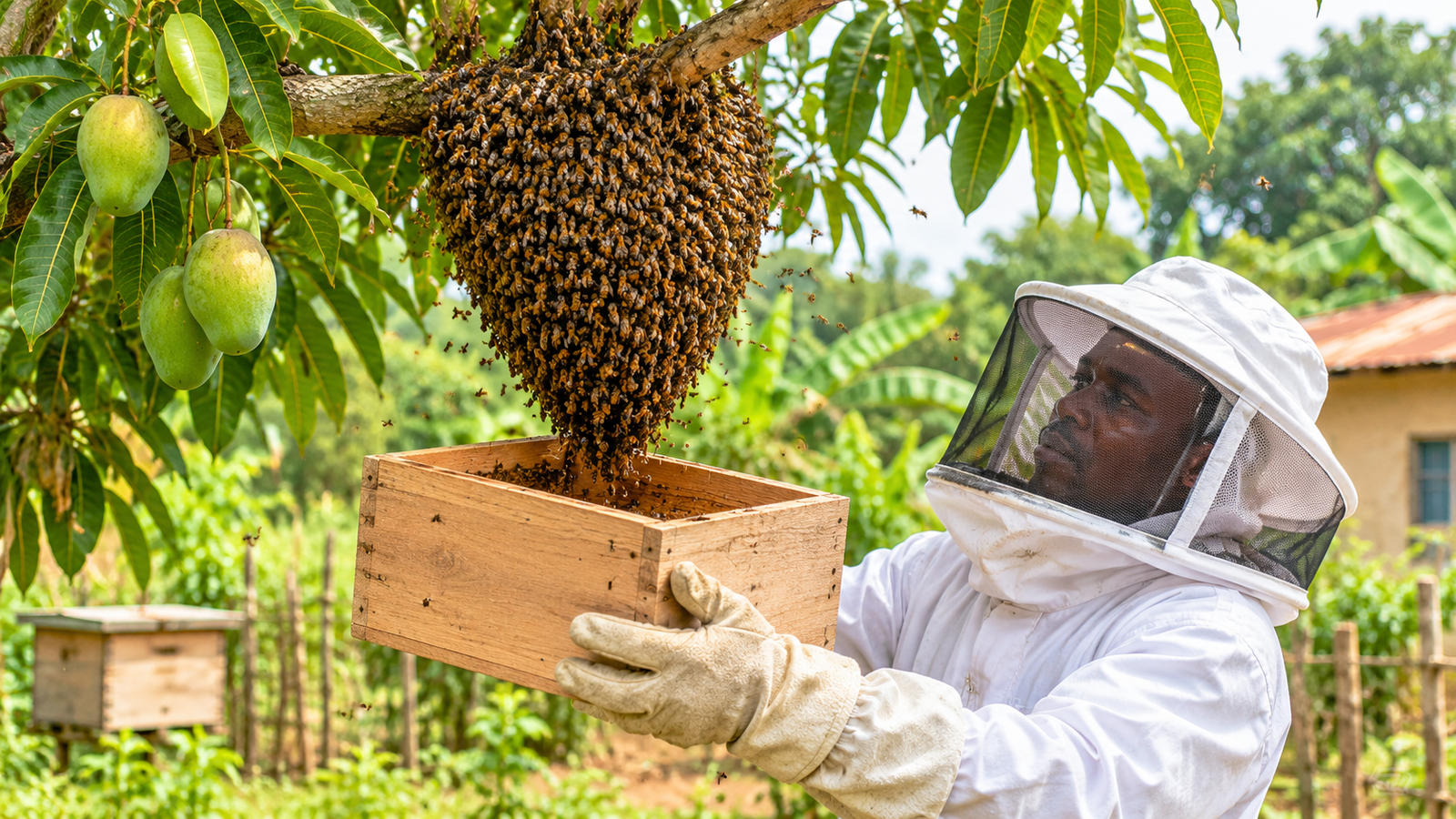
Catching a swarm of bees is one way to establish a honey bee colony in Nigeria without purchasing an established colony. During natural swarming, a queen and thousands of worker bees leave an existing colony and gather temporarily on a tree branch, fence, or another exposed surface while searching for a permanent nesting place. A beekeeper can capture an accessible swarm using a suitable collection box or attract one into an empty bait hive.
However, successfully catching a swarm involves more than placing a bucket underneath a cluster of bees. You need to identify the right type of bee, understand its behaviour, prepare a suitable container, and ensure that the queen and enough workers enter the new hive.
This is particularly important in Nigeria, where African honey bees can be highly defensive and tropical conditions such as excessive heat, heavy rainfall, and seasonal food shortages can affect colony establishment.
This guide explains how to catch a swarm of bees in Nigeria, including the equipment required, direct collection methods, bait-hive preparation, queen-related behaviour, common mistakes, and how to care for a captured colony.
Can You Catch a Swarm of Bees in Nigeria?
Yes. Natural honey bee swarms can be captured in Nigeria using suitable beekeeping equipment and appropriate collection techniques.
The western honey bee, Apis mellifera, occurs in Nigeria and is adapted to African tropical environments. These bees reproduce through colony division, a process known as reproductive swarming.
When a strong colony prepares to swarm, the old queen leaves with a large group of workers. The departing bees gather temporarily around the queen while scout bees search for a suitable nesting cavity.
For example, a swarm may settle on a mango tree on a farm in Ogun State, a branch beside a cocoa plantation in Ondo State, or a fence near a rural property in Oyo State. If the cluster is accessible and can be approached safely, an experienced beekeeper may collect it using a swarm box.
There are two main ways to obtain a natural swarm:
- Direct swarm collection: Collecting a cluster that has already settled on an exposed branch or surface.
- Bait-hive collection: Preparing an empty hive that scout bees may discover and select as a new nesting place.
Direct collection is useful when you have located a visible swarm. Bait hives are useful when you want to attract swarms without searching for individual clusters.
Important: A temporary swarm is different from an established colony living inside a tree, wall, roof, or underground cavity. Removing an established colony requires a different method and should be handled by an experienced live-bee removal specialist.
1. How to Identify a Honey Bee Swarm Before Catching It
Before collecting bees, establish whether you are looking at a temporary swarm, an established colony, or another type of bee.
A honey bee swarm is a temporary cluster formed when a colony divides naturally. The workers gather around their queen, creating a protective mass while scout bees search for a permanent nesting location.
What does a swarm of bees look like?
A typical honey bee swarm resembles a hanging bunch of grapes. Thousands of bees may cling closely together on a tree branch, fence, shrub, or another supporting surface.
Common identification features include:
- A compact cluster: Bees form a dense mass rather than flying individually around a location.
- An exposed position: The cluster may hang from a branch, fence, or building edge.
- No established comb: A newly settled swarm normally has no developed honeycomb.
- Constant movement: Individual bees crawl over the surface while others fly around the cluster.
- Scout activity: Some workers leave and return as they investigate possible nesting locations.
A swarm may remain in one location for several hours or longer while the bees evaluate potential homes.
Swarm versus established honey bee colony
| Identification feature | Temporary swarm | Established colony |
|---|---|---|
| Appearance | Dense cluster of bees | Bees occupying a nest cavity |
| Honeycomb | Usually absent | Usually present |
| Location | Exposed branch or surface | Tree hole, wall, roof, or cavity |
| Bee activity | Workers cluster together | Workers repeatedly enter and leave an entrance |
| Queen | Usually within the cluster | Lives inside the established nest |
| Collection | Suitable for swarm-box methods | Requires specialist colony removal |
For example, if you find a large cluster hanging from a mango branch, it may be a temporary swarm. If you see bees repeatedly entering a small opening in a mango tree trunk, there may already be an established colony inside.
Do not cut open the tree or pour chemicals into the opening.
Are all clusters of bees honey bee swarms?
No. Nigeria also has other bee groups, including stingless bees and solitary bees.
Some stingless bees live in colonies and may occupy cavities, while many solitary bees nest individually in soil, wood, or hollow plant stems.
A large cluster of flying insects should not automatically be classified as a honey bee swarm.
Correct identification matters because ordinary honey bee collection techniques are not suitable for every bee species.
2. Why Do Honey Bees Form Swarms?
Understanding why bees swarm helps explain when and how to collect them.
Swarming is a natural reproductive process that allows a honey bee colony to establish another colony.
It normally occurs when the parent colony has developed sufficiently to divide its population.
What happens during natural swarming?
The process generally involves several stages:
- The original colony develops reproductive queen cells and prepares for division.
- The old queen departs with a large group of worker bees.
- The departing bees settle temporarily around the queen.
- Scout bees search for suitable nesting cavities.
- Scouts communicate information about potential sites.
- The swarm eventually moves to its selected permanent home.
The remaining colony continues with developing or newly emerged queens.
This explains why a beekeeper may find a large group of bees hanging from a tree without seeing any honeycomb. The bees are not necessarily building a permanent nest on that branch. They are temporarily resting while searching for a suitable home.
Why do scout bees matter when catching a swarm?
Scout bees are experienced worker bees that investigate possible nesting locations.
They assess features such as:
- Internal cavity space.
- Entrance size and position.
- Protection from rain.
- Suitability for defending the colony.
- Available room for comb construction and colony growth.
After inspecting a potential home, scouts return to the cluster and communicate information through waggle dances.
Research by Thomas Seeley and P. Kirk Visscher shows that honey bee swarms use collective decision-making to select nesting locations. A suitable site gradually gains support from more scout bees until the swarm is ready to move.
For a Nigerian beekeeper, this has a practical implication: a bait hive should offer a dry, protected, secure cavity rather than simply having an attractive smell.
3. When Is the Best Time to Catch a Swarm of Bees in Nigeria?
The best time to collect a swarm is when it has settled temporarily in an accessible location and can be handled under safe weather conditions.
There is no single guaranteed swarming month throughout Nigeria. Local flowering patterns, rainfall, nectar availability, colony strength, and environmental conditions all influence swarm activity.
Regional considerations for Nigerian beekeepers
| Region | Examples of locations | What to monitor |
|---|---|---|
| Southwest | Lagos, Ogun, Oyo, Ondo | Flowering trees, farm vegetation, and changing rainfall |
| Southeast | Enugu, Anambra, Imo, Abia | Seasonal flowering and colony development |
| South-South | Rivers, Delta, Edo, Akwa Ibom | Local flowering and periods of nectar availability |
| North-Central | Abuja, Niger, Benue, Nasarawa | Flowering vegetation following seasonal rains |
| Northwest | Kano, Kaduna, Katsina, Sokoto | Vegetation and flowering after rainfall |
| Northeast | Bauchi, Gombe, Adamawa, Borno | Seasonal flowering and available forage |
These are monitoring considerations, not scientifically established swarm calendars for each state. Local observations are more useful than assuming every area follows the same schedule.
Should you catch a swarm in the morning or evening?
Both periods can be suitable, but late afternoon or early evening is often convenient for an experienced beekeeper.
| Time | Advantages | Limitations |
|---|---|---|
| Morning | Good visibility and an opportunity to collect a recently settled swarm | More workers may be flying |
| Midday | Good visibility | Heat may increase handling stress |
| Late afternoon | Many workers begin returning to the cluster | Conditions can still be hot |
| Early evening | Most workers may be settled, making transport easier | Poor visibility requires adequate lighting and safe preparation |
Avoid working in thunderstorms, strong winds, extreme heat, or heavy rain.
4. Equipment Needed to Catch a Swarm of Bees
Prepare all your equipment before approaching a swarm. Having a suitable collection box is not enough; you also need protective clothing and a safe transportation arrangement.
Essential equipment includes:
| Equipment | Purpose |
|---|---|
| Full beekeeping suit | Protects the body from stings |
| Properly fitted bee veil | Protects the face, neck, and eyes |
| Protective gloves | Protects the hands |
| Closed boots | Protects the feet and ankles |
| Swarm-catching box | Temporarily holds the collected bees |
| Bee brush | Gently guides remaining bees when appropriate |
| Collection basket or suitable container | Provides an alternative collection method |
| White sheet or tarpaulin | Helps make fallen bees easier to observe |
| Smoker | Used cautiously by trained beekeepers when appropriate |
| Ventilated entrance screen | Allows safe transportation |
| Hive frames or top bars | Provides structure for the new colony |
What type of swarm-catching box is best?
A wooden nucleus box or properly constructed swarm box is a practical choice.
It should have:
- A secure removable lid.
- Adequate ventilation.
- A suitable entrance.
- Enough room for the cluster.
- A dry, clean interior.
- Frames or top bars compatible with the hive system.
For example, a Nigerian beekeeper using a top-bar hive can prepare a smaller temporary collection box and transfer the bees into the permanent top-bar hive after collection.
A collection box should not be airtight, particularly when transporting bees in Nigeria’s hot weather.
5. How to Catch a Swarm of Bees Step by Step
Direct collection works best when the swarm is hanging from an accessible branch or another suitable surface.
The following process explains the basic collection procedure for a trained beekeeper. Beginners should arrange practical supervision, particularly when dealing with African honey bees.
Step 1: Inspect the swarm from a safe distance
Observe the cluster before attempting to collect it.
Determine:
- Whether the bees are honey bees.
- Whether the cluster is temporary or part of an established nest.
- How high the swarm is located.
- Whether the supporting branch is accessible.
- Whether people or animals are nearby.
- Whether the bees are showing defensive behaviour.
For example, a cluster hanging from a low mango branch on an isolated farm may be a suitable collection situation. A swarm hanging above a busy market entrance is not.
If the swarm is high in a tree, near electricity cables, inside a building, or in a crowded area, contact a trained professional.
Step 2: Wear complete protective clothing
Put on your protective suit, veil, gloves, and boots before approaching.
Check that the clothing is properly closed around the wrists, ankles, neck, and zip.
Never assume a swarm is harmless because it is not currently attacking.
Step 3: Prepare the collection box
Position the swarm box where it can receive the bees safely.
If the swarm is hanging from a low branch, an experienced beekeeper can position a suitable collection container underneath it.
Ensure that the box is stable and that the bees can enter without being crushed.
Step 4: Collect the cluster carefully
The collection technique depends on where the swarm has settled.
For a suitable low branch, an experienced beekeeper may use a controlled shake to dislodge the cluster into a container.
If shaking is inappropriate, a suitable collection basket or other specialist method may be necessary.
Avoid striking the branch repeatedly, crushing bees, or using excessive smoke.
Do not attempt to collect bees from an unstable ladder or dangerous height.
Step 5: Allow the remaining workers to regroup
After the main cluster enters the container, some workers may continue flying around the original location.
Give the bees time to settle and observe their behaviour.
Honey bee swarms use chemical signals and wing-fanning behaviour to help workers locate their queen and regroup.
Research published in the Proceedings of the National Academy of Sciences in 2021 examined how bees use pheromone signals and fanning behaviour to locate the queen within a swarm.
This explains why workers may gradually gather around a collection box after the main cluster has entered.
Step 6: Check that the queen has been collected
The queen is essential to successful swarm establishment.
However, she may be hidden inside the mass of workers, making visual identification difficult.
Look for signs that the swarm is consolidating inside the box rather than repeatedly returning to the original branch.
Do not assume that a large number of bees in the box automatically proves that the queen is present.
If the bees repeatedly return to the original location, stop disturbing them and reassess the situation. The queen may have remained outside the box.
Never grab a queen with bare fingers.
Step 7: Secure the container for transportation
Once the bees have settled, secure the container using a suitable screened closure.
Maintain ventilation throughout transportation.
Keep the box shaded and avoid leaving it in a hot vehicle.
Do not seal the bees inside an airtight bucket, bag, or box.
Step 8: Transfer the swarm into a prepared hive
Transfer the bees into a suitable permanent hive under appropriate conditions.
Use frames or top bars compatible with your chosen hive system.
Handle the bees carefully and avoid crushing the queen or workers.
Once transferred, close the hive and allow the colony to settle.
The FAO’s African beekeeping manual describes direct swarm collection using box or bag methods and paper-and-brush methods, alongside bait-hive colonisation.
6. How to Catch a Swarm of Bees Without Shaking a Tree
Not every swarm settles on a branch that can be shaken.
In some situations, the cluster may be attached to a fence, shrub, building edge, or another surface.
A bait hive provides another way of obtaining a colony without physically collecting a visible cluster.
A bait hive is an empty cavity prepared to attract scout bees searching for a permanent nesting location.
Step 1: Prepare a suitable bait hive
Use a clean wooden swarm box or an appropriately prepared beehive.
For best results:
- Remove cobwebs and dirt.
- Ensure the box is dry.
- Check for cracks and unwanted openings.
- Provide suitable frames or top bars.
- Apply a small amount of clean beeswax.
- Use suitable old comb only if its health and origin are known.
Step 2: Make the hive attractive to scout bees
Bees do not choose a home based only on its smell.
They evaluate the physical qualities of a potential nesting cavity.
A suitable bait hive should offer protection from rain, a defensible entrance, adequate internal space, and a stable structure.
Beeswax and suitable old comb can help make the hive attractive.
Some African beekeeping manuals also describe traditional bait materials, including lemongrass, as part of hive preparation. However, these materials should not be treated as guaranteed swarm attractants.
Avoid using contaminated comb or spilling honey and syrup around the hive.
Step 3: Choose a suitable location in Nigeria
Place the bait hive in a location where swarms are likely to pass and where it can remain protected.
Examples include:
- Quiet farm boundaries.
- Woodland edges where placement is permitted.
- Established apiary areas.
- Suitable locations near flowering vegetation.
- Secure positions away from busy roads and residential walkways.
In southern Nigeria, pay attention to dampness, rainfall, and termite damage.
In northern Nigeria, consider intense afternoon heat, dry winds, and the availability of flowering vegetation.
Step 4: Position the bait hive securely
A bait hive can be mounted on a suitable stand or securely suspended where local conditions allow.
The most important considerations are stability, protection from rain, and safe access for inspection.
Do not use an unstable tree branch or an installation that could fall onto people or livestock.
Step 5: Monitor for scout bees and occupation
Inspect the bait hive from a safe distance.
Early signs of interest include:
- Individual bees investigating the entrance.
- Bees repeatedly entering and leaving.
- Increased activity around the entrance.
- A growing number of workers remaining inside.
Scout activity does not mean a swarm has already moved in.
A successful occupation usually involves a much larger number of bees entering and remaining in the hive.
The FAO publication Beekeeping in Africa explains hive colonisation through installed bait hives and natural swarm occupation.
7. How to Tell Whether a Swarm Has Entered Your Bait Hive
This is an important distinction because scout bees can visit an empty hive without selecting it.
Use the following guide:
| Observation | Likely interpretation |
|---|---|
| One or two bees inspecting the entrance | Initial scouting |
| Several bees entering and leaving | Possible site investigation |
| Bees repeatedly inspecting the entrance | Continued interest |
| Many bees arriving together | Possible swarm arrival |
| Sustained traffic after occupation | Stronger indication of colony establishment |
| Bees bringing pollen into the hive | Evidence of an established, functioning colony |
Pollen collection is particularly useful evidence because it generally indicates that workers are beginning to forage for an established colony.
However, confirm occupation through careful inspection at an appropriate time rather than relying on one observation.
8. How to Transfer a Captured Swarm into a Permanent Beehive
A swarm-catching box is usually a temporary holding place. The colony needs a suitable permanent hive where it can build comb, raise brood, and store food.
Prepare the hive before transferring the bees
Make sure the hive is:
- Clean and dry.
- Protected from rain.
- Free from ants and termites.
- Properly ventilated.
- Suitable for the local climate.
- Equipped with compatible frames or top bars.
Transfer the bees carefully
For a swarm collected in a temporary box:
- Prepare the permanent hive before opening the collection box.
- Position the two containers securely.
- Transfer the bees using an appropriate controlled method.
- Avoid crushing the queen or workers.
- Arrange the frames or top bars correctly.
- Close the hive and allow the colony to settle.
Do not force bees into the hive by pouring them from an excessive height or repeatedly shaking the container.
What if the swarm is already living in the bait hive?
If the bait hive has already become occupied, moving it requires additional care.
Returning workers may have learned the original location through orientation flights.
For this reason, it is better to install bait hives at the intended apiary location whenever possible. If relocation is necessary, use a suitable established relocation procedure with advice from an experienced beekeeper.
9. Why Do Captured Swarms Sometimes Leave Their New Hive?
When an entire colony abandons its new hive, the behaviour is known as absconding.
This is different from reproductive swarming. During reproductive swarming, a colony divides and the parent colony remains behind. During absconding, the colony leaves its current nest.
Possible reasons include:
| Problem | Why it matters | Practical response |
|---|---|---|
| Excessive heat | Can create stressful hive conditions | Provide appropriate shade and ventilation |
| Food shortage | Limits the colony’s ability to establish itself | Assess forage and feed appropriately if necessary |
| Pest disturbance | Ants and other pests may disrupt the colony | Use suitable pest barriers |
| Repeated inspections | Prevents the colony from settling | Minimise disturbance |
| Poor hive condition | Dampness and unsuitable cavities discourage occupation | Prepare a sound, dry hive |
| Queen loss | May disrupt successful establishment | Handle collection and transfer carefully |
| Water entering the hive | Damages comb and creates unsuitable conditions | Improve roofing and drainage |
Do not assume that every swarm that leaves was queenless. Environmental stress, poor nesting conditions, and disturbance can also contribute.
10. What Is the Difference Between a Primary and Secondary Swarm?
Not all swarms have the same size or queen characteristics.
A primary swarm generally leaves with the old, mated queen and a substantial number of workers.
A secondary swarm, sometimes called an afterswarm, may leave later with a virgin queen and a smaller population.
| Feature | Primary swarm | Secondary swarm |
|---|---|---|
| Queen | Usually the old mated queen | Usually a virgin queen |
| Population | Generally larger | Generally smaller |
| Timing | Often the first swarm | May follow the primary swarm |
| Establishment | Often has a larger initial workforce | May need more time to develop |
| Collection | Can be suitable for a new hive | Requires careful monitoring |
A smaller secondary swarm is not necessarily unsuitable for beekeeping. However, it may have fewer workers available for comb construction, foraging, and brood care.
Do not judge the future productivity of a colony by its initial cluster size alone.
11. Common Mistakes to Avoid When Catching a Swarm of Bees in Nigeria
Avoid these mistakes:
- Using insecticides: Chemicals can kill bees and contaminate the collection.
- Collecting without protective clothing: African honey bees can become defensive.
- Confusing an established colony with a swarm: A cavity colony needs specialist removal.
- Using a poorly ventilated container: Bees can overheat during transportation.
- Ignoring the queen: Successful establishment depends on retaining a viable queen.
- Using rotten comb: Contaminated comb can introduce pests and disease.
- Placing the hive in an exposed location: Excessive heat and rain can discourage occupation.
- Inspecting too frequently: Repeated disturbance can encourage absconding.
- Climbing unstable trees: Falls and bee attacks can cause serious injuries.
- Assuming every bee cluster is harmless: Always assess the situation before approaching.
12. How to Care for a Swarm After Catching It
Capturing the swarm is only the first stage. The next priority is helping the colony establish itself.
Provide water
Honey bees use water for temperature regulation and other colony activities.
Provide a clean, shallow water source with safe landing surfaces such as stones or floating wood.
Monitor food availability
A newly captured swarm needs nectar and pollen to build comb, feed developing larvae, and support adult workers.
If natural food is scarce, supplementary feeding may be necessary.
Use appropriate feeders and avoid spilling syrup around the hive because this can attract ants and encourage robbing.
Protect the hive from excessive heat and rain
In Nigerian conditions, the hive needs protection from direct afternoon heat and heavy rainfall.
Use a suitable roof, a stable stand, and a well-drained apiary site.
Monitor pests
Inspect for ants, termites, wax moths, and other locally relevant pests.
A weak or newly established colony may be particularly vulnerable.
Check whether the queen is laying
After allowing the colony to settle, inspect it carefully when weather and colony conditions permit.
Look for:
- Fresh comb.
- Eggs.
- Young larvae.
- Pollen stores.
- Nectar or honey stores.
- Normal worker activity.
Eggs and young larvae are useful evidence that the queen is functioning.
However, the absence of eggs during an early inspection does not automatically prove that the queen is missing.
13. Is Catching a Swarm Better Than Buying a Bee Colony in Nigeria?
Both methods can help you establish an apiary, but they have different advantages.
| Factor | Catching a natural swarm | Buying an established colony |
|---|---|---|
| Cost of obtaining bees | Usually lower | Requires payment |
| Availability | Depends on natural swarm activity | Depends on suppliers |
| Colony condition | May be uncertain | Can be assessed before purchase |
| Initial development | May need time to establish | May already have established comb |
| Main challenge | Finding and collecting the swarm | Finding a reliable seller |
| Suitability | Useful for expanding an apiary | Useful when a colony is needed more predictably |
Catching natural swarms can reduce the cost of obtaining additional colonies, but it does not eliminate the cost of hives, protective clothing, transport, and colony management.
For a Nigerian beginner, learning to identify and collect natural swarms can be a valuable beekeeping skill.
14. Safety Precautions When Catching African Honey Bees
African honey bees can defend their colonies aggressively when threatened.
Never assume that a temporary swarm cannot sting. Although swarming bees may be less defensive in some circumstances, their behaviour is not predictable enough to justify approaching them without protection.
Follow these precautions:
- Wear a complete protective suit and properly fitted veil.
- Keep children and animals away.
- Avoid loud noises and sudden movements.
- Do not spray chemicals or throw objects at the swarm.
- Never attempt collection near electricity cables.
- Avoid unstable ladders and dangerous heights.
- Keep an escape route available.
- Do not work in poor visibility or dangerous weather.
- Seek professional help if the bees are near a busy public area or inside a building.
If stung, move away from the bees and remove any retained sting promptly. Wash the affected area and use a cold compress. Difficulty breathing, throat or tongue swelling, dizziness, fainting, or other signs of a severe allergic reaction require immediate emergency medical attention. Multiple stings also require urgent medical assessment.
Frequently Asked Questions About Catching a Swarm of Bees
1. How do you catch a swarm of bees?
Wear appropriate protective clothing and use a suitable swarm-catching box. An experienced beekeeper can collect an accessible cluster using a controlled collection method, allow the workers to regroup, and transfer the colony into a prepared hive.
2. What is the best time to catch a swarm of bees?
Late afternoon or early evening is often convenient because many workers have returned to the cluster. Morning collection is also possible when the swarm is accessible and conditions are safe.
3. How long does a swarm stay in one place?
A swarm may remain in a temporary cluster for several hours or a few days while scout bees investigate nesting sites. Its departure depends on the colony’s behaviour and environmental conditions.
4. How do you attract a swarm into an empty hive?
Prepare a clean, dry bait hive with suitable internal space and a secure entrance. A small amount of clean beeswax or suitable old comb can make it attractive. Install it in a protected location where swarms are likely to pass.
5. Does lemongrass attract honey bee swarms?
Lemongrass is traditionally used as a bee attractant. However, its effectiveness should not be treated as a guarantee of occupation. The physical suitability of the bait hive remains important.
6. Can you catch a swarm of bees with a bucket?
A clean, suitable bucket can serve as a temporary collection container in some situations, but it must provide adequate ventilation and safe handling. A purpose-built swarm box or basket is generally more suitable for transportation.
7. Why do bees leave after being caught?
A captured swarm may abscond because of excessive heat, poor hive conditions, food shortage, pest disturbance, repeated inspections, or other environmental stresses.
8. Can you catch a swarm of bees at night?
Nighttime is generally more suitable for securing and transporting a swarm that has already been collected than for attempting the initial collection. Poor visibility makes night collection more difficult and dangerous.
9. What should you do if a swarm settles on your house?
Keep people and animals away and contact a trained beekeeper. Do not spray the bees, throw stones, or attempt to remove an established colony from a roof or wall yourself.
10. How many bees are in a swarm?
The number varies considerably. A large primary swarm may contain tens of thousands of workers, while smaller secondary swarms may contain considerably fewer.
11. Can a small swarm become a strong colony?
Yes, provided it has a viable queen, sufficient workers, suitable nesting conditions, and adequate food. However, smaller swarms generally have fewer workers available for comb building and brood rearing.
12. Can you make money from catching bee swarms in Nigeria?
Yes. Captured colonies can help expand an apiary and eventually support honey production, beeswax production, and other beekeeping activities. The profitability depends on colony survival, management costs, and access to buyers.
Conclusion
Catching a swarm of bees in Nigeria requires more than finding a cluster and placing it in a box. Successful collection depends on identifying a genuine honey bee swarm, understanding its behaviour, using suitable equipment, retaining the queen, and transferring the bees into a properly prepared hive.
For an accessible cluster, direct collection may be appropriate for an experienced beekeeper. For people who want to attract naturally occurring swarms, a properly prepared bait hive offers another practical option.
Remember that a captured swarm is not automatically an established honey-producing colony. It still needs suitable food, water, protection from excessive heat and rain, and careful monitoring.
By understanding how honey bee swarms form and select new nesting sites, Nigerian beekeepers can improve their chances of capturing and establishing healthy colonies.
Complete Article Review and Improvement: How to Catch a Swarm of Bees in Nigeria
The previous article covers the basic process, but I would not consider it fully publication-ready for BeekeeperBase yet.
It answers the main question, but several sections need stronger scientific explanations, more practical Nigerian examples, and clearer distinctions between catching a temporary swarm and removing an established colony.
The biggest improvement should be to make the article explain not just how to catch a swarm, but also why the method works, how to recognise successful capture, and what to do when the swarm behaves differently than expected.
1. Evaluation against the six quality questions
| Quality question | Previous article | What needs improvement |
|---|---|---|
| 1. Does it answer the reader’s question completely? | Partially | Explain the complete process, including queen capture, difficult collection situations, and successful transfer. |
| 2. Does it go beyond competitors? | Partially | Add bee behaviour, swarm decision-making, bait-hive science, and Nigerian field examples. |
| 3. Does it contain accurate, specific examples? | Partially | Include realistic examples involving mango trees, farm boundaries, wooden bait hives, and Nigerian seasonal conditions. |
| 4. Does it explain differences and exceptions? | Partially | Distinguish swarms from established colonies, primary from secondary swarms, and honey bees from solitary bees. |
| 5. Does it cite reliable sources? | Needs improvement | Use identifiable scientific publications, university extension resources, FAO manuals, and African beekeeping research. |
| 6. Does it offer information beyond superficial content? | Partially | Add a practical decision guide, collection troubleshooting, bait-hive specifications, and post-capture assessment. |
Needs substantial improvement
2. What we need to improve
A. Original explanations
The previous article says that a queen is essential for keeping a swarm together, but it does not sufficiently explain the biological reason.
A stronger explanation should describe how worker bees respond to the queen’s pheromones and how this influences their clustering behaviour.
It should also explain that scout bees communicate potential nesting locations through behaviour, including waggle dances, and that a swarm selects a new home through a collective decision-making process.
B. Scientific information relevant to the focus keyword
The article should concentrate on scientific information that helps readers catch swarms:
- Why honey bee colonies swarm.
- What happens to the old queen and the remaining colony.
- Why workers cluster around a queen.
- How scout bees identify and evaluate nesting cavities.
- Why a swarm may leave a collection box.
- Why honey bee swarms behave differently from solitary bees and stingless bees.
One important correction: Apis mellifera adansonii should not be presented as the only honey bee type found in Nigeria without stronger evidence. African honey bee populations have complex taxonomic and geographic classifications. The article should use the broader term African honey bee, Apis mellifera, unless a particular subspecies is established for the location being discussed.
C. Practical examples
The article should show what a beekeeper should actually do in situations such as:
- A swarm hanging from a mango tree on a farm.
- A cluster gathering on a fence near a rural home.
- Scout bees investigating a wooden bait hive.
- A swarm entering a hole in a tree.
- A swarm entering a collection box but returning to its original branch.
D. Meaningful comparisons
The article needs a better identification guide explaining which bees can be collected using ordinary swarm-catching methods and which require specialist handling.
E. Stronger references
Use scientific and educational sources, particularly research on honey bee swarming, African honey bee behaviour, swarm nest-site selection, and tropical beekeeping.
F. Relevant photographs
Use photographs showing actual swarm clusters, bait hives, collection equipment, queen and worker bees, and safe hive transfer. Avoid generic photographs of people standing near beehives that do not demonstrate the process.
3. Fully Improved SEO Article
The following is the revised version. It incorporates the scientific explanations, practical examples, identification comparisons, Nigerian context, and stronger references. It also removes unnecessary repetition and keeps the main answer aligned with the focus keyword.
Revised publication draft
How to Catch a Swarm of Bees in Nigeria: A Complete Step-by-Step Guide
Catching a swarm of bees is one way to establish a honey bee colony in Nigeria without purchasing an established colony. During natural swarming, a queen and thousands of worker bees leave an existing colony and gather temporarily on a tree branch, fence, or another exposed surface while searching for a permanent nesting place. A beekeeper can capture an accessible swarm using a suitable collection box or attract one into an empty bait hive.
However, successfully catching a swarm involves more than placing a bucket underneath a cluster of bees. You need to identify the right type of bee, understand its behaviour, prepare a suitable container, and ensure that the queen and enough workers enter the new hive.
This is particularly important in Nigeria, where African honey bees can be highly defensive and tropical conditions such as excessive heat, heavy rainfall, and seasonal food shortages can affect colony establishment.
This guide explains how to catch a swarm of bees in Nigeria, including the equipment required, direct collection methods, bait-hive preparation, queen-related behaviour, common mistakes, and how to care for a captured colony.
Can You Catch a Swarm of Bees in Nigeria?
Yes. Natural honey bee swarms can be captured in Nigeria using suitable beekeeping equipment and appropriate collection techniques.
The western honey bee, Apis mellifera, occurs in Nigeria and is adapted to African tropical environments. These bees reproduce through colony division, a process known as reproductive swarming.
When a strong colony prepares to swarm, the old queen leaves with a large group of workers. The departing bees gather temporarily around the queen while scout bees search for a suitable nesting cavity.
For example, a swarm may settle on a mango tree on a farm in Ogun State, a branch beside a cocoa plantation in Ondo State, or a fence near a rural property in Oyo State. If the cluster is accessible and can be approached safely, an experienced beekeeper may collect it using a swarm box.
There are two main ways to obtain a natural swarm:
- Direct swarm collection: Collecting a cluster that has already settled on an exposed branch or surface.
- Bait-hive collection: Preparing an empty hive that scout bees may discover and select as a new nesting place.
Direct collection is useful when you have located a visible swarm. Bait hives are useful when you want to attract swarms without searching for individual clusters.
Important: A temporary swarm is different from an established colony living inside a tree, wall, roof, or underground cavity. Removing an established colony requires a different method and should be handled by an experienced live-bee removal specialist.
1. How to Identify a Honey Bee Swarm Before Catching It
Before collecting bees, establish whether you are looking at a temporary swarm, an established colony, or another type of bee.
A honey bee swarm is a temporary cluster formed when a colony divides naturally. The workers gather around their queen, creating a protective mass while scout bees search for a permanent nesting location.
What does a swarm of bees look like?
A typical honey bee swarm resembles a hanging bunch of grapes. Thousands of bees may cling closely together on a tree branch, fence, shrub, or another supporting surface.
Common identification features include:
- A compact cluster: Bees form a dense mass rather than flying individually around a location.
- An exposed position: The cluster may hang from a branch, fence, or building edge.
- No established comb: A newly settled swarm normally has no developed honeycomb.
- Constant movement: Individual bees crawl over the surface while others fly around the cluster.
- Scout activity: Some workers leave and return as they investigate possible nesting locations.
A swarm may remain in one location for several hours or longer while the bees evaluate potential homes.
Swarm versus established honey bee colony
| Identification feature | Temporary swarm | Established colony |
|---|---|---|
| Appearance | Dense cluster of bees | Bees occupying a nest cavity |
| Honeycomb | Usually absent | Usually present |
| Location | Exposed branch or surface | Tree hole, wall, roof, or cavity |
| Bee activity | Workers cluster together | Workers repeatedly enter and leave an entrance |
| Queen | Usually within the cluster | Lives inside the established nest |
| Collection | Suitable for swarm-box methods | Requires specialist colony removal |
For example, if you find a large cluster hanging from a mango branch, it may be a temporary swarm. If you see bees repeatedly entering a small opening in a mango tree trunk, there may already be an established colony inside.
Do not cut open the tree or pour chemicals into the opening.
Are all clusters of bees honey bee swarms?
No. Nigeria also has other bee groups, including stingless bees and solitary bees.
Some stingless bees live in colonies and may occupy cavities, while many solitary bees nest individually in soil, wood, or hollow plant stems.
A large cluster of flying insects should not automatically be classified as a honey bee swarm.
Correct identification matters because ordinary honey bee collection techniques are not suitable for every bee species.
2. Why Do Honey Bees Form Swarms?
Understanding why bees swarm helps explain when and how to collect them.
Swarming is a natural reproductive process that allows a honey bee colony to establish another colony.
It normally occurs when the parent colony has developed sufficiently to divide its population.
What happens during natural swarming?
The process generally involves several stages:
- The original colony develops reproductive queen cells and prepares for division.
- The old queen departs with a large group of worker bees.
- The departing bees settle temporarily around the queen.
- Scout bees search for suitable nesting cavities.
- Scouts communicate information about potential sites.
- The swarm eventually moves to its selected permanent home.
The remaining colony continues with developing or newly emerged queens.
This explains why a beekeeper may find a large group of bees hanging from a tree without seeing any honeycomb. The bees are not necessarily building a permanent nest on that branch. They are temporarily resting while searching for a suitable home.
Why do scout bees matter when catching a swarm?
Scout bees are experienced worker bees that investigate possible nesting locations.
They assess features such as:
- Internal cavity space.
- Entrance size and position.
- Protection from rain.
- Suitability for defending the colony.
- Available room for comb construction and colony growth.
After inspecting a potential home, scouts return to the cluster and communicate information through waggle dances.
Research by Thomas Seeley and P. Kirk Visscher shows that honey bee swarms use collective decision-making to select nesting locations. A suitable site gradually gains support from more scout bees until the swarm is ready to move.
For a Nigerian beekeeper, this has a practical implication: a bait hive should offer a dry, protected, secure cavity rather than simply having an attractive smell.
3. When Is the Best Time to Catch a Swarm of Bees in Nigeria?
The best time to collect a swarm is when it has settled temporarily in an accessible location and can be handled under safe weather conditions.
There is no single guaranteed swarming month throughout Nigeria. Local flowering patterns, rainfall, nectar availability, colony strength, and environmental conditions all influence swarm activity.
Regional considerations for Nigerian beekeepers
| Region | Examples of locations | What to monitor |
|---|---|---|
| Southwest | Lagos, Ogun, Oyo, Ondo | Flowering trees, farm vegetation, and changing rainfall |
| Southeast | Enugu, Anambra, Imo, Abia | Seasonal flowering and colony development |
| South-South | Rivers, Delta, Edo, Akwa Ibom | Local flowering and periods of nectar availability |
| North-Central | Abuja, Niger, Benue, Nasarawa | Flowering vegetation following seasonal rains |
| Northwest | Kano, Kaduna, Katsina, Sokoto | Vegetation and flowering after rainfall |
| Northeast | Bauchi, Gombe, Adamawa, Borno | Seasonal flowering and available forage |
These are monitoring considerations, not scientifically established swarm calendars for each state. Local observations are more useful than assuming every area follows the same schedule.
Should you catch a swarm in the morning or evening?
Both periods can be suitable, but late afternoon or early evening is often convenient for an experienced beekeeper.
| Time | Advantages | Limitations |
|---|---|---|
| Morning | Good visibility and an opportunity to collect a recently settled swarm | More workers may be flying |
| Midday | Good visibility | Heat may increase handling stress |
| Late afternoon | Many workers begin returning to the cluster | Conditions can still be hot |
| Early evening | Most workers may be settled, making transport easier | Poor visibility requires adequate lighting and safe preparation |
Avoid working in thunderstorms, strong winds, extreme heat, or heavy rain.
4. Equipment Needed to Catch a Swarm of Bees
Prepare all your equipment before approaching a swarm. Having a suitable collection box is not enough; you also need protective clothing and a safe transportation arrangement.
Essential equipment includes:
| Equipment | Purpose |
|---|---|
| Full beekeeping suit | Protects the body from stings |
| Properly fitted bee veil | Protects the face, neck, and eyes |
| Protective gloves | Protects the hands |
| Closed boots | Protects the feet and ankles |
| Swarm-catching box | Temporarily holds the collected bees |
| Bee brush | Gently guides remaining bees when appropriate |
| Collection basket or suitable container | Provides an alternative collection method |
| White sheet or tarpaulin | Helps make fallen bees easier to observe |
| Smoker | Used cautiously by trained beekeepers when appropriate |
| Ventilated entrance screen | Allows safe transportation |
| Hive frames or top bars | Provides structure for the new colony |
What type of swarm-catching box is best?
A wooden nucleus box or properly constructed swarm box is a practical choice.
It should have:
- A secure removable lid.
- Adequate ventilation.
- A suitable entrance.
- Enough room for the cluster.
- A dry, clean interior.
- Frames or top bars compatible with the hive system.
For example, a Nigerian beekeeper using a top-bar hive can prepare a smaller temporary collection box and transfer the bees into the permanent top-bar hive after collection.
A collection box should not be airtight, particularly when transporting bees in Nigeria’s hot weather.
5. How to Catch a Swarm of Bees Step by Step
Direct collection works best when the swarm is hanging from an accessible branch or another suitable surface.
The following process explains the basic collection procedure for a trained beekeeper. Beginners should arrange practical supervision, particularly when dealing with African honey bees.
Step 1: Inspect the swarm from a safe distance
Observe the cluster before attempting to collect it.
Determine:
- Whether the bees are honey bees.
- Whether the cluster is temporary or part of an established nest.
- How high the swarm is located.
- Whether the supporting branch is accessible.
- Whether people or animals are nearby.
- Whether the bees are showing defensive behaviour.
For example, a cluster hanging from a low mango branch on an isolated farm may be a suitable collection situation. A swarm hanging above a busy market entrance is not.
If the swarm is high in a tree, near electricity cables, inside a building, or in a crowded area, contact a trained professional.
Step 2: Wear complete protective clothing
Put on your protective suit, veil, gloves, and boots before approaching.
Check that the clothing is properly closed around the wrists, ankles, neck, and zip.
Never assume a swarm is harmless because it is not currently attacking.
Step 3: Prepare the collection box
Position the swarm box where it can receive the bees safely.
If the swarm is hanging from a low branch, an experienced beekeeper can position a suitable collection container underneath it.
Ensure that the box is stable and that the bees can enter without being crushed.
Step 4: Collect the cluster carefully
The collection technique depends on where the swarm has settled.
For a suitable low branch, an experienced beekeeper may use a controlled shake to dislodge the cluster into a container.
If shaking is inappropriate, a suitable collection basket or other specialist method may be necessary.
Avoid striking the branch repeatedly, crushing bees, or using excessive smoke.
Do not attempt to collect bees from an unstable ladder or dangerous height.
Step 5: Allow the remaining workers to regroup
After the main cluster enters the container, some workers may continue flying around the original location.
Give the bees time to settle and observe their behaviour.
Honey bee swarms use chemical signals and wing-fanning behaviour to help workers locate their queen and regroup.
Research published in the Proceedings of the National Academy of Sciences in 2021 examined how bees use pheromone signals and fanning behaviour to locate the queen within a swarm.
This explains why workers may gradually gather around a collection box after the main cluster has entered.
Step 6: Check that the queen has been collected
The queen is essential to successful swarm establishment.
However, she may be hidden inside the mass of workers, making visual identification difficult.
Look for signs that the swarm is consolidating inside the box rather than repeatedly returning to the original branch.
Do not assume that a large number of bees in the box automatically proves that the queen is present.
If the bees repeatedly return to the original location, stop disturbing them and reassess the situation. The queen may have remained outside the box.
Never grab a queen with bare fingers.
Step 7: Secure the container for transportation
Once the bees have settled, secure the container using a suitable screened closure.
Maintain ventilation throughout transportation.
Keep the box shaded and avoid leaving it in a hot vehicle.
Do not seal the bees inside an airtight bucket, bag, or box.
Step 8: Transfer the swarm into a prepared hive
Transfer the bees into a suitable permanent hive under appropriate conditions.
Use frames or top bars compatible with your chosen hive system.
Handle the bees carefully and avoid crushing the queen or workers.
Once transferred, close the hive and allow the colony to settle.
The FAO’s African beekeeping manual describes direct swarm collection using box or bag methods and paper-and-brush methods, alongside bait-hive colonisation.
6. How to Catch a Swarm of Bees Without Shaking a Tree
Not every swarm settles on a branch that can be shaken.
In some situations, the cluster may be attached to a fence, shrub, building edge, or another surface.
A bait hive provides another way of obtaining a colony without physically collecting a visible cluster.
A bait hive is an empty cavity prepared to attract scout bees searching for a permanent nesting location.
Step 1: Prepare a suitable bait hive
Use a clean wooden swarm box or an appropriately prepared beehive.
For best results:
- Remove cobwebs and dirt.
- Ensure the box is dry.
- Check for cracks and unwanted openings.
- Provide suitable frames or top bars.
- Apply a small amount of clean beeswax.
- Use suitable old comb only if its health and origin are known.
Step 2: Make the hive attractive to scout bees
Bees do not choose a home based only on its smell.
They evaluate the physical qualities of a potential nesting cavity.
A suitable bait hive should offer protection from rain, a defensible entrance, adequate internal space, and a stable structure.
Beeswax and suitable old comb can help make the hive attractive.
Some African beekeeping manuals also describe traditional bait materials, including lemongrass, as part of hive preparation. However, these materials should not be treated as guaranteed swarm attractants.
Avoid using contaminated comb or spilling honey and syrup around the hive.
Step 3: Choose a suitable location in Nigeria
Place the bait hive in a location where swarms are likely to pass and where it can remain protected.
Examples include:
- Quiet farm boundaries.
- Woodland edges where placement is permitted.
- Established apiary areas.
- Suitable locations near flowering vegetation.
- Secure positions away from busy roads and residential walkways.
In southern Nigeria, pay attention to dampness, rainfall, and termite damage.
In northern Nigeria, consider intense afternoon heat, dry winds, and the availability of flowering vegetation.
Step 4: Position the bait hive securely
A bait hive can be mounted on a suitable stand or securely suspended where local conditions allow.
The most important considerations are stability, protection from rain, and safe access for inspection.
Do not use an unstable tree branch or an installation that could fall onto people or livestock.
Step 5: Monitor for scout bees and occupation
Inspect the bait hive from a safe distance.
Early signs of interest include:
- Individual bees investigating the entrance.
- Bees repeatedly entering and leaving.
- Increased activity around the entrance.
- A growing number of workers remaining inside.
Scout activity does not mean a swarm has already moved in.
A successful occupation usually involves a much larger number of bees entering and remaining in the hive.
The FAO publication Beekeeping in Africa explains hive colonisation through installed bait hives and natural swarm occupation.
7. How to Tell Whether a Swarm Has Entered Your Bait Hive
This is an important distinction because scout bees can visit an empty hive without selecting it.
Use the following guide:
| Observation | Likely interpretation |
|---|---|
| One or two bees inspecting the entrance | Initial scouting |
| Several bees entering and leaving | Possible site investigation |
| Bees repeatedly inspecting the entrance | Continued interest |
| Many bees arriving together | Possible swarm arrival |
| Sustained traffic after occupation | Stronger indication of colony establishment |
| Bees bringing pollen into the hive | Evidence of an established, functioning colony |
Pollen collection is particularly useful evidence because it generally indicates that workers are beginning to forage for an established colony.
However, confirm occupation through careful inspection at an appropriate time rather than relying on one observation.
8. How to Transfer a Captured Swarm into a Permanent Beehive
A swarm-catching box is usually a temporary holding place. The colony needs a suitable permanent hive where it can build comb, raise brood, and store food.
Prepare the hive before transferring the bees
Make sure the hive is:
- Clean and dry.
- Protected from rain.
- Free from ants and termites.
- Properly ventilated.
- Suitable for the local climate.
- Equipped with compatible frames or top bars.
Transfer the bees carefully
For a swarm collected in a temporary box:
- Prepare the permanent hive before opening the collection box.
- Position the two containers securely.
- Transfer the bees using an appropriate controlled method.
- Avoid crushing the queen or workers.
- Arrange the frames or top bars correctly.
- Close the hive and allow the colony to settle.
Do not force bees into the hive by pouring them from an excessive height or repeatedly shaking the container.
What if the swarm is already living in the bait hive?
If the bait hive has already become occupied, moving it requires additional care.
Returning workers may have learned the original location through orientation flights.
For this reason, it is better to install bait hives at the intended apiary location whenever possible. If relocation is necessary, use a suitable established relocation procedure with advice from an experienced beekeeper.
9. Why Do Captured Swarms Sometimes Leave Their New Hive?
When an entire colony abandons its new hive, the behaviour is known as absconding.
This is different from reproductive swarming. During reproductive swarming, a colony divides and the parent colony remains behind. During absconding, the colony leaves its current nest.
Possible reasons include:
| Problem | Why it matters | Practical response |
|---|---|---|
| Excessive heat | Can create stressful hive conditions | Provide appropriate shade and ventilation |
| Food shortage | Limits the colony’s ability to establish itself | Assess forage and feed appropriately if necessary |
| Pest disturbance | Ants and other pests may disrupt the colony | Use suitable pest barriers |
| Repeated inspections | Prevents the colony from settling | Minimise disturbance |
| Poor hive condition | Dampness and unsuitable cavities discourage occupation | Prepare a sound, dry hive |
| Queen loss | May disrupt successful establishment | Handle collection and transfer carefully |
| Water entering the hive | Damages comb and creates unsuitable conditions | Improve roofing and drainage |
Do not assume that every swarm that leaves was queenless. Environmental stress, poor nesting conditions, and disturbance can also contribute.
10. What Is the Difference Between a Primary and Secondary Swarm?
Not all swarms have the same size or queen characteristics.
A primary swarm generally leaves with the old, mated queen and a substantial number of workers.
A secondary swarm, sometimes called an afterswarm, may leave later with a virgin queen and a smaller population.
| Feature | Primary swarm | Secondary swarm |
|---|---|---|
| Queen | Usually the old mated queen | Usually a virgin queen |
| Population | Generally larger | Generally smaller |
| Timing | Often the first swarm | May follow the primary swarm |
| Establishment | Often has a larger initial workforce | May need more time to develop |
| Collection | Can be suitable for a new hive | Requires careful monitoring |
A smaller secondary swarm is not necessarily unsuitable for beekeeping. However, it may have fewer workers available for comb construction, foraging, and brood care.
Do not judge the future productivity of a colony by its initial cluster size alone.
11. Common Mistakes to Avoid When Catching a Swarm of Bees in Nigeria
Avoid these mistakes:
- Using insecticides: Chemicals can kill bees and contaminate the collection.
- Collecting without protective clothing: African honey bees can become defensive.
- Confusing an established colony with a swarm: A cavity colony needs specialist removal.
- Using a poorly ventilated container: Bees can overheat during transportation.
- Ignoring the queen: Successful establishment depends on retaining a viable queen.
- Using rotten comb: Contaminated comb can introduce pests and disease.
- Placing the hive in an exposed location: Excessive heat and rain can discourage occupation.
- Inspecting too frequently: Repeated disturbance can encourage absconding.
- Climbing unstable trees: Falls and bee attacks can cause serious injuries.
- Assuming every bee cluster is harmless: Always assess the situation before approaching.
12. How to Care for a Swarm After Catching It
Capturing the swarm is only the first stage. The next priority is helping the colony establish itself.
Provide water
Honey bees use water for temperature regulation and other colony activities.
Provide a clean, shallow water source with safe landing surfaces such as stones or floating wood.
Monitor food availability
A newly captured swarm needs nectar and pollen to build comb, feed developing larvae, and support adult workers.
If natural food is scarce, supplementary feeding may be necessary.
Use appropriate feeders and avoid spilling syrup around the hive because this can attract ants and encourage robbing.
Protect the hive from excessive heat and rain
In Nigerian conditions, the hive needs protection from direct afternoon heat and heavy rainfall.
Use a suitable roof, a stable stand, and a well-drained apiary site.
Monitor pests
Inspect for ants, termites, wax moths, and other locally relevant pests.
A weak or newly established colony may be particularly vulnerable.
Check whether the queen is laying
After allowing the colony to settle, inspect it carefully when weather and colony conditions permit.
Look for:
- Fresh comb.
- Eggs.
- Young larvae.
- Pollen stores.
- Nectar or honey stores.
- Normal worker activity.
Eggs and young larvae are useful evidence that the queen is functioning.
However, the absence of eggs during an early inspection does not automatically prove that the queen is missing.
13. Is Catching a Swarm Better Than Buying a Bee Colony in Nigeria?
Both methods can help you establish an apiary, but they have different advantages.
| Factor | Catching a natural swarm | Buying an established colony |
|---|---|---|
| Cost of obtaining bees | Usually lower | Requires payment |
| Availability | Depends on natural swarm activity | Depends on suppliers |
| Colony condition | May be uncertain | Can be assessed before purchase |
| Initial development | May need time to establish | May already have established comb |
| Main challenge | Finding and collecting the swarm | Finding a reliable seller |
| Suitability | Useful for expanding an apiary | Useful when a colony is needed more predictably |
Catching natural swarms can reduce the cost of obtaining additional colonies, but it does not eliminate the cost of hives, protective clothing, transport, and colony management.
For a Nigerian beginner, learning to identify and collect natural swarms can be a valuable beekeeping skill.
14. Safety Precautions When Catching African Honey Bees
African honey bees can defend their colonies aggressively when threatened.
Never assume that a temporary swarm cannot sting. Although swarming bees may be less defensive in some circumstances, their behaviour is not predictable enough to justify approaching them without protection.
Follow these precautions:
- Wear a complete protective suit and properly fitted veil.
- Keep children and animals away.
- Avoid loud noises and sudden movements.
- Do not spray chemicals or throw objects at the swarm.
- Never attempt collection near electricity cables.
- Avoid unstable ladders and dangerous heights.
- Keep an escape route available.
- Do not work in poor visibility or dangerous weather.
- Seek professional help if the bees are near a busy public area or inside a building.
If stung, move away from the bees and remove any retained sting promptly. Wash the affected area and use a cold compress. Difficulty breathing, throat or tongue swelling, dizziness, fainting, or other signs of a severe allergic reaction require immediate emergency medical attention. Multiple stings also require urgent medical assessment.
Frequently Asked Questions About Catching a Swarm of Bees
1. How do you catch a swarm of bees?
Wear appropriate protective clothing and use a suitable swarm-catching box. An experienced beekeeper can collect an accessible cluster using a controlled collection method, allow the workers to regroup, and transfer the colony into a prepared hive.
2. What is the best time to catch a swarm of bees?
Late afternoon or early evening is often convenient because many workers have returned to the cluster. Morning collection is also possible when the swarm is accessible and conditions are safe.
3. How long does a swarm stay in one place?
A swarm may remain in a temporary cluster for several hours or a few days while scout bees investigate nesting sites. Its departure depends on the colony’s behaviour and environmental conditions.
4. How do you attract a swarm into an empty hive?
Prepare a clean, dry bait hive with suitable internal space and a secure entrance. A small amount of clean beeswax or suitable old comb can make it attractive. Install it in a protected location where swarms are likely to pass.
5. Does lemongrass attract honey bee swarms?
Lemongrass is traditionally used as a bee attractant. However, its effectiveness should not be treated as a guarantee of occupation. The physical suitability of the bait hive remains important.
6. Can you catch a swarm of bees with a bucket?
A clean, suitable bucket can serve as a temporary collection container in some situations, but it must provide adequate ventilation and safe handling. A purpose-built swarm box or basket is generally more suitable for transportation.
7. Why do bees leave after being caught?
A captured swarm may abscond because of excessive heat, poor hive conditions, food shortage, pest disturbance, repeated inspections, or other environmental stresses.
8. Can you catch a swarm of bees at night?
Nighttime is generally more suitable for securing and transporting a swarm that has already been collected than for attempting the initial collection. Poor visibility makes night collection more difficult and dangerous.
9. What should you do if a swarm settles on your house?
Keep people and animals away and contact a trained beekeeper. Do not spray the bees, throw stones, or attempt to remove an established colony from a roof or wall yourself.
10. How many bees are in a swarm?
The number varies considerably. A large primary swarm may contain tens of thousands of workers, while smaller secondary swarms may contain considerably fewer.
11. Can a small swarm become a strong colony?
Yes, provided it has a viable queen, sufficient workers, suitable nesting conditions, and adequate food. However, smaller swarms generally have fewer workers available for comb building and brood rearing.
12. Can you make money from catching bee swarms in Nigeria?
Yes. Captured colonies can help expand an apiary and eventually support honey production, beeswax production, and other beekeeping activities. The profitability depends on colony survival, management costs, and access to buyers.
Conclusion
Catching a swarm of bees in Nigeria requires more than finding a cluster and placing it in a box. Successful collection depends on identifying a genuine honey bee swarm, understanding its behaviour, using suitable equipment, retaining the queen, and transferring the bees into a properly prepared hive.
For an accessible cluster, direct collection may be appropriate for an experienced beekeeper. For people who want to attract naturally occurring swarms, a properly prepared bait hive offers another practical option.
Remember that a captured swarm is not automatically an established honey-producing colony. It still needs suitable food, water, protection from excessive heat and rain, and careful monitoring.
By understanding how honey bee swarms form and select new nesting sites, Nigerian beekeepers can improve their chances of capturing and establishing healthy colonies.
4. Stronger Scientific and Educational References
1. Food and Agriculture Organization (FAO), 2011. Beekeeping in Africa: Colonization of a Bee Hive. Covers bait-hive colonisation, direct swarm collection, and removal of established colonies. FAOHome
2. Food and Agriculture Organization (FAO), 2011. Beekeeping in Africa: Colony Management I. Explains colony organisation, inspections, and natural swarming. FAOHome
3. Seeley, T. D., and Visscher, P. K., 2008. Sensory Coding of Nest-Site Value in Honeybee Swarms. Journal of Experimental Biology, 211, 3691–3697. Explains how scout bees evaluate and communicate nesting-site quality. PubMed
4. Marshall, J. A. R., et al., 2018. Different Bees, Different Needs: How Nest-Site Requirements Have Shaped the Decision-Making Processes in Homeless Honeybees. Philosophical Transactions of the Royal Society B. Explains differences in nesting behaviour among honey bee species. PubMed Central (PMC)
5. 2021 PNAS research. Flow-Mediated Olfactory Communication in Honeybee Swarms. Proceedings of the National Academy of Sciences, 118(13). Explains how pheromone signals and wing-fanning behaviour help workers locate the queen. PubMed Central (PMC)
6. Food and Agriculture Organization (FAO), 2021. Visual Manual on Good Beekeeping Practices for Small-Scale Beekeepers in Africa. Provides practical guidance on sustainable beekeeping and equipment.
