

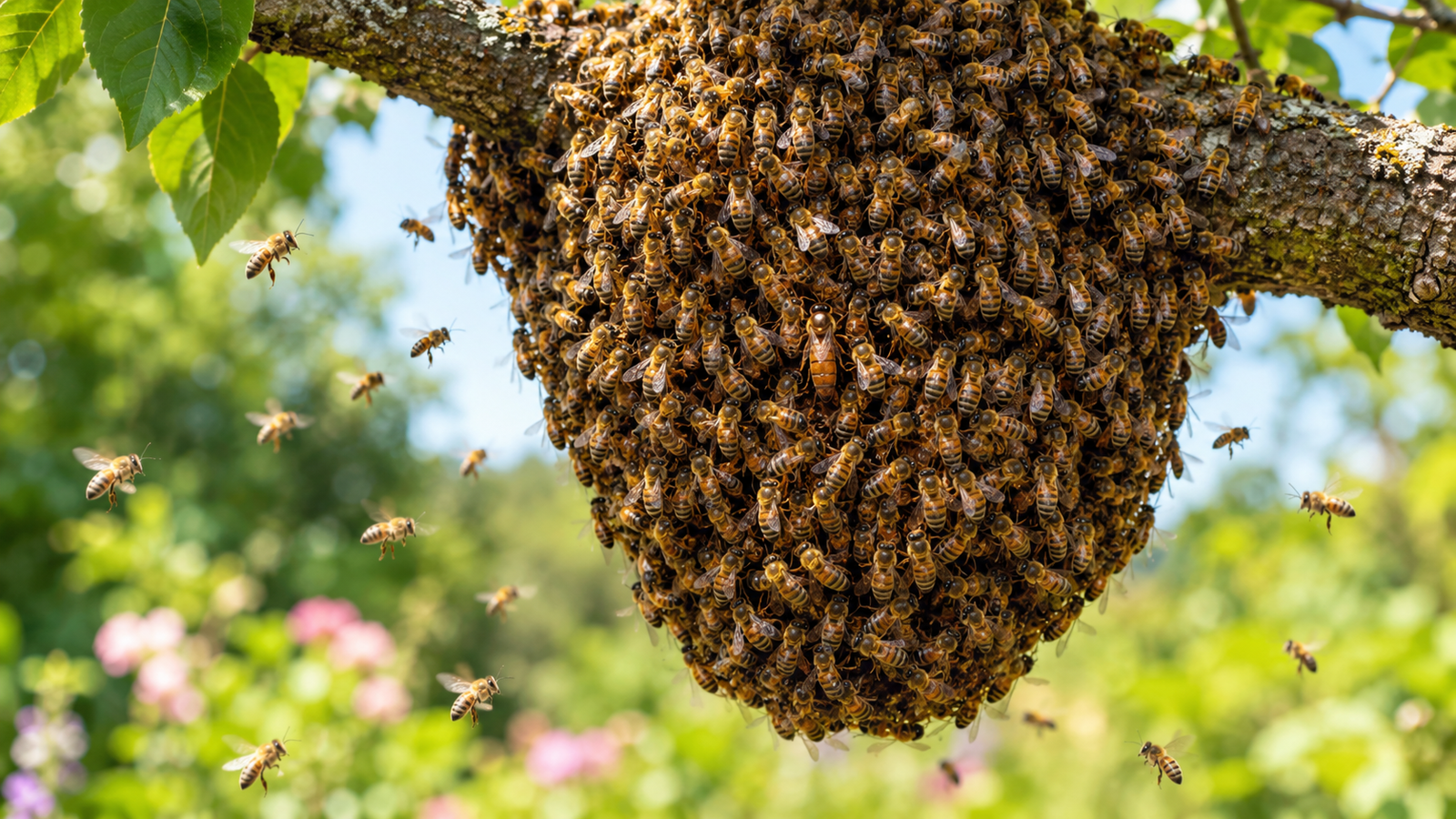
Bees swarm because honey bee colonies reproduce by dividing. When a colony becomes strong and conditions are suitable, a large group of worker bees leaves the original nest with the existing queen and searches for a new home. The bees that remain behind continue the original colony with a new queen.
Swarming is therefore more than bees simply looking for extra space. It is a natural form of colony-level reproduction that allows one honey bee colony to become two.
Rapid colony growth, crowding, seasonal conditions, food availability, and the condition of the colony can all contribute to the circumstances in which swarming occurs.
But what exactly causes bees to swarm, what happens before they leave, and where do they go?
What Is a Bee Swarm?
A bee swarm is a large group of honey bees that leaves an established colony as part of the colony’s natural reproductive process.
A typical primary swarm contains the old queen and a large number of worker bees. The bees may initially fly together before settling temporarily on a tree branch, fence, building, shrub, or another nearby structure.
While the swarm is temporarily clustered, scout bees search for a suitable permanent nesting location.
Once a suitable site is selected, the swarm leaves the temporary cluster and establishes a new colony.
A swarm is therefore different from an established bee nest. A swarm may only remain in one location temporarily, while a nest is where the colony eventually builds comb, raises brood, stores food, and lives.
Why Do Bees Swarm?
The main reason bees swarm is reproduction at the colony level.
An individual queen reproduces by laying eggs that develop into new bees. But the colony also needs a way to reproduce as a whole.
Swarming provides that mechanism.
Instead of one colony remaining as a single unit, it divides into two groups:
- One group leaves with the existing queen.
- The other group remains in the original nest.
- The remaining bees produce or raise a new queen.
- The swarm establishes a new colony elsewhere.
In this way, one established colony can give rise to another colony.
Is Lack of Space the Main Reason Bees Swarm?
Crowding and lack of space can contribute to swarming, particularly when a colony is growing rapidly.
However, it is too simplistic to say that bees swarm only because the hive is full.
Swarming is a complex biological behavior influenced by several factors, including:
- Rapid population growth
- Colony congestion
- Availability of nesting space
- Abundant food resources
- Seasonal conditions
- Queen condition
- Colony genetics and behavior
- The overall reproductive state of the colony
The deeper biological purpose is reproduction.
How Does a Honey Bee Colony Prepare to Swarm?
A swarm usually involves considerable preparation before the bees actually leave.
The colony must produce a new queen for the bees that remain behind while preparing the existing queen and a large group of workers to leave.
Several important changes can occur during this preparation period.
1. The Colony Population Increases
During favorable periods, a honey bee colony can grow rapidly.
More eggs are laid, more larvae develop, and increasing numbers of adult workers join the colony.
As the population grows, the colony becomes increasingly crowded.
At the same time, bees may be collecting large amounts of nectar and pollen and storing food inside the nest.
These conditions can contribute to swarm preparation.
2. Workers Prepare Queen Cells
Worker bees construct special structures called queen cells.
A queen develops inside a queen cell rather than an ordinary worker-brood cell.
When a colony is preparing to swarm, the existing queen lays eggs in these cells. The developing queens will eventually provide the colony with potential replacements for the old queen.
This is an important part of the swarm process because the original colony needs a queen after the old queen leaves.
3. The Existing Queen Stops Laying as Much
The old queen needs to be capable of flying with the swarm.
A queen that is actively laying large numbers of eggs can be heavier and less suited to flight.
As swarming approaches, her egg laying may decrease and her feeding can change.
This helps prepare the queen for the swarm flight.
What Happens When Bees Swarm?
The actual swarm can be one of the most dramatic events in the life of a honey bee colony.
When the colony is ready, the existing queen leaves the nest accompanied by a large group of worker bees.
The bees may pour out of the nest and fill the surrounding air.
They then move together toward a temporary location.
The swarm may settle on:
- A tree branch
- A fence
- A wall
- A shrub
- A roof
- A garden structure
- Another nearby object
The bees form a dense cluster around the queen.
This is usually not their permanent home.
Why Do Swarming Bees Cluster Together?
Swarming bees cluster around the queen to keep the group together while they wait for the next stage of the relocation process.
The queen is central to the colony, so keeping her protected and surrounded by workers is essential.
While the swarm is clustered, scout bees leave the group to investigate possible nesting sites.
The swarm may therefore appear to be doing nothing while an important decision is being made.
How Do Bees Find a New Home After Swarming?
Scout bees search the surrounding area for potential nesting sites.
They look for locations that can provide adequate protection and space for the new colony.
Potential nesting locations can include:
- Hollow trees
- Tree cavities
- Wall cavities
- Roof spaces
- Empty structures
- Other protected cavities
Scout bees inspect potential sites and return to the swarm.
They communicate information about promising locations through behavioral signals, including the famous waggle dance.
Through interactions among the scouts, the colony gradually reaches a collective decision about which site to use.
This remarkable process allows thousands of bees to coordinate their movement without a single bee directing the entire swarm.
Where Do Bees Go After They Swarm?
The swarm usually does not remain permanently at the first location where it clusters.
The initial cluster is often an interim stopping point.
Once the scout bees have identified a suitable nesting location, the swarm can suddenly take flight and move to the selected site.
There, the bees begin establishing their new colony.
They can build comb, establish brood-rearing areas, store food, and begin the process of developing a functioning nest.
What Happens to the Bees That Stay Behind?
The bees that remain in the original nest do not simply disappear.
They continue the colony’s life cycle.
The new queen that develops from the queen cells can emerge and become the colony’s queen.
Once she is established and successfully mates, she can begin laying eggs and rebuilding the colony’s population.
This means the original colony can continue functioning after the old queen and a large group of workers have departed.
The result is essentially:
One colony → swarm leaves → new colony + original colony continues
That is why swarming is considered reproduction at the colony level.
What Is a Primary Swarm?
The first major swarm leaving a colony is commonly called a primary swarm or prime swarm.
It generally contains the old queen and a substantial number of worker bees.
The primary swarm is often the largest swarm produced during the colony’s reproductive process.
After it leaves, the original colony remains behind and continues with a developing replacement queen.
Can Bees Swarm More Than Once?
Yes.
A colony can sometimes produce additional swarms after the primary swarm.
These later swarms are known as after-swarms or secondary swarms.
An after-swarm may leave with a newly emerged virgin queen and a smaller group of workers.
In some situations, more than one after-swarm can occur.
Repeated swarming can significantly reduce the population of the original colony.
What Are the Signs That Bees Are Preparing to Swarm?
Beekeepers may watch for several signs that a colony could be approaching a swarm.
Common indicators include:
Rapid Population Growth
A rapidly expanding population can increase congestion inside the nest and create conditions associated with swarming.
Numerous Queen Cells
The presence of developing queen cells can be an important indication that the colony is preparing to replace or reproduce its queen.
Reduced Space
A colony with brood, pollen, nectar, and honey occupying much of its available nesting area may have increased congestion.
Strong Brood Production
Large amounts of developing brood indicate that the colony is actively expanding.
Changes in the Queen’s Egg Laying
The queen’s laying pattern can change as the colony prepares for the swarm.
Reduced Space for Expansion
When bees have little room to expand brood-rearing and food-storage areas, the colony can become more likely to enter swarm preparation.
No single sign guarantees that a colony will swarm, so beekeepers generally consider several conditions together.
When Do Bees Swarm?
Swarming is strongly associated with periods when honey bee colonies are growing rapidly and environmental conditions are favorable.
In many temperate regions, swarming is particularly common during spring and early summer.
However, the exact timing depends on the local environment.
Factors include:
- Climate
- Temperature
- Flowering patterns
- Nectar availability
- Pollen availability
- Colony strength
- Local bee genetics
- Availability of nesting space
In warmer climates, including tropical and subtropical regions, swarm timing may differ from the classic spring swarm pattern seen in temperate areas.
Do Bees Swarm Because They Are Looking for Food?
Not primarily.
Individual worker bees leave the colony every day to collect nectar, pollen, water, and other resources.
That is normal foraging behavior.
Swarming is different.
During a swarm, a large group of bees leaves the colony together with the queen and searches for a new nesting location.
Therefore:
Foraging = individual workers collecting resources.
Swarming = part of the colony relocating as part of reproduction.
Do Bees Swarm Because They Are Angry?
No.
Swarming is not an expression of anger.
A swarm is primarily engaged in relocation and colony reproduction.
However, this does not mean that a swarm cannot sting.
Bees can sting when they are threatened, handled, trapped, crushed, or otherwise disturbed.
It is therefore best to observe a swarm from a safe distance rather than attempting to touch or move it.
Are Swarming Bees Dangerous?
A large cluster of bees can look frightening, but swarming bees are generally focused on staying together and finding a new nesting site rather than defending an established nest.
This can make a swarm less defensive than a colony protecting its established nest.
Nevertheless, bees can still sting.
People should be particularly careful if:
- Someone nearby has a serious bee-sting allergy.
- The swarm is close to a doorway.
- Children or pets can easily disturb it.
- The bees have entered a building.
- The colony appears to have established itself inside a structure.
Do not throw objects at a swarm, spray it with chemicals, or attempt to handle the bees.
If removal is necessary, contacting an experienced beekeeper or qualified bee-removal professional is a safer approach.
How Long Does a Bee Swarm Stay in One Place?
A temporary swarm cluster may remain in one location for several hours or longer.
The exact amount of time varies according to the circumstances and how quickly the scout bees find an acceptable nesting site.
Once the swarm reaches a collective decision, the bees can suddenly leave the temporary cluster and move to their selected home.
This is why a large swarm hanging from a tree can sometimes disappear without human intervention.
How Many Bees Are in a Swarm?
The number of bees in a swarm varies depending on the size and condition of the original colony.
A swarm can contain thousands of worker bees, and a large primary swarm can contain a substantial portion of the colony’s adult population.
The exact number is affected by factors such as:
- Colony strength
- Population size
- Queen condition
- Season
- Type of swarm
- Colony genetics
- Local environmental conditions
Because of this variation, there is no single number that describes every bee swarm.
Is a Bee Swarm the Same as a Bee Hive?
No.
A swarm is a temporary group of bees that has left an established colony and is searching for a new home.
A hive or nest is an established living location where bees carry out their normal colony activities.
Once a swarm reaches its new location, it can begin constructing comb and establishing a permanent colony.
So a swarm hanging from a branch does not necessarily mean that the bees have built their permanent nest there.
What Is the Difference Between a Swarm and a Bee Nest?
The main difference is that a swarm is generally temporary, while a nest is an established home.
Bee swarm
- Large group of bees
- Often contains the old queen
- Usually temporary
- Searching for a new home
- May cluster on an exposed object
Established bee colony
- Has a permanent nesting location
- Builds and maintains comb
- Raises brood
- Stores food
- Has an established queen
- Defends its nesting site
Understanding this difference can help explain why bees hanging from a tree branch may leave on their own.
Why Is Swarming Important to Honey Bees?
Swarming is an important natural reproductive strategy.
It allows a successful colony to produce another colony without waiting for a completely new population of bees to develop from eggs.
A strong colony can divide its existing population:
Original colony → divides → new swarm + remaining colony
Each group can then continue developing as a separate colony.
This allows honey bee populations to expand and occupy new nesting locations.
Can Swarming Help Honey Bee Populations Grow?
Yes.
When a swarm successfully establishes a new nest and survives, it creates another colony capable of producing more bees.
Over time, repeated colony reproduction can contribute to the expansion of honey bee populations.
However, successful colony establishment depends on many factors, including:
- Availability of food
- Suitable nesting habitat
- Weather
- Predators
- Parasites
- Diseases
- Queen health
- Colony strength
A swarm does not automatically become a successful colony simply because it finds a nesting site.
What Should You Do If You Find a Bee Swarm?
If you find a large cluster of honey bees, avoid disturbing it.
Keep your distance
Give the bees enough space to remain undisturbed.
Keep children and pets away
Children and animals may accidentally disturb the swarm.
Do not spray the bees
Spraying chemicals can injure or kill bees and may cause them to become defensive.
Do not hit or shake the cluster
Disturbing the bees can cause them to take flight and may increase the risk of stings.
Contact a beekeeper if removal is necessary
A local beekeeper may be able to safely collect the swarm and give it an appropriate home.
If bees have established a colony inside a wall, roof, chimney, or another building cavity, professional removal may be necessary.
Frequently Asked Questions About Why Bees Swarm
Why do bees swarm?
Bees swarm primarily as a natural form of colony reproduction. A large group of bees leaves the original colony with the existing queen and establishes a new colony elsewhere while the remaining bees continue with a new queen.
What causes bees to swarm?
Swarming is influenced by several factors, including rapid colony growth, congestion, seasonal conditions, food availability, queen condition, and the colony’s reproductive state.
Do bees swarm because the hive is full?
Crowding and limited space can contribute to swarm preparation, but swarming is not simply caused by a hive being full. Its deeper biological purpose is colony reproduction.
Do bees swarm with the queen?
Yes. A primary swarm normally leaves with the existing queen and a large group of worker bees.
What happens to the queen after bees swarm?
The existing queen leaves with the primary swarm. A new queen develops in the original colony from queen cells that were prepared before the swarm.
What happens to the bees left in the hive?
The remaining bees continue maintaining the colony and eventually have a new queen. Once established and mated, the new queen can begin laying eggs.
How do bees choose where to live after swarming?
Scout bees investigate potential nesting sites and communicate information about suitable locations to the swarm. The group eventually reaches a collective decision and moves to the selected site.
How long does a bee swarm stay on a tree?
A swarm may remain temporarily clustered for several hours or longer, depending on how quickly the scout bees locate and select a suitable nesting site.
Are swarming bees dangerous?
Swarming bees are generally focused on relocation rather than defending an established nest, but they can still sting if disturbed. It is safest to observe them from a distance.
Do bees swarm every year?
Not every colony swarms every year. Swarming depends on colony condition, population growth, environmental conditions, resources, genetics, and other factors.
Can a bee colony swarm more than once?
Yes. After a primary swarm, a colony can sometimes produce additional swarms called after-swarms.
Do bees swarm because they are looking for food?
No. Swarming is primarily a reproductive and relocation behavior. Individual worker bees forage for food, while a swarm moves together with a queen to establish a new colony.
Do bees swarm because they are angry?
No. Swarming is not caused by anger. It is a natural part of the honey bee colony’s reproductive cycle.
Final Answer: Why Do Bees Swarm?
Bees swarm because honey bee colonies reproduce by dividing.
When a colony grows strong and conditions become suitable for reproduction, the existing queen leaves with a large group of worker bees. The swarm temporarily clusters while scout bees search for a suitable nesting location.
Meanwhile, the bees remaining in the original nest raise a new queen.
Eventually, the swarm moves into its selected home and begins establishing another colony.
Therefore, while crowding and lack of space can contribute to the conditions that lead to swarming, the deeper reason bees swarm is colony-level reproduction.
One colony becomes two, allowing honey bees to establish new colonies and expand into new nesting locations.
That makes swarming one of the most important and fascinating natural behaviors in the life of a honey bee colony.
