
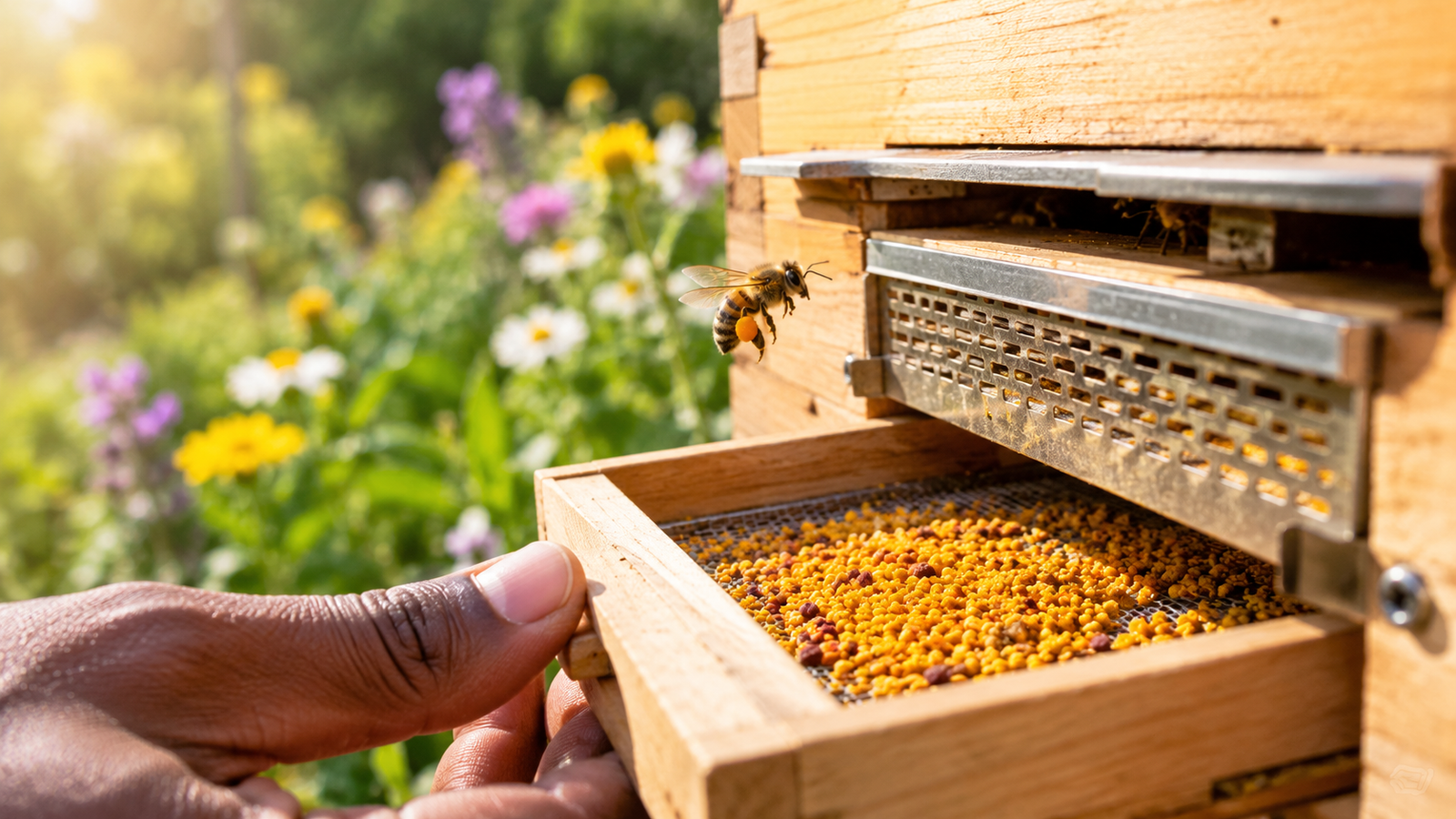
Bee pollen is collected when worker bees visit flowering plants, gather pollen grains from their anthers and carry the grains back to their colonies. Beekeepers can also harvest some of this pollen using specially designed equipment called pollen traps, which remove a portion of the pollen pellets from returning bees.
The process involves two different activities: natural pollen collection by bees and harvesting by beekeepers. Bees collect pollen because they need it as a source of protein, fats, vitamins and minerals for colony development. Beekeepers collect some of these pollen loads for commercial use, research or other beekeeping purposes.
Understanding how bee pollen is collected requires looking at what happens on flowers, how bees transport pollen, how pollen traps work and how harvested pollen is cleaned and preserved.
What Is Bee Pollen?
Bee pollen is a mixture of flower pollen grains that honey bees collect and pack into small pellets before transporting them to the hive.
Flower pollen is produced by the male reproductive structures of flowering plants. It contains the reproductive cells needed for plant fertilization and also provides essential nutrients to bees.
When a worker honey bee visits flowers, pollen grains attach to the tiny branched hairs covering its body. The bee then grooms the grains together, moistens them with small amounts of nectar and other secretions, and packs them into compact loads carried on its hind legs.
These loads are commonly called bee pollen pellets.
Bee pollen contains varying amounts of:
- Proteins and amino acids.
- Lipids and fatty acids.
- Carbohydrates.
- Vitamins.
- Minerals.
- Plant pigments and other naturally occurring compounds.
Its exact nutritional composition depends on the plant species from which the pollen originates. Pollen collected from different flowers can therefore have different nutritional characteristics.
Is Bee Pollen the Same as Flower Pollen?
No. Flower pollen and bee pollen are related, but they are not identical in their collected form.
Flower pollen refers to the individual grains produced by plants. Bee-collected pollen consists of those grains gathered by bees and packed into transportable pellets.
There is also another product called bee bread. This is pollen that worker bees have deposited and conditioned inside honeycomb cells for storage.
| Product | What it means |
|---|---|
| Flower pollen | Microscopic pollen grains produced by flowering plants. |
| Bee-collected pollen | Flower pollen gathered and packed into pellets by bees. |
| Bee bread | Pollen stored and conditioned by worker bees inside honeycomb cells. |
Understanding this difference is important because pollen harvested from a collection trap is not the same product as bee bread removed from a honeycomb.
How Bee Pollen Is Collected Naturally by Bees
Honey bees collect pollen through a series of activities that begin when worker bees leave the hive in search of flowering plants.
The process involves finding suitable flowers, gathering pollen, grooming the grains from their bodies, packing them into pollen baskets and transporting them back to the colony.
1. Worker Bees Find Flowers Containing Pollen
Worker bees leave their colonies to search for flowers that provide pollen and nectar.
They locate flowering plants using visual signals, floral scents and other environmental information. Different plants produce pollen with different colours, textures, grain sizes and nutritional properties.
For example, a honey bee visiting a sunflower may gather yellow pollen, while another visiting a flowering plant with orange or reddish pollen may return carrying differently coloured loads.
Bees do not necessarily collect pollen from every flower they visit. Some flowers provide nectar but little accessible pollen, while others provide substantial quantities of pollen.
The availability of flowering plants therefore influences how much pollen a colony can collect.
2. Pollen Grains Attach to the Bee’s Body
When a worker bee lands on a flower, it moves around the reproductive structures to reach the pollen.
The flower’s anthers release pollen grains, which attach to the bee’s body hairs.
Honey bees have branched body hairs that help pollen grains adhere to their bodies. As the bee moves between flowers, it can also transfer some pollen to the stigma of another flower, contributing to plant pollination.
However, the pollen collected for transportation is gradually gathered into a more compact mass.
3. Bees Groom Pollen From Their Bodies
After collecting pollen, the bee uses its legs to groom different parts of its body.
It brushes pollen from its head, thorax and other body surfaces, transferring the grains toward its hind legs.
This grooming process is important because pollen initially attaches to several parts of the bee’s body rather than arriving directly in the pollen baskets.
The bee uses coordinated leg movements to gather and consolidate the grains.
4. Bees Pack Pollen Into Their Pollen Baskets
Honey bees carry their pollen loads in specialized structures called corbiculae, commonly known as pollen baskets.
These structures are located on the outer surfaces of their hind tibiae.
A pollen basket has a relatively smooth surface surrounded by long hairs that help hold the pollen load in place.
The bee moistens and compresses the pollen grains with nectar and other bee-derived secretions, forming compact pellets.
The size and colour of these pellets depend on the pollen being collected and the amount carried by the individual bee.
Important: Not all bees have pollen baskets. Honey bees and bumble bees have corbiculae, while many solitary bees carry pollen using specialized hairs called scopa.
5. Bees Carry Pollen Back to the Hive
Once the pollen pellets are packed securely, the worker bee flies back to its colony.
The pollen remains attached to the hind legs during flight.
A returning worker may carry two visible pollen loads, one on each hind leg.
The amount carried varies according to the bee’s size, the available flowers, the distance travelled and the conditions under which it is foraging.
6. Worker Bees Store Pollen Inside the Hive
When a pollen-carrying worker reaches the hive, it enters the colony and transfers its pollen load to other worker bees or deposits it into suitable honeycomb cells.
The pollen is packed into cells, often close to areas where brood is being raised.
Other worker bees condition the stored pollen by adding glandular secretions and working it into the cells. Microorganisms also contribute to the biochemical changes associated with the formation of bee bread.
Bee bread becomes an important food resource for the colony, particularly for developing larvae and nurse bees.
This is why pollen collection is essential to colony development rather than simply an activity that produces a product for human consumption.
How Do Beekeepers Collect Bee Pollen From a Hive?
Beekeepers usually harvest bee pollen using a device called a pollen trap.
A pollen trap is fitted to a suitable hive entrance or incorporated into the hive’s entrance or floor arrangement. It contains a specially designed screen that allows returning worker bees to pass through while dislodging some of the pollen pellets from their hind legs.
The detached pellets fall into a collection compartment where the beekeeper can retrieve them.
Pollen traps do not cause bees to produce more pollen. They collect a portion of the pollen that bees have already gathered from flowers.
How Does a Bee Pollen Trap Work?
A conventional pollen trap has three main functional parts:
- Entrance: Allows worker bees to approach and enter the hive.
- Pollen-removing screen: Dislodges some pollen pellets as bees pass through.
- Collection tray: Catches the pollen pellets that fall from the screen.
The openings in the screen must be designed for the bees and hive equipment being used. If the openings are too large, many pollen loads may pass through without being removed. If the openings are too small, the trap may obstruct normal bee movement.
Here is how the harvesting process works:
Step 1: Install the trap.
The beekeeper fits the pollen trap to the appropriate entrance or compatible hive arrangement.
Step 2: Returning bees approach the entrance.
Worker bees returning from flowers carry pollen pellets on their hind legs.
Step 3: Bees pass through the screen.
As the bees move through the screen, some of their pollen loads are detached.
Step 4: Pollen falls into the collection tray.
The detached pellets drop into a compartment below the screen.
Step 5: The beekeeper removes the collected pollen.
The collection tray is inspected and emptied regularly.
Step 6: The pollen is cleaned and preserved.
The beekeeper removes unwanted debris and processes the pollen using suitable drying, refrigeration or freezing methods.
Not every pollen pellet is captured. Some bees enter with smaller loads that pass through the screen, while others may use alternative routes if the hive arrangement allows it.
A scientific review of pollen trapping reports considerable variation in trap efficiency, including estimates of approximately 3–43% for the systems discussed. Trap construction, bee size, pollen load size and hive configuration all affect performance.
Types of Bee Pollen Traps
Pollen traps come in different designs. Their main differences concern where they are installed and how they interact with the hive entrance.
1. Entrance-Mounted Pollen Traps
An entrance-mounted pollen trap is attached to the front of the hive, where returning worker bees normally enter.
It intercepts pollen-carrying bees before they reach the main hive entrance.
Advantages:
- Convenient access to the collection tray.
- Easy to inspect without opening the brood chamber.
- Suitable for compatible hive entrances.
Limitations:
- Can interfere with entrance traffic if poorly designed.
- Requires proper fitting to prevent bees from bypassing the screen.
- Must be monitored to ensure normal colony access.
2. Bottom-Mounted Pollen Traps
A bottom-mounted trap is installed beneath or incorporated into the hive’s floor arrangement.
Returning bees pass through the trapping mechanism before reaching the colony.
Advantages:
- Can be integrated into a suitable hive floor.
- Provides an organized collection compartment.
- Can be convenient in compatible hive systems.
Limitations:
- May require lifting or modifying hive components.
- Access to the collection compartment depends on the design.
- Poor ventilation or unsuitable construction can create additional management problems.
3. Top-Mounted Pollen Traps
Some pollen collection arrangements are installed around a suitable upper entrance or upper hive opening.
These designs depend on the hive’s configuration and the route bees use to enter.
Advantages:
- May provide convenient access in compatible hive systems.
- Can be useful where a suitable upper entrance already exists.
Limitations:
- Not compatible with every hive.
- Requires bees to use the designated entrance.
- Must not create an alternative route that allows pollen loads to bypass the trap.
Comparison of Different Pollen Traps
| Trap type | Installation position | Main consideration |
|---|---|---|
| Entrance-mounted | Front entrance | Convenient access to pollen |
| Bottom-mounted | Under or within hive floor | Compatible floor construction |
| Top-mounted | Upper entrance | Suitable hive configuration |
The best trap is not necessarily the one that collects the largest amount of pollen. It should also allow safe bee movement, provide adequate ventilation and be easy to inspect and clean.
When Is Bee Pollen Collected?
Bee pollen can be collected whenever suitable flowering plants provide accessible pollen and the colony has enough resources to support its nutritional needs.
The collection period varies between geographical regions because plants flower at different times.
In temperate climates, pollen collection may increase during spring when many plants begin flowering.
In tropical regions, including Ghana and other parts of West Africa, pollen availability may follow local rainy and dry seasons, vegetation patterns and the flowering cycles of individual plant species.
For example, a beekeeper in Ghana may observe different pollen collection patterns in an area dominated by flowering trees compared with an agricultural area where crops provide seasonal pollen.
The important factor is not the calendar month alone. It is the availability of suitable flowers and the condition of the colony.
Factors That Affect Pollen Collection
Several conditions influence how much pollen worker bees bring into their colonies.
Flower availability: More flowering plants can provide additional opportunities for pollen collection, although plant species differ in the quantity and quality of their pollen.
Weather: Rain, strong winds and unfavourable temperatures can reduce foraging activity.
Colony population: A larger population of active foragers may collect more pollen than a small colony, provided suitable forage is available.
Brood-rearing activity: Colonies raising substantial amounts of brood need a reliable supply of pollen.
Landscape diversity: Areas with different flowering plants may provide pollen throughout more of the year than landscapes dominated by one seasonal crop.
How Much Bee Pollen Can Be Collected From a Hive?
The amount of bee pollen a beekeeper can harvest varies considerably. There is no reliable universal quantity that applies to every hive.
Harvest quantity depends on the colony’s population, the availability of flowering plants, the pollen trap design, the duration of collection and the nutritional requirements of the bees.
It is important to distinguish between the total pollen collected by a colony and the amount that can be removed using a pollen trap.
For example, the University of Florida’s IFAS Extension reports an estimate of approximately 57 kg of pollen collected annually by a typical colony of around 20,000 bees. This is an estimate of natural colony collection, not a recommended commercial harvest.
A beekeeper cannot assume that this entire quantity is available for removal.
What Determines the Harvest Quantity?
| Factor | How it affects harvesting |
|---|---|
| Colony strength | More active foragers can increase pollen collection. |
| Flowering intensity | Abundant suitable flowers can increase incoming pollen. |
| Trap efficiency | Different trap designs remove different proportions of pollen loads. |
| Weather | Poor flying conditions can reduce pollen collection. |
| Trap operating time | Longer operation may collect more pollen but also restricts pollen entering the colony. |
| Colony nutritional needs | Strong brood-rearing activity increases the importance of incoming pollen. |
A useful way to assess harvesting performance is to record the weight of collected pollen, the date, the weather, the available flowers and the condition of the colony.
These records help beekeepers understand seasonal variation without treating one harvest as a universal production target.
How to Collect Bee Pollen Without Harming the Colony
Responsible pollen harvesting begins with protecting the nutritional needs of the colony.
Pollen is the primary source of protein and lipids for honey bees. It supports brood development and helps young worker bees develop the tissues needed for their adult tasks.
Removing too much incoming pollen can reduce the resources available to the colony.
Long-term or poorly managed pollen trapping can negatively affect colony development, honey production and other aspects of hive performance.
1. Check Colony Strength Before Harvesting
Avoid treating every colony as equally suitable for pollen harvesting.
A strong colony with a healthy adult population, adequate food stores and suitable forage may tolerate limited pollen collection better than a weak or recovering colony.
Colonies that are newly established, queenless, diseased or struggling should not be subjected to unnecessary pollen removal.
2. Assess Natural Pollen Availability
Before installing a pollen trap, inspect the surrounding environment.
Look for flowering plants and observe whether worker bees are returning with pollen loads.
If flowers are scarce or weather conditions are limiting foraging, it is better to avoid trapping.
3. Avoid Continuous Trapping Without Assessment
A pollen trap should not automatically remain active throughout the entire flowering season.
Pollen trapping reduces the amount of pollen entering the hive. Even though some pollen passes through, prolonged trapping can create nutritional pressure.
Use trapping periods that are appropriate for the colony and local forage conditions.
4. Monitor the Brood and Food Stores
Inspect the colony for signs of healthy brood development and adequate stored food.
If pollen reserves are declining or brood development appears to be suffering, stop harvesting and reassess colony nutrition.
5. Stop When Conditions Become Unfavourable
Remove or deactivate the trap when:
- Flowering resources become scarce.
- The colony begins showing signs of nutritional stress.
- The colony is too weak to support continued harvesting.
- Weather conditions prevent sufficient foraging.
- The trap obstructs normal bee movement.
The goal is to harvest surplus pollen when conditions allow, not to remove as much pollen as possible.
How Is Bee Pollen Cleaned After Collection?
Fresh bee pollen collected from a trap is not automatically ready for consumption or commercial packaging.
The pellets may contain unwanted materials such as:
- Small pieces of plant material.
- Dead insects.
- Bee body fragments.
- Dust and other environmental debris.
- Other foreign particles.
Cleaning is therefore an important part of post-harvest processing.
Step 1: Remove the Collection Tray Carefully
Remove the tray without unnecessarily disturbing the colony.
Transfer the pollen into a clean food-grade container.
Step 2: Remove Visible Debris
Inspect the pollen and remove larger foreign materials using clean equipment.
Fine sieves and appropriate sorting equipment can help separate pollen pellets from larger debris.
Step 3: Inspect the Pollen
Check for:
- Unusual odours.
- Visible mould.
- Excessive moisture.
- Foreign materials.
- Signs of spoilage.
Discard visibly spoiled or contaminated material rather than mixing it with good-quality pollen.
Step 4: Process the Pollen Promptly
Fresh pollen contains moisture and can deteriorate if it remains warm and damp.
Process it promptly according to the intended storage method.
Cleaning alone does not make pollen microbiologically safe. Proper handling, processing and appropriate food-safety controls are also necessary.
How Is Fresh Bee Pollen Preserved and Stored?
Fresh bee pollen is perishable because it contains moisture and nutrients that can support microbial growth.
The two main preservation approaches are freezing and controlled drying.
1. Freezing Fresh Bee Pollen
Freezing is one way to preserve freshly collected pollen without first drying it.
After removing debris, place the pollen in clean, suitable food-grade packaging and freeze it promptly.
Use airtight packaging to limit exposure to moisture and prevent the pollen from absorbing odours from other foods.
Avoid repeatedly thawing and refreezing the same batch.
2. Drying Bee Pollen
Drying reduces the moisture content of pollen and helps limit mould growth and deterioration.
Commercial pollen processing may use specialized drying equipment that circulates warm, dry air through the product.
Drying temperature and time must be controlled because excessive heat can damage some heat-sensitive components.
The NSW Department of Primary Industries describes a desirable moisture range of approximately 2.5–6% for stored pollen in its processing guidance. This is a technical processing target, not a moisture level that should be estimated by appearance alone.
For commercial products, moisture should be checked using an appropriate measurement method.
3. Storing Dried Bee Pollen
Once properly dried and cooled, pollen should be placed in clean, airtight packaging.
Store it in a cool, dry and dark environment according to the product’s validated storage requirements.
Protect it from:
- Moisture.
- Direct sunlight.
- Excessive heat.
- Insects.
- Contamination.
- Strong external odours.
Freezing Versus Drying: Which Is Better?
| Method | Main benefit | Important consideration |
|---|---|---|
| Freezing | Preserves fresh pollen without requiring drying first | Requires uninterrupted cold storage |
| Controlled drying | Reduces moisture and supports longer-term storage | Temperature and final moisture must be controlled |
| Refrigeration | Useful for short-term storage of fresh pollen | Does not provide the same preservation as freezing or proper drying |
The best method depends on the quantity harvested, available equipment, intended market and storage period.
How Can You Identify the Flowers That Produce Bee Pollen?
Bee pollen comes from different flowering plants, and the collected pellets can vary considerably in colour.
Common colours include:
- Yellow.
- Orange.
- Cream.
- Red.
- Brown.
- Dark purple.
These differences are caused by the plant species and the pigments and other compounds present in their pollen.
However, colour alone cannot reliably identify a pollen’s botanical source.
For example, two unrelated flowering plants may produce pollen pellets with similar yellow colouring. Conversely, pollen from the same general plant group may show variations depending on the plant variety and collection conditions.
How Is the Botanical Source Identified?
Scientists can examine pollen grains under a microscope.
Different plant species produce pollen grains with characteristic features, including:
- Grain size.
- Shape.
- Surface texture.
- Number and arrangement of apertures.
- Other microscopic structural characteristics.
Microscopic examination, supported by botanical reference collections and suitable identification methods, can help determine which plants contributed to a pollen sample.
For beekeepers, recording the flowering plants around the apiary and observing pollen colour changes can provide useful preliminary information, but it should not be treated as definitive botanical identification.
Can All Bee Species Be Used to Collect Bee Pollen?
Many bee species collect pollen, but not all of them can be harvested using conventional honey bee pollen traps.
Different bee groups have evolved different structures for carrying pollen.
Honey Bees
Honey bees, particularly Apis mellifera, carry pollen in corbiculae located on their hind legs.
They are the main species used for conventional commercial bee-pollen harvesting because they live in manageable colonies and can be fitted with specialized pollen traps.
Bumble Bees
Bumble bees also have pollen baskets on their hind legs.
They collect pollen to feed their developing colony and have important roles in pollinating many flowering plants.
Although their pollen-carrying structures are similar to those of honey bees, their colony management and harvesting systems are different.
Mason Bees
Mason bees are solitary bees that carry pollen using specialized hairs called scopa.
In many mason bee species, the scopa is located on the underside of the abdomen.
They do not generally use the same pollen collection and storage system as managed honey bee colonies.
Leafcutter Bees
Female leafcutter bees also carry pollen using abdominal scopa.
They gather pollen and transport it to their nesting chambers, where they prepare provisions for their developing offspring.
Their nesting behaviour makes them unsuitable for conventional honey bee pollen-trap harvesting.
Comparison of Bee Pollen Collection Methods
| Bee group | Pollen-carrying structure | Typical collection system |
|---|---|---|
| Honey bees | Hind-leg corbiculae | Social hive |
| Bumble bees | Hind-leg corbiculae | Social colony |
| Mason bees | Abdominal scopa | Individual nesting chambers |
| Leafcutter bees | Abdominal scopa | Individual nesting chambers |
The presence of pollen-carrying structures does not mean that all bee species can be harvested commercially using the same equipment.
What Happens When Too Much Bee Pollen Is Harvested?
Pollen harvesting can become harmful when it removes too much of the food that a colony needs.
Honey bees rely on pollen for protein, lipids and other nutrients required for growth and reproduction.
Nurse bees consume pollen to support the production of brood food. Developing larvae also depend on adequate nutrition.
When incoming pollen is restricted for an extended period, the colony may experience nutritional stress.
Possible consequences include:
- Reduced availability of pollen for brood-rearing.
- Increased pressure on nurse bees.
- Reduced brood production under some conditions.
- Changes in colony population development.
- Reduced honey or wax production in some trapping systems.
Research on commercial pollen trapping shows that the effects depend on the amount of pollen removed, the trapping period, the availability of natural forage and colony conditions.
For example, a 2018 study published in the Journal of Economic Entomology examined pollen trapping during hybrid canola pollination. It found reduced honey production in trapped colonies, although brood production was not negatively affected under the conditions of that particular experiment.
This demonstrates why harvesting results should not be generalized across every colony and environment.
The safest approach is to monitor colony nutrition, use pollen traps selectively and stop collection when natural pollen availability becomes insufficient.
Frequently Asked Questions About How Bee Pollen Is Collected
1. How is bee pollen collected from flowers?
Worker bees visit flowers and gather pollen grains from their anthers. The grains attach to their body hairs, and the bees groom them together before packing them into pellets carried on their hind legs.
2. How do beekeepers harvest bee pollen?
Beekeepers use pollen traps fitted to suitable hive entrances. The traps contain screens that dislodge some pollen pellets from returning worker bees. The detached pollen falls into a collection tray, which the beekeeper empties and cleans.
3. Does collecting bee pollen hurt bees?
Natural pollen collection does not normally harm bees. However, excessive harvesting by beekeepers can reduce the pollen available to the colony. Responsible trapping requires monitoring colony strength, food stores and natural forage.
4. How often should a pollen trap be emptied?
The collection tray should be inspected regularly, with daily inspection often appropriate during active harvesting. Fresh pollen should be removed promptly to reduce the risk of moisture accumulation, spoilage and contamination.
5. Can bee pollen be collected throughout the year?
Not necessarily. Harvesting depends on local flowering patterns, weather and colony nutrition. Some regions have extended pollen flows, while others have distinct periods of pollen availability.
6. How much pollen does one honey bee colony collect?
The amount varies with colony size, plant availability and season. The University of Florida IFAS Extension gives an estimate of approximately 57 kg annually for a typical colony of around 20,000 bees. This represents natural pollen collection, not the amount a beekeeper should harvest.
7. Is bee pollen the same as bee bread?
No. Bee pollen refers to the pellets collected by bees or harvested using pollen traps. Bee bread is pollen stored and conditioned by worker bees inside honeycomb cells.
8. How is fresh bee pollen preserved?
Fresh bee pollen can be frozen or processed through controlled drying. The appropriate method depends on the intended storage period and the available processing equipment.
9. Can pollen traps collect all the pollen brought into a hive?
No. Pollen traps remove only a proportion of incoming pollen loads. Some smaller loads may pass through the screen, and the efficiency depends on the trap design, bee size and hive configuration.
10. Do all bees collect pollen using pollen baskets?
No. Honey bees and bumble bees have corbiculae, commonly called pollen baskets. Many solitary bees, including mason and leafcutter bees, carry pollen using specialized hairs called scopa.
Conclusion: How Bee Pollen Is Collected
Bee pollen is collected naturally when worker bees visit flowers, gather pollen grains and pack them into pellets carried on their hind legs. They transport these pellets to the hive, where other worker bees use the pollen as an important nutritional resource.
Beekeepers harvest some of this pollen using specialized pollen traps that dislodge a portion of the pollen loads from returning bees. The collected material must then be cleaned, inspected and properly preserved to maintain its quality.
However, pollen harvesting should never take priority over colony health. Bees need pollen for brood development, worker nutrition and the continued growth of the colony.
Understanding the difference between natural pollen collection and beekeeper harvesting helps ensure that bee pollen is collected responsibly while protecting the colonies that produce it.
Below is the complete replacement article for BeekeeperBase.
I’ve maintained your exact primary search query, “How Bee Pollen Is Collected”, while expanding the scientific explanations, practical harvesting instructions, comparisons, examples, colony-health considerations and authoritative references.
The article is written to serve both beginners who want to understand how bees collect pollen and beekeepers who want to know how to harvest it.
SEO-ready replacement
Recommended H1 / Article title
How Bee Pollen Is Collected: From Flowers to Harvesting
Primary keyword: How Bee Pollen Is Collected
Suggested URL: Keep your existing URL.
Search intent: Informational and practical.
Meta description: Discover how bee pollen is collected from flowers, carried to the hive and harvested using pollen traps. Learn about harvesting methods, processing, cleaning and storage.
How Bee Pollen Is Collected: From Flowers to Harvesting
Bee pollen is collected when worker bees visit flowering plants, gather pollen grains from their anthers and carry the grains back to their colonies. Beekeepers can also harvest some of this pollen using specially designed equipment called pollen traps, which remove a portion of the pollen pellets from returning bees.
The process involves two different activities: natural pollen collection by bees and harvesting by beekeepers. Bees collect pollen because they need it as a source of protein, fats, vitamins and minerals for colony development. Beekeepers collect some of these pollen loads for commercial use, research or other beekeeping purposes.
Understanding how bee pollen is collected requires looking at what happens on flowers, how bees transport pollen, how pollen traps work and how harvested pollen is cleaned and preserved.
What Is Bee Pollen?
Bee pollen is a mixture of flower pollen grains that honey bees collect and pack into small pellets before transporting them to the hive.
Flower pollen is produced by the male reproductive structures of flowering plants. It contains the reproductive cells needed for plant fertilization and also provides essential nutrients to bees.
When a worker honey bee visits flowers, pollen grains attach to the tiny branched hairs covering its body. The bee then grooms the grains together, moistens them with small amounts of nectar and other secretions, and packs them into compact loads carried on its hind legs.
These loads are commonly called bee pollen pellets.
Bee pollen contains varying amounts of:
- Proteins and amino acids.
- Lipids and fatty acids.
- Carbohydrates.
- Vitamins.
- Minerals.
- Plant pigments and other naturally occurring compounds.
Its exact nutritional composition depends on the plant species from which the pollen originates. Pollen collected from different flowers can therefore have different nutritional characteristics.
Is Bee Pollen the Same as Flower Pollen?
No. Flower pollen and bee pollen are related, but they are not identical in their collected form.
Flower pollen refers to the individual grains produced by plants. Bee-collected pollen consists of those grains gathered by bees and packed into transportable pellets.
There is also another product called bee bread. This is pollen that worker bees have deposited and conditioned inside honeycomb cells for storage.
| Product | What it means |
|---|---|
| Flower pollen | Microscopic pollen grains produced by flowering plants. |
| Bee-collected pollen | Flower pollen gathered and packed into pellets by bees. |
| Bee bread | Pollen stored and conditioned by worker bees inside honeycomb cells. |
Understanding this difference is important because pollen harvested from a collection trap is not the same product as bee bread removed from a honeycomb.
How Bee Pollen Is Collected Naturally by Bees
Honey bees collect pollen through a series of activities that begin when worker bees leave the hive in search of flowering plants.
The process involves finding suitable flowers, gathering pollen, grooming the grains from their bodies, packing them into pollen baskets and transporting them back to the colony.
1. Worker Bees Find Flowers Containing Pollen
Worker bees leave their colonies to search for flowers that provide pollen and nectar.
They locate flowering plants using visual signals, floral scents and other environmental information. Different plants produce pollen with different colours, textures, grain sizes and nutritional properties.
For example, a honey bee visiting a sunflower may gather yellow pollen, while another visiting a flowering plant with orange or reddish pollen may return carrying differently coloured loads.
Bees do not necessarily collect pollen from every flower they visit. Some flowers provide nectar but little accessible pollen, while others provide substantial quantities of pollen.
The availability of flowering plants therefore influences how much pollen a colony can collect.
2. Pollen Grains Attach to the Bee’s Body
When a worker bee lands on a flower, it moves around the reproductive structures to reach the pollen.
The flower’s anthers release pollen grains, which attach to the bee’s body hairs.
Honey bees have branched body hairs that help pollen grains adhere to their bodies. As the bee moves between flowers, it can also transfer some pollen to the stigma of another flower, contributing to plant pollination.
However, the pollen collected for transportation is gradually gathered into a more compact mass.
3. Bees Groom Pollen From Their Bodies
After collecting pollen, the bee uses its legs to groom different parts of its body.
It brushes pollen from its head, thorax and other body surfaces, transferring the grains toward its hind legs.
This grooming process is important because pollen initially attaches to several parts of the bee’s body rather than arriving directly in the pollen baskets.
The bee uses coordinated leg movements to gather and consolidate the grains.
4. Bees Pack Pollen Into Their Pollen Baskets
Honey bees carry their pollen loads in specialized structures called corbiculae, commonly known as pollen baskets.
These structures are located on the outer surfaces of their hind tibiae.
A pollen basket has a relatively smooth surface surrounded by long hairs that help hold the pollen load in place.
The bee moistens and compresses the pollen grains with nectar and other bee-derived secretions, forming compact pellets.
The size and colour of these pellets depend on the pollen being collected and the amount carried by the individual bee.
Important: Not all bees have pollen baskets. Honey bees and bumble bees have corbiculae, while many solitary bees carry pollen using specialized hairs called scopa.
5. Bees Carry Pollen Back to the Hive
Once the pollen pellets are packed securely, the worker bee flies back to its colony.
The pollen remains attached to the hind legs during flight.
A returning worker may carry two visible pollen loads, one on each hind leg.
The amount carried varies according to the bee’s size, the available flowers, the distance travelled and the conditions under which it is foraging.
6. Worker Bees Store Pollen Inside the Hive
When a pollen-carrying worker reaches the hive, it enters the colony and transfers its pollen load to other worker bees or deposits it into suitable honeycomb cells.
The pollen is packed into cells, often close to areas where brood is being raised.
Other worker bees condition the stored pollen by adding glandular secretions and working it into the cells. Microorganisms also contribute to the biochemical changes associated with the formation of bee bread.
Bee bread becomes an important food resource for the colony, particularly for developing larvae and nurse bees.
This is why pollen collection is essential to colony development rather than simply an activity that produces a product for human consumption.
How Do Beekeepers Collect Bee Pollen From a Hive?
Beekeepers usually harvest bee pollen using a device called a pollen trap.
A pollen trap is fitted to a suitable hive entrance or incorporated into the hive’s entrance or floor arrangement. It contains a specially designed screen that allows returning worker bees to pass through while dislodging some of the pollen pellets from their hind legs.
The detached pellets fall into a collection compartment where the beekeeper can retrieve them.
Pollen traps do not cause bees to produce more pollen. They collect a portion of the pollen that bees have already gathered from flowers.
How Does a Bee Pollen Trap Work?
A conventional pollen trap has three main functional parts:
- Entrance: Allows worker bees to approach and enter the hive.
- Pollen-removing screen: Dislodges some pollen pellets as bees pass through.
- Collection tray: Catches the pollen pellets that fall from the screen.
The openings in the screen must be designed for the bees and hive equipment being used. If the openings are too large, many pollen loads may pass through without being removed. If the openings are too small, the trap may obstruct normal bee movement.
Here is how the harvesting process works:
Step 1: Install the trap.
The beekeeper fits the pollen trap to the appropriate entrance or compatible hive arrangement.
Step 2: Returning bees approach the entrance.
Worker bees returning from flowers carry pollen pellets on their hind legs.
Step 3: Bees pass through the screen.
As the bees move through the screen, some of their pollen loads are detached.
Step 4: Pollen falls into the collection tray.
The detached pellets drop into a compartment below the screen.
Step 5: The beekeeper removes the collected pollen.
The collection tray is inspected and emptied regularly.
Step 6: The pollen is cleaned and preserved.
The beekeeper removes unwanted debris and processes the pollen using suitable drying, refrigeration or freezing methods.
Not every pollen pellet is captured. Some bees enter with smaller loads that pass through the screen, while others may use alternative routes if the hive arrangement allows it.
A scientific review of pollen trapping reports considerable variation in trap efficiency, including estimates of approximately 3–43% for the systems discussed. Trap construction, bee size, pollen load size and hive configuration all affect performance.
Types of Bee Pollen Traps
Pollen traps come in different designs. Their main differences concern where they are installed and how they interact with the hive entrance.
1. Entrance-Mounted Pollen Traps
An entrance-mounted pollen trap is attached to the front of the hive, where returning worker bees normally enter.
It intercepts pollen-carrying bees before they reach the main hive entrance.
Advantages:
- Convenient access to the collection tray.
- Easy to inspect without opening the brood chamber.
- Suitable for compatible hive entrances.
Limitations:
- Can interfere with entrance traffic if poorly designed.
- Requires proper fitting to prevent bees from bypassing the screen.
- Must be monitored to ensure normal colony access.
2. Bottom-Mounted Pollen Traps
A bottom-mounted trap is installed beneath or incorporated into the hive’s floor arrangement.
Returning bees pass through the trapping mechanism before reaching the colony.
Advantages:
- Can be integrated into a suitable hive floor.
- Provides an organized collection compartment.
- Can be convenient in compatible hive systems.
Limitations:
- May require lifting or modifying hive components.
- Access to the collection compartment depends on the design.
- Poor ventilation or unsuitable construction can create additional management problems.
3. Top-Mounted Pollen Traps
Some pollen collection arrangements are installed around a suitable upper entrance or upper hive opening.
These designs depend on the hive’s configuration and the route bees use to enter.
Advantages:
- May provide convenient access in compatible hive systems.
- Can be useful where a suitable upper entrance already exists.
Limitations:
- Not compatible with every hive.
- Requires bees to use the designated entrance.
- Must not create an alternative route that allows pollen loads to bypass the trap.
Comparison of Different Pollen Traps
| Trap type | Installation position | Main consideration |
|---|---|---|
| Entrance-mounted | Front entrance | Convenient access to pollen |
| Bottom-mounted | Under or within hive floor | Compatible floor construction |
| Top-mounted | Upper entrance | Suitable hive configuration |
The best trap is not necessarily the one that collects the largest amount of pollen. It should also allow safe bee movement, provide adequate ventilation and be easy to inspect and clean.
When Is Bee Pollen Collected?
Bee pollen can be collected whenever suitable flowering plants provide accessible pollen and the colony has enough resources to support its nutritional needs.
The collection period varies between geographical regions because plants flower at different times.
In temperate climates, pollen collection may increase during spring when many plants begin flowering.
In tropical regions, including Ghana and other parts of West Africa, pollen availability may follow local rainy and dry seasons, vegetation patterns and the flowering cycles of individual plant species.
For example, a beekeeper in Ghana may observe different pollen collection patterns in an area dominated by flowering trees compared with an agricultural area where crops provide seasonal pollen.
The important factor is not the calendar month alone. It is the availability of suitable flowers and the condition of the colony.
Factors That Affect Pollen Collection
Several conditions influence how much pollen worker bees bring into their colonies.
Flower availability: More flowering plants can provide additional opportunities for pollen collection, although plant species differ in the quantity and quality of their pollen.
Weather: Rain, strong winds and unfavourable temperatures can reduce foraging activity.
Colony population: A larger population of active foragers may collect more pollen than a small colony, provided suitable forage is available.
Brood-rearing activity: Colonies raising substantial amounts of brood need a reliable supply of pollen.
Landscape diversity: Areas with different flowering plants may provide pollen throughout more of the year than landscapes dominated by one seasonal crop.
How Much Bee Pollen Can Be Collected From a Hive?
The amount of bee pollen a beekeeper can harvest varies considerably. There is no reliable universal quantity that applies to every hive.
Harvest quantity depends on the colony’s population, the availability of flowering plants, the pollen trap design, the duration of collection and the nutritional requirements of the bees.
It is important to distinguish between the total pollen collected by a colony and the amount that can be removed using a pollen trap.
For example, the University of Florida’s IFAS Extension reports an estimate of approximately 57 kg of pollen collected annually by a typical colony of around 20,000 bees. This is an estimate of natural colony collection, not a recommended commercial harvest.
A beekeeper cannot assume that this entire quantity is available for removal.
What Determines the Harvest Quantity?
| Factor | How it affects harvesting |
|---|---|
| Colony strength | More active foragers can increase pollen collection. |
| Flowering intensity | Abundant suitable flowers can increase incoming pollen. |
| Trap efficiency | Different trap designs remove different proportions of pollen loads. |
| Weather | Poor flying conditions can reduce pollen collection. |
| Trap operating time | Longer operation may collect more pollen but also restricts pollen entering the colony. |
| Colony nutritional needs | Strong brood-rearing activity increases the importance of incoming pollen. |
A useful way to assess harvesting performance is to record the weight of collected pollen, the date, the weather, the available flowers and the condition of the colony.
These records help beekeepers understand seasonal variation without treating one harvest as a universal production target.
How to Collect Bee Pollen Without Harming the Colony
Responsible pollen harvesting begins with protecting the nutritional needs of the colony.
Pollen is the primary source of protein and lipids for honey bees. It supports brood development and helps young worker bees develop the tissues needed for their adult tasks.
Removing too much incoming pollen can reduce the resources available to the colony.
Long-term or poorly managed pollen trapping can negatively affect colony development, honey production and other aspects of hive performance.
1. Check Colony Strength Before Harvesting
Avoid treating every colony as equally suitable for pollen harvesting.
A strong colony with a healthy adult population, adequate food stores and suitable forage may tolerate limited pollen collection better than a weak or recovering colony.
Colonies that are newly established, queenless, diseased or struggling should not be subjected to unnecessary pollen removal.
2. Assess Natural Pollen Availability
Before installing a pollen trap, inspect the surrounding environment.
Look for flowering plants and observe whether worker bees are returning with pollen loads.
If flowers are scarce or weather conditions are limiting foraging, it is better to avoid trapping.
3. Avoid Continuous Trapping Without Assessment
A pollen trap should not automatically remain active throughout the entire flowering season.
Pollen trapping reduces the amount of pollen entering the hive. Even though some pollen passes through, prolonged trapping can create nutritional pressure.
Use trapping periods that are appropriate for the colony and local forage conditions.
4. Monitor the Brood and Food Stores
Inspect the colony for signs of healthy brood development and adequate stored food.
If pollen reserves are declining or brood development appears to be suffering, stop harvesting and reassess colony nutrition.
5. Stop When Conditions Become Unfavourable
Remove or deactivate the trap when:
- Flowering resources become scarce.
- The colony begins showing signs of nutritional stress.
- The colony is too weak to support continued harvesting.
- Weather conditions prevent sufficient foraging.
- The trap obstructs normal bee movement.
The goal is to harvest surplus pollen when conditions allow, not to remove as much pollen as possible.
How Is Bee Pollen Cleaned After Collection?
Fresh bee pollen collected from a trap is not automatically ready for consumption or commercial packaging.
The pellets may contain unwanted materials such as:
- Small pieces of plant material.
- Dead insects.
- Bee body fragments.
- Dust and other environmental debris.
- Other foreign particles.
Cleaning is therefore an important part of post-harvest processing.
Step 1: Remove the Collection Tray Carefully
Remove the tray without unnecessarily disturbing the colony.
Transfer the pollen into a clean food-grade container.
Step 2: Remove Visible Debris
Inspect the pollen and remove larger foreign materials using clean equipment.
Fine sieves and appropriate sorting equipment can help separate pollen pellets from larger debris.
Step 3: Inspect the Pollen
Check for:
- Unusual odours.
- Visible mould.
- Excessive moisture.
- Foreign materials.
- Signs of spoilage.
Discard visibly spoiled or contaminated material rather than mixing it with good-quality pollen.
Step 4: Process the Pollen Promptly
Fresh pollen contains moisture and can deteriorate if it remains warm and damp.
Process it promptly according to the intended storage method.
Cleaning alone does not make pollen microbiologically safe. Proper handling, processing and appropriate food-safety controls are also necessary.
How Is Fresh Bee Pollen Preserved and Stored?
Fresh bee pollen is perishable because it contains moisture and nutrients that can support microbial growth.
The two main preservation approaches are freezing and controlled drying.
1. Freezing Fresh Bee Pollen
Freezing is one way to preserve freshly collected pollen without first drying it.
After removing debris, place the pollen in clean, suitable food-grade packaging and freeze it promptly.
Use airtight packaging to limit exposure to moisture and prevent the pollen from absorbing odours from other foods.
Avoid repeatedly thawing and refreezing the same batch.
2. Drying Bee Pollen
Drying reduces the moisture content of pollen and helps limit mould growth and deterioration.
Commercial pollen processing may use specialized drying equipment that circulates warm, dry air through the product.
Drying temperature and time must be controlled because excessive heat can damage some heat-sensitive components.
The NSW Department of Primary Industries describes a desirable moisture range of approximately 2.5–6% for stored pollen in its processing guidance. This is a technical processing target, not a moisture level that should be estimated by appearance alone.
For commercial products, moisture should be checked using an appropriate measurement method.
3. Storing Dried Bee Pollen
Once properly dried and cooled, pollen should be placed in clean, airtight packaging.
Store it in a cool, dry and dark environment according to the product’s validated storage requirements.
Protect it from:
- Moisture.
- Direct sunlight.
- Excessive heat.
- Insects.
- Contamination.
- Strong external odours.
Freezing Versus Drying: Which Is Better?
| Method | Main benefit | Important consideration |
|---|---|---|
| Freezing | Preserves fresh pollen without requiring drying first | Requires uninterrupted cold storage |
| Controlled drying | Reduces moisture and supports longer-term storage | Temperature and final moisture must be controlled |
| Refrigeration | Useful for short-term storage of fresh pollen | Does not provide the same preservation as freezing or proper drying |
The best method depends on the quantity harvested, available equipment, intended market and storage period.
How Can You Identify the Flowers That Produce Bee Pollen?
Bee pollen comes from different flowering plants, and the collected pellets can vary considerably in colour.
Common colours include:
- Yellow.
- Orange.
- Cream.
- Red.
- Brown.
- Dark purple.
These differences are caused by the plant species and the pigments and other compounds present in their pollen.
However, colour alone cannot reliably identify a pollen’s botanical source.
For example, two unrelated flowering plants may produce pollen pellets with similar yellow colouring. Conversely, pollen from the same general plant group may show variations depending on the plant variety and collection conditions.
How Is the Botanical Source Identified?
Scientists can examine pollen grains under a microscope.
Different plant species produce pollen grains with characteristic features, including:
- Grain size.
- Shape.
- Surface texture.
- Number and arrangement of apertures.
- Other microscopic structural characteristics.
Microscopic examination, supported by botanical reference collections and suitable identification methods, can help determine which plants contributed to a pollen sample.
For beekeepers, recording the flowering plants around the apiary and observing pollen colour changes can provide useful preliminary information, but it should not be treated as definitive botanical identification.
Can All Bee Species Be Used to Collect Bee Pollen?
Many bee species collect pollen, but not all of them can be harvested using conventional honey bee pollen traps.
Different bee groups have evolved different structures for carrying pollen.
Honey Bees
Honey bees, particularly Apis mellifera, carry pollen in corbiculae located on their hind legs.
They are the main species used for conventional commercial bee-pollen harvesting because they live in manageable colonies and can be fitted with specialized pollen traps.
Bumble Bees
Bumble bees also have pollen baskets on their hind legs.
They collect pollen to feed their developing colony and have important roles in pollinating many flowering plants.
Although their pollen-carrying structures are similar to those of honey bees, their colony management and harvesting systems are different.
Mason Bees
Mason bees are solitary bees that carry pollen using specialized hairs called scopa.
In many mason bee species, the scopa is located on the underside of the abdomen.
They do not generally use the same pollen collection and storage system as managed honey bee colonies.
Leafcutter Bees
Female leafcutter bees also carry pollen using abdominal scopa.
They gather pollen and transport it to their nesting chambers, where they prepare provisions for their developing offspring.
Their nesting behaviour makes them unsuitable for conventional honey bee pollen-trap harvesting.
Comparison of Bee Pollen Collection Methods
| Bee group | Pollen-carrying structure | Typical collection system |
|---|---|---|
| Honey bees | Hind-leg corbiculae | Social hive |
| Bumble bees | Hind-leg corbiculae | Social colony |
| Mason bees | Abdominal scopa | Individual nesting chambers |
| Leafcutter bees | Abdominal scopa | Individual nesting chambers |
The presence of pollen-carrying structures does not mean that all bee species can be harvested commercially using the same equipment.
What Happens When Too Much Bee Pollen Is Harvested?
Pollen harvesting can become harmful when it removes too much of the food that a colony needs.
Honey bees rely on pollen for protein, lipids and other nutrients required for growth and reproduction.
Nurse bees consume pollen to support the production of brood food. Developing larvae also depend on adequate nutrition.
When incoming pollen is restricted for an extended period, the colony may experience nutritional stress.
Possible consequences include:
- Reduced availability of pollen for brood-rearing.
- Increased pressure on nurse bees.
- Reduced brood production under some conditions.
- Changes in colony population development.
- Reduced honey or wax production in some trapping systems.
Research on commercial pollen trapping shows that the effects depend on the amount of pollen removed, the trapping period, the availability of natural forage and colony conditions.
For example, a 2018 study published in the Journal of Economic Entomology examined pollen trapping during hybrid canola pollination. It found reduced honey production in trapped colonies, although brood production was not negatively affected under the conditions of that particular experiment.
This demonstrates why harvesting results should not be generalized across every colony and environment.
The safest approach is to monitor colony nutrition, use pollen traps selectively and stop collection when natural pollen availability becomes insufficient.
Frequently Asked Questions About How Bee Pollen Is Collected
1. How is bee pollen collected from flowers?
Worker bees visit flowers and gather pollen grains from their anthers. The grains attach to their body hairs, and the bees groom them together before packing them into pellets carried on their hind legs.
2. How do beekeepers harvest bee pollen?
Beekeepers use pollen traps fitted to suitable hive entrances. The traps contain screens that dislodge some pollen pellets from returning worker bees. The detached pollen falls into a collection tray, which the beekeeper empties and cleans.
3. Does collecting bee pollen hurt bees?
Natural pollen collection does not normally harm bees. However, excessive harvesting by beekeepers can reduce the pollen available to the colony. Responsible trapping requires monitoring colony strength, food stores and natural forage.
4. How often should a pollen trap be emptied?
The collection tray should be inspected regularly, with daily inspection often appropriate during active harvesting. Fresh pollen should be removed promptly to reduce the risk of moisture accumulation, spoilage and contamination.
5. Can bee pollen be collected throughout the year?
Not necessarily. Harvesting depends on local flowering patterns, weather and colony nutrition. Some regions have extended pollen flows, while others have distinct periods of pollen availability.
6. How much pollen does one honey bee colony collect?
The amount varies with colony size, plant availability and season. The University of Florida IFAS Extension gives an estimate of approximately 57 kg annually for a typical colony of around 20,000 bees. This represents natural pollen collection, not the amount a beekeeper should harvest.
7. Is bee pollen the same as bee bread?
No. Bee pollen refers to the pellets collected by bees or harvested using pollen traps. Bee bread is pollen stored and conditioned by worker bees inside honeycomb cells.
8. How is fresh bee pollen preserved?
Fresh bee pollen can be frozen or processed through controlled drying. The appropriate method depends on the intended storage period and the available processing equipment.
9. Can pollen traps collect all the pollen brought into a hive?
No. Pollen traps remove only a proportion of incoming pollen loads. Some smaller loads may pass through the screen, and the efficiency depends on the trap design, bee size and hive configuration.
10. Do all bees collect pollen using pollen baskets?
No. Honey bees and bumble bees have corbiculae, commonly called pollen baskets. Many solitary bees, including mason and leafcutter bees, carry pollen using specialized hairs called scopa.
Conclusion: How Bee Pollen Is Collected
Bee pollen is collected naturally when worker bees visit flowers, gather pollen grains and pack them into pellets carried on their hind legs. They transport these pellets to the hive, where other worker bees use the pollen as an important nutritional resource.
Beekeepers harvest some of this pollen using specialized pollen traps that dislodge a portion of the pollen loads from returning bees. The collected material must then be cleaned, inspected and properly preserved to maintain its quality.
However, pollen harvesting should never take priority over colony health. Bees need pollen for brood development, worker nutrition and the continued growth of the colony.
Understanding the difference between natural pollen collection and beekeeper harvesting helps ensure that bee pollen is collected responsibly while protecting the colonies that produce it.
Scientific references
These sources support the scientific and practical explanations in the updated article.
1. University of Florida IFAS Extension – The Benefits of Pollen to Honey Bees. Supports pollen nutrition, natural pollen collection and pollen baskets. Ask IFAS
2. Food and Agriculture Organization (FAO) – How to Collect Raw Honeybee Pollen from the Hive. Supports practical pollen harvesting from movable-frame hives. FAOHome
3. Journal of Economic Entomology – Pollen Collection, Honey Production, and Pollination Services. Supports pollen trap efficiency and colony nutrition considerations. PMC
4. NSW Department of Primary Industries – Pollen Trapping and Storage. Supports cleaning, drying and storage recommendations. dpi.nsw.gov.au
5. Scientific research on bee pollen collection – Specialized and Generalized Pollen-Collection Strategies. Supports differences in pollen-carrying structures among bee groups. PMC

1 Comment
Pingback: How Bee Pollen Is Made: From Flowers to the Beehive - BeekeeperBase