
Have you ever watched a honey bee moving across a flower and wondered how it collects the tiny grains of pollen that eventually become the colourful pellets carried back to its hive? Bees do not actually produce pollen themselves. Flowering plants produce pollen grains, while bees collect them, gather the grains from their bodies, mix them with small amounts of nectar and other secretions, and compact them into transportable pellets commonly called bee pollen.
The process involves several specialized adaptations, including branched body hairs, coordinated leg movements and pollen-carrying structures on the hind legs. When worker honey bees return to their colony, they unload the pollen and store it in honeycomb cells. Other worker bees pack and condition the material, which can develop into bee bread, an important source of protein and other nutrients for the colony.
Understanding how bees make bee pollen means following the entire journey, from pollen production in flowers to collection, transportation and storage inside the hive. It also helps explain why different bee species collect and carry pollen in different ways.
What Is Bee Pollen?
Bee pollen is plant pollen collected by bees and transported from flowers to their nests. In honey bees, the collected grains are commonly combined with small amounts of nectar or regurgitated fluid to form compact pellets that attach to specialized structures on the hind legs.
The original pollen grains come from flowering plants. They are produced in structures called anthers, which are part of a flower’s male reproductive system. When bees visit flowers, pollen grains attach to their bodies as they move around the reproductive structures.
A honey bee then uses its legs and mouthparts to groom the loose pollen from its body and gather it into manageable loads.
Bee pollen contains material from one or several botanical sources, depending on which flowers the bee visits. Its colour, size, chemical composition and nutritional characteristics can therefore vary.
It is important to distinguish three related terms:
- Flower pollen: The microscopic grains produced by plants.
- Bee pollen: Pollen collected and transported by bees, commonly in compact pellets.
- Bee bread: Pollen stored and conditioned inside a bee colony, particularly in honeycomb cells in honey bee colonies.
Beekeepers can collect bee pollen using specially designed pollen traps, but this harvested product is not the same as bee bread taken from the comb.
How Do Bees Make Bee Pollen? Step by Step
Bees make transportable pollen pellets through a series of coordinated activities. The process begins when a forager visits a flower and ends when it returns to its colony carrying pollen.
1. Flowers Produce Pollen Grains
The first stage happens in the flower, not inside the bee.
Flowering plants produce pollen in their anthers. These tiny grains contain the male reproductive cells involved in plant reproduction.
Pollen grains differ in size, shape, surface texture and colour among plant species. Some are relatively smooth, while others have textured or spiny outer surfaces.
For example, a honey bee visiting a sunflower may encounter abundant yellow pollen around the flower head. A bee visiting another flowering plant may collect pollen that looks orange, cream or reddish.
The pollen provides food for bees, but its original biological purpose is plant reproduction.
2. Bees Visit Flowers and Collect Pollen
Worker honey bees leave the hive to search for food. Some foragers concentrate mainly on nectar, while others collect pollen. A bee may also gather both during the same foraging trip.
When a pollen-collecting bee lands on a flower, it moves across the flower’s reproductive structures. Pollen grains are released from the anthers and attach to the bee’s body.
Honey bees have branched body hairs that help retain pollen grains. Their movement across flowers also brings them into contact with anthers, increasing the amount of pollen that sticks to their bodies.
The bee may simultaneously transfer some pollen to another flower’s stigma, helping pollination occur.
Practical example: Imagine a worker honey bee visiting a sunflower. As it walks over the flower head, pollen grains collect on its hairy thorax, abdomen, legs and other body surfaces. The bee now has pollen that it can groom and gather for transportation.
3. Pollen Grains Attach to the Bee’s Hairy Body
A honey bee’s body is covered with fine hairs that help it collect and retain pollen.
During flight, a bee can acquire an electrostatic charge. This electrical effect can help pollen grains become attracted to the bee’s body when it approaches a flower.
The branched structure of many bee hairs also helps trap pollen grains.
As the bee continues visiting flowers, pollen accumulates on different body regions. Some grains remain on the bee long enough to be transferred to other flowers, while others are collected for the colony.
This distinction is important: not all pollen that attaches to a bee eventually becomes a pollen pellet. Some pollen contributes to pollination, while the bee gathers another portion for food.
4. Bees Groom Pollen From Their Bodies
After pollen has attached to its body, a honey bee uses coordinated movements of its legs and mouthparts to collect the grains.
The bee does not simply shake the pollen off. It uses specialized grooming movements to remove pollen from its head, thorax, abdomen and legs.
Its forelegs help clean the head and other body regions. The middle and hind legs participate in transferring and consolidating the collected grains.
The pollen is gradually moved towards the hind legs, where the bee can pack it into transportable loads.
This process allows the bee to collect pollen efficiently without losing most of it during flight.
Why this matters: Grooming is not just a cleaning activity. It is an essential part of pollen transportation. Without coordinated leg movements, the bee would have difficulty gathering loose grains into compact loads.
5. Bees Mix and Pack Pollen Into Pellets
Once the bee has gathered enough pollen, it begins consolidating the grains.
The bee uses specialized movements of its legs to press and transfer pollen into a compact mass. Small amounts of nectar or regurgitated fluid help the grains adhere to one another.
The resulting mixture becomes a pollen pellet that is easier to carry than loose grains.
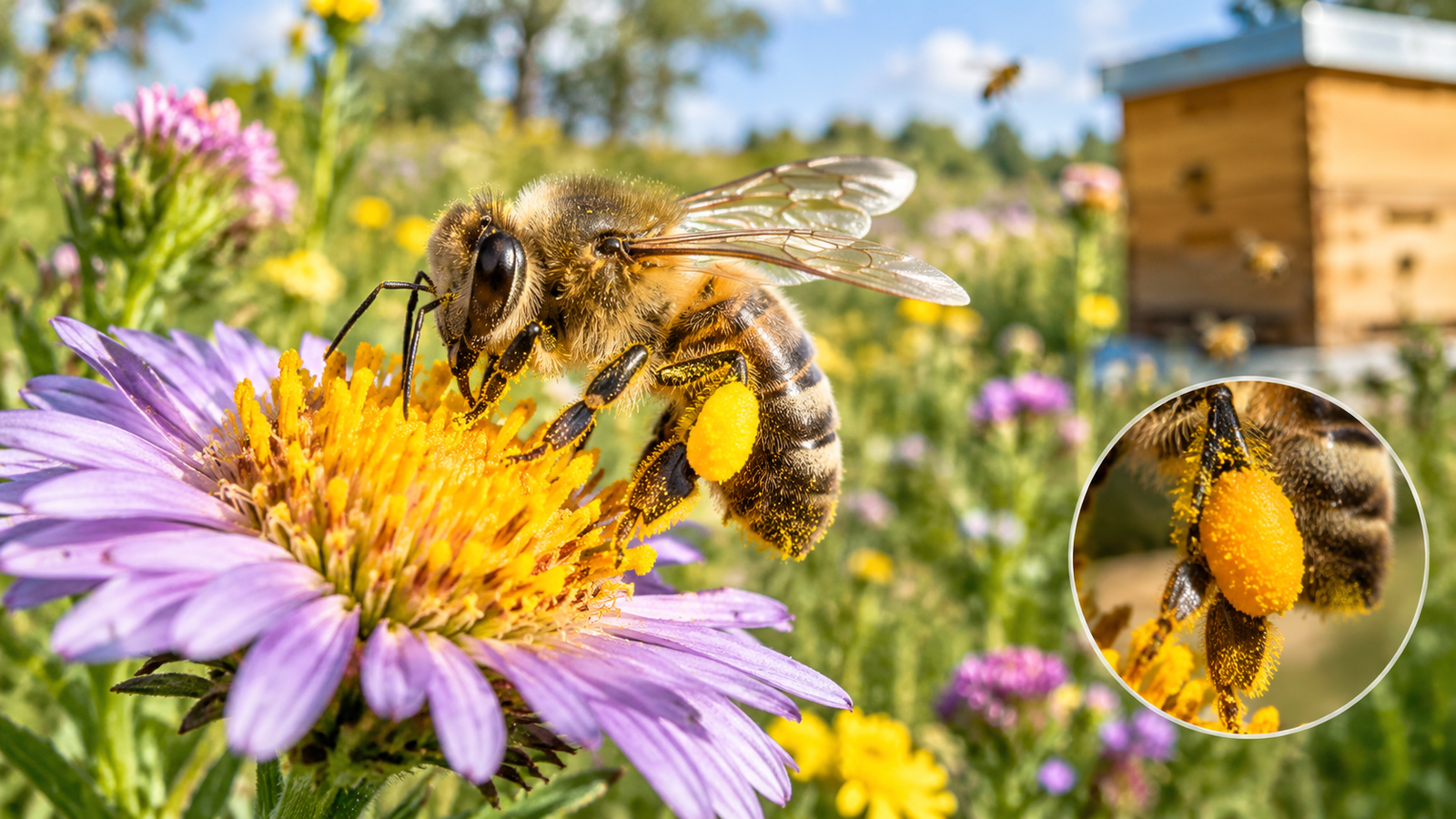
Honey bees place these pellets into structures called corbiculae, commonly known as pollen baskets, on their hind legs.
A returning worker often carries one pellet on each hind leg.
The amount collected depends on several factors, including the bee’s size, the pollen source, the availability of flowers and the distance travelled.
Example: A worker bee visiting several flowers in a garden may gradually build two yellowish pollen loads on its hind legs. Another bee visiting different plant species may return with orange or reddish pellets.
The important point is that bees do not manufacture the pollen grains. They collect, moisten and compact pollen that already exists in flowers.
6. Bees Carry the Pollen Back to the Hive
When a pollen-collecting worker has gathered a suitable load, it flies back to its nest or colony.
Honey bees transport pollen pellets using their hind-leg corbiculae. These structures help hold the compacted pollen in place during flight.
The pollen is carried alongside other food resources collected by the colony, including nectar.
The two products serve different nutritional purposes. Nectar provides carbohydrates that supply energy, while pollen provides much of the protein, lipids and other nutrients required for growth and normal colony functions.
A colony’s pollen requirements change according to its condition, brood production and the availability of other food resources.
7. Worker Bees Store the Pollen in the Hive
When a pollen-collecting worker returns, it unloads the pollen into suitable storage cells.
In a honey bee colony, the pellets are placed in honeycomb cells, often in areas surrounding the brood-rearing region.
Other worker bees may help remove and pack the pollen. They press additional pollen into the cells as new loads arrive.
The pollen stored in these cells becomes an important food reserve for the colony.
Nurse bees consume stored pollen because they require its nutrients to support their development and produce the glandular secretions used to feed developing larvae.
The storage process therefore connects flower visits with the next generation of bees.
8. Stored Pollen Can Develop Into Bee Bread
The final stage involves changes to pollen stored inside the colony.
Worker honey bees pack pollen into honeycomb cells and may add nectar, honey and glandular secretions. Microorganisms naturally associated with the pollen and hive environment can contribute to changes during storage.
The stored material is commonly called bee bread.
Bee bread is not simply a fresh pollen pellet placed inside a honeycomb cell. It is pollen that has undergone additional handling and conditioning within the colony.
Research has identified microbial and biochemical changes during the transformation of pollen into bee bread. These can include changes in acidity, microbial composition and the availability of certain nutrients.
However, the degree of fermentation and the exact changes are not identical in every colony. They depend on pollen composition, microorganisms and storage conditions.
Bee bread serves as an important nutritional resource for honey bees, particularly nurse bees involved in brood care.
How Do Honey Bees Carry Pollen? Understanding the Pollen Basket
Honey bees carry compacted pollen on their hind legs using specialized structures called corbiculae.
The corbicula is commonly known as a pollen basket. It is found on the outer surface of the hind tibia, the segment of the leg between the femur and the basitarsus.
Unlike ordinary body hairs, the pollen basket has a relatively smooth central area surrounded by specialized hairs. These surrounding hairs help hold the compacted pollen load in position.
The pollen is packed against this surface and held by the surrounding structures.
What Makes the Pollen Basket Special?
The pollen basket has several important features:
- It is located on the hind leg.
- It has a relatively smooth central surface.
- Specialized hairs surround the central area.
- It holds compacted pollen during transportation.
- It allows a worker honey bee to carry a substantial pollen load.
The corbicula is not exclusive to honey bees. Bumblebees and certain other corbiculate bees also have pollen baskets.
However, many other bee species use a different arrangement of specialized hairs called scopae to transport pollen.
This is an important difference between bee groups.
Why Does Bee Pollen Have Different Colours?
Bee pollen can appear yellow, orange, cream, red, brown, greenish or even nearly black.
The colour depends largely on the botanical source of the pollen.
Different flowering plants produce pollen grains with different pigments, chemical compositions and surface characteristics.
For example:
- Sunflower pollen is commonly yellow.
- Some poppy species produce dark blue or blue-black pollen.
- Other flowering plants produce orange, reddish, cream or greenish pollen.
A honey bee colony may collect pollen from several plant species during the same period. Consequently, pollen pellets collected from the same hive may have noticeably different colours.
Can You Identify a Flower From the Colour of Bee Pollen?
Colour can provide a useful clue, but it cannot reliably identify a plant species by itself.
Several plants can produce similarly coloured pollen. In addition, pollen colour may vary according to botanical variety, maturity and other characteristics.
Accurate identification may require microscopic examination of pollen grains, including their shape, size and surface patterns.
This is why researchers use pollen analysis, sometimes called melissopalynology, to investigate the botanical origins of bee-collected pollen and other bee products.
How Does Bee Pollen Become Bee Bread?
Bee pollen becomes bee bread through storage and conditioning inside the colony.
In honey bees, pollen pellets are unloaded into honeycomb cells. Worker bees pack the pollen and may add nectar, honey and glandular secretions.
Naturally occurring microorganisms can then participate in biochemical changes during storage.
Research has identified lactic acid bacteria, yeasts and other microorganisms associated with bee bread.
These organisms can contribute to changes in acidity and the chemical composition of stored pollen.
The resulting material is important because honey bees need a dependable supply of protein and other nutrients to support brood development and colony maintenance.
Bee Pollen Versus Bee Bread
| Feature | Bee pollen | Bee bread |
|---|---|---|
| Origin | Pollen collected from flowers | Pollen stored inside the colony |
| Processing | Groomed, moistened and compacted | Further packed and conditioned |
| Appearance | Individual pellets | Material inside honeycomb cells |
| Location | Carried on bees’ legs or harvested by traps | Stored inside the nest |
| Main purpose | Transportation and colony nutrition | Stored colony food |
| Microbial changes | May occur during handling and storage | More pronounced storage-related changes are studied |
One important distinction is that bee bread formation does not follow one universal fermentation schedule. Its development depends on the pollen, colony environment and microorganisms involved.
How Do Different Bee Species Collect Pollen?
Not all bees collect and transport pollen in the same way.
Honey bees are familiar examples because they carry pollen in visible baskets on their hind legs. However, many solitary bees and other bee groups use specialized hairs rather than corbiculae.
These pollen-carrying hairs are called scopae.
1. Honey Bees
Honey bees, including the western honey bee (Apis mellifera), carry pollen in corbiculae on their hind legs.
The worker gathers pollen from flowers, grooms it from the body, moistens and compacts it, and transports it to the colony.
Inside the hive, the pollen is stored in honeycomb cells.
2. Bumblebees
Bumblebees belong to the genus Bombus.
Like honey bees, female workers and queens of many bumblebee species have pollen baskets on their hind legs.
They collect pollen from flowers and transport it back to their nests, where it is used to feed developing offspring and support colony growth.
3. Mason Bees
Mason bees belong to the genus Osmia.
Many mason bee species carry pollen using specialized hairs on the underside of the abdomen rather than the corbicula found in honey bees.
Female mason bees collect pollen and nectar to prepare food provisions for their developing larvae.
They typically construct individual nesting chambers rather than maintaining large colonies with the same social organization as honey bees.
4. Leafcutter Bees
Leafcutter bees belong to the genus Megachile.
Female leafcutter bees generally carry pollen on specialized abdominal hairs called scopae.
They use leaves to construct brood cells and place pollen provisions inside those cells for their offspring.
Comparison of Pollen Collection Structures
| Bee group | Pollen-carrying structure | Typical location |
|---|---|---|
| Honey bees (Apis) | Corbicula | Hind legs |
| Bumblebees (Bombus) | Corbicula | Hind legs |
| Mason bees (Osmia) | Scopa | Underside of abdomen |
| Leafcutter bees (Megachile) | Scopa | Underside of abdomen |
| Many other solitary bees | Scopa | Hind legs or other body regions |
Important: These are representative examples, not an exhaustive classification. Pollen-carrying structures vary among bee families and species.
The main lesson is that bees have evolved different adaptations for collecting and transporting pollen. A pollen basket is not a feature shared by every bee.
Why Do Bees Need Pollen?
Pollen is essential to the normal nutrition and development of honey bee colonies.
It supplies nutrients that nectar alone cannot provide in sufficient amounts.
Pollen is particularly important because it provides protein, amino acids, lipids, vitamins and minerals.
Honey bees use these nutrients for several purposes.
1. Feeding Developing Larvae
Developing honey bee larvae require appropriate nutrition to grow.
Nurse bees consume pollen-derived nutrients and use them to support the production of food secretions supplied to developing larvae.
Without adequate pollen, a colony may struggle to maintain normal brood production.
2. Supporting Nurse Bees
Nurse bees are responsible for feeding young larvae.
They require sufficient nutrients to maintain the glands involved in producing larval food.
Pollen therefore supports the workers responsible for raising the next generation.
3. Maintaining Colony Growth
A colony needs a continuing supply of nutrients to replace older workers and produce new bees.
Pollen provides much of the protein and other nutrients required for this process.
4. Supporting Adult Bee Nutrition
Adult worker bees also require nutrients for normal bodily functions.
Although nectar and honey provide energy, pollen supplies other nutritional components needed for colony maintenance.
What Is the Difference Between Pollen and Nectar?
Pollen and nectar are both collected from flowers, but they serve different nutritional functions.
| Feature | Pollen | Nectar |
|---|---|---|
| Produced by | Flower anthers | Floral nectaries |
| Main nutritional role | Protein and other nutrients | Carbohydrate energy |
| Physical form | Fine grains | Sugary liquid |
| Collection method | Body hairs and specialized pollen-carrying structures | Proboscis |
| Main use in colony | Growth, brood nutrition and maintenance | Energy and honey production |
| Stored form | Bee pollen and bee bread | Honey |
A bee may collect both resources during a foraging trip, but pollen and nectar are handled differently.
Nectar is carried in the crop, a specialized internal storage structure, while pollen is generally carried externally on the body and specialized pollen-carrying structures.
Is Bee Pollen the Same as Honey?
No. Bee pollen and honey are different products.
Bee pollen comes from plant pollen collected by bees. It is particularly important as a source of protein and other nutrients.
Honey is made mainly from nectar collected from flowers. Bees process and store the sugary liquid, reducing its moisture content until it becomes a concentrated food.
The two products therefore serve different purposes in a honey bee colony.
Pollen supports growth and brood development, while honey provides much of the carbohydrate energy needed for daily activities.
How Do Beekeepers Harvest Bee Pollen?
Beekeepers can collect bee pollen using specially designed devices called pollen traps.
A pollen trap is usually fitted near the entrance of a honey bee hive. It contains an opening or grid through which returning worker bees must pass.
As bees move through the trap, some pollen pellets are dislodged from their hind legs.
The pellets fall into a collection compartment where the beekeeper can retrieve them.
How a Pollen Trap Works
- The beekeeper installs a suitable pollen trap near the hive entrance.
- Returning foragers pass through the trap.
- Some pollen pellets are removed from the bees’ hind legs.
- The pellets fall into a collection tray.
- The beekeeper periodically removes the collected pollen.
- The pollen is cleaned and preserved using appropriate food-handling procedures.
How Is Harvested Bee Pollen Cleaned?
Freshly collected pollen may contain unwanted material such as plant fragments, wax particles, dust and other debris.
Beekeepers or processors remove these materials before the pollen is packaged.
The collected product must also be handled carefully because fresh pollen can contain moisture and may spoil if stored improperly.
How Is Bee Pollen Preserved?
Depending on the product and processing method, harvested pollen may be refrigerated, frozen or dried under controlled conditions.
The purpose is to limit moisture-related spoilage and maintain product quality.
Processing should follow appropriate food-safety standards. Drying temperature, moisture content, packaging and storage conditions all influence the quality of the final product.
Can Collecting Too Much Pollen Harm a Bee Colony?
Yes. Excessive pollen harvesting can reduce the amount of food available to the colony.
Pollen is especially important when a colony is raising large numbers of larvae or when natural pollen sources are limited.
Beekeepers should therefore monitor colony strength, brood production, pollen availability and seasonal conditions before using pollen traps.
A pollen trap should not be treated as a device that can collect pollen indefinitely without affecting the colony’s food supply.
Can Humans Eat Bee Pollen?
Bee pollen is sold as a food product and dietary supplement.
Its composition varies according to the plant species, geographical origin, season and processing method.
However, bee pollen should not be presented as a proven treatment or cure for diseases.
It can also trigger allergic reactions in susceptible individuals, including potentially severe reactions.
People with pollen allergies or concerns about consuming bee pollen should consult a qualified healthcare professional before using it.
Frequently Asked Questions About How Bees Make Bee Pollen
Do bees actually make pollen?
No. Flowering plants produce pollen grains. Bees collect these grains, groom them from their bodies, moisten and compact them into pellets for transportation. The resulting pellets are commonly called bee pollen.
How do bees collect pollen from flowers?
Pollen grains attach to the hairs covering a bee’s body when it visits flowers. The bee then uses its legs and mouthparts to groom the pollen and gather it into compact loads.
Do bees make pollen from nectar?
No. Nectar and pollen are different substances. Nectar is a sugary liquid produced by flowers, while pollen is produced by the anthers of flowering plants. Bees collect both resources but use them for different nutritional purposes.
Why do bees carry pollen on their back legs?
Honey bees have specialized pollen baskets called corbiculae on their hind legs. These structures help hold compacted pollen pellets in place during transportation back to the hive.
Do all bees have pollen baskets?
No. Honey bees and bumblebees have corbiculae, but many solitary bees carry pollen using specialized hairs called scopae. These hairs may be located on the hind legs or underneath the abdomen, depending on the species.
Do bees eat the pollen they collect?
Yes. Pollen is an important food resource for bees. Honey bee workers consume stored pollen and bee bread to obtain protein, lipids and other nutrients needed for normal colony functions.
Why is some bee pollen yellow while other pollen is orange or red?
Pollen colour depends largely on its botanical source. Different flowering plants produce pollen grains with different natural pigments and characteristics. A colony visiting several plant species can therefore collect pellets of different colours.
How much pollen can a honey bee carry?
The amount varies with the bee’s size, the pollen source and the conditions during foraging. A University of Florida extension publication reports that a pollen load can weigh approximately 35% of a worker honey bee’s body weight. This is an approximate observation, not a fixed capacity for every bee or trip.
Is bee pollen the same as bee bread?
No. Bee pollen refers to pollen collected and transported by bees, commonly in pellets. Bee bread is pollen that has been stored and further conditioned inside the colony.
How long does it take for bee pollen to become bee bread?
There is no single fixed time that applies to every colony. Bee bread formation depends on the pollen’s composition, storage conditions, microbial activity and the bees’ processing behaviour.
Can bees collect pollen from different flowers?
Yes. Honey bees can collect pollen from different flowering plant species. Individual pollen loads may be dominated by one botanical source, while pollen stored in a hive cell may contain material from several sources.
Can bees survive without pollen?
Honey bee colonies need pollen or an appropriate substitute to maintain normal nutrition and brood development. Prolonged shortages can affect larval rearing, nurse bee condition and colony growth.
Conclusion: How Do Bees Make Bee Pollen?
So, how do bees make bee pollen? They collect pollen grains produced by flowering plants, groom the grains from their hairy bodies, mix them with small amounts of nectar or other secretions, and compact them into pellets that can be carried back to their nests.
Honey bees use specialized pollen baskets called corbiculae on their hind legs to transport these loads. Once inside the hive, worker bees unload and pack the pollen into honeycomb cells. Further handling and microbial activity can transform stored pollen into bee bread, an important food resource for the colony.
Other bee species use different pollen-carrying structures, including specialized hairs called scopae, demonstrating that pollen collection is not identical across all bees.
From the first grain collected on a flower to the food stored inside a hive, bee pollen illustrates the remarkable relationship between flowering plants and pollinating insects.
Scientific References and Further Reading
The following educational and scientific publications provide additional information about pollen collection, honey bee nutrition, pollen transportation and bee bread formation.
- University of Florida IFAS Extension – The Benefits of Pollen to Honey Bees.
https://ask.ifas.ufl.edu/publication/in868 - Purdue University Extension – The Complex Life of the Honey Bee.
https://ag.purdue.edu/department/extension/ppp/ppp-publications/ppp-116.pdf - Biomechanics of Pollen Pellet Removal by the Honey Bee.
https://pmc.ncbi.nlm.nih.gov/articles/PMC8385348/ - Nutritional Physiology and Ecology of Honey Bees.
https://doi.org/10.1146/annurev-ento-020117-043423 - The Process of Pollen Transformation into Bee Bread: Changes in Bioactivity, Bioaccessibility, and Microbial Dynamics.
https://doi.org/10.1039/D3FO04466A - Antimicrobial Activity of Bee-Collected Pollen and Beebread: State of the Art and Future Perspectives.
https://pmc.ncbi.nlm.nih.gov/articles/PMC7697837/ - Specialized and Generalized Pollen-Collection Strategies in an Ancient Bee Lineage.
https://pmc.ncbi.nlm.nih.gov/articles/PMC6485464/
These sources provide educational and scientific background for understanding how bees collect, transport and store pollen.
