

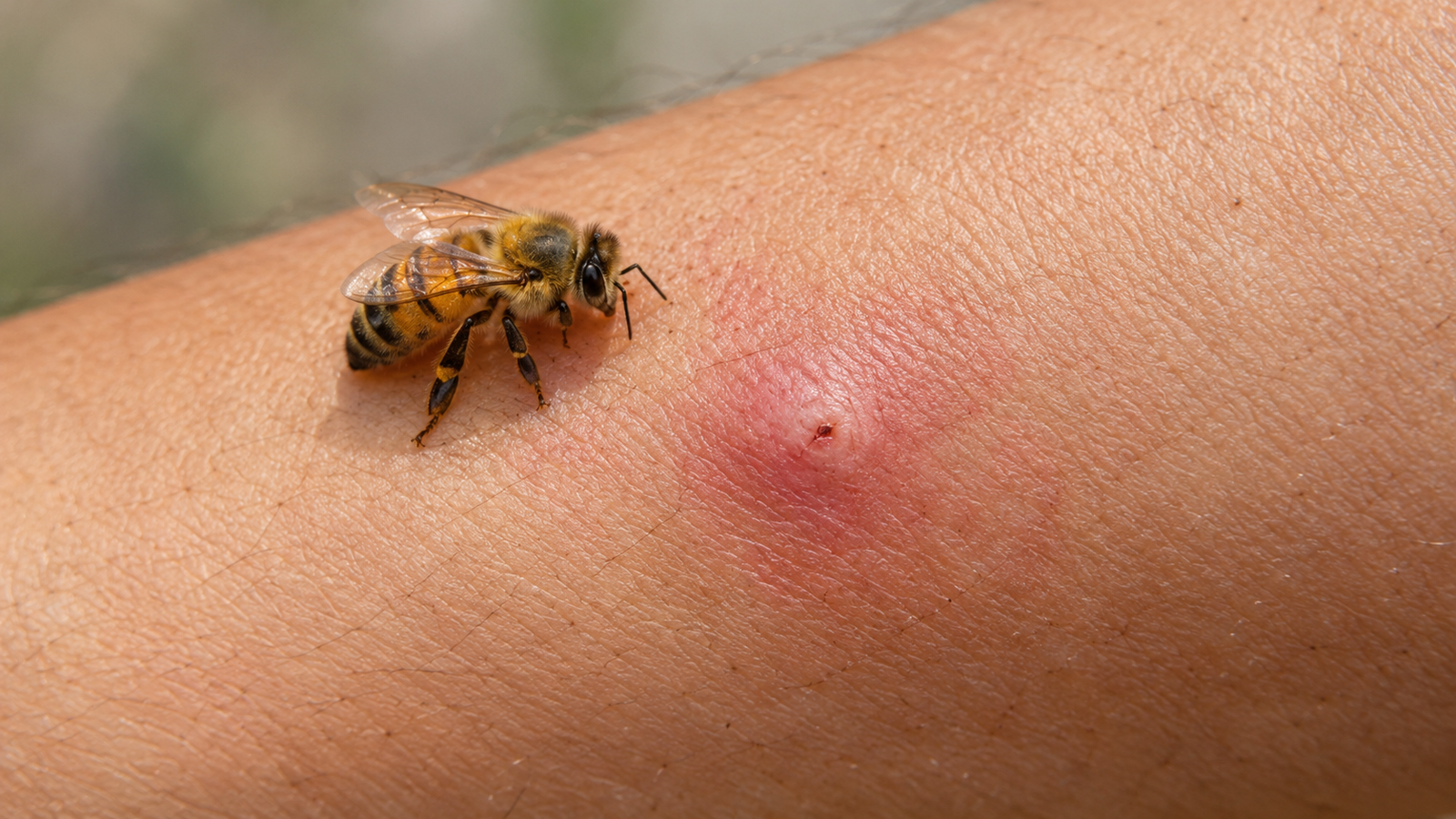
How bee sting look like? A bee sting usually appears as a small, raised bump with a tiny puncture mark at the center and surrounding swelling. Depending on the person’s skin tone and reaction to the venom, the affected area may look red, pink, purple, brown, or darker than the surrounding skin. A honey bee may also leave a tiny barbed stinger embedded in the skin.
The appearance can change over time. Immediately after a sting, you may notice a small puncture and localized pain. Within several hours, the area may become swollen, warm, itchy, and more noticeable. Some reactions begin to improve within a day, while larger local reactions can continue developing for 24–48 hours before gradually settling.
Knowing what a bee sting looks like at different stages can help you distinguish an ordinary skin reaction from a more serious problem. This guide explains the typical appearance of a bee sting, how it changes during healing, what a retained stinger looks like, and which warning signs require medical attention.
What Does a Bee Sting Look Like?
A typical bee sting looks like a small raised area of irritated skin, often with a tiny puncture mark near the center. The surrounding skin may become swollen, tender, warm, and itchy.
The exact appearance varies according to the type of bee, the amount of venom injected, the location of the sting, and the person’s sensitivity to the venom.
Common visible characteristics include:
- A small puncture mark: A tiny opening where the stinger entered the skin.
- A raised bump: The affected area may develop a small, rounded swelling.
- Surrounding discoloration: The skin may appear red, pink, purple, brown, or darker than its normal color.
- Localized swelling: The skin around the puncture may become puffy or enlarged.
- A visible stinger: A honey bee may leave its barbed stinger behind, sometimes appearing like a tiny dark splinter.
The bump does not always have a clearly visible central hole. Sometimes the swelling and surrounding discoloration make the puncture difficult to identify.
A normal local reaction generally stays around the sting site. However, some people develop much larger areas of swelling.
What Does a Bee Sting Look Like on Different Skin Tones?
A bee sting does not look exactly the same on every person’s skin. The inflammatory reaction is similar, but its visible color can differ depending on natural skin pigmentation.
On lighter skin, the affected area may appear pink or red. On medium and darker skin, it may appear purple, brown, dusky, or darker than the surrounding skin.
The absence of obvious redness does not mean that a sting has not occurred.
Bee Sting on Light Skin
On lighter skin, a bee sting may appear as a pink or red raised bump surrounded by a larger area of redness. The center may show a tiny puncture mark or retained stinger.
The swelling is often easier to distinguish from the surrounding skin because of the color contrast.
Bee Sting on Brown or Medium Skin
On brown or medium skin, the affected area may appear reddish-brown, purple, or slightly darker than the surrounding skin. The swelling may be more noticeable than the color change.
A small raised bump with localized tenderness can still indicate a bee sting even when the area does not look bright red.
Bee Sting on Dark Skin
On deeply pigmented skin, redness may be less apparent. The affected area may instead look darker, purplish, brownish, or slightly swollen.
Look for other signs, including:
- A small puncture mark.
- Localized puffiness.
- Tenderness when touched.
- Increased warmth.
- Itching around the affected area.
Important: Skin color alone cannot determine how serious a sting reaction is. The size of the swelling, how quickly it changes, and whether symptoms occur elsewhere on the body are more useful indicators.
What Does a Bee Sting Look Like Immediately After Being Stung?
Immediately after a bee sting, the skin may show a tiny puncture mark with little visible swelling.
The person will usually notice sharp, sudden pain or burning before the affected area develops its full appearance.
A fresh sting may have:
- A tiny central puncture.
- A small raised spot.
- Mild surrounding redness or discoloration.
- Localized tenderness.
- A visible stinger if the insect was a honey bee and it remained embedded.
The skin does not always become noticeably swollen immediately. In some people, the inflammatory response becomes more visible over the following hours.
For example, someone stung on the finger while handling flowers may initially see only a small mark. Later, the finger may become swollen and uncomfortable.
A lack of dramatic swelling immediately after the sting does not rule out a reaction.
What Does a Bee Sting Look Like When Swollen?
A swollen bee sting looks like an enlarged, raised area surrounding the original puncture site.
The swelling may be limited to a small bump or spread across a larger part of the affected body area.
For example, a sting on the hand may cause swelling around the puncture and sometimes extend into nearby fingers.
There are two important patterns to understand.
Mild Local Swelling
A mild local reaction usually consists of:
- A small raised bump.
- Limited surrounding swelling.
- Localized pain or tenderness.
- Itching and warmth around the sting site.
The reaction generally remains close to where the bee entered the skin.
Large Local Reaction
A large local reaction involves swelling that spreads well beyond the immediate puncture.
The area may become several inches wide, and swelling can involve much of a hand, foot, or nearby joint.
Unlike a mild reaction, a large local reaction can continue increasing during the first 24–48 hours.
It may take approximately a week or longer to settle, depending on the individual.
A large local reaction is not automatically anaphylaxis. However, it should be assessed by a healthcare professional when the swelling is severe, significantly worsening, affects function, or causes concern.
What Does a Bee Sting Look Like After 24 Hours?
After 24 hours, a bee sting may appear more swollen and noticeable than it did immediately after the sting.
The surrounding skin may be:
- More raised.
- Wider in diameter.
- Warmer than nearby skin.
- Itchy or tender.
- Redder, darker, or more discolored.
This happens because the body’s inflammatory response continues after the venom enters the skin.
A person who initially notices a tiny puncture on the hand may wake up the following morning with swelling extending around the finger or across part of the hand.
This does not automatically mean the sting is infected.
Large local reactions can continue to expand for up to approximately 48 hours. The important consideration is whether the symptoms remain localized or are accompanied by signs of a systemic allergic reaction.
What Does a Bee Sting Look Like After 2–3 Days?
After two or three days, a typical bee sting may begin to look less swollen and irritated.
However, the appearance depends on the severity of the original reaction.
A mild reaction may already be improving, while a large local reaction may still be swollen or itchy.
Possible changes include:
- Reduced swelling.
- Less tenderness.
- Gradual fading of surrounding discoloration.
- A smaller raised area.
- Persistent itching as the skin settles.
Some people may still have considerable swelling after three days, especially following a large local reaction.
The important distinction is whether the symptoms are gradually improving or continuing to worsen.
Persistent or increasing pain, spreading redness, pus, fever, or red streaks should prompt medical assessment.
What Does a Bee Sting Look Like When Healing?
A healing bee sting usually becomes less raised, less swollen, and less uncomfortable over time.
The surrounding discoloration may gradually fade, although the skin can remain temporarily darker or lighter than its normal appearance.
The puncture site may become less noticeable as the local inflammation settles.
Bee Sting Healing Stages
| Stage | Approximate time | What the sting may look like |
|---|---|---|
| Initial reaction | Immediately | Tiny puncture, pain and possible small raised bump |
| Early inflammation | First several hours | Swelling, warmth, tenderness and surrounding discoloration |
| Developing reaction | 12–48 hours | Swelling may increase, particularly with a large local reaction |
| Early recovery | Days 2–4 | Mild reactions often begin settling; itching may remain |
| Continued healing | Days 4–7 | Swelling and tenderness gradually decrease |
| Longer recovery | After one week | Most mild reactions have resolved; larger reactions may take longer |
These are approximate patterns, not a fixed schedule. Some mild reactions settle within 24 hours, while large local reactions may persist for seven to ten days or occasionally longer.
What Does a Healing Bee Sting Look Like on the Skin?
A healing sting may show:
- A smaller raised area than before.
- Less surrounding swelling.
- Reduced warmth and tenderness.
- Fading redness or other discoloration.
- Occasional itching without increasing pain.
A temporary dark mark can remain after the swelling has disappeared. This may represent post-inflammatory pigmentation rather than an active infection.
If the skin becomes increasingly painful, hot, swollen, or begins producing pus, do not assume that it is simply healing.
What Does a Bee Stinger Look Like in the Skin?
A retained honey bee stinger may look like a tiny dark splinter, needle, or black-brown point sticking out of the skin.
It can be difficult to see without good lighting because the stinger is very small.
The honey bee’s stinging apparatus includes a barbed stinger connected to a venom sac. When a worker honey bee stings human skin, the barbed apparatus can become lodged in the skin as the bee pulls away.
The stinger and attached venom apparatus may continue delivering venom briefly after the bee has departed.
This is why a visible honey bee stinger should be removed promptly.
Do All Bees Leave Their Stingers Behind?
No. Different bees have different stinger structures.
| Bee type | Stinger characteristics | Can it sting more than once? |
|---|---|---|
| Worker honey bee | Barbed stinger commonly becomes embedded in mammalian skin | Generally no |
| Bumblebee | Smooth stinger that is usually retained | Yes |
| Other bee species | Varies by species | Many can sting repeatedly |
Only female bees possess stingers. Male honey bees, called drones, cannot sting.
Important: Not seeing a stinger does not mean the insect was not a bee. Bumblebees generally retain their stingers, and even a honey bee’s stinger may not be obvious after the sting.
Bee Sting vs. Wasp Sting vs. Mosquito Bite: What Is the Difference?
A bee sting, wasp sting, and mosquito bite can all cause swelling and itching. However, their typical patterns are different.
The most useful distinction is how the skin reaction begins and whether a stinger remains in the skin.
| Feature | Bee sting | Wasp sting | Mosquito bite |
|---|---|---|---|
| Initial sensation | Usually sudden sharp pain | Usually sudden sharp pain | Often unnoticed initially |
| Central mark | May have a puncture or retained stinger | Small puncture may be visible | Small bite punctum may appear |
| Swelling | Localized or extensive | Localized or extensive | Usually a small raised bump |
| Itching | Common after initial pain | Common | Often prominent |
| Stinger left behind | Honey bees commonly leave one | Generally no | No |
| Can sting or bite again? | Some bee species can sting repeatedly | Yes | Mosquitoes can bite repeatedly |
How to Distinguish a Bee Sting from a Wasp Sting
A honey bee sting may leave a visible barbed stinger embedded in the skin.
A wasp generally does not leave its stinger behind and can sting repeatedly.
However, the skin reactions can look very similar. A raised bump, redness, swelling, and pain are not enough to identify the insect with certainty.
How to Distinguish a Bee Sting from a Mosquito Bite
A mosquito bite is commonly an itchy raised bump, sometimes with a small central punctum.
A bee sting more commonly produces immediate sharp pain followed by swelling and localized tenderness.
The timing of the symptoms can therefore provide a useful clue, although it cannot confirm the insect species.
What Does an Infected Bee Sting Look Like?
An infected bee sting may appear increasingly red or discolored, swollen, warm, and painful.
However, normal bee sting inflammation can also cause redness, warmth, and swelling. These symptoms alone do not prove that bacteria have infected the skin.
Look for warning signs such as:
- Pain that continues getting worse rather than improving.
- Increasing redness or discoloration spreading around the sting.
- Pus or cloudy fluid coming from the puncture.
- Fever or feeling generally unwell.
- Red streaks extending away from the affected area.
- Increasing tenderness or skin swelling.
A person who scratches the sting repeatedly may damage the skin and increase the risk of introducing bacteria.
Seek medical assessment if infection is suspected, particularly when symptoms are worsening.
Do not confuse a large local reaction with an infection. A large local reaction can cause extensive swelling during the first two days without necessarily involving bacterial infection.
What Does an Allergic Reaction to a Bee Sting Look Like?
A serious allergic reaction can look very different from an ordinary local bee sting.
Instead of symptoms remaining around the puncture, an allergic reaction may affect other parts of the body.
Possible visible signs include:
- Hives or raised itchy welts across the body.
- Swelling of the lips, tongue, face, or throat.
- Widespread skin flushing or discoloration.
- Swelling away from the sting site.
Other symptoms may include:
- Difficulty breathing.
- Wheezing or chest tightness.
- Dizziness or fainting.
- Vomiting or abdominal cramps.
- A rapid or weak pulse.
Local Reaction vs. Systemic Allergic Reaction
| Feature | Local reaction | Systemic allergic reaction |
|---|---|---|
| Location | Around the sting site | Can affect multiple body areas |
| Skin appearance | Localized bump and swelling | Hives or widespread skin changes may occur |
| Swelling | Usually limited to the affected area | May involve lips, tongue, face or throat |
| Breathing symptoms | Not expected | May occur |
| Dizziness or collapse | Not expected | May occur |
| Urgency | Depends on severity | Medical emergency |
Emergency warning: Difficulty breathing, throat or tongue swelling, collapse, faintness, or other signs of anaphylaxis require immediate emergency medical assistance. Use an epinephrine auto-injector immediately if prescribed and available, and activate local emergency services. Do not wait for a skin rash to appear.
A severe allergic reaction can happen even when the original sting mark looks very small.
What Does a Bee Sting Look Like on Different Parts of the Body?
The appearance of a bee sting can vary depending on where the insect enters the skin.
Bee Sting on the Hand or Finger
A sting on a finger may produce a small central puncture followed by swelling around the affected finger.
The finger may feel tight, tender, and uncomfortable when bent.
A large local reaction can extend into the hand.
Bee Sting on the Arm
A sting on the arm may initially look like a small raised bump.
Over time, the surrounding area may become swollen, warm, itchy, and discolored.
Bee Sting on the Foot or Ankle
A sting on the foot or ankle can cause swelling around the puncture site.
Because these areas may become uncomfortable when walking or wearing shoes, even localized swelling can be noticeable.
Bee Sting on the Face
A sting on the face can cause considerable swelling, particularly around loose tissues such as the eyelids.
Swelling near the eye may look dramatic even when it is a local reaction. However, a sting in the eye itself requires prompt medical assessment.
Swelling involving the tongue or throat, or any breathing difficulty, is an emergency.
What Should You Do When You Identify a Bee Sting?
If the reaction appears localized and there are no emergency symptoms, take these steps:
- Move away from the bee activity to avoid additional stings.
- If a honey bee stinger remains visible, remove it promptly by scraping it away or gently plucking it out without delaying removal.
- Wash the affected area with soap and water.
- Apply a cold pack wrapped in a cloth for short periods to help reduce discomfort and swelling.
- Avoid scratching or squeezing the affected area.
- Monitor the reaction over the following hours and days.
If you develop signs of a serious allergic reaction, seek emergency assistance immediately rather than relying on home treatment.
If swelling becomes severe, the sting is near the eye or inside the mouth, or you suspect infection, obtain medical advice.
When Should You Worry About How a Bee Sting Looks?
Not every swollen bee sting is dangerous. However, certain changes should never be ignored.
| What you notice | What it may indicate | What to do |
|---|---|---|
| Small raised bump and localized itching | Ordinary local reaction | Monitor and use basic first aid |
| Swelling that increases during the first 48 hours | Possible large local reaction | Monitor and seek advice if severe or concerning |
| Hives across the body | Possible systemic allergy | Seek emergency medical assistance |
| Tongue or throat swelling | Possible anaphylaxis | Emergency assistance immediately |
| Difficulty breathing or fainting | Possible severe anaphylaxis | Emergency assistance immediately |
| Pus, fever or worsening pain | Possible infection | Seek medical assessment |
| Sting inside the eye | Risk of eye injury | Prompt medical assessment |
People who have previously experienced a severe reaction to insect stings should follow their clinician’s allergy-management plan.
Frequently Asked Questions
1. What does a normal bee sting look like?
A normal bee sting usually looks like a small raised bump with a central puncture and surrounding localized swelling. The area may become pink, red, purple, brown, or darker than the surrounding skin. Pain, warmth, and itching are also common.
2. Does a bee sting always leave a hole in the skin?
No. A tiny puncture may be present, but it is not always easy to see. Swelling and surrounding inflammation can make the original entry point difficult to identify.
3. What does a bee sting look like when the stinger is still inside?
A retained honey bee stinger may look like a tiny dark splinter or needle protruding from the skin. The attached venom apparatus may also be visible.
4. Can a bee sting look like a mosquito bite?
Yes. Both can cause a small raised bump with surrounding irritation. However, bee stings generally cause sudden sharp pain, while mosquito bites are often noticed because of itching.
5. Why does my bee sting look worse the next day?
The body’s inflammatory response can continue developing after the initial sting. A local reaction may become more swollen and discolored during the first 24–48 hours. This does not automatically mean the sting is infected.
6. Can a bee sting turn purple or brown?
Yes. The visible color of a bee sting varies according to skin pigmentation and the inflammatory response. On some people, the affected area may appear purple, brown, or darker rather than bright red.
7. What does a bee sting look like after three days?
A mild bee sting may be less swollen and less painful after three days. A larger reaction may remain swollen or itchy. The important sign is whether the overall condition is improving.
8. How long does a bee sting take to heal?
A mild local reaction often improves within hours to a few days. Large local reactions can take seven to ten days or longer to settle. Healing time varies according to the person’s reaction and the location of the sting.
9. Can a bee sting leave a dark mark?
Yes. Some people develop temporary dark pigmentation after the swelling and irritation have disappeared. This is called post-inflammatory hyperpigmentation and can be more noticeable on darker skin tones.
10. Can a bee sting cause a blister?
Blistering or bullous skin reactions can occur, although they are not the typical appearance of an ordinary bee sting. A blister should not automatically be assumed to be a normal healing stage. Seek medical advice if it is large, worsening, painful, or accompanied by other concerning symptoms.
11. Does a bee sting always swell?
No. Some people experience only a small puncture, brief pain, and mild irritation. Others develop noticeable swelling, including large local reactions.
12. Can a bee sting look infected without actually being infected?
Yes. A large local inflammatory reaction can cause considerable redness, warmth, and swelling without a bacterial infection. Increasing pain, pus, fever, and worsening skin changes require medical assessment.
Conclusion: How Does a Bee Sting Look Like?
A bee sting typically looks like a small raised bump with a central puncture and surrounding swelling. The skin may appear red, pink, purple, brown, or darker than usual, depending on the person’s skin tone and inflammatory response.
A honey bee may leave a tiny barbed stinger embedded in the skin, while bumblebees generally retain their stingers and can sting more than once.
As the reaction develops, the affected area may become more swollen and itchy during the first 24–48 hours. Mild reactions usually improve within a few days, while larger local reactions may take a week or longer to settle.
The most important distinction is between an ordinary localized reaction and symptoms of a serious allergic reaction. Breathing difficulties, throat or tongue swelling, and fainting require immediate emergency attention.
Understanding these different appearances makes it easier to recognize a typical bee sting, follow its healing progress, and identify symptoms that need medical care.
Medical References
The following medical and educational sources support the explanations in this article:
- Poison Control: Bee Stings: Is It an Allergic Reaction? — bee sting appearance, honey bee and bumblebee stingers, local reactions, and allergic symptoms.
- DermNet: Bee and Wasp Stings — clinical features, localized reactions, large local reactions, and allergic manifestations.
- American Academy of Dermatology: How to Treat a Bee Sting — stinger removal, washing, cold packs, and emergency warning signs.
- NCBI Bookshelf: Hymenoptera Envenomation — scientific explanations of venom reactions, large local reactions, and anaphylaxis.
- American Heart Association: 2024 Guidelines for First Aid — evidence-based first aid recommendations for bee and wasp stings.
- MedlinePlus: Bee Sting — educational medical image and guidance on sting reactions.
